Every quotation is copied from a named translation and checked, word for word, against the page it comes from before it reaches you. A line that cannot be found in the text is dropped. Nothing is paraphrased inside quotation marks, and no verse number is ever guessed.
Ask the texts
Bring what is troubling you, and read what the texts say about it
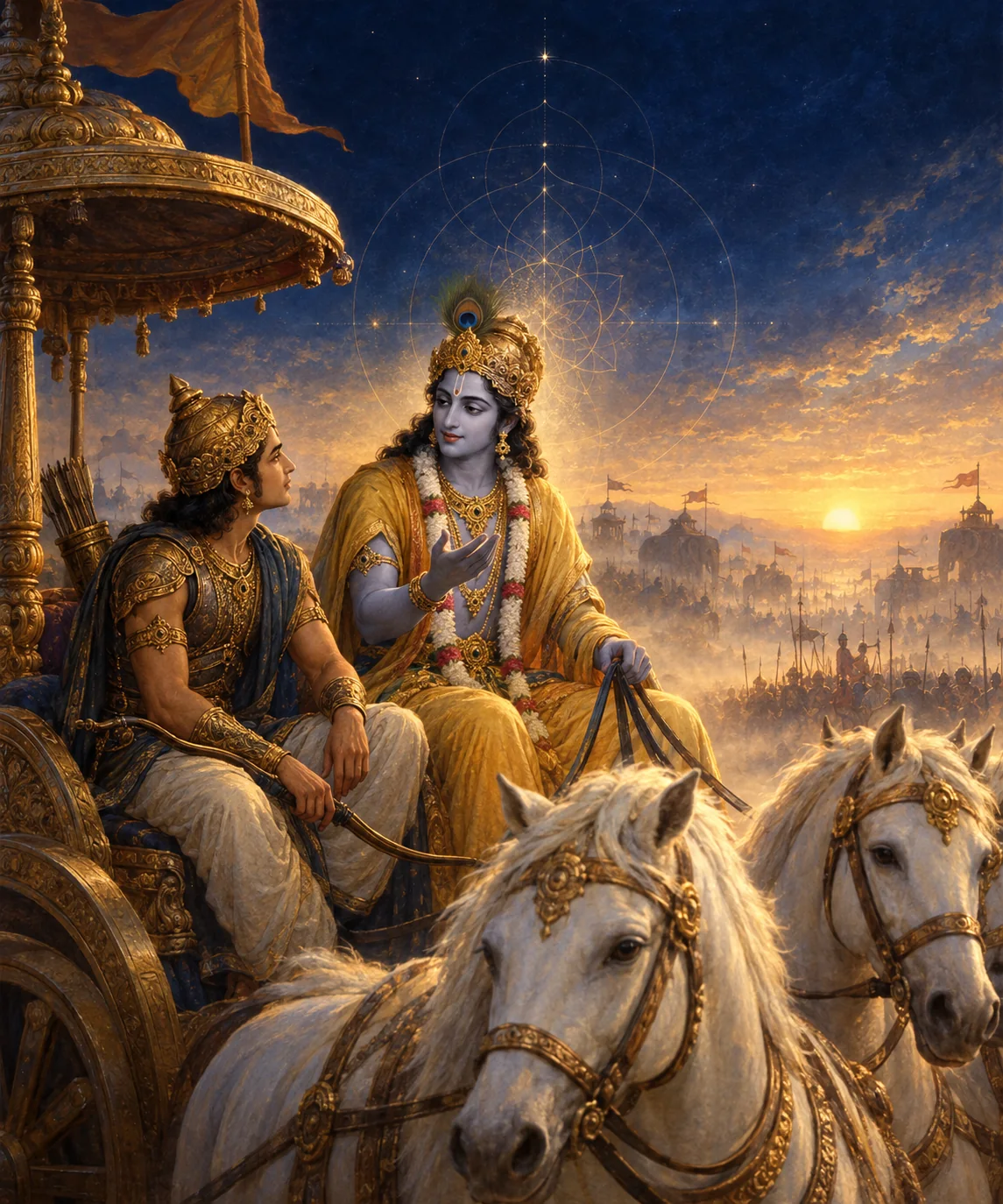
Arjuna did not come to the Gītā with a philosophical question. He came because he could not go on. Every text on this shelf begins the same way — with a person in trouble asking someone who had seen further. This page lets you do the same, in your own words. It listens for what lies beneath the words, searches the whole reading room, and answers as an elder of the tradition would — in one unhurried letter that weaves in the lines that are actually there, each named to its verse and edition, each put in plain words with a parallel from today’s world.
How it works
Three promises
The answer says what the text says, in the text’s own terms — not what you should have done, not what kind of person you are. Where the teachers differ, it says so. It is not medical, legal or financial advice, and it says that too.
One Sanskrit term, with its meaning. One parallel from ordinary life for each idea. One small thing to try today, and one question to carry. If a passage cannot be explained in plain words, it is not used.
The shelf it reads from
Every text, and the edition each quotation is taken from
Where a text has its own page on this site, the link goes there. Each quotation in an answer also links to the exact place it was copied from: for the scanned books, the search inside the book at the words quoted; for the Gospel of Sri Ramakrishna and the Complete Works of Swami Vivekananda (all nine volumes), the chapter or lecture itself; and for the Gītā and the Upaniṣads, the verse with Śaṅkara’s Sanskrit commentary as well.
Scripture
- Bhagavad Gītā with the commentary of Śaṅkara — A. Mahadeva Sastri’s translation (1897)
- Eleven Upaniṣads — Kaṭha, Īśā, Kena, Muṇḍaka, Śvetāśvatara, Praśna, Māṇḍūkya with Gauḍapāda’s Kārikā, Aitareya, Bṛhadāraṇyaka, Taittirīya, Chāndogya — Swami Nikhilananda’s translation
Śaṅkara’s shorter works and the later manuals
- Vivekacūḍāmaṇi (Swami Madhavananda), Upadeśa Sāhasrī (Swami Jagadananda), Aparokṣānubhūti (Swami Vimuktananda), Ātma Bodha (Ramana Maharshi’s rendering), Bhaja Govindam
- Dṛg-Dṛśya-Viveka (Swami Nikhilananda) and Vidyāraṇya’s Pañcadaśī (Swami Swahananda)
The teachers
- Talks with Sri Ramana Maharshi and Who Am I?
- The Gospel of Sri Ramakrishna (Swami Nikhilananda) and the Complete Works of Swami Vivekananda
- Sri Sarada Devi, Swami Chinmayananda and Swami Sivananda — from the pages of their own institutions
Nothing you type is stored. A finished answer is kept for a week under a scrambled key so the same question does not have to be read twice; the question itself is not kept with it. Up to thirty questions an hour from one connection, and a daily ceiling for the whole room, so that it stays free.