Swami Sivananda
Founder of the Divine Life Society
1887–1963 · The Sri Chinmaya Lineage
- When
- 1887–1963
- Born
- Pattamadai, Tamil Nadu
- Where the life was lived
- Born on 8 September at Pattamadai on the Tāmraparaṇī river in Tamil Nadu; studied medicine at Tanjore and practised at Tiruchirapalli; worked as a doctor in Malaya from 1913 to 1923; took monastic vows at Rishikesh on the Ganga, where he founded his āśramam and never once travelled abroad.
- What is left of it
- Over two hundred books, among them Bliss Divine, Sadhana, Practice of Karma Yoga and his commentary on the Bhagavad Gītā.
Founded the Divine Life Society at Rishikesh in 1936 and a forest academy for scriptural study; treated and fed pilgrims and monks for decades; sent out disciples who took Vedanta and yoga worldwide.
The India he was born into
He was born before dawn on Thursday, 8 September 1887, in Pattamadai, a village on the Tāmraparṇī river in the far south of the Tamil country, in what is now Tirunelveli district. The village was known then, as it is now, for one thing: the finest woven mats in India, so closely worked that a full-sized mat could be rolled and passed through a ring. It is a small, exact craft, done sitting down, over many hours, and it is not a bad emblem for the man who would spend forty years writing three hundred books.
The India around the village was the Madras Presidency at the height of the Raj. Queen Victoria's Golden Jubilee had been celebrated across the empire that summer. The Indian National Congress was two years old and met in borrowed halls. The Tamil country had a functioning civil service in which educated Brahmin families served as revenue officers, clerks and magistrates, and his father, P. S. Vengu Iyer, was one of them — a revenue officer and, in the Divine Life Society's phrase, "a great Śiva bhakta." There was also, in those years, a growing literate middle class that read English, went to mission colleges, took up medicine and law, and travelled by steamer to Ceylon, Burma and Malaya for work. He would do all of these things before he became a monk, and none of them was wasted.
What makes his life unusual among the teachers on this site is not the renunciation but the long detour before it. Sri Ramana Maharshi was realised at sixteen. Swami Tapovanam was writing verse on the Infinite at eighteen. Kuppuswamy Iyer became a doctor, ran a hospital, wore ten gold rings, and did not leave the world until he was thirty-six. When he did, he brought the whole of the detour with him — the medicine, the journalism, the administrative competence, the taste for organising — and put it to a use nobody had foreseen.
Where the life was lived
The life has three geographies: the Tamil south of his youth, the Malayan rubber estates where he practised for a decade, and the bank of the Ganga at Rishikesh where he lived for thirty-nine years without ever again having a permanent address anywhere else. Only the first and third fit on a map of India; Seremban, Kailāsa and Ceylon lie beyond it.
Present-day locations. The dotted line follows the order of the recorded journeys from the Tamil south to the Ganga at Rishikesh, not an exact road. Seremban in Malaya, where he practised medicine from 1913 to 1923, Mount Kailāsa, and the 1950 tour of Ceylon lie beyond the edges of the map.
- 1Pattamadai (Tirunelveli district, Tamil Nadu) — born 8 September 1887 on the Tāmraparṇī as Kuppuswamy
- 2Ettayapuram (Tamil Nadu) — Rajah's High School; sang for the Governor of Madras, 1901
- 3Tiruchirappalli (Tamil Nadu) — S.P.G. College; medical practice; The Ambrosia journal
- 4Thanjavur (Tamil Nadu) — Tanjore Medical School
- 5Rameswaram (Tamil Nadu) — pilgrimage with kīrtan and lectures, 1920s–30s
- 6Puducherry — visited Sri Aurobindo's ashram; met Suddhananda Bharati
- 7Tiruvannamalai (Tamil Nadu) — saw Sri Ramana Maharshi on the Maharshi's birthday; sang and danced
- 8Chennai (Tamil Nadu) — returned from Malaya in 1923 and left his luggage at a friend's house
- 9Dhalaj, near Pandharpur (Maharashtra) — lived as the village postmaster's cook, 1923–24
- 10Varanasi (Uttar Pradesh) — darśana of Viśvanātha on the way north
- 11Rishikesh (Uttarakhand) — Swargashram hut 1924; dispensary 1927; Divine Life Society 1936; died 14 July 1963
- 12Badrinath (Uttarakhand) — pilgrimage on foot, before 1936
Kuppuswamy: the boy who gave his sweets away
The Society's biography records the childhood in a few plain scenes. He was the third and last son. He was clever and mischievous. He fed the hungry at the door and made his father put a coin into the hand of any beggar who passed. He was given cakes and sweets by his mother and handed them out to the other children, and to the dogs, cats, crows and sparrows, without eating any himself. He brought flowers and bilva leaves for his father's daily worship of Śiva. He had, the biography says, "a sweet voice and a wonderful memory."
He was sent to the Rajah's High School at Ettayapuram, the seat of a small Tamil zamindari — the same town, as it happens, where the poet Subramania Bharati was growing up a few years ahead of him. He topped his class every year. In 1901, when the Governor of Madras, Lord Ampthill, came to the hills nearby to hunt, the fourteen-year-old was chosen to sing a song of welcome on the railway platform at Kumarapuram. He went on to the S.P.G. College at Tiruchirappalli, an Anglican mission college, where he debated and acted; in 1905 he played Helena in A Midsummer Night's Dream, and played her, the biography insists, beautifully. Then he went to the Medical School at Tanjore.
The medical student is the first place where the adult becomes visible. He never went home in the holidays; he spent them in the hospital. He had free run of the operating theatre. In his first year, the biography says, he could answer examination papers set for the final year. He qualified, practised at Tiruchirappalli, and started a medical journal, The Ambrosia, on a hundred rupees borrowed from his mother, which he distributed free because he was too shy to ask anyone for a subscription. When his mother later wanted a hundred and fifty rupees for a festival, he had it ready. The habits of the future publisher are all there: the compulsion to put useful knowledge into print, the giving it away, the inability to ask for money.
The doctor with ten rings
His father died, and soon afterwards, in 1913, a call came from Malaya. He sailed on the S.S. Tara. Being an orthodox Brahmin and afraid of the ship's food, he took a bag of his mother's sweets and lived on them for the voyage, and was, in the biography's words, "almost half dead" when he reached Singapore. A Dr Iyengar there gave him a letter of introduction to Dr Harold Parsons at Seremban, and Parsons introduced him to A. G. Robins, the manager of a rubber estate with its own hospital and no doctor. Robins asked him whether he could manage a hospital by himself. "Yes," he said, "I can manage even three hospitals." He was appointed on the spot at a hundred and fifty dollars a month, fifty more than the local Indians had told him to hold out for.
For ten years he was the estate doctor, and the Society's account of those years is affectionate and unsparing in the same breath. He worked ferociously and wanted to resign; Robins would not let him. He sat up all night with serious cases. He treated the poor without charging them and often gave them money for food after discharge. Once a man came drenched through the night because his wife was in labour; the doctor went, delivered the child, and waited outside the hut in the rain until morning to be sure. People called him "the Heart of Love." He was also — and the biography does not soften this — a man who loved fine clothes and collected gold, silver and sandalwood ornaments, who bought whatever he saw in a shop without haggling, and who sometimes wore ten rings on ten fingers at once. He rarely kept a cook, preferring to cook for himself; when he did engage one and the man wanted his photograph taken, the doctor took him to the best studio in town, dressed him in his own suit, shoes and hat, and had the portrait made.
Two things were happening at once. A sādhu he had treated gave him a book, Jīva-Brahma-Aikyam by Swami Satchidananda — "the identity of the individual soul and the Absolute" — and it went in like a seed. He began reading Sri Śaṅkara, Swami Vivekananda and Swami Rama Tirtha, the Imitation of Christ and the Bible, the Gītā and the Bhāgavata; he sat for worship each morning, practised āsanas, sang kīrtan, and conducted readings of the Tamil saint Nandanār's story. His medical practice, he wrote later, gave him "ample evidence of the sufferings of this world" and concrete proof of the old saying "sarvaṁ duḥkhaṁ vivekinaḥ" — to a thinking person, all of this is suffering. In 1923, at the height of a lucrative practice, he gave it up and sailed for India. He left his luggage at a friend's house in Madras and walked out of the house without it.
The postmaster's cook
The year of wandering that followed is told in two incidents. He went to Benares and stood before Viśvanātha. Then, at a village called Dhalaj on the Chandrabhāgā river in Maharashtra, he fell in with the local postmaster and moved in with him — as his cook. Each evening when the postmaster came home, the former estate doctor was waiting to massage his legs, and would not be dissuaded. It was the postmaster who, when asked where a man might go for solitary meditation, suggested Rishikesh. He arrived there on 8 May 1924.
Rishikesh then was a scatter of alms-houses and thatched huts on either bank of the Ganga where it leaves the mountains, with a rope bridge at Lakshmanjhula and a footpath through jungle to Badrinath. He settled at Swargashram on the far bank, in a broken-down hut nobody else wanted because of the scorpions. On 1 June 1924 a monk called Swami Viśvānanda Saraswatī passed through. The two spoke for a few minutes. The Society's account puts it exactly: "the doctor saw a Guru in the monk, and the monk saw a chela in the doctor." Swami Viśvānanda gave him sannyāsa on the spot — jñāna-sannyāsa, without ritual — and the name Sivananda, and later sent the written instructions on the duties of a monk from Benares. The rites of the viraja homa were performed afterwards by Swami Viṣṇudevānanda of Kailash Ashram, the same monastery from which Swami Tapovanam received his own initiation. He had two teachers, for a few minutes each, and honoured both equally for the rest of his life.
Twelve years as "a fire of renunciation"
From 1924 to 1936 he practised, and the practice was ferocious. Those who saw him then called him "the fire of renunciation" and "the virakta mahātmā of Swargashram." He ate dry roti from the alms-house with Ganga water — no dal, no ghee, no milk, no tea — in a climate where dysentery was endemic among the monks on that diet, and he was a doctor who kept no medicine for himself. He stood in the river in winter. He hid from visitors by crossing the rope bridge to sit on a sandbank through the night, and came back only for the appointed alms. Asked later what meditation he had done in those years, he never told anyone; his closest disciple of twenty-six years said he never learned what japa his teacher used or what he meditated on. Asked once what he had done, he answered: "You do not bother about what I did, but you do what I say."
What he did say, he said first to himself. He stitched used envelopes and scraps into little notebooks and filled them with instructions in his own hand. The Society has printed some, and they are the rawest record of a modern sādhana that exists in English:
"Give up salt, give up sugar, give up spices, give up vegetables, give up chutnies, give up tamarind."
"Serve Bhangis, serve rogues, serve inferiors, remove faecal matter, clean clothes of Sadhus – take delight, carry water."
"Do not revenge, resist not evil, return good for evil, bear insult and injury."
"Forget like a child any injury done by somebody immediately. Never keep it in the heart. It kindles hatred."
From the self-instruction notebooks of the Swargashram years, as printed by the Divine Life Society.
And the service was not a metaphor. He went from hut to hut with medicines, massaged the legs of sick monks, begged food for them, sat up with cholera and smallpox cases, washed their huts with water carried from the Ganga, and carried sick men on his back to the hospital. A schoolteacher from Nagpur who had heard of him on the pilgrim road began sending a money order of one rupee a month; he spent every rupee on medicine or a cup of curd for a neighbour with dysentery, and never on himself. When an insurance policy from his Malayan years matured, he used the money in 1927 to open a small free dispensary at Lakshmanjhula, the Satya Sevāśrama. The pilgrims who came through, he said, were Nārāyaṇa, and he treated them accordingly. He also walked: to Rameswaram in the far south, singing kīrtan and lecturing; to Puducherry, where he met the Tamil poet-saint Suddhananda Bharati at Sri Aurobindo's ashram; to Tiruvannamalai, where he saw Sri Ramana Maharshi on the Maharshi's birthday and sang and danced with the devotees; and to Badrinath and across the border to Kailāsa and Mānasarovar. Somewhere in these years, the Society records, the practice ended in what it calls nirvikalpa samādhi, and the wandering stopped.
A cowshed on the Ganga: the Divine Life Society
He came back to Rishikesh in 1936 and found, on the town side of the river three kilometres upstream, a derelict building that had been a cowshed. It had four "rooms." He cleaned them and moved in. To him, the biography says, it was more than a palace. As students gathered, the Society's history records with some relish, they found more cowsheds nearby, most full of hay and dung and one still occupied by an elderly cowherd; it took about a year for him to vacate, and "the Divine Life army completed the occupation." That is the site of Sivananda Ashram today. He registered the Divine Life Society as a trust in 1936 with two stated objects: to disseminate spiritual knowledge and to serve humanity without regard to reward. "I called my instrument of work 'The Divine Life Society'," he wrote later, and the word "instrument" is exact.
What followed, over twenty-seven years, is the most concentrated spell of building by a Vedāntin in the twentieth century, and the dates are worth having. The monthly journal The Divine Life began in September 1938, timed for his birthday. On 3 December 1943, in the middle of the war, he started an unbroken round-the-clock chanting of the mahāmantra, "to release a continuous stream of peace-current throughout the world"; it has not stopped since. On 31 December 1943 he installed Viśvanātha in a temple on the hill with worship three times a day. An Āyurvedic pharmacy followed in 1945 and, on 28 December of that year, an All-World Religions Federation; an All-World Sadhus Federation on 19 February 1947, his diamond jubilee year, when a row of new buildings went up. In 1948 he founded the Yoga-Vedanta Forest Academy, to give resident students a systematic training; its press followed in September 1951. In 1950 he made a lightning tour of all India and Ceylon, the only long journey of his later life, and the Society says without exaggeration that it "created a spiritual stir throughout the country." In 1953 he convened a World Parliament of Religions at the ashram. The little dispensary grew into a hospital with an X-ray unit and, in December 1957, a ten-bed eye hospital. In 1958 his disciples founded a Sivananda Literature Research Institute to translate his books systematically into every Indian language. When the Society celebrated its silver jubilee in 1961 he had lived to see the whole of it.
Among those who came in these years were the men who would carry the house forward and outward: Swami Chidananda, who became its President after him; Swami Krishnananda, who arrived as a young Kannada brahmin in 1944 and served as General Secretary for forty years; Swami Venkatesananda, his biographer; Swami Satchidananda and Swami Vishnudevananda, who took the yoga to the West. And in February 1949, at the Śivarātri initiation on the ashram ghat, he gave the ochre robe to a sceptical young journalist from Kerala named Balakrishna Menon and named him Chinmayananda, then sent him up the river to Swami Tapovanam. He gave freely and did not keep. When people spoke of his disciples he corrected them: "I have no disciples." He said, too, that he had no organisation and no ashram, and the men who ran both understood exactly what he meant.
Beyond India: Malaya, Kailāsa and Ceylon, mapped
Three of the places on this page lie outside the map of India — and they are the ten years in Malaya as a doctor, the pilgrimage to Kailāsa in 1931, and the crossing to Ceylon in the autumn of 1950. Here they are on one sheet.
Three journeys beyond India's present borders: the ten years as a doctor in Malaya (1913–1923), the Kailāsa–Mānasarovar pilgrimage of 1931, and the crossing to Ceylon on the tour of 1950. The Divine Life Society's statement that he "never travelled abroad" refers to the West: he never went there, or wished to. Coastlines only; no borders.
- 1Tiruchirapalli — Dr Kuppuswamy's practice before he sailed
- 2Chennai — sailed from Madras on the S.S. Tara, 1913, living on sweets for the voyage
- 3Singapore — landed "almost half dead"; Dr Iyengar's letter of introduction; sailed home from here in 1923
- 4Seremban — the Estate Hospital, about seven years under Dr Harold Parsons
- 5Johor Bahru — the Johore Medical Office, about three years; renounced it all in 1923
- 6Rishikesh — Ananda Kutir on the Ganga — home from 1924; left it for the 1950 tour on 9 September
- 7Almora — set out for Kailāsa from here, 12 June 1931
- 8Kailāsa — Tibet: the mountain and Lake Mānasarovar, pilgrimage of 12 June to 22 August 1931
- 9Rameswaram — October 1950; by ship from Dhanushkodi to Ceylon
- 10Colombo — the great public meeting of the 1950 All-India and Ceylon tour
- 11Thiruvananthapuram — Trivandrum, on the way north again
Sources: his Autobiography and the Divine Life Society's account of the 1950 tour.
What he actually taught
He called it the Yoga of Synthesis, and it is easy to hear that as vagueness. It was the opposite. He had watched monks who could argue the Brahmasūtra but could not sit beside a cholera case, and devotees who could weep at kīrtan but could not read, and yogis who could hold a posture for an hour and had never examined a thought. His teaching was that the head, the heart and the hand were one instrument and had to be trained together: jñāna, bhakti and karma, with the body kept fit by haṭha yoga so that it did not get in the way. The whole of his programme fits in six words, which he wrote out by hand five days before he died: "Serve, love, meditate, realise."
The order matters. Service comes first, not because it is highest but because it is where an ordinary person can start on a Monday. It purifies the heart; a pure heart can love; a loving heart can sit still; a still mind can know. He would not let the sequence be shortened. "An ounce of practice," he said, in the sentence the Society quotes most, "is worth tons of theory," and he meant it as a rebuke to people like the man he had been in Malaya, who read Sri Śaṅkara at night and wore ten rings by day.
Under the synthesis the metaphysics was plain Advaita. Almost every book, essay and lecture began with the same sentence — "Goal of life is God-realisation" — and he refused to let it be diluted. People wanted, his disciples record, "God plus world" or "God plus humanity." He would not add anything to God, because to add to perfection is to diminish it. Renunciation, in his teaching, was not leaving the world but relinquishing false values: he quoted the Īśāvāsya constantly, "tena tyaktena bhuñjīthāḥ," renounce and enjoy — enjoyment through letting go rather than owning — and "mā gṛdhaḥ kasyasvid dhanam," covet nothing that belongs to another, which for him meant everything. And tapas, which he defined as "burning like fire by sense-control," was the same thing as sannyāsa; not the robe, but the fire.
Two further marks were his own. He wrote for householders, women and students as much as for monks, and he restored brahmacarya — continence — to a respectable place in the vocabulary of young Indians who had been taught to be embarrassed by it. And he was a synthesiser of religions as well as of yogas: the Federation of 1945, the Parliament of 1953 and the constant quotation of the Bible and the Imitation of Christ alongside the Gītā came not from indifference to doctrine but from the Advaitin's conviction that there is one reality and many doors.
The sayings, and what they were for
He wrote in short imperative sentences, in English, and repeated them until they stuck. That was a method, not a limitation: he was writing for people who had one hour a day and a bus to catch. The lines below are the ones the Society itself puts forward.
"Goal of life is God-realisation."
The opening sentence of most of his books, essays and lectures.
"Serve, love, meditate, realise."
Written out in his own hand on 8 July 1963, six days before his death; the Society treats it as his last written message.
"Tapas is burning like fire by sense-control."
His definition of austerity, given when asked what tapas was.
"You do not bother about what I did, but you do what I say."
To disciples who asked what practices he had followed in his twelve years at Swargashram.
"Develop good manners, extreme politeness, courtesy, etiquette, good demeanour, nobility, gentleness, mildness. Never be rude, harsh, or cruel. There is nothing to be hated in the world. Hatred is ignorance."
From the self-instruction notebooks.
"Happiness comes when the individual merges in God."
His last dictated sentence, late June 1963, followed after a long pause by a single Tamil word: "Porum!" — "Enough."
Notice how few of these are about doctrine and how many are about behaviour. He believed that a person who kept his temper, told the truth and cleaned up after the sick would find the doctrine confirming itself, and that a person who did not would find the doctrine useless. It was Vedānta as a set of instructions for Tuesday, and it reached more people in the twentieth century than any other presentation of it.
The books, and how to read them
He wrote more than three hundred books in a simple, direct, unornamented English, and the Divine Life Society gives a great many of them away free as electronic texts from its own site — the link is below. The Society's own summary of the range is accurate: anatomy and hygiene, physical exercise and first aid, āsana and prāṇāyāma, the psychology of the mind, the duties of family and nation, the Upaniṣads, the Gītā, the Brahmasūtra, the Yoga Sūtras, the Bhāgavata, the Rāmāyaṇa and the Yoga-Vāsiṣṭha, and above all sādhana: collected, classified and set out so that anyone could begin. The books were translated in his lifetime into French, German, Italian, Spanish, Danish, Latvian and Estonian, and the Institute of 1958 saw to the Indian languages.
For a newcomer the Society itself recommends a path, and this site follows it. Begin with Bliss Divine, a large alphabetical book of short essays that is the best single door into the whole man. Then Mind: Its Mysteries and Control, which is the psychology underneath everything else he taught. Then the Autobiography, short and startlingly candid, in which the ten rings appear in his own words. After that the commentaries — his Bhagavad Gītā, his Brahma Sūtras (typed from his dictation by the young Swami Krishnananda) and his Principal Upaniṣads — read alongside Sri Śaṅkara's originals, which are linked from the text pages on this site. He is not a subtle commentator; he is a clear one, and clarity is what a beginner needs.
The last days: a calendar open at July
He knew. The Society's account of the last months, taken from Swami Venkatesananda's biography, is precise about the signs. At an evening satsang early in 1963 he said that everyone who wanted sannyāsa should take it on the coming Śivarātri, and added, "Who knows what may happen next Śivarātri?" A man who had spent his whole life giving and spending, and had taught the ashram "to give and give and give," suddenly began an economy drive and cut expenses, a thing unheard of for him. In May and June he kept asking for a calendar; found looking at July, and asked why, he said only, "You don't know." From early May he sat every morning for hours reading his books aloud onto tape, asking every few days how much he had recorded and how long it would run, and warning those around him: "The sight is getting dim; take whatever you want now. The hearing is getting dull; tell whatever you want to tell, now itself."
The pain in his hip began on 21 June. He missed the satsang for once, then insisted the next day on his quota of tape-recording and a little dictation. A few days later he began dictating as usual, stopped after a few sentences, and said quietly, "Happiness comes when the individual merges in God." After a long pause someone asked whether he would continue. "Porum!" he said in Tamil. Enough. A doctor from Dehradun told him not to worry about anything. "How can that be possible?" he answered. "I must think of many things, I must look after many people." Asked how he was, he said what he had always said: "Most wonderful," or, smiling, "I am perfectly alright." From 8 July, wheeled onto his verandah with the doors open to the river, he wrote out "Serve, love, meditate, realise," and on 12 July, two words: "Remember. Forget."
On the evening of 14 July he ran a fever and could not swallow. His attendants offered barley water; he insisted on Ganga water, took half a glass without difficulty, and at 11.15 that night left the body. His disciples set it in the lotus posture and chanted the mahāmantra on the verandah through the night. On Tuesday 16 July, with the bank of the river too crowded to stand on, they bathed the body in the Ganga, carried it on a palanquin of flowers up to the Viśvanātha temple hill, and placed it in the samādhi shrine where it lies. That month, for the first time since the great flood of 1922, the Ganga rose and filled his hut neck-deep; the monks who told the story years later said there had been nothing like it since.
The timeline, plainly
- 8 September 1887 — Born Kuppuswamy at Pattamadai on the Tāmraparṇī, Tirunelveli district, Tamil Nadu; third son of P. S. Vengu Iyer and Parvati Ammal.
- c. 1895–1905 — Rajah's High School, Ettayapuram (sings for the Governor, 1901); S.P.G. College, Tiruchirappalli (plays Helena, 1905).
- c. 1905–1912 — Tanjore Medical School; practises at Tiruchirappalli; founds the medical journal The Ambrosia.
- 1913 — Sails on the S.S. Tara to Malaya; estate hospital doctor at Seremban for ten years.
- 1923 — Renounces the practice; returns to Madras; wanderings to Benares and to Dhalaj, where he cooks for the postmaster.
- 8 May 1924 — Reaches Rishikesh; settles in a scorpion-infested hut at Swargashram.
- 1 June 1924 — Sannyāsa from Swami Viśvānanda Saraswatī; rites by Swami Viṣṇudevānanda of Kailash Ashram; named Sivananda Saraswati.
- 1924–1936 — Twelve years of austerity and service; the self-instruction notebooks; free dispensary at Lakshmanjhula, 1927; pilgrimages to Rameswaram, Puducherry, Tiruvannamalai, Badrinath and Kailāsa.
- 1936 — Moves into the abandoned cowshed at Rishikesh; the Divine Life Society registered as a trust.
- September 1938 — The Divine Life monthly begins.
- 3 and 31 December 1943 — Unbroken mahāmantra kīrtan begins; Viśvanātha temple installed.
- 1945–1948 — Āyurvedic pharmacy; All-World Religions Federation (28 December 1945); All-World Sadhus Federation (19 February 1947); Yoga-Vedanta Forest Academy (1948).
- 25 February 1949 — Gives sannyāsa to Balakrishna Menon, who becomes Swami Chinmayananda.
- 1950 — All-India and Ceylon tour.
- 1951–1958 — Forest Academy press (September 1951); World Parliament of Religions at the ashram (1953); eye hospital (December 1957); Sivananda Literature Research Institute (1958).
- 1961 — Silver jubilee of the Society.
- 14 July 1963 — Dies at 11.15 p.m. in his hut on the Ganga at Shivanandanagar, Rishikesh. Interred on the Viśvanātha temple hill, 16 July.
For the seeker now
He is the teacher on this site most likely to be underrated by a serious reader of Advaita, because he wrote plainly, repeated himself, and spent his energy on hospitals. That is exactly why he is useful.
First, he is proof that the detour is not lost time. Thirty-six years of a worldly life — the exams, the estate, the rings — went into a monk who could run a press, a hospital and a school, and who understood from the inside what a busy man's spiritual life actually looks like. Whatever you have done before you arrived at this page is material, not waste.
Second, he insists on a sequence most seekers try to skip. Modern Advaita is often taken up at the top, as a set of ideas about consciousness, by people who have not yet learned to keep their temper. He would say: start with service and manners, because they are within reach today, and the ideas will become true for you in proportion as your conduct makes room for them. The notebooks are the model: write down what you will do, in imperatives, and then do it.
Third, he took Vedānta out of Sanskrit and out of the monastery without cheapening it. Three hundred free books in plain English, most of them still downloadable from the Society's site tonight, are the concrete result. If the Upaniṣads on this site feel too far away, read Bliss Divine for a week and come back. The distance will have shrunk.
A note on the pictures
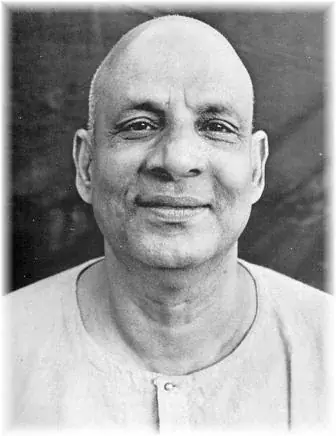
He is the most photographed teacher on this site: the Divine Life Society holds a large archive of photographs from the 1930s onwards, and its pages carry many of them. The portrait at the head of this page is one such photograph, published under a free licence and credited on the credits page; beyond it this site does not reproduce the Society's archive, and it will not generate imitations of a real man's face. The map above is drawn from present-day coordinates. For his face, go to the Society's pages linked below; for his voice, the recordings he made in the last weeks of his life, read aloud from his own books, still exist, and the books themselves are free.
Read the originals
The Divine Life Society keeps his ashram, his archive and his books, most of which it gives away. Every link below goes to the Society itself, not to a general encyclopaedia.
- The Divine Life Society: his life, in full
- His books, free to read and download from the Society (Bliss Divine, Mind: Its Mysteries and Control, the Gītā, the Brahma Sūtras, the Upaniṣads and hundreds more)
- Autobiography of Swami Sivananda, in his own words (free download)
- Bliss Divine, the book the Society recommends first
- Mind: Its Mysteries and Control
- The last days, from Swami Venkatesananda's biography
- "Sivananda: the fire of sannyāsa" — a disciple's recollection of the Swargashram years
Every daily message names the teacher it came from. Read the messages, or see the whole line this teacher stands in: all fifty-one teachers.