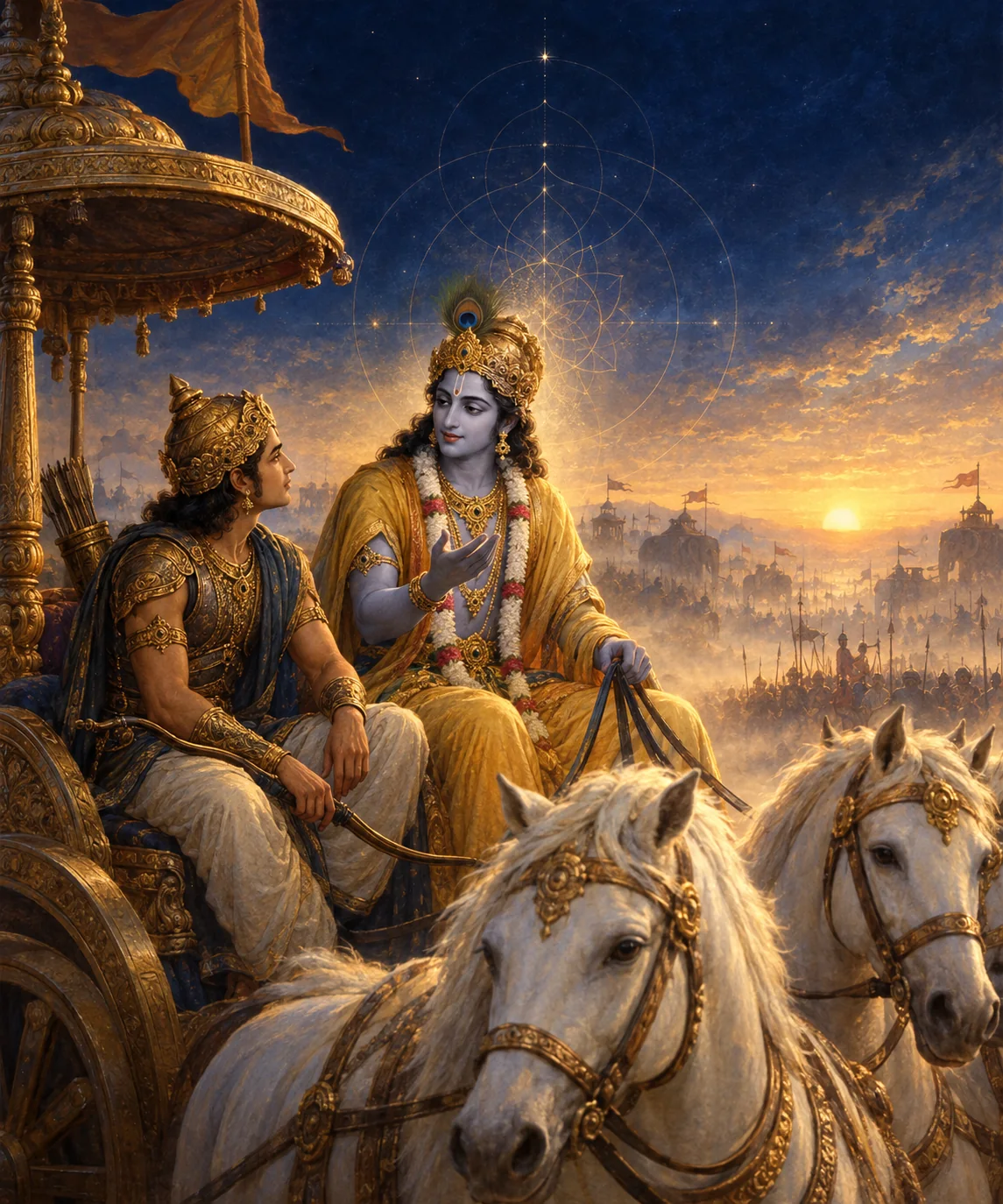
Īśa Upaniṣad
Eighteen verses. Enjoy the world, own none of it; act fully, renounce the grip.
c. 500–400 BCE
- When
- c. 500–400 BCE
- Where it sits
- The three points of departure
The shortest complete statement of how non-duality is supposed to be lived by someone with a job and a family.
What this is, in one breath
The Īśāvāsya Upaniṣad is eighteen verses long. You can chant it in four minutes and spend the rest of your life on it. It is called Īśā (or Īśa) because that is its first word — īśā vāsyam, "to be covered by the Lord" — in the way a hymn gets named by the phrase it opens with. It is the only one of the principal Upaniṣads that sits inside a Veda's core text rather than in the forest-books appended to it: it is the fortieth and final chapter of the Vājasaneyi Saṁhitā of the White (Śukla) Yajur Veda, the collection of formulae used by the priests who actually performed the sacrifices. For that reason it is also sometimes called the Vājasaneyi Saṁhitā Upaniṣad, and it holds a place of honour: in the traditional list of the ten or eleven Upaniṣads on which Sri Śaṅkara wrote commentaries, it is placed first.
It has no author in the ordinary sense; the tradition calls it śruti, "what was heard", and the next sections explain what that means and why it matters. It survives in two recensions — the Kāṇva, with eighteen mantras, which is the one Sri Śaṅkara commented on and the one this page follows, and the Mādhyandina, which has the same material with a different order and a slightly different count. Its subject is the whole of Vedānta in miniature: what the Self is, how the world is to be lived in by someone who knows it, what the two kinds of knowledge are and how they relate, and what a person who has spent a life this way says at the end of it. Gandhi said in 1937 that if every scripture in India were burnt and only the first verse of this one survived, Hinduism would live. He was not exaggerating by much.
The world it came from
Put yourself in the Gangetic plain somewhere in the first half of the first millennium before Christ. The dates are argued over and this site does not pretend to settle them; the text is usually placed between about 700 and 400 BCE, later than the oldest Upaniṣads (the Bṛhadāraṇyaka and Chāndogya, which are in prose and enormous) and earlier than the Buddha's movement had spread, or roughly contemporary with it. The people who preserved it were the Vājasaneyins — the school of Yājñavalkya, the great sage of the Bṛhadāraṇyaka, from whose name the tradition derives the word Vājasaneyi. Their calling was the sacrifice: the soma offering, the fire altar built of a thousand bricks, the new- and full-moon rites, the year-long ceremonies of kings. Their Veda is the Yajur, the Veda of the yajus, the ritual formula — the sentence the priest says while he pours, lifts, lays or burns.
It is important to feel how practical and how confident that world was. These were not mystics in caves. They were technicians of the sacred, working from a handbook so precise that it specifies the number of bricks in a layer, and they believed — reasonably, given the evidence available to them — that correctly performed action produced results in this life and the next as reliably as seed produces harvest. The whole of the Vājasaneyi Saṁhitā, thirty-nine chapters of it, is the text of that action.
And then, at the end, comes a fortieth chapter that says: everything here is to be covered by the Lord; do not covet; the doers of good and the doers of ritual both walk into darkness if that is all they do; the Self is one, motionless and faster than the mind; the face of truth is covered by a golden lid. The placement is the first thing to understand about the text. A ritual tradition put, as the last word of its own handbook, the verses that relativise the handbook. That is not an accident and it is not a later editor's subversion. It is the tradition telling you what all the bricks were for.
Two other features of that world matter for reading it. The first is oral transmission. Nobody wrote this down for centuries; it was carried in the memory of teachers and repeated, syllable-perfect, with the pitch accents, from mouth to ear. The Vedic schools developed a technology of memorisation — reciting the words forward, backward, in interlocking pairs — that has preserved the text with a precision written manuscripts cannot match, which is why a reciter in the far south and a reciter in Varanasi chant identical syllables today. When this page says the text is "self-revealed", it is partly saying that it was never anyone's property: it belonged to the school, the school belonged to the sacrifice, and the sacrifice belonged to the gods. The second feature is the idea of the ṛṣi, the seer, which the next section is about.
Who wrote it — and why the tradition says nobody did
Ask a Vedāntin who composed the Īśā Upaniṣad and you will get a precise answer: nobody. The Vedas are apauruṣeya, "not from a person", and the men whose names attach to Vedic hymns are called mantra-draṣṭā, "seers of the mantra", not its makers. Before dismissing this as pious inflation, it is worth understanding exactly what is being claimed, because it is more careful than it first sounds.
The claim is not that a book fell from the sky. It is that certain truths about the nature of the Self and of reality are not the kind of thing anybody could have invented, because they are not opinions or theories; they are facts about the one who is knowing, and a fact is discovered, not authored. A mathematician who proves that there are infinitely many primes does not create the primes; she sees something that was already the case and reports it. The tradition holds that the seers of the Upaniṣads stand in the same relation to what they said. What they saw was there before them and is there now; their genius was to see it and to find words for it. Hence śruti, "the heard": the words came to the seer in a state of stilled attention as something heard, not something thought up, and were passed on as heard.
This is why the tradition refuses to give the Īśā an author, and why the refusal is respectable rather than evasive. If a person wrote it, it is that person's view and you may hold another. If it is a report of what is the case about you, then your only honest response is to check — which is exactly what Sri Śaṅkara will tell you to do, and what every teacher in the lineages on this site tells you to do. The authority of śruti, properly understood, is the authority of a witness, and a witness invites verification.
The one name the tradition does attach to this Veda is Yājñavalkya. The story — and it is told as a story — is that he received the White Yajur Veda from the Sun, Sūrya, who appeared to him in the form of a horse (vājin), which is one derivation of Vājasaneyi. The historical Yājñavalkya, if we may call him that, is the towering figure of the Bṛhadāraṇyaka Upaniṣad, the man who told his wife Maitreyī that it is for the sake of the Self that anything at all is dear, and who reduced the assembly of King Janaka to silence. The Īśā belongs to his school. Whether any of its eighteen verses came from his mouth, nobody knows and the tradition does not need to know.
The last chapter of a ritual handbook
Sri Śaṅkara opens his commentary with a sentence that governs the whole reading. The mantras beginning īśāvāsyam, he says, are not to be used in ritual, because they reveal the true nature of the Self, which is not a product of action. The ritual chapters of the Saṁhitā describe things to be done; these verses describe what already is. That distinction — between what is to be accomplished and what is simply the case — is the hinge on which all of Vedānta turns, and he puts it in the first line.
Why does he need to say it? Because the priests of the Yajur Veda had, quite reasonably, treated the fortieth chapter like the other thirty-nine and looked for the rite it belonged to. The ritualist commentators Uvaṭa and Mahīdhara, who wrote on the whole Saṁhitā, read the Īśā with the eyes of men who have to perform something tomorrow morning. Sri Śaṅkara's point is that a sentence like "the Self is one, unmoving, swifter than thought" cannot be an instruction; there is nothing to do about it. It is information, and the only appropriate response to information is to understand it. So the last chapter of the handbook is not the last rite. It is the disclosure of what the ritualist was, all along, and what the sacrifice was ultimately for.
That said, Sri Śaṅkara does not read the text as anti-ritual — and this is where a careful reader has to slow down. His view, developed across the eighteen verses and defended against the school of the ritualists (the Mīmāṁsakas) in his introduction, is that the text speaks to two kinds of person. To the one who is able to see the Self in everything, it says: live by renouncing, want nothing, act freely, you are not touched. To the one who is not yet able to, it says: keep doing your work and your rites, do them for a hundred years, do them well, they will not stain you — and they will ready you. This is the same teaching as the Gītā's, which Sri Śaṅkara also expounded, and it is why the two texts are so often taught together. The point of the placement is not that the bricks were a mistake. It is that the bricks were a ladder, and this is the roof.
Who has explained it, and how they differ
Because the text is short and central, almost every major teacher in the tradition has left an account of it, and reading them against one another is one of the pleasures of a deeper study. The principal ones, and where to find them, are these.
- Sri Śaṅkara (8th century) — the Īśāvāsyopaniṣad-bhāṣya, the oldest surviving Vedāntic commentary and the one this page follows. Dense, argumentative, and at three or four points startling: he reads the Kāṇva recension, insists the mantras are not ritual, distinguishes the knower's path from the doer's, and in verses 9–14 gives the words vidyā and sambhūti technical meanings that surprise a first reader. Ānandagiri's gloss on the commentary, written some centuries later, is where students traditionally go when Sri Śaṅkara is too terse. The Sanskrit is online in full at the Sringeri Śāradā Pīṭham's Advaita Śāradā project, and Swami Gambhirananda's English translation for Advaita Ashrama is the standard one.
- Uvaṭa and Mahīdhara (11th and 16th centuries) — the ritualists' commentaries on the whole Vājasaneyi Saṁhitā, which read chapter forty as part of the sacrificial text. Valuable precisely because they show what Sri Śaṅkara was arguing against.
- Sri Madhva (13th century) — the founder of the dualist school also commented on it, reading īśā vāsyam as the Lord's dwelling in everything rather than covering it. A reminder that the first word can be read two ways, and that the schools part company on the first word.
- The Ramakrishna Order — Swami Nikhilananda's translation with notes (in The Upanishads, volume one) and Swami Gambhirananda's translation of Sri Śaṅkara (in Eight Upaniṣads, volume one) from Advaita Ashrama; and, in our own day, Swami Sarvapriyananda's long lecture series at the Vedanta Society of New York, which takes the eighteen verses one at a time for a general audience and is the best spoken introduction available.
- Swami Sivananda (Divine Life Society, Rishikesh) — a short devotional commentary in plain English, free from the Society.
- Swami Chinmayananda — his Īśāvāsya Upaniṣad, one of the nine Upaniṣad commentaries, built from the Jñāna Yajña talks. His reading of the first verse — that renunciation is a change of ownership, not a change of address — is the one this site quotes most.
- Swami Dayananda Saraswati and Swami Paramarthananda (Arsha Vidya) — word-by-word unfoldings in the strict Sri Śaṅkara line, transcribed and freely downloadable from the Arsha Avinash Foundation. Dayananda's insistence on reading tena tyaktena as "by what is given by Him" — the world as gift rather than as possession — is a genuinely different emphasis from Sri Śaṅkara's "by renunciation", and the two readings are compared below.
Outside the lineages this site follows, Sri Aurobindo's Isha Upanishad (1914–15) is the most influential modern commentary and is worth knowing about, and Gandhi's remarks on the first verse are what made it famous to the wider public. They are not linked here because this site links to the lineages' own sources, but a serious student will meet them.
The essence, in a sentence, and the shape of the text
Here is the whole thing in one sentence: everything you see belongs to the Lord, including the one who is seeing; live in the world fully, own none of it; know the Self as one and unmoving in everything; do not mistake either your knowledge or your works for the final thing; and when the body ends, remember what you have done and ask to be led by the good path.
The eighteen verses fall into four movements, and it helps enormously to see the architecture before going verse by verse, because a first reader who does not see it thinks the text wanders. It does not. It moves.
- Mantras 1–3: how to live. Two ways of living rightly — the knower's and the worker's — and the one way of living wrongly, which is to kill the Self by ignoring it.
- Mantras 4–8: what the Self is. The most concentrated description of the Ātman in the Upaniṣads: unmoving and faster than mind; far and near; inside and outside; the one who sees it in all beings is beyond grief and delusion.
- Mantras 9–14: two kinds of knowing, two kinds of worship. A warning, twice over, against clinging to either half of any pair — knowledge or action, the manifest or the unmanifest — and an instruction to hold both together and pass through death with the one and reach immortality with the other.
- Mantras 15–18: the prayer at the end. A dying man's address to the Sun: take off the golden lid; let me see your fairest form; that Person there — I am He. Then the body to ash, the breath to the wind, and the last cry to memory and to fire: remember; lead us by the good road.
Notice the movement. It starts in the marketplace (do your work, want nothing), climbs to the summit (the Self is one), comes back down to correct the two mistakes a climber makes (thinking the knowledge alone or the work alone is enough), and ends at the deathbed, where all of it is tested. That is not a collection of sayings. It is a life.
The peace chant: taking the whole from the whole
The Upaniṣad is chanted with a peace invocation before and after it, and the invocation attached to this one is the most famous in the Vedic corpus: Om pūrṇam adaḥ pūrṇam idam pūrṇāt pūrṇam udacyate; pūrṇasya pūrṇam ādāya pūrṇam evāvaśiṣyate. "That is full; this is full; from the full the full arises; taking the full from the full, the full alone remains." It is placed here from the Bṛhadāraṇyaka, and it is placed here on purpose, because it states the mathematics that the eighteen verses assume.
Think about it the way you would think about counting. If you have ten apples and take away ten, none remain. If you have all the whole numbers — one, two, three, on forever — and you take away all the even ones, you are left with the odd ones, and there are exactly as many of those as you started with. Infinity minus infinity is still infinity. Take the full from the full and the full remains. That is not a paradox; it is what "full" means when the word is used properly. Anything that gets smaller when you remove something from it was never full; it was merely large.
Now apply it to what the Upaniṣad is about to say. "That" — Brahman, the reality behind everything — is full. "This" — the world in front of you, including you — is also full, because it is that same reality appearing. The world arising from Brahman does not deplete Brahman, and the world being "taken away" — in knowledge, when you see through it, or in death, when it goes — leaves Brahman exactly as it was. Nothing is ever lost. Nothing was ever added. When verse one says "cover all this with the Lord" and verse six says "he who sees all beings in the Self", this is the arithmetic they rest on. You cannot subtract from it. That is why you can afford to let go of it.
Mantras 1–3: how to live
Mantra 1 — īśāvāsyam idaṁ sarvaṁ yat kiñca jagatyāṁ jagat
Plainly: All this — whatever moves in this moving world — is to be covered over by the Lord. By that renunciation, enjoy. Do not covet; whose, after all, is wealth?
What it says. Three instructions and a question. Cover everything with the Lord: see the whole world, including your own body and mind, as pervaded by and belonging to the one reality, the way a room is filled by the light that shows it. Enjoy — the word bhuñjīthāḥ is emphatic; you are not told to abstain — by letting go: tena tyaktena, "by that which is renounced" or, in the other reading, "by that which is allotted". And do not grasp at what belongs to another — which, since it all belongs to the Lord, is everything. The closing question, "whose is wealth?", is not rhetorical flourish. It is a genuine question with a genuine answer: nobody's. The deed of ownership was always a fiction.
What Sri Śaṅkara says. He reads the verse as addressed to the one who is fit for knowledge. Īśā is the supreme Self as Lord of all; vāsyam, "to be covered", means: let everything unreal be covered over by the awareness of the one Self, as the smell of damp is driven out of sandalwood by rubbing so that its own fragrance shows — his own image. Tyaktena he takes as renunciation, and he is explicit that what is renounced is the sense of ownership — the threefold desire for children, wealth and worlds. "Protect yourself by renunciation", he says; the renouncer has no need to grasp, since there is nothing outside the Self to grasp. On this reading, the verse is the charter of the sannyāsī and of the knower who lives in the world without being in its grip.
The other reading. Swami Dayananda and his students stress tyaktena as "given", as one might say in Sanskrit that a share has been "left" or "set aside" for someone. Then the sentence reads: the whole world is the Lord's; what is set aside for you by Him, enjoy that — and do not reach for more. It is a householder's reading rather than a monk's, and it is not in conflict with Sri Śaṅkara's; it is the same instruction from the other side. One says: give up the claim. The other says: receive the gift. In both, you are not the owner, and in both, you are not told to stop enjoying.
An analogy for now. Sri Ramakrishna's is the best: the maidservant in a rich man's house. She runs the household, feeds the children, calls them "my Ram, my Hari", loves them, scolds them, and knows every day that the house is not hers and that her own home is in the village. She works with total devotion and total non-attachment, and she is the happiest person in the building. The owner, by contrast, lies awake. Or think of a good hotel room. You enjoy it completely — the bed, the view, the bath — precisely because you have no anxiety about the roof or the mortgage. You did not stop enjoying it because it was not yours; you enjoyed it more. The Upaniṣad says: the world is the hotel. The Lord owns the building. Check in fully; check out lightly.
Mantra 2 — kurvann eveha karmāṇi jijīviṣec chataṁ samāḥ
Plainly: Doing works here indeed, one should wish to live a hundred years. For you, thus — for a person like this — there is no other way; action does not cling to the man.
What it says. Where verse one spoke to the one who can let go, this speaks to the one who cannot yet, and it is astonishingly kind to him. It does not say: give up your job and your rites or you are lost. It says: do your work, and want to live a full life doing it, and understand that for you this is the way — there is no other — and that work done this way does not stain. The evam tvayi, "for you, being thus", is Sri Śaṅkara's key: the verse is for the person who identifies with the body and its duties, and it tells him that his path is legitimate. The householder is not a second-class seeker. He has a first-class road of his own.
What Sri Śaṅkara says. He is at pains here to head off the ritualists' argument that knowledge and works should always be combined. The two verses, he says, address two different people: the first, the one established in knowledge; the second, the one who is not, and for whom action with the right attitude is the discipline that purifies the mind until knowledge becomes possible. Karma, he glosses, means the fire-rites and the like; na lipyate, "does not cling", means that action so performed — as duty, without the grasping condemned in verse one — does not produce the bondage that action usually produces. This is the whole of the Gītā's karma-yoga in a line.
An analogy for now. A surgeon in a public hospital operates all day on people she will never see again. She does not own the outcomes; some patients live, some die; she does the work with total care and goes home. Her hands are in blood all day and she is not stained by it, because she is not grasping. A different surgeon, who operates for reputation and lies awake over each result, is "stained" by the very same actions — not on his hands but in his mind. Same work, different grip. The Upaniṣad says the difference is the whole difference.
Mantra 3 — asuryā nāma te lokā andhena tamasāvṛtāḥ
Plainly: Demonic indeed are those worlds, covered in blind darkness, to which go, after death, those people who are slayers of the Self.
What it says. Having described two right ways to live, the text names the wrong one, and the name is severe: ātmahanaḥ, "self-killers". Who are they? Not the suicides — the Self cannot be killed. Sri Śaṅkara's answer is exact: those who ignore the Self, who live as if the ever-present Ātman did not exist, are as good as its murderers, because for them it might as well not exist. The "worlds without light" they go to are, on his reading, the states of ignorance and misery in this life and after it. The verse is not a threat from an angry god; it is a diagnosis. To live without ever asking who is living is to spend one's life in a dark room with the lamp unlit.
An analogy for now. Imagine a man who inherits a house with one room he never opens. He lives in the others for eighty years, complains of the cold, and dies. The room was heated. The Upaniṣad's word for him is not "sinner". It is "self-killer", and it means: you had it, and you never looked.
Mantras 4–8: what the Self is
Mantra 4 — anejad ekaṁ manaso javīyo
Plainly: Unmoving, one, swifter than the mind; the gods did not reach it, it ran ahead. Standing still, it outruns the others who run. In it, the wind sets the waters in motion.
What it says. The description of the Self begins with a contradiction on purpose: it does not move, and it is faster than the mind. The point is that the Self is not a thing in the race at all. Wherever your mind arrives — a memory of childhood, the far side of the galaxy — awareness is already there, because there is no "there" that is not lit by it. It never left; that is why it is "swifter". The gods — the senses, on one reading; the deities, on another — cannot reach it because it is what they reach with. And "in it the wind sets the waters in motion": all activity in the world, all cause and effect, happens within this unmoving presence, as weather happens within the sky without the sky doing anything.
An analogy for now. Think of a cinema screen. The chase scene is fast; the screen is perfectly still. Whatever the film does, the screen is already there — the film cannot get ahead of it or outside it — and the screen is never touched by the fire or the flood it shows. The mind is the film. Awareness is the screen. That is mantra four.
Mantra 5 — tad ejati tan naijati tad dūre tad v antike
Plainly: It moves; it does not move. It is far; it is near. It is inside all this; it is outside all this.
What it says. Six statements in three pairs, each pair a contradiction, and the contradictions are the teaching. The Self "moves" in the sense that it appears as everything that moves, and "does not move" in itself. It is "far" — infinitely far for the one who is not looking, further than any journey — and "near", nearer than your own breath, for the one who is; Sri Śaṅkara says: nearer than near, being one's very Self. It is inside everything as its reality and outside everything as not limited by any of it. The Upaniṣad is doing here what only poetry or mathematics can do: describing something that is not an object by saying, of every pair of predicates, both — until you stop looking for it among objects.
An analogy for now. Where is the number three? It is in three apples and three stars and three thoughts — inside all of them. It is also not in any of them; take the apples away and three is untouched. It is far — you cannot go and get it — and near — you use it before breakfast. Nobody has ever seen the number three, and nobody has ever doubted it. The Self is like that, except that it is not an abstraction: it is the one who counts.
Mantra 6 — yas tu sarvāṇi bhūtāny ātmany evānupaśyati
Plainly: But the one who sees all beings in the Self alone, and the Self in all beings — he does not, because of that, shrink from anything.
What it says. After the metaphysics, the consequence. The knower sees every creature as existing within the one Self — the way every wave exists within the ocean — and sees the Self present in every creature, the way the ocean is present in every wave. And the result named is not bliss or power but something quieter and more useful: he does not vijugupsate, does not recoil, does not hate, is not repelled. Sri Śaṅkara says: aversion arises from seeing something as other and as bad; for one who sees only the Self, there is no other, so there is nothing to shrink from. This is the ethics of Advaita in one verse, and it is not a commandment. It is a description of what happens to hatred when there is no one to hate.
An analogy for now. You do not hate your left hand for being clumsy or your foot for being cold. You cannot; they are you. Now widen the "you". Sri Ramakrishna, seeing a boatman beating another man, cried out and was found to have the welts on his own back — the story is told by his disciples. That is not a miracle to believe. It is mantra six taken literally.
Mantra 7 — yasmin sarvāṇi bhūtāny ātmaivābhūd vijānataḥ
Plainly: When, for the one who knows, all beings have become the Self alone — then what delusion, what sorrow, for him who sees oneness?
What it says. Two questions that expect no answer: ko mohaḥ, kaḥ śokaḥ — what delusion, what grief? These are the two afflictions the whole tradition sets out to end, and the verse says they simply have no purchase where there is no second thing. Delusion is mistaking one thing for another; grief is the loss of something one had. Where there is only one, there is nothing to mistake it for and nothing to lose. Sri Śaṅkara points out the past tense, abhūt, "have become": this is not a mood to cultivate but a fact seen once and for all. The Gītā's Arjuna, who began the conversation in delusion and grief on a battlefield, is the person this verse is written for.
Mantra 8 — sa paryagāc chukram akāyam avraṇam asnāviram
Plainly: He has reached the bright, the bodiless, the unwounded, the sinewless, the pure, unpierced by evil — the seer, the thinker, the all-encompassing, the self-existent; he has rightly assigned things their purposes for endless years.
What it says. The description closes with a chain of negatives and a turn. Bodiless, without wound, without sinews: everything a body is, this is not. Pure, untouched by wrong: everything a mind's history is, this is not. Then the positives: kavi, the seer — all-seeing; manīṣī, the ruler of the mind; paribhū, that which surrounds everything; svayambhū, existing by itself, needing nothing to be. And the last clause is the surprise: this bodiless, unmoving Self is also the one who has ordered the whole world, "distributing purposes" rightly through all time. The Self is not a blank. Sri Śaṅkara reads this as the Lord's ordering of the world for the sake of all beings — the same Īśa of verse one. The transcendent and the ordering are one. The text has climbed to the summit, and from the summit it points back down at the world and says: that too.
An analogy for now. The rules of arithmetic have no body, cannot be wounded, have never done anything wrong, exist by themselves, and yet every bridge that stands and every account that balances does so because of them. They "assign things their purposes" without lifting a finger. Something like that — but aware — is what the verse is pointing at.
Mantras 9–14: two kinds of knowing, two kinds of worship
This is the section where first readers get lost and where Sri Śaṅkara does his most careful work, so it is worth taking slowly. Six verses form two matched triplets. Each triplet has the same shape: a warning against clinging to either half of a pair (9, 12); a report that the wise have always said the two halves give different results (10, 13); and an instruction to hold both together, crossing death with one and reaching immortality with the other (11, 14). The first triplet is about vidyā and avidyā, knowledge and — literally — non-knowledge. The second is about sambhūti and asambhūti, the manifest and the unmanifest, or becoming and non-becoming. The verses are printed here in the Kāṇva order; the Mādhyandina recension arranges the same six differently.
Mantras 9–11 — andhaṁ tamaḥ praviśanti ye'vidyām upāsate
Plainly (9): Into blind darkness enter those who worship non-knowledge; into greater darkness still, as it were, those who delight in knowledge. (10): One thing, they say, comes from knowledge; another, they say, from non-knowledge. Thus have we heard from the wise who explained it to us. (11): The one who knows both together, knowledge and non-knowledge — by non-knowledge crossing over death, by knowledge he reaches immortality.
The surprise. Verse nine seems to say that knowledge leads to a worse darkness than ignorance, and every reader stops dead. The resolution lies in what the words mean here, and this is where Sri Śaṅkara's commentary earns its place. Avidyā, he says, is not ignorance in the ordinary sense; in this context it means karma — ritual action, the rites of the preceding thirty-nine chapters, called "non-knowledge" because action is what one does instead of knowing. Vidyā, likewise, is not Self-knowledge here; it means devatā-jñāna, knowledge of and meditation on the deities, the upāsanās that the same ritualists practised. So the verse is not about the Self at all yet. It is a warning to the religious. Those who do only the rites walk into darkness — the darkness of endless doing. Those who do only the meditations walk into a subtler darkness — the darkness of a refined mind that mistakes its refinement for the goal. And the wise, verse ten reports, have always said the two produce different results. Verse eleven then gives the instruction: do both. By action, cross "death" — which Sri Śaṅkara defines as the natural pull of one's own desires and habits, the impulses that drive an untrained person; by meditation, reach "immortality" — which he is careful to call relative immortality, āpekṣikam amṛtam, the long life of the gods, not the absolute freedom the earlier verses described.
Why this matters. Sri Śaṅkara's reading has a consequence he draws out at length in his introduction. The combination the verse recommends is of action with meditation, two things a person can do together. It is not a combination of action with Self-knowledge, which he holds cannot be combined with anything, any more than light can be combined with the darkness it removes. Knowing that you are the Self is the end of the sense of being a doer; you cannot at the same time act as a doer for a result. So the verse does not, as the ritualist school claimed, teach that even the knower must keep up his rites. It teaches the person on the way what to do on the way. This distinction — between what prepares the mind and what frees it — is the spine of Advaita Vedānta, and the Īśā is where Sri Śaṅkara first draws it.
An analogy for now. Think of learning a language. There is drill — vocabulary, verb tables, the daily grind that trains the tongue and ear; that is "action", and someone who does only drill for twenty years can recite every table and still not speak. There is immersion — listening, reading, thinking in the language; that is "meditation", and someone who does only that without the drill speaks fluently and wrongly, and does not know it, which is the "greater darkness": confident error. Do both, says the Upaniṣad, and you will cross the death of your bad habits with the drill and reach the "immortality" of real fluency with the immersion. But — and this is Sri Śaṅkara's point — fluency is still not the same as having something to say. That is the knowledge the earlier verses were about, and no amount of drill produces it. Drill and immersion make you ready to hear it.
Mantras 12–14 — andhaṁ tamaḥ praviśanti ye'sambhūtim upāsate
Plainly (12): Into blind darkness enter those who worship the unmanifest; into greater darkness still, as it were, those who delight in the manifest. (13): One thing, they say, comes from the manifest; another from the unmanifest. Thus have we heard from the wise who explained it to us. (14): The one who knows both together, the manifest and the perishing — by the perishing crossing over death, by the unmanifest he reaches immortality.
What Sri Śaṅkara says. The second triplet repeats the pattern one level up. Now the pair is not two practices but two objects of worship. Sambhūti is the manifest — in Sri Śaṅkara's gloss, Hiraṇyagarbha, the cosmic person, the "effect-Brahman", the totality of the manifested universe considered as a single divine being. Asambhūti is the unmanifest — prakṛti, the undifferentiated seed-state of the universe before anything has appeared. Worshippers of the unmanifest alone, he says, attain dissolution into prakṛti — a kind of cosmic sleep, "blind darkness" indeed. Worshippers of the manifest alone attain the powers of Hiraṇyagarbha — to become small, to become great, to have what one wills — and the text calls this "greater darkness" because it is so much more seductive; nobody is trapped by a cosmic sleep, but many are trapped by power. Verse fourteen's instruction to hold both together contains a famous grammatical move: the word for "the perishing", vināśa, is read as another name for the manifest (since perishing is its nature), and the word sambhūtyā in the last line is read as a-sambhūtyā with the initial vowel elided, as Sanskrit sandhi permits. So: by the manifest cross over "death" — the lack of power, the unrighteousness, the desire that mark an ordinary life; by the unmanifest reach "immortality" — again relative, the peaceful dissolution into the source. The two together are the highest result available to a person who worships rather than knows, and it is still not liberation.
Why the tradition keeps these verses. A reader might ask why a text about the one Self spends a third of its length on grades of religious attainment that fall short of freedom. The answer is honesty. The Upaniṣad is describing the actual landscape. Most religious practice, in every tradition, aims at one of these four things — the discipline of action, the refinement of meditation, the attainment of power, or the peace of dissolution — and the text says clearly that each of them is real, each produces what it produces, none of them is the end, and the person who takes any one of them for the end walks into a darkness proportional to how bright it looked. Then, having mapped the foothills, it goes to the deathbed of a man who climbed them.
An analogy for now. Consider two ways of being wealthy. One person owns everything — houses, companies, influence; that is the manifest, Hiraṇyagarbha's powers, and it is a "greater darkness" precisely because it works so well that its owner never asks what he is. Another has given everything away and lives in perfect simplicity; that is the unmanifest, prakṛti, and it is a "blind darkness" if it is simply withdrawal — a peace that has not understood anything, only left. The Upaniṣad's advice is: use the world to cross the weakness and disorder of an untrained life, and use simplicity to reach peace, and then understand that you are neither the one who owns nor the one who renounced. That last step is not in these verses. It is in verses four to eight, and the text has already given it to you.
Mantras 15–18: the prayer at the end
The last four verses change register completely. They are not statements; they are a prayer, in the first person, spoken by someone at the point of death. Sri Śaṅkara says they are the words of the person described in verses nine to fourteen — the one who combined action and meditation and now, at the end, faces the sun and asks for the way. The tradition holds that these verses are the origin of a very old Indian custom: they are recited at the cremation ground. Anyone who has stood at one knows that a text which can be said there has earned its authority.
Mantra 15 — hiraṇmayena pātreṇa satyasyāpihitaṁ mukham
Plainly: By a golden vessel the face of truth is covered. That, O Nourisher, uncover — for me, whose law is truth, to see.
What it says. The most beautiful line in the text, and one of the most quoted in Indian literature. The dying man addresses the sun as Pūṣan, the Nourisher, and says: your golden disc — the blaze of your rays — is a lid over the face of the real. Take it off. Let one who has lived by truth see what is behind the light. Sri Śaṅkara reads the sun here as the seat of the deity the meditator has been contemplating all his life, and the "golden vessel" as the dazzle that hides the Brahman within the solar orb. The plea is to be shown, at last, not the brightness but what the brightness was covering.
An analogy for now. Stand at a window at dusk with the lights on inside. You see your own reflection and the lit room; you cannot see the garden. Turn the lights off and the garden appears — it was there all along, hidden by the very brightness you were using to see. The dying man asks the sun to turn the lights off.
Mantra 16 — pūṣann ekarṣe yama sūrya prājāpatya
Plainly: O Nourisher, sole seer, controller, Sun, child of the Lord of creatures — spread apart your rays, gather in your light. That form of yours which is most beautiful, that I see. That Person who is there, there — I am He.
What it says. The prayer builds through five names for the sun — nourisher, solitary traveller of the sky, ruler of the world's time, the sun itself, the offspring of the creator — and asks it to part its rays and draw its glare together so that its "most gracious form" can be seen. And then the sentence that Vedānta exists to say: yo'sāv asau puruṣaḥ so'ham asmi. That Person there, in the sun — I am He. Sri Śaṅkara says: the "I" here is the one who has been meditating; at the moment of seeing, the seer and the seen are known as one. The Upaniṣad has been careful for fourteen verses to distinguish grades of attainment; in the sixteenth, at the moment of death, it lets the distinction fall. It is the same statement as the Chāndogya's "You are That" and the Bṛhadāraṇyaka's "I am Brahman", spoken here in the second person to the sun and then, in the same breath, in the first.
Mantra 17 — vāyur anilam amṛtam athedaṁ bhasmāntaṁ śarīram
Plainly: Let the breath go to the immortal wind; and now this body ends in ash. Om. O will, remember; remember what has been done. O will, remember; remember what has been done.
What it says. The body's parts return to where they came from: the breath to the wind, the body to ash. This is said plainly and without fear, as a fact about matter. Then Om — the single syllable that the tradition uses as the name of Brahman — and then a cry, repeated: krato smara, kṛtaṁ smara. Sri Śaṅkara reads krato as the mind in its aspect of will and intention, and the cry as: remember what is to be remembered — what has been meditated on — and remember what has been done, the whole life of action, because the mind at death goes where its remembrance goes. The repetition is not literary. It is what a person does when it matters.
An analogy for now. Everyone who has watched someone die has seen this verse. The body does what bodies do; what remains, at the end, is what the person had made themselves into and what they held in mind. The Upaniṣad does not sentimentalise it. It says: be ready to remember.
Mantra 18 — agne naya supathā rāye asmān
Plainly: O Fire, lead us by the good path to what is worth having, you who know all our ways. Turn from us the crooked wrong. To you we offer the fullest word of homage.
What it says. The last verse is the oldest: it is a hymn from the Ṛg Veda, the first Veda, placed here as the closing prayer. Agni, the fire — the god who carries the offering, who lights the dark, who receives the body — is asked to lead by the good road, the bright path northward that the tradition calls the way of the gods, to the goal that is truly worth having, and to remove the "crooked wrong", juhurāṇam enaḥ, whatever bends the path. Sri Śaṅkara notes that the plural, "lead us", is the voice of all who have lived this way. It ends with homage — nama-ukti, the word of bowing — because that is what one has left when one has nothing left. A text that began by telling a person to want nothing ends with the same person asking for nothing but the road.
The two arguments a serious reader must have
This site promised to treat these texts as claims to be tested, not articles to be believed, so the two arguments that any thinking reader will pick with the Īśā are set out here, with the strongest case on each side.
First argument: is "renounce and enjoy" honest, or is it having it both ways?
The objection. Verse one tells you to enjoy the world and to give it up. A cynic says this is a trick: either you want things or you do not; a philosophy that lets you keep your comforts while feeling detached is just comfort with better public relations. And the long history of religious people who preached renunciation and lived well is evidence for the cynic.
The reply. The verse does not say "want things and pretend not to". It says: enjoy by renouncing — the renunciation is the cause of the enjoyment, not a cover for it. And this is testable in a single afternoon. Notice what actually spoils your enjoyment of anything: the fear of losing it, the comparison with what someone else has, the anxiety about whether it will last, the resentment that it is not more. Every one of those is ownership talking. Strip out the sense of "mine" and what is left is the thing itself, which was always enjoyable and rarely enjoyed. Sri Ramakrishna's maidservant is not a hypocrite; she is the only person in the house who is actually enjoying the children. Swami Chinmayananda put it as a change of ownership, not of address: you do not have to leave; you have to stop clutching. The strongest version of the reply is that the alternative — enjoyment through possession — has been tried by every human being who has ever lived, and its results are in.
What the objection gets right. The cynic is correct that "detachment" is easy to fake and that the fakes are numerous. The Upaniṣad's own answer to that is verse three: the test is not what you say about ownership but whether you have looked at the Self. A person who talks of renunciation and has never asked who is renouncing is, in the text's own severe word, a self-killer, whatever his lifestyle.
Second argument: is Self-knowledge a fact, or a faith?
The objection. The Upaniṣad describes the Self as one, unmoving, present in all beings, free of grief. That is a large claim, and it is unfalsifiable: no experiment would show it false. It sounds like every other religious claim about souls and gods — comforting, unprovable, to be taken on trust.
The reply, as the teachers make it. Start with what is not in doubt. You can doubt every belief you hold; you can doubt the world, other people, your memory, your senses. You cannot doubt that there is doubting going on — the doubt itself is evidence of the awareness in which it happens. Sri Ramana Maharshi's entire method rests on this: whatever you are aware of can be questioned, but the awareness is not something you are aware of; it is what you are. This is not a faith claim. It is the one thing that cannot be a faith claim, because it is presupposed by the act of believing or disbelieving anything. The Upaniṣad's verses four and five are describing exactly this: what is "swifter than mind" because every thought already presupposes it, "far" because you cannot make it an object, "near" because it is what you are.
Now the second step. Is that awareness one, or are there many? Here the teachers argue, not assert. Awareness has no observable boundaries — you have never found the edge of it; you find edges of things in it. It has no properties by which two awarenesses could be told apart; whatever differs between your mind and mine is content, not the awareness of content. And the sense that "my" awareness is separate from "yours" is itself a thought, which appears in awareness and so cannot be the thing that divides it. The conclusion that awareness is one and undivided is not a leap; it is what remains when the assumption of division is examined and found to have no evidence behind it. Sri Śaṅkara's method throughout his commentaries is precisely this: not "believe that you are Brahman" but "show me the evidence that you are not, and watch it dissolve."
What the objection gets right. The skeptic is right that no laboratory experiment settles it, and right to be suspicious of anything that claims exemption from testing. The reply is that the Self is not exempt from testing; it is tested by a different instrument — direct examination of one's own experience, which is the only instrument that could possibly reach it, as no microscope can see the eye that looks through it. The tradition's claim is that this test can be run by anyone, has been run by many, and gives the same result every time; the Upaniṣad's "thus have we heard from the wise who explained it to us" is the report of exactly that repeated verification. The invitation is not to believe them. It is to run it.
For a ten-year-old, and for a hundred-year-old
If you are ten. Imagine you are staying at your grandmother's house for the whole summer. It is not your house. You did not buy the garden or the dog or the swing. But you get to play in all of it, every day, and because it is not yours you never worry about it; you just enjoy it. The Īśā Upaniṣad says the whole world is like your grandmother's house. It belongs to God — or, if you like, to the one big Life that everything is part of. You get to use all of it. You should not grab it or say "mine, mine". And here is the secret part: the one inside you who is enjoying the summer — the one who is awake, looking out of your eyes — is the same one looking out of everyone else's eyes too, and out of the dog's. It does not get old and it does not get hurt, even when your knee does. When you are very old, the Upaniṣad says, you can look at the sun and say: I know who you are. You are the same as me.
If you are a hundred. You have done your work; the text's second verse says that was the right thing to do and that it does not stain you. You have seen most of what you owned pass to others, and you have found, perhaps to your surprise, that the letting go was not the loss it looked like from a distance; the first verse said it would be so. You know now that grief comes from the sense of a second thing — a thing lost, a person gone — and the seventh verse asks you the question you are ready for: for one who sees the one, what grief? The last four verses are yours. The breath will go to the wind and the body to ash, and that is simply true. What the text asks of you is one thing: remember. Remember what you have done, and remember what you are — the one who was watching all of it, who was never a hundred years old, who is the same as the one in the sun. And ask, without shame, to be led by the good road.
How to approach a deeper study
The Īśā is the traditional first Upaniṣad for a student, and the order below is the order the lineages on this site actually use.
- Learn to say it. Eighteen verses is a fortnight's work. Chant with a recording or a teacher until the words are yours; the Sanskrit is online in Devanāgarī at the Sringeri Advaita Śāradā site, alongside Sri Śaṅkara's commentary. Understanding follows sound in this tradition, not the other way round.
- Read one plain translation whole, twice, without notes — Swami Nikhilananda's or Swami Gambhirananda's. Get the shape: the four movements described above.
- Then read Sri Śaṅkara, in Gambhirananda's translation, one verse a day, paying particular attention to his introduction and to verses one, two, nine and eleven. Where he is too terse, Swami Paramarthananda's transcribed classes unfold him line by line.
- Then hear it taught. Swami Sarvapriyananda's lecture series at the Vedanta Society of New York is the most accessible spoken commentary; Swami Chinmayananda's book carries the voice of his Jñāna Yajñas; Swami Dayananda's word-by-word is the strictest. Notice where they emphasise differently — on tyaktena above all — and ask which reading your own life bears out.
- Read it alongside three other texts. The Kena Upaniṣad (next on this shelf) asks the question the Īśā answers — by whom is the mind sent? Chapters three and five of the Bhagavad Gītā develop verse two into a complete way of working. And the Māṇḍūkya Upaniṣad with Sri Gauḍapāda's Kārikā takes verses four and five — the unmoving, the far and the near — to their logical conclusion.
- Keep one verse. Most students end up with the first or the sixth. Say it before the day begins. It is a four-second reminder of who owns the day.
The eighteen, plainly
For reference, one line each, following Sri Śaṅkara's Kāṇva text.
- All this is the Lord's. Enjoy by letting go. Do not covet — whose is wealth?
- Or else: work, wish to live a hundred years working, and action will not stain you.
- But those who ignore the Self altogether go into darkness — the self-killers.
- The Self does not move and is faster than the mind; the senses cannot reach it; in it all action happens.
- It moves and does not move; it is far and near; inside everything and outside everything.
- Whoever sees all beings in the Self and the Self in all beings shrinks from nothing.
- For the one who sees oneness, what delusion? what grief?
- It is bodiless, unwounded, pure, self-existent — and it has ordered the world through all time.
- Those who do only rites go into darkness; those who do only meditations, into a subtler one.
- The wise have always said the two give different results.
- Do both: cross the death of your own habits by action; reach the long life of the gods by meditation.
- Those who worship only the unmanifest go into darkness; those who worship only the manifest, into a subtler one.
- The wise have always said the two give different results.
- Hold both: cross weakness by the manifest; reach dissolution by the unmanifest.
- Nourisher, the face of truth is covered by a golden lid. Uncover it for one who has lived by truth.
- Sun, part your rays, gather your light, let me see your fairest form. That Person there — I am He.
- Breath to the wind, body to ash. Om. Will, remember; remember what was done.
- Fire, lead us by the good road. Turn the crooked wrong from us. To you, our fullest homage.
A note on sources. Everything above follows Sri Śaṅkara's Kāṇva text and commentary as published by Advaita Ashrama and by the Sringeri Śāradā Pīṭham, checked against the teachers of the Ramakrishna, Chinmaya and Arsha Vidya lineages listed below. Where a reading is Sri Śaṅkara's alone, this page says so. Where the teachers differ, this page gives both. The dates given for the text are the range most scholars accept; the tradition itself does not date what it regards as beginningless.
The text itself
Complete originals, in free copies wherever one exists.
Commentaries worth trusting
Read by teachers within the tradition, not summaries of it.
- Īśāvāsya Upaniṣad — Swami Chinmayananda's commentary (Chinmaya Publications) The Jñāna Yajña reading: renunciation as a change of ownership, not of address. One of his nine Upaniṣad commentaries.
- Īśāvāsya Upaniṣad, class transcripts — Swami Paramarthananda (Arsha Avinash Foundation) Sri Śaṅkara's commentary unfolded line by line in the Arsha Vidya line of Swami Dayananda Saraswati. Free download.
- Isha Upaniṣad lectures — Swami Sarvapriyananda (Vedanta Society of New York) The Ramakrishna Order's teacher taking the eighteen mantras one at a time for a general audience. Find the Īśa series under the scripture list.
- Īśāvāsya Upaniṣad — Swami Sivananda (Divine Life Society, Rishikesh) A short devotional commentary in plain English, free from the Society.
This text sits inside a shelf with a shape. See how the whole corpus is organised, or start from today's message.