Sri Sarada Devi
Holy Mother
1853–1920 · The Sri Ramakrishna Lineage
- When
- 1853–1920
- Born
- Jayrāmbāṭī, Bengal
- Where the life was lived
- Born on 22 December at Jayrambati, a village adjoining Kamarpukur in West Bengal; lived at Dakshineswar with Sri Ramakrishna, then between Jayrambati, Kamarpukur and Kolkata.
- What is left of it
- Her conversations and counsel, recorded by disciples as her teachings and reminiscences.
Worshipped by Sri Ramakrishna as the Divine Mother in 1872; after 1886 became the guide of the young Order for thirty-four years, giving initiation herself and supporting the education of girls.
The Bengal she was born into
She was born on 22 December 1853 in Jayrāmbāṭī, a village of mud houses and rice fields in the Bankura district of Bengal, three miles from Kāmārpukur, the village where the man she would marry had been born seventeen years earlier. In 1853 Bengal belonged to the East India Company. The Company had four years left to live; the rebellion of 1857 would end it and put the country directly under the Crown, but news of that kind reached a village like Jayrāmbāṭī slowly, if at all. The railway from Calcutta had not yet been laid. The nearest town of any size, Bishnupur, was a day's walk. The village had a pond, a temple to the goddess Siṃhavāhinī, a few dozen Brahmin and farming families, and no school for girls.
Her father, Rāmachandra Mukhopādhyāy, was a poor Brahmin who farmed a little land and performed priestly duties; her mother, Śyāmāsundarī Devī, ran the household and worked in the fields. The family was pious and poor in the ordinary way of the Bengal countryside, and Sāradā, the eldest of seven children, was put to work almost as soon as she could walk: minding the younger children, carrying rice to the labourers in the fields, looking after the cattle. She never went to school. Much later, in Calcutta, she taught herself to read Bengali well enough to follow the Rāmāyaṇa, and she never learned to write more than her name. When people who had read everything came to her for instruction, this was the woman they found.
Two features of that world matter for what follows. The first is that a girl in rural Bengal in the 1850s was married in childhood — the ceremony a religious sacrament rather than the start of married life — and went to her husband's house only years later, when she was grown. The second is that the religion of the countryside was intensely devotional and intensely practical: the goddess in the village temple was fed, dressed and spoken to as a living presence, and the women of the house did most of that speaking. Sāradā grew up inside that intimacy with the divine as a matter of daily housework. It shaped her more than any book could have.
Where the life was lived
The whole of her life was lived within a small triangle of Bengal — Jayrāmbāṭī, Kāmārpukur, and Calcutta with its northern suburb of Dakṣiṇeśvar — with three long pilgrimages beyond it. The map below shows the places on present-day coordinates. She never left India, and until she was eighteen she had never been further than the neighbouring village.
Present-day India. A life lived inside a small triangle of Bengal — Jayrāmbāṭī, Kāmārpukur, Dakṣiṇeśvar and Calcutta, too close together to be shown as separate points at this scale — with three pilgrimages beyond it: to Kāśī and Vṛndāvan in 1886–87 and again in 1912, to Purī in 1888, and to the great southern temples in 1911. The connecting line follows the order of her journeys, not the roads.
- 1Jayrāmbāṭī and Kāmārpukur (West Bengal) — Two villages twenty-six kilometres apart. Born at Jayrāmbāṭī 22 December 1853, her home for much of her life, where Matri Mandir now stands; married at Kāmārpukur, Sri Ramakrishna’s village, in 1859, and lived there through the years of privation, 1887–88
- 2Calcutta, Dakṣiṇeśvar and Belur (West Bengal) — One stretch of the Ganges. The music tower in the Dakṣiṇeśvar temple garden, her home 1872–85, and the Ṣoḍaśī Pūjā of 5 June 1872; rented rooms in north Calcutta from 1888 and the Udbodhan house at Bāgbāzār from 1909, where she died on 21 July 1920; cremation at Belur Math, where her temple stands
- 3Kāśī (Uttar Pradesh) — Pilgrimage 1886 and again 1912
- 4Vṛndāvan (Uttar Pradesh) — A year here, 1886–87; initiated Swami Yogānanda, her first disciple; again in 1912
- 5Purī (Odisha) — Pilgrimage to Jagannāth, 1888
- 6Madras (Tamil Nadu) — Southern pilgrimage, 1911
- 7Madurai (Tamil Nadu) — The Mīnākṣī temple, 1911
- 8Rāmeśvaram (Tamil Nadu) — Worship and the sea-bath at the tip of the country, 1911
A child bride, and a strange husband
In May 1859, aged five — "about six", by the Order's reckoning — she was married to Gadādhar Chaṭṭopādhyāy of Kāmārpukur, who was twenty-three. Gadādhar had been serving as a priest in the Kālī temple at Dakṣiṇeśvar, north of Calcutta, and had thrown himself into spiritual practice with such abandon that his family feared for his sanity; the marriage was arranged, as such marriages sometimes were, to bring him back to earth. He himself, according to the tradition, named the village and the house where the bride would be found. After the ceremony Sāradā went back to her parents, as was the custom, and Gadādhar went back to Dakṣiṇeśvar and to the practices that made him, within a few years, Sri Ramakrishna.
She saw him twice in the next twelve years. In 1867, when she was fourteen, he spent some months at Kāmārpukur recovering his health, and she was brought to stay in the house. He taught her — how to keep a house, how to conduct herself, and how to meditate and pray — with a patience she remembered for the rest of her life. Then he went back to the temple, and the years passed, and the village talk began: that her husband had gone mad, that he wandered about naked, that he had abandoned her. Nobody in Jayrāmbāṭī could have told her what he had actually become, because nobody there knew.
In March 1872, when she was eighteen, she decided to find out for herself. With her father she walked the sixty miles to Dakṣiṇeśvar. On the way she fell ill with fever and had to be left for a night in a rest-house in the fields; she later described a dark-skinned young woman who sat by her and stroked her head through the night and said she would reach Dakṣiṇeśvar safely — and who, when Sāradā asked who she was, said she was her sister. Whatever one makes of that, she reached Dakṣiṇeśvar, and Sri Ramakrishna received her, the Belur Math account says, "with great affection", and told her that if she had come to draw him into worldly life she was welcome to try, and that if she had come to help him she was welcome to stay. She stayed.
The room in the music tower
For the next thirteen years, with intervals in the village, she lived in the ground-floor room of the nahabat, the small octagonal music tower in the temple garden, a few yards from his room. The room was so low that she could not stand up straight in it, and so small that a few pots and a bedroll filled it. She cooked for him — his stomach was weak and he ate only what she made — and for the growing crowd of visitors who came to hear him talk, sometimes for dozens at a time, over a wood fire in a space the size of a cupboard. She went to the river to bathe before dawn so that no man would see her, and she stayed inside the tower during the day so completely that some visitors of years' standing did not know she existed. She said later that she was happy.
What was between them has been described by everyone who wrote about either of them, and the descriptions agree. They lived as husband and wife in name and as fellow practitioners in fact. He treated her as his first disciple and, before long, as something more. On the night of 5 June 1872, the night of the Phalahāriṇī Kālī Pūjā, he seated her on the seat of worship in his room and performed the Ṣoḍaśī Pūjā — the worship of the Divine Mother in the form of a living woman — with her as the Mother. At the end he laid the fruit of all his practice at her feet. She sat through it, the accounts say, in a state beyond ordinary consciousness. Nothing that came later can be understood without this: from that night, for him, she was the Mother of the universe, and the tradition has never called her anything else.
She asked him once how he regarded her, and he said: as the Mother in the temple, as my own mother, and as you who are here. She asked him, in the plainest terms, whether she should help him lead an ordinary life, and he asked her what she herself wanted, and she said she wanted nothing but to serve him and to know God. That settled it. He taught her to meditate in the small hours of the night; he gave her instruction in everything from mantra to how to give a guest a glass of water; and when the young men who would become his monastic disciples began to arrive from Calcutta in the early 1880s, he told her — and told them — that they were her children.
The death of the Master, and what she saw
Sri Ramakrishna's throat began to trouble him in 1885; it was cancer. He was moved to Śyāmpukur in Calcutta and then to a garden house at Cossipore, and she went with him and cooked his diet through the last months, while Narendra — later Swami Vivekananda — and the other young men nursed him. He died in the small hours of 16 August 1886. She was thirty-two.
A Hindu widow of her time and place removed her bangles, wore white for the rest of her life, and disappeared. She began to take off her bracelets, and — she told this many times, and it is in every account — he appeared to her and said: have I died, that you should do that? I have only passed from one room to another. She kept the bracelets on, and a thin red border on her white cloth, until she died. It was the first sign of something the Order took decades to understand fully: that what he had begun, she was going to continue.
Vṛndāvan, and the first disciple
Within weeks of his death she left Calcutta on pilgrimage with a small party of devotees — to Deoghar, to Kāśī, to Ayodhyā, and then to Vṛndāvan, the town of Kṛṣṇa's childhood on the Yamunā, where she stayed for a year. It was the hardest year of her life. She wept in the Rādhāramaṇa temple until the priests asked what she was doing; she meditated for hours; and she said afterwards that in Vṛndāvan the grief was finally lifted from her, in a way she never described in detail. It was there, too, that she did the first thing that showed what she would be. Swami Yogānanda — Yogīn Mahārāj, one of the Master's young disciples, who had travelled with the party as her attendant — asked her for initiation. She hesitated; she said she was only a woman and knew nothing; and then, at the Master's instruction in a vision, she gave it. He was her first disciple. In the thirty-four years that followed there would be thousands.
The years of privation
She came back to Kāmārpukur in 1887 and lived there in poverty so complete that the accounts do not soften it. The Master's family had almost nothing; the village treated the widow of the "mad priest" with pity or contempt; she went without salt for months, and there were days when she had nothing to eat but boiled rice and greens. She told no one. When the young monks at the Barānagore monastery finally heard how she was living — from a devotee who had visited — they were ashamed, and in 1888 they brought her to Calcutta, where she lived for years in rented rooms in the north of the city or in the houses of devotees, going back to Jayrāmbāṭī for long spells. It was, the Belur Math account says, "a turning point in her life": in Calcutta she began, quietly, to receive people.
The poverty never entirely left. Until Swami Sāradānanda built her a house in 1909, she had no settled home of her own. In Jayrāmbāṭī she lived with her brothers and their families, who — the Order's own account puts it plainly — "gave her endless troubles": quarrels about money, about land, about who would inherit what from the growing stream of gifts brought by devotees. She bore it, the same account says, "calm and self-possessed", and she used it. Asked why she put up with them, she said that if she did not have a family to look after, her mind would go so far up that it would not come back, and then whom would she help?
Radhu, and the anchor
The clearest example of that is Rādhu — Rādhārāṇī — the daughter of her brother Abhay, who died leaving a widow who was mentally unwell and a baby girl. Sāradā took the child. Rādhu grew up sickly, wilful, mentally unstable, and demanding beyond anything an ordinary aunt would have tolerated; she abused her, struck her, refused medicine, and had to be nursed through illness after illness and, later, a difficult marriage and childbirth. Sāradā looked after her for twenty years. The devotees could not understand it, and one of them finally asked. She said: I am attached to Rādhu so that I stay in the body. If that attachment goes, I go. The Master showed her to me after his death and said, hold on to this child, or you will not remain. And near the very end of her life, when Rādhu was nearby, she said, "I have withdrawn my mind from Rādhu," and the devotees knew what it meant.
The story matters because it shows the method. Sri Ramakrishna's philosophy, in her hands, had no vocabulary. It was a way of handling a difficult child. Nobody who watched her could accuse the teaching of being about escaping the world.
The Mother of everyone
From the 1890s until her death she gave initiation and guidance to anyone who came, and the range of who came is the astonishing thing about her life. The monks of the Order took her word as final; Swami Vivekananda, who wrote to her from America asking her blessing before he dared to speak in public, said that without her permission nothing of his would have succeeded, and that with the coming of the Holy Mother "the awakening of women in modern times" had begun. When his Western women disciples — Sister Niveditā, Sara Bull, Josephine MacLeod — came to Calcutta in 1898, orthodox Bengal expected the widow of a Brahmin priest to keep them at a distance; she received them as daughters, ate with them, and gave Niveditā's school for girls her open support. It was, the Belur Math account says, done "despite the restrictions of orthodox society at that time".
The other end of the range was Amjad, a Muslim labourer of the district with a reputation as a thief, who worked on the house at Jayrāmbāṭī and whom she fed with her own hands, to the horror of her niece. Her reply has become one of the sentences by which she is known: "Śarat is my son, and Amjad is my son too." Śarat was Swami Sāradānanda, the general secretary of the Order. She said the same of a man who came to her having killed someone; she said it of drunkards, of women the town had discarded, of everyone. "I am the mother of the virtuous as well as the wicked." "If my son wallows in the dust or mud, it is I who have to wipe all the dirt and take him on my lap."
She initiated freely, without examining the candidate's fitness in the way a traditional teacher would, and the monks worried about it. Her answer was that the Master had left her behind to do exactly this. "You know the Master had a maternal attitude towards every one," she told one of them. "He has left me behind to manifest that Divine Motherhood in the world." She took on herself, she said, the burden of whatever those she initiated had done, and there were nights when she could not sleep for it, and she went on doing it.
The Udbodhan house
In May 1909 Swami Sāradānanda, who had taken the debt on his own head, finished a house for her in Bāgbāzār, north Calcutta, above the office of the Order's Bengali magazine Udbodhan. It was the first home she had ever had that was hers, and the devotees called it Māyer Bāṛi, the Mother's House. From then until her death she divided her time between it and Jayrāmbāṭī. The house had a shrine room where she worshipped the Master every morning, and a small room where she received people — one at a time, often for a few minutes, a whispered mantra, a hand on the head, a question about their children.
The accounts of those years describe a routine that would have exhausted a young woman, kept up by a woman in her sixties with malaria. She rose at three. She worshipped, meditated, and then, from dawn, received visitors, initiated, listened, fed people — she insisted on feeding everyone who came — and did the housework herself: sweeping, drawing water, dressing vegetables, washing the clothes of the household. When the monks protested that she should not, she said, what else should I do? People asked her the hardest questions in the tradition and she answered in the language of the kitchen. Someone asked how to attain God, and she said: repeat the Name; as wind removes a cloud, so the Name of God removes the cloud of worldliness. Someone asked about renunciation, and she said that one must work — "it is only through work that the bondage of work will be cut". Someone asked about the mind, and she said that the mind is like a restless child, and you must give it something to hold.
The pilgrimages
Three times she went beyond Bengal. The first was Vṛndāvan in 1886–87, with Kāśī and Ayodhyā on the way. In 1888 she went to Purī, to Jagannāth, where the Master had never gone. And in 1911, in her fifty-eighth year, she made the long southern pilgrimage that the Order arranged for her: to Madras, where the Order had its first southern centre; to Madurai and its great temple of Mīnākṣī; to Rāmeśvaram, at the very tip of the country, where she worshipped Śiva and had the traditional bath in the sea; and to Bangalore on the way home. In 1912, with Swami Sāradānanda, she went to Kāśī again and to Vṛndāvan a second time. She saw the country, in other words, as pilgrims had always seen it — temple by temple — and she said very little about any of it, except that she was glad to have seen Jagannāth and that the southern temples were beautiful.
The difficulties, which she did not hide
She was not spared anything. She was a child bride, a wife who lived in a tower and cooked for a husband who was frequently in states in which he did not recognise her, and a widow at thirty-two with nothing. She was ill for much of her life — malaria, rheumatism, dysentery — and the Order's account says plainly that "constant physical work and self-denial strained her health" and that she "suffered repeated attacks of malaria". Her own family exploited her. Her niece struck her. She was surrounded, in the last decades, by people who worshipped her, and she said many times that it was a burden she had not asked for and would have laid down if the Master had allowed it.
What she did with the difficulties is the teaching. Asked by a monk how she stood her brothers, she said that one must look on the world as one's own — "learn to make the whole world your own" — and that if you did, no one could be a stranger to you and no one could hurt you. Asked whether the devotees' worship did not inflate her, she said she was the Master's servant and that everything that came to her went to him. She never once, in thirty-four years of teaching, gave a lecture, wrote a book, or put forward a doctrine. Sister Niveditā's sentence about her has never been bettered: "Her life was one long stillness of prayer."
The sayings, and what they were for
Her sayings were taken down by the monks and devotees who sat with her, and collected after her death. They are short, and every one of them is addressed to somebody. Here are the ones the tradition returns to, with the Order's own translation.
"I tell you one thing — if you want peace, do not find fault with others. Rather see your own faults. Learn to make the whole world your own. No one is a stranger, my child; the whole world is your own."
Her last recorded teaching, five days before her death, to a devotee who asked for a final word. As given on Belur Math's page on her life and teachings.
"I am the mother of the virtuous as well as the wicked."
As given on Belur Math's page on her life and teachings.
"God is one's very own. It is an eternal relationship."
As given on Belur Math's page on her life and teachings.
"It is idle to expect that dangers and difficulties will not come. They are bound to come. But for a devotee they will pass away under the feet like water."
As given on Belur Math's page on her life and teachings.
"Even water, which has a natural tendency to flow downwards, is drawn up to the sky by the sun's rays. In the same way, God's grace lifts up the mind which has got a tendency to run after sense objects."
As given on Belur Math's page on her life and teachings.
"One must perform work. It is only through work that the bondage of work will be cut asunder and one will acquire a spirit of non-attachment."
As given on Belur Math's page on her life and teachings.
Notice what the sayings do. They never state the non-dual conclusion; they enact it. "No one is a stranger" is the whole of Advaita — there is no other — put in a form a grandmother could use on a quarrelling family. "The mother of the wicked" is the refusal to divide the world into those who deserve and those who do not, which is what the seeing of one Self in all beings looks like when it has to feed people. The Gītā's description of the knower, "the same to friend and enemy, in honour and dishonour", was, in her house, simply how the cooking was done.
The last months
Her health broke in 1919. She was brought from Jayrāmbāṭī to the Udbodhan house in early 1920 with fever that would not lift — kālā-āzār, the doctors thought — and she lay in the small upstairs room through the summer, receiving fewer and fewer people, and finally none. Five days before the end a devotee came in weeping and asked what she should do after the Mother was gone. The answer was the sentence about strangers. She died in the small hours of 21 July 1920, at the house in Bāgbāzār, aged sixty-six. Her body was taken across the river to Belur Math and cremated on the bank of the Ganges opposite the spot where the Master's ashes had been enshrined; a temple stands there now.
The Order she left had been, in 1886, a dozen young men in a rented house with no money. In 1920 it had monasteries and missions across India and centres in America, and she had been its final authority throughout — not in administration, which she left entirely to the monks, but in the sense that no one in it acted against her word. Swami Vivekananda had called her the ideal for women in the modern age; the Order has held that she was, in her own person, the third of its founders alongside him and the Master. In 1954, when the Order had accepted that it could not admit women to its monastic ranks without a separate institution, it founded Sri Sarada Math on the Ganges at Dakṣiṇeśvar, a mile from the temple where she lived in the music tower, and the nuns there trace their lineage to her.
The timeline, plainly
- 22 December 1853 — born at Jayrāmbāṭī, Bankura district, Bengal, eldest of seven children of Rāmachandra Mukhopādhyāy and Śyāmāsundarī Devī.
- May 1859 — aged five, married to Gadādhar Chaṭṭopādhyāy of Kāmārpukur, later Sri Ramakrishna, then twenty-three.
- 1867 — aged fourteen, spends months at Kāmārpukur with Sri Ramakrishna, who instructs her.
- March 1872 — aged eighteen, walks with her father to Dakṣiṇeśvar; falls ill on the way; is received and stays.
- 5 June 1872 — the Ṣoḍaśī Pūjā: Sri Ramakrishna worships her as the Divine Mother.
- 1872–1885 — lives in the nahabat, the music tower, at Dakṣiṇeśvar, with spells in the village; cooks for the Master and his visitors.
- 1885–86 — his illness; she nurses him at Śyāmpukur and Cossipore.
- 16 August 1886 — his death. She keeps her bracelets at his instruction in a vision.
- 1886–87 — pilgrimage to Kāśī, Ayodhyā and Vṛndāvan; a year at Vṛndāvan; initiates Swami Yogānanda, her first disciple.
- 1887–88 — great privation at Kāmārpukur; brought to Calcutta by the Master's disciples in 1888; pilgrimage to Purī.
- 1888–1909 — lives between rented rooms in north Calcutta and Jayrāmbāṭī; begins to give initiation widely; takes in her niece Rādhu.
- 1898 — receives Swami Vivekananda's Western women disciples as daughters; supports Sister Niveditā's school for girls.
- May 1909 — moves into the Udbodhan house in Bāgbāzār, Calcutta, built for her by Swami Sāradānanda.
- 1911 — southern pilgrimage: Madras, Madurai, Rāmeśvaram, Bangalore.
- 1912 — second pilgrimage to Kāśī and Vṛndāvan.
- 1919–20 — final illness; brought to Calcutta; gives her last teaching five days before the end.
- 21 July 1920 — dies at the Udbodhan house, aged sixty-six; cremated at Belur Math, where her temple now stands.
- 1954 — Sri Sarada Math founded at Dakṣiṇeśvar, the women's monastic order in her name.
For the seeker now
She is the teacher on this site for people who suspect that the philosophy is not for them — who have a house to run, children or parents to look after, no Sanskrit, no time, and a family that is not helpful. She had all of those. She never sat in a classroom and never gave a lecture, and the monks who had read the whole of Vedānta took her word as final. What she demonstrates is that the seeing of one Self in all is not an intellectual achievement but a way of treating people, and that it can be reached — she is the evidence — through prayer, work and the refusal to exclude anyone, by someone who could barely read.
Her instructions to householders were practical and few. Keep a time for prayer, however short, in the middle of the busiest day — "can one achieve anything without effort?" Repeat the Name; it works on the mind the way wind works on cloud. Do your work; idle thoughts fill an idle mind. Do not find fault with others; when you see faults, your own mind is the first thing dirtied. And make the whole world your own. If you want to know what Advaita looks like without the vocabulary, look at her.
A note on the pictures and the dates
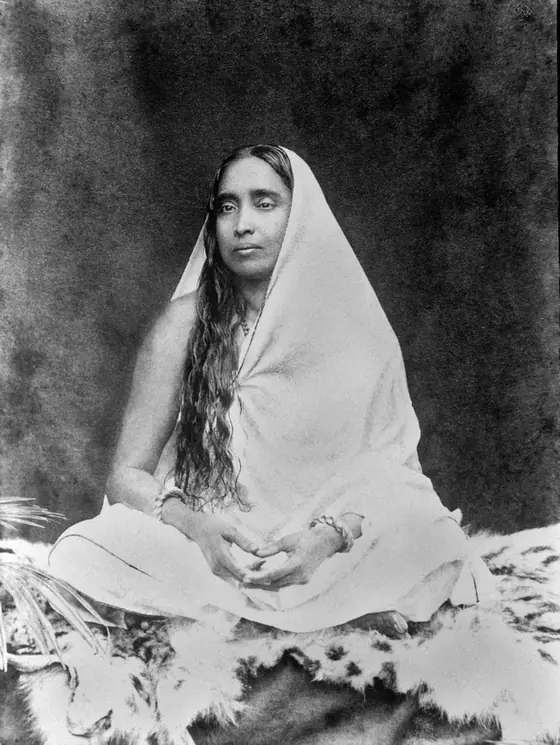
The portrait on this page is one of the photographs of her taken in Calcutta in her later years, of which several survive; it comes from the Ramakrishna Order’s archives, is published under a free licence, and is credited on the picture credits page. It is a photograph, not a painting or a generated image. Dates and places follow Belur Math's own account of her life and the Order's biographies; where sources differ — her death is given as the night of 20 July or the small hours of 21 July 1920 — the Order's date has been used. The map is drawn on present-day coordinates, not from any historical source.
Read the originals
Belur Math’s own page carries her life and her sayings; the books are the Order’s. Nothing here links to a third-party encyclopaedia.
- Sri Sarada Devi — Belur Math’s account of her life, with her teachings
- The Gospel of the Holy Mother — her conversations, recorded by her disciples (Ramakrishna Math)
- Life and Message of the Holy Mother — Swami Ghanananda’s account
- Sri Sarada Devi, the Holy Mother — the Ramakrishna Math’s full biography
- Sri Sarada Math — the women’s monastic order founded in her name, 1954
- Belur Math — the Order she guided for thirty-four years
Every daily message names the teacher it came from. Read the messages, or see the whole line this teacher stands in: all fifty-one teachers.