Swami Chinmayananda
Founder of Chinmaya Mission
1916–1993 · The Sri Chinmaya Lineage
- When
- 8 May 1916 – 3 August 1993
- Born
- Ernakulam, Kerala
- Where the life was lived
- Born Balakrishna Menon at Ernakulam in Kerala; a journalist during the freedom movement; came to Swami Sivananda at Rishikesh in September 1947 and then to Swami Tapovan in the Himalaya; from 1951 taught across India and, for forty years, worldwide; his shrine is at Sidhbari in Himachal Pradesh beneath the Dhauladhar range.
- What is left of it
- Commentaries on the Bhagavad Gītā, the principal Upaniṣads and Vivekacūḍāmaṇi; The Holy Geeta; Kindle Life; Self-Unfoldment.
Began the public Jñāna Yajña in Pune in 1951, founded Chinmaya Mission on 8 August 1953 and its children's classes, and opened the Sandeepany school that has trained the teachers now running more than three hundred centres.
The India he was born into
He was born on 8 May 1916, in the second year of the First World War, in a country that was not yet a country. Ernakulam, where the family house stood, was the administrative seat of the princely state of Cochin — a small, prosperous, literate kingdom on the Malabar coast that governed itself under a British Resident, with its own Maharaja, its own courts and its own temple calendar. Gandhi had returned from South Africa sixteen months earlier and had not yet become the Mahatma of the newsreels. The Congress was a debating society of lawyers. Nobody in that house could have imagined that the boy would be jailed by the British as a young man, or that he would spend the last forty years of his life persuading a free India that it had forgotten its own scriptures.
Two things about that world matter for everything that followed. The first is the household. Kerala's Nair families were matrilineal: property, name and belonging ran through the mother's line, and a large joint household under a senior woman was the normal shape of a family. The Chinmaya Archives describe exactly this — a "joint matriarchal family" in Poothampalli House, in which a boy who lost his mother at five was simply absorbed by his aunt and raised as her own son. He grew up, in other words, inside an institution that already knew how to hold many people under one roof and one discipline, which is what he would spend his life building.
The second is the evening. The family kept the Kerala custom of gathering at dusk to light the lamp and chant, and he said later — in an interview the Archives date to December 1949, before he had taught a single public class — that this daily prayer had gone into him deeper than anything at school. The sound of Sanskrit recited by ordinary people at the end of an ordinary day was, for him, the native shape of religion. When he later filled halls with clerks and housewives chanting the Gītā, he was not inventing a method. He was scaling up a living room.
Where the life was lived
The map below places the life on present-day India. It begins in the far south-west and ends in the far north, under the Himalaya, with the working decades spread between the great cities of the plains and the west coast. Nothing on the map is decorative: each pin is a dated event from the record kept by his own Mission.
Pins are placed on present-day India; the numbers follow the order of the life. Drawn from map coordinates, not from an illustration.
- 1Ernakulam (Kochi) (Kerala) — born Balakrishna Menon, 8 May 1916
- 2Thrissur (Kerala) — school and St Thomas College
- 3Lucknow (Uttar Pradesh) — university, the National Herald, the freedom movement
- 4Rishikesh (Uttarakhand) — Swami Sivananda; sannyāsa on 25 February 1949
- 5Uttarkashi & Gangotri (Uttarakhand) — the years of study with Swami Tapovan Maharaj
- 6Pune (Maharashtra) — first Jñāna Yajña, 31 December 1951
- 7Chennai (Tamil Nadu) — Chinmaya Mission registered, 8 August 1953
- 8New Delhi (Delhi) — first Gītā Jñāna Yajña, September 1955
- 9Powai, Mumbai (Maharashtra) — Sandeepany Sadhanalaya, 9 January 1963
- 10Sidhbari (Himachal Pradesh) — Sandeepany Himalayas from 1979; his samādhi shrine, 1993
Two places are not on it because they are outside India: Piercy, in the redwood country of northern California, where Chinmaya Mission West ran what he called the "Sandeepany of the West" from 1979; and San Diego, where he died in Sharp Memorial Hospital on 3 August 1993 — after which his body was flown home and carried up the Kangra valley to Sidhbari.
A boy in Poothampalli House
His name was Balakrishna Menon, and everyone called him Balan. His father, Kuttan Menon, was a man of the law; his mother, Parukutty Amma, died when he was five. His aunt Kochu Narayani Amma brought him up, and her son Bhaskara Menon became something between an elder brother and a lifelong ally. There were two sisters, Padmini and Kanakam, and later, when his father remarried, four half-siblings. It was a full house, comfortably off, conventionally devout.
The schooling was the ordinary route of a bright Kerala boy of the time: Sri Rama Varma High School in Ernakulam for the first years; Vivekodayam Boys' High School in Thrissur for the later ones; then St Thomas College, also in Thrissur, for his first degree. Thrissur lies an hour north of Kochi today and was already the cultural capital of central Kerala — the town of the Vadakkunnathan temple and the great Pooram festival. Its churches and temples stand within a few streets of one another, and a boy educated there by a Christian college in a Hindu town learnt early that religions can share a pavement.
Nothing in the record suggests piety beyond the ordinary. What the record does suggest is a sharp tongue and a sharper pen. He read widely in English literature, argued, wrote, and was — by the account his own Mission gives with some relish — a sceptic. That is the man the story needs. A saint who was always a saint teaches nobody anything about how to begin.
Lucknow: the reporter
He went north to Lucknow University, the great university of the United Provinces, and enrolled for a double degree — a Master of Arts in English literature and a law degree, the LLB. The Archives record that he completed the M.A. It was the late 1930s. Lucknow was a political city, and the newspaper that mattered there was the National Herald, founded in 1938 with Jawaharlal Nehru behind it, and edited by K. Rama Rao. Under Rama Rao the young Menon trained as a journalist, wrote a run of articles on whatever came to hand, and then went freelance — the hardest way to learn the trade and the surest way to develop a nose for humbug.
The freedom movement took him, as it took most of his generation of students. The Mission's account is brief and does not fix the dates: he was drawn in at Lucknow, became active, was arrested, and spent some months in prison. He fell seriously ill there — the family tradition says typhus — and was let out to recover or die. He recovered, slowly, over nearly six months at Baroda (now Vadodara, in Gujarat) in the house of his cousin Achyuta Menon. It is the first of several times in this life when the body nearly ended the story early, and the first time he learnt what he later taught: that a man who has been very ill and got up again is not easily frightened.
The reporter went back to work. And the reporter — this is the point of the next chapter — was still a reporter when he took the train to the mountains.
The assignment that turned
In 1947, in the months around Partition, with the country coming apart along its railway lines, he went to Rishikesh. The assignment, on his own later telling, was an exposé. The Mission's introduction to his life is candid about it: he planned "even more fiery exposés" and had "abandoned all that, for none of them explained to him the purpose of his birth." He meant to find out what the swamis on the Ganga were really doing with the money and the credulity of the pious, and to write it up.
What he found at the Divine Life Society was Swami Sivananda — a doctor from Tamil country who had practised medicine in Malaya, renounced it, and since 1936 had been running on the riverbank an ashram that gave away its books, fed whoever arrived and asked nothing. Swami Sivananda did not argue with the reporter. He put him to work. The Archives call this visit, simply, "the turning point of his life", and are careful not to dress it up. Menon stayed, left, came back, and was still coming back two years later. On Śivarātri, 25 February 1949, Swami Sivananda initiated him into sannyāsa and gave him the name by which the world knows him: Chinmayananda — the bliss of pure consciousness.
Then Swami Sivananda did the thing that made the rest possible. He sent him away. A monastery can teach devotion and service; it cannot, in the middle of feeding two hundred pilgrims a day, teach a man the Upaniṣads line by line. For that there was one teacher in the Himalaya whom everyone acknowledged and almost no one could bear to study under. Swami Sivananda told the new sannyāsī to go up the river to Uttarkashi and ask Swami Tapovan to take him.
Uttarkashi: the hardest school in India
Uttarkashi sits on the Bhagirathi, the headwater of the Ganga, at about 1,150 metres, three days' hard walking above Rishikesh in those years; Gangotri, the temple at the river's source, lies another hundred kilometres up and a further two thousand metres higher. Today both are in Uttarakhand, reached by road in a day. Then there was no road worth the name. Swami Tapovan Maharaj — born in 1889 at Mudappallur in Kerala, largely self-taught in Sanskrit, the author of the classic Malayalam travelogue of the mountains, Himagiri Vihāram — lived in Uttarkashi in a bare room, moved up to Gangotri each summer when the snows allowed, owned nothing, accepted no institution around himself, and taught only those who would stay and suffer the cold.
Swami Chinmayananda stayed. The Archives describe "intense study and extreme austerity", the move to Gangotri "during the summer months", and the reaching of "the pinnacle of the study of the Upaniṣads" at the source of the river. The method was the old one: the text, a sentence at a time, in Sanskrit, with Sri Śaṅkara's commentary, until the student could not only recite it but defend it. Swami Tapovan taught in the monastic manner, which is to say by not repeating himself. A disciple who had not prepared was not scolded; he was simply not taught that day.
Years later Swami Chinmayananda wrote of his teacher a sentence the Archives preserve and which tells you what he thought the real thing looked like: "A God without temple, a Veda without language, was this master mind and he lived for 68 years; a monumental expression of an ideal Vedantic teacher." A God without a temple: no building, no organisation, no followers to speak of. A Veda without language: the whole tradition present in one silent man. It is worth holding that sentence against the three hundred centres that Swami Chinmayananda himself would go on to build. He knew precisely what he was trading, and he decided the trade was worth it, because Swami Tapovan could teach ten and the country needed ten million.
The break came in 1951. He asked his teacher's permission to go down and see for himself what the people of India knew of their own scriptures. Permission was given. From May to October of that year he travelled the length of the country — the Archives call it his All-India Tour — and came back with a diagnosis: educated India had abandoned the Upaniṣads not because it had examined and rejected them, but because nobody had ever put them in front of it in a language it could read. The scriptures were locked in Sanskrit and guarded by a priesthood that had stopped explaining. He went back up to Uttarkashi and drew up what the Archives call the Gangotri Plan: to go from city to city and teach the Upaniṣads in English, in public, to anyone who came.
Four annas and eighteen listeners
He arrived at Poona railway station on 23 December 1951, with, the Archives say, four annas in his pocket — a quarter of a rupee. India's first general election was under way that winter; the country was arguing about everything, and the last thing on any newspaper's mind was the Kena Upaniṣad. He gave his first talk that evening. The exhibit kept by Chinmaya Mission Mumbai records the venue: a satsang in Smt Sushila Mudaliar's garden, with six listeners besides the host. Swamiji, the exhibit says, was delighted.
The yajña proper opened on 31 December 1951 at the Ganesha temple of the Hari Hara Bhajana Samajam in Rasta Peth, an old quarter of Pune, and ran for a hundred days, to 8 April 1952. The texts were the Kena and Kaṭha Upaniṣads. Eighteen people came on the first night. He lived in the Madras Dharamshala, a pilgrims' lodging, and dyed with his own hands the cloth that devotees gave him, because a swami is expected to wear ochre and he had no money to buy any. A saffron flag with Om on it was hoisted at the temple — the first of thousands. By the end the crowd was over a thousand. The Archives describe the impression he made on a city where nobody knew him: "impeccable English", "a unique head-dress", and "missionary zeal".
Two habits from that first winter shaped everything after. He called the lecture series a Jñāna Yajña — a sacrifice of knowledge, borrowing the Gītā's own phrase — and gave it the full ritual frame: a fire ceremony each morning, bhajans, unbroken chanting, and then, at the centre of it, an hour of plain English exposition of a Sanskrit text. This was deliberate and it was shrewd. The orthodox could hardly object to a yajña; the modern could hardly object to a lecture; and both came. And he had every talk taken down in shorthand, corrected the notes himself, and had them printed and in the hands of the audience within twenty-four hours as booklets called Yajña Prasād. The first copy of the first booklet he posted up the mountain to Uttarkashi, with a line on it for his teacher: "Thy knowledge broadcast through thy own voice-box."
Ask why this worked when a century of Sanskrit scholarship had not, and the answer is the man's earlier trade. He was a reporter. He knew that a message is only delivered when it is received, that a hall is filled by word of mouth in the first three days or not at all, that a booklet in the hand beats a sermon in the memory, and that people will forgive anything in a speaker except boredom. He was funny. He was fast. He used the blackboard. He took questions. He treated the Upaniṣads as news.
"Don't start any organisation in my name"
From Pune he went to Madras (now Chennai) for the second yajña, on the Muṇḍaka Upaniṣad, and then to Delhi for the Māṇḍūkya — the shortest and most difficult of the principal Upaniṣads, taught to a general public in a school hall, which nobody had attempted before. After Madras the first structured study group formed: people who wanted to go on meeting after the swami had left. By June 1953, with several such groups in several cities, the Madras devotees asked him for an umbrella body to hold them together.
His answer is preserved verbatim by the Archives, and it is the most important thing to know about the institution that now bears his name: "Don't start any organisation in my name. I have not come here to be institutionalised. I have come here to give the message of our ancient sages, which has benefited me. If it has benefited you also, pass it on." They persisted, and they found a way round him — the name, they argued, would not honour a man but a meaning: chinmaya, "made of pure consciousness", the truth they were all seeking. On 8 August 1953 Chinmaya Mission was registered in Madras. He accepted it as one accepts weather.
The yajñas kept coming, and they changed shape. The first had run a hundred days; the format shrank to a fortnight, then ten days, then a week, as he learnt what a working city could sustain. From 1955 he began teaching the Bhagavad Gītā as well as the Upaniṣads — the first Gītā Jñāna Yajña was held at the Modern School on Barakhamba Road in New Delhi from 18 September to 26 October 1955 — and settled into the pattern that lasted forty years: the Gītā in the evening for everyone, an Upaniṣad in the morning for the serious. The demand for the printed talks outgrew the post: by September 1955 more than thirty-five thousand people had asked to be mailed the booklets, and on 1 September that year he launched a fortnightly, Tyagi, to carry them. His twenty-fifth yajña was in Hyderabad in December 1956.
That same month he climbed to Uttarkashi for the last time to see Swami Tapovan, who was dying. The Archives record one sentence from the teacher at that meeting: "Death is born with us when we are born." Swami Tapovan Maharaj left the body at half past four in the morning on 16 January 1957, the full-moon day. His disciple, who had by then addressed more people about the Upaniṣads than any Indian in history, went back down and continued.
A school that makes teachers
The arithmetic of one man in a hall was never going to reach the country, and he knew it from 1957, when — the Archives record — he began looking for land for a gurukula: a residential academy that would take in young people, teach them Sanskrit and the full Advaita syllabus for two years, and send them out to run study groups and yajñas of their own. The land came from a devotee, Smt Tara Sarup, on the shore of Powai Lake at the then-remote north-eastern edge of Bombay; it was registered on 19 January 1960. Sandeepany Sadhanalaya — named after Sandīpani, the sage who was Kṛṣṇa's own teacher — was inaugurated on 9 January 1963, Tapovan Day, with its first batch of thirty students, in the grim winter after the Indo-China war. He wrote for the occasion: "This Sadhanalaya stands for the revival of our glorious culture, a culture that will run as a golden chord, binding us all as one people of divine nobility and spiritual brotherhood."
Six months later, on 14 July 1963, Swami Sivananda died at Rishikesh. Swami Chinmayananda's response was to take a vow of a year's austerities — a tapovrata — while continuing to teach. Both his teachers were now gone, and the institution had to carry what they had carried in person. In June 1964 the Central Chinmaya Mission Trust was set up to govern the whole. Two months later, at Sandeepany over the Janmāṣṭamī weekend of 29–30 August 1964, sixty delegates from the branches of Hinduism met to plan a body that would become the Vishva Hindu Parishad; he served as its first acting president, on the understanding — recorded at the time — that it was to be a spiritual and cultural forum with no political affiliation. The organisation later took a direction he did not live to see, and this site records the fact without adjudicating it.
The rest of the structure grew from the ground up. Children's sections in the early centres, from the late 1950s, became Bala Vihar — the Sunday-morning classes in which two generations of Indian children on four continents have now learnt their first Sanskrit verse. A youth camp during a Gītā yajña in May 1975 became Chinmaya Yuva Kendra. The first Chinmaya Vidyalaya school opened at Kollengode in Kerala, on land given by the Queen of Vengunad; there are now dozens. A primary health-care centre begun at Sidhbari on 10 April 1985 became CORD, the Mission's rural-development arm, explained in his own words: "The people of the Himalayas, especially women, have selflessly served the wandering sadhus. This will be our repayment of debt to them." The Chinmaya International Foundation, registered at Kochi on 25 April 1989 for Sanskrit research, was to be "a life-giving bridge between science and spirituality". And Sandeepany itself multiplied: a Hindi-medium course at Sidhbari from April 1981, a Telugu one planned at Chinmayaranyam in Andhra Pradesh from 1982, and the English one at Powai turning out a new batch of teachers every two and a half years to this day.
Twenty-seven journeys round the world
On 7 March 1965 he left India on his first world tour: under four months, three continents, thirty-nine cities, ending on 24 June. He was forty-eight, and he did it twenty-six more times. The diaspora that had begun to form in Britain, East Africa, the United States and Australia in those decades was, for the most part, technically Hindu and practically ignorant — engineers and doctors who could recite nothing and explain less, raising children who asked them why. He gave them the Gītā in the English they worked in, and then he gave them Bala Vihar so that their children would not have to ask. In 1966 he launched a postal course in Vedānta for people no yajña would ever reach. Chinmaya Mission West was incorporated in the San Francisco Bay Area in August 1975. In November 1979 the first two-year Vedānta course outside India opened at Krishnalaya in Piercy, California, with about forty-two students.
The body kept trying to stop him. He had his first heart attack in Mysore on 21 March 1970, at fifty-three; the Archives note that "the heart problem" was known from that year, and that when rest was unavoidable he went to Uttarkashi, and wrote books there. In 1980, in the United States, more than eighty per cent blockage was found in his four main arteries and he was flown to St Luke's in the Texas Medical Center at Houston, where Dr Denton Cooley — the surgeon who had performed the first artificial-heart implant — operated on him. He was back on tour within the year. To a devotee anxious about tomorrow he said, in a line the Archives keep: "What happens by evening, we do not know, and you worry about the future?"
The Gītā yajñas passed five hundred. For the five-hundredth he ran a national children's chanting competition — ten thousand entries, two winners, a girl from Nagpur and a girl from Delhi. The Archives' careful phrase is that he conducted "more than 500" jñāna yajñas in India and abroad; the Mission's own literature commonly gives the total as five hundred and seventy-six. Either way it is the largest sustained public teaching of a Sanskrit text by a single person of which any record exists.
Beyond India: the journeys, mapped
The map of India above ends at the coast, and a good part of the last three decades happened beyond it. What follows marks the places outside India that the Mission's own records name and date: the Bay Area where Chinmaya Mission West was incorporated, the redwood retreat at Piercy that he called the Sandeepany of the West, the Houston hospital of 1980, the Pennsylvania ashram he opened in 1992, and the four American stops of the last month of his life.
Only the places the Mission's own records name are marked. The twenty-seven world tours between 1965 and 1993 touched Britain, East Africa, the United States and Australia, but the Archives' timeline lists their cities only in aggregate — "three continents, thirty-nine cities" for the first, which left Mumbai on 7 March 1965 — so they are not drawn. The dotted line is the last journey of July 1993: Chicago, the camp at Piercy, the final yajña in Virginia, and San Diego. Coastlines only; no borders.
- 1Piercy — Krishnalaya, in the redwood country of northern California: the first two-year Vedānta course outside India opened 7 November 1979; the "Sandeepany of the West"; his last camp, July 1993
- 2San Francisco Bay Area — Chinmaya Mission West incorporated here, August 1975
- 3San Diego — Sharp Memorial Hospital: he left the body here on 3 August 1993; it was flown home to India on 7 August and interred at Sidhbari on 9 August
- 4Houston — 1980: quadruple-artery surgery at St Luke's in the Texas Medical Center, under Dr Denton Cooley
- 5Chicago — July 1993: the scheduled yajña, kept
- 6Massanetta Springs — Virginia, outside Washington: the last Gītā Jñāna Yajña, chapter seventeen, 19–25 July 1993
- 7Chinmaya Kedar — the Philadelphia Mission's ashram in Pennsylvania — the last centre he opened in person, 30 November 1992
- 8Trinidad — a Chinmaya Vidyalaya school in the Caribbean, recorded in the Mission's timeline of his work
Sources: the Chinmaya Mission Archives' timeline, Chinmaya Mission Philadelphia's own account of Chinmaya Kedar and Chinmaya Mission West's record of its consecration on 30 November 1992.
Sidhbari
He needed, at the end, to be in the mountains again, and he chose the western Himalaya rather than the Ganga gorge. Sidhbari is a village in the Kangra valley of Himachal Pradesh, a few kilometres below Dharamsala, on a shelf of land facing north across fields to the Dhauladhar range — a wall of rock and snow that rises four thousand metres straight out of the valley floor. In 1979 he established Sandeepany Himalayas there, as, the Mission says, "a tribute to his guru, Swami Tapovan, and to the sacred Himalayas". The first Hindi-medium Vedānta course began on 25 April 1981. On 10 October 1982 a Hanumān of black granite, carved by Sri Kashinath of Shimoga and standing kneeling under the open sky on a high pedestal, was consecrated — Vīra Hanumān, the hero, facing the mountains. The following October he presided over the installation of Rāma and Sītā as forest-dwellers, vanavāsī, in the new temple, and on 21 October 1983, in the same place, gave sannyāsa to the young man who would succeed him, Brahmachari Vivek Chaitanya, as Swami Tejomayananda.
Sidhbari became, the Mission says simply, "his home". The rural-health work began there. He kept a small kutir with a rose garden behind it. It is where he asked to be brought.
What he actually taught
Strip away the institutions and the sheer quantity of it, and the teaching is Sri Śaṅkara's Advaita, exactly as Swami Tapovan gave it to him, delivered in a form that a person with a job and a family and no Sanskrit could use on Monday morning. He did not simplify the doctrine. He simplified the access. Five things stand out.
The Upaniṣads first, and in public. "Hinduism in its whole vigour and power is in the Upaniṣads," he said at the first yajña, and he broke with a thousand years of practice by teaching them to open halls. The Upaniṣads had been treated as the innermost room of the tradition, reserved for the qualified and the initiated. He held that the qualification was wanting to know, and that the danger was not that unqualified people would misunderstand them but that qualified people had stopped reading them. The other line from those years is the one his Mission still quotes with a smile: "My mission is to convert Hindus to Hinduism."
The Gītā as a manual, not a scripture. He taught it as what it is: a conversation between a man who has lost his nerve at the decisive moment of his life and a friend who talks him back to his feet. "The Lord's Divine Song was not a prescription for one Arjuna of the Mahābhārata days. It is for all times, to all of us — Arjuna is a sample young man of the world." Every chapter, on his reading, answers a question a real person actually has: why should I act at all, how do I act without being destroyed by the results, what is this mind, what do I do with fear. The metaphysics comes in exactly where the practical question needs it, and not before.
A chart you can draw on a napkin. To make the whole of Vedānta hold together for a beginner he devised the BMI chart, which the Mission still teaches from and has built as an exhibit in Mumbai. You have three instruments — Body, Mind, Intellect. Through them you function as three things — the Perceiver, the Feeler, the Thinker. And those three are always turned outward on three fields — Objects, Emotions, Thoughts. Underneath the whole apparatus sit your vāsanās, the inherited tendencies that decide what you reach for, and above it stands Om — the consciousness that lights the lot and is what you actually are. Every experience you have ever had fits somewhere in that diagram. And the entire teaching is one instruction: stop identifying with the instruments and their fields, and recognise the light. Children learn the chart in Bala Vihar. It is Sri Śaṅkara's dṛg-dṛśya-viveka — the discrimination of seer from seen — in nine letters.
Work as the way in. He did not tell Indians to renounce. He told them to work harder and want less — to act with total attention and to hand the result over. He called this, in a phrase that made engineers sit up, "efficiency in action", and he insisted that the karma-yoga of the Gītā's third chapter was not a lesser path for the unintelligent but the only door most people would ever fit through. A mind that has learnt to act without grasping is a mind that can, eventually, sit still and ask what it is.
Religion is not belief. He argued, on every continent, that Vedānta is not a faith to be adopted but a science of the subject — a set of observations about the one who is observing — and that its claims are to be tested in one's own experience, not swallowed. This is the tradition's own position; the Mission's own summary of him is that his goal was "to reach the knowledge and wisdom of the ancient Hindu scriptures to the common person in everyday life". Nothing in it asks you to take his word for anything.
The sayings, and what they were for
He was quotable, and he knew it, and he used it. A one-line saying survives a lecture in the way a booklet survives a hall. The ones below are kept in the Chinmaya Archives with their occasions, which is why they are the ones this site uses.
- "Don't start any organisation in my name. I have not come here to be institutionalised." — Madras, June 1953, on being asked to found what became Chinmaya Mission. The sentence is a standing instruction to the institution about what it is for.
- "Thy knowledge broadcast through thy own voice-box." — the note sent to Swami Tapovan with the first printed talk, 1952. Everything he ever said, he held, was his teacher's; the voice-box was the only part that was his.
- "Hinduism in its whole vigour and power is in the Upaniṣads." — Pune, December 1951. The founding claim of the whole enterprise: go to the source, not the customs.
- "Arjuna is a sample young man of the world." — on why the Gītā is to be taught to everyone. If Arjuna is a hero from an epic, the book is literature. If he is you, the book is instructions.
- "What happens by evening, we do not know, and you worry about the future?" — to an anxious devotee, late in life. The teaching on anxiety in one sentence: you already live without the certainty you are demanding.
- "A God without temple, a Veda without language." — of Swami Tapovan Maharaj. His own definition of the real thing, written by the man who built the temples.
- "This will be our repayment of debt to them." — Sidhbari, 1985, founding the rural health work. Vedānta that does not turn into service, he held, has not been understood.
The books, and how to read them
On 8 March 1961 in Madras he launched the Chinmaya Publication Trust and handed it, the Archives say, about fifty-nine books he had already written; the Mission's count of his publications today runs to over ninety. Almost all of them began as talks taken down in shorthand and corrected by him, which is why they read as they do — direct, digressive, argued with the listener rather than at him. The ones that matter, and the order in which the Mission itself recommends them, are these.
- Kindle Life — the deliberate first book: what Vedānta is, why the mind behaves as it does, what a seeker is trying to do. Written to be read before any scripture.
- Self-Unfoldment (also published as A Manual of Self-Unfoldment) — the second step, a structured account of the whole Vedāntic map of the person, built around the BMI chart. This is where the Mission's own two-year course begins.
- The Holy Geeta — his life's work: the eighteen chapters with every verse in Sanskrit, transliterated, translated and then commented on at length in the voice of the yajñas. It is the most widely read English Gītā commentary written by an Indian teacher of the tradition, and the commentary on the second and third chapters alone is a complete course in Advaita.
- The nine Upaniṣads — Īśāvāsya, Kena, Kaṭha, Praśna, Muṇḍaka, Māṇḍūkya (with Sri Gauḍapāda's Kārikā), Taittirīya, Aitareya and Kaivalya, each with text, word-by-word meaning and commentary. Read the Kena first: it is where he began in Pune, and it asks the question — by whom is the mind moved? — that the whole tradition is an answer to.
- Vivekacūḍāmaṇi, Ātma Bodha and Bhaja Govindam — Sri Śaṅkara's own teaching manuals, with his commentary; the Mission's syllabus reads them between the Gītā and the Upaniṣads.
- Meditation and Life, The Art of Man-Making, and the small books on the mind — the practical side, for readers who want to know what to actually do in the mornings.
Every one of these is in print from the Mission's own publishing arm, Chinmaya Prakashan, and available worldwide through its shop; the links below go there and to the Archives, not to any third party. If you are new to all of it, the Mission's advice is the right one: Kindle Life, then Self-Unfoldment, then the Gītā from chapter two — and a study group, because he did not believe anyone learns this alone.
The last yajña
By the early 1990s the heart was failing openly, and the doctors who examined him — the Archives note — could not reconcile the readings with the energy of the man on the platform. In 1992 Hinduism Today gave him its Hindu Renaissance Award; on 30 November that year he opened Chinmaya Kedar in Pennsylvania, the last centre he inaugurated in person. In July 1993 he flew to Chicago as scheduled and conducted a yajña there, then a camp at Krishnalaya in Piercy, then travelled east.
The final Gītā Jñāna Yajña was held from 19 to 25 July 1993 at Massanetta Springs in Virginia, outside Washington. The text was the seventeenth chapter, which the Mission calls "The Yoga of Threefold Faith" — the chapter on what a person's faith is made of, and how to tell the three kinds apart. His last lecture was on verses 25 to 28, which end the chapter with the word Om tat sat and the statement that an act done without faith is nothing, here or hereafter. He fell ill in Washington, flew west towards Los Angeles, was taken to Sharp Memorial Hospital in San Diego, and died there on 3 August 1993, forty-two years and seven months after stepping off the train in Pune with four annas.
The body came home on 7 August and was carried up to Sidhbari, where on 9 August 1993 it was interred in the earth — bhū-samādhi, the burial the tradition gives a knower rather than the cremation it gives everyone else — in the rose garden behind his kutir, facing the Dhauladhar. A shrine in the Kerala style now stands over it, with a seated image of him in eight metals. On 22 August the Trust unanimously made Swami Tejomayananda head of the Mission worldwide. Asked what it was like to be in Gurudev's shoes, Swami Tejomayananda gave the answer the Archives preserve: "I am not in his shoes; I am at his feet."
The timeline, plainly
- 8 May 1916 — born Balakrishna Menon at Ernakulam, Cochin State (now Kochi, Kerala).
- c. 1921 — mother Parukutty Amma dies; raised by his aunt Kochu Narayani Amma in Poothampalli House.
- 1920s–30s — Sri Rama Varma High School, Ernakulam; Vivekodayam High School and St Thomas College, Thrissur.
- Late 1930s–40s — Lucknow University (M.A., LLB); trains under K. Rama Rao at the National Herald; freelance journalist; joins the freedom movement; arrested and jailed for some months; falls gravely ill; six months' recovery at Baroda.
- 1947 — goes to Rishikesh to write about the swamis; meets Swami Sivananda.
- 25 February 1949 — sannyāsa from Swami Sivananda on Śivarātri; named Chinmayananda. Sent to Swami Tapovan Maharaj at Uttarkashi.
- 1949–51 — study of the Upaniṣads with Swami Tapovan Maharaj at Uttarkashi and Gangotri.
- May–October 1951 — All-India Tour, with his teacher's permission; the Gangotri Plan.
- 23 December 1951 — arrives in Pune with four annas; first talk that evening to six people.
- 31 December 1951 – 8 April 1952 — first Jñāna Yajña, Ganesha temple, Rasta Peth, Pune: Kena and Kaṭha Upaniṣads; 18 listeners grow to over a thousand. Yajña Prasād booklets begin.
- 1952–53 — yajñas at Madras (Muṇḍaka) and Delhi (Māṇḍūkya); first study group.
- 8 August 1953 — Chinmaya Mission registered, Madras, over his objection.
- 18 September – 26 October 1955 — first Gītā Jñāna Yajña, Modern School, New Delhi. Tyagi launched 1 September 1955.
- December 1956 — 25th yajña, Hyderabad; last meeting with Swami Tapovan Maharaj, who dies 16 January 1957.
- 15 March 1958 — Usha, the Mission's first monthly. Bala Vihar grows from the children's sections.
- 8 March 1961 — Chinmaya Publication Trust founded; about 59 books handed over.
- 1 February – 2 March 1962 — 100th yajña, Madras. Tapovan Prasad journal, 30 December 1962.
- 9 January 1963 — Sandeepany Sadhanalaya inaugurated at Powai, Bombay; first batch of 30.
- 14 July 1963 — Swami Sivananda dies; a year's tapovrata.
- 27 June 1964 — Central Chinmaya Mission Trust. 29–30 August 1964: Vishva Hindu Parishad planned at Sandeepany; first acting president.
- 7 March – 24 June 1965 — first world tour: 3 continents, 39 cities. Twenty-six more follow.
- 1966 — postal course in Vedānta. 10 November 1968 — Jagadīśvara temple, Powai. November 1969 — Balvihar magazine.
- 21 March 1970 — first heart attack, Mysore.
- May 1975 — Chinmaya Yuva Kendra. August 1975 — Chinmaya Mission West incorporated.
- March 1978 — Deenabandhu temple, Bangalore. 1979 — Sandeepany Himalayas founded at Sidhbari; 7 November 1979 — first overseas Vedānta course, Piercy, California.
- 1980 — quadruple-artery blockage; surgery under Dr Denton Cooley, Houston.
- 25 April 1981 — first Hindi Vedānta course, Sidhbari. 10 October 1982 — Hanumān consecrated. 21–22 October 1983 — Rāma-Sītā temple; Swami Tejomayananda initiated.
- 10 April 1985 — rural health centre at Sidhbari, later CORD. 25 April 1989 — Chinmaya International Foundation, Kochi.
- 1992 — Hindu Renaissance Award. 30 November 1992 — Chinmaya Kedar, Pennsylvania, the last centre he opened.
- 19–25 July 1993 — final Gītā yajña, Massanetta Springs, Virginia: chapter 17.
- 3 August 1993 — dies at Sharp Memorial Hospital, San Diego. 9 August 1993 — bhū-samādhi at Sidhbari.
For the seeker now
Three things in this life are directly usable by anyone reading this page, whatever their circumstances.
The first is the shape of the beginning. He did not start as a believer. He started as a professional doubter who went to look, and the tradition's own instruction — do not take our word, come and see — met him exactly where he stood. If you are reading about Advaita with your arms folded, you are in the right posture. Keep them folded and keep reading. The only thing the teaching asks is that you actually look at what it points to, which is your own experience of being the one who knows.
The second is the diagram. Body, mind, intellect; perceiver, feeler, thinker; objects, emotions, thoughts; and the one who is aware of all nine. Draw it. Then, the next time you are frightened or furious or bored, locate the event on the chart. It is always in the middle rows. You are never in the middle rows. That is not a doctrine to accept; it is an observation to make, and it can be made in a traffic jam.
The third is his answer to the question every householder asks, which is when. He took a country of people who believed that Vedānta was for the retired and the renounced, and told them that the Gītā was spoken on a battlefield to a man with a job to do, and that the method was to do the job with everything you had and to let go of the result. He said it to clerks in Pune in 1951 and to surgeons in Houston in 1980, and the daily messages on this site say it to you. Efficiency in action; hand over the outcome; and in the quiet that follows, ask who is watching.
A note on the pictures
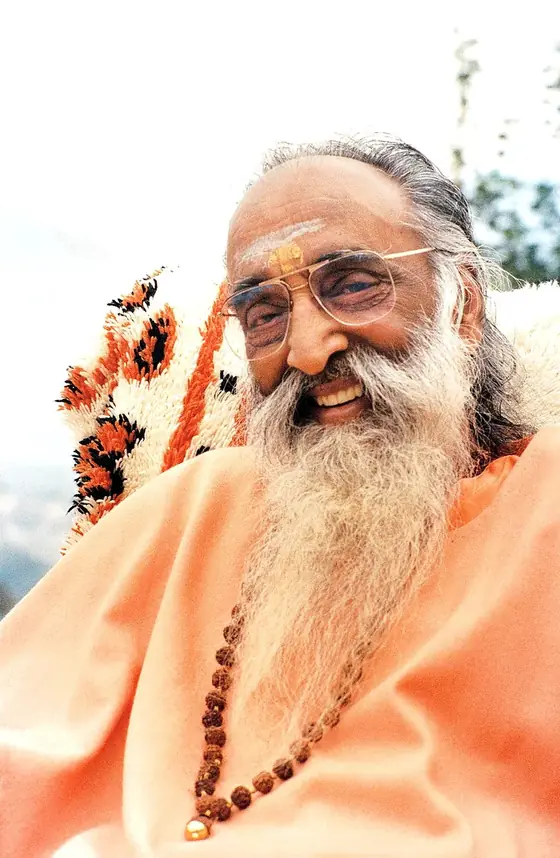
The portrait at the head of this page is a licensed photograph; the credits page says where it came from. This site does not manufacture images of real people or real places, and it will not paint you a Rishikesh of 1947 or a Pune temple of 1951 and call it a photograph. The real pictures exist, and they are better than anything invented: the Chinmaya Archives hold photographs from every decade of the life — the young sannyāsī at Uttarkashi, the first yajñas, the world tours, Sidhbari — together with his letters and manuscripts, and they are open to everyone at the links below. Go and look at the actual man.
Read the originals
Primary texts and the records kept by the teacher's own institution. Every link goes to the Mission, its archive or its publishers.
- The Chinmaya Archives: his life, letters and photographs
- The Mission's dated timeline of the life and the work
- The first Jñāna Yajña, Pune, 1951–52
- The Holy Geeta — his complete commentary on the Bhagavad Gītā
- The nine Upaniṣad commentaries
- Kindle Life — the book he wrote to be read first
- All his published works, from the Mission's publishers
- The BMI chart, explained by the Mission
- Sidhbari — Sandeepany Himalayas and the samādhi shrine
- Chinmaya Mission, which he founded
Every daily message names the teacher it came from. Read the messages, or see the whole line this teacher stands in: all fifty-one teachers.