Skip to content
In the background, with respect

Other schools of Vedānta, and beyond

The teachers who read the same texts and concluded differently — Sri Rāmānuja, Sri Madhva, Sri Nimbārka, Sri Vallabha, Sri Chaitanya — and the Śaiva, Vīraśaiva and classical systems that stand beside Vedānta: each explained in one breath, compared with Advaita, and introduced through its own teachers, places and books.

Eleven traditions · 71 teachers, 26 with pictures · every institution and text linked to its own pages · pick one school or read them all

This site keeps Advaita in the foreground. It would be a poor kind of foreground that pretended nothing stood behind it. The same three sources — the Upaniṣads, the Bhagavad Gītā and the Brahma Sūtras — were read by other great teachers who came to different conclusions, argued them for centuries with the Advaitins, and built living traditions that are worshipped in today by many more people than read this page. Beyond Vedānta altogether stand the Śaiva systems of Kashmir and the Tamil country, the Vīraśaiva movement of Karnataka, and the six classical schools from which all of Indian philosophy takes its vocabulary. This page is a map of that ground: who the teachers were, where and when they were born, where they travelled, what they built, and what each of them held. It is written with respect, by people who hold a different view, and it links to each tradition's own institutions and texts rather than to anyone's summary of them.

One set of texts, many readings

Every school of Vedānta starts from the same "triple foundation" (prasthāna-traya): the Upaniṣads, the Gītā, and Bādarāyaṇa's Brahma Sūtras, 555 terse aphorisms that try to reconcile the Upaniṣads into one doctrine. The sūtras are so compressed that they cannot be read without a commentary, and the commentaries are where the schools part. Sri Śaṅkara's is the oldest surviving one. Sri Rāmānuja's, Sri Madhva's, Sri Nimbārka's, Sri Vallabha's, Sri Bhāskara's, Sri Śrīkaṇṭha's and Sri Baladeva's followed over the next thousand years, each written against its predecessors.

The question they divide over can be stated in a sentence. The Upaniṣads say both that Brahman is one without a second and that the world and the individual souls exist; how are the two statements to be held together? Advaita says the second statement describes an appearance: from the standpoint of truth there is only Brahman, and the soul is Brahman under a misapprehension it can be released from. Viśiṣṭādvaita says souls and world are real and are the body of Brahman, distinct from it as attributes are from their substance, and never dissolved into it. Dvaita says the difference is absolute and eternal. The Bhedābheda schools say difference and non-difference are both real, as waves are both the sea and not the sea. Each of these positions is worked out with immense care, and none of them is a careless reading. When this site says "the teaching", it means the Advaita teaching; it does not mean that the others are not teachings.

One more thing needs saying plainly. The Śaiva traditions of Kashmir and Tamil Nadu and the Vīraśaivas are not Vedānta at all in the strict sense — they rest on the Śaiva Āgamas and on Tamil and Kannada scripture as well as on the Vedas — and the six darśanas are older than any commentary on the Brahma Sūtras. They are here because a seeker who reads Advaita will meet them: in Sri Śaṅkara's arguments against Sāṅkhya and Mīmāṃsā, in Sri Ramaṇa Maharṣi's Tamil Śaiva surroundings at Aruṇācala, in Swami Vivekananda's use of Patañjali, and in the recognition-philosophy of Kashmir, which comes to conclusions so near Advaita's that the two are often confused.

How to use this page

  1. Pick a school from the bar below — it stays with you as you scroll — and the page shows only that school; choose “All schools” to see everything again.
  2. Each school opens with In one breath, a plain explanation anyone can follow, then the tradition’s own picture — the image its teachers themselves used.
  3. What it holds and Where it differs from Advaita put the two side by side, always followed by where they agree.
  4. Then come the teachers, with pictures where a free one exists, their dates, where they lived on today’s map, what they are known for and their body of work — every title linked to an edition you can read for nothing.
  5. Where, on today’s map and When place the school; Read the full account opens the longer essay for those who want the detail.
  6. At the end, Side by side compares every school with Advaita on twelve points, with a header that stays put while you scroll.
Side by side ↓

Eleven traditions follow. Pick one above to read it on its own, or scroll to read them in order.

Where these traditions were born

Almost all of the founders below were born in the south of the subcontinent and the west of it, and almost all of them travelled the whole of it. The map plots birthplaces and principal seats from present-day coordinates. It is drawn, not photographed, and nothing on it is invented.

Where the other schools were born and taught — an overviewKāṭṭumannārkōyil: Viśiṣṭādvaita: Sri Nāthamuni’s birthplace, then Vīranārāyaṇapuram; Srirangam: Viśiṣṭādvaita: The school’s capital: Sri Yāmuna, Sri Rāmānuja (died 1137), Sri Piḷḷai Lokācārya, Sri Vedānta Deśika, Sri Māmunigaḷ; Śrīperumbūdūr: Viśiṣṭādvaita: Sri Rāmānuja born, 1017; Kāñcīpuram & Tūppul: Viśiṣṭādvaita: Sri Rāmānuja studied here under Yādava Prakāśa; Sri Vedānta Deśika born at Tūppul, 1268; Madurāntakam: Viśiṣṭādvaita: Periya Nambi initiated Sri Rāmānuja under a tree, in the rain; Tirukkōṭṭiyūr: Viśiṣṭādvaita: The eighteen walks from Srirangam for the secret meaning of the mantra; Madurai & Tiruvādavūr: Viśiṣṭādvaita: Sri Yāmuna’s debate at the Pāṇḍya court; Sri Piḷḷai Lokācārya died at Jyotiṣkuḍi nearby, 1323; Śaiva Siddhānta: Sri Māṇikkavācakar’s birthplace; Sri Guru Jñānasambandar’s awakening at the Madurai temple; Melkote: Viśiṣṭādvaita: Tirunārāyaṇapuram: Sri Rāmānuja’s twelve years of exile; temple restored; Tirupati: Viśiṣṭādvaita: Temple administration organised by Sri Rāmānuja; Sri Vedānta Deśika lived here; Dvaita: Sri Vyāsatīrtha’s twelve years as temple priest, by the tradition; Āḻvār Tirunagari: Viśiṣṭādvaita: Sri Maṇavāḷa Māmunigaḷ born, 1370; Udupi & Pājaka: Dvaita: Sri Madhva born 1238 at Pājaka; Kṛṣṇa installed and eight maṭhas founded at Udupi; disappeared here 1317; Acintya-bhedābheda (Chaitanya): The debate with the Mādhvas, 1510–12; Kundāpura & Sode: Dvaita: Sri Vādirāja born at Hūvinakere near Kundāpura; his Sode Maṭha lies inland; Maṅgaḷavēḍhe: Dvaita: Sri Jayatīrtha born c. 1345; Malkhed: Dvaita: Sri Jayatīrtha’s tomb on the Kāgiṇī; Bannūr: Dvaita: Sri Vyāsatīrtha born 1460; Hampi (Vijayanagara): Dvaita: Vijayanagara: Sri Vyāsatīrtha at Kṛṣṇadevarāya’s court; Sri Purandara Dāsa; Sri Vyāsatīrtha’s tomb at Nava Bṛndāvana; Śuddhādvaita (Vallabha): The debate at Kṛṣṇadevarāya’s court and the golden bath; Bhuvanagiri: Dvaita: Sri Rāghavendra born 1595; Kumbakonam: Dvaita: Sri Rāghavendra trained here; Śrīmuṣṇam: Dvaita: Sri Madhva’s rainy-season retreat, recorded by the Uttarādi Maṭha; Mantrālayam: Dvaita: Sri Rāghavendra’s shrine, 1671; Badrinath: Dvaita: Sri Madhva’s two Himālayan journeys; the Gītā-bhāṣya followed the first; Vaidūryapaṭṭanam (Godāvarī): Dvaitādvaita (Nimbārka): Sri Nimbārka’s birthplace by the tradition’s account; Nimbagrāma & Govardhan: Dvaitādvaita (Nimbārka): Where Sri Nimbārka settled; Salemabad: Dvaitādvaita (Nimbārka): The Nimbārkācārya Pīṭha, established in the sixteenth century; Campāraṇya: Śuddhādvaita (Vallabha): Sri Vallabha born in the forest, 1479; Kāśī: Śuddhādvaita (Vallabha): Sri Vallabha educated here; entered the Ganga at Hanumān Ghāṭ, 1531; Gokul & Govardhan: Śuddhādvaita (Vallabha): Brahma-sambandha received at Gokul, 1493; Śrīnāthjī’s worship begun at Govardhan; Aḍel (Prayāg): Śuddhādvaita (Vallabha): Sri Vallabha’s later home; Nāthdwārā: Śuddhādvaita (Vallabha): Śrīnāthjī enshrined here since 1672; Navadvīpa & Māyāpur: Acintya-bhedābheda (Chaitanya): Sri Chaitanya born 1486; Sri Bhaktivinoda re-identified the birthplace; The six darśanas: Sri Raghunātha Śiromaṇi and the new logic; Katwa: Acintya-bhedābheda (Chaitanya): Sannyāsa from Keśava Bhāratī, January 1510; Gayā: Acintya-bhedābheda (Chaitanya): Initiation by Īśvara Purī, 1508; Purī: Acintya-bhedābheda (Chaitanya): The last eighteen years, in the Gambhīrā; disappeared 1534; Vṛndāvana: Acintya-bhedābheda (Chaitanya): Sri Chaitanya’s visit of 1515; the Six Gosvāmīs wrote here; Prayāg & Kāśī: Acintya-bhedābheda (Chaitanya): Months of teaching Rūpa and Sanātana on the way back from Vṛndāvana; Jaipur: Acintya-bhedābheda (Chaitanya): Sri Baladeva’s Govinda-bhāṣya, c. 1718; Calcutta: Acintya-bhedābheda (Chaitanya): Swami Prabhupāda born 1896; Gauḍīya Maṭha founded 1920; Aḍayapālam (Arani): Śivādvaita: Sri Appayya Dīkṣita born 1520; temple inscription of 1582; Vellore: Śivādvaita: Court of Cinna Bomma Nāyaka; Chidambaram: Śivādvaita: Sri Appayya died here, 1593; Śaiva Siddhānta: Tiruvācakam composed here; Sri Aghoraśiva and Sri Umāpati; the temple of the dancing Śiva; Srinagar & Harwan: Kashmir Śaivism: Sri Vasugupta’s rock at Harwan; Sri Abhinavagupta born c. 950; Swami Lakshmanjoo born 1907, ashram at Ishber; Bīrwā: Kashmir Śaivism: The cave Sri Abhinavagupta entered, c. 1016, by the tradition; Jālandhara: Kashmir Śaivism: Sri Abhinavagupta received the Kaula tradition from Śambhunātha; Tiruveṇṇainallūr: Śaiva Siddhānta: Sri Meykaṇḍār, 1232; Tiruvāvaḍuturai & Dharmapuram: Śaiva Siddhānta: The two ādīnams of the Cauvery delta, sixteenth century; Sri Tirumūlar; Tiruvannamalai: Śaiva Siddhānta: Aruṇācala, a Siddhānta temple where Sri Ramaṇa Maharṣi lived; Basavana Bāgēvāḍi: Vīraśaivism: Sri Basavaṇṇa born c. 1131; Kūḍalasaṅgama: Vīraśaivism: Where the Kṛṣṇā and Malaprabhā meet; Sri Basavaṇṇa studied here and became one with the liṅga, 1196; Basavakalyāṇ: Vīraśaivism: Kalyāṇa: the Anubhava Maṇṭapa; the marriage of 1167 and the collapse; Baḷḻigāve & Uḍutaḍi: Vīraśaivism: Sri Allama Prabhu and Akka Mahādēvi, Shimoga district; Śrīśailam: Vīraśaivism: Akka Mahādēvi’s union; Solapur: Vīraśaivism: Sri Siddharāma’s Sonnalige; Mithilā (Darbhanga): The six darśanas: Nyāya’s home: Sri Vācaspati, Sri Udayana, Sri Gaṅgeśa; Sringeri: The six darśanas: Sri Vidyāraṇya’s seatNew DelhiMumbaiBengaluruHyderabadKāṭṭumannārkōyilSrirangamŚrīperumbūdūrKāñcīpuram & TūppulMadurāntakamTirukkōṭṭiyūrMadurai & TiruvādavūrMelkoteTirupatiĀḻvār TirunagariUdupi & PājakaKundāpura & SodeMaṅgaḷavēḍheMalkhedBannūrHampi (Vijayanagara)BhuvanagiriKumbakonamŚrīmuṣṇamMantrālayamBadrinathVaidūryapaṭṭanam (Godāvarī)Nimbagrāma & GovardhanSalemabadCampāraṇyaKāśīGokul & GovardhanAḍel (Prayāg)NāthdwārāNavadvīpa & MāyāpurKatwaGayāPurīVṛndāvanaPrayāg & KāśīJaipurCalcuttaAḍayapālam (Arani)VelloreChidambaramSrinagar & HarwanBīrwāJālandharaTiruveṇṇainallūrTiruvāvaḍuturai & DharmapuramTiruvannamalaiBasavana BāgēvāḍiKūḍalasaṅgamaBasavakalyāṇBaḷḻigāve & UḍutaḍiŚrīśailamSolapurMithilā (Darbhanga)SringeriNew DelhiMumbai

Every place named on this page — 54 of them — on present-day coordinates, one dot per place and one colour per tradition. The names are in the five close-ups that follow, region by region, and each school below has its own closer map. The map is drawn, not photographed.

The same places, region by region

Filled dots are birthplaces, open dots are seats or resting places; the numbers match the list under each map. Where a name had to move away from its dot to stay clear of its neighbours, a thin line joins the two.

The Tamil country · 18 places

Śrīvaiṣṇava, Śaiva Siddhānta, Śivādvaita and Dvaita places between Tirupati and the far south

The Tamil country — 18 placesKāṭṭumannārkōyil: Viśiṣṭādvaita: Sri Nāthamuni’s birthplace, then Vīranārāyaṇapuram; Srirangam: Viśiṣṭādvaita: The school’s capital: Sri Yāmuna, Sri Rāmānuja (died 1137), Sri Piḷḷai Lokācārya, Sri Vedānta Deśika, Sri Māmunigaḷ; Śrīperumbūdūr: Viśiṣṭādvaita: Sri Rāmānuja born, 1017; Kāñcīpuram & Tūppul: Viśiṣṭādvaita: Sri Rāmānuja studied here under Yādava Prakāśa; Sri Vedānta Deśika born at Tūppul, 1268; Madurāntakam: Viśiṣṭādvaita: Periya Nambi initiated Sri Rāmānuja under a tree, in the rain; Tirukkōṭṭiyūr: Viśiṣṭādvaita: The eighteen walks from Srirangam for the secret meaning of the mantra; Madurai & Tiruvādavūr: Viśiṣṭādvaita: Sri Yāmuna’s debate at the Pāṇḍya court; Sri Piḷḷai Lokācārya died at Jyotiṣkuḍi nearby, 1323; Śaiva Siddhānta: Sri Māṇikkavācakar’s birthplace; Sri Guru Jñānasambandar’s awakening at the Madurai temple; Tirupati: Viśiṣṭādvaita: Temple administration organised by Sri Rāmānuja; Sri Vedānta Deśika lived here; Dvaita: Sri Vyāsatīrtha’s twelve years as temple priest, by the tradition; Āḻvār Tirunagari: Viśiṣṭādvaita: Sri Maṇavāḷa Māmunigaḷ born, 1370; Bhuvanagiri: Dvaita: Sri Rāghavendra born 1595; Kumbakonam: Dvaita: Sri Rāghavendra trained here; Śrīmuṣṇam: Dvaita: Sri Madhva’s rainy-season retreat, recorded by the Uttarādi Maṭha; Aḍayapālam (Arani): Śivādvaita: Sri Appayya Dīkṣita born 1520; temple inscription of 1582; Vellore: Śivādvaita: Court of Cinna Bomma Nāyaka; Chidambaram: Śivādvaita: Sri Appayya died here, 1593; Śaiva Siddhānta: Tiruvācakam composed here; Sri Aghoraśiva and Sri Umāpati; the temple of the dancing Śiva; Tiruveṇṇainallūr: Śaiva Siddhānta: Sri Meykaṇḍār, 1232; Tiruvāvaḍuturai & Dharmapuram: Śaiva Siddhānta: The two ādīnams of the Cauvery delta, sixteenth century; Sri Tirumūlar; Tiruvannamalai: Śaiva Siddhānta: Aruṇācala, a Siddhānta temple where Sri Ramaṇa Maharṣi lived123456789101112131415161718KāṭṭumannārkōyilSrirangamŚrīperumbūdūrKāñcīpuram & TūppulMadurāntakamTirukkōṭṭiyūrMadurai & TiruvādavūrTirupatiĀḻvār TirunagariBhuvanagiriKumbakonamŚrīmuṣṇamAḍayapālam (Arani)VelloreChidambaramTiruveṇṇainallūrTiruvāvaḍuturai & DharmapuramTiruvannamalaiKāṭṭumannārkōyilSrirangamŚrīperumbūdūrKāñcīpuram & TūppulMadurāntakamTirukkōṭṭiyūrMadurai & TiruvādavūrTirupatiĀḻvār TirunagariBhuvanagiriKumbakonamŚrīmuṣṇamAḍayapālam (Arani)VelloreChidambaramTiruveṇṇainallūrTiruvāvaḍuturai & DharmapuramTiruvannamalai
  1. 1Kāṭṭumannārkōyil (Tamil Nadu) — Viśiṣṭādvaita: Sri Nāthamuni’s birthplace, then Vīranārāyaṇapuram
  2. 2Srirangam (Tamil Nadu) — Viśiṣṭādvaita: The school’s capital: Sri Yāmuna, Sri Rāmānuja (died 1137), Sri Piḷḷai Lokācārya, Sri Vedānta Deśika, Sri Māmunigaḷ
  3. 3Śrīperumbūdūr (Tamil Nadu) — Viśiṣṭādvaita: Sri Rāmānuja born, 1017
  4. 4Kāñcīpuram & Tūppul (Tamil Nadu) — Viśiṣṭādvaita: Sri Rāmānuja studied here under Yādava Prakāśa; Sri Vedānta Deśika born at Tūppul, 1268
  5. 5Madurāntakam (Tamil Nadu) — Viśiṣṭādvaita: Periya Nambi initiated Sri Rāmānuja under a tree, in the rain
  6. 6Tirukkōṭṭiyūr (Tamil Nadu) — Viśiṣṭādvaita: The eighteen walks from Srirangam for the secret meaning of the mantra
  7. 7Madurai & Tiruvādavūr (Tamil Nadu) — Viśiṣṭādvaita: Sri Yāmuna’s debate at the Pāṇḍya court; Sri Piḷḷai Lokācārya died at Jyotiṣkuḍi nearby, 1323; Śaiva Siddhānta: Sri Māṇikkavācakar’s birthplace; Sri Guru Jñānasambandar’s awakening at the Madurai temple
  8. 8Tirupati (Andhra Pradesh) — Viśiṣṭādvaita: Temple administration organised by Sri Rāmānuja; Sri Vedānta Deśika lived here; Dvaita: Sri Vyāsatīrtha’s twelve years as temple priest, by the tradition
  9. 9Āḻvār Tirunagari (Tamil Nadu) — Viśiṣṭādvaita: Sri Maṇavāḷa Māmunigaḷ born, 1370
  10. 10Bhuvanagiri (Tamil Nadu) — Dvaita: Sri Rāghavendra born 1595
  11. 11Kumbakonam (Tamil Nadu) — Dvaita: Sri Rāghavendra trained here
  12. 12Śrīmuṣṇam (Tamil Nadu) — Dvaita: Sri Madhva’s rainy-season retreat, recorded by the Uttarādi Maṭha
  13. 13Aḍayapālam (Arani) (Tamil Nadu) — Śivādvaita: Sri Appayya Dīkṣita born 1520; temple inscription of 1582
  14. 14Vellore (Tamil Nadu) — Śivādvaita: Court of Cinna Bomma Nāyaka
  15. 15Chidambaram (Tamil Nadu) — Śivādvaita: Sri Appayya died here, 1593; Śaiva Siddhānta: Tiruvācakam composed here; Sri Aghoraśiva and Sri Umāpati; the temple of the dancing Śiva
  16. 16Tiruveṇṇainallūr (Tamil Nadu) — Śaiva Siddhānta: Sri Meykaṇḍār, 1232
  17. 17Tiruvāvaḍuturai & Dharmapuram (Tamil Nadu) — Śaiva Siddhānta: The two ādīnams of the Cauvery delta, sixteenth century; Sri Tirumūlar
  18. 18Tiruvannamalai (Tamil Nadu) — Śaiva Siddhānta: Aruṇācala, a Siddhānta temple where Sri Ramaṇa Maharṣi lived

The Deccan · 16 places

Karnataka, Andhra and Maharashtra — Dvaita, Vīraśaiva and the Sringeri seat

The Deccan — 16 placesMelkote: Viśiṣṭādvaita: Tirunārāyaṇapuram: Sri Rāmānuja’s twelve years of exile; temple restored; Udupi & Pājaka: Dvaita: Sri Madhva born 1238 at Pājaka; Kṛṣṇa installed and eight maṭhas founded at Udupi; disappeared here 1317; Acintya-bhedābheda (Chaitanya): The debate with the Mādhvas, 1510–12; Kundāpura & Sode: Dvaita: Sri Vādirāja born at Hūvinakere near Kundāpura; his Sode Maṭha lies inland; Maṅgaḷavēḍhe: Dvaita: Sri Jayatīrtha born c. 1345; Malkhed: Dvaita: Sri Jayatīrtha’s tomb on the Kāgiṇī; Bannūr: Dvaita: Sri Vyāsatīrtha born 1460; Hampi (Vijayanagara): Dvaita: Vijayanagara: Sri Vyāsatīrtha at Kṛṣṇadevarāya’s court; Sri Purandara Dāsa; Sri Vyāsatīrtha’s tomb at Nava Bṛndāvana; Śuddhādvaita (Vallabha): The debate at Kṛṣṇadevarāya’s court and the golden bath; Mantrālayam: Dvaita: Sri Rāghavendra’s shrine, 1671; Vaidūryapaṭṭanam (Godāvarī): Dvaitādvaita (Nimbārka): Sri Nimbārka’s birthplace by the tradition’s account; Basavana Bāgēvāḍi: Vīraśaivism: Sri Basavaṇṇa born c. 1131; Kūḍalasaṅgama: Vīraśaivism: Where the Kṛṣṇā and Malaprabhā meet; Sri Basavaṇṇa studied here and became one with the liṅga, 1196; Basavakalyāṇ: Vīraśaivism: Kalyāṇa: the Anubhava Maṇṭapa; the marriage of 1167 and the collapse; Baḷḻigāve & Uḍutaḍi: Vīraśaivism: Sri Allama Prabhu and Akka Mahādēvi, Shimoga district; Śrīśailam: Vīraśaivism: Akka Mahādēvi’s union; Solapur: Vīraśaivism: Sri Siddharāma’s Sonnalige; Sringeri: The six darśanas: Sri Vidyāraṇya’s seat12345678910111213141516MelkoteUdupi & PājakaKundāpura & SodeMaṅgaḷavēḍheMalkhedBannūrHampi (Vijayanagara)MantrālayamVaidūryapaṭṭanam (Godāvarī)Basavana BāgēvāḍiKūḍalasaṅgamaBasavakalyāṇBaḷḻigāve & UḍutaḍiŚrīśailamSolapurSringeriMelkoteUdupi & PājakaKundāpura & SodeMaṅgaḷavēḍheMalkhedBannūrHampi (Vijayanagara)MantrālayamVaidūryapaṭṭanam (Godāvarī)Basavana BāgēvāḍiKūḍalasaṅgamaBasavakalyāṇBaḷḻigāve & UḍutaḍiŚrīśailamSolapurSringeri
  1. 1Melkote (Karnataka) — Viśiṣṭādvaita: Tirunārāyaṇapuram: Sri Rāmānuja’s twelve years of exile; temple restored
  2. 2Udupi & Pājaka (Karnataka) — Dvaita: Sri Madhva born 1238 at Pājaka; Kṛṣṇa installed and eight maṭhas founded at Udupi; disappeared here 1317; Acintya-bhedābheda (Chaitanya): The debate with the Mādhvas, 1510–12
  3. 3Kundāpura & Sode (Karnataka) — Dvaita: Sri Vādirāja born at Hūvinakere near Kundāpura; his Sode Maṭha lies inland
  4. 4Maṅgaḷavēḍhe (Maharashtra) — Dvaita: Sri Jayatīrtha born c. 1345
  5. 5Malkhed (Karnataka) — Dvaita: Sri Jayatīrtha’s tomb on the Kāgiṇī
  6. 6Bannūr (Karnataka) — Dvaita: Sri Vyāsatīrtha born 1460
  7. 7Hampi (Vijayanagara) (Karnataka) — Dvaita: Vijayanagara: Sri Vyāsatīrtha at Kṛṣṇadevarāya’s court; Sri Purandara Dāsa; Sri Vyāsatīrtha’s tomb at Nava Bṛndāvana; Śuddhādvaita (Vallabha): The debate at Kṛṣṇadevarāya’s court and the golden bath
  8. 8Mantrālayam (Andhra Pradesh) — Dvaita: Sri Rāghavendra’s shrine, 1671
  9. 9Vaidūryapaṭṭanam (Godāvarī) (Andhra Pradesh) — Dvaitādvaita (Nimbārka): Sri Nimbārka’s birthplace by the tradition’s account
  10. 10Basavana Bāgēvāḍi (Karnataka) — Vīraśaivism: Sri Basavaṇṇa born c. 1131
  11. 11Kūḍalasaṅgama (Karnataka) — Vīraśaivism: Where the Kṛṣṇā and Malaprabhā meet; Sri Basavaṇṇa studied here and became one with the liṅga, 1196
  12. 12Basavakalyāṇ (Karnataka) — Vīraśaivism: Kalyāṇa: the Anubhava Maṇṭapa; the marriage of 1167 and the collapse
  13. 13Baḷḻigāve & Uḍutaḍi (Karnataka) — Vīraśaivism: Sri Allama Prabhu and Akka Mahādēvi, Shimoga district
  14. 14Śrīśailam (Andhra Pradesh) — Vīraśaivism: Akka Mahādēvi’s union
  15. 15Solapur (Maharashtra) — Vīraśaivism: Sri Siddharāma’s Sonnalige
  16. 16Sringeri (Karnataka) — The six darśanas: Sri Vidyāraṇya’s seat

The north — Braj, Rajasthan and the Gaṅgā plain · 11 places

The Nimbārka, Vallabha and Chaitanya traditions at Vṛndāvana, Govardhan, Kāśī and Prayāg; Mithilā for the logicians

The north — Braj, Rajasthan and the Gaṅgā plain — 11 placesNimbagrāma & Govardhan: Dvaitādvaita (Nimbārka): Where Sri Nimbārka settled; Salemabad: Dvaitādvaita (Nimbārka): The Nimbārkācārya Pīṭha, established in the sixteenth century; Kāśī: Śuddhādvaita (Vallabha): Sri Vallabha educated here; entered the Ganga at Hanumān Ghāṭ, 1531; Gokul & Govardhan: Śuddhādvaita (Vallabha): Brahma-sambandha received at Gokul, 1493; Śrīnāthjī’s worship begun at Govardhan; Aḍel (Prayāg): Śuddhādvaita (Vallabha): Sri Vallabha’s later home; Nāthdwārā: Śuddhādvaita (Vallabha): Śrīnāthjī enshrined here since 1672; Gayā: Acintya-bhedābheda (Chaitanya): Initiation by Īśvara Purī, 1508; Vṛndāvana: Acintya-bhedābheda (Chaitanya): Sri Chaitanya’s visit of 1515; the Six Gosvāmīs wrote here; Prayāg & Kāśī: Acintya-bhedābheda (Chaitanya): Months of teaching Rūpa and Sanātana on the way back from Vṛndāvana; Jaipur: Acintya-bhedābheda (Chaitanya): Sri Baladeva’s Govinda-bhāṣya, c. 1718; Mithilā (Darbhanga): The six darśanas: Nyāya’s home: Sri Vācaspati, Sri Udayana, Sri Gaṅgeśa1234567891011Nimbagrāma & GovardhanSalemabadKāśīGokul & GovardhanAḍel (Prayāg)NāthdwārāGayāVṛndāvanaPrayāg & KāśīJaipurMithilā (Darbhanga)Nimbagrāma & GovardhanSalemabadKāśīGokul & GovardhanAḍel (Prayāg)NāthdwārāGayāVṛndāvanaPrayāg & KāśīJaipurMithilā (Darbhanga)
  1. 1Nimbagrāma & Govardhan (Uttar Pradesh) — Dvaitādvaita (Nimbārka): Where Sri Nimbārka settled
  2. 2Salemabad (Rajasthan) — Dvaitādvaita (Nimbārka): The Nimbārkācārya Pīṭha, established in the sixteenth century
  3. 3Kāśī (Uttar Pradesh) — Śuddhādvaita (Vallabha): Sri Vallabha educated here; entered the Ganga at Hanumān Ghāṭ, 1531
  4. 4Gokul & Govardhan (Uttar Pradesh) — Śuddhādvaita (Vallabha): Brahma-sambandha received at Gokul, 1493; Śrīnāthjī’s worship begun at Govardhan
  5. 5Aḍel (Prayāg) (Uttar Pradesh) — Śuddhādvaita (Vallabha): Sri Vallabha’s later home
  6. 6Nāthdwārā (Rajasthan) — Śuddhādvaita (Vallabha): Śrīnāthjī enshrined here since 1672
  7. 7Gayā (Bihar) — Acintya-bhedābheda (Chaitanya): Initiation by Īśvara Purī, 1508
  8. 8Vṛndāvana (Uttar Pradesh) — Acintya-bhedābheda (Chaitanya): Sri Chaitanya’s visit of 1515; the Six Gosvāmīs wrote here
  9. 9Prayāg & Kāśī (Uttar Pradesh) — Acintya-bhedābheda (Chaitanya): Months of teaching Rūpa and Sanātana on the way back from Vṛndāvana
  10. 10Jaipur (Rajasthan) — Acintya-bhedābheda (Chaitanya): Sri Baladeva’s Govinda-bhāṣya, c. 1718
  11. 11Mithilā (Darbhanga) (Bihar) — The six darśanas: Nyāya’s home: Sri Vācaspati, Sri Udayana, Sri Gaṅgeśa

The east — Bengal, Odisha and Chhattisgarh · 5 places

Sri Chaitanya’s Navadvīpa and Purī; Sri Vallabha’s birthplace in the forest of Campāraṇya

The east — Bengal, Odisha and Chhattisgarh — 5 placesCampāraṇya: Śuddhādvaita (Vallabha): Sri Vallabha born in the forest, 1479; Navadvīpa & Māyāpur: Acintya-bhedābheda (Chaitanya): Sri Chaitanya born 1486; Sri Bhaktivinoda re-identified the birthplace; The six darśanas: Sri Raghunātha Śiromaṇi and the new logic; Katwa: Acintya-bhedābheda (Chaitanya): Sannyāsa from Keśava Bhāratī, January 1510; Purī: Acintya-bhedābheda (Chaitanya): The last eighteen years, in the Gambhīrā; disappeared 1534; Calcutta: Acintya-bhedābheda (Chaitanya): Swami Prabhupāda born 1896; Gauḍīya Maṭha founded 192012345CampāraṇyaNavadvīpa & MāyāpurKatwaPurīCalcuttaCampāraṇyaNavadvīpa & MāyāpurKatwaPurīCalcutta
  1. 1Campāraṇya (Chhattisgarh) — Śuddhādvaita (Vallabha): Sri Vallabha born in the forest, 1479
  2. 2Navadvīpa & Māyāpur (West Bengal) — Acintya-bhedābheda (Chaitanya): Sri Chaitanya born 1486; Sri Bhaktivinoda re-identified the birthplace; The six darśanas: Sri Raghunātha Śiromaṇi and the new logic
  3. 3Katwa (West Bengal) — Acintya-bhedābheda (Chaitanya): Sannyāsa from Keśava Bhāratī, January 1510
  4. 4Purī (Odisha) — Acintya-bhedābheda (Chaitanya): The last eighteen years, in the Gambhīrā; disappeared 1534
  5. 5Calcutta (West Bengal) — Acintya-bhedābheda (Chaitanya): Swami Prabhupāda born 1896; Gauḍīya Maṭha founded 1920

The Himalaya and the Punjab plain · 4 places

Kashmir Śaivism’s valley, Sri Abhinavagupta’s teacher at Jālandhara, and Sri Madhva’s Badrinath

The Himalaya and the Punjab plain — 4 placesBadrinath: Dvaita: Sri Madhva’s two Himālayan journeys; the Gītā-bhāṣya followed the first; Srinagar & Harwan: Kashmir Śaivism: Sri Vasugupta’s rock at Harwan; Sri Abhinavagupta born c. 950; Swami Lakshmanjoo born 1907, ashram at Ishber; Bīrwā: Kashmir Śaivism: The cave Sri Abhinavagupta entered, c. 1016, by the tradition; Jālandhara: Kashmir Śaivism: Sri Abhinavagupta received the Kaula tradition from Śambhunātha1234BadrinathSrinagar & HarwanBīrwāJālandharaBadrinathSrinagar & HarwanBīrwāJālandhara
  1. 1Badrinath (Uttarakhand) — Dvaita: Sri Madhva’s two Himālayan journeys; the Gītā-bhāṣya followed the first
  2. 2Srinagar & Harwan (Jammu and Kashmir) — Kashmir Śaivism: Sri Vasugupta’s rock at Harwan; Sri Abhinavagupta born c. 950; Swami Lakshmanjoo born 1907, ashram at Ishber
  3. 3Bīrwā (Jammu and Kashmir) — Kashmir Śaivism: The cave Sri Abhinavagupta entered, c. 1016, by the tradition
  4. 4Jālandhara (Punjab) — Kashmir Śaivism: Sri Abhinavagupta received the Kaula tradition from Śambhunātha

When they began

The founding teachers on one line, with Sri Śaṅkara for reference. Dates are the traditions’ own; Sri Nimbārka’s is the scholars’ estimate.
When the schools began — founding teachers on one line, 700 to 2000 CE700 CE90011001300150017001900Sri ŚaṅkaraAdvaita · c. 8th centurySri BhāskaraBhedābhedaSri VasuguptaKashmir ŚaivismSri Rāmānuja bornViśiṣṭādvaitaSri Basavaṇṇa bornVīraśaivismŚivajñānabōdhamŚaiva SiddhāntaSri Madhva bornDvaitaSri Nimbārka (scholars’ date)DvaitādvaitaSri Vallabha bornŚuddhādvaitaSri Chaitanya bornAcintya-bhedābhedaSri Appayya Dīkṣita bornŚivādvaitaSwami Lakshmanjoo bornKashmir ŚaivismSwami Prabhupāda sails westGauḍīya

Swipe sideways to see the whole line.

The traditions, century by century

One line for all eleven traditions, with a few Advaita dates for bearings. Each entry names its tradition, its place and, wherever one exists, a source you can read for nothing. Dates before the sixteenth century are mostly the traditions’ own, and “c.” marks an approximation; where the scholars’ reckoning differs, both are given. Pick a tradition to see its own line.

  1. Before the common era 2

    1. c. 250 BCE

      The Mīmāṃsā Sūtras of Sri Jaimini

      The rules for reading the Veda — how a sentence commands, what a word means in a ritual — are set down; Vedānta will inherit these rules for reading the Upaniṣads.

      Source ↗
    2. c. 200 BCE

      The Vaiśeṣika Sūtras of Sri Kaṇāda

      The categories of what exists — substance, quality, motion, universal, particular, inherence — and the atoms of which things are made: India’s first physics and ontology.

      Source ↗
  2. The first seven centuries 7

    1. c. 150 CE
      The six darśanasMithilā — Bihar, by tradition

      The Nyāya Sūtras of Sri Gautama Akṣapāda

      The school of logic: the four means of valid knowledge and the five-membered inference, which every later school, Advaita included, had to use or answer.

      Source ↗
    2. c. 2nd–4th c.

      The Yoga Sūtras of Sri Patañjali

      A hundred and ninety-five aphorisms: the stilling of the mind’s movements and the eight limbs of practice, with Vyāsa’s commentary as their oldest reading.

      Source ↗
    3. c. 4th–5th c.

      The Sāṅkhya-kārikā of Sri Īśvarakṛṣṇa; Śabara’s Mīmāṃsā commentary

      Seventy-two verses preserve the oldest system — the twenty-five principles unfolding from matter, and the witness beyond them — while Śabara fixes the Mīmāṃsā reading of Sri Jaimini.

      Source ↗
    4. c. 6th c.

      Sri Praśastapāda’s Vaiśeṣika compendium

      The categories of Sri Kaṇāda are restated in the form the schools would debate for a thousand years.

      Source ↗
    5. c. 6th–7th c.
      Advaita, for reference

      Sri Gauḍapāda’s Kārikā on the Māṇḍūkya Upaniṣad

      The earliest surviving Advaita treatise: waking, dream and sleep examined, and the fourth, Turīya, shown as the one reality — the text Sri Śaṅkara’s teacher’s teacher left him.

      On this site →
    6. c. 7th c.

      Sri Kumārila Bhaṭṭa and Sri Prabhākara

      Mīmāṃsā’s two great readers: Sri Kumārila’s defence of the Veda against the Buddhists is credited by the tradition with turning the tide; Sri Prabhākara founds a rival reading of the same sūtras.

      Source ↗
    7. c. 7th c.
      Śaiva SiddhāntaSīrkāḻi and Tiruvāmūr — Tamil Nadu

      Sri Tirujñānasambandar and Sri Appar sing the Tēvāram

      The child-saint and the former Jain monk walk the temples of the Tamil country singing to Śiva in Tamil; their hymns become the first books of the Śaiva canon and are sung in the temples to this day.

      Source ↗
  3. Eighth to tenth centuries 14

    1. c. 8th c.
      Śaiva SiddhāntaTirunāvalūr — Tamil Nadu

      Sri Sundarar completes the three great hymnists

      The third of the Tēvāram poets, whose hymns fill the seventh book of the canon.

      Source ↗
    2. 788–820, by the common reckoning
      Advaita, for referenceKālaṭi — Kerala; Kedārnāth, by tradition

      Sri Śaṅkara

      The commentaries on the Brahma Sūtras, the Gītā and the principal Upaniṣads that fix Advaita; the four seats; the debates across India. Every school on this page defines itself in relation to him.

      On this site →
    3. c. 8th–9th c.

      Sri Bhāskara’s commentary on the Brahma Sūtras

      A generation or so after Sri Śaṅkara, the oldest surviving non-Advaita reading of the sūtras: the soul both different and not different from Brahman, and ritual duty joined with knowledge. Sri Rāmānuja later borrows its arguments against māyā.

      Source ↗
    4. c. 9th c.
      Śaiva SiddhāntaTiruvādavūr and Chidambaram — Tamil Nadu

      Sri Māṇikkavācakar’s Tiruvācakam

      A minister of the Pāṇḍya king composes “the sacred utterance” at Chidambaram — of which the Tamils say that whoever is not melted by it will be melted by nothing.

      Source ↗
    5. c. 875
      Kashmir ŚaivismSrinagar and Harwan — Jammu and Kashmir

      Sri Vasugupta and the Śiva Sūtras

      On the Mahādeva mountain above Srinagar, the tradition says, directions in a dream lead him to a rock on which seventy-seven sūtras are inscribed; the rock at Harwan is still shown. Kashmir Śaivism begins.

      Source ↗
    6. c. late 9th c.

      Sri Kallaṭa’s Spanda-kārikā

      Sri Vasugupta’s disciple writes the verses on vibration — consciousness as a pulsation, not a stillness.

      Source ↗
    7. c. 9th–10th c.
      ViśiṣṭādvaitaKāṭṭumannārkōyil — Tamil Nadu

      Sri Nāthamuni gathers the hymns of the Āḻvārs

      At Vīranārāyaṇapuram he recovers the four thousand scattered Tamil verses, arranges them as the Nālāyira Divya Prabandham and sets them to music for temple recital — the act that makes Tamil devotion into scripture.

      Source ↗
    8. c. 900–950

      Sri Somānanda’s Śivadṛṣṭi

      The first sustained philosophical argument for the school — the “recognition” branch is founded.

    9. c. 9th–10th c.
      The six darśanasMithilā — Bihar

      Sri Vācaspati Miśra

      The one scholar who comments on almost every system from the inside — Nyāya, Sāṅkhya and Yoga, and the Bhāmatī on Sri Śaṅkara.

      Source ↗
    10. c. 925–975

      Sri Utpaladeva’s verses on the recognition of the Lord

      The Īśvara-pratyabhijñā-kārikā, the system’s foundation, and the Śivastotrāvalī, hymns of a personal devotion that surprise readers who expect only philosophy.

      Source ↗
    11. c. 984
      The six darśanasMithilā — Bihar

      Sri Udayana’s Nyāya-kusumāñjali

      The classical proofs of God’s existence, written at Mithilā.

      Source ↗
    12. c. 950–1016
      Kashmir ŚaivismSrinagar; Bīrwā — Jammu and Kashmir

      Sri Abhinavagupta — the summit of the school

      Thirty-seven chapters of the Tantrāloka systematise the whole of Śaiva scripture; the standard commentary on Sri Utpaladeva; and the works on drama and poetry that make aesthetic experience into a philosophy. Never married; studied under more than a dozen teachers. In 1016, by the tradition, he walks into the Bīrwā cave with his disciples and is not seen again.

      Source ↗
    13. c. 1000
      Śaiva SiddhāntaThe Coḻa country — Tamil Nadu

      Sri Nambi Āṇḍār Nambi collects the hymns

      Under Rājarāja Coḻa the scattered Tēvāram hymns are gathered and arranged — the Tamil Śaiva canon takes shape.

      Source ↗
    14. c. 1000
      ViśiṣṭādvaitaSrirangam — Tamil Nadu

      Sri Yāmunācārya at Srirangam

      Sri Nāthamuni’s grandson establishes, against Advaitins and Buddhists, the reality of the soul, of God and of knowledge (Siddhi-traya); the tradition says he dies before he can meet the young Rāmānuja, three fingers folded for three unfulfilled wishes.

      Source ↗
  4. Eleventh and twelfth centuries 11

    1. 1017, by the tradition
      ViśiṣṭādvaitaŚrīperumbūdūr — Tamil Nadu

      Sri Rāmānuja born at Śrīperumbūdūr

      He studies at Kāñcīpuram under Sri Yādava Prakāśa and breaks with him over the reading of a single Upaniṣadic sentence.

      Source ↗
    2. c. 11th c.
      BhedābhedaKāñcīpuram — Tamil Nadu

      Sri Yādava Prakāśa teaches at Kāñcīpuram

      The bhedābheda teacher of the young Rāmānuja, who holds the difference to be natural rather than conditional; the tradition says he ends as his former pupil’s disciple.

    3. c. 1000–1050

      Sri Kṣemarāja’s Pratyabhijñā-hṛdayam

      Sri Abhinavagupta’s pupil writes the short texts by which the school is usually entered — “the heart of recognition” in twenty sūtras, and the commentaries on the Śiva Sūtras and the Spanda-kārikā.

      Source ↗
    4. c. 1100
      ViśiṣṭādvaitaSrirangam — Tamil Nadu

      The Śrī Bhāṣya

      Sri Rāmānuja’s commentary on the Brahma Sūtras — the school’s foundation — with the Vedārtha-saṅgraha and the Gītā-bhāṣya; he reorganises the temples of Srirangam and Tirupati, opens the tradition to people of every caste and, the tradition says, teaches the secret mantra aloud from a temple tower so that everyone below can hear.

      Source ↗
    5. c. 1131
      VīraśaivismBasavana Bāgēvāḍi — Karnataka

      Sri Basavaṇṇa born

      At Basavana Bāgēvāḍi or nearby Iṅgaḷēśvara; refuses the sacred thread as a boy and studies at Kūḍalasaṅgama.

      Source ↗
    6. 1137, by the tradition
      ViśiṣṭādvaitaSrirangam — Tamil Nadu

      Sri Rāmānuja dies at Srirangam

      After a life of a hundred and twenty years by the tradition’s reckoning, and twelve years of exile at Melkote during a Coḻa persecution; said to have appointed seventy-four teaching seats.

      Source ↗
    7. c. 12th c.
      Śaiva SiddhāntaChidambaram — Tamil Nadu

      Sekkiḻār’s Periya Purāṇam; Sri Aghoraśiva’s manuals

      The lives of the sixty-three Nāyanmār saints are written in Tamil verse, and Sri Aghoraśiva of Chidambaram fixes the ritual and doctrine for the temples of the south in Sanskrit — manuals their priests still use.

      Source ↗
    8. c. 11th–13th c.
      ŚivādvaitaThe Tamil country

      Sri Śrīkaṇṭha’s Brahma-mīmāṃsā-bhāṣya

      The Brahma Sūtras read with Śiva as Brahman and the world as his body — the founding text of the Śaiva Vedānta.

    9. c. 1160
      VīraśaivismBasavakalyāṇ — Karnataka

      The Anubhava Maṇṭapa at Kalyāṇa

      Sri Basavaṇṇa, treasurer and chief minister of King Bijjaḷa, builds the “hall of experience”, where people of every caste and both sexes debate and compose vachanas; Sri Allama Prabhu presides on the “seat of the void”; Akka Mahādēvi, the tradition recounts, is questioned by Sri Allama Prabhu and admitted.

      Source ↗
    10. 1167
      VīraśaivismBasavakalyāṇ — Karnataka

      The marriage and the collapse

      A marriage across caste lines among the śaraṇas brings the king’s wrath; the community at Kalyāṇa is broken and scattered, carrying the vachanas across the Kannada country.

      Source ↗
    11. c. 1196
      VīraśaivismKūḍalasaṅgama — Karnataka

      Sri Basavaṇṇa becomes one with the liṅga at Kūḍalasaṅgama

      At the meeting of the Kṛṣṇā and Malaprabhā rivers, the place his vachanas address as “the Lord of the Meeting Rivers”.

      Source ↗
  5. Thirteenth century 11

    1. 1232, by the tradition
      Śaiva SiddhāntaTiruveṇṇainallūr — Tamil Nadu

      Sri Meykaṇḍār’s Śivajñānabōdham

      “He who saw the truth” sets down twelve sūtras with his own gloss — the school’s foundation and one of the shortest foundational texts of any system. First of the four lineage teachers (Santāna Kuravar).

      Source ↗
    2. 1238, by the Uttarādi Maṭha’s account
      DvaitaPājaka — Karnataka

      Sri Madhva born at Pājaka

      Takes sannyāsa in his eleventh year and out-argues his own Advaitin teacher; travels twice to the Himālaya, to Badrinath.

      Source ↗
    3. c. 13th c., by the scholars
      Dvaitādvaita (Nimbārka)Nimbagrāma — Uttar Pradesh

      Sri Nimbārka in Braj

      The tradition dates him very early; scholars to the thirteenth century or later. Born, by the tradition’s account, at Vaidūryapaṭṭanam on the Godāvarī, he settles at Nimbagrāma near Govardhan, writes the shortest of all commentaries on the Brahma Sūtras and the ten verses (Daśaślokī), and first makes Rādhā and Kṛṣṇa together the object of worship.

      Source ↗
    4. c. 13th c.

      Sri Aruḷnandi Śivācārya’s Śivajñāna-siddhiyār

      Sri Meykaṇḍār’s disciple expands the twelve sūtras into a work that sets out and refutes the rival systems before stating its own.

      Source ↗
    5. 1268, by the tradition
      ViśiṣṭādvaitaKāñcīpuram — Tamil Nadu

      Sri Vedānta Deśika born at Tūppul

      Born Veṅkaṭanātha in Kāñcīpuram; will write over a hundred works in four languages and lead the northern (Vaḍakalai) branch.

      Source ↗
    6. c. late 13th c.
      DvaitaUdupi — Karnataka

      The Udupi Kṛṣṇa and the eight maṭhas

      Sri Madhva installs the image of the child Kṛṣṇa at Udupi and founds the eight maṭhas whose rotation continues to this day; his thirty-seven works, together the Sarvamūla, include the Brahma-sūtra-bhāṣya, the Anuvyākhyāna and ten Upaniṣad commentaries.

      Source ↗
    7. c. 13th c.
      Dvaitādvaita (Nimbārka)Braj — Uttar Pradesh

      Sri Śrīnivāsācārya’s Vedānta-kaustubha

      The disciple expands the master’s brief commentary into the school’s full statement.

      Source ↗
    8. c. late 13th c.
      DvaitaMaharashtra; Odisha

      Sri Padmanābha Tīrtha and Sri Narahari Tīrtha carry the doctrine outward

      The first ordained disciple takes the teaching north to the Marāṭhā country; the minister of Kaliṅga brings the images of Rāma and Sītā that the school still worships.

      Source ↗
    9. c. 1300
      The six darśanasMithilā — Bihar

      Sri Gaṅgeśa’s Tattva-cintāmaṇi — the new logic

      Navya-Nyāya is founded at Mithilā with a precision that modern logicians have found startling; Sri Raghunātha Śiromaṇi of Navadvīpa will refine it in the sixteenth century.

    10. c. 1300
      Śaiva SiddhāntaChidambaram — Tamil Nadu

      Sri Umāpati Śivācārya completes the fourteen treatises

      A Chidambaram priest, expelled by his colleagues for taking a low-caste teacher, completes the canon of fourteen Siddhānta treatises with the Śivaprakāśam and a hundred couplets on grace.

      Source ↗
    11. c. 1300
      ViśiṣṭādvaitaSrirangam — Tamil Nadu

      Sri Piḷḷai Lokācārya’s eighteen secret treatises

      The principal teacher of the southern (Teṉkalai) branch writes in Maṇipravāḷa prose on grace and the disciple’s complete dependence — the cat carries the kitten, and the kitten does nothing.

      Source ↗
  6. Fourteenth century 8

    1. 1317, by the tradition
      DvaitaUdupi — Karnataka

      Sri Madhva disappears from sight at Udupi

      While teaching the Aitareya Upaniṣad, the tradition says, he is covered in a shower of flowers and seen no more; the school holds that he lives on at Badrinath.

      Source ↗
    2. 1323
      ViśiṣṭādvaitaSrirangam — Tamil Nadu

      Srirangam sacked; the image carried south

      Sri Vedānta Deśika hides among the dead and saves the Śruta-prakāśikā commentary; the processional image is carried to safety and returns decades later.

      Source ↗
    3. c. 1345
      DvaitaMaṅgaḷavēḍhe — Maharashtra

      Sri Jayatīrtha born at Maṅgaḷavēḍhe

      Born Dhoṇḍo Raghunāth near Pandharpur: the young horseman who, asked whether he had been a bullock in a former life, remembers that he had, and follows the ascetic who asked. His Nyāya-sudhā becomes the text a Dvaita scholar is measured by; his tomb is at Malkhed.

      Source ↗
    4. c. 1350
      The six darśanasSringeri and Hampi — Karnataka

      Sri Mādhava-Vidyāraṇya’s Sarva-darśana-saṅgraha

      Sixteen systems, from the materialists to Advaita, each stated fairly in its own terms before the next replies — written by the Advaitin who later heads the Sringeri seat, and the model this page follows.

      Source ↗
    5. c. 14th c.

      Lal Ded’s vākh

      Sri Lalleśvarī puts the teaching into Kashmiri verses that every Kashmiri still knows.

      Source ↗
    6. 1369, by the tradition
      ViśiṣṭādvaitaSrirangam — Tamil Nadu

      Sri Vedānta Deśika dies

      The most formidable logician and most prolific poet of the school — the Rahasya-traya-sāra, the Tattva-muktā-kalāpa, the Śatadūṣaṇī, the Pādukā-sahasra.

      Source ↗
    7. 1370
      ViśiṣṭādvaitaĀḻvār Tirunagari — Tamil Nadu

      Sri Maṇavāḷa Māmunigaḷ born

      At Āḻvār Tirunagari in the far south; the last of the great Teṉkalai teachers, who will organise the branch’s lineage into eight seats.

    8. c. 1398
      ViśiṣṭādvaitaAhobilam — Andhra Pradesh

      The Ahobila Maṭha founded

      The Vaḍakalai teaching seat that still leads the northern branch.

      Source ↗
  7. Fifteenth century 8

    1. 1443
      ViśiṣṭādvaitaSrirangam — Tamil Nadu

      Sri Māmunigaḷ dies at Srirangam

      Leaving commentaries on the Śrīvacana-bhūṣaṇa, the Āḻvārs and the Tiruvāymoḻi.

    2. c. 15th c.
      Dvaitādvaita (Nimbārka)Braj — Uttar Pradesh

      Sri Keśava Kāśmīrī Bhaṭṭa

      A celebrated debater from Kashmir settles in Braj; his Vedānta-kaustubha-prabhā is the sub-commentary the tradition studies.

    3. c. 1450
      VīraśaivismKarnataka

      The Śūnya-sampādane compiled

      The anthology that frames the vachanas of the Kalyāṇa śaraṇas within Sri Allama Prabhu’s examinations — the movement’s scripture in its classical form.

      Source ↗
    4. 1460
      DvaitaBannūr — Karnataka

      Sri Vyāsatīrtha born at Bannūr

      He will make Dvaita a power at the Vijayanagara court under Kṛṣṇadevarāya, serve, the tradition says, twelve years as priest at Tirupati, and begin the Haridāsa movement of Kannada song.

      Source ↗
    5. 1479
      Śuddhādvaita (Vallabha)Campāraṇya — Chhattisgarh

      Sri Vallabhācārya born in the forest of Campāraṇya

      To Telugu parents travelling from Kāśī; completes his studies by eleven, by the tradition’s account.

      Source ↗
    6. 1484
      DvaitaKarnataka

      Sri Purandara Dāsa born

      The wealthy merchant who will give everything away; his Kannada compositions become the foundation of Carnatic music.

      Source ↗
    7. 18 February 1486
      Acintya-bhedābheda (Chaitanya)Navadvīpa — West Bengal

      Sri Chaitanya Mahāprabhu born at Navadvīpa

      A brilliant young Sanskrit scholar of the Navadvīpa schools, where Navya-Nyāya is at its height.

      Source ↗
    8. 1493
      Śuddhādvaita (Vallabha)Gokul and Govardhan — Uttar Pradesh

      Brahma-sambandha received at Gokul

      Sri Vallabha receives the mantra of the soul’s bond with Kṛṣṇa, the initiation of the Puṣṭimārga; he wins the debate at Kṛṣṇadevarāya’s court at Vijayanagara and, the tradition says, the golden bath, and establishes the worship of Śrīnāthjī at Govardhan.

      Source ↗
  8. Sixteenth century 20

    1. 1508

      Initiation at Gayā

      Sri Chaitanya is transformed after initiation at Gayā and returns to Navadvīpa to lead the singing of the Name.

      Source ↗
    2. January 1510
      Acintya-bhedābheda (Chaitanya)Katwa — West Bengal

      Sannyāsa at Katwa; the southern journey

      Sri Chaitanya takes sannyāsa and walks the length of India — debating at Udupi, meeting the Śrīvaiṣṇavas at Srirangam — before settling at Purī.

      Source ↗
    3. 1515
      Acintya-bhedābheda (Chaitanya)Prayāg, Kāśī and Vṛndāvana

      To Vṛndāvana; Sri Rūpa and Sri Sanātana taught

      At Prayāg and Kāśī Sri Chaitanya instructs the two brothers, ministers at Gauḍa, who will settle in Vṛndāvana and, with Sri Jīva, Sri Gopāla Bhaṭṭa and the two Raghunāthas, write the school’s theology as the Six Gosvāmīs.

      Source ↗
    4. 1516
      Śuddhādvaita (Vallabha)Braj — Uttar Pradesh

      Sri Viṭṭhalanātha born

      Sri Vallabha’s younger son, who will complete the Aṇubhāṣya, organise the service of the eight watches and gather the eight poets (Aṣṭachāp).

      Source ↗
    5. 1520
      ŚivādvaitaAḍayapālam — Tamil Nadu

      Sri Appayya Dīkṣita born at Aḍayapālam

      Near Arani in the Tiruvannamalai district; one of the great polymaths of Indian letters — a hundred and four works by the tradition’s count.

      Source ↗
    6. 1522
      DvaitaUdupi — Karnataka

      Sri Vādirāja fixes the two-year Paryāya

      The Udupi rotation is reorganised to its present two-year cycle; Sri Vādirāja also installs the image of Sri Madhva at Pājaka and leaves a versified account of his pilgrimage around India.

      Source ↗
    7. 1531
      Śuddhādvaita (Vallabha)Kāśī — Uttar Pradesh

      Sri Vallabha enters the Ganga at Kāśī

      After three pilgrimages around India and the Aṇubhāṣya, the Ṣoḍaśa-grantha and the Subodhinī on the Bhāgavata, he takes sannyāsa and, by the tradition, enters the river at Hanumān Ghāṭ.

      Source ↗
    8. 1534

      Sri Chaitanya disappears at Purī

      After eighteen years at Purī in states of absorption his companions recorded; he leaves one written work of eight verses, the Śikṣāṣṭaka.

      Source ↗
    9. 1539
      DvaitaHampi — Karnataka

      Sri Vyāsatīrtha dies

      His Nyāyāmṛta has provoked a written debate with Advaita — answered by Sri Madhusūdana Sarasvatī’s Advaita-siddhi — that will run for three hundred years; his tomb is at Nava Bṛndāvana near Hampi.

      Source ↗
    10. c. 16th c.
      BhedābhedaNorth India

      Sri Vijñānabhikṣu’s revival

      Bhedābheda is restated in commentaries that also try to reconcile Vedānta with Sāṅkhya and Yoga.

    11. c. 16th c.
      Dvaitādvaita (Nimbārka)Salemabad — Rajasthan

      The Salemabad seat established

      Sri Harivyāsa Devācārya and Sri Paraśurāma Devācārya establish near Ajmer the seat that still leads the tradition, the Akhil Bhāratīya Nimbārkācārya Pīṭha.

      Source ↗
    12. c. 16th c.
      Śaiva SiddhāntaDharmapuram and Tiruvāvaḍuturai — Tamil Nadu

      The Dharmapuram and Tiruvāvaḍuturai ādīnams

      Sri Guru Jñānasambandar, awakened at the Golden Lotus tank of the Madurai temple, founds the Dharmapuram ādīnam; the two monastic seats of the Cauvery delta become the school’s guardians.

      Source ↗
    13. c. 16th c.
      Śuddhādvaita (Vallabha)Braj — Uttar Pradesh

      Sri Sūrdās and the Aṣṭachāp

      The foremost of the eight poets of the Puṣṭimārga sings Kṛṣṇa’s childhood in Hindi — the Sūrsāgar, among the treasures of the language.

      Source ↗
    14. c. 16th c.
      Acintya-bhedābheda (Chaitanya)Vṛndāvana — Uttar Pradesh

      Sri Jīva Gosvāmī’s Ṣaṭ-sandarbha

      Six treatises on the Bhāgavata Purāṇa argue acintya-bhedābheda — the school’s philosophical foundation; Sri Rūpa’s Bhakti-rasāmṛta-sindhu has analysed devotional love as an aesthetic experience.

      Source ↗
    15. 1564
      DvaitaHampi — Karnataka

      Sri Purandara Dāsa dies

      Disciple of Sri Vyāsatīrtha; with Sri Kanaka Dāsa, the shepherd-poet, he has made the Haridāsa song the people’s Dvaita.

      Source ↗
    16. 1582
      ŚivādvaitaAḍayapālam — Tamil Nadu

      The Kālakaṇṭheśvara temple inscription

      Sri Appayya Dīkṣita, court scholar at Vellore and bathed in gold by Cinna Bomma Nāyaka, builds the temple in his own village; the inscription records it.

      Source ↗
    17. 1586
      Śuddhādvaita (Vallabha)Gokul — Uttar Pradesh

      Sri Viṭṭhalanātha dies

      The succession is divided among his seven sons, whose houses still lead the community.

      Source ↗
    18. 1593
      ŚivādvaitaChidambaram — Tamil Nadu

      Sri Appayya Dīkṣita dies at Chidambaram

      Leaving the Śivārka-maṇi-dīpikā on Sri Śrīkaṇṭha, the Siddhānta-leśa-saṅgraha on Advaita, the Kuvalayānanda on poetics and the Ātmārpaṇa-stuti; his grandnephew Sri Nīlakaṇṭha continues the line at Madurai.

      Source ↗
    19. 1595, by the maṭha’s tradition
      DvaitaBhuvanagiri — Tamil Nadu

      Sri Rāghavendra Tīrtha born at Bhuvanagiri

      Born Veṅkaṭanātha; trained at Kumbakonam; the commentator across the whole corpus, above all the Parimaḻa on the Nyāya-sudhā.

      Source ↗
    20. 1600, by the tradition
      DvaitaSode — Karnataka

      Sri Vādirāja Tīrtha dies

      Head of the Sode Maṭha for, the tradition says, a hundred and twenty years; author of the Yukti-mallikā.

      Source ↗
  9. Seventeenth and eighteenth centuries 3

    1. 1671
      DvaitaMantrālayam — Andhra Pradesh

      Sri Rāghavendra enters his tomb at Mantrālayam

      Alive, by the tradition; the shrine on the Tungabhadrā draws more pilgrims than any other in the school.

      Source ↗
    2. 1672
      Śuddhādvaita (Vallabha)Nāthdwārā — Rajasthan

      Śrīnāthjī carried to Nāthdwārā

      Moved from Govardhan during the disturbances of the time, the image is settled in Mewar, where it has been served ever since.

      Source ↗
    3. c. 1718

      Sri Baladeva Vidyābhūṣaṇa’s Govinda-bhāṣya

      Written at Jaipur in answer to the challenge that a tradition without its own commentary on the Brahma Sūtras could not claim Vedāntic standing.

      Source ↗
  10. Nineteenth century 3

    1. 1836–1886
      Advaita, for referenceKāmārpukur and Dakṣiṇeśvar — West Bengal

      Sri Ramakrishna

      At Dakṣiṇeśvar the priest of Kālī who practised every path — Vaiṣṇava, Tantric, Advaitic, Islamic, Christian — and found them true; the modern demonstration that the schools on this page are not rivals.

      On this site →
    2. 1838

      Sri Bhaktivinoda Ṭhākura born

      A magistrate who will write a hundred books, re-identify Sri Chaitanya’s birthplace at Māyāpur and begin the modern revival; his Śrī Chaitanya, His Life and Precepts (1896) introduces the tradition to English readers.

      Source ↗
    3. 1893
      Advaita, for referenceChicago; Belur — West Bengal

      Swami Vivekananda at Chicago

      Vedānta addressed to the world; the Ramakrishna Order he founds in 1897 will teach Advaita alongside a respect for every path.

      On this site →
  11. Twentieth century 7

    1. 9 May 1907
      Kashmir ŚaivismSrinagar — Jammu and Kashmir

      Swami Lakshmanjoo born in Srinagar

      The last master of the oral tradition of Kashmir Śaivism.

      Source ↗
    2. 1920
      Acintya-bhedābheda (Chaitanya)Māyāpur and Calcutta — West Bengal

      The Gauḍīya Maṭha founded

      Sri Bhaktisiddhānta Sarasvatī founds the mission at Māyāpur and Calcutta; in 1933 he sends the first missionaries to London and Berlin.

      Source ↗
    3. 1924
      The six darśanasLonavla — Maharashtra

      Kaivalyadhama founded at Lonavla

      Swami Kuvalayananda begins the scientific study of yoga practice with Sri Patañjali’s text at the centre — the first of the modern yoga research institutes.

      Source ↗
    4. 1879–1950
      Advaita, for referenceTiruvannamalai — Tamil Nadu

      Sri Ramana Maharshi

      At Arunachala the silent teacher of self-enquiry, to whom seekers of every tradition on this page came and were received.

      On this site →
    5. 1965

      Swami Prabhupāda sails to New York

      At sixty-nine, with a trunk of books; the following year he founds the International Society for Krishna Consciousness, and translates the Gītā, the Bhāgavata and the Caitanya-caritāmṛta.

      Source ↗
    6. 1977
      Acintya-bhedābheda (Chaitanya)Vṛndāvana — Uttar Pradesh

      Swami Prabhupāda dies at Vṛndāvana

      His society has temples on every continent; its books are printed in the tens of millions.

      Source ↗
    7. 1991
      Kashmir ŚaivismSrinagar — Jammu and Kashmir

      Swami Lakshmanjoo leaves the body

      After fifty years of teaching at Ishber on Dal Lake to anyone who came, and a year after the Pandit community was driven from the valley; the Ishwar Ashram Trust carries the teaching outside Kashmir.

      Source ↗

Viśiṣṭādvaita — Sri Rāmānuja and the Śrīvaiṣṇavas

“Non-dualism of the qualified” — one Reality that always has real souls and a real world as its body

Great teacher
Sri Rāmānuja, 1017–1137
Beginnings
Sri Nāthamuni, ninth to tenth century, gathering the hymns of the Āḻvārs
Heartland today
Tamil Nadu — Srirangam, Kāñcīpuram, Tirupati; and Melkote in Karnataka
Root texts
Śrī Bhāṣya, Vedārtha-saṅgraha, Gītā-bhāṣya; the Nālāyira Divya Prabandham in Tamil
Living seats
The Srirangam temple; the Ahobila Maṭha; the Parakāla Maṭha of Mysore; the Andavan Ashramams

In one breath

Picture one great living Person, and everything that exists — every soul, every star, every grain of sand — as that Person’s body. Your hand is not you, yet it is nothing without you; it moves because you move it. That, says Sri Rāmānuja, is how souls and the world stand to God, whom this school calls Nārāyaṇa. So there is only one Reality — that is the “advaita” — but a Reality that always has a body of real souls and real things — that is the “viśiṣṭa”, the qualification. The soul’s goal is not to vanish into God but to know itself as His and to serve Him, in joy, for ever.

The tradition’s own picture: The soul and its body

The school’s own model is the bond between a soul and the body it lives in (śarīra–śarīri-bhāva). The body is real, it is distinct from the soul, and it exists entirely for the soul and by the soul’s support. Sri Rāmānuja reads every Upaniṣadic sentence about Brahman and the world through this single picture, in the Vedārtha-saṅgraha and the Śrī Bhāṣya.

What it holds

  • Brahman is Nārāyaṇa — a Person with infinite auspicious qualities, never a bare, featureless absolute.
  • Souls and the world are real and eternal, but never independent: they are Brahman’s body, as your body is yours.
  • “Non-dual” is true of a Brahman qualified by souls and matter — not of a Brahman that has swallowed them.
  • The way is devotion (bhakti) grown by knowledge, or, for those who cannot manage that, complete surrender (prapatti).
  • Liberation is eternal, blissful service of God in His realm, the soul remaining itself — never merged, never lost.

Where it differs from Advaita

Is the world real?
Advaita: real only as an appearance of Brahman, as a rope appears as a snake in poor light — true until one looks properly. Viśiṣṭādvaita: real always, as God’s own body; nothing is being mistaken for anything.
Does Brahman have qualities?
Advaita: in itself, no — every quality belongs to the level of appearance, and the Upaniṣads’ “not this, not this” means what it says. Viśiṣṭādvaita: yes — “without qualities” only means “without bad ones”.
What is liberation?
Advaita: the ending of a mistake — the self recognises that it was Brahman all along and there is no second thing left to serve or be served. Viśiṣṭādvaita: the soul, still a distinct self, serves God for ever.
How is it reached?
Advaita: by knowledge, prepared by right action, devotion and a teacher; nothing has to be produced, only seen. Viśiṣṭādvaita: by loving devotion or surrender — and the last step is God’s, not the soul’s.

Where they agree

Both begin from the same three texts, both hold that there is one supreme Reality, both teach that the self is not the body and does not die, and both count a teacher and devotion indispensable. Advaita too speaks of Īśvara, the Lord, in terms Sri Rāmānuja would recognise; the argument is about whether that is the last word.

What it says to us — three key messages

  1. God is real, you are real, the world is realNothing here is a trick of the mind. The one Brahman is Nārāyaṇa, and souls and matter are his body — as real as he is, and never separate from him.
  2. Surrender is enoughKnowledge is not withheld from anyone. The soul that gives itself over (prapatti) is carried; the two branches differ only on whether the soul must reach out first.
  3. Tamil song is scriptureThe hymns of the Āḻvārs stand beside the Veda — the “dual Vedānta” (Ubhaya Vedānta) — so that devotion in one’s own language is a full path to God.

The teachers of this tradition

Sri Nāthamuni — Icons of Sri Nāthamuni and Sri Yāmuna at Kāṭṭumannārkōyil

Sri Nāthamuni

ninth to tenth century

Where Vīranārāyaṇapuram, now Kāṭṭumannārkōyil in the Cauvery delta — Tamil Nadu

Known for Recovered the four thousand scattered verses of the Āḻvārs, arranged them as the Nālāyira Divya Prabandham and set them to music for temple recital — the act that made Tamil devotional poetry into scripture.

Body of work Nālāyira Divya Prabandham (arrangement) · Nyāya-tattva and Yoga-rahasya — lost except in quotation

Icons of Sri Nāthamuni and Sri Yāmuna at Kāṭṭumannārkōyil

Sri Yāmunācārya (Āḻavandār) — Icon of Sri Yāmuna, Āḻavandār

Sri Yāmunācārya (Āḻavandār)

tenth to early eleventh century

Where Srirangam — Tamil Nadu; his name records a debate won at the Pāṇḍya court in Madurai

Known for Sri Nāthamuni’s grandson; established, against Advaitins and Buddhists, the reality of the individual soul, of God and of knowledge; the tradition says he died before he could meet the young Rāmānuja, three fingers folded for three unfulfilled wishes.

Body of work Siddhi-traya ↗ · Āgama-prāmāṇya · Gītārtha-saṅgraha · Stotra-ratna

Icon of Sri Yāmuna, Āḻavandār

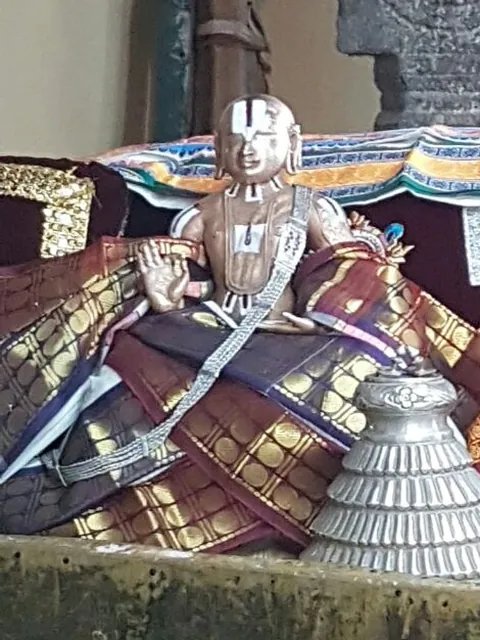
Sri Rāmānuja — Sri Rāmānuja — a Vijayanagara-period bronze

Sri Rāmānuja

1017–1137, by the tradition’s reckoning

Where Born at Śrīperumbūdūr near Kāñcīpuram — Tamil Nadu; died at Srirangam; twelve years of exile at Melkote — Karnataka

Known for The school’s great teacher: wrote the Śrī Bhāṣya, opened the tradition to people of every caste, reorganised the temples of Srirangam and Tirupati, is said to have appointed seventy-four teaching seats, and taught the secret mantra aloud from a temple tower so that everyone below could hear it.

Body of work Śrī Bhāṣya on the Brahma Sūtras ↗ · Vedārtha-saṅgraha ↗ · Gītā-bhāṣya · Vedānta-dīpa, Vedānta-sāra · Gadya-traya; Nitya-grantha

Sri Rāmānuja — a Vijayanagara-period bronze

Sri Piḷḷai Lokācārya — Icon of Sri Piḷḷai Lokācārya

Sri Piḷḷai Lokācārya

thirteenth to early fourteenth century

Where Srirangam — Tamil Nadu; died on the road at Jyotiṣkuḍi near Madurai, carrying the temple’s image to safety in 1323

Known for Principal teacher of the southern (Teṉkalai) branch: eighteen “secret treatises” in Maṇipravāḷa prose on grace and the disciple’s complete dependence — the cat carries the kitten, and the kitten does nothing.

Body of work Śrīvacana-bhūṣaṇa ↗ · the eighteen Rahasya treatises

Icon of Sri Piḷḷai Lokācārya

Sri Vedānta Deśika — Icon of Sri Vedānta Deśika at Tūppul, his birthplace

Sri Vedānta Deśika

1268–1369, by the tradition’s reckoning

Where Born Veṅkaṭanātha at Tūppul in Kāñcīpuram — Tamil Nadu; lived at Kāñcīpuram, Tirupati and Srirangam; years of exile at Satyagālam — Karnataka

Known for The school’s most formidable logician and most prolific poet — over a hundred works in four languages; principal teacher of the northern (Vaḍakalai) branch, for whom grace responds to the soul’s turning, as the monkey’s infant clings to its mother. Hid among the dead when Srirangam was sacked in 1323 and saved the Śruta-prakāśikā.

Body of work Śrīmad Rahasya-traya-sāra ↗ · Tattva-muktā-kalāpa ↗ · Śatadūṣaṇī ↗ · Nyāya-siddhāñjana; Nyāya-pariśuddhi · Pādukā-sahasra; Yādavābhyudaya; Saṅkalpa-sūryodaya

Icon of Sri Vedānta Deśika at Tūppul, his birthplace

Sri Maṇavāḷa Māmunigaḷ — Icon of Sri Maṇavāḷa Māmunigaḷ at Nārāyaṇa Tirumala

Sri Maṇavāḷa Māmunigaḷ

1370–1443

Where Born at Āḻvār Tirunagari in the far south — Tamil Nadu; settled at Srirangam

Known for The last of the great Teṉkalai teachers: commentaries on Sri Piḷḷai Lokācārya, on the Āḻvārs and on the Tiruvāymoḻi, and the organisation of the branch’s teaching lineage into eight seats.

Body of work Commentaries on the Śrīvacana-bhūṣaṇa and the Tiruvāymoḻi

Icon of Sri Maṇavāḷa Māmunigaḷ at Nārāyaṇa Tirumala

Where, on today’s map

Where the Viśiṣṭādvaita teachers were born and taughtKāṭṭumannārkōyil: Sri Nāthamuni’s birthplace, then Vīranārāyaṇapuram; Srirangam: The school’s capital: Sri Yāmuna, Sri Rāmānuja (died 1137), Sri Piḷḷai Lokācārya, Sri Vedānta Deśika, Sri Māmunigaḷ; Śrīperumbūdūr: Sri Rāmānuja born, 1017; Kāñcīpuram & Tūppul: Sri Rāmānuja studied here under Yādava Prakāśa; Sri Vedānta Deśika born at Tūppul, 1268; Madurāntakam: Periya Nambi initiated Sri Rāmānuja under a tree, in the rain; Tirukkōṭṭiyūr: The eighteen walks from Srirangam for the secret meaning of the mantra; Madurai: Sri Yāmuna’s debate at the Pāṇḍya court; Sri Piḷḷai Lokācārya died at Jyotiṣkuḍi nearby, 1323; Melkote: Tirunārāyaṇapuram: Sri Rāmānuja’s twelve years of exile; temple restored; Tirupati: Temple administration organised by Sri Rāmānuja; Sri Vedānta Deśika lived here; Āḻvār Tirunagari: Sri Maṇavāḷa Māmunigaḷ born, 137012345678910KāṭṭumannārkōyilSrirangamŚrīperumbūdūrKāñcīpuram & TūppulMadurāntakamTirukkōṭṭiyūrMaduraiMelkoteTirupatiĀḻvār TirunagariKāṭṭumannārkōyilSrirangamŚrīperumbūdūrKāñcīpuram & TūppulMadurāntakamTirukkōṭṭiyūrMaduraiMelkoteTirupatiĀḻvār Tirunagari

Birthplaces (filled) and seats or resting places (open) of the Viśiṣṭādvaita teachers, on present-day coordinates; the inset shows where this is in India. Drawn, not photographed.

  1. 1Kāṭṭumannārkōyil (Tamil Nadu) — Sri Nāthamuni’s birthplace, then Vīranārāyaṇapuram
  2. 2Srirangam (Tamil Nadu) — The school’s capital: Sri Yāmuna, Sri Rāmānuja (died 1137), Sri Piḷḷai Lokācārya, Sri Vedānta Deśika, Sri Māmunigaḷ
  3. 3Śrīperumbūdūr (Tamil Nadu) — Sri Rāmānuja born, 1017
  4. 4Kāñcīpuram & Tūppul (Tamil Nadu) — Sri Rāmānuja studied here under Yādava Prakāśa; Sri Vedānta Deśika born at Tūppul, 1268
  5. 5Madurāntakam (Tamil Nadu) — Periya Nambi initiated Sri Rāmānuja under a tree, in the rain
  6. 6Tirukkōṭṭiyūr (Tamil Nadu) — The eighteen walks from Srirangam for the secret meaning of the mantra
  7. 7Madurai (Tamil Nadu) — Sri Yāmuna’s debate at the Pāṇḍya court; Sri Piḷḷai Lokācārya died at Jyotiṣkuḍi nearby, 1323
  8. 8Melkote (Karnataka) — Tirunārāyaṇapuram: Sri Rāmānuja’s twelve years of exile; temple restored
  9. 9Tirupati (Andhra Pradesh) — Temple administration organised by Sri Rāmānuja; Sri Vedānta Deśika lived here
  10. 10Āḻvār Tirunagari (Tamil Nadu) — Sri Maṇavāḷa Māmunigaḷ born, 1370

When

  1. c. 900 Sri Nāthamuni gathers the Āḻvārs’ hymns
  2. 1000 Sri Yāmuna at Srirangam
  3. 1017 Sri Rāmānuja born
  4. 1137 Sri Rāmānuja dies at Srirangam
  5. 1268 Sri Vedānta Deśika born
  6. 1300 Sri Piḷḷai Lokācārya’s treatises
  7. 1323 Srirangam sacked; the image carried south
  8. 1369 Sri Vedānta Deśika dies
  9. 1370 Sri Māmunigaḷ born
  10. 1398 Ahobila Maṭha founded
  11. 1443 Sri Māmunigaḷ dies

The tradition today

The tradition lives in the 108 Divya Deśam temples the Āḻvārs sang of — above all Srirangam, the seat of Sri Rāmānuja, and Tirupati, whose Tirumala Tirupati Devasthanams is among the largest temple institutions in the world; in the teaching seats of the two branches, such as the Vaḍakalai Ahobila Maṭha (founded c. 1398) and the Srirangam Srimad Andavan Ashramam; and in the daily recital of the Nālāyira Divya Prabandham in temple and home. Its scholars still write in Maṇipravāḷa, the Tamil–Sanskrit prose of Sri Piḷḷai Lokācārya, and its festivals — Vaikuṇṭha Ekādaśī at Srirangam, the Brahmotsavam at Tirumala — draw millions.

Its own institutions

Read the full account of Viśiṣṭādvaita — the earlier essay text, in detail

What it holds. Brahman is Nārāyaṇa, a person with infinite auspicious qualities, and the souls and the world are real and eternal — but not independent. They are Brahman's body, as your body is yours: distinct from you, wholly dependent on you, incapable of existing a moment apart from you. So "non-dual" (advaita) is true, Sri Rāmānuja says, but only of a Brahman "qualified" (viśiṣṭa) by souls and world; hence the name. Liberation is not the disappearance of the soul into Brahman but its release from karma into an eternity of conscious service and love in Nārāyaṇa's presence, and the way there is surrender (prapatti) as much as knowledge. The tradition also gives scriptural authority to the Tamil hymns of the twelve Āḻvārs, poet-saints of the sixth to ninth centuries, alongside the Sanskrit Veda, and calls itself the Ubhaya-Vedānta, the Vedānta of both languages.

Sri Nāthamuni (ninth to tenth century) was born at Vīranārāyaṇapuram, now Kāṭṭumannārkōyil in the Cauvery delta of Tamil Nadu. The tradition credits him with recovering the four thousand verses of the Āḻvārs, which had been scattered and half-forgotten, arranging them as the Nālāyira Divya Prabandham and setting them to music for recital in temples — the act that made a Tamil devotional literature into scripture. He also wrote a Nyāya-tattva and a Yoga-rahasya, both now lost except in quotation.

Sri Yāmunācārya, called Āḻavandār, "he who came to rule", was Sri Nāthamuni's grandson, active in the tenth and early eleventh centuries at Srirangam. His name records a debate he won as a young man at the Pāṇḍya court in Madurai, but his lasting work is philosophical: the Siddhi-traya, three treatises establishing the reality of the individual soul, of God and of knowledge against the Advaitins and the Buddhists; the Āgama-prāmāṇya, defending the authority of the Pāñcarātra scriptures; the Gītārtha-saṅgraha, a summary of the Gītā that fixed the school's reading of it; and the Stotra-ratna, a hymn of surrender that Sri Rāmānuja knew by heart. The tradition says that he died at Srirangam before he could meet the young Rāmānuja, and that his hand was found with three fingers folded — three unfulfilled wishes, which his successor spent his life fulfilling.

Sri Rāmānuja is the school's great teacher. He was born, by the tradition's reckoning, in 1017 at Śrīperumbūdūr near Kāñcīpuram in Tamil Nadu, to Āsūri Keśava Somayājī and Kāntimatī, and was named Lakṣmaṇa, or in Tamil Iḷaiya Perumāḷ. The Srirangam Andavan Ashramam's account gives the birth-star as Ārdrā in the month of Cittirai. He married young, moved to Kāñcīpuram and studied Vedānta under the Bhedābheda teacher Yādava Prakāśa — and broke with him, the tradition says, over the reading of a single Upaniṣadic sentence describing the eyes of the Lord: Yādava rendered "like the buttocks of a monkey" what Rāmānuja insisted meant "like a lotus opened by the sun". The story is remembered because it is the whole method in miniature: he would not let a grammatical possibility override the beauty and dignity of what the text was for.

After Yāmuna's death he received the tradition from five teachers in turn, of whom two matter most to the story. Periya Nambi initiated him at Madurāntakam, under a tree, in the rain, without waiting for the proper place — because, he said, the proper time was now. Tirukkōṭṭiyūr Nambi made him walk from Srirangam to Tirukkōṭṭiyūr eighteen times before consenting to teach him the secret meaning of the eight-syllable mantra, on condition of secrecy; and Rāmānuja, having learnt it, climbed the temple tower and taught it aloud to everyone who had gathered below. Asked whether he knew this meant hell for him, he is recorded as saying that it would be a small price if so many were saved. Whatever one makes of the account, the movement he led was in fact opened to people of every caste, and the temple town of Srirangam, whose administration he reorganised, became the school's capital.

The travels are extensive even by the standards of Indian teachers. He is said to have gone to Kashmir to consult the ancient commentary of Bodhāyana on the Brahma Sūtras — the tradition says the manuscript was taken from him on the way back and his disciple Kūratāḻvān recited it from memory — and, in a journey around the subcontinent, to have debated at Puri, Dvārakā, Badrinath and Kāśī. The most consequential journey was forced. In the early twelfth century the Coḷa king, a Śaiva, demanded that the Vaiṣṇava teachers of his kingdom sign a declaration of Śiva's supremacy; Kūratāḻvān and Periya Nambi went in Rāmānuja's place and were blinded, and Rāmānuja himself escaped west into the Hoysaḷa kingdom in what is now Karnataka. He lived about twelve years at Tirunārāyaṇapuram — Melkote, on its rock above the Cauvery plain — restored the temple there, and is said to have brought the Hoysaḷa king Biṭṭideva into the faith under the name Viṣṇuvardhana. He returned to Srirangam when the persecution ended and died there, aged one hundred and twenty by the tradition's count, in 1137. His body is preserved in the temple.

His nine works are the school's foundation: the Śrī Bhāṣya, the great commentary on the Brahma Sūtras, with two shorter commentaries on the same text, the Vedānta-dīpa and Vedānta-sāra; the Vedārtha-saṅgraha, his most original book, which sets out the whole system as a reading of the Upaniṣads before attacking Advaita, Bhedābheda and the doctrine of a Brahman without qualities; the Gītā-bhāṣya; the three prose hymns called the Gadya-traya, of which the Śaraṇāgati-gadya is the school's charter of surrender; and the Nitya-grantha, a manual of daily worship. What he made was not only a philosophy but an institution — the seventy-four teaching seats (siṁhāsanādhipatis) he is said to have appointed, the temple administration at Srirangam and Tirupati, the opening of the tradition to all.

Sri Piḷḷai Lokācārya, of Srirangam in the thirteenth and early fourteenth centuries, wrote eighteen "secret treatises" in the mixed Tamil-Sanskrit prose called Maṇipravāḷa, the greatest of them the Śrīvacana-bhūṣaṇa, "the jewel of good words", on the nature of grace and the disciple's utter dependence. He is the principal ācārya of the school's southern (Teṉkalai) branch, which holds that grace needs no cause on the soul's side — the cat carries the kitten; the kitten does nothing. The tradition remembers that when the Delhi armies fell on Srirangam in 1323, it was the aged Lokācārya who carried the processional image of the Lord south to safety, and that he died on the road at Jyotiṣkuḍi near Madurai.

Sri Vedānta Deśika is the other great name. Born Veṅkaṭanātha at Tūppul, in Kāñcīpuram, in 1268, to Ananta Sūri and Totārambā, and taught from the age of seven by his maternal uncle Kiḍāmbi Appuḷḷār, he became the school's most formidable logician and its most prolific poet — over a hundred works in Sanskrit, Tamil, Prakrit and Maṇipravāḷa. Against Advaita he wrote the Śatadūṣaṇī, a hundred objections of which sixty-six survive; for his own school the Tattva-muktā-kalāpa, the Nyāya-siddhāñjana and the Nyāya-pariśuddhi, which give Viśiṣṭādvaita a complete epistemology and logic; for the ordinary devotee the Śrīmad Rahasya-traya-sāra, a long treatise in Maṇipravāḷa on the three secret mantras, which remains the school's standard manual of the path of surrender. He wrote the Pādukā-sahasra, a thousand verses on the Lord's sandals, in a single night, the tradition says, to win a poetry contest; an allegorical drama, the Saṅkalpa-sūryodaya; a Sanskrit epic on Kṛṣṇa, the Yādavābhyudaya; and a commentary on Sri Rāmānuja's Gītā-bhāṣya. He lived at Kāñcīpuram, Tirupati and Srirangam, and in 1323, when Srirangam was sacked, he hid among the dead, escaped with the commentary called Śruta-prakāśikā and the sons of its author, and lived in exile at Satyagālam in the Karnataka country for many years, returning to Srirangam in extreme old age when the image was restored. He is the principal ācārya of the northern (Vaḍakalai) branch, which holds that grace, though free, responds to the soul's turning — the monkey's infant clings to the mother. He died, by the tradition's reckoning, in 1369.

Sri Maṇavāḷa Māmunigaḷ (1370–1443), born at Āḻvār Tirunagari in the far south and settled at Srirangam, is the last of the great Teṉkalai ācāryas: a commentator on Piḷḷai Lokācārya, on the Āḻvārs and on the Tiruvāymoḻi, and the organiser of the branch's teaching lineage into eight seats. The Vaḍakalai branch's institutions include the Ahobila Maṭha, founded around 1398 by Sri Ādivaṉ Śaṭhakōpa Jīyar, and the Parakāla Maṭha of Mysore; the Śrīvaiṣṇava temples of Srirangam, Tirupati, Kāñcīpuram and Melkote remain the school's living centres, and its teachers are still active on every continent.
· Compare side by side · Back to the picker

Dvaita — Sri Madhva and the Tattvavāda

“Dualism” — God, souls and matter are eternally distinct, and the difference is real to the end

Founding teacher
Sri Madhva (Ānanda Tīrtha), 1238–1317
Heartland today
Coastal and central Karnataka — Udupi, Hampi, Malkhed; Mantrālayam in Andhra Pradesh
Root texts
Sri Madhva’s Brahma-sūtra-bhāṣya and Anuvyākhyāna; the thirty-seven works of the Sarvamūla
Living seats
The eight maṭhas of Udupi; the Uttarādi Maṭha; the Śrī Rāghavendra Svāmī Maṭha at Mantrālayam
Also known as
Tattvavāda, “the doctrine of reality”

In one breath

Stand a candle in front of a mirror. The flame is real; its reflection is also real — you can see it, it moves when the flame moves — but the reflection is not the flame, never was, and never will be. Sri Madhva teaches that God (Viṣṇu) is the one independent Reality and that every soul is real, eternal and utterly dependent on Him, as a reflection depends on its flame. The world is real too, not a trick of the mind. There are countless souls, no two alike, and even in liberation each keeps its own nature and enjoys God in its own measure. Difference, for this school, is not a problem to be dissolved; it is the truth to be loved.

The tradition’s own picture: The flame and its reflection

Sri Madhva’s tradition speaks of the soul as a reflection (pratibimba) of the Lord — real, eternal, resembling Him, and wholly dependent on Him, never Him. It adds the teaching of gradation (tāratamya): souls differ in capacity, as reflections differ with the mirror, and the difference is permanent. The five differences (pañca-bheda) — God and soul, God and matter, soul and soul, soul and matter, matter and matter — are the school’s map of reality.

What it holds

  • Viṣṇu alone is independent; everything else is real but depends on Him.
  • Difference is real, eternal and fivefold; no argument and no experience ever cancels it.
  • Souls are innumerable, each distinct, and graded in capacity — and the gradation continues in liberation.
  • The world is not an appearance; the doctrine of māyā is the school’s principal target.
  • Knowledge of God through study and His grace, and devotion to Him, are the way; liberation is the full enjoyment of one’s own nature in His presence.

Where it differs from Advaita

What is the soul?
Advaita: the soul is Brahman itself, appearing limited — as the space inside a pot is the one space, seemingly enclosed. Dvaita: the soul is a real reflection of God, resembling Him and eternally distinct from Him.
Is māyā real?
Advaita: māyā is the power by which the one appears as many; it is neither wholly real nor wholly unreal, and knowledge ends it. Dvaita: there is no such power — the world is real, and calling it an appearance is a mistake about the texts.
Are all souls equal?
Advaita: in truth there is one Self and no plurality of selves at all. Dvaita: souls are many and differ permanently in capacity, and liberation does not level them.
The last word of the Upaniṣads
Advaita: “That thou art” — identity. Dvaita: the same sentence is read as “thou art of That”, or as spoken to a particular soul, and the difference texts (“two birds on one tree”) are taken as literal.

Where they agree

Both say that God is the only independent reality, that the world of birth and death is not the soul’s home, that scripture and a teacher are the means, and that grace is real. It was in answer to this school that Advaita wrote one of its most careful books, the Advaita-siddhi — a compliment paid in the only currency scholars accept.

What it says to us — three key messages

  1. Difference is the truth, not a mistakeFive differences — God and soul, God and matter, soul and soul, soul and matter, matter and matter — are real and eternal. Knowing them rightly is liberation, not overcoming them.
  2. Viṣṇu is supreme and independent; everything else dependsOne reality is independent (svatantra), all the rest is dependent (paratantra). Devotion is the recognition of that dependence, gladly.
  3. Each soul has its own nature and its own blissSouls are many and unequal by nature, and each is fulfilled in the measure of its own capacity — a hierarchy that ends in everyone’s happiness, not in sameness.

The teachers of this tradition

Sri Madhva (Ānanda Tīrtha) — The image of Sri Madhva at Pājaka, installed by Sri Vādirāja

Sri Madhva (Ānanda Tīrtha)

1238–1317, by the Uttarādi Maṭha’s account

Where Born at Pājaka near Udupi — Karnataka; disappeared from sight at Udupi while teaching the Aitareya Upaniṣad

Known for Founder of the school: took sannyāsa in his eleventh year, out-argued his own Advaitin teacher, travelled twice to the Himālaya, installed the image of the child Kṛṣṇa at Udupi and founded the eight maṭhas whose two-year rotation (Paryāya) continues to this day. Wrote thirty-seven works, together the Sarvamūla.

Body of work Brahma-sūtra-bhāṣya, in English ↗ · Gītā-bhāṣya and Gītā-tātparya, in English ↗ · Viṣṇu-tattva-vinirṇaya ↗ · Anuvyākhyāna; ten Upaniṣad commentaries; Mahābhārata- and Bhāgavata-tātparya-nirṇaya; the Daśa-prakaraṇas

The image of Sri Madhva at Pājaka, installed by Sri Vādirāja

Sri Padmanābha Tīrtha

thirteenth to fourteenth century

Where The Marāṭhā country — today’s Maharashtra

Known for Sri Madhva’s first ordained disciple, who carried the doctrine north.

No freely licensed picture exists, so a symbol stands here rather than an invented face.

Sri Narahari Tīrtha

thirteenth to fourteenth century

Where The Kaliṅga court — today’s Odisha

Known for A minister of Kaliṅga, remembered for bringing the images of Rāma and Sītā that the school still worships.

No freely licensed picture exists, so a symbol stands here rather than an invented face.

Sri Jayatīrtha

c. 1345–1388

Where Born Dhoṇḍo Raghunāth at Maṅgaḷavēḍhe near Pandharpur — Maharashtra; tomb at Malkhed on the Kāgiṇī — Karnataka

Known for The school’s greatest commentator: the young horseman who, asked whether he had been a bullock in a former life, remembered that he had, and followed the ascetic who asked. His Nyāya-sudhā is the text a Dvaita scholar is measured by.

Body of work Nyāya-sudhā on the Anuvyākhyāna ↗ · Tattva-prakāśikā on the Brahma-sūtra-bhāṣya

No freely licensed picture exists, so a symbol stands here rather than an invented face.

Sri Vyāsatīrtha

1460–1539

Where Born at Bannūr near Mysore — Karnataka; tomb at Nava Bṛndāvana near Hampi

Known for Made Dvaita a power at the Vijayanagara court under Kṛṣṇadevarāya; served, the tradition says, twelve years as priest at Tirupati; began the Haridāsa movement of Kannada song. His Nyāyāmṛta provoked a written debate with Advaita that ran for three hundred years.

Body of work Nyāyāmṛta, with the Advaita-siddhi and commentaries ↗ · Tarka-tāṇḍava; Tātparya-candrikā

No freely licensed picture exists, so a symbol stands here rather than an invented face.

Sri Purandara Dāsa

1484–1564

Where Vijayanagara — Hampi, Karnataka

Known for The wealthy merchant who gave everything away; his Kannada compositions are the foundation of Carnatic music. A disciple of Sri Vyāsatīrtha.

Body of work Purandara Dāsara Padagaḻu — the songs, in Kannada ↗

No freely licensed picture exists, so a symbol stands here rather than an invented face.

Sri Kanaka Dāsa

sixteenth century

Where Karnataka

Known for The shepherd-poet of the Haridāsa movement, disciple of Sri Vyāsatīrtha; his songs are sung across Karnataka.

No freely licensed picture exists, so a symbol stands here rather than an invented face.

Sri Vādirāja Tīrtha

1480–1600, by the tradition

Where Born at Hūvinakere near Kundāpura — Karnataka; head of the Sode Maṭha

Known for Reorganised the Udupi Paryāya to its present two-year cycle in 1522; installed the image of Sri Madhva at Pājaka; left the Tīrtha-prabandha, a versified first-hand account of his pilgrimage around the whole of India.

Body of work Yukti-mallikā ↗ · Rukmiṇīśa-vijaya; Tīrtha-prabandha

No freely licensed picture exists, so a symbol stands here rather than an invented face.

Sri Rāghavendra Tīrtha — A drawing of Sri Rāghavendra recovered from the maṭha at Kumbakonam

Sri Rāghavendra Tīrtha

1595–1671, by the maṭha’s tradition

Where Born Veṅkaṭanātha at Bhuvanagiri — Tamil Nadu; trained at Kumbakonam; shrine at Mantrālayam on the Tuṅgabhadrā — Andhra Pradesh

Known for Commentator across the whole corpus, above all the Parimaḻa on Sri Jayatīrtha’s Nyāya-sudhā; in 1671 entered his tomb alive, by the tradition, at Mantrālayam, whose shrine draws more pilgrims than any other in the school.

Body of work Parimaḻa on the Nyāya-sudhā · Commentaries on the Sarvamūla

A drawing of Sri Rāghavendra recovered from the maṭha at Kumbakonam

Where, on today’s map

Where the Dvaita teachers were born and taughtPājaka & Udupi: Sri Madhva born 1238 at Pājaka; Kṛṣṇa installed and eight maṭhas founded at Udupi; disappeared here 1317; Kundāpura & Sode: Sri Vādirāja born at Hūvinakere near Kundāpura; his Sode Maṭha lies inland; Maṅgaḷavēḍhe: Sri Jayatīrtha born c. 1345; Malkhed: Sri Jayatīrtha’s tomb on the Kāgiṇī; Bannūr: Sri Vyāsatīrtha born 1460; Hampi: Vijayanagara: Sri Vyāsatīrtha at Kṛṣṇadevarāya’s court; Sri Purandara Dāsa; Sri Vyāsatīrtha’s tomb at Nava Bṛndāvana; Tirupati: Sri Vyāsatīrtha’s twelve years as temple priest, by the tradition; Bhuvanagiri: Sri Rāghavendra born 1595; Kumbakonam: Sri Rāghavendra trained here; Śrīmuṣṇam: Sri Madhva’s rainy-season retreat, recorded by the Uttarādi Maṭha; Mantrālayam: Sri Rāghavendra’s shrine, 1671; Badrinath: Sri Madhva’s two Himālayan journeys; the Gītā-bhāṣya followed the first123456789101112Pājaka & UdupiKundāpura & SodeMaṅgaḷavēḍheMalkhedBannūrHampiTirupatiBhuvanagiriKumbakonamŚrīmuṣṇamMantrālayamBadrinathPājaka & UdupiKundāpura & SodeMaṅgaḷavēḍheMalkhedBannūrHampiTirupatiBhuvanagiriKumbakonamŚrīmuṣṇamMantrālayamBadrinathNew DelhiMumbaiKolkata

Birthplaces (filled) and seats or resting places (open) of the Dvaita teachers, on present-day coordinates; the inset shows where this is in India. Drawn, not photographed.

  1. 1Pājaka & Udupi (Karnataka) — Sri Madhva born 1238 at Pājaka; Kṛṣṇa installed and eight maṭhas founded at Udupi; disappeared here 1317
  2. 2Kundāpura & Sode (Karnataka) — Sri Vādirāja born at Hūvinakere near Kundāpura; his Sode Maṭha lies inland
  3. 3Maṅgaḷavēḍhe (Maharashtra) — Sri Jayatīrtha born c. 1345
  4. 4Malkhed (Karnataka) — Sri Jayatīrtha’s tomb on the Kāgiṇī
  5. 5Bannūr (Karnataka) — Sri Vyāsatīrtha born 1460
  6. 6Hampi (Karnataka) — Vijayanagara: Sri Vyāsatīrtha at Kṛṣṇadevarāya’s court; Sri Purandara Dāsa; Sri Vyāsatīrtha’s tomb at Nava Bṛndāvana
  7. 7Tirupati (Andhra Pradesh) — Sri Vyāsatīrtha’s twelve years as temple priest, by the tradition
  8. 8Bhuvanagiri (Tamil Nadu) — Sri Rāghavendra born 1595
  9. 9Kumbakonam (Tamil Nadu) — Sri Rāghavendra trained here
  10. 10Śrīmuṣṇam (Tamil Nadu) — Sri Madhva’s rainy-season retreat, recorded by the Uttarādi Maṭha
  11. 11Mantrālayam (Andhra Pradesh) — Sri Rāghavendra’s shrine, 1671
  12. 12Badrinath (Uttarakhand) — Sri Madhva’s two Himālayan journeys; the Gītā-bhāṣya followed the first

When

  1. 1238 Sri Madhva born at Pājaka
  2. 1317 Sri Madhva disappears at Udupi
  3. 1345 Sri Jayatīrtha born
  4. 1460 Sri Vyāsatīrtha born
  5. 1484 Sri Purandara Dāsa born
  6. 1522 Sri Vādirāja fixes the two-year Paryāya
  7. 1539 Sri Vyāsatīrtha dies
  8. 1595 Sri Rāghavendra born
  9. 1671 Sri Rāghavendra enters his tomb at Mantrālayam

The tradition today

The eight maṭhas Sri Madhva founded at Udupi still take turns, two years each, to serve the child Kṛṣṇa he installed — the Paryāya that Sri Vādirāja fixed in 1522 — and the Uttarādi, Vyāsarāja and Rāghavendra Svāmī maṭhas carry the scholarly line, with Mantrālayam the most visited shrine of the school. The Haridāsa movement that Sri Vyāsatīrtha began still gives Karnataka its music: the songs of Sri Purandara Dāsa and Sri Kanaka Dāsa are sung in concert halls and kitchens alike, and Dvaita scholars continue the written debate with Advaita that Sri Vyāsatīrtha opened five hundred years ago.

Its own institutions

Read the full account of Dvaita — the earlier essay text, in detail

What it holds. Difference is real, eternal and fivefold: between God and souls, God and matter, soul and soul, soul and matter, and one piece of matter and another. Viṣṇu is the only independent reality; everything else is real but dependent on Him. Souls are innumerable, each distinct, graded eternally in capacity (tāratamya), and liberated not into identity with God but into the full enjoyment of their own nature in His presence — and even in liberation the gradation stays. The world is not an appearance; Sri Madhva's most sustained polemics are against the "doctrine of māyā", which he regarded as a disguised Buddhism. Knowledge of God, gained by study and by His grace, and devotion to Him, are the way. The school calls itself Tattvavāda, "the doctrine of reality".

Sri Madhva was born in 1238 — the Uttarādi Maṭha's own account gives the year — at Pājaka, a village near Udupi on the coast of what is now Karnataka, to Madhyageha Bhaṭṭa and Vedavatī, and was named Vāsudeva. The accounts remember a boy of extraordinary physique, a wrestler, swimmer and runner nicknamed Bhīma, who took the sacred thread at five and, against his parents' grief, sannyāsa in his eleventh year from the Advaitin ascetic Acyutaprekṣa, who named him Pūrṇaprajña and later Ānanda Tīrtha. The pupil soon out-argued the teacher, and Acyutaprekṣa handed him his seat. He travelled twice to the Himālaya — to Badrinath, and beyond it, the tradition says, to the hidden Badarī where he received his teaching from Vyāsa himself, the author of the Brahma Sūtras; he returned from the first journey with his Gītā-bhāṣya and wrote the Brahma-sūtra-bhāṣya after it. He toured south and north India debating, camped at Śrīmuṣṇam near Chidambaram for a rainy-season retreat that the Uttarādi Maṭha still records, and at Udupi installed the image of the child Kṛṣṇa that is the centre of the town to this day — recovered, the tradition says, from a lump of sacred clay in the cargo of a ship from Dvārakā that he had saved from a storm. He founded a maṭha for its worship and ordained eight young monks to keep it in rotation; their eight maṭhas (Aṣṭa Maṭhas) still do, the two-year rotation called Paryāya being one of the great public festivals of coastal Karnataka. He wrote thirty-seven works, collectively the Sarvamūla, and disappeared from sight in 1317, by the tradition, while teaching the Aitareya Upaniṣad in the Anantēśvara temple at Udupi, a shower of flowers falling where he had sat. His followers hold him to be the third incarnation of Vāyu, after Hanumān and Bhīma.

The works are the most systematic attack on Advaita ever written, and Advaita became more precise in answering them. The Brahma-sūtra-bhāṣya, and the Anuvyākhyāna in which he defends it verse by verse; commentaries on the Gītā and on ten Upaniṣads; the Bhāgavata-tātparya-nirṇaya and the Mahābhārata-tātparya-nirṇaya, which fix the school's reading of the epics; the Viṣṇu-tattva-vinirṇaya, his longest independent treatise; and ten short tracts (Daśa-prakaraṇas) including the Māyāvāda-khaṇḍana and the Upādhi-khaṇḍana, aimed directly at the Advaita doctrines of illusion and of limiting adjuncts. The technical instruments — the doctrine of viśeṣa, which lets a thing be one and yet have many attributes; the sākṣī, the "witness" faculty that certifies knowledge; the analysis of testimony — became the common property of later Indian logic.

Sri Padmanābha Tīrtha, his first ordained disciple, carried the doctrine north into the Marāṭhā country. Sri Narahari Tīrtha, a minister of the Kaliṅga court, is remembered for bringing the images of Rāma and Sītā that the school still worships. Sri Jayatīrtha (about 1345–1388), born Dhoṇḍo Raghunāth at Maṅgaḷavēḍhe near Pandharpur, a young horseman who, the story says, drank from a river without dismounting and was asked by a passing ascetic whether he had been a bullock in a previous life — and remembered that he had, and followed the ascetic — became the school's greatest commentator. His Nyāya-sudhā on Sri Madhva's Anuvyākhyāna is the text a Dvaita scholar is measured by, and his Tattva-prakāśikā on the Brahma-sūtra-bhāṣya is read beside the original. His tomb (bṛndāvana) is at Malkhed on the Kāgiṇī river.

Sri Vyāsatīrtha (1460–1539), born at Bannūr near Mysore, made Dvaita a power at the Vijayanagara court, where he was honoured by Kṛṣṇadevarāya; the tradition says he served twelve years as priest of the Tirupati temple before that. His three works — the Nyāyāmṛta, the Tarka-tāṇḍava and the Tātparya-candrikā — are the "Vyāsa-traya", and the first of them, a massive refutation of Advaita, provoked Sri Madhusūdana Sarasvatī's Advaita-siddhi a century later, which provoked in turn the Nyāyāmṛta-taraṅgiṇī of Sri Rāmācārya and the Laghucandrikā of Sri Brahmānanda Sarasvatī — a debate conducted in writing across three hundred years, at a level of rigour that has few parallels anywhere. He also began the Haridāsa movement of Kannada devotional song: Sri Purandara Dāsa (1484–1564), the wealthy merchant who gave everything away and whose compositions are the foundation of Carnatic music, and Sri Kanaka Dāsa, the shepherd-poet, were both his disciples. His tomb is at Nava Bṛndāvana, an island in the Tuṅgabhadrā near Hampi.

Sri Vādirāja Tīrtha (the tradition gives 1480–1600), born at Hūvinakere near Kundāpura and head of the Sode Maṭha, reorganised the Udupi Paryāya to its present two-year cycle in 1522, wrote the Yukti-mallikā, a comprehensive defence of the school, and the Rukmiṇīśa-vijaya, an epic on Kṛṣṇa, and left the Tīrtha-prabandha, a versified account of his pilgrimage around the whole of India — a rare first-hand travel record by a medieval Indian teacher. Sri Rāghavendra Tīrtha (the maṭha's tradition gives 1595–1671), born Veṅkaṭanātha at Bhuvanagiri in Tamil Nadu and trained at Kumbakonam, wrote the Parimaḷa on Sri Jayatīrtha's Nyāya-sudhā and commentaries across the whole corpus, and in 1671 entered his tomb alive, by the tradition, at Mantrālayam on the Tuṅgabhadrā in what is now Andhra Pradesh. His shrine there draws more pilgrims than any other in the school; the Śrī Rāghavendra Svāmī Maṭha traces its lineage directly from Sri Madhva through Sri Padmanābha Tīrtha and Sri Jayatīrtha.

· Compare side by side · Back to the picker

Bhedābheda — difference and non-difference

“Difference-and-non-difference” — the soul is both other than Brahman and not other, and both statements are literally true

Principal teacher
Sri Bhāskara, eighth to ninth century
Also
Sri Yādava Prakāśa of Kāñcīpuram, eleventh century; Sri Vijñānabhikṣu, sixteenth century
Root text
Sri Bhāskara’s commentary on the Brahma Sūtras — the oldest surviving non-Advaita commentary
Where it lives on
Chiefly through Sri Nimbārka’s tradition, which is a form of it

In one breath

Look at a wave. Is it the sea? Yes — there is nothing in it but sea-water. Is it the sea? No — it rises, has a shape of its own, and falls. Bhedābheda says the soul stands to Brahman exactly like that, and that both answers are plainly true at once, with no need to call one of them an illusion. Sri Bhāskara’s version adds that the one Brahman really becomes many through limiting conditions, as one open space becomes many small spaces inside many pots, and that when the pots break the spaces are simply space again.

The tradition’s own picture: Space in pots; sparks from a fire

Sri Bhāskara’s own analogy is the pot-space (ghaṭākāśa): the pot is a real limiting condition (upādhi), the enclosed space is really enclosed while the pot lasts, and the difference is real but temporary. The older Upaniṣadic pictures the school leans on are sparks flying from a fire and waves on the sea — the many are the one, and are still many.

What it holds

  • Brahman is really one and really becomes many through limiting conditions.
  • The soul’s difference from Brahman is real, but not permanent: it lasts as long as the conditions last.
  • Liberation needs works as well as knowledge (jñāna-karma-samuccaya) — ritual duty is never simply dropped.
  • The doctrine of māyā is rejected; the world is a real transformation of Brahman.
  • This is probably the oldest reading of the Upaniṣads of all — the Brahma Sūtras themselves seem closer to it than to any later school.

Where it differs from Advaita

Does Brahman really change?
Advaita: no — the world is an appearance of Brahman, as a rope appears as a snake; Brahman is untouched. Bhedābheda: yes — Brahman really becomes the world and the souls, and really takes them back.
Is the pot-space really enclosed?
Both schools love this picture, and read it oppositely. Advaita (following Sri Gauḍapāda): the space was never really divided — the division is only apparent. Sri Bhāskara: the division is real while the pot lasts.
Knowledge alone, or knowledge with works?
Advaita: knowledge alone liberates, because ignorance is the only bond and no action can remove a misunderstanding. Bhedābheda: knowledge must be combined with the performance of duties.

Where they agree

Both hold that Brahman is one and that the soul is finally not other than it; both use the same pictures of space, sparks and waves. Sri Śaṅkara took this school seriously enough to argue with it on almost every page of his commentary, which is a kind of respect.

What it says to us — three key messages

  1. Both at onceThe soul and the world are different from Brahman and not different from it — as a wave is and is not the sea. Neither half of the sentence may be dropped.
  2. Action and knowledge togetherSri Bhāskara held that ritual duty and knowledge combine (jñāna-karma-samuccaya) — one does not retire from the Veda’s commands in order to know.
  3. The oldest alternativeThis is the earliest surviving reading of the Brahma Sūtras after Sri Śaṅkara’s, and the ground on which Sri Rāmānuja, Sri Nimbārka and Sri Chaitanya’s school all later built.

The teachers of this tradition

Sri Bhāskara

eighth to ninth century — a generation or so after Sri Śaṅkara

Where Uncertain

Known for Wrote the oldest surviving non-Advaita commentary on the Brahma Sūtras and a commentary on the Gītā; attacked the māyā doctrine in terms Sri Rāmānuja later borrowed.

Body of work Brahma-sūtra-bhāṣya ↗ · Gītā-bhāṣya

No freely licensed picture exists, so a symbol stands here rather than an invented face.

Sri Yādava Prakāśa

eleventh century

Where Kāñcīpuram — Tamil Nadu

Known for Teacher of the young Rāmānuja, who broke with him over the reading of a single Upaniṣadic sentence; held that the difference is natural rather than conditional; the tradition says he ended as his former pupil’s disciple.

No freely licensed picture exists, so a symbol stands here rather than an invented face.

Sri Vijñānabhikṣu

sixteenth century

Where North India

Known for Revived the position in commentaries that also tried to reconcile Vedānta with Sāṅkhya and Yoga.

Body of work Vijñānāmṛta-bhāṣya; commentaries on the Sāṅkhya and Yoga Sūtras

No freely licensed picture exists, so a symbol stands here rather than an invented face.

When

  1. c. 800 Sri Bhāskara’s commentary
  2. 1050 Sri Yādava Prakāśa teaches at Kāñcīpuram
  3. 1550 Sri Vijñānabhikṣu’s revival

The tradition today

Bhedābheda has no maṭha or temple of its own today; it lives as a position in the argument, studied wherever the Brahma Sūtras are read with all their commentaries, and in the traditions that inherited its central move — Sri Nimbārka’s dvaitādvaita and Sri Chaitanya’s acintya-bhedābheda are both “difference-and-non-difference” schools. Sri Bhāskara’s commentary survives in a Chowkhamba edition; Sri Yādava Prakāśa is known chiefly through the biographies of his pupil Sri Rāmānuja.

Its own institutions

Read the full account of Bhedābheda — the earlier essay text, in detail

What it holds. That the soul and the world are both different from Brahman and not different from it, in the way a wave is and is not the ocean, or a spark is and is not the fire — and that both statements are literally, not figuratively, true. This is probably the oldest reading of the Upaniṣads of all; the Brahma Sūtras themselves seem closer to it than to any later school, and Sri Śaṅkara's commentary spends much of its energy arguing against a Bhedābheda position that was clearly the established one in his day.

Sri Bhāskara, active in the eighth or ninth century, a generation or so after Sri Śaṅkara, wrote the oldest surviving non-Advaita commentary on the Brahma Sūtras and a commentary on the Gītā. He held that Brahman is really one and becomes really many through limiting conditions (upādhi), as one space becomes many spaces in many pots; that the soul's difference from Brahman is therefore real but temporary; and, against Sri Śaṅkara, that liberation needs works as well as knowledge (jñāna-karma-samuccaya). He attacked the māyā doctrine in terms Sri Rāmānuja later borrowed. Sri Yādava Prakāśa, the eleventh-century Kāñcīpuram teacher of Sri Rāmānuja, held a version in which the difference is natural rather than conditional; the tradition says he ended as his former pupil's disciple. Sri Vijñānabhikṣu in the sixteenth century revived the position in commentaries that also tried to reconcile Vedānta with Sāṅkhya and Yoga. The school survives today chiefly through Sri Nimbārka's tradition, which is a form of it.

· Compare side by side · Back to the picker

Dvaitādvaita — Sri Nimbārka

“Dual-non-dual” — souls and world are at once different from Brahman and not different, naturally and always

Founding teacher
Sri Nimbārka — dated by the tradition very early, by most scholars to the thirteenth century or later
Heartland today
Braj — Nimbagrāma near Govardhan, Uttar Pradesh; Salemabad near Ajmer, Rajasthan; and Bengal
Root texts
Vedānta-pārijāta-saurabha; Daśaślokī; Sri Śrīnivāsa’s Vedānta-kaustubha
Living seat
The Akhil Bhāratīya Nimbārkācārya Pīṭha at Salemabad — forty-eight ācāryas in succession
Distinctive
The first school to place Rādhā and Kṛṣṇa together at the centre of its theology

In one breath

Think of the sun and its rays. A ray is not the sun — it is thin, it is here on your hand while the sun is far away — and yet there is nothing in the ray but the sun’s own light. Sri Nimbārka taught that every soul is like that: different from God in size and power, never different from Him in nature, and this both-at-once is simply how things are, not a stage on the way to something else. God here is Kṛṣṇa together with Rādhā, and the way to Him is to hand oneself over to the teacher and to the couple’s grace.

The tradition’s own picture: The sun and its rays; the snake and its coils

The school’s pictures are the sun and its rays, and the snake and its coils — the Brahma Sūtras’ own image (3.2.27) for a relation that is difference and non-difference together. Sri Nimbārka’s ten verses (the Daśaślokī) state the whole doctrine in the space of a page.

What it holds

  • Brahman is Kṛṣṇa with Rādhā; souls and the world are His powers, real and eternal.
  • The relation is natural (svābhāvika) difference-and-non-difference — unlike Sri Bhāskara, no limiting conditions are needed to explain it.
  • The way is prapatti — surrender to the guru and to the grace of the divine pair.
  • Liberation is to live in Kṛṣṇa’s presence in one’s own true form, never to lose oneself in Him.

Where it differs from Advaita

One Self or many?
Advaita: one Self, appearing as many. Dvaitādvaita: many real souls, each a ray of the one light, eternally distinct and eternally dependent.
Is the difference an appearance?
Advaita: yes — it is what ignorance adds, and knowledge removes it. Dvaitādvaita: no — the difference is as natural and permanent as the non-difference; nothing is added and nothing is removed.
Where does love end?
Advaita: in the recognition that lover and beloved were never two, when love has done its work. Dvaitādvaita: in a love that has no end, because the two remain.

Where they agree

Both read the same sūtra about the snake and its coils, both hold that the soul is of the same nature as Brahman, and both teach surrender to a teacher as the door. Advaita agrees that at the level of the world the soul is truly a ‘ray’; the question is what the ray is when it stops looking away from the sun.

What it says to us — three key messages

  1. Rādhā and Kṛṣṇa togetherSri Nimbārka was the first to make the divine couple, not Kṛṣṇa alone, the object of worship — the love between them is the picture of how God and soul are related.
  2. Different and not different, by natureSouls and the world are distinct from Brahman as attributes are from their substance, yet cannot exist apart from it. The difference is natural, not imposed.
  3. The shortest commentaryThe whole doctrine is carried in a commentary on the Brahma Sūtras brief enough to be read in an hour, and in ten verses — teaching by concentration rather than by volume.

The teachers of this tradition

Sri Nimbārka (Niyamānanda) — Sri Nimbārka, as painted for the Sri Golok Dham Ashram

Sri Nimbārka (Niyamānanda)

uncertain — the tradition says very early; scholars, the thirteenth century or later

Where Born at Vaidūryapaṭṭanam on the Godāvarī — Andhra Pradesh, by the tradition’s account; settled at Nimbagrāma near Govardhan in Braj — Uttar Pradesh

Known for Founder; wrote the shortest of all commentaries on the Brahma Sūtras and ten verses that carry the whole doctrine; first to make Rādhā and Kṛṣṇa together the object of worship.

Body of work Vedānta-pārijāta-saurabha, with Sri Śrīnivāsa’s Vedānta-kaustubha, in English (Roma Bose, 1940) ↗ · Vedānta-pārijāta-saurabha, in Sanskrit ↗ · Daśaślokī

Sri Nimbārka, as painted for the Sri Golok Dham Ashram

Sri Śrīnivāsācārya

the generation after Sri Nimbārka

Where Braj — Uttar Pradesh

Known for Sri Nimbārka’s disciple; expanded the master’s brief commentary into the school’s full statement, the Vedānta-kaustubha.

Body of work Vedānta-kaustubha, in English ↗

No freely licensed picture exists, so a symbol stands here rather than an invented face.

Sri Keśava Kāśmīrī Bhaṭṭa

fifteenth century

Where Kashmir, then Braj

Known for A celebrated debater; his Vedānta-kaustubha-prabhā is the sub-commentary the tradition studies.

Body of work Vedānta-kaustubha-prabhā

No freely licensed picture exists, so a symbol stands here rather than an invented face.

Sri Harivyāsa Devācārya and Sri Paraśurāma Devācārya

sixteenth century

Where Salemabad near Ajmer — Rajasthan

Known for Established the seat that still leads the tradition, the Akhil Bhāratīya Nimbārkācārya Pīṭha.

No freely licensed picture exists, so a symbol stands here rather than an invented face.

Where, on today’s map

Where the Dvaitādvaita (Nimbārka) teachers were born and taughtVaidūryapaṭṭanam (Godāvarī): Sri Nimbārka’s birthplace by the tradition’s account; Nimbagrāma & Govardhan: Where Sri Nimbārka settled; Salemabad: The Nimbārkācārya Pīṭha, established in the sixteenth century123Vaidūryapaṭṭanam (Godāvarī)Nimbagrāma & GovardhanSalemabadVaidūryapaṭṭanam (Godāvarī)Nimbagrāma & GovardhanSalemabadNew DelhiMumbaiHyderabad

Birthplaces (filled) and seats or resting places (open) of the Dvaitādvaita (Nimbārka) teachers, on present-day coordinates; the inset shows where this is in India. Drawn, not photographed.

  1. 1Vaidūryapaṭṭanam (Godāvarī) (Andhra Pradesh) — Sri Nimbārka’s birthplace by the tradition’s account
  2. 2Nimbagrāma & Govardhan (Uttar Pradesh) — Where Sri Nimbārka settled
  3. 3Salemabad (Rajasthan) — The Nimbārkācārya Pīṭha, established in the sixteenth century

When

  1. 1250 Sri Nimbārka in Braj (scholars’ dating)
  2. 1450 Sri Keśava Kāśmīrī Bhaṭṭa
  3. 1550 The Salemabad seat established

The tradition today

The tradition is led from the Akhil Bhāratīya Nimbārkācārya Pīṭha at Nimbārka Tīrtha (Salemabad) near Ajmer, whose own page lists its forty-eight ācāryas in succession, and it worships in Braj — at Nimbagrāma near Govardhan and in the temples of Vṛndāvana — and in Bengal. Its distinctive mark is the joint worship of Rādhā and Kṛṣṇa with the mantra Rādhe Kṛṣṇa, and the “sakhī” devotion of the companions of Rādhā; its texts are read in Roma Bose’s three-volume English translation of 1940.

Its own institutions

Read the full account of Dvaitādvaita (Nimbārka) — the earlier essay text, in detail

Sri Nimbārka was born, according to the account kept by the Divine Life Society from the tradition's sources, at Vaidūryapaṭṭanam on the banks of the Godāvarī in what is now Andhra Pradesh, to the ascetic Aruṇa Muni and Jayantī Devī, and named Niyamānanda. The date is genuinely uncertain: the tradition places him very early, some accounts in the eleventh century, most modern scholars in the thirteenth or later, since his commentary appears to know Sri Rāmānuja's. He settled in the Braj country at Nimbagrāma near Govardhan, and his short commentary on the Brahma Sūtras, the Vedānta-pārijāta-saurabha, and his ten verses, the Daśaślokī, teach that souls and world are both different and non-different from Brahman, who is Kṛṣṇa together with Rādhā — the first school to place the pair at the centre of its theology. The path is surrender to the guru and the couple's grace. His disciple Sri Śrīnivāsācārya expanded the commentary into the Vedānta-kaustubha; Sri Keśava Kāśmīrī Bhaṭṭa, in the fifteenth century, a celebrated debater, wrote the Vedānta-kaustubha-prabhā; Sri Harivyāsa Devācārya and Sri Paraśurāma Devācārya in the sixteenth century established the seat that still leads the tradition, at Salemabad near Ajmer in Rajasthan, the Akhil Bhāratīya Nimbārkācārya Pīṭha, which counts forty-eight ācāryas in unbroken succession. The tradition remains strong in Braj, Rajasthan and Bengal.

· Compare side by side · Back to the picker

Śuddhādvaita — Sri Vallabha and the Path of Grace

“Pure non-dualism” — the world is Brahman really, not by illusion, and the soul is a spark of Him

Founding teacher
Sri Vallabhācārya, 1479–1531
Heartland today
Braj — Gokul and Govardhan, Uttar Pradesh; Nāthdwārā, Rajasthan; Gujarat and Mumbai
Root texts
Aṇubhāṣya on the Brahma Sūtras; Subodhinī on the Bhāgavata Purāṇa; Tattvārtha-dīpa-nibandha; the Ṣoḍaśa-grantha
Living seats
The houses of Sri Viṭṭhalanātha’s seven sons; the Śrīnāthjī temple at Nāthdwārā
Also known as
Puṣṭimārga, “the path of grace”

In one breath

Watch sparks fly up from a bonfire. Each spark is fire — small, brief, but fire and nothing else. Sri Vallabha says you are a spark of Kṛṣṇa, and the whole world is His play, real through and through. Nothing needs to be seen through, and nothing needs to be given up; what changes is what you do with it. You offer everything first — the food, the music, the morning — and only then use it. The name of the path says it: puṣṭi, “nourishing”. The soul is not to escape the world but to be fed, in the world, by God’s grace, through a love that expects nothing back.

The tradition’s own picture: Sparks of one fire; the world as play

The school’s image for the soul is the spark of a fire, taken from the Upaniṣads — as sparks, though small, are fire. Its image for the world is play (līlā): Kṛṣṇa’s own enjoyment, real because He is real. And its discipline is offering — everything one has is placed before Him first; the offering, not renunciation, is the practice.

What it holds

  • The world is Brahman, really and not by illusion; Sri Vallabha rejected māyā as firmly as Sri Madhva did.
  • The soul is a real part of Brahman, as sparks are of fire — Kṛṣṇa’s being and consciousness, with bliss hidden.
  • Kṛṣṇa is Brahman; the world is His play; grace (puṣṭi) is the cause of liberation, not one’s own effort.
  • The way is a love that expects nothing, and the offering of everything one has and does.
  • Brahma-sambandha, the dedication of the self to God received at Gokul in 1493, is the initiation to this day.

Where it differs from Advaita

Is the world an appearance?
Advaita: yes — real as Brahman, unreal as world, like the rope seen as a snake. Śuddhādvaita: no — the world is Brahman’s own play and as real as He is; the “pure” in the school’s name means “pure of māyā”.
What is the soul missing?
Advaita: nothing at all — it is Brahman, and only seems limited. Śuddhādvaita: it is a spark of Brahman in which bliss lies hidden; grace, not knowledge alone, uncovers it.
Renounce, or offer?
Advaita’s classical way runs through renunciation (sannyāsa), though it honours householders who see. Śuddhādvaita keeps the householder’s life and makes offering itself the discipline.

Where they agree

Both say there is one Brahman and nothing else; both hold the soul to be of Brahman’s own nature; both say that the Bhāgavata Purāṇa and the Gītā are Vedānta’s living voice. The disagreement is narrow and deep: whether the many-ness we see is Brahman’s play or Brahman’s appearance.

What it says to us — three key messages

  1. Pure non-dualism, without māyāThe world is Brahman really, not apparently — Kṛṣṇa’s own play, in which he hides only his bliss. Nothing has to be explained away.
  2. Grace nourishesPuṣṭi means nourishment: the soul cannot climb to God by effort; God feeds it. Hence the “Path of Grace”, and the surrender of the self and all it has (samarpaṇa).
  3. Worship as a household artThe service of Śrīnāthjī through eight watches of the day — with music, painting, food and dress — makes the whole of ordinary life an offering.

The teachers of this tradition

Sri Vallabhācārya — Sri Vallabhācārya, painted by Nihāl Chand

Sri Vallabhācārya

1479–1531

Where Born in the forest of Campāraṇya — Chhattisgarh — to Telugu parents travelling from Kāśī; educated at Kāśī; lived at Aḍel near Prayāg; walked into the Ganga at Kāśī in 1531

Known for Founder of the Puṣṭimārga: completed his studies by eleven by the tradition’s account; won the debate at Kṛṣṇadevarāya’s court at Vijayanagara and, the tradition says, the golden bath; received the mantra of brahma-sambandha at Gokul in 1493; established the worship of Śrīnāthjī at Govardhan; made three pilgrimages around India.

Body of work Aṇubhāṣya on the Brahma Sūtras ↗ · Ṣoḍaśa-grantha — the sixteen short works ↗ · Subodhinī on the Bhāgavata Purāṇa; Tattvārtha-dīpa-nibandha

Sri Vallabhācārya, painted by Nihāl Chand

Sri Viṭṭhalanātha (Gusāīṁjī)

1516–1586

Where Gokul and Govardhan — Uttar Pradesh

Known for Sri Vallabha’s younger son: completed the Aṇubhāṣya, organised the daily service of the eight watches that gives the school its music, painting and cuisine, gathered the eight poets (Aṣṭachāp), and divided the succession among his seven sons, whose houses still lead the community.

Body of work Completion of the Aṇubhāṣya ↗

No freely licensed picture exists, so a symbol stands here rather than an invented face.

Sri Sūrdās — Sri Sūrdās on a 1952 Indian stamp

Sri Sūrdās

sixteenth century

Where Braj — Uttar Pradesh

Known for Foremost of the Aṣṭachāp, the eight poets of the Puṣṭimārga; his Hindi songs of Kṛṣṇa’s childhood are among the treasures of the language.

Body of work Sūrsāgar (1907 edition) ↗

Sri Sūrdās on a 1952 Indian stamp

Where, on today’s map

Where the Śuddhādvaita (Vallabha) teachers were born and taughtCampāraṇya: Sri Vallabha born in the forest, 1479; Kāśī: Sri Vallabha educated here; entered the Ganga at Hanumān Ghāṭ, 1531; Gokul & Govardhan: Brahma-sambandha received at Gokul, 1493; Śrīnāthjī’s worship begun at Govardhan; Aḍel (Prayāg): Sri Vallabha’s later home; Vijayanagara (Hampi): The debate at Kṛṣṇadevarāya’s court and the golden bath; Nāthdwārā: Śrīnāthjī enshrined here since 1672123456CampāraṇyaKāśīGokul & GovardhanAḍel (Prayāg)Vijayanagara (Hampi)NāthdwārāCampāraṇyaKāśīGokul & GovardhanAḍel (Prayāg)Vijayanagara (Hampi)NāthdwārāNew DelhiMumbaiHyderabad

Birthplaces (filled) and seats or resting places (open) of the Śuddhādvaita (Vallabha) teachers, on present-day coordinates; the inset shows where this is in India. Drawn, not photographed.

  1. 1Campāraṇya (Chhattisgarh) — Sri Vallabha born in the forest, 1479
  2. 2Kāśī (Uttar Pradesh) — Sri Vallabha educated here; entered the Ganga at Hanumān Ghāṭ, 1531
  3. 3Gokul & Govardhan (Uttar Pradesh) — Brahma-sambandha received at Gokul, 1493; Śrīnāthjī’s worship begun at Govardhan
  4. 4Aḍel (Prayāg) (Uttar Pradesh) — Sri Vallabha’s later home
  5. 5Vijayanagara (Hampi) (Karnataka) — The debate at Kṛṣṇadevarāya’s court and the golden bath
  6. 6Nāthdwārā (Rajasthan) — Śrīnāthjī enshrined here since 1672

When

  1. 1479 Sri Vallabha born
  2. 1493 Brahma-sambandha received at Gokul
  3. 1516 Sri Viṭṭhalanātha born
  4. 1531 Sri Vallabha enters the Ganga at Kāśī
  5. 1586 Sri Viṭṭhalanātha dies
  6. 1672 Śrīnāthjī carried to Nāthdwārā

The tradition today

Śrīnāthjī has been served at Nāthdwārā in Rajasthan since 1672, where the temple’s own board publishes the daily order of darśans; the descendants of Sri Viṭṭhalanātha’s seven sons still lead the community’s houses (havelīs) in Gujarat, Rajasthan, Mumbai and abroad. The eight watches (aṣṭayāma) of service gave India the havelī music of the Aṣṭachāp poets, the pichhwāī painted hangings of Nāthdwārā, and a cuisine of offerings; the songs of Sri Sūrdās are sung far beyond the community.

Its own institutions

Read the full account of Śuddhādvaita (Vallabha) — the earlier essay text, in detail

What it holds. "Pure non-dualism": the world is Brahman, really and not by illusion — Sri Vallabha rejected māyā as firmly as Sri Madhva did — and the soul is a real part of Brahman, as sparks are of fire. Kṛṣṇa is Brahman; the world is His play; the soul is not to escape it but to enter into His grace (puṣṭi), through a love that expects nothing. Everything one has is offered to Him first, and the offering, not renunciation, is the discipline.

Sri Vallabhācārya was born in 1479 — the tradition's own date is the eleventh day of the dark fortnight of Caitra in the Vikrama year 1535 — in the forest of Campāraṇya in what is now Chhattisgarh, to Lakṣmaṇa Bhaṭṭa and Illammāgāru, Telugu Brahmins of the Vellanāḍu community who were on the road from Kāśī to their native Kāṅkarvāḍ in Andhra when the child came. He was educated at Kāśī, had completed the Vedas, Purāṇas, the six systems and the Buddhist and Jaina literatures by eleven, according to the Puṣṭimārga's own account, and set out on the first of three long pilgrimages around India. At Vijayanagara he took part in the debate at Kṛṣṇadevarāya's court and, the tradition says, received the "golden bath" (kanakābhiṣeka) as its victor. At Gokul in Braj, in 1493, he received from Kṛṣṇa the mantra of brahma-sambandha, the dedication of the self to God, which is the sect's initiation to this day; at Govardhan he established the worship of the image now called Śrīnāthjī. He lived latterly at Aḍel near Prayāg, married, and had two sons; in 1531, aged fifty-two, he took sannyāsa at Kāśī and, on the day of the Rathayātrā, walked into the Ganga at Hanumān Ghāṭ and did not return — a bright light, the tradition says, rising into the sun.

His Aṇubhāṣya on the Brahma Sūtras, unfinished at his death and completed by his son, is the school's commentary; the Subodhinī, on the Bhāgavata Purāṇa, is its heart; the Tattvārtha-dīpa-nibandha its systematic statement; and the sixteen short works (Ṣoḍaśa-grantha) its practical manual. Sri Viṭṭhalanātha (1516–1586), the younger son, called Gusāīṁjī, completed the commentary, organised the worship into the elaborate daily service (sevā) of the eight watches that gives the school its music, painting and cuisine, gathered the eight poets (Aṣṭachāp) including Sūrdās, whose Hindi songs are among the treasures of the language, and divided the succession among his seven sons, whose houses still lead the community. In 1672 the image of Śrīnāthjī was carried from Govardhan to Mewar for safety and enshrined at the place now called Nāthdwārā in Rajasthan, the tradition's chief seat. The Puṣṭimārga is strong in Gujarat, Rajasthan and Mumbai, and wherever the Gujarati merchant communities have gone.

· Compare side by side · Back to the picker

Acintya-bhedābheda — Sri Chaitanya and the Gauḍīya Vaiṣṇavas

“Inconceivable difference-and-non-difference” — soul and world are one with God and different from Him, and love, not argument, is the way in

Founding teacher
Sri Chaitanya Mahāprabhu, 1486–1534
Heartland today
Bengal — Navadvīpa and Māyāpur; Purī, Odisha; Vṛndāvana, Uttar Pradesh; and now every continent
Root texts
Śikṣāṣṭaka; Bhakti-rasāmṛta-sindhu; Ṣaṭ-sandarbha; Govinda-bhāṣya; Caitanya-caritāmṛta
Living seats
The Gauḍīya Maṭha and Mission; the Rādhāramaṇa temple, Vṛndāvana; the International Society for Krishna Consciousness
Distinctive
The founder wrote eight verses; the theology was written by his followers in Vṛndāvana

In one breath

Is sunshine the sun? It is nothing but the sun — and yet you sit in the sunshine, not in the sun. Sri Chaitanya’s followers say that souls and the world are God’s energies, one with Him as sunshine is one with the sun, and different from Him as sunshine is different — and that how both can be true at once is beyond the mind’s reach, “inconceivable”. That is not a defeat. It is an invitation to stop arguing and start singing: the path is the chanting of God’s names, and the goal is not to know Brahman but to join the love between Kṛṣṇa and Rādhā.

The tradition’s own picture: The sun and its sunshine

The school’s model is energy and its source (śakti–śaktimat): sunshine is the sun’s own energy, inseparable from it, and yet not the sun. Souls are Kṛṣṇa’s marginal energy, the world His external energy, Rādhā His own bliss-energy. Sri Jīva Gosvāmī argues the position in the Ṣaṭ-sandarbha; Sri Rūpa Gosvāmī maps the love itself, as an aesthetic experience with its own stages, in the Bhakti-rasāmṛta-sindhu.

What it holds

  • Kṛṣṇa is the supreme Brahman; souls and world are His energies, at once one with Him and different.
  • The relation is inconceivable (acintya) — not a paradox to be resolved but a truth beyond argument, entered by love.
  • The highest state is not knowledge of Brahman but participation in the love between Kṛṣṇa and Rādhā.
  • The means is the chanting of the names (kīrtana), open to everyone, of every caste and country.
  • Devotional love has an anatomy — stages, flavours (rasa), obstacles — mapped in the Gosvāmīs’ books.

Where it differs from Advaita

Is the highest goal knowledge?
Advaita: yes — liberation is knowing what one is, and nothing further remains to be done. Gauḍīya: no — knowledge of Brahman is a lesser goal; the highest is loving service, which never ends.
Is the soul Brahman?
Advaita: the soul is Brahman entire, appearing limited. Gauḍīya: the soul is a minute particle of Kṛṣṇa’s energy, one in quality and different in quantity, for ever.
Can the mind settle the question?
Advaita: the Upaniṣads, properly heard, do settle it, and the settled mind can see. Gauḍīya: the relation is inconceivable by design; it is to be tasted, not solved.
What is the world?
Advaita: an appearance in Brahman. Gauḍīya: Kṛṣṇa’s real external energy — a lower one, but His.

Where they agree

Both hold that Kṛṣṇa of the Gītā is Brahman; both put the Bhāgavata Purāṇa at the centre; both say that the name of God, sincerely spoken, purifies. The tradition traces Sri Chaitanya’s initiation lineage to Sri Madhva, and his sannyāsa name came from the Bhāratī order that descends from Sri Śaṅkara; the tradition tells of his winning over the Advaitin sannyāsīs of Kāśī — a meeting, not a war.

What it says to us — three key messages

  1. Inconceivably one and differentGod and soul are simultaneously one and different, and the how of it is beyond thought (acintya) — a truth to be lived in love rather than solved.
  2. The Name is the wayFor this age the means is the singing of God’s names together (nāma-saṅkīrtana) — open to everyone, needing nothing but a voice.
  3. Love is the highest knowledgeDevotion (bhakti) is not a step towards knowledge; it is the goal itself, and its stages and flavours can be described as precisely as any philosophy.

The teachers of this tradition

Sri Chaitanya Mahāprabhu — The wooden image of Sri Chaitanya at the Dhameśvara Mahāprabhu temple, Navadvīpa

Sri Chaitanya Mahāprabhu

18 February 1486 – 1534

Where Born at Navadvīpa — West Bengal; sannyāsa at Katwa; last eighteen years at Purī — Odisha; travelled the whole south and to Vṛndāvana

Known for Founder; a brilliant young Sanskrit scholar transformed after initiation at Gayā in 1508; took sannyāsa in January 1510; walked the length of India, debated at Udupi and taught Rūpa and Sanātana at Prayāg and Kāśī; spent his last years at Purī in states of absorption his companions recorded; left one written work of eight verses.

Body of work Śikṣāṣṭaka — the eight verses · His life: Sri Bhaktivinoda’s Śrī Chaitanya, His Life and Precepts (1896) ↗

The wooden image of Sri Chaitanya at the Dhameśvara Mahāprabhu temple, Navadvīpa

Sri Rūpa Gosvāmī — Sri Rūpa Gosvāmī

Sri Rūpa Gosvāmī

sixteenth century

Where A minister at Gauḍa in Bengal; settled at Vṛndāvana — Uttar Pradesh

Known for The school’s analyst of devotional love as an aesthetic experience — its stages, its flavours, its obstacles.

Body of work Bhakti-rasāmṛta-sindhu ↗ · Ujjvala-nīlamaṇi

Sri Rūpa Gosvāmī

Sri Sanātana Gosvāmī

sixteenth century

Where Gauḍa, then Vṛndāvana — Uttar Pradesh

Known for Sri Rūpa’s elder brother; gave the school its cosmology and its ritual.

Body of work Bṛhad-bhāgavatāmṛta; Hari-bhakti-vilāsa

No freely licensed picture exists, so a symbol stands here rather than an invented face.

Sri Jīva Gosvāmī — Statue of Sri Jīva Gosvāmī at his tomb in Vṛndāvana

Sri Jīva Gosvāmī

sixteenth century

Where Vṛndāvana — Uttar Pradesh

Known for Nephew of Sri Rūpa and Sri Sanātana; wrote the school’s philosophical foundation, six treatises on the Bhāgavata Purāṇa, in which acintya-bhedābheda is argued.

Body of work Ṣaṭ-sandarbha (Tattva-sandarbha) ↗

Statue of Sri Jīva Gosvāmī at his tomb in Vṛndāvana

Sri Gopāla Bhaṭṭa Gosvāmī

sixteenth century

Where From Srirangam — Tamil Nadu; Vṛndāvana

Known for Founded the Rādhāramaṇa temple in Vṛndāvana, still served by his descendants.

No freely licensed picture exists, so a symbol stands here rather than an invented face.

Sri Raghunātha Dāsa and Sri Raghunātha Bhaṭṭa Gosvāmī

sixteenth century

Where Vṛndāvana — Uttar Pradesh

Known for The remaining two of the Six Gosvāmīs who wrote the school’s theology.

No freely licensed picture exists, so a symbol stands here rather than an invented face.

Sri Baladeva Vidyābhūṣaṇa

eighteenth century

Where From Odisha; wrote at Jaipur — Rajasthan, around 1718

Known for Wrote the Govinda-bhāṣya, the school’s own commentary on the Brahma Sūtras, in answer to the challenge that a tradition without one could not claim Vedāntic standing.

Body of work Govinda-bhāṣya, in English ↗

No freely licensed picture exists, so a symbol stands here rather than an invented face.

Sri Bhaktisiddhānta Sarasvatī — Sri Bhaktisiddhānta Sarasvatī during his vow at Māyāpur

Sri Bhaktisiddhānta Sarasvatī

1874–1937

Where Māyāpur and Calcutta — West Bengal

Known for Founded the Gauḍīya Maṭha in 1920 and sent the first missionaries to London and Berlin in 1933.

Body of work Brahma-saṁhitā, translated with commentary ↗

Sri Bhaktisiddhānta Sarasvatī during his vow at Māyāpur

Swami A. C. Bhaktivedanta Prabhupāda

1896–1977

Where Born in Calcutta — West Bengal; sailed to New York in 1965

Known for At sixty-nine sailed to New York with a trunk of books and founded, the following year, the International Society for Krishna Consciousness; translated and commented on the Gītā, the Bhāgavata Purāṇa and the Caitanya-caritāmṛta.

Body of work His books — the Bhaktivedanta Book Trust ↗

No freely licensed picture exists, so a symbol stands here rather than an invented face.

Where, on today’s map

Where the Acintya-bhedābheda (Chaitanya) teachers were born and taughtNavadvīpa & Māyāpur: Sri Chaitanya born 1486; Sri Bhaktivinoda re-identified the birthplace; Katwa: Sannyāsa from Keśava Bhāratī, January 1510; Gayā: Initiation by Īśvara Purī, 1508; Purī: The last eighteen years, in the Gambhīrā; disappeared 1534; Vṛndāvana: Sri Chaitanya’s visit of 1515; the Six Gosvāmīs wrote here; Prayāg & Kāśī: Months of teaching Rūpa and Sanātana on the way back from Vṛndāvana; Udupi: The debate with the Mādhvas, 1510–12; Jaipur: Sri Baladeva’s Govinda-bhāṣya, c. 1718; Calcutta: Swami Prabhupāda born 1896; Gauḍīya Maṭha founded 1920123456789Navadvīpa & MāyāpurKatwaGayāPurīVṛndāvanaPrayāg & KāśīUdupiJaipurCalcuttaNavadvīpa & MāyāpurKatwaGayāPurīVṛndāvanaPrayāg & KāśīUdupiJaipurCalcuttaNew DelhiMumbaiChennaiHyderabad

Birthplaces (filled) and seats or resting places (open) of the Acintya-bhedābheda (Chaitanya) teachers, on present-day coordinates; the inset shows where this is in India. Drawn, not photographed.

  1. 1Navadvīpa & Māyāpur (West Bengal) — Sri Chaitanya born 1486; Sri Bhaktivinoda re-identified the birthplace
  2. 2Katwa (West Bengal) — Sannyāsa from Keśava Bhāratī, January 1510
  3. 3Gayā (Bihar) — Initiation by Īśvara Purī, 1508
  4. 4Purī (Odisha) — The last eighteen years, in the Gambhīrā; disappeared 1534
  5. 5Vṛndāvana (Uttar Pradesh) — Sri Chaitanya’s visit of 1515; the Six Gosvāmīs wrote here
  6. 6Prayāg & Kāśī (Uttar Pradesh) — Months of teaching Rūpa and Sanātana on the way back from Vṛndāvana
  7. 7Udupi (Karnataka) — The debate with the Mādhvas, 1510–12
  8. 8Jaipur (Rajasthan) — Sri Baladeva’s Govinda-bhāṣya, c. 1718
  9. 9Calcutta (West Bengal) — Swami Prabhupāda born 1896; Gauḍīya Maṭha founded 1920

When

  1. 1486 Sri Chaitanya born at Navadvīpa
  2. 1510 Sannyāsa; the southern journey begins
  3. 1515 To Vṛndāvana; Rūpa and Sanātana taught
  4. 1534 Sri Chaitanya disappears at Purī
  5. 1718 Govinda-bhāṣya written at Jaipur
  6. 1838 Sri Bhaktivinoda born
  7. 1920 Gauḍīya Maṭha founded
  8. 1933 Missionaries reach London and Berlin
  9. 1965 Swami Prabhupāda sails to New York
  10. 1977 Swami Prabhupāda dies

The tradition today

From Sri Bhaktisiddhānta’s Gauḍīya Maṭha (1920) and from the society Swami Prabhupāda founded in New York in 1966 — the International Society for Krishna Consciousness — the tradition has become the most widely travelled of all the Vedānta schools: its temples stand on every continent, its Ratha-yātrā processions pass through London and New York as well as Purī, and Māyāpur, the birthplace Sri Bhaktivinoda re-identified, is now a pilgrim town with the Sri Chaitanya Maṭha and ISKCON’s headquarters side by side. Its books, from the Bhaktivedanta Book Trust, are among the most printed religious texts in the world; Vṛndāvana’s Rādhāramaṇa temple is still served by the descendants of Sri Gopāla Bhaṭṭa.

Its own institutions

Read the full account of Acintya-bhedābheda (Chaitanya) — the earlier essay text, in detail

What it holds. That the soul and the world are simultaneously one with God and different from Him, and that this is "inconceivable" (acintya) — not a paradox to be resolved but a truth beyond the reach of argument, to be entered by love. Kṛṣṇa is the supreme Brahman; His energies are the souls and the world; Rādhā is His own bliss-energy; and the highest state is not knowledge of Brahman but participation in the love between them, cultivated by chanting His names. The school's theology was written by its second generation; its founder wrote eight verses.

Sri Chaitanya Mahāprabhu was born on 18 February 1486, on the full-moon evening of Phālguna during an eclipse, at Navadvīpa in Bengal, to Jagannātha Miśra and Śacī Devī, and named Viśvambhara — Nimāi to his family, Gaurāṅga, "the golden-limbed", to everyone after. He was a brilliant and combative young Sanskrit scholar who opened his own school at sixteen, the Gauḍīya Mission's account says, and was famous for defeating visiting pandits. In 1508 he went to Gayā to perform his father's rites and was initiated there by Īśvara Purī with the ten-syllable Gopāla mantra; he came back a different man, unable to teach for weeping, and Navadvīpa filled at night with his processions of singing (kīrtana). In January 1510, aged twenty-three years and eleven months by the same account, he left his mother and his wife Viṣṇupriyā at night and took sannyāsa from Keśava Bhāratī at Katwa, receiving the name Kṛṣṇa Chaitanya. He walked to Purī, where the king Pratāparudra became his devotee; then, in 1510–12, through the whole of the south — Srirangam, where he spent a rainy season in the house of Veṅkaṭa Bhaṭṭa, the far south at Kanyākumārī, the west coast, Udupi, where he debated with the Mādhvas, and the Vijayanagara country, bringing back two texts, the Brahma-saṁhitā and the Kṛṣṇa-karṇāmṛta, that the school still treasures. In 1515 he went north to Vṛndāvana through the forests of Jhārikhaṇḍa, identified the sites of Kṛṣṇa's life that had been lost, and on the way back, at Prayāg and Kāśī, taught for months the two brothers Rūpa and Sanātana, ministers of the Sultan of Bengal, and, the tradition says, converted the Advaitin sannyāsīs of Kāśī under their leader Prakāśānanda Sarasvatī. He spent his last eighteen years at Purī, in a room called the Gambhīrā in the house of Kāśī Miśra, in states of absorption that his companions Svarūpa Dāmodara and Rāmānanda Rāya recorded, and disappeared in 1534; the traditions differ on how. He left one written work, the eight verses of the Śikṣāṣṭaka.

The theology was written in Vṛndāvana by the Six Gosvāmīs: Sri Rūpa, whose Bhakti-rasāmṛta-sindhu and Ujjvala-nīlamaṇi are the school's analysis of devotional love as an aesthetic experience; Sri Sanātana, whose Bṛhad-bhāgavatāmṛta and Hari-bhakti-vilāsa give it its cosmology and its ritual; their nephew Sri Jīva, whose Ṣaṭ-sandarbha, six treatises on the Bhāgavata Purāṇa, is its philosophical foundation and the work in which acintya-bhedābheda is argued; Sri Gopāla Bhaṭṭa, from Srirangam, who founded the Rādhāramaṇa temple; and Sri Raghunātha Dāsa and Sri Raghunātha Bhaṭṭa. Two centuries later Sri Baladeva Vidyābhūṣaṇa, from Odisha, wrote the Govinda-bhāṣya, the school's own commentary on the Brahma Sūtras, at Jaipur around 1718, in answer to a challenge that a tradition without one could not claim Vedāntic standing. The modern revival came through Sri Bhaktivinoda Ṭhākura (1838–1914), a magistrate who wrote a hundred books and re-identified the birthplace at Māyāpur; his son Sri Bhaktisiddhānta Sarasvatī (1874–1937), who founded the Gauḍīya Maṭha in 1920 and sent the first missionaries to London and Berlin in 1933; and his disciple Swami A. C. Bhaktivedanta Prabhupāda (1896–1977), who sailed to New York in 1965 at the age of sixty-nine with a trunk of books and founded, the following year, the International Society for Krishna Consciousness. The tradition's presence in the West is now larger than that of any other Indian school except Advaita's, and the sound of its chanting is the one most people outside India have heard.

· Compare side by side · Back to the picker

Śivādvaita — Sri Śrīkaṇṭha and Sri Appayya Dīkṣita

“Śiva non-dualism” — Brahman is Śiva, qualified by His energy and by the souls and world that are His body

Founding teacher
Sri Śrīkaṇṭha Śivācārya, between the eleventh and thirteenth centuries
Great expounder
Sri Appayya Dīkṣita, 1520–1593
Heartland today
Northern Tamil Nadu — Aḍayapālam near Arani, Vellore, Chidambaram
Root texts
Brahma-mīmāṃsā-bhāṣya; Śivārka-maṇi-dīpikā
Also called
Śiva-viśiṣṭādvaita

In one breath

Take Sri Rāmānuja’s picture — one great Person whose body is every soul and every thing — and put Śiva in the place of Nārāyaṇa. That is Śivādvaita. Sri Śrīkaṇṭha read the Brahma Sūtras that way; four hundred years later Sri Appayya Dīkṣita, a man who seems to have read everything, wrote the enormous commentary that keeps the reading alive — while himself being an Advaitin, who thought his master’s dualism a gentle first step for beginners. That is worth pausing on: here is a school kept in print by a scholar who did not finally agree with it, because he thought it deserved to be understood.

The tradition’s own picture: Śiva and His body

The structure is Viśiṣṭādvaita’s soul-and-body picture, with Śiva as the soul of all. Sri Appayya added the thought that the difference taught there is a concession, a rung on a ladder whose top is Advaita — and wrote, in the Siddhānta-leśa-saṅgraha, the fairest survey of Advaita’s own internal differences ever made.

What it holds

  • Brahman is Śiva, qualified by His energy (Śakti); souls and the world are His body.
  • The reading is structurally parallel to Sri Rāmānuja’s, with Śiva in the place of Nārāyaṇa.
  • In Sri Appayya’s hands, the school becomes a stage on the way to Advaita rather than a rival to it.

Where it differs from Advaita

Is the world Brahman’s body?
Advaita: the world is Brahman’s appearance, not His body. Śivādvaita: it is His body, real and dependent, as in Viśiṣṭādvaita.
Is Śiva the same as Advaita’s Brahman?
Sri Appayya himself said yes — Śiva and Brahman are one — and treated the school’s dualistic language as provisional. So the distance between this school and Advaita is the shortest of all.

Where they agree

Almost everything, in Sri Appayya’s reading: he held Śiva and Brahman to be one, wrote Advaita masterpieces, and defended Śrīkaṇṭha with respect. He is the model this page tries to follow — the last man, perhaps, to hold the whole Vedāntic argument in one head without contempt for any part of it.

What it says to us — three key messages

  1. Brahman is ŚivaThe Brahma Sūtras, read by a Śaiva: the one reality of the Upaniṣads is Śiva, with the world as his body — the mirror image of Sri Rāmānuja’s reading.
  2. One scholar, many systemsSri Appayya Dīkṣita wrote from inside Advaita, Śivādvaita and even Sri Rāmānuja’s school in turn — teaching that a great mind can state every position fairly before choosing.
  3. Devotion and knowledge meetThe Śivādvaitin ends where the Advaitin ends — in non-duality — but arrives by way of worship, so that the temple and the text are not two paths.

The teachers of this tradition

Sri Śrīkaṇṭha Śivācārya

between the eleventh and thirteenth centuries

Where The Tamil country

Known for Wrote the Brahma-mīmāṃsā-bhāṣya, reading Brahman as Śiva; the founder of the Śaiva Vedānta.

Body of work Brahma-mīmāṃsā-bhāṣya

No freely licensed picture exists, so a symbol stands here rather than an invented face.

Sri Appayya Dīkṣita

1520–1593

Where Born at Aḍayapālam near Arani — Tiruvannamalai district, Tamil Nadu; court scholar at Vellore; died at Chidambaram

Known for One of the great polymaths of Indian letters — a hundred and four works by the tradition’s count, spanning Advaita, Śivādvaita, Sri Rāmānuja’s school, Mīmāṃsā, poetics and hymns; bathed in gold by Cinna Bomma Nāyaka of Vellore; built the Kālakaṇṭheśvara temple in his village, recorded by an inscription of 1582.

Body of work Siddhānta-leśa-saṅgraha ↗ · Kuvalayānanda, in English (1903) ↗ · Śivārka-maṇi-dīpikā; Parimala; Caturmata-sāra-saṅgraha; Ātmārpaṇa-stuti · His life — Dr N. Ramesan’s study ↗

No freely licensed picture exists, so a symbol stands here rather than an invented face.

Sri Nīlakaṇṭha Dīkṣita

seventeenth century

Where Madurai — Tamil Nadu

Known for Sri Appayya’s grandnephew, who continued the line at Madurai.

No freely licensed picture exists, so a symbol stands here rather than an invented face.

Where, on today’s map

Where the Śivādvaita teachers were born and taughtAḍayapālam (Arani): Sri Appayya Dīkṣita born 1520; temple inscription of 1582; Vellore: Court of Cinna Bomma Nāyaka; Chidambaram: Sri Appayya died here, 1593123Aḍayapālam (Arani)VelloreChidambaramAḍayapālam (Arani)VelloreChidambaramChennaiBengaluru

Birthplaces (filled) and seats or resting places (open) of the Śivādvaita teachers, on present-day coordinates; the inset shows where this is in India. Drawn, not photographed.

  1. 1Aḍayapālam (Arani) (Tamil Nadu) — Sri Appayya Dīkṣita born 1520; temple inscription of 1582
  2. 2Vellore (Tamil Nadu) — Court of Cinna Bomma Nāyaka
  3. 3Chidambaram (Tamil Nadu) — Sri Appayya died here, 1593

When

  1. 1150 Sri Śrīkaṇṭha’s commentary (approximate)
  2. 1520 Sri Appayya Dīkṣita born
  3. 1582 Kālakaṇṭheśvara temple inscription
  4. 1593 Sri Appayya dies at Chidambaram

The tradition today

Śivādvaita has no maṭha of its own; it lives in scholarship and in the Tamil Śaiva temples where Sri Appayya Dīkṣita’s hymns are still recited — the Kālakaṇṭheśvara temple he built at Aḍayapālam stands, with its inscription of 1582. His Kuvalayānanda remains a standard textbook of poetics across India, and his Siddhānta-leśa-saṅgraha is read by every serious student of Advaita for its even-handed survey of the school’s internal debates. Dr N. Ramesan’s study is the fullest modern account of his life.

Its own institutions

Read the full account of Śivādvaita — the earlier essay text, in detail

There is a Śaiva Vedānta too. Sri Śrīkaṇṭha Śivācārya, whose date is disputed but who probably wrote between the eleventh and the thirteenth centuries, produced the Brahma-mīmāṃsā-bhāṣya, a commentary on the Brahma Sūtras which reads Brahman as Śiva, qualified by His energy (Śakti) and by the souls and world that are His body — a structure parallel to Sri Rāmānuja's, with Śiva in the place of Nārāyaṇa, and the text the school calls Śiva-viśiṣṭādvaita. It might have remained obscure had it not found, four centuries later, one of the great polymaths of Indian letters.

Sri Appayya Dīkṣita was born in 1520 at Aḍayapālam, a village near Arani in what is now Tiruvannamalai district of Tamil Nadu, into a family of Śaiva scholars; his father was Raṅgarāja Adhvarin. He wrote, by the tradition's count, a hundred and four works, and what is remarkable is their spread: an Advaita masterpiece, the Siddhānta-leśa-saṅgraha, which catalogues the differences between the sub-schools of Advaita with perfect fairness, and the Parimala on the Bhāmatī tradition; the Śivārka-maṇi-dīpikā, his enormous commentary on Sri Śrīkaṇṭha, which is the reason Śivādvaita is still read; a work on Sri Vedānta Deśika's epic; the Caturmata-sāra-saṅgraha, a survey of four schools of Vedānta; the Kuvalayānanda and Citra-mīmāṃsā on poetics, which every student of Sanskrit rhetoric still reads; treatises on Mīmāṃsā; and Śaiva hymns of great personal intensity, above all the Ātmārpaṇa-stuti, composed, the story goes, when he had deliberately taken a drug to see what his mind would produce when unguarded — and it produced a hymn to Śiva. He was the court scholar of Cinna Bomma Nāyaka of Vellore, who bathed him in gold; he built the temple of Kālakaṇṭheśvara in his village, whose inscription of 1582 records it; and he died, the tradition says, at Chidambaram in 1593, in his seventy-third year. He was an Advaitin who held that Śiva and Brahman are one, a defender of Śrīkaṇṭha who thought Śrīkaṇṭha's dualism a concession to beginners, and a scholar of Sri Rāmānuja's school who wrote on its texts with respect: the last man, perhaps, to hold the whole of the Vedāntic argument in one head without contempt for any part of it. His grandnephew Nīlakaṇṭha Dīkṣita continued the line at Madurai.

· Compare side by side · Back to the picker

Kashmir Śaivism — the philosophy of recognition

“Recognition” (pratyabhijñā) — one free, dynamic consciousness that appears as the universe and can recognise itself in you

Beginnings
Sri Vasugupta, c. 875–925, and the Śiva Sūtras
Summit
Sri Abhinavagupta, c. 950–1016
Last oral master
Swami Lakshmanjoo, 1907–1991
Heartland
The Kashmir valley — Srinagar, Harwan, Ishber on Dal Lake; the Trust now also in Jammu and Delhi
Root texts
Śiva Sūtras; Spanda-kārikā; Śivadṛṣṭi; Īśvara-pratyabhijñā-kārikā; Tantrāloka; Pratyabhijñā-hṛdayam
Also called
Trika, “the triad” — Śiva, Śakti and the individual

In one breath

Advaita says there is one consciousness and the world is its appearance. Kashmir Śaivism says: yes, one consciousness — but not a still, silent one. It is alive, utterly free, and it shows its freedom by becoming a universe, the way a mirror shows a whole city without ceasing to be a mirror. You are that consciousness, having freely made yourself small and forgotten. So liberation is not gaining anything; it is recognition — the moment a woman, told all her life about a man she has never seen, meets a stranger and realises it is he. The world is not to be seen through. It is Śiva’s own dance, and the point is to recognise the dancer.

The tradition’s own picture: The city in the mirror; recognising the beloved

Sri Abhinavagupta’s image (Tantrāloka, chapter 3) is a city reflected in a mirror: the whole city is there, in every detail, and the mirror is unchanged. The school’s other picture is recognition itself — the beloved known at last in a stranger’s face. Its word for consciousness is spanda, “vibration”: not a stillness but a pulse.

What it holds

  • One reality, Śiva, who is pure consciousness — and that consciousness is absolutely free (svātantrya).
  • The universe is Śiva’s real self-manifestation, not an appearance to be discarded.
  • The individual is Śiva who has freely contracted and forgotten; bondage is a self-chosen forgetting.
  • Liberation is recognition (pratyabhijñā) — of what one has always been — and can happen in the middle of life.
  • Aesthetic delight is a taste of the delight that is consciousness itself: the school made rasa into a philosophy.

Where it differs from Advaita

Is the ultimate still or moving?
Advaita: Brahman is changeless; all movement belongs to appearance. Kashmir Śaivism: consciousness is a vibration (spanda), and its freedom is shown precisely in movement and creation.
Is the world an appearance?
Advaita: yes — Brahman is the rope, the world the snake; knowledge ends it. Kashmir Śaivism: the world is real as Śiva’s manifestation, as the reflected city is really there in the mirror.
What is ignorance?
Advaita: a beginningless not-knowing that has no cause and simply ends in knowledge. Kashmir Śaivism: a free act of self-contraction by consciousness itself — Śiva hiding from Śiva.
What is the body of scripture?
Advaita: the Upaniṣads, Gītā and Brahma Sūtras. Kashmir Śaivism: the Śaiva Āgamas and Tantras, systematised by Sri Abhinavagupta — a different library reaching a neighbouring conclusion.

Where they agree

More than with any other school: one consciousness, the individual as that consciousness limited, liberation as recognition rather than acquisition, and no journey to another world. Swami Lakshmanjoo’s ashram taught anyone who came. The two traditions have argued for a thousand years about the reality and value of the world — a family argument, conducted in the same language.

What it says to us — three key messages

  1. Everything is consciousness, vibratingThe one reality is Śiva as pure awareness, and the world is not its illusion but its free play (spanda) — a pulsation, not a stillness.
  2. Liberation is recognitionNothing has to be acquired; the bound soul is Śiva who has forgotten. To recognise (pratyabhijñā) one’s own nature is the whole of freedom.
  3. Beauty is a doorSri Abhinavagupta showed that the experience of art — the taste (rasa) of a poem or a play — is a glimpse of the same self-luminous consciousness, which is why the school shaped Indian aesthetics.

The teachers of this tradition

Sri Vasugupta

c. 875–925

Where Mahādeva mountain above Srinagar — Jammu and Kashmir; the rock at Harwan

Known for Received, the tradition says, directions in a dream to a rock on which the seventy-seven Śiva Sūtras were inscribed; the rock at Harwan is still shown.

Body of work Śiva Sūtras, with Sri Kṣemarāja’s Vimarśinī (1938) ↗

No freely licensed picture exists, so a symbol stands here rather than an invented face.

Sri Kallaṭa

ninth century

Where Kashmir

Known for Sri Vasugupta’s disciple; wrote the verses on vibration — consciousness as a pulsation, not a stillness.

Body of work Spanda-kārikā, with the Nirṇaya (1925) ↗

No freely licensed picture exists, so a symbol stands here rather than an invented face.

Sri Somānanda

c. 900–950

Where Kashmir

Known for Founded the school’s philosophical branch with the first sustained argument for it.

Body of work Śivadṛṣṭi

No freely licensed picture exists, so a symbol stands here rather than an invented face.

Sri Utpaladeva

c. 925–975

Where Kashmir

Known for Wrote the verses on the recognition of the Lord, the system’s foundation, and hymns of a personal devotion that surprise readers who expect only philosophy.

Body of work Īśvara-pratyabhijñā-kārikā, with Sri Abhinavagupta’s Vimarśinī ↗ · Śivastotrāvalī

No freely licensed picture exists, so a symbol stands here rather than an invented face.

Sri Abhinavagupta

c. 950–1016

Where Born in Srinagar; studied at Jālandhara in the Punjab under Śambhunātha; entered, the tradition says, the cave at Bīrwā near Srinagar

Known for The summit of the school: thirty-seven chapters of the Tantrāloka systematising the whole of Śaiva scripture; the standard philosophical commentary on Sri Utpaladeva; and the works on drama and poetry that made aesthetic experience into a philosophy. Never married; studied under more than a dozen teachers.

Body of work Tantrāloka ↗ · Īśvara-pratyabhijñā-vimarśinī ↗ · Tantrasāra; Paramārthasāra; Parātrīśikā-vivaraṇa; Gītārtha-saṅgraha · Abhinava-bhāratī; Dhvanyāloka-locana

No freely licensed picture exists, so a symbol stands here rather than an invented face.

Swami Lakshmanjoo — Swami Lakshmanjoo, photographed in 1974

Swami Lakshmanjoo

9 May 1907 – 1991

Where Born in Srinagar; ashram at Ishber on Dal Lake — Jammu and Kashmir

Known for The last master of the oral tradition: taught the school’s texts for fifty years to anyone who came, recorded the lectures his Ishwar Ashram Trust has published, and translated the Tantrāloka and the Śiva Sūtras into living speech. Left the body in 1991, a year after the Pandit community was driven from the valley.

Body of work The Kashmir Shaiva Institute — his life and recorded teachings ↗

Swami Lakshmanjoo, photographed in 1974

Where, on today’s map

Where the Kashmir Śaivism teachers were born and taughtSrinagar & Harwan: Sri Vasugupta’s rock at Harwan; Sri Abhinavagupta born c. 950; Swami Lakshmanjoo born 1907, ashram at Ishber; Bīrwā: The cave Sri Abhinavagupta entered, c. 1016, by the tradition; Jālandhara: Sri Abhinavagupta received the Kaula tradition from Śambhunātha123Srinagar & HarwanBīrwāJālandharaSrinagar & HarwanBīrwāJālandharaNew Delhi

Birthplaces (filled) and seats or resting places (open) of the Kashmir Śaivism teachers, on present-day coordinates; the inset shows where this is in India. Drawn, not photographed.

  1. 1Srinagar & Harwan (Jammu and Kashmir) — Sri Vasugupta’s rock at Harwan; Sri Abhinavagupta born c. 950; Swami Lakshmanjoo born 1907, ashram at Ishber
  2. 2Bīrwā (Jammu and Kashmir) — The cave Sri Abhinavagupta entered, c. 1016, by the tradition
  3. 3Jālandhara (Punjab) — Sri Abhinavagupta received the Kaula tradition from Śambhunātha

When

  1. c. 875 Sri Vasugupta and the Śiva Sūtras
  2. c. 925 Sri Utpaladeva born
  3. c. 950 Sri Abhinavagupta born
  4. 1016 Sri Abhinavagupta enters the cave
  5. 1050 Sri Kṣemarāja
  6. 1350 Lal Ded’s verses
  7. 1907 Swami Lakshmanjoo born
  8. 1991 Swami Lakshmanjoo leaves the body

The tradition today

The oral line came down to Swami Lakshmanjoo (1907–1991), who taught at Ishber on Dal Lake for fifty years; the Ishwar Ashram Trust he founded, and the Kashmir Shaiva Institute, publish his recorded teachings and translations, and carry the tradition outside the valley after the departure of the Pandit community in 1990. The Śiva Sūtras, the Spanda-kārikā and the Pratyabhijñā-hṛdayam are now read across the world, and Lal Ded’s verses remain the common possession of every Kashmiri, Hindu and Muslim alike.

Its own institutions

Read the full account of Kashmir Śaivism — the earlier essay text, in detail

What it holds. That there is one reality, Śiva, who is pure consciousness — and that this consciousness is not still and featureless, as Advaita's Brahman is, but absolutely free (svātantrya), and expresses that freedom by appearing as the universe. The world is therefore real, as Śiva's own manifestation, not an appearance to be seen through; the individual is Śiva who has freely contracted Himself and forgotten; and liberation is recognition (pratyabhijñā) — not the acquisition of anything but the recognition of what one has always been, as a woman recognises in a stranger the lover she was told about. The school is also called Trika, "the triad", after its three principles of Śiva, Śakti and the individual, and its non-dualism is so close to Advaita's that the two traditions have argued with each other for a thousand years chiefly about the reality and value of the world, and about whether the ultimate is static or dynamic.

The lineage begins with Sri Vasugupta (about 875–925), who lived on the Mahādeva mountain above Srinagar and received, the tradition says, in a dream, directions to a rock on which the seventy-seven Śiva Sūtras were inscribed; the rock at Harwan is still shown. His disciple Sri Kallaṭa wrote the Spanda-kārikā, the verses on "vibration", the doctrine that consciousness is a pulsation, not a stillness. Sri Somānanda (about 900–950) founded the school's philosophical branch with the Śivadṛṣṭi, the first sustained argument for it; his pupil Sri Utpaladeva (about 925–975) wrote the Īśvara-pratyabhijñā-kārikā, the "verses on the recognition of the Lord", which are the system's foundation, and the Śivastotrāvalī, hymns of a personal devotion that surprise readers who expect only philosophy.

Sri Abhinavagupta is the summit. Born in Srinagar around 950 into a learned Brahmin family — his father Narasiṁhagupta taught him grammar; his mother Vimalā died when he was small, which he records as the event that turned him inward — he studied under more than a dozen teachers in every branch of learning, travelled to Jālandhara in the Punjab to receive the Kaula tradition from Śambhunātha, whom he calls his true master, and never married. He wrote, between about 975 and 1020, the Tantrāloka, "light on the tantras", thirty-seven chapters that systematise the whole of Śaiva scripture, ritual and philosophy into one edifice; its summary, the Tantrasāra; two commentaries on Utpaladeva's verses, of which the Īśvara-pratyabhijñā-vimarśinī is the school's standard philosophical text; the Parātrīśikā-vivaraṇa and Mālinīvijaya-vārttika; the Paramārthasāra, a short verse manual; a commentary on the Gītā; and — the reason he is read by people who care nothing for theology — the Abhinava-bhāratī, his commentary on the Nāṭyaśāstra, and the Locana on the Dhvanyāloka, which between them made the theory of aesthetic experience (rasa) into a philosophy, and argued that the delight of the spectator at a play is a taste of the delight that is consciousness itself. The tradition says that around 1016 he walked into a cave at Bīrwā near Srinagar with twelve hundred disciples, reciting a hymn, and was not seen again. His pupil Sri Kṣemarāja (about 1000–1050) wrote the short texts by which the school is usually entered — the Pratyabhijñā-hṛdayam, "the heart of recognition", twenty sūtras with his own commentary, and the Spanda-nirṇaya — and commentaries on the Śiva Sūtras and the Śaiva scriptures. Lalleśvarī, Lal Ded, in the fourteenth century, put the teaching into Kashmiri verses (vākh) that every Kashmiri still knows.

Swami Lakshmanjoo (1907–1991) was the last master of the oral tradition. Born on 9 May 1907 in Srinagar to Narain Dass Raina — who, his institute's account notes, introduced the houseboat to Kashmir — and Arnimal, he was making clay liṅgas at three, was trained by Swami Mahatabakak, and at thirty-one made a silent pilgrimage across India to test his realisation against other saints, the Kashmir Shaiva Institute records. He built an ashram at Ishber on the shore of Dal Lake and there, for fifty years, taught the texts of the school to anyone who came — Kashmiri Pandits, Indian scholars, Europeans — recording the lectures that his Ishwar Ashram Trust has since published, and translating the Tantrāloka and the Śiva Sūtras into living speech. He left the body in 1991, a year after the Pandit community of the valley was driven from it. The Trust continues in Srinagar, Jammu and Delhi.

· Compare side by side · Back to the picker

Śaiva Siddhānta — the Tamil Śaiva theology

“The established conclusion of the Śaivas” — Lord, souls and bonds are three eternal realities; grace removes the bonds

Hymnists
Sri Sambandar, Sri Appar, Sri Sundarar — seventh to eighth century; Sri Māṇikkavācakar — ninth
Philosopher
Sri Meykaṇḍār, thirteenth century — the tradition gives 1232 for the Śivajñānabōdham
Heartland today
Tamil Nadu — Chidambaram, the Cauvery delta, Madurai; also Sri Lanka and the Tamil diaspora
Scriptures
The twenty-eight Śaiva Āgamas; the twelve books of the Tirumuṛai; the fourteen Meykaṇḍa Śāstras
Living seats
The ādīnams of Tiruvāvaḍuturai and Dharmapuram; the great Śiva temples of Tamil Nadu

In one breath

Stir a spoon of salt into water. Now find the salt. You cannot — it is everywhere in the water, inseparable from it; and yet the salt has not stopped being salt. Śaiva Siddhānta says that is what liberation is: the soul, freed, is one with Śiva as salt is with water — not separable, not identical. Three things are eternal here: the Lord, the souls (“cattle”, because they are bound), and the bonds — the soul’s inborn darkness, its deeds, and the real stuff of the world. Nothing removes the bonds but Śiva’s grace, and the school’s hymns, which every Tamil temple still sings, are how the soul asks.

The tradition’s own picture: Salt in water; the eye and the sun

The school’s image for liberation is salt dissolved in water. Its image for grace is the eye and the sun: the eye can see, but only when light is given. And its “advaita”, by its own gloss, means not “one only” but “not-two” in the sense of “not separable” — the single word on which its whole disagreement with Advaita turns.

What it holds

  • Three eternal realities: the Lord (pati), the souls (paśu), and the bonds (pāśa).
  • The bonds are three — the soul’s innate darkness (āṇava), karma, and māyā, which here means the real material of the world.
  • Liberation is the removal of the bonds by Śiva’s grace (aruḷ), after which the soul is one with Śiva as salt with water.
  • The path is fourfold — service (caryā), ritual (kriyā), yoga and knowledge (jñāna).
  • The theology of the great Śiva temples of Tamil Nadu, and of the Tirumuṛai hymns sung in them.

Where it differs from Advaita

What does “advaita” mean?
Advaita: “one only” — there is nothing but Brahman. Śaiva Siddhānta: “not-two” in the sense of “not separable” — the soul and Śiva are as inseparable as salt and water, and as distinct.
What is māyā?
Advaita: the power by which the one appears as many, ending in knowledge. Śaiva Siddhānta: the real, eternal material of the world, one of the three bonds — a thing, not a trick.
Is the soul’s darkness beginningless ignorance or a real bond?
Advaita: ignorance has no beginning and no substance; it is a not-knowing. Śaiva Siddhānta: āṇava is a real, individual impurity, removed only by grace.
Do the many souls remain?
Advaita: there is one Self. Śaiva Siddhānta: souls are many and remain many, each united with Śiva.

Where they agree

Both hold that the self is not the body, that the Lord is one, that grace is needed, and that the highest state is beyond words. The great Śiva temples of the Tamil country — Chidambaram, Aruṇācala where Sri Ramaṇa Maharṣi lived — are Siddhānta’s, and Advaita’s sages have lived and prayed in them; Advaita’s own tradition sings Sri Śaṅkara’s hymns to Śiva.

What it says to us — three key messages

  1. Three eternal realitiesThe Lord (pati), souls (paśu) and the bonds (pāśa) are all real and beginningless; liberation is not the soul’s disappearance but the fall of its bonds through Śiva’s grace.
  2. Grace comes through a teacherŚiva himself comes as the guru; the tradition’s foundational text, the Śivajñānabōdham, is twelve sūtras — one of the shortest foundations of any system.
  3. Singing is theologyThe Tēvāram hymns and the Tiruvācakam are the school’s scripture as much as the Āgamas — sung daily in the temples by the ōduvārs, so that the doctrine is heard before it is read.

The teachers of this tradition

Sri Tirumūlar — Sri Tirumūlar — a temple icon

Sri Tirumūlar

disputed across five centuries

Where Tiruvāvaḍuturai in the Cauvery delta — Tamil Nadu

Known for Wrote the Tirumantiram, three thousand verses that are the canon’s tenth book and its first philosophical statement.

Body of work Tirumantiram ↗

Sri Tirumūlar — a temple icon

Sri Tirujñānasambandar — Sri Sambandar — a Chola bronze

Sri Tirujñānasambandar

seventh century

Where Sīrkāḻi in the Cauvery delta — Tamil Nadu

Known for The child-saint among the three great hymnists of the Tēvāram, who walked the temples of the Tamil country singing.

Body of work Tēvāram ↗

Sri Sambandar — a Chola bronze

Sri Appar (Tirunāvukkaracar) — Sri Appar — a Chola bronze, twelfth century

Sri Appar (Tirunāvukkaracar)

seventh century

Where Tiruvāmūr near Chidambaram — Tamil Nadu

Known for The second of the three Tēvāram hymnists, shown with the hoe with which he cleared the temple courtyards.

Body of work Tēvāram ↗

Sri Appar — a Chola bronze, twelfth century

Sri Sundarar

eighth century

Where Tirunāvalūr — Tamil Nadu

Known for The third of the Tēvāram hymnists.

Body of work Tēvāram ↗

No freely licensed picture exists, so a symbol stands here rather than an invented face.

Sri Māṇikkavācakar — Sri Māṇikkavācakar — a Chola bronze, eleventh to twelfth century

Sri Māṇikkavācakar

ninth century

Where Tiruvādavūr near Madurai — Tamil Nadu; composed at Chidambaram

Known for A minister of the Pāṇḍya king who composed the Tiruvācakam, “the sacred utterance”, of which the Tamils say that whoever is not melted by it will be melted by nothing.

Body of work Tiruvācakam, translated by G. U. Pope (1900) ↗

Sri Māṇikkavācakar — a Chola bronze, eleventh to twelfth century

Sri Nambi Āṇḍār Nambi and Sri Sekkiḻār

eleventh and twelfth centuries

Where The Coḷa country — Tamil Nadu

Known for Nambi collected the hymns under Rājarāja Coḻa around the turn of the eleventh century; Sekkiḻār wrote the lives of the sixty-three saints, the Periya Purāṇam, in the twelfth.

Body of work Periya Purāṇam

No freely licensed picture exists, so a symbol stands here rather than an invented face.

Sri Aghoraśiva

twelfth century

Where Chidambaram — Tamil Nadu

Known for Fixed the ritual and doctrine for the temples of the south in Sanskrit; his manuals are still used by their priests.

No freely licensed picture exists, so a symbol stands here rather than an invented face.

Sri Meykaṇḍār

thirteenth century — 1232 by the tradition

Where Tiruveṇṇainallūr — Tamil Nadu

Known for “He who saw the truth”: twelve sūtras with his own gloss, the school’s foundation and one of the shortest foundational texts of any system anywhere. First of the four “lineage teachers” (Santāna Kuravar).

Body of work Śivajñānabōdham ↗

No freely licensed picture exists, so a symbol stands here rather than an invented face.

Sri Aruḷnandi Śivācārya

thirteenth century

Where Tamil Nadu

Known for Sri Meykaṇḍār’s disciple; expanded the twelve sūtras into a work that sets out and refutes the rival systems before stating its own.

Body of work Śivajñāna-siddhiyār, in English (1913) ↗

No freely licensed picture exists, so a symbol stands here rather than an invented face.

Sri Umāpati Śivācārya

around 1300

Where Chidambaram — Tamil Nadu

Known for A temple priest expelled by his colleagues for taking a low-caste teacher; completed the fourteen canonical treatises.

Body of work Śivaprakāśam, in English ↗ · Tiruvaruṭpayaṉ — a hundred couplets on grace

No freely licensed picture exists, so a symbol stands here rather than an invented face.

Sri Guru Jñānasambandar

sixteenth century

Where Madurai and Dharmapuram — Tamil Nadu

Known for Founder of the Dharmapuram ādīnam; his awakening at the Golden Lotus tank of the Madurai temple is recorded in the ādīnam’s own history.

Body of work Dharmapuram Ādīnam — the history ↗

No freely licensed picture exists, so a symbol stands here rather than an invented face.

Where, on today’s map

Where the Śaiva Siddhānta teachers were born and taughtChidambaram: Tiruvācakam composed here; Sri Aghoraśiva and Sri Umāpati; the temple of the dancing Śiva; Tiruvādavūr (Madurai): Sri Māṇikkavācakar’s birthplace; Sri Guru Jñānasambandar’s awakening at the Madurai temple; Tiruveṇṇainallūr: Sri Meykaṇḍār, 1232; Tiruvāvaḍuturai & Dharmapuram: The two ādīnams of the Cauvery delta, sixteenth century; Sri Tirumūlar; Tiruvannamalai: Aruṇācala, a Siddhānta temple where Sri Ramaṇa Maharṣi lived12345ChidambaramTiruvādavūr (Madurai)TiruveṇṇainallūrTiruvāvaḍuturai & DharmapuramTiruvannamalaiChidambaramTiruvādavūr (Madurai)TiruveṇṇainallūrTiruvāvaḍuturai & DharmapuramTiruvannamalaiChennaiBengaluru

Birthplaces (filled) and seats or resting places (open) of the Śaiva Siddhānta teachers, on present-day coordinates; the inset shows where this is in India. Drawn, not photographed.

  1. 1Chidambaram (Tamil Nadu) — Tiruvācakam composed here; Sri Aghoraśiva and Sri Umāpati; the temple of the dancing Śiva
  2. 2Tiruvādavūr (Madurai) (Tamil Nadu) — Sri Māṇikkavācakar’s birthplace; Sri Guru Jñānasambandar’s awakening at the Madurai temple
  3. 3Tiruveṇṇainallūr (Tamil Nadu) — Sri Meykaṇḍār, 1232
  4. 4Tiruvāvaḍuturai & Dharmapuram (Tamil Nadu) — The two ādīnams of the Cauvery delta, sixteenth century; Sri Tirumūlar
  5. 5Tiruvannamalai (Tamil Nadu) — Aruṇācala, a Siddhānta temple where Sri Ramaṇa Maharṣi lived

When

  1. c. 650 Sri Sambandar and Sri Appar
  2. c. 750 Sri Sundarar
  3. c. 850 Sri Māṇikkavācakar’s Tiruvācakam
  4. 1000 Nambi collects the hymns
  5. 1150 Sekkiḻār’s Periya Purāṇam; Sri Aghoraśiva
  6. 1232 Śivajñānabōdham
  7. 1300 Sri Umāpati completes the fourteen treatises
  8. 1550 The two ādīnams founded

The tradition today

The ādīnams — Dharmapuram, Tiruvāvaḍuturai, Madurai and others — are the school’s monastic seats in the Tamil country, ordaining monks, running schools and publishing the Tamil Śaiva canon; the Tēvāram is still sung before the deity in the great temples of Chidambaram, Madurai and Tiruvannamalai. The tradition has also crossed the sea: the Kauai Aadheenam in Hawaii, founded by Satguru Sivaya Subramuniyaswami (1927–2001), who was initiated in Jaffna in the Śaiva Siddhānta line of Sri Yogaswami, publishes the magazine Hinduism Today and trains monks in the same theology.

Its own institutions

Read the full account of Śaiva Siddhānta — the earlier essay text, in detail

What it holds. Three eternal realities: the Lord (pati), the souls (paśu, literally "cattle"), and the bonds (pāśa) — three of them, the soul's innate darkness (āṇava), karma, and māyā, which here means the real material of the world, not an illusion. Liberation is the removal of the bonds by Śiva's grace (aruḷ), after which the soul is united with Śiva as salt with water — inseparable, indistinguishable, and yet not identical. The school's name means "the established conclusion of the Śaivas", and its "advaita" means, by its own gloss, "not-two" in the sense of "not separable", against the Advaita meaning of "one only". The path is fourfold — service (caryā), ritual (kriyā), yoga, and knowledge (jñāna) — and the school is the theology of the great Śiva temples of Tamil Nadu, including Chidambaram and Aruṇācala, where Sri Ramaṇa Maharṣi lived.

Its scriptures are twofold: the twenty-eight Sanskrit Śaiva Āgamas, and the Tamil canon of the Tirumuṛai, twelve books of hymns. Tirumūlar, whose date is disputed across five centuries, wrote the Tirumantiram, three thousand verses that are the canon's tenth book and its first philosophical statement — the source of the line "love and Śiva are two, said the ignorant; that love itself is Śiva, none knew". The three great hymnists of the seventh and eighth centuries, Sri Tirujñānasambandar, Sri Appar and Sri Sundarar, walked the temples of the Tamil country singing the Tēvāram, and Sri Māṇikkavācakar of Tiruvādavūr near Madurai, a minister of the Pāṇḍya king in the ninth century, composed at Chidambaram the Tiruvācakam, "the sacred utterance", of which the Tamils say that whoever is not melted by it will be melted by nothing. The hymns were collected around the turn of the eleventh century by Nambi Āṇḍār Nambi under the Coḷa king Rājarāja, and the lives of the sixty-three saints (Nāyanmār) were written in the twelfth by Sekkiḻār as the Periya Purāṇam.

The philosophy proper begins with Sri Meykaṇḍār, "he who saw the truth", of Tiruveṇṇainallūr in the thirteenth century — the tradition gives 1232 for his work — whose Śivajñānabōdham, twelve sūtras with his own gloss, is the school's foundation and one of the shortest foundational texts of any system anywhere. His disciple Sri Aruḷnandi Śivācārya expanded it into the Śivajñāna-siddhiyār, which sets out and refutes the rival systems before stating its own; Sri Maṛaijñāna Sambandar followed; and Sri Umāpati Śivācārya of Chidambaram, around 1300 — a temple priest who was expelled by his colleagues for taking a low-caste teacher — completed the fourteen canonical treatises (Meykaṇḍa Śāstras) with the Śivaprakāśam and the Tiruvaruṭpayaṉ, a hundred couplets on grace. These four are the Santāna Kuravar, the "lineage teachers". In Sanskrit, Sri Aghoraśiva of Chidambaram, in the twelfth century, fixed the ritual and the doctrine for the temples of the south; his manuals are still used by their priests. The tradition is carried today by the monastic establishments (ādīnams) of the Cauvery delta — Tiruvāvaḍuturai and Dharmapuram, both founded in the sixteenth century, the latter by Sri Guru Jñānasambandar, whose spiritual awakening at the Golden Lotus tank of the Madurai temple the ādīnam's own history records — and by the Śaiva Siddhānta institutions of Sri Lanka and the Tamil diaspora.

· Compare side by side · Back to the picker

Vīraśaivism — Sri Basavaṇṇa and the śaraṇas of Kalyāṇa

“Heroic Śaivism” — Śiva as the liṅga worn on the body; no temple, priest or caste between the devotee and God

Founding figure
Sri Basavaṇṇa, c. 1131–1196
Heartland today
Northern Karnataka — Basavakalyāṇ (Bidar), Kūḍalasaṅgama (Bagalkot), Basavana Bāgēvāḍi (Vijayapura)
Root texts
The vachanas of the śaraṇas; the Śūnya-sampādane (fifteenth century)
Philosophical name
Śakti-viśiṣṭādvaita — non-dualism of a Brahman qualified by its energy
Community today
The Liṅgāyats — many millions in Karnataka; Basava Jayanti is a public holiday

In one breath

Sri Basavaṇṇa asked a simple question: if God is everywhere, why do you need a building, a priest and a birth-certificate to reach Him? His answer was to wear a small liṅga on the body, so that the temple travels with you and belongs to everyone — cobbler, washerman, queen, drummer. Your work is your worship; what you earn you share; and you climb towards Śiva through six stages, from devotee to “one who has become one”. The teaching came not in Sanskrit treatises but in short Kannada sayings, composed by working men and women eight hundred years ago in a debating hall where everyone had a seat.

The tradition’s own picture: The body as the temple

The movement’s own picture is in Sri Basavaṇṇa’s vachana, quoted here verbatim: “The rich will make temples for Śiva. What shall I, a poor man, do? My legs are pillars, the body the shrine, the head a cupola of gold.” The liṅga on the body (iṣṭaliṅga) is that picture made a practice.

What it holds

  • God is Śiva as the liṅga, worn on the body and worshipped there; no temple, priest or caste stands between.
  • The soul rises to union with Śiva through six stages (ṣaṭ-sthala), from devotee to one who has become one.
  • Work is worship (kāyaka); sharing is duty (dāsōha); birth confers nothing.
  • The later philosophical statement is Śakti-viśiṣṭādvaita; but Karnataka knows the movement by its sayings, not its metaphysics.

Where it differs from Advaita

Where is God met?
Advaita: God is the Self, found by turning within and seeing what is already the case. Vīraśaivism: Śiva is met in the liṅga on one’s own body, in one’s work and in one’s sharing — a practice more than a seeing.
Is union a climb?
Advaita: there is no journey — the self was never bound; only the mistake ends. Vīraśaivism: the soul rises through six real stages, and the last is union.
Renounce the world, or work in it?
Advaita’s classical path honoured renunciation. Vīraśaivism refused it: the cobbler at his last was already at worship.

Where they agree

Both say that birth confers nothing and that the divine is not confined to a building — Advaita’s tradition tells of Sri Śaṅkara bowing to an outcaste at Kāśī, and the Manīṣā-pañcaka attributed to him says why. Both teach that the end is to become one with what one worships, and both prize direct experience over inherited authority.

What it says to us — three key messages

  1. The body is the templeEach śaraṇa wears the personal liṅga (iṣṭaliṅga) and worships it on the palm — no temple, no priest and no pilgrimage stand between the person and God.
  2. Work is worshipKāyaka — one’s labour, honestly done — is the true offering, and its fruit is to be shared (dāsōha). The movement made the dignity of every occupation a religious teaching.
  3. Everyone speaksThe vachanas were composed in Kannada by weavers, cobblers, women and kings alike, and debated in the Anubhava Maṇṭapa — a hall where caste and sex gave no one precedence.

The teachers of this tradition

Sri Basavaṇṇa — Sri Basavaṇṇa — a statue near Basavakalyāṇ

Sri Basavaṇṇa

c. 1131–1196

Where Born at Basavana Bāgēvāḍi or nearby Iṅgaḷēśvara — Vijayapura district, Karnataka; studied at Kūḍalasaṅgama; minister at Kalyāṇa, now Basavakalyāṇ — Bidar district; returned to Kūḍalasaṅgama

Known for Refused the sacred thread as a boy; rose to treasurer and chief minister of King Bijjaḷa; built the Anubhava Maṇṭapa, the “hall of experience”, where people of every caste and both sexes debated and composed; became one with the liṅga at Kūḍalasaṅgama after the collapse of 1167.

Body of work The vachanas — “The Lord of the Meeting Rivers” ↗ · Basava Samithi, Bengaluru — the vachanas and studies ↗

Sri Basavaṇṇa — a statue near Basavakalyāṇ

Sri Allama Prabhu

twelfth century

Where Baḷḻigāve — Shimoga district, Karnataka; presided at Kalyāṇa

Known for A temple drummer whose young wife’s death drove him into the wandering that ended in illumination; presided on the “seat of the void” at the Anubhava Maṇṭapa; his vachanas to “the Lord of caves” are the most difficult and the most admired in the canon.

Body of work Śūnya-sampādane, the fifteenth-century anthology framed by his examinations ↗

No freely licensed picture exists, so a symbol stands here rather than an invented face.

Akka Mahādēvi — Akka Mahādēvi — the image at Uḍutaḍi

Akka Mahādēvi

twelfth century

Where Uḍutaḍi — Shimoga district, Karnataka; Kalyāṇa; Śrīśailam — Andhra Pradesh

Known for Walked out of a king’s palace to search for the Lord she called Cennamallikārjuna; was tested by Allama at Kalyāṇa and admitted; attained union at Śrīśailam in her twenties, the tradition says. The first woman in Kannada literature; her vachanas are among the great love-poems of India.

Body of work Her vachanas — Basava Samithi ↗

Akka Mahādēvi — the image at Uḍutaḍi

Sri Cennabasavaṇṇa

twelfth century

Where Kalyāṇa — Karnataka

Known for Sri Basavaṇṇa’s nephew, who systematised the six stages.

No freely licensed picture exists, so a symbol stands here rather than an invented face.

Sri Siddharāma

twelfth century

Where Sonnalige, now Solapur — Maharashtra

Known for Built tanks and temples and joined the movement late.

No freely licensed picture exists, so a symbol stands here rather than an invented face.

Where, on today’s map

Where the Vīraśaivism teachers were born and taughtBasavana Bāgēvāḍi: Sri Basavaṇṇa born c. 1131; Kūḍalasaṅgama: Where the Kṛṣṇā and Malaprabhā meet; Sri Basavaṇṇa studied here and became one with the liṅga, 1196; Basavakalyāṇ: Kalyāṇa: the Anubhava Maṇṭapa; the marriage of 1167 and the collapse; Baḷḻigāve & Uḍutaḍi: Sri Allama Prabhu and Akka Mahādēvi, Shimoga district; Śrīśailam: Akka Mahādēvi’s union; Solapur: Sri Siddharāma’s Sonnalige123456Basavana BāgēvāḍiKūḍalasaṅgamaBasavakalyāṇBaḷḻigāve & UḍutaḍiŚrīśailamSolapurBasavana BāgēvāḍiKūḍalasaṅgamaBasavakalyāṇBaḷḻigāve & UḍutaḍiŚrīśailamSolapurMumbaiChennaiBengaluruHyderabad

Birthplaces (filled) and seats or resting places (open) of the Vīraśaivism teachers, on present-day coordinates; the inset shows where this is in India. Drawn, not photographed.

  1. 1Basavana Bāgēvāḍi (Karnataka) — Sri Basavaṇṇa born c. 1131
  2. 2Kūḍalasaṅgama (Karnataka) — Where the Kṛṣṇā and Malaprabhā meet; Sri Basavaṇṇa studied here and became one with the liṅga, 1196
  3. 3Basavakalyāṇ (Karnataka) — Kalyāṇa: the Anubhava Maṇṭapa; the marriage of 1167 and the collapse
  4. 4Baḷḻigāve & Uḍutaḍi (Karnataka) — Sri Allama Prabhu and Akka Mahādēvi, Shimoga district
  5. 5Śrīśailam (Andhra Pradesh) — Akka Mahādēvi’s union
  6. 6Solapur (Maharashtra) — Sri Siddharāma’s Sonnalige

When

  1. 1131 Sri Basavaṇṇa born
  2. 1160 The Anubhava Maṇṭapa at Kalyāṇa
  3. 1167 The marriage and the collapse
  4. 1196 Sri Basavaṇṇa becomes one with the liṅga
  5. 1450 The Śūnya-sampādane compiled

The tradition today

Vīraśaivism is the faith of a large part of Karnataka. Its maṭhas run some of the state’s biggest networks of schools and hospitals — the Siddaganga Math at Tumkur, whose head Sri Shivakumara Swami (1907–2019) gave free food, schooling and shelter to thousands of children for decades under the twin principles of vidyādāna and annadāna, and the Suttur Math’s JSS Mahavidyapeetha at Mysuru; Kūḍalasaṅgama, where Sri Basavaṇṇa became one with the liṅga, is developed by a state board as a centre of pilgrimage; and the Basava Samithi at Bengaluru keeps the vachanas in print and in study. The vachanas themselves are read in every Kannada school and sung in every Kannada home.

Its own institutions

Read the full account of Vīraśaivism — the earlier essay text, in detail

What it holds. That God is Śiva as the liṅga, worn on the body (iṣṭaliṅga) and worshipped there, so that no temple, priest or caste stands between the devotee and the divine; that the soul rises to union with Śiva through six stages (ṣaṭ-sthala), from devotee to "one who has become one"; that work is worship (kāyaka) and sharing is duty (dāsōha); and that birth confers nothing. The philosophical statement, worked out later, is called Śakti-viśiṣṭādvaita — non-dualism of a Brahman qualified by its energy — but the movement was first of all a revolution in Kannada, conducted in short free-verse sayings (vachana) by men and women of every caste, and it is those sayings, not the metaphysics, that Karnataka knows by heart.

Sri Basavaṇṇa was born about 1131 at Basavana Bāgēvāḍi, or in the nearby village of Iṅgaḷēśvara, in what is now Vijayapura district of Karnataka, to Mādarasa and Mādalāmbike, Śaiva Brahmins. He refused, the tradition says, to wear the sacred thread that marked him off from others, left home as a boy for Kūḍalasaṅgama, where the Kṛṣṇā and the Malaprabhā meet, and studied there for years under Jātavēda Muni. He entered the service of the Kalachuri king Bijjaḷa at Maṅgaḷavēḍhe and rose, when the king took Kalyāṇa — now Basavakalyāṇ in Bidar district — to be his treasurer and chief minister. In Kalyāṇa he built the Anubhava Maṇṭapa, "the hall of experience", where devotees of every caste and both sexes debated and composed together, with Sri Allama Prabhu presiding on the "seat of the void" (Śūnya Siṁhāsana). His own vachanas, each ending with his address to "the Lord of the meeting rivers", Kūḍalasaṅgamadēva, are among the most direct religious poems in any language: "The rich will make temples for Śiva. What shall I, a poor man, do? My legs are pillars, the body the shrine, the head a cupola of gold." The movement's marriage in 1167 of a Brahmin's daughter to a cobbler's son brought the reaction: the fathers were executed, the king was assassinated soon after, the śaraṇas were scattered, and Basavaṇṇa went back to Kūḍalasaṅgama, where he became one with the liṅga (aikya) — the tradition gives 1196 for the year, though some accounts place it soon after the collapse. The Aikya Maṇṭapa at Kūḍalasaṅgama, now surrounded by a reservoir, marks the place; Basava Jayanti is a public holiday in Karnataka.

Sri Allama Prabhu, of Baḷḷigāve in Shimoga district, a temple drummer whose young wife's death drove him into the wandering that ended in illumination, addressed his vachanas to "the Lord of caves", Guhēśvara; they are the most difficult and the most admired in the canon, and his examination of every śaraṇa who came to Kalyāṇa is the frame of the Śūnya-sampādane, the fifteenth-century anthology that is the movement's central text. Akka Mahādēvi, of Uḍutaḍi in the same district, walked out of a king's palace, and, the tradition says, out of her clothes, covered only by her hair, to search for the Lord she called Cennamallikārjuna, "the beautiful jasmine-white Lord"; was tested by Allama at Kalyāṇa and admitted; and went on to Śrīśailam in the Andhra hills, where she is said to have attained union in her twenties. Her vachanas are among the great love-poems of India, and she is the first woman in Kannada literature. Sri Cennabasavaṇṇa, Basavaṇṇa's nephew, systematised the six stages; Sri Siddharāma of Sonnalige (Solapur) built tanks and temples and joined the movement late; and the roll of śaraṇas includes cobblers, ferrymen, washermen, potters, soldiers and dozens of women, each with vachanas of their own — a body of scripture composed by working people, which has no parallel in the twelfth century anywhere. The community, now called Liṅgāyat, numbers many millions in Karnataka; the Basava Samithi in Bengaluru publishes the vachanas and the studies of the tradition, and Kūḍalasaṅgama is a place of pilgrimage.

· Compare side by side · Back to the picker

The six darśanas — the classical schools

The six classical “views” every Vedānta teacher learnt first — logic, atoms, enumeration, practice, interpretation, and Vedānta itself

The three pairs
Nyāya & Vaiśeṣika; Sāṅkhya & Yoga; Mīmāṃsā & Vedānta
Oldest
Sāṅkhya, attributed to Kapila; Vaiśeṣika to Kaṇāda, perhaps second century BCE
Great centres
Mithilā in Bihar for Nyāya; Navadvīpa in Bengal for the new logic
Root texts
Nyāya Sūtras; Vaiśeṣika Sūtras; Sāṅkhya-kārikā; Yoga Sūtras; Mīmāṃsā Sūtras; Brahma Sūtras
Why they matter here
Sri Śaṅkara’s commentary argues with every one of them; their vocabulary is everyone’s

In one breath

Before anyone argued about Brahman, India worked out how to argue at all. Nyāya asked: how do we know anything — by seeing, by reasoning, by comparison, by being told? Vaiśeṣika asked what the world is made of and answered: atoms, and categories. Sāṅkhya counted the pieces of a person and found two things that never mix — a silent watcher and a restless nature — like a lame man carried by a blind one. Yoga said: here is how to sit still long enough to see that. Mīmāṃsā said: the Veda is a book of instructions, so do what it says. And Vedānta said: the Veda’s last chapters are not instructions at all; they are telling you who you are. Every school on this page grew up on these six.

The tradition’s own picture: The lame man and the blind man

Sāṅkhya’s own picture (Sāṅkhya-kārikā 21) for the meeting of consciousness and nature is a lame man carried by a blind man: the watcher cannot act, nature cannot see, and the world runs on their partnership. Yoga’s picture (Yoga Sūtras 1.41) is the clear crystal that takes the colour of whatever is placed beside it — the stilled mind. Nyāya’s is smoke on the hill, from which one infers fire. Advaita took all three and asked what the watcher is when the crystal is empty.

What it holds

  • Nyāya: four means of knowledge — perception, inference, comparison, testimony; a realist and, from Sri Udayana on, a theistic school.
  • Vaiśeṣika: atoms and categories — substance, quality, action, universal, particular, inherence, absence.
  • Sāṅkhya: two principles — many passive witnesses (puruṣa) and one evolving nature (prakṛti) — and liberation as the witness’s recognition that it was never involved.
  • Yoga: Sāṅkhya’s metaphysics with God as a special self, and the eight-limbed practice from restraint to absorption.
  • Mīmāṃsā: the Veda is eternal and authorless, its purpose is to enjoin action, and ritual bears fruit by an unseen potency without a God to administer it.
  • Vedānta, the sixth, is the “later enquiry” — and every school on this page is a form of it.

Where it differs from Advaita

How many selves?
Sāṅkhya and Yoga: many witnesses. Advaita: one — it takes over the whole Sāṅkhya analysis of the witness and rejects the count.
Is nature independently real?
Sāṅkhya: yes — prakṛti is a second ultimate. Advaita: no — the world evolves from a principle that depends on Brahman. Sri Śaṅkara called Sāṅkhya “the principal opponent”, and his argument with it is the longest in his commentary.
Is the world made of atoms?
Vaiśeṣika: yes. Advaita: no — Sri Śaṅkara’s refutation of atomism is in the second chapter of his commentary.
Are the Upaniṣads commands?
Mīmāṃsā: everything in the Veda serves an injunction to act. Advaita: the Upaniṣads state a fact about what you are, and knowing a fact is not a kind of doing — the first question Sri Śaṅkara’s commentary settles.
Can logic prove God?
Nyāya: yes — Sri Udayana’s proofs. Advaita: Brahman is known from the Upaniṣads and one’s own being, not proved from the world; logic serves, it does not lead.

Where they agree

Advaita is Sāṅkhya’s heir in analysis, Yoga’s in discipline, Nyāya’s in logic and Mīmāṃsā’s in method — its very name, “the enquiry into Brahman”, is modelled on Jaimini’s “enquiry into dharma”. Every teacher on this site sat in Yoga’s posture; Swami Vivekananda’s Rāja Yoga is a commentary on Patañjali. The darśanas are not rivals to be beaten but the ground Vedānta stands on.

What it says to us — three key messages

  1. Know how you knowNyāya asked, before anything else, what counts as a valid means of knowing — perception, inference, comparison, testimony — and every later school, Advaita included, had to answer in its terms.
  2. Count what there isVaiśeṣika listed the kinds of things there are, down to atoms; Sāṅkhya counted the twenty-five principles that unfold from matter and the witness beyond them — the map the Gītā and Yoga both use.
  3. Practice and interpretationYoga gave the eight limbs of discipline that every teacher on this site uses; Mīmāṃsā gave the rules for reading a sacred text that Vedānta itself inherited.

The teachers of this tradition

Sri Gautama Akṣapāda

perhaps second century CE

Where Mithilā — Bihar, by tradition

Known for The Nyāya Sūtras — the school of logic and the means of knowledge.

Body of work Nyāya Sūtras, in English ↗

No freely licensed picture exists, so a symbol stands here rather than an invented face.

Sri Udayana

around 984

Where Mithilā — Bihar

Known for Gave the classical proofs of God’s existence.

Body of work Nyāya-kusumāñjali, with four commentaries ↗

No freely licensed picture exists, so a symbol stands here rather than an invented face.

Sri Gaṅgeśa and Sri Raghunātha Śiromaṇi

c. 1300 and the sixteenth century

Where Mithilā — Bihar; Navadvīpa — West Bengal

Known for Founded and refined the “new logic” (Navya-Nyāya) to a precision that modern logicians have found startling.

Body of work Tattva-cintāmaṇi

No freely licensed picture exists, so a symbol stands here rather than an invented face.

Sri Kaṇāda and Sri Praśastapāda

perhaps second century BCE; sixth century CE

Where Uncertain

Known for Vaiśeṣika — the atomism and theory of categories that gave India its physics and its ontology.

Body of work Vaiśeṣika Sūtras, translated by Nandalal Sinha (1923) ↗

No freely licensed picture exists, so a symbol stands here rather than an invented face.

Sri Kapila and Sri Īśvarakṛṣṇa — Sri Kapila — a Company School painting

Sri Kapila and Sri Īśvarakṛṣṇa

Kapila — the ancient sage; Īśvarakṛṣṇa — fourth or fifth century

Where Uncertain

Known for Sāṅkhya, the oldest system, known to the Gītā; its surviving foundation is the seventy-two verses of the Sāṅkhya-kārikā, with Sri Vācaspati Miśra’s commentary.

Body of work Sāṅkhya-kārikā, in English ↗

Sri Kapila — a Company School painting

Sri Jaimini, Sri Śabara, Sri Kumārila Bhaṭṭa and Sri Prabhākara

third century BCE to the seventh century CE

Where Uncertain

Known for Mīmāṃsā — the school of Vedic interpretation. Sri Kumārila’s defence of the Veda against the Buddhists is credited by the tradition with turning the tide; Sri Prabhākara founded a rival reading.

Body of work Mīmāṃsā Sūtras ↗ · Sri Kumārila’s Śloka-vārttika, in English (1907) ↗

No freely licensed picture exists, so a symbol stands here rather than an invented face.

Sri Vācaspati Miśra

ninth or tenth century

Where Mithilā — Bihar

Known for Wrote on Nyāya, Sāṅkhya and Yoga as well as the Bhāmatī on Sri Śaṅkara — the one scholar who commented on almost every system from the inside.

No freely licensed picture exists, so a symbol stands here rather than an invented face.

Sri Mādhava-Vidyāraṇya — Sri Vidyāraṇya carried in procession — ceiling painting, Virūpākṣa temple, Hampi

Sri Mādhava-Vidyāraṇya

fourteenth century

Where Sringeri and Hampi — Karnataka

Known for The Sarva-darśana-saṅgraha surveys sixteen systems from the materialists to Advaita, each stated fairly in its own terms before the next replies — the method this page tries to follow.

Body of work Sarva-darśana-saṅgraha, translated by Cowell and Gough (1882) ↗

Sri Vidyāraṇya carried in procession — ceiling painting, Virūpākṣa temple, Hampi

The classical schools on one line. Dates before the common era are approximate and are the traditions’ own.
The classical schools — root texts and great commentators, 400 BCE to 1500 CE400 BCE200 BCE0 CE200400600800100012001400Mīmāṃsā SūtrasSri JaiminiVaiśeṣika SūtrasSri KaṇādaNyāya SūtrasSri GautamaYoga SūtrasSri PatañjaliSāṅkhya-kārikāSri ĪśvarakṛṣṇaŚloka-vārttikaSri KumārilaBhāmatī and moreSri VācaspatiNyāya-kusumāñjaliSri UdayanaTattva-cintāmaṇiSri GaṅgeśaSarva-darśana-saṅgrahaSri Vidyāraṇya

Swipe sideways to see the whole line.

Where, on today’s map

Where the six darśanas teachers were born and taughtMithilā (Darbhanga): Nyāya’s home: Sri Vācaspati, Sri Udayana, Sri Gaṅgeśa; Navadvīpa: Sri Raghunātha Śiromaṇi and the new logic; Sringeri: Sri Vidyāraṇya’s seat123Mithilā (Darbhanga)NavadvīpaSringeriMithilā (Darbhanga)NavadvīpaSringeriKolkataChennaiBengaluruHyderabad

Birthplaces (filled) and seats or resting places (open) of the six darśanas teachers, on present-day coordinates; the inset shows where this is in India. Drawn, not photographed.

  1. 1Mithilā (Darbhanga) (Bihar) — Nyāya’s home: Sri Vācaspati, Sri Udayana, Sri Gaṅgeśa
  2. 2Navadvīpa (West Bengal) — Sri Raghunātha Śiromaṇi and the new logic
  3. 3Sringeri (Karnataka) — Sri Vidyāraṇya’s seat

When

  1. 250 BCE Jaimini’s Mīmāṃsā Sūtras
  2. 200 BCE Kaṇāda’s Vaiśeṣika Sūtras
  3. c. 150 Nyāya Sūtras
  4. c. 300 Yoga Sūtras compiled
  5. c. 450 Sāṅkhya-kārikā; Śabara
  6. c. 650 Sri Kumārila and Sri Prabhākara
  7. c. 950 Sri Vācaspati Miśra
  8. c. 984 Sri Udayana
  9. 1300 Sri Gaṅgeśa’s new logic
  10. 1350 Sarva-darśana-saṅgraha

The tradition today

Nyāya, Vaiśeṣika, Sāṅkhya, Yoga and Mīmāṃsā are still taught as living disciplines in India’s Sanskrit universities and pāṭhaśālās — the Central Sanskrit University alone has campuses across the country — and Navya-Nyāya remains a formidable technical training. Yoga has become the most widely practised Indian discipline in the world; institutes such as Kaivalyadhama (founded 1924) study it scientifically while keeping Sri Patañjali’s text at the centre. The Sarva-darśana-saṅgraha of Sri Mādhava-Vidyāraṇya, written at the Sringeri seat in the fourteenth century, is still the model of how to state every system fairly in its own words.

Its own institutions

Read the full account of The six darśanas — the earlier essay text, in detail

Behind all of the above stand the six classical systems (ṣaḍ-darśana, "the six views") that Indian tradition counts as orthodox because they accept the authority of the Veda — though several of them do very little with it. They are usually grouped in three pairs. Every Vedānta teacher learnt them first; Sri Śaṅkara's Brahma-sūtra-bhāṣya argues with all of them; and the vocabulary of every later argument — cause and effect, substance and quality, perception and inference, the means of knowledge (pramāṇa) — comes from them.

Nyāya, "the method", is the school of logic and epistemology. Its Nyāya Sūtras are attributed to Gautama Akṣapāda, perhaps in the second century of the common era; Vātsyāyana's commentary followed in the fifth, Uddyotakara's in the sixth, and Sri Vācaspati Miśra — the same ninth- or tenth-century Mithilā scholar whose Bhāmatī is the main commentary on Sri Śaṅkara — wrote on it too. Sri Udayana of Mithilā, around 984, gave in the Nyāya-kusumāñjali the classical proofs of God's existence; Sri Gaṅgeśa, also of Mithilā, around 1300, founded the "new logic" (Navya-Nyāya) with his Tattva-cintāmaṇi, and Sri Raghunātha Śiromaṇi of Navadvīpa carried it in the sixteenth to a technical refinement that modern logicians have found startling. Nyāya defines the four means of knowledge — perception, inference, comparison and testimony — that every other school then had to accept or argue with; it is a realist and, from Udayana on, a theistic school, and the Advaitins used its logic while rejecting its conclusions. Vaiśeṣika, "the school of particulars", paired with it, is attributed to Kaṇāda, perhaps of the second century before the common era, and systematised by Praśastapāda in the sixth century after it; it is an atomism and a theory of categories — substance, quality, action, universal, particular, inherence, and, later, absence — which gave India its physics and its ontology. Sri Śaṅkara's refutation of atomism is in the second chapter of his commentary.

Sāṅkhya, "the enumeration", is the oldest of the systems, attributed to the sage Kapila and known to the Gītā and the later Upaniṣads, but its surviving foundation is Sri Īśvarakṛṣṇa's Sāṅkhya-kārikā, seventy-two verses of the fourth or fifth century, with a commentary by the same Sri Vācaspati Miśra. It teaches two ultimate principles: consciousness (puruṣa), which is many, passive and only a witness, and nature (prakṛti), which is one and evolves, under the gaze of the witness, into the twenty-three further principles that make up mind, senses and world. Liberation is the witness's recognition that it was never involved. Advaita takes over almost the whole of this analysis — the witness that does not act, the evolution of the world from an unconscious principle, the doctrine that the effect pre-exists in its cause — and rejects its two conclusions: that there are many witnesses, and that nature is independently real. Sri Śaṅkara's argument against Sāṅkhya is the longest in his commentary; he called it "the principal opponent". Yoga, paired with it, is Patañjali's Yoga Sūtras, a hundred and ninety-five aphorisms compiled perhaps between the second and fourth centuries, with Vyāsa's commentary and, again, one by Sri Vācaspati; it accepts Sāṅkhya's metaphysics, adds God as a special self, and supplies the practice — the eight limbs of restraint, observance, posture, breath, withdrawal, concentration, meditation and absorption. Every teacher on this site uses its discipline; Swami Vivekananda's Rāja Yoga is a commentary on it; and Sri Ramaṇa's warning against mistaking the stillness of absorption for knowledge is a warning about this school.

Mīmāṃsā, "the enquiry", is the school of Vedic interpretation. Jaimini's Mīmāṃsā Sūtras, some two thousand seven hundred aphorisms in twelve chapters from perhaps the third century before the common era, are the longest of the sūtra texts; Śabara's commentary, perhaps of the fifth century after it, is their basis, and in the seventh the school divided between Sri Kumārila Bhaṭṭa, whose Śloka-vārttika and Tantra-vārttika defended the Veda against the Buddhists with such force that the tradition credits him with turning the tide, and Sri Prabhākara, whose Bṛhatī founded a rival interpretation. Mīmāṃsā holds that the Veda is eternal and authorless, that its purpose is to enjoin action, and that its statements about the nature of things are subordinate to its commands; the ritual it prescribes is dharma, and its result comes by an unseen potency (apūrva), without a God to administer it. Advaita is its child and its adversary at once. Sri Śaṅkara's "enquiry into Brahman" is named on the model of Jaimini's "enquiry into dharma", uses its rules of interpretation on every page, and begins by denying its central claim — that the Upaniṣads must be read as injunctions to act. The debate in the Brahma-sūtra-bhāṣya over whether knowledge is a kind of doing is the Mīmāṃsā debate; and Sri Maṇḍana Miśra, who wrote the Mīmāṃsā treatises Vidhi-viveka and Bhāvanā-viveka before, the tradition says, his defeat by Sri Śaṅkara made him an Advaitin, personifies the passage from one to the other. Vedānta itself, the "end of the Veda", is the sixth of the six, also called the Uttara-Mīmāṃsā, "the later enquiry"; every school on this page is a form of it.

Outside the six stand the systems that rejected the Veda — the Buddhists, whose Madhyamaka and Yogācāra schools were the Advaitins' sharpest philosophical opponents and, their critics said, their nearest relatives; the Jainas, with their doctrine that every judgement is true only from a standpoint; and the Cārvākas or Lokāyatas, the materialists, who held that consciousness is a product of the body and perishes with it, and whose arguments the Upaniṣads and their commentators answer at length. Sri Mādhava-Vidyāraṇya's fourteenth-century Sarva-darśana-saṅgraha, the "compendium of all views", surveys sixteen systems beginning with the Cārvākas and ending with Advaita, each stated fairly in its own terms before the next is allowed to reply — the method this page has tried, at a fraction of the depth, to follow.

· Compare side by side · Back to the picker

Side by side

A single table cannot carry the weight of any of these systems, and each of them would object to its row. It is here because a reader new to the field needs a first orientation, and can then read the fuller sections above.

Scroll inside the table; the aspect names and the school names stay in view.
AspectAdvaitaViśiṣṭādvaitaDvaitaBhedābhedaDvaitādvaita (Nimbārka)Śuddhādvaita (Vallabha)Acintya-bhedābheda (Chaitanya)ŚivādvaitaKashmir ŚaivismŚaiva SiddhāntaVīraśaivismThe six darśanas
What is finally real?Brahman alone — one, without a secondBrahman with souls and world as His bodyGod, souls and matter — all real, God alone independentBrahman, really becoming manyBrahman with souls and world as His powersBrahman — the world is Brahman, reallyKṛṣṇa and His energiesŚiva qualified by His energy, souls and worldOne free consciousness, ŚivaLord, souls and bonds — three, eternalŚiva as the liṅgaSāṅkhya: witnesses and nature. Vaiśeṣika: atoms
Who or what is God?Īśvara: Brahman seen through māyā; finally the Self itselfNārāyaṇa, a Person of infinite qualitiesViṣṇu, the one independent RealityBrahman as cause of the worldKṛṣṇa together with RādhāKṛṣṇa; the world is His playKṛṣṇa, with Rādhā as His bliss-energyŚivaŚiva — consciousness itself, dynamic and freeŚiva, the Lord (pati)Śiva, worn on the bodyNyāya and Yoga: yes. Sāṅkhya and Mīmāṃsā: not needed
What is the soul?Brahman itself, seeming limitedReal, eternal, distinct; a mode of GodReal reflection of God, eternally distinctBrahman limited by real conditionsA ray of the sun — real, distinct, dependentA spark of the fire, bliss hiddenA particle of His energy — one in quality, different in quantityPart of Śiva’s bodyŚiva, freely contracted and forgottenReal, many, bound by three bondsRises through six stagesSāṅkhya/Yoga: many passive witnesses
Is the world real?An appearance of Brahman — real as Brahman, unreal as worldReal, always — God’s bodyReal, not an appearanceA real transformation of BrahmanRealReal: pure of māyāReal: His external energyReal — Śiva’s bodyReal: Śiva’s own manifestationReal — māyā is its real materialThe field of work and sharingReal, and analysable
Soul and BrahmanIdentity: “That thou art”Body to soul: distinct, dependentDifference, fivefold and permanentDifferent and non-different, by conditionsNaturally different and non-differentPart to whole, spark to fireOne and different, inconceivablyBody to soul (as in Viśiṣṭādvaita)Identity, to be recognisedSalt in water: inseparable, not identicalUnion through six stages—
What “non-dual” means“One only”: nothing else existsOne Reality, qualified by real partsNot accepted: difference is the truthOneness that really becomes pluralBoth-at-once, without conditions“Pure”: no māyā in the accountAccepted and denied together — beyond thoughtQualified oneness; a step to Advaita, said Sri AppayyaOne consciousness that really becomes all“Not-two” as “not separable”Non-dualism qualified by energy—
Māyā or ignoranceThe power of appearance; ends in knowledgeRejected as illusion; God’s wonderful powerNo such power; the world is realRejectedNot an illusionRejectedHis external energy, not unrealŚiva’s energyŚiva’s own free self-limitationA real bond, the stuff of the world——
The wayKnowledge, prepared by action, devotion and a teacherDevotion or surrender; God’s graceKnowledge of God, devotion, graceKnowledge together with worksSurrender to the guru and the divine pairGrace (puṣṭi) through selfless love; offeringChanting the names; loving devotionKnowledge and devotion to ŚivaRecognition, by grace and practiceService, ritual, yoga, knowledge; graceWearing the liṅga; work as worship; sharingLogic; analysis; practice; ritual
Liberation isRecognising one was never bound; no second thing remainsEternal loving service, the soul remaining itselfEnjoying one’s own nature in Viṣṇu’s presence, gradedThe pot breaks; the space is space againLiving in Kṛṣṇa’s presence in one’s true formEntering Kṛṣṇa’s play by His graceSharing the love of Rādhā and KṛṣṇaAttaining Śiva’s natureRecognising oneself as Śiva, hereUnion with Śiva without identityBecoming one with the liṅga (aikya)Sāṅkhya: the witness sees it was never involved
Root textsSri Śaṅkara’s commentaries; Sri Gauḍapāda’s KārikāŚrī Bhāṣya; Vedārtha-saṅgraha; the Āḻvārs’ hymnsMadhva’s Bhāṣya and Anuvyākhyāna; Nyāya-sudhāSri Bhāskara’s BhāṣyaVedānta-pārijāta-saurabha; DaśaślokīAṇubhāṣya; Subodhinī; Ṣoḍaśa-granthaṢaṭ-sandarbha; Bhakti-rasāmṛta-sindhu; Govinda-bhāṣyaBrahma-mīmāṃsā-bhāṣya; Śivārka-maṇi-dīpikāŚiva Sūtras; Tantrāloka; Pratyabhijñā-hṛdayamŚivajñānabōdham; the Tirumuṛai; the ĀgamasThe vachanas; Śūnya-sampādaneThe six Sūtra texts
Founding teacherSri Gauḍapāda; Sri Śaṅkara, c. 8th centurySri Rāmānuja, 1017–1137Sri Madhva, 1238–1317Sri Bhāskara, 8th–9th centurySri Nimbārka, date disputedSri Vallabha, 1479–1531Sri Chaitanya, 1486–1534Sri Śrīkaṇṭha; Sri Appayya Dīkṣita, 1520–1593Sri Vasugupta, c. 900; Sri Abhinavagupta, c. 950–1016Sri Meykaṇḍār, 13th centurySri Basavaṇṇa, c. 1131–1196Kapila, Kaṇāda, Gautama, Patañjali, Jaimini
Heartland todaySringeri, Kāñcī, Dwārakā, Purī, Badrinath; everywhereSrirangam, Kāñcī, Tirupati, MelkoteUdupi, Hampi, Malkhed, MantrālayamLives on through Sri Nimbārka’s traditionBraj; Salemabad, Rajasthan; BengalBraj; Nāthdwārā; Gujarat; MumbaiNavadvīpa; Purī; Vṛndāvana; worldwideNorthern Tamil NaduThe Kashmir valley; Jammu; DelhiTamil Nadu; Sri Lanka; the diasporaNorthern KarnatakaMithilā; Navadvīpa; everywhere

Each cell is a compression of a library. Read it as a signpost, then read the school’s own section above and its own texts.

How to hold all this

Three things seem worth saying to a reader who has come this far. The first is that the arguments between these schools were real, were conducted at the highest level of which the human mind is capable, and are not settled; anyone who tells you that one side "won" has not read the other. The second is that they were conducted, for the most part, with a courtesy that is itself a teaching: Sri Appayya Dīkṣita wrote the standard textbook of a school he did not belong to; Sri Vidyāraṇya set out the materialist's case before answering it; Sri Chaitanya spent a rainy season in a Śrīvaiṣṇava household at Srirangam, and Sri Ramaṇa Maharṣi's ashram stands under a Śaiva Siddhānta mountain, and no one thought either odd. The third is that they agree about more than they dispute — that the life we are living is not the whole story; that the self we take ourselves to be is not what we are; that there is a way out and that teachers have walked it; and that the way, whatever it is finally called, passes through stillness, honesty, study and love.

This site is an Advaita site, and it will go on saying, every morning, that you are what you are looking for. It says so in the knowledge that Sri Rāmānuja would have replied that you are His, that Sri Madhva would have said the difference is eternal, and that Sri Basavaṇṇa would have asked what temple you had built with your own body today. Read them. They will make you a better reader of Advaita, and they are worth reading for themselves.

A note on the pictures and the dates

The pictures on this page are of three kinds, and each card says which. For the teachers of the last two centuries they are photographs. For the older teachers they are the traditions’ own images — temple icons, bronzes, statues, paintings and, in one case, a postage stamp — which is to say the form in which each tradition remembers its teacher, not a likeness taken from life. Every one of them is in the public domain or under a free licence, and each is credited, with its artist, licence and file record, on the picture credits page. Where no freely licensed picture exists the card carries a lotus rather than an invented or borrowed face; nothing here is generated. The maps are drawn from present-day coordinates. Dates before the sixteenth century are the traditions’ own, and are given as such; where scholars differ substantially from a tradition, the text says so. Every institution named links to its own pages, and every text to a complete edition that can be read for nothing.

Read the originals

The institutions' own pages, and complete free editions of the texts named above, gathered from every section. Dates and places in this page were checked against them.

This site keeps Advaita in the foreground. Meet its teachers, or read how the Advaitins answer the burning questions these schools also asked.