Sri Ramakrishna Paramahamsa
Mystic of Dakshineswar
1836–1886 · The Sri Ramakrishna Lineage
- When
- 1836–1886
- Born
- Kāmārpukur, Bengal
- Where the life was lived
- Born at Kamarpukur, a village about sixty miles north-west of Kolkata; from 1855 priest of the Kālī temple at Dakshineswar on the Ganga, where he spent nearly his whole adult life.
- What is left of it
- He wrote nothing. His conversations were recorded by Mahendranath Gupta as the Śrī Śrī Rāmakṛṣṇa Kathāmṛta, translated into English in 1942 as The Gospel of Sri Ramakrishna.
Practised within several religious traditions in turn and reported the same goal in each; taught a small group of young men who became the Ramakrishna Order; left his body in the early hours of 16 August 1886.
The India he was born into
He was born in 1836, which is to say into the last generation of India before the railway, the telegraph and the Mutiny. Bengal had been under the East India Company for eighty years. Calcutta, sixty miles from his village, was the capital of British India and the most intellectually restless city in Asia: Rammohun Roy had died in Bristol three years before, leaving behind the Brahmo Samaj he had founded to purify Hinduism of images and priests; Macaulay's minute on education, issued the year before Gadadhar's birth, had just committed the government to making Indians English in taste and opinion; and the Hindu College was producing a generation of young men who read Hume and Mill, laughed at the village gods, and were about to discover that they had nothing to put in their place. Within his lifetime the first train would run out of Howrah (1854), the Mutiny would break and be broken (1857), the Crown would take over from the Company (1858), and Calcutta's educated class would split between those who wanted to be Christians, those who wanted to be Brahmos, and those who wanted to be nothing at all. That class — the English-educated, God-hungry, image-despising bhadralok of Calcutta — is the class that would come out to Dakshineswar in the 1880s to sit at the feet of a village priest who could barely write. The whole meaning of his life lies in that reversal, and it cannot be understood without the century that produced the visitors.
Kamarpukur was none of this. It was a village of the Hooghly district, in the Arambagh country west of the river — today about a hundred kilometres by road from Kolkata, in West Bengal — of rice fields, ponds and mango groves, with a small landlord family, the Lahas, a weekly market, and a rest-house for the pilgrims who walked through it on the road to Purī. Those pilgrims mattered. Wandering monks stopped at Kamarpukur on their way to Jagannātha, and the boy who would not go to school spent his days with them, listening, serving, and picking up by ear the Rāmāyaṇa, the Bhāgavata and the songs of the Bengali saints. His own religion was the village Vaiṣṇava and Śākta Hinduism of rural Bengal — Raghuvīra, the family's image of Rāma; the goddess Śītalā; Kālī — untouched by anything that was happening in Calcutta. He came into the modern world, in other words, straight out of the medieval one, and it was the modern world that came to him.
Where the life was lived
The map is short. Kamarpukur for sixteen years; Calcutta and then Dakshineswar, a few miles up the Hooghly from the city, for the rest of his life; one pilgrimage in 1868, with his patron Mathur, to Deoghar, Varanasi, Prayāg and Vrindavan; a boat trip to Navadvīp; and, at the very end, two rented houses in north Calcutta, at Shyampukur and Cossipore. He never saw the sea, never went south of the Ganges delta or west of Mathurā, and left Bengal only that once. The disciples he made travelled to four continents; he did not need to.
Sri Ramakrishna's India, on today's map. Birth at Kamarpukur (Hooghly district); the whole adult life at the Dakshineswar temple on the Hooghly; the single pilgrimage of 1868 with Mathur, traced as a line; death at Cossipore in north Kolkata. Positions are approximate and drawn programmatically.
- 1Kamarpukur (West Bengal) — born 18 February 1836
- 2Dakshineswar (Kolkata, West Bengal) — temple priest, 1855–1885
- 3Cossipore (Kolkata, West Bengal) — died 16 August 1886
- 4Navadvīp (West Bengal) — by boat, about 1870
- 5Deoghar (Jharkhand) — Vaidyanātha; the villagers fed, 1868
- 6Varanasi (Uttar Pradesh) — the golden city, 1868
- 7Prayāg (Prayagraj, Uttar Pradesh) — the confluence, 1868
- 8Vrindavan (Uttar Pradesh) — Gaṅgāmātā, 1868
Kamarpukur
He was born on 18 February 1836 in Kamarpukur, a village about sixty miles north-west of Kolkata, and named Gadadhar. His parents, Kshudiram Chattopadhyaya and Chandramani Devi, were poor, devout and locally respected. The village liked the boy. He sang well, drew well, mimicked people mercilessly, learned the epics by ear from travelling performers, and would not be made to study — an aversion to formal schooling and to what he later called bread-winning education that never left him.
Two events from the childhood are worth having exactly. At about six, walking along a field, he looked up at a flight of white cranes crossing a black storm cloud and lost outward consciousness altogether; that was the first of the states that would define his life. At seven, his father died, which he later said drove him inward and loosened whatever hold the world had on him.
Two more things from the village are worth having. At a Śivarātri festival, when he was about eight, the boy who was to play Śiva in the village play fell ill, and Gadadhar was dressed in the part; as he walked on with matted hair and ash he lost consciousness of everything but Śiva, and the play had to be stopped. A little earlier, walking with some village women to the shrine of the goddess Viśālākṣī at Anur, he had gone into the same state and had to be brought round with the goddess's name. The village was not alarmed. It had a category for such things; it decided he was a boy on whom God descended easily, and left him alone. It is one of the great pieces of luck in the history of religion that he was born where nobody thought to cure him.
Dakshineswar
At sixteen he was taken to Kolkata by his elder brother Ramkumar to help in his priestly work. In 1855 the Kālī temple at Dakshineswar, built on the bank of the Hooghly by Rani Rasmani, was consecrated; Ramkumar became its chief priest and the younger brother assisted him. Within months Ramkumar died, and the priesthood of the temple fell to Gadadhar, who was not yet twenty.
What happened over the next twelve years is the part that has no parallel in the modern record of any tradition.
He took the worship of the Mother literally. Not as symbol, not as devotional exercise: he wanted to know whether there was anyone there. He would spend the whole night in the woods beside the temple, weep openly through the day, forget the sequence of the ritual, feed the image and refuse to eat until it had eaten. Everyone concerned thought he was ill, and several doctors were called. His account of the end of that phase is well known and entirely unsentimental: driven past bearing, he reached for the sword hanging in the shrine, intending to end a life that had not produced the one thing he wanted, and at that instant, he said, the ordinary room went and there was nothing but a shoreless light. He called it the Mother.
His relatives, alarmed by the state he was in, arranged a marriage, on the reasonable village theory that responsibility settles a young man. The girl was Saradamani, from the neighbouring village of Jayrambati. The marriage held for the rest of his life, and it was never consummated; that is not a private inference but something both of them stated plainly.
Mathur, and the coin and the clay
Rani Rasmani, who had built the temple, was a widow of the fisherman caste, rich, pious and unusually independent; she had built at Dakshineswar because the Brahmins of Calcutta would not accept an offering from her hand, and she had had to find a priest who would. That she found this one is the first of the accidents that made him possible. When she died in 1861 her son-in-law Mathur Nath Biswas took over both the temple and the young priest, and it was Mathur who, over the next ten years, protected him from everyone who wanted him sent home, sacked or cured. Mathur had his reasons. He said that he had seen, one afternoon, the young priest pacing the verandah of the temple, and that as he walked away from him he was Śiva and as he walked back he was Kālī, and that after that he did not ask questions. He paid for the teachers, the food, the medicines and the pilgrimage, indulged every whim, and convened the assembly of scholars mentioned later on this page, which he need not have done and which the priest did not want.
The disciplines of these years were not all ecstatic. He set out, deliberately, to break the two attachments he said kept a human being small — to money and to the body's pleasures — and he did it with a method. He would sit on the bank of the Ganges with a coin in one hand and a lump of earth in the other, and pass them from hand to hand, saying "ṭākā māṭi, māṭi ṭākā" — money is clay, clay is money — until the two felt the same, and then throw both into the river. He did this for so long that his body took the lesson over from his mind, which is why, decades later, his fingers would curl back from a coin as from a hot iron. He treated all women as forms of the Mother and could not, he said, think of them otherwise. He scrubbed latrines with his own hair to break his Brahmin pride. He ate the leavings of the poor. A cousin who was a pandit told him that all this was madness and that his visions were the delusions of a disordered brain; he went to the Mother in tears to ask whether it was so, and came back, he said, reassured — but the fact that he asked is worth remembering. He did not take his own experiences on trust.
The unrepeatable experiment
From 1861 a series of teachers came to Dakshineswar, and this is where his life stops resembling anyone else's.
The first was a woman: the Bhairavī Brāhmaṇī, an accomplished adept, learned in the texts, who recognised what was happening to him and put him through the difficult disciplines of the Tantric path. He completed them all. Three years later the wandering monk Totāpurī arrived — a strict non-dualist with no time for images, worship or the Mother. Under him, in a matter of days, Sri Ramakrishna entered the state the texts call nirvikalpa samādhi, awareness with no division left in it at all, and then remained in it for six months, unaware even of his own body and kept alive by others. Totāpurī, who had taken eleven years over it, stayed for months instead of days and, by his own admission, learned something at Dakshineswar he had not come to learn.
Then he went further out. He practised as a Muslim, and as a Christian, and reported arriving in each case at the same terminus. He venerated Jesus and the Buddha as embodiments of God and honoured the ten Sikh Gurus. The whole extraordinary programme produced one short sentence that is now quoted everywhere, usually without the twelve years behind it: yato mat, tato path — as many faiths, so many paths.
Notice what the sentence is and is not. It is not the modern liberal claim that all religions say the same thing, which is obviously false and which he never made. It is the report of somebody who ran the experiment from inside each path in turn and found they converged at the far end, while remaining quite different in the middle.
Two incidents from Totāpurī's stay are the best commentary on the whole period. Once the monk found his pupil weeping and calling on the Mother, and laughed at him: what, he asked, was the point of scouring the brass pot every day? And the pupil answered that a brass pot must be scoured every day or it tarnishes — that the mind, however high it has gone, must be kept bright by practice. Later Totāpurī fell ill with dysentery at Dakshineswar, could not meditate for the pain, and in disgust walked into the Ganges to be rid of a body that had become a hindrance — and found that he could not drown, that the river was shallow wherever he stepped, and, standing in it, understood something he had never accepted: that the power which had stopped him, the Mother his pupil talked to, was not other than the Brahman he had spent his life realising. He went back to the temple and bowed to the image he had refused to bow to for eleven months. Sri Ramakrishna, who had been saying this all along in his own way, said only that Brahman and Śakti are one, as fire and its power to burn are one, and that whoever has the one has the other.
The one pilgrimage
In January 1868 Mathur took him, with a large party, on the pilgrimage that was his only real journey. They went by rail and road to Deoghar, in what is now Jharkhand, to the temple of Vaidyanātha, and here occurred the incident that his disciples would later treat as the seed of their whole social mission. He saw the villagers around the temple — starving, ragged, their hair matted for want of oil — and stopped. He told Mathur that these people were to be fed a full meal, given oil for their hair and a new piece of cloth each. Mathur pointed out that they were on pilgrimage, that there were hundreds of them, that this would cost a great deal. He answered that in that case he would not go on to Varanasi; he would stay with these people. Mathur gave in, the village was fed and clothed, and the party went on. Swami Vivekananda, who was five years old at the time, would build an order of monks on the principle that God is to be served in the poor; the principle had already been acted out at Deoghar.
At Varanasi he saw the city, he said, as made of gold — not figuratively; from the boat on the Ganges the whole bank appeared to him as gold — and at the burning ghat of Maṇikarṇikā he saw, in ecstasy, Śiva himself bending over each of the dying to whisper the mantra that liberates. He met the celebrated ascetic Trailaṅga Swāmī, who lived on the ghats and kept silence, fed him sweets with his own hand, and said afterwards that in him the Viśveśvara of the city was walking about alive. At Prayāg he shaved his head and bathed at the confluence. At Vrindavan, where Kṛṣṇa's childhood is remembered on every bank of the Yamunā, he wept at the sight of the cowherds bringing the cattle home at dusk, and was recognised by an old Vaiṣṇava woman, Gaṅgāmātā, who saw in him a companion of Rādhā and begged him to stay. He very nearly did. What brought him back, by his own account, was the thought of his mother, who was now living in the music tower at Dakshineswar and had nobody else. He came home, and did not go anywhere again except to Kamarpukur and, once, by boat to Navadvīp and Kālnā, where he met the aged Vaiṣṇava saint Bhagavān Dās Bābājī and was blessed by him.
The pilgrimage is worth this space because of what it shows about the man's relation to holy places. He went to the greatest of them, saw them more vividly than any pilgrim has recorded, and came away saying that the Ganges at Dakshineswar was the same Ganges and the Mother in his temple the same Mother. He never told anyone to go anywhere. The journey is inward, and he had proved it by making the outward one.
The Mother, and a woman on a stool
In 1872 Sarada, then nineteen, came from Jayrambati to Dakshineswar. He received her warmly and taught her how to run a household while living an intensely spiritual life. One night that year, in his room, he seated her and worshipped her formally as the Divine Mother, dedicating the fruit of all his practice at her feet.
It is worth pausing on that act, because it is easy to file as picturesque and it is nothing of the kind. In nineteenth-century Bengal a wife was a dependant. He worshipped his own wife as God, in private, with nobody watching, at the end of the most intense spiritual career of the century. And he then let her carry the results: after his death Sri Sarada Devi became the authority to whom his monastic disciples deferred, and there was no argument about it.
Keshab, Vidyasagar and the educated city
Until 1875 almost nobody in Calcutta had heard of him. In March of that year he went to a garden house at Belgharia to see Keshab Chandra Sen, the leader of the reforming Brahmo Samaj and the most famous Indian of his day — a man who had toured England, been received by the Queen, and was trying to build a rational religion without images. Keshab's followers saw a small, shy man in a coarse cloth who fell into a trance in the middle of his first sentence. Keshab saw something else, and said so in print. Over the next few years he came again and again to Dakshineswar, brought his Brahmos with him, wrote about the priest in his papers and printed his sayings, and it was through Keshab that the educated city found the road to the temple. Sri Ramakrishna, for his part, teased him without mercy and loved him without reserve. When Keshab died in January 1884 he grieved as for a member of his own family.
On 5 August 1882 he went to see the other great man of the city, Ishwar Chandra Vidyasagar, the Sanskrit scholar and educational reformer who had campaigned for widow remarriage and against child marriage, and who was, by then, an agnostic worn out by good works. The meeting is in the Gospel almost word for word, because M. was in the room. He told Vidyasagar that so far he had seen only canals and marshes and, at the most, a river, and that today he was face to face with the sāgara, the ocean — punning on the scholar's name — and then, without pause, that the ocean of Vidyasagar was an ocean of compassion and not of dry learning. And then he said the thing about Brahman that his disciples would quote for a century: that everything in the world — the Vedas, the Purāṇas, the Tantras, the six systems of philosophy — has been defiled, like food that has been touched by the tongue, because it has been spoken; and that Brahman alone has never been defiled by the tongue, because no one has ever been able to say what it is. Vidyasagar, who had spent his life with the books, listened. He did not come to Dakshineswar. But he did not laugh either, and in that city, in that decade, that was itself a kind of conversion.
The dramatist Girish Chandra Ghosh, the greatest figure in the Bengali theatre, came in 1884 as a drunkard and a sceptic and stayed as the most passionate of the householder disciples. He could not promise to pray morning and evening, he said; he could not promise anything. Then, said the priest, give me your power of attorney — the lawyer's vakālatnāmā — and let me do it for you. Girish did, and spent the rest of his life saying that he had been saved by a document. On 21 September 1884 Sri Ramakrishna went to the Star Theatre to see Girish's play about the life of Chaitanya, went into ecstasy in his seat, and afterwards blessed the actress who had played the saint — a woman of the theatre, whom no Brahmin of the day would have spoken to — with the words "may you have chaitanya," may you have consciousness. It is characteristic that he found God at the theatre, and characteristic that he said so.
The teaching, and the classroom
He wrote nothing and never lectured. What survives is conversation, recorded by devotees — above all by Mahendranath Gupta, who kept a diary of what he heard and published it as the Kathāmṛta, translated as The Gospel of Sri Ramakrishna. It is unusual among scriptures in that it reads like a transcript, including the interruptions, the laughter and the singing.
He taught in parables, drawn from the village and the kitchen rather than the library, and this is why the stories outlive the arguments:
- The salt doll walks into the sea to measure its depth, dissolves on entering, and can never come back to report. That is his answer to the demand that liberation be described.
- A tiger cub raised by sheep bleats and eats grass until an older tiger drags it to the water and makes it look at its own reflection. Nothing is added; a mistake about identity is removed.
- The mind is like a jar of water with sediment; stop shaking it and it clears on its own. He would not let people treat clarity as something to be manufactured.
- Two men in a mango orchard: one counts the trees and estimates the yield, the other eats the mangoes. He had a low opinion of theology conducted at a distance from experience.
On money and possessiveness he was physically incapable of pretence. His own hand would not close on a coin, and he was constitutionally unable to hold one. He called the double grip of money and craving the thing that keeps an ordinary life opaque, and he said it in front of wealthy patrons.
He divided those who came to him without ceremony. Householders he taught to find God while doing their duty and keeping their families, explicitly refusing to make monks of them. A small group of young men, mostly from educated middle-class Bengali families, he trained differently and deliberately, for renunciation and for service. The foremost of them was Narendranath Datta, who became Swami Vivekananda.
By then his reputation had spread, Rani Rasmani's son-in-law Mathur Nath Biswas had taken over the care of him, and an assembly of scholars convened at Dakshineswar had declared that he was not an ordinary man. He appears to have found that mildly embarrassing and entirely irrelevant.
Narendra
The young man who would carry all this to the world came to Dakshineswar for the first time in November 1881, brought by a college friend, having sung at a house in Calcutta where the priest had heard him and asked who he was. Narendranath Datta was eighteen, an attorney's son, a Brahmo, a reader of Mill and Herbert Spencer, a boxer and a singer, and he had been going about the city asking holy men one question. He asked it here: "Sir, have you seen God?" And the answer, as Belur Math still gives it, was: "Yes, I have. I see Him as clearly as I see you, only in a much intenser sense." No one had said that to him before. He came back.
The second visit is the one the disciples told and retold. The priest took him into his room, wept, told him he had come very late, that he had been waiting, that he knew who he really was; and then, as Narendra sat there thinking he had come to a madman, touched him — and the room, the walls, the young man's own body began to dissolve into a void, and he cried out, "What are you doing to me? I have parents at home!" The priest laughed and touched him again, and everything came back. Narendra spent the next four years trying to explain that away. He tested the man: he was one of the young men who hid a rupee under the mattress and watched the body leap from the bed as if stung; he watched for hypocrisy in a man who lived in a temple full of it and found none; he argued for the Brahmo God-without-form and against the Mother, and was told to go and look for himself. When the priest talked about Advaita — that everything, the pot, the cup, the man in the room, was Brahman — Narendra went out on the verandah and made jokes about it to a friend: this jug is God, this cup is God. The priest heard, came out, touched him, and for days afterwards Narendra could not tell the tram from the road, the food from the plate, or himself from either. He stopped joking.
The training that followed was deliberate and, for the young man, severe. He was not allowed to stop at the formless God, and he was not allowed to stop at ecstasy either. When, at Cossipore, he finally asked for the nirvikalpa state and was given it, and came out of it asking to stay there, the dying priest was angry: shame on you, he said; I thought you would be a great banyan tree under which thousands would shelter, and you want to sit in bliss for yourself. He was made to see the Mother, whom he had despised, and he did; he was made to lead the other young men, and he did; and in the last days he was told, in a sentence he repeated for the rest of his life, that the priest had given him everything and become a fakir. Two days before the end, as Narendra stood by the bed thinking that if this man, in this agony, would say he was an incarnation, he would believe it — the priest turned and said: "O my Naren, are you still not convinced? He who was Rāma, he who was Kṛṣṇa, is now Ramakrishna in this body — but not in your Vedāntic sense." Narendra did not, at the time, know what to do with that. He spent sixteen years finding out.
The last year
In September 1885 the pain in his throat was diagnosed as cancer. He was moved to a house at Shyampukur and then to a rented villa at Cossipore, where the young disciples nursed him through the final months — Narendranath among them, penniless himself after his father's death, unable to find work, and leading the group anyway.
The illness was cruel in a specific way: a man whose whole life had been devotional singing and speech lost the use of his throat, and could barely swallow. He went on teaching in whispers. Near the end he distributed ochre cloth among the young men, sent them out to beg their food, and gave Narendranath instructions about the monastic order they were to form. He died in the small hours of 16 August 1886.
He was fifty. He had never travelled further than a few hundred miles from his birthplace, held no office, wrote no book, and left behind a movement that within twelve years was operating on several continents.
One day of the last year needs its own record. On 1 January 1886, at Cossipore, feeling a little better, he came down into the garden in the afternoon and walked among the householder disciples who had come for the holiday. He asked Girish what he had been saying about him, and Girish, kneeling, said that he was God come down for the good of the world. The priest went into ecstasy and, coming out of it, touched each man there and said, "Be illumined" — tomāder chaitanya hok — and the men who were touched said afterwards that each had had, for that afternoon, the thing he had come for. The Ramakrishna Order keeps the day as the Kalpataru festival, after the wish-fulfilling tree of the myths. The young monastic disciples were not in the garden; they were resting or at work, and he did not call them. They had been given something harder, and it was not for an afternoon.
The sayings, and what they were for
"Yato mat, tato path — as many faiths, so many paths."
The sentence in which he summed up twelve years of practice inside several religions; Belur Math gives it as the essence of his realisations.
"Yes, I have. I see Him as clearly as I see you, only in a much intenser sense."
To Narendranath Datta, who had asked whether he had seen God; Dakshineswar, November 1881.
"Ṭākā māṭi, māṭi ṭākā — money is clay, clay is money."
The words he repeated on the bank of the Ganges with a coin in one hand and earth in the other, before throwing both into the river.
"Brahman alone has never been defiled by the tongue."
To Ishwar Chandra Vidyasagar, 5 August 1882, as M. recorded it in the Gospel: everything that has been spoken has been touched, like food; Brahman has never been said.
"Not compassion for creatures — service to them as Śiva."
Overheard by Narendranath at Dakshineswar in 1884, when the priest, in ecstasy, corrected a devotional commonplace about pity for all beings; Narendra said afterwards that if he lived he would give the world that one sentence. The Ramakrishna Mission is its consequence.
Notice how few of these are doctrines. They are, almost all of them, corrections — of a young man who wanted proof, of a priest who wanted money, of a scholar who wanted books, of a devotee who wanted to feel superior to the people he pitied. He did not set out a system. He met people one at a time and told each the one thing that was in the way, in the language of that person's kitchen, and the sayings survive because the people they were said to never forgot them. The one general statement, "as many faiths, so many paths," is not a theory of religion. It is a field report.
The books, and how to read them
There is one book that matters above all the others, and he did not write it. Mahendranath Gupta — "M.", a headmaster in Calcutta — began coming to Dakshineswar in February 1882 and kept, for the four and a half years that followed, a diary of what he heard. He published it in Bengali in five volumes between 1902 and 1932 as the Śrī Śrī Rāmakṛṣṇa Kathāmṛta, the nectar of Sri Ramakrishna's words, and Swami Nikhilananda's English translation of 1942, The Gospel of Sri Ramakrishna, is the form in which most of the world has met him. Read it as what it is: a dated transcript, with the visitors named, the songs given, the interruptions left in, and the teacher's village Bengali preserved as far as English allows. Begin with the chapters of August 1882 — the visit to Vidyasagar — and of 1884 and 1885, when the young men are in the room, rather than at the beginning, and do not try to read it through. It is a book to be opened at random for forty years. The full English text is linked below.
The second book is Swami Saradananda's Śrī Śrī Rāmakṛṣṇa Līlāprasaṅga, written by a direct disciple between 1909 and 1919 and translated as Sri Ramakrishna, the Great Master: the only full account of the years before the diarists arrived — the sādhanā, the Bhairavī, Totāpurī, the pilgrimage — written by a man who could ask the priest's wife and nephew what had happened. The third is Swami Vivekananda's lecture "My Master," given in New York and England in 1896, which is the disciple's portrait in the disciple's own voice, and is linked below from the Complete Works. Belur Math's own biography, also linked, is the short, authoritative version, and the Math's sites carry the photographs. There are also the Sayings, collected by the Order, which are the parables without the conversations, and are the right book to give to someone who will read only one page.
The timeline, plainly
- 18 February 1836: born at Kamarpukur, sixty miles from Kolkata.
- About 1842: the flight of cranes; the first ecstatic state. 1843: his father dies.
- 1852: taken to Kolkata by his brother Ramkumar.
- 1855: the Kālī temple at Dakshineswar is consecrated; Ramkumar is chief priest, and within months Sri Ramakrishna succeeds him.
- Later 1850s: the years of extreme longing, the vision of the Mother, and the family's alarm; marriage to Saradamani of Jayrambati.
- 1861: Rani Rasmani dies; her son-in-law Mathur Nath Biswas becomes his patron and protector until his own death in 1871.
- 1861: the Bhairavī Brāhmaṇī arrives; the Tantric disciplines are completed.
- About 1864: Totāpurī arrives; nirvikalpa samādhi, followed by six months in that state.
- Following years: practice within Islam and Christianity; "as many faiths, so many paths."
- January 1868: the pilgrimage with Mathur to Deoghar, Varanasi, Prayāg and Vrindavan; the villagers at Deoghar are fed and clothed at his insistence.
- About 1870: by boat to Navadvīp and Kālnā; meets Bhagavān Dās Bābājī.
- 1872: Sarada comes to Dakshineswar; he worships her as the Divine Mother.
- March 1875: meets Keshab Chandra Sen at Belgharia; Calcutta begins to hear of him.
- 26 February 1882: Mahendranath Gupta ("M.") comes to Dakshineswar and begins the diary that becomes the Kathāmṛta. 5 August 1882: the visit to Ishwar Chandra Vidyasagar.
- 1884: Girish Chandra Ghosh comes; 21 September 1884, at the Star Theatre for the Chaitanya play.
- 1870s to 1880s: the householders and the young monastic disciples; Narendranath first comes in November 1881.
- September 1885: throat cancer; Shyampukur, then Cossipore.
- 1 January 1886: the Kalpataru afternoon in the Cossipore garden: "Be illumined."
- 16 August 1886: dies at Cossipore, aged fifty.
- 1902–1932: M. publishes the Kathāmṛta in five volumes; Swami Nikhilananda's English translation, The Gospel of Sri Ramakrishna, follows in 1942.
What he gives a reader who wants none of the ecstasy
Three things, and all of them survive translation into an ordinary week.
He is the empirical end of this tradition. He did not accept the non-dual teaching because the texts say it; he had it confirmed by a teacher who tested him, and he then went and checked it inside three religions. If you distrust doctrine, he is the one to read first.
He removes the excuse that this is for scholars. He could barely write. His images come from cooking, farming, ponds and animals, and they are why the stories stay with anyone who hears them once.
And he closes the gap between devotion and enquiry that is usually presented as a choice. The man who worshipped an image as a living Mother, and the man who sat for six months with no division left in awareness, were the same man in the same room, and he refused to rank the two.
A note on the pictures
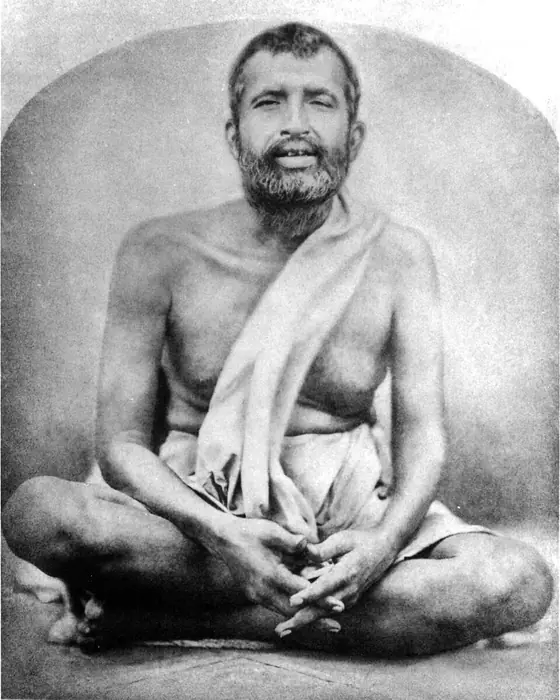
A very small number of photographs of Sri Ramakrishna were taken in his lifetime — the tradition counts three, all from his last seven years, including the one in ecstasy that is worshipped in Ramakrishna Math shrines across the world — and Belur Math reproduces them on its site, linked below, together with photographs of the Dakshineswar temple, the Cossipore house and the Kamarpukur home. The portrait at the head of this page is one of those few: the seated photograph, long out of copyright and reproduced by the Order for well over a century, credited on the credits page. For the rest, the reader should go to Belur Math's own pages. Nothing on this page has been drawn or generated by a machine to imitate his face; a made-up likeness of a man of whom true photographs exist would be a small dishonesty on a page about a man who had none. The map above is drawn from the places named in his own conversations and in the accounts of his disciples, and the pins are to today's West Bengal, Jharkhand and Uttar Pradesh.
Read the originals
Every link below goes to the Ramakrishna Order's own institutions or to the full text of the primary record. Nothing here points to an encyclopaedia.
- The Ramakrishna Order's own account of his life, with the photographs — Belur Math
- The Gospel of Sri Ramakrishna, recorded by Mahendranath Gupta ("M."), full English text
- "My Master" — Swami Vivekananda's 1896 lecture on his teacher, Complete Works, volume 4
- Sri Sarada Devi, the Holy Mother — Belur Math
- The Dakshineswar Kali Temple, where the life was lived — official site
- Advaita Ashrama, the Order's publishing house — Sri Ramakrishna, the Great Master and the Sayings
Every daily message names the teacher it came from. Read the messages, or see the whole line this teacher stands in: all fifty-one teachers.