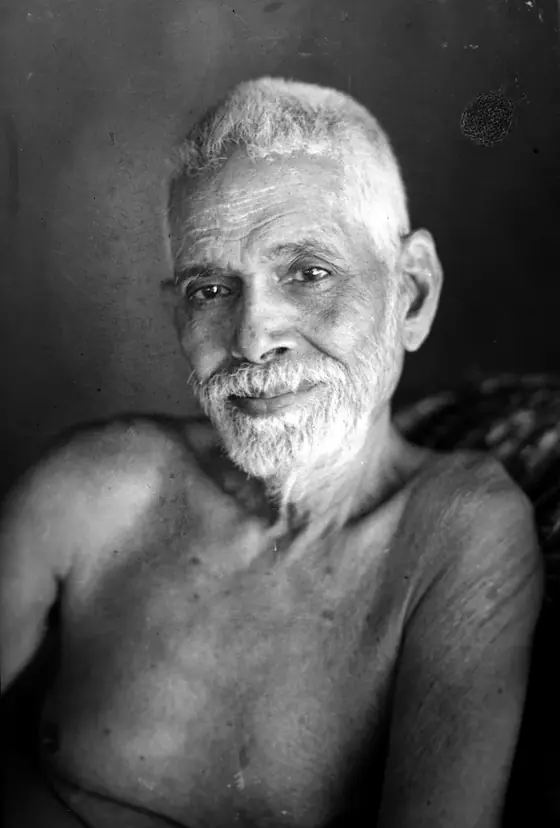
Sri Ramana Maharshi
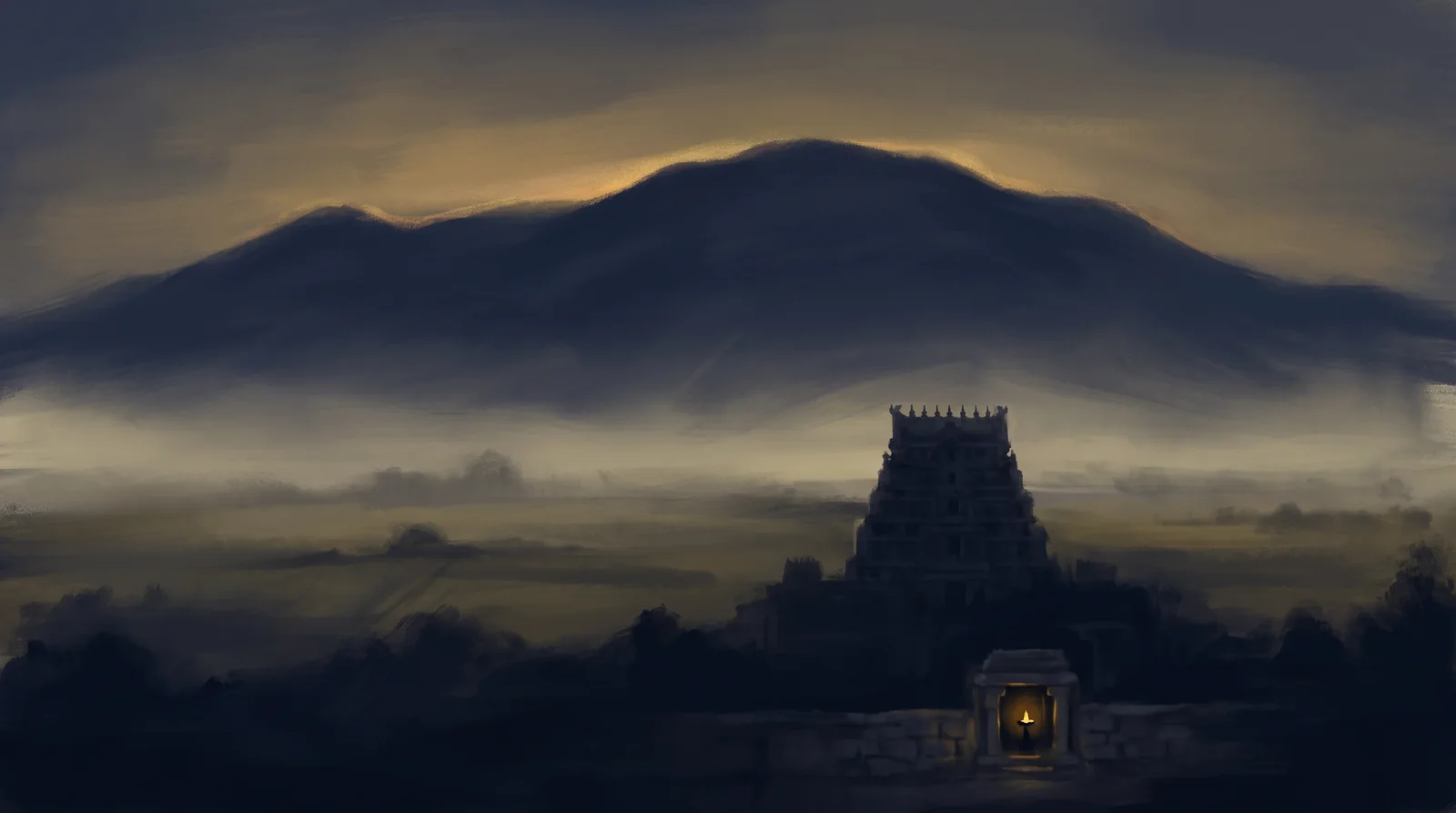
The sage of Arunachala
1879–1950 · The Ramana Lineage
- When
- 1879–1950
- Born
- Tiruchuli, Tamil Nadu
- Where the life was lived
- Born at Tiruchuli in Tamil Nadu; reached Tiruvannamalai on 1 September 1896 at sixteen and never left Arunachala again — the great temple, the Pātāla Liṅgam vault, Pavalakkunru, seventeen years in the Virūpākṣa cave on the hill, then Skandāśramam and the āśramam at its foot — fifty-four years in one place.
- What is left of it
- Who Am I?; Upadeśa Undiyār; Forty Verses on Reality; Tamil renderings of Ātma Bodha, the Vivekacūḍāmaṇi and the Dṛg-Dṛśya-Viveka; the Five Hymns to Arunachala.
Recovered self-enquiry — the plain question 'who am I?' — as a complete practice, and taught it for over fifty years mostly in silence, free of charge, to anyone who walked in.
A house in Tiruchuli
He was born just after one in the morning on 30 December 1879, in the small temple town of Tiruchuli in what is now Tamil Nadu, and named Venkataraman. The date fell on Ārudrā Darśana, the day the tradition keeps for Śiva's appearance as the dancer, which is the sort of coincidence a tradition notices afterwards. The house is still there; it is called Sundara Mandiram now, after his father.
The family was ordinary. His father Sundaram Iyer was a pleader in the local courts. There were two brothers, Nagaswami and Nagasundaram, and a sister, Alamelu. The boy was strong, played hard, slept so deeply that friends could carry him about without waking him, and was an indifferent student with an unusually retentive memory. Nothing in the early record points forward, apart from one small story the ashram keeps: reprimanded for making kites and paper boats out of a bundle of his father's discarded case papers, he vanished, and the search failed — until the priest, in the middle of worship at the shrine of the Goddess Sahāyavallī, found him sitting silently behind the image.
His father died on 18 February 1892, when the boy was twelve. The household broke up, and he went to Madurai to live with his uncle Subba Iyer and attend school there.
Two things heard in Madurai
In November 1895 an elderly relative mentioned, in passing, that he had come from Arunachala. The boy had known the name all his life as something enormous and abstract, a holy place spoken of the way one speaks of heaven; hearing that a person had simply walked there from a train produced, on his own later account, a jolt out of proportion to the words. Around the same time, or a few months after, he read the Periya Purāṇam, the Tamil lives of the Śaiva saints — the first religious book he had read for himself, and one full of people who gave up everything without hedging.
Mid-July 1896
He was sixteen, alone in an upstairs room of his uncle's house in Madurai, in good health, with no crisis under way. A violent fear of death came over him with no cause at all.
What he did next is the whole of his teaching in embryo. He did not pray, and he did not call for help. He decided to find out, immediately, what it was that was about to die. He lay down, held his limbs stiff, held his breath, shut his mouth so no sound could escape, and put the question as concretely as he could: the body is going; when the body is a corpse and burned to ash, am I gone with it? The answer, as he described it ever afterwards, was not a conclusion he reached but something that declared itself — that the body dies and the awareness in which even the body appears does not, and that this awareness was not an idea about himself but the closest thing to himself there was.
The fear did not come back. Neither did the schoolboy. He lost interest in study, food, company and status in a matter of weeks. The house in which this happened is now called Ramana Mandiram.
Arunachala, 1 September 1896
On 29 August 1896 he left a note, took a small sum for the fare, and went to the hill. He arrived on 1 September, went straight into the great temple of Arunācaleśvara to the inner shrine, and — this is the detail worth keeping — on being asked whether he wanted his head shaved, consented, walked to the Ayyaṅkuḷam tank, had it shaved, and threw the money he had left into the water. He was sixteen, he had no plan, and he never left the hill again in the fifty-four years that followed.
The first years were severe and are recorded in detail by the ashram. He sat in the underground cellar of the temple known as Pātāḷa Liṅga, so absorbed that he did not notice insects feeding on his legs, and had to be carried out bodily to the Subrahmaṇya shrine. Seśādri Swāmī, a local figure thought mad by the town, tried to guard him. He moved to the tower shrine, then the flower garden, then a room where the temple floats were stored, then under a tree. In February 1898 he moved to Gurumūrtam on the edge of Tiruvannamalai, and there Palaniswami began attending on him, which he continued to do for twenty-one years. From 1899 he was on the hill itself, in a series of caves, and from about then until 1916 he lived mostly in Virūpākṣa cave, using the Mango Tree cave in the hot season.
He was silent for years. Not under a vow — he said later that he simply had nothing to say and no inclination to say it.
How the teaching got written down at all
He never sat down to compose a system. Every one of the foundational texts exists because somebody asked and somebody else wrote down the answers.
Between 1900 and 1902 a devotee named Gambhīram Śeṣayya put questions to him in writing; the replies became the tract known in English as Self-Enquiry. In 1902 Śivaprakāśam Piḷḷai, a government official, brought fourteen questions; those answers became Who Am I?, which remains the shortest complete statement of the method in existence and can be read in twenty minutes. Later came the Tamil poems: Upadeśa Undiyār on the paths of action, devotion, breath and knowledge, and Uḷḷadu Nārpadu, forty verses on what is, composed in 1928 at the request of the poet Muruganar. Decades of conversations with visitors were recorded by others; one collection of them, taken down over four years in the 1930s, is the book usually called Talks.
What he actually taught
One instruction, held for five decades without softening.
He said the trouble is that a single thought — the sense of being a separate someone, the "I" that claims the body and the biography — is taken for granted and never examined, and that every other thought hangs off it. So look at it. Not think about it: look. When a thought arises, ask to whom it has arisen; the answer will be "to me"; then ask what that "me" is, and keep the attention there rather than answering in words. He called the method vicāra, enquiry, and he was blunt that it is not a technique for producing a state. The self is not something absent that enquiry will fetch. It is what is looking, and the enquiry simply stops the attention running outward long enough for that to be obvious.
He was notably unromantic about the rest. Asked about postures, he said the only posture needed is steadiness in the self. Asked about the ideal place, he said the place is the self. Asked whether one must give up work and family, he almost always said no: do the work, and find out who is doing it. Asked about other paths, he did not attack them; he said devotion and enquiry arrive at the same place, since surrendering the one who would surrender is exactly what enquiry does.
And he taught mostly by sitting there. Visitors who came with prepared questions frequently reported that the questions dissolved before they were asked. That is not a claim anybody can verify from outside, but it is what the record says, repeatedly, from hostile and friendly witnesses alike.
The difficulties, which were real
The hagiography can make this look effortless. It was not.
His body took years of damage in the early period through sheer neglect. His family came looking for him: his mother Alagammal arrived with his brother in December 1898 and begged him to come home, and he would not answer her, finally writing a note saying that what is to happen will happen and that the best course is to remain silent. She eventually came to live at the hill and stayed until her death in 1922; the shrine built over her samādhi became the centre of the present ashram, and the ashram grew around a grave rather than around a plan.
As his reputation spread, an establishment assembled itself around a man who had never asked for one, and with it came the ordinary human friction of any institution: control of donations, who could approach him, who spoke for him. He refused to arbitrate, would not accept anything given for his personal use, and declined to name a successor or found an order, which is precisely why there is no organisation that owns his teaching today.
In his last years he developed a sarcoma on his left arm. It was operated on four times; it returned each time. He refused to let attendants treat his body as more important than anyone else's, continued to give darśan to the end, and when devotees wept he asked where they imagined he could go. He died on 14 April 1950 at Tiruvannamalai. He had lived at the foot of one hill for fifty-four years.
The timeline, plainly
- 30 December 1879: born at Tiruchuli.
- 18 February 1892: his father dies; the family moves; he goes to school in Madurai.
- November 1895: hears that Arunachala is a place a person can walk to; reads the Periya Purāṇam.
- Mid-July 1896: the death enquiry, in an upstairs room in Madurai, at sixteen.
- 29 August 1896: leaves home. 1 September 1896: arrives at Arunachala; shaves his head; throws away the remaining money.
- 1896 to 1899: the temple precincts, Gurumūrtam, the mango orchard, Pavaḷakkuṉṟu.
- 1899 to 1916: the caves of the hill, mostly Virūpākṣa.
- 1900 to 1902: Self-Enquiry. 1902: Who Am I?
- 1916 to 1922: Skandāśramam, higher up the hill, with his mother in residence.
- 1922: his mother dies; the ashram forms around her shrine at the foot of the hill.
- 1928: Uḷḷadu Nārpadu.
- 14 April 1950: dies at Tiruvannamalai, of a sarcoma, having never left the hill.
Why it is usable now
Because it needs nothing. No membership, no belief, no Sanskrit, no quiet room, no free hour. It is a question you can put to yourself in a queue, in a meeting, in the middle of an argument you are losing, and the whole of the practice is to notice who is claiming the state you are in.
And because it is testable in the only place that matters. Ramana's claim is not that you will feel better, though people did. It is that the one you are defending all day will not survive being looked at directly. That is a factual claim about your own experience. You can check it this evening, and no one can check it for you.
Read the originals
Primary texts and the records kept by the teacher's own institution.
Every daily message names the teacher it came from. Read the messages, or see the whole line this teacher stands in: all fifty-one teachers.