Sri Sadhu Om
Poet and expositor of self-enquiry; editor of Sri Muruganar's verses
c. 1922–1985 · The Sri Ramana Lineage
- When
- c. 1922 – 17 March 1985
- Born
- Thanjavur district, Tamil Nadu; the sources name only the district
- Where the life was lived
- Thanjavur district; Tiruvannamalai from 1945 (the ashram’s date) or July 1946 (his book’s preface) — in the ashram 1955–60, then a house at Ramananagar for over twenty years; Pondicherry only for the hospital in his last days.
- What is left of it
- The Path of Sri Ramana (Sri Ramana Vazhi), Parts One and Two, and Sadhanai Saram; the Tamil commentary (urai) on Guru Vacaka Kovai and its English translation with Michael James; commentary on Upadesa Undiyar; Sri Ramana Gitam, Sri Ramana Varnangal, Sri Ramana Sahasram and nearly six thousand songs; the editing of Sri Muruganar’s manuscripts (Sri Ramana Jnana Bodham).
Kept Sri Ramana's recorded words usable, in the language they were spoken in and in English.
The district he came from
Almost everything that is known about him for certain was written down in the spring of 1985, in the three months after he died, by three men who had known him well: Professor K. Swaminathan of the Ramana Kendra, New Delhi; V. Ganesan, the managing editor of the ashram’s journal The Mountain Path; and Michael James, the Englishman in whose house he died. Their memorial articles filled eleven pages of the July 1985 issue, and this page rests on them, on the prefaces and notes printed in his own books, and on a short editorial note the journal printed with one of his commentaries in 2004. What they say about his beginnings is brief, and this page will be brief too, because the sources are. “Born in the Thanjavur District of Tamil Nadu, Sadhu Om first came to Bhagavan in 1945. He became a close associate of Muruganar and settled permanently in Ramananagar. A naturally gifted poet he wrote many philosophical verses and songs. His book The Path of Sri Ramana Part One is an authentic and original exposition of Bhagavan’s teachings. He attained samadhi in 1985.” That is the whole of the 2004 note. The publisher’s note to Part Two of his book adds a little: “Sri Sadhu Om hails from the Thanjavur district (in Tamil Nadu) which is famous as the centre of Tamil learning and culture. From his early childhood he was of a spiritual bent of mind showing great reverence towards Saints and Sages. In his early teens a poet in Tamil by divine Grace, the inspiration having come to him at the tender age of fourteen.”
Thanjavur is the old Chola heartland in the Kaveri delta: the district of the great Brihadisvara temple, of the Saraswati Mahal library, of the Tamil Saiva hymnists whose songs are sung in its temples every evening, and of a scholarly, temple-centred Tamil culture that has produced poets for a thousand years. A boy from that district who began composing Tamil verse at fourteen was doing something the district understood. The preface to The Path of Sri Ramana, written by those who knew him, says that “the author of this book, Sri Sadhu Om Swamigal, developed a deep yearning for spiritual knowledge even in his early childhood, and that yearning began to express itself in his fourteenth year in the form of a copious flow of Tamil verses and songs. In due course in his early twenties his spiritual yearning naturally drew him to the Feet of his Sadguru, Bhagavan Sri Ramana.” His age at death, given by the memorial as “only 63” in March 1985, puts his birth in 1921 or 1922; later accounts generally give 1922, and this page follows them while noting that the primary sources give only the age. His birth name, his village and the names of his parents are given in some later accounts, but none of the sources used for this page records them, and they are not stated here as fact. He himself, as will be seen, prayed to remain unknown, and it seems right that a page about him should begin by admitting how far that prayer was answered.
Where the life was lived
The map is nearly a straight line. He was born in the Thanjavur district and came, in his early twenties, by train from Tanjore to Tiruvannamalai, and there he stayed for the rest of his life: in the ashram itself for five years from 1955, and afterwards in a house near it, in the settlement the devotees call Ramananagar, for more than twenty. He walked round the hill two or three times a week until the last week of his life. He never founded anything, never travelled to teach, and refused invitations to the West in words that are quoted below. The only other place on the map is Pondicherry, where he was taken to hospital on the last Friday of his life and from which, at his own long-standing wish, he was brought back to die in sight of Arunachala.
Present-day India; no border but India’s is shown. The pins are the only three places the sources name; the dotted line is the one journey of his life, by train from Tanjore to Tiruvannamalai in 1945 or 1946, and is not a surveyed route. The district town of Thanjavur is pinned because The Mountain Path names only the district of his birth.
- 1Thanjavur (Tamil Nadu) — Born in the Thanjavur district about 1922; the sources name only the district, so the pin marks the district town, from whose station he took the train to Tiruvannamalai composing Kuyilodu Kooral on the way
- 2Tiruvannamalai (Tamil Nadu) — Came in 1945 (July 1946 by his own book’s preface) and stayed for life: sent to Sri Muruganar on the first day; in the ashram 1955–60; then more than twenty years in a house at Ramananagar near it; giri-pradakṣiṇa two or three times a week to the last; died 17 March 1985, 9.05 a.m., in the hall of Michael James’s house facing Arunachala; his samādhi is here
- 3Pondicherry (Puducherry) — Jipmer hospital, Friday 15 March 1985, after the haemorrhage; brought back to Tiruvannamalai the next day at his own wish
The map is drawn on present-day coordinates. The Thanjavur pin marks the district town, because the sources name only the district; the pin’s note says so.
The song on the train
The one story everyone tells about his arrival is the story of a song. Michael James: “On the very first day that Sri Sadhu Om came to Sri Bhagavan in 1945, Sri Bhagavan sent him to meet Sri Muruganar and to show him his song Kuyilodu Kooral, which had spontaneously surged forth from his heart while he was travelling by train from Tanjore to Tiruvannamalai.” Kuyilodu Kooral means, roughly, “speaking with the cuckoo”. A young Tamil poet composed a song on the train to see his guru; his guru, on the first day, did not keep the poet for himself but sent him to the older poet who lived across the road; and the two of them were friends for nearly thirty years. V. Ganesan tells it the same way: “He was fortunate that on the very first day he came to Sri Bhagavan in 1945, an intimate friendship was forged between himself and Sri Muruganar, the fountain-head of Ramana-bhakti.” The sending is the point of the story. Sri Ramana seldom gave instructions; here he gave a new arrival a friend and a life’s work in a single gesture, and the young man understood it as an instruction and obeyed it until he died.
The year needs a note. Both memorial articles of 1985, and the journal’s own note of 2004, say he came in 1945. The preface to the fourth edition of The Path of Sri Ramana, printed in 1990 and reprinted since, says something different: “Though his outward contact with Sri Bhagavan lasted barely four years (from July 1946 till April 1950)…” The same preface, a page later, quotes a questioner saying he had lived with Sri Ramana “for only five years”, and the “About the Author” note in Part Two also says five. Some later accounts give the exact date of 6 July 1946. This page cannot resolve the difference from its sources and does not try; it reports 1945 as the ashram’s date and July 1946 as the date given in his own book’s preface, and notes that the two are eighteen months apart, that both were written by people who knew him, and that neither he nor they seem to have thought the question important. What both agree on is what he did with the time.
The story he liked to tell against himself belongs here. “Though the time a disciple has spent in the physical presence of his Sadguru is not a criterion by which one can judge his spiritual attainment, some people used to gauge the worth of each devotee of Sri Bhagavan by the number of years they had lived with Him. When one such person once asked Sri Swamigal in a slightly disparaging manner, ‘You lived with Sri Ramana for only five years; are there not many who lived with Him for many more years than you did?’ he replied, ‘Yes, I am indeed ashamed about it, because when even five seconds were more than sufficient for the divine Power shining in the Presence of Sri Bhagavan to quench the spiritual thirst of mature souls, if five years were necessary in my case, does it not show my state of immaturity?’” The answer turns a boast into a confession and a confession into a teaching, in one sentence, and it is entirely characteristic. The publisher’s note in Part Two makes the same point with Sri Ramana’s own image, quoted from A Sadhu’s Reminiscences: “Coal takes time to ignite, but charcoal is proportionately quicker, while gun powder ignites immediately. So it is with men under the powerful glance of a Jnani.”
“One for tapas, two for Tamil”
Sri Muruganar was the poet of the ashram: the author of Sri Ramana Sannidhi Murai, the great sequence of hymns to Sri Ramana in the manner of the Tamil Saiva saints, and of Guru Vācaka Kōvai, the versified record of Sri Ramana’s spoken teaching, every verse of which Sri Ramana read and checked. This site has a page on him. He was more than thirty years older than the newcomer, a Tamil scholar who had worked on the University of Madras Tamil Lexicon, and he was, in the memorial’s word, the “fountain-head” of devotion to Sri Ramana in verse. What passed between them is described by Michael James with a precision that suggests he had watched it: “Through his association with Sri Muruganar, Sri Sadhu Om was able to learn many subtle points about classical Tamil grammar and prosody, to gain a deep insight into the terse and cryptic style of Tamil used by Sri Bhagavan in His works, and also to perfect his own innate but untrained poetic genius. In return, Sri Sadhu Om did singular service to Sri Muruganar in helping him to finalise his verses and to preserve them for posterity. As Sri Muruganar used to say ‘One for tapas, two for Tamil’ (tavattuku oruvar, tamizhukku iruvar), because such refined literary work can be done perfectly only when two equally accomplished poets assist each other.”
The saying is a small piece of Tamil wisdom: austerity is done alone, but poetry needs two. Muruganar wrote his verses on scraps of paper, thousands upon thousands of them, and it was the younger man who copied them out, kept them, checked their metre and their meaning, and saw them through the press. Professor Swaminathan: “Sri Sadhu Om was closely associated with Sri Muruganar from the year 1945. He immersed himself fully in the divine sweetness of Sri Muruganar’s poetic out-pourings, and he was responsible for copying and preserving most of his verses.” Muruganar knew what he owed. “Sri Muruganar himself emphatically stated, ‘If any of my verses are to be printed at any time by anyone, they should be published only if Sri Sadhu Om is entrusted with editing them and with seeing that they are printed without any errors’. When the third edition of Sri Ramana Sannidhi Murai and the second edition of Guru Vachaka Kovai were published by Sri Ramanasramam during the last years of Muruganar’s life, they were edited and proof-corrected only by Sri Sadhu Om. No wonder Sri Muruganar entrusted all his manuscripts to the sole care of Sri Sadhu Om.” In his last days, Michael James records, the old poet put it more violently: “If Sadhu Om is not entrusted with full responsibility for preserving and editing all my unpublished verses, then it will be better to bundle all of them together and offer them into the Deepam-fire on top of Arunachala or drown them into the Bay of Bengal.” Muruganar died in 1973. The manuscripts came to Sadhu Om, and the last twelve years of his life were spent, in large part, on another man’s poems.
There was a third. “Another old devotee with whom Sri Sadhu Om had a very intimate and long-standing friendship was Sri Natanananda Swami. Indeed, Sri Muruganar, Sri Natanananda and Sri Sadhu Om formed a trio of accomplished Tamil poets wholly dedicated to Sri Bhagavan and His teachings.” Sri Natanananda had come to Sri Ramana in 1918 and was much the elder; he wrote, the memorial says, more than seventy verses on the younger man’s life and work, some of which “declared openly his high spiritual attainment”. Two are given in translation in the memorial. “O heart, due to the quality of contentment, Sadhu Om has for ever attained perfect tranquility of mind in Bhuma (the state of Brahman).” “O heart, it is very rare to revel like him (Sadhu Om) in the sat-bhava ‘Who is there other than oneself?’ just like a bee which has drunk honey.” This page reports these as what a senior fellow disciple wrote about him; it makes no judgement of its own about anyone’s attainment, and he would have been the first to object if it did.
The three memorial articles are in The Mountain Path, volume 22 number 3 (July 1985), pages 195–205, linked at the foot of this page; Professor Swaminathan’s piece is described there as extracts from a talk he gave on 5 May 1985 at the Ramana Kendra, New Delhi, which had placed its appreciation on record on 24 March. The 2004 note is on page 53 of the January 2004 issue, introducing Sri Sadhu Om’s commentary on Sri Arunachala Pancharatnam.
After 1950: the bookstall and the dispensary
Sri Ramana died in April 1950. What the young poet did in the five years immediately after is not recorded in the sources used here; what he did from 1955 is. V. Ganesan, who ran the ashram for many years and knew its working parts: “Sri Sadhu Om’s association with the Ashram was close and active, though for over 20 years he was living independently in a house near the Ashram. In this respect he was just like Muruganar, Natanananda and Kunju Swami, who also lived outside the Ashram yet helped the Ashram in every possible way. While he was living in the Ashram from 1955 to 1960, he worked hard and efficiently in the bookstall and dispensary. In the later years, in spite of his weak eye-sight, he continued to take great pains to read, edit and correct the proofs of many Ashram publications. Like Sri Muruganar, he was very particular that Ashram publications should be totally free from errors.” A gifted poet who sold books and dispensed medicines for five years, and then read proofs for twenty-five with failing eyes, is not the usual picture of a spiritual teacher, and it is the picture the sources give. He seems to have regarded the accuracy of a printed text of Sri Ramana’s words as a form of devotion, and he was probably right.
The hill was the other constant. “The last activity he did before losing his normal waking consciousness was to go round Holy Arunachala. He held Giri-pradakshina to be of great spiritual efficacy and advised people to go round this ‘Hill of Grace’ at every opportunity. He himself did Giri-pradakshina regularly twice or thrice a week till his end. Mr. Michael James, who lived with him, does this daily for the past eight years.” Giri-pradakṣiṇa is the walk of some fourteen kilometres clockwise round Arunachala, barefoot by custom, which Sri Ramana himself recommended and which devotees still make in their thousands at every full moon. He held that Arunachala was Sri Ramana, and Sri Ramana had said so; the walk round the hill was therefore, for him, a way of being physically in his guru’s presence after the body had gone, and he went on doing it into his sixties.
Ganesan’s summary of what drove the whole life is worth having in full: “Ekagra-bhakti, one-pointed devotion to Sri Bhagavan, was the current underlying the entire life of Sri Sadhu Om. … A poet at heart and a consummate master of the Tamil language, Sadhu Om dedicated his talents to the service of his Satguru alone. His devotion to Sri Bhagavan found varied and abundant expression in the thousands of heart-melting Tamil songs which flowed from his heart. The salient feature of his teaching was the emphasis which he always placed upon one following Sri Bhagavan’s path of Self-enquiry. He used to encourage all Tamil-knowing devotees to study the works of the Master in the original Tamil rather than depending upon translations. Sri Ramana Nool Tirattu (The Tamil Collected Works) was his Bible! For him every verse composed by Sri Bhagavan was a mantra, and hence he would encourage even foreigners to learn and recite His works, especially Sri Arunachala Stuti Panchakam, for which he had the greatest admiration.”
“We should not open the door unless it is knocked”
He was, the sources agree, a teacher who refused to teach, and the refusal is the most instructive thing about him. “Though he was one of the foremost devotees of Sri Bhagavan, during his own lifetime Sri Sadhu Om remained little known to the world, except perhaps to a small circle of sincere Ramana-bhaktas. A man of many gifts and talents — indeed a versatile genius — he nevertheless chose to live and pass away from the world without the least stain of name and fame.” The preface to his book gives the rule he lived by: “‘We should not open the door unless it is knocked’ was the principle underlying all his acts. Unless he was questioned with sincere earnestness, he would not speak or write anything about spiritual matters. Rising and going outwards to teach the world, getting on platforms to deliver lectures, seeking to enlighten the world by writing voluminous books, founding institutions, propagating religious doctrines by publishing magazines — all such activities he used strictly to avoid. And in doing so, he was but following the path lived and exemplified by Bhagavan Sri Ramana.”
He explained the rule when asked, and the explanation is a small Advaita sermon in Tamil homely imagery: “We should not run after the world; we should not look outwards at the world, we should look inwards at Self. Those sannyasis who run after the world achieve neither the world nor Self (God). If we try to chase after our shadow, we will never catch it; but if we go towards the sun, our shadow will automatically come running behind us. Those sannyasis who are always attending to the world with the aim of teaching the world became spoilt in the end… No Sage (jnani) who ever came on earth was the product of an ashramam, math or any such institution. Each one of them stood alone and realized the Truth by himself. There is no rule that a man can attain true knowledge (jnana) only by becoming an inmate of a religious institution. Therefore, in the name of service to the world, let no one cheat himself and retard his spiritual progress by forming foundations and associations and by preaching, shouting slogans and running magazines.” It should be said at once that this is one devotee’s view, held with force, and that this site has pages on teachers who founded great institutions and served the world through them with distinction. He is not quoted here to belittle them; he is quoted because it is what he thought, and because it explains a life that would otherwise look like waste.
Three refusals are on record. Someone wrote from Australia asking for his photograph, and he replied: “Sri Bhagavan being the Guru common to yourself and myself, His name and form alone are to be glorified and adored; my photo is therefore immaterial.” A friend wanted to write and publish an article about him, and “he objected humbly, explaining that he preferred to remain unknown to the world and pointing out to verse 623 of Guru Vachaka Kovai, in which Sri Bhagavan says: ‘Because it brings one under the great evil of yielding to pramada (forgetfulness of Self), through which one is made to think that one is the worthless and mean body, while in fact one is the supreme Brahman, fame (or praise) is to be rejected with great contempt and is not at all to be aspired for by wise people’.” And an earnest seeker in the United States wrote, “Will you not come to the West and guide us?” His reply is printed in the preface to his book: “…It is therefore unnecessary for the Reality to run after the world. Moreover, according to the great truth discovered and revealed by Sri Ramana Bhagavan, a good person leading a simple yet highly spiritual life and passing away unknown to the world does far greater good to the world than all the political and social reformers and all the platform-heroes of philosophy. A truly enlightened life will surely help earnest seekers even though they may be living in a remote corner of the world and even without any physical contact, communications, magazines or writings. This is Sri Ramana Bhagavan’s method of teaching the world through speech-transcending Mystic Silence, the greatest Power. Is it not up to us to follow the footsteps of our Guru, Sri Ramana?… So why should I think of going anywhere? As He who has guided me to His home is the Father, Lord and inmost Self of one and all, does He not know best how to guide home earnest seekers, wherever they may be? Why then should an ego rise with the thought ‘I should guide people’? If such an ‘I’ were to rise, would it not be a self-conceited attempt to belittle the Grace of Sri Ramana, the one reality? Therefore, the thought of going to the West or the East, or here, there or anywhere else, has never occurred to me and will never occur to me!”
“The Guru alone is living, we are all dead”
The refusal that mattered most was the refusal to be anyone’s guru. “Sri Sadhu Om truly stood as a peerless example of perfect Guru-bhakti. Though there were some people who wished to take him as their Guru, he always steadfastly refused to accept for himself the position of Guru. He often used to point to the shining example of Sri Muruganar, who was the foremost disciple of Sri Bhagavan yet who never accepted for himself the position of Guru even after Sri Bhagavan had left the body. Sri Sadhu Om used to say that one of the important signs of a true disciple of Sri Bhagavan is that he will never accept for himself the position of Guru but will always encourage all devotees to take Sri Bhagavan alone as their Guru.” People pressed him on the obvious objection, that Sri Ramana was dead and a seeker needs a living guru, and his answer became famous among devotees: “The Guru alone is living, we are all dead. If by the term ‘living Guru’ you mean a Guru whose body is living, then such a living Guru will one day become a dead Guru. What is the use of such a Guru who will not be living for ever? But if you take Sri Bhagavan alone as your Guru, then you will have an ever-living Guru, because Sri Bhagavan is the ever-existing Self shining in the hearts of all people.”
He did not, however, teach that a seeker can do without a guru in name and form; his position was more careful than that, and Michael James is careful to report it. “However, although Sri Sadhu Om thus denied the need for a ‘living guru’ he always emphasised the need for us to accept one particular name and form as our Guru. Only a very few rare souls such as Sri Bhagavan and Lord Buddha have attained Self-knowledge without a Guru in name and form. For the majority of spiritual aspirants, a Guru in name and form is absolutely essential, though that name and form need not be the name and form of a person whose body is now living. Of all the names and forms, assured Sri Sadhu Om, the ideal one for us all to accept as our Guru is that of Sri Bhagavan, who will ever live and shine as an unequalled and unsurpassed manifestation of Divine Grace.” And to those who asked how a dead teacher’s grace could reach them, he gave the answer that also explains why he never left Tiruvannamalai. “Sri Bhagavan’s help and guidance is never lacking or insufficient”, Michael James says he often used to assure people, “indeed, His Grace is the sole existing reality in this false world. There can never be any need for any devotee of Sri Bhagavan to go to any other God or Guru. No intermediary is necessary between Him and us. Of His own accord, He directly contacts the heart of each devotee who comes to Him, without the need for any intercession from others. To obtain His Sat-sanga, we have but to think of Him, pray to Him, read His teachings, reflect on them and practise them. Such mental contact with the Sadguru is the best Sat-sanga. And if at all we want Sat-sanga with His physical form, He is and ever will be standing here in the form of Arunachala. In His works Sri Bhagavan has revealed that Arunachala is Himself… Arunachala is the foremost physical embodiment of the reality or Sat, so there is no better form of outward Sat-sanga than to live in Tiruvannamalai and to do Arunachala-pradakshina.”
The reader should notice what this position does and does not claim. It does not claim that Sri Ramana is the only guru, or that other teachers and other schools are worthless; the first chapter of his own book quotes with approval Sri Ramana’s verse that one should follow the religion in which one has faith and not argue against others. It claims that for one who has taken Sri Ramana as guru, the death of the body changes nothing, because the guru was never the body; and that is simply Advaita applied to the relationship of disciple and master: the guru, in the tradition’s older words, is the Self, appearing outside in order to turn the mind within.
How the book was written
He did not intend to write a book, and the account of how one came to exist is given in the preface to it. “After Bhagavan Sri Ramana cast off His mortal body in 1950, many of His devotees from both India and abroad gradually came to recognize Sri Sadhu Om Swamigal, the author of this book, not only as one of the foremost disciples of Sri Bhagavan, but also as a person endowed with a rare gift to elucidate His teachings in a clear and simple manner which could easily be understood and followed in practice by all seekers of true knowledge. Thus many devotees used to approach Sri Swamigal seeking clarification from him about all aspects of Sri Bhagavan’s teachings, especially about the method of practising Self-enquiry. Finding the lucid explanations given by Sri Swamigal in answer to their various questions to be of great help in their spiritual practice, some devotees used to make notes of the replies he gave orally, while others used to collect and preserve the letters which he wrote to them in answer to their doubts.” One of them, Dr R. Santanam, spent several years gathering the letters and notes and asked him to edit them. He refused to make a miscellany of them, selected only what bore on the direct path of Self-enquiry, and arranged it so that the ideas flowed in sequence; Dr Santanam published the result in Tamil in 1967 as Sri Ramana Vazhi, Part One. An English version followed in 1971, at the request of devotees who did not read Tamil. Readers then asked why he had said nothing about surrender, God, the world and karma; he went back to the material Dr Santanam had gathered, took the replies he had set aside, and compiled Part Two, on the world and God, on love or bhakti, and on karma, which appeared in English in 1976. The verses and songs he had written in reply to Tamil questioners were gathered as Sadhanai Saram, “the essence of spiritual practice”, and published in Tamil in 1983 as the third part. In 1984–85, as the third Tamil edition of Parts One and Two was being printed, he revised both, adding explanations he had given to readers of the earlier editions; the revised Tamil volume was released, as it turned out, some seven weeks after his death.
His own view of all this was stated plainly. “When aspirants used to ask him questions about spiritual matters Sri Swamigal would sometimes reply, ‘Since you ask me, I can answer, but only in accordance with the teachings of Sri Bhagavan. Do not expect me to give replies in such a manner as merely to please you. I can tell you only what I have come to know from Sri Bhagavan. If you ask about paths other than Sri Bhagavan’s path of Self-enquiry, I can also explain about them, but only in the light of Sri Bhagavan’s teachings. His teachings alone are the authoritative sastras for me. If the world chooses not to accept my ideas, it does not matter; let it throw them away’.” And of the books that bore his name: “I told whatever I know only for those who asked me. I do not object if they wish to share these ideas with others by printing them in the form of books. But I have not come to the world for writing books. I am not a writer, nor do I have any desire to become a writer. If the world likes to have these ideas, then it is its own responsibility to publish them.” The book, in other words, is a transcript of answers, arranged by the man who gave them, and it should be read as one: not as a treatise by an author but as a long reply to a long series of questions, most of them about how, exactly, one is supposed to do what Sri Ramana said.
The publishing history is from the preface to the fourth English edition (1990) of The Path of Sri Ramana, Part One, reprinted in the sixth edition of 2005 that is linked below, and from the publisher’s notes to Part Two. Michael James’s own page on the book, also linked, adds that the English of the early editions was made largely by friends who were not native speakers, that Part Two in particular remained “the same unsatisfactory translation that was published in the first edition”, and that a thoroughly revised single-volume translation was published in 2023 by the Sri Ramana Center of Houston. This page quotes the older translations because they are the ones freely available in full.
What the book says: happiness
The book begins where Sri Ramana’s Nāṉ Yār? begins, with the observation that everyone wants to be happy, and treats it not as a platitude but as the first premise of an argument. “The world progresses by intellect. All that is great in this world is just a manifestation of the intellect. What is the goal towards which the world is moving? What is the world striving for? Careful observation will show that all are striving for happiness. From the smallest ant to the greatest emperor, everyone is tirelessly working. For what? For happiness, and happiness alone!” The happiness people obtain through the senses, he goes on, is fleeting; a flower’s scent fades, a cool breeze palls, and beyond a limit every pleasure becomes a pain. Yet “the desire for happiness is not wrong! Happiness must be obtained! It is in fact the Supreme goal (purushartha) for all human beings! But the means to obtain it which have been charted and followed by people up till now are wrong. The defect is only in the means and not in the goal.”
The religions, he says, are the paths people have found towards this goal, and he is careful, at the outset, to disclaim any quarrel with any of them, quoting Sri Ramana from the Guru Vācaka Kōvai: “With true love and faith, follow that religion in which you have belief and turn within; do not jump outwards, criticizing and arguing against other religions on account of bigotry for your own religion.” What Sri Ramana adds to the religions, he argues, is a short cut: “It will be found at the end of this research how His Teaching is the direct path, like the hypotenuse of a right-angled triangle, and an easy one to follow.” And for whom? “Now, who is fit to follow this path to bliss which Sri Bhagavan has shown? Are the brahmins alone fit to follow it? Or are Hindus alone qualified to follow it? Is Bhagavan Sri Ramana a Guru for Hindus only? Does He propagate a particular religious faith which is already in the world, or is it an altogether new religion? Such questions may arise in the mind of the reader. The path of Sri Ramana is meant for anyone who craves for happiness. Is there anyone in the world who does not want happiness?” The second and third chapters carry the argument on: happiness is not in objects but in the mind’s subsiding when a desire is met, which is why one is happy in deep sleep with no objects at all; therefore happiness is one’s own nature, obscured by the mind’s activity; therefore the way to permanent happiness is the permanent subsiding of the mind; and the mind, being nothing but attention going outwards, subsides when attention is turned upon itself. That last step is the whole of the book, and the remaining chapters are about how to take it and how not to.
What the book says: the clue
The chapter that made his reputation among practitioners is the sixth, “‘Who am I?’ is not Sōham Bhāvanā”. Its argument is that the Upaniṣadic method of negation, as it is usually taught, tells the seeker what to conclude but not what to do. “For ages past the sastras have been declaring, ‘Who are you? You are not the body, prana, mind, intellect, ego or the like; you are Self (atman); you are consciousness, which is Self’. However, they do not go beyond telling us, ‘Eliminate the five sheaths, which are non-Self, as “not I, not I” (neti, neti)’. They do not explain who is to eliminate or the practical method how to eliminate, nor do they give in a precise and direct manner the proper clues to eliminate the non-Self. That is why even those who have made an extensive study of Vedanta are found to be devoid of the practical experience of jnana, which is the loss of the ego, the ‘I am the body’-consciousness (dehatma-buddhi).” He adds, in a footnote, that the scriptures were never meant to do more: in former times the student went from them to a guru, and the practical clue was given in person. Sri Ramana’s contribution, as he sees it, is to have given the clue in writing, for anyone. “The reason why Sri Bhagavan and those of His disciples who came to Him solely for the experience of Self-knowledge rejoice and exclaim, ‘Ah! Knowing Self is the easiest thing! Indeed, it is the easiest!’, must be that on the path of Self-enquiry some new clue which is refined and easy to put into practice has been given by Sri Bhagavan. Let us see what this clue is.”
The clue, as the book develops it over two chapters, is that “Who am I?” is not a question to be answered, nor a sentence to be repeated, nor the affirmation “I am He” to be meditated on, but a direction of attention. The mind can attend to what he calls second and third persons, things other than itself, or it can attend to the first person, the feeling “I”; and the whole of Self-enquiry is the second of these. “Thus it is proved by what Sri Bhagavan Himself did that, as we have been explaining all along, only such a firm fixing of our attention on Self is ‘Self-enquiry’ (atma-vichara).” The technique chapter then lets Sri Ramana speak, in a long paraphrase from Nāṉ Yār? and the Vicāra Saṅgraham, and one passage is worth giving because it shows how he read his master: “If other thoughts rise disturbing Self-attention, one should, without attempting to complete them, enquire ‘To whom did they rise?’ It will then be known ‘To me’; immediately, if we observe ‘Who is this I that thinks?’, the mind (our power of attention which was hitherto engaged in thinking of second and third persons) will turn back to its source (Self). Hence (since no one is there to attend to them), the other thoughts which had risen will also subside. By repeatedly practising thus, the power of the mind to abide in its source increases.” And on scripture itself, still in Sri Ramana’s voice as he renders it: “In order to destroy the mind, it is necessary to enquire who one is; then how, instead of enquiring thus within oneself, to enquire and know who one is in scriptures? For Rama to know himself to be Rama, is a mirror necessary?”
Readers should be clear about what kind of book this is. It is not a work of scholarship on Advaita Vedānta; it cites Sri Ramana’s Tamil works and the Guru Vācaka Kōvai almost exclusively, and it says of the classical texts that they were never meant to be a substitute for the practice. Nor is it a book of stories, though he tells stories well, including the one about the boy who sees a ghost in a lopped tree-trunk at dusk. It is a manual, written for people who had already accepted Sri Ramana as their guru and wanted to know what, precisely, they were supposed to be doing when they sat down. Its distinction, which Michael James’s summary of it brings out, is that it never lets the reader mistake a thought about the Self for attention to the Self. Its limitation, which he would have accepted cheerfully, is that it is not addressed to anyone who wants anything else.
Surrender is Self-attention
Part Two deals with the path he had left out of Part One, and its second chapter, on love or bhakti, is the place where his teaching is most his own. The Advaita tradition has always had to explain how devotion to God and knowledge of the non-dual Self can be one path, and Sri Ramana’s answer, in the last verses of Upadeśa Undiyār, was that the two are one. Sri Sadhu Om’s exposition of that answer is characteristically practical. A devotee who has really surrendered to God, he argues, is watching within himself lest the “I” that surrendered should rise again and take back what it gave; so the devotee is, in fact, attending to the first person exactly as the enquirer does. “Hence, the same Self-attention which is going on in an enquirer is also going on in a devotee! Thus it is clear that an attention withdrawn from second and third persons and focused on ‘I’ is the correct and practical method of surrendering oneself to God. On the other hand, if a devotee seeks God outside himself, it will amount to being a second person attention. Since God ever shines as the reality of the first person, attending to the first person is the right attention to God and this is the true path of devotion.” The publisher’s note to the same volume puts the thesis in a sentence: the book shows “how a correct Self-surrender is nothing but a Self-enquiry and vice-versa.”
He was severe on anything that looked like bargaining with God, and the passage on astrology in the chapter on karma shows both the severity and the fairness. Of the seeker who claims to want liberation but consults horoscopes and remedies: “If an aspirant says that he is longing for Liberation, but at the same time shows a great deal of interest in those arts and crafts, he cannot be a real devotee or a real enquirer.” He quotes Māṇikkavācakar, the Tamil saint whose Tiruvācakam he knew as a Thanjavur boy would: “The very moment You took me as Your own, I lost my individuality! You may do good or wrong to me! Who am I to interfere, O my Lord!” And then, in the manner that makes him trustworthy: “From what has been said above it would be wrong if any reader comes to the conclusion that we are declaring that those arts and crafts are bogus or that we hate them. But, let the reader know that we merely conclude that they are good only for the students in Ist, IInd and IIIrd (a) standards of our School, but not at all necessary to an aspirant aiming for the Truth only.” The image of the school with its standards, in which nothing is false but everything has its class, is how he handled every path other than the one he taught. It is a courteous way of being uncompromising, and it is the tone this site tries to take towards the other schools of Vedānta.
The doctor and the shop
The book’s third appendix, “Sadhana and Work”, first appeared as an article in The Mountain Path in January 1984, fourteen months before he died, and it is the best short statement of his teaching for a person with a job. It begins from deep sleep. If you were happy in sleep without any object, he asks, does that not show that happiness is in you, the first person, and not in objects? Why then not attend, in waking too, to the first person rather than to second and third persons? “Being the perfect spiritual doctor that He is, Sri Bhagavan has diagnosed the exact cause of our sufferings, and has prescribed the perfect course of treatment — namely taking the medicine of Self-attention and observing the diet-restriction of abstaining from attending to second and third persons.” The seekers who accept the diagnosis he calls, in the classical term, mumukṣus, those who want liberation; and he defines the qualification in a single sentence: “In order to qualify as an aspirant, one must have the absolute conviction that happiness, the sole aim of all living beings, can be obtained not from external objects but only from one’s own inmost Self.”
Then the shop. A businessman rents a shop; if he works only to pay the rent and makes no profit, the business is worthless; but if he does not pay the rent he cannot stay in the shop to make a profit at all. “Our body is like the shop rented by the businessman. The aim with which we rent this body is to realize Self, while the rent we have to pay for the body is food, clothing and shelter. In order to pay this rent, it is necessary for us to work, using the mind, speech and body as our instruments. If we do not pay the rent, we cannot live in the body and earn the great profit of Self-knowledge. However, we should not spend our whole life — all our time and effort — in working to pay the rent. The mind, speech and body should work only for that amount of time and with that amount of effort which is required for paying the rent — for providing the food, clothing and shelter necessary for the body.” The passage is a reply to the oldest question a lay seeker asks, whether one has to give up work to follow the path, and the answer is no, with a condition: work is the rent, not the business. He had sold books and mixed medicines for five years, and read proofs for a living for twenty more, and he did not think it had cost him anything.
The poet
He would have been remembered, had he permitted it, as a poet before anything else. The publisher’s note says he “composed nearly six thousand songs and verses singing his devotion to his Guru Ramana or depicting the unique glory and the beauty of His life or expounding His philosophy in the most undiluted form in a language that is a marvel of simplicity and clarity”. Two collections, Sri Ramana Gitam and Sri Ramana Varnangal, were published by the ashram in his lifetime; a Tamil commentary on Upadeśa Undiyār and the great commentary on the Guru Vācaka Kōvai, the urai, were his prose monuments; and there was Sri Ramana Sahasram, a thousand verses in the veṇbā metre praying for jñāna, which Michael James says “may perhaps be called his poetical magnum opus”. He did not want it printed. In one of its prefatory verses he wrote: “These venbas are not for print, approval or appreciation of loving friends. These are my words of love, the lover’s appeal to the Beloved, the Lord of my heart, made with great inner yearning, and hence it is not proper for others to overhear them.” Another verse, from Sri Ramana Guruvarul Antadi, is printed in the preface to his book in an English rendering that keeps the rhyme: “Not to teach the world, the myth, / Not to gain a mass of wealth, / Not for name and fame that hails, / ‘There a Sage in samadhi dwells, / Flock you all and worship Him’, / ’Tis not for these I sing this hymn; / Only for the great reward, / The death of ego, I pray, my Lord!”
What the songs were for is stated by Michael James: “On reading his verses, we find that they are filled not only with fervent and one-pointed devotion to Sri Bhagavan, but also that His teachings are deftly and beautifully woven into them, thus transforming even prayers and praises into profound works of jnana and thereby helping us to understand the oneness of jnana and bhakti. Many of the songs of Sri Sadhu Om have been chosen by individual Ramana-bhaktas for daily recitation, because earnest seekers find in his verses an ample expression of their own love for Sri Bhagavan and all of their own longing for His Grace.” Professor Swaminathan adds that he “was also a master of music and his lyrics freely lend themselves to be set to music. No wonder that his countless songs on Sri Bhagavan are so immensely popular.” On the evening the Delhi Kendra honoured his memory, the professor notes, “lady-devotees will sing some of his compositions on Sri Bhagavan”; they are still sung in Tiruvannamalai. About his own gift he was, by all accounts, without vanity and also without false modesty. “When people used to praise his poems and songs, he would sometimes say with child-like simplicity, ‘When I see these verses, I myself wonder whether I could really have composed them. Truly it can only be Bhagavan and not I who has given such verses.’” Most of the six thousand were still in manuscript when he died. “Whatever he sang, he sang only for Sri Bhagavan, so unless the initiative was taken by others, his writings remained unknown to the world.”
The last eight years, and the Englishman
Michael James came to him, on Ganesan’s evidence, about eight years before the end, and lived with him. “Mr. Michael James, who lived with him, does this daily for the past eight years” — the daily walk round the hill. The years of their association were the years in which his work finally began to reach print. He had inherited Muruganar’s manuscripts in 1973 and was editing them into the nine volumes of Sri Ramana Jnana Bodham, of which four had appeared by his death and the remaining five were, Professor Swaminathan says, largely edited. He had written the commentary on the Guru Vācaka Kōvai and, with Michael James, was translating that work into English; the translation was published in 2005, twenty years after his death, and is linked below. And he had, at Michael James’s “pressing request”, allowed articles to appear in The Mountain Path. The memorial is candid that this was against his grain: “In many of his verses Sri Sadhu Om has prayed to Sri Bhagavan to keep him unknown to the world and to protect him from the great peril of name and fame. Throughout most of Sri Sadhu Om’s life Sri Bhagavan fulfilled this prayer of his, though during the last few years more and more devotees came to know of the greatness of Sri Sadhu Om and gradually more and more of his writings came to be published in the form of books or in the form of articles which (at my pressing request) he allowed to be published in The Mountain Path. Hence, when an awareness of his greatness was thus beginning to spread among the world-wide family of Sri Bhagavan’s devotees, it was perhaps appropriate and in keeping with his prayer that Sri Bhagavan should at this time choose to withdraw from our midst the physical presence of Sri Sadhu Om.”
The picture of the man in those years, drawn by someone who shared a house with him, is the most intimate the sources give. “In spite of his genius as a poet, musician and philosopher, which could easily have earned him quick fame and popularity if he had so desired, Sri Sadhu Om always lived in such a simple and humble fashion that anyone would naturally take him to be only an ordinary devotee. He truly hid his greatness in a most perfect fashion. However, those of us who were blessed with the rare fortune of associating with him closely, found in him an ocean of abundant love and kindness. For each one of us, whether young or old, adult or child, educated or uneducated, he had some special love, and he moved with each of us at our own level. With a child he was a child, with a philosopher he was a philosopher, with a devotee he was a devotee, and with a worker he was a worker. And all this was without the least pretence or acting.” Professor Swaminathan, a scholar of standing and a generation older, describes the relationship from the other side: “For many years I depended upon him, as I used to depend upon Sri Muruganar or Sri Viswanatha Swami, and now I don’t know where to turn for light when my poor mind fails to penetrate the obscurity of some inspired utterance of Sri Muruganar.” Ganesan, who managed the ashram’s affairs for many years, ends his tribute with a personal debt: “I cannot but recount here how he helped me in understanding, and following Bhagavan’s teaching of Atma-vichara. I also know that, like me, a number of other devotees have been initiated by Sadhu Om into the ‘wonder-world of Sri Ramana’s Atma-vichara’!”
“And I am in minus two”
He had had high blood pressure for years and would not treat it. “We had known for some years that Sri Sadhu Om was suffering from high B.P. (blood pressure), but he was never interested in taking any treatment for it. He used to say in his usual cheerful fashion, ‘B.P. means Bhagavan’s Protection, so why should we take treatment for it?’ On a number of occasions friends urged him to take some treatment, but whatever treatment was tried did not agree with him and made him feel too weak to attend to his normal work, so he would soon discontinue it. Once, about a month before his end, he said to me, ‘Really this B.P. is the best of all the diseases and the easiest way to leave the body. One minute we will be there, and the next minute we will be gone. It will be no trouble either to us or to others’.” Michael James records the hints that nobody took seriously. “For instance, at the time of Sivaratri in 1983, some friends were talking about a certain boy and one of them casually mentioned, ‘He is now studying in plus two’, whereupon Sri Sadhu Om smiled and said, ‘And I am in minus two’. And on many occasions during the last few years he used to say, ‘I already have my bags packed and am ready to go’. But I for one was never able to take such hints very seriously, and I used to dismiss them just as general reminders of the transitoriness and uncertainty of our life in this world. To me Sri Sadhu Om was so full of life and joy that I was never able to imagine that he could leave us so soon.” “Plus two” is the Indian term for the last two years of school; he was saying, two years early, that he was two years from leaving.
The end is described by the man in whose house it happened. “The end of Sri Sadhu Om’s bodily life came in a most sudden and unexpected fashion. On the evening of Thursday 14th March, which was the first of the Tamil month Panguni, he did Giri-pradakshina, and after returning home he took food and went to bed as usual. During the night he had a cerebral haemorrhage, and when we found him early next morning he was partially paralysed and unable to speak. On the advice of the local doctor we rushed him to Jipmer hospital in Pondicherry, but by midnight of Friday the doctors there told us that the haemorrhage was very severe and that there was no possibility of treating it in any way. Since Sri Sadhu Om’s wish was to shed the body only in Tiruvannamalai, on Saturday morning we brought him back here and laid him on a bed in the hall of my house in the view of the Holy Hill Arunachala. By the next morning, Sunday 17th March, it was clear that his breathing was slowly and gently subsiding, so all the friends and devotees who had gathered from far and near assembled around his bed and began to chant Sri Arunachala Aksharamanamalai. At 9.05 a.m., while we were all singing the final refrain ‘Arunachala Siva, Arunachala Siva’, our beloved Swamiji peacefully breathed his last and was absorbed for ever in absolute union with his Divine Father and Sadguru, Bhagavan Sri Arunachalaramana.” He was sixty-three. The Akṣaramaṇamālai is Sri Ramana’s hymn of a hundred and eight verses to Arunachala, the “marital garland of letters”, sung every evening at the ashram; its refrain, “Arunachala Siva”, was the last sound he heard, and he had spent his life insisting that Arunachala and Śiva and Sri Ramana were one. Michael James: “So he cast off the burden of his physical body in just the manner he had wished, like a coolie throwing down his burden after reaching his destination or like a person throwing away his leaf after taking his food.” Professor Swaminathan: “When the Master calls, the servant goes.”
On 24 March the Ramana Kendra in Delhi placed its appreciation on record. On 3 May, the forty-eighth day, his friends in Tiruvannamalai performed the maṇḍala-abhiṣeka pūjā at his samādhi, and the same day the combined and revised Tamil volume of Sri Ramana Vazhi, the one he had spent his last year enlarging, was released; the journal’s photograph shows V. Ganesan handing the first copy to Kunju Swami, one of the most senior of Sri Ramana’s devotees, with Michael James beside them. On 5 May Professor Swaminathan spoke of him in Delhi. That is the whole of the public record of his passing: three dates, a book, and eleven pages in a quarterly journal, which is about what he would have allowed.
The difficulties, which he did not hide
The first difficulty is the one this page began with: that he is hard to know, and meant to be. He turned away the biographer, the photographer and the lecture tour; he prayed in verse to be kept unknown; and the result is that a man his fellow disciples considered one of the greatest of them all has left a public record thinner than that of many lesser figures. A reader who wants a life with a childhood in it will not find one here, and should not trust any account that supplies one without saying where it comes from. That is a difficulty he created deliberately, and it should be honoured rather than papered over.
The second is the translations. His Tamil, by every account, was of the first rank; his English, the publisher’s note says, he “professes of not having a high command over”, and the English versions of his book were made with the help of friends who were mostly not native speakers, at various times, from various Tamil editions. Michael James, who loved him and translated him, says flatly that Part Two remained an “unsatisfactory translation” for decades and that even Part One did not reflect the enlarged Tamil text of 1985. The freely available English, which this page quotes, is therefore a rough window on to a polished original, and readers who find the prose stiff should know that the stiffness is not his. A thoroughly revised translation exists since 2023; it is not free, and this page links the older one.
The third is the untreated illness. He knew for years that his blood pressure was dangerously high, declined treatment on the ground that the initials stood for Bhagavan’s Protection, and died at sixty-three of a haemorrhage that treatment might have delayed. His friends record this without criticism, and he had, by their account, made his peace with it and even looked forward to it. But a reader is entitled to notice that a man of his gifts left the world with nine volumes of his master’s friend’s poetry half-edited, six thousand of his own verses unpublished, and his book unrevised in English, and that his own explanation, that it was “the easiest way to leave the body”, is a teaching about death rather than a medical opinion. This page does not presume to judge the choice. It reports it.
The fourth is the one he pointed to himself: that he needed five years in Sri Ramana’s presence where, he said, five seconds should have sufficed, and that he was “ashamed” of it. Whether one takes that as humility or as a sober self-assessment, it is on the record, in his own words, and it stands against every claim anyone else made for him.
What he taught
He would have said that he taught nothing, and that the sentence “Sri Sadhu Om taught” is a category error, since he only repeated what Sri Ramana taught to those who asked. The claim is honest but incomplete, because what he did with his master’s teaching was to make it usable, and that is a kind of teaching. Three things stand out. First, the distinction between attending to the Self and thinking about the Self. Meditation on “I am Brahman”, repetition of “Who am I?”, negation of the sheaths one by one, are all, on his account, thoughts, and a thought is attention to a second or third person; Self-enquiry is attention to the first person, the plain feeling of being, without any thought about it. He was uncompromising about this, and it is the point on which practitioners of Sri Ramana’s path most often say he helped them.
Second, the identity of surrender and enquiry. He did not treat devotion as a lower path or a preliminary; he argued that a devotee who has really given himself to God is doing exactly what an enquirer does, watching the first person so that it does not rise and take back the gift, and that the two paths differ in vocabulary and not in practice. This is Advaita’s old claim about the unity of bhakti and jñāna, but stated as an observation about what actually happens in a practitioner’s attention, which is where he always preferred to state things.
Third, the ever-living guru. He held, and lived, the position that the guru is not the body and that a disciple of Sri Ramana has lost nothing by his death; that grace comes directly, without intermediaries; that Arunachala is the master’s standing form; and that anyone who sets up as a substitute is, precisely to that extent, not his disciple. He applied this to himself with complete consistency, refusing the title, the photograph, the article and the tour, and the consistency is itself the teaching. Whether a reader accepts the position or not, it is worth noticing that a man who could have had a following chose to have none, on principle, and that his principle was a doctrine about the nature of the Self.
The sayings, and what they were for
His sayings were replies; he did not issue pronouncements, and each of the ones the sources preserve was made to a particular questioner. “The Guru alone is living, we are all dead” was said to people who wanted a living guru, and it was meant to relieve them of a fear, not to win an argument. “B.P. means Bhagavan’s Protection” was said to friends who were worried about him, and it was a joke that carried a theology. “We should not open the door unless it is knocked” was his answer to why he did not teach, and “If we try to chase after our shadow, we will never catch it; but if we go towards the sun, our shadow will automatically come running behind us” was the reason. The shop and the rent were for a person with a job who thought the path required him to leave it. The doctor and the diet were for a person who wanted to know what, in a word, he was supposed to do and not do. And “When I see these verses, I myself wonder whether I could really have composed them” was for people who praised his poetry, to turn the praise where he thought it belonged.
The reader will notice that none of these is a metaphysical statement, and that is deliberate. He believed the metaphysics had been stated, finally, by his master in a few hundred Tamil verses, and that his own job was to answer the question that comes after a person has read them and been persuaded: yes, but what do I actually do? His sayings are all answers to that question, or to the fear that keeps a person from asking it. That is what they were for.
The books, and how to read them
Start with The Path of Sri Ramana, Part One, which is linked below as a free scan of the sixth English edition, and read it slowly and in order, because its chapters are an argument and the later ones depend on the earlier. Chapters one to three establish what happiness is; chapter four, who one is; chapters five and six, what Self-enquiry is not; seven and eight, what it is and how to do it. The appendices contain his translation of Nāṉ Yār?, which is worth comparing with the ashram’s, and the “Sadhana and Work” article. Then Part Two, for the world, God, love and karma, remembering that the English is admittedly rough. The Tamil originals, for those who read Tamil, are the real thing, and he would have said so: he told Tamil speakers to read Sri Ramana in Tamil and not in translation, and the same applies to him.
Then the Guru Vācaka Kōvai, Muruganar’s record of Sri Ramana’s spoken teaching, in the English translation he made with Michael James, published in 2005 and available online on Michael James’s site and on Arunachala Ashrama’s; his Tamil commentary, the urai, is the standard one. The Sadhanai Saram verses, in Michael James’s translation, are on the same site. His songs are in Tamil and mostly untranslated; the two ashram collections, Sri Ramana Gitam and Sri Ramana Varnangal, are the ones to look for. And the three memorial articles in The Mountain Path for July 1985, on which this page is largely built, are the nearest thing to a biography that his wishes allowed; the whole issue is linked below and the pages are 195 to 205.
For the seeker now
He is the teacher on this site for the person who has read enough. Someone who has been through the Upaniṣads and Sri Śaṅkara and Sri Ramana, has accepted the conclusion, and finds that nothing has changed, is the reader he wrote for, and his diagnosis of that condition is exact: the texts tell you what to conclude, and you have concluded it, but concluding is a thought, and a thought is attention pointed away from the one thing that needs attending to. His remedy is not another book. It is to notice, now, the plain feeling of being that is present whether or not any thought is, and to keep noticing it, and when a thought comes, to ask to whom it came and let the asking bring attention back. That is the whole of it, and the book is eight chapters of clearing away the misunderstandings that make it seem more complicated.
He would also say, to the seeker who has no guru and feels the lack, that the lack is not what it seems: that a guru in name and form is indeed necessary for almost everyone, but that the form need not be alive, that Sri Ramana’s is available to anyone who reads him and turns within, and that the person who offers himself as a substitute should be politely declined. Whether or not one takes Sri Ramana as guru, the structure of the advice is sound Advaita: the guru is the Self appearing outside to draw the mind inside, and what draws is not the body. And he would say, finally, to the seeker with a family and a job, that the body is a rented shop, the rent must be paid, and the business is something else, and that there is no need to stop paying the rent in order to start the business. He paid his own rent in a bookstall and a dispensary and at a proof-reader’s table, and nobody who knew him thought the business had suffered.
A note on the pictures and the dates
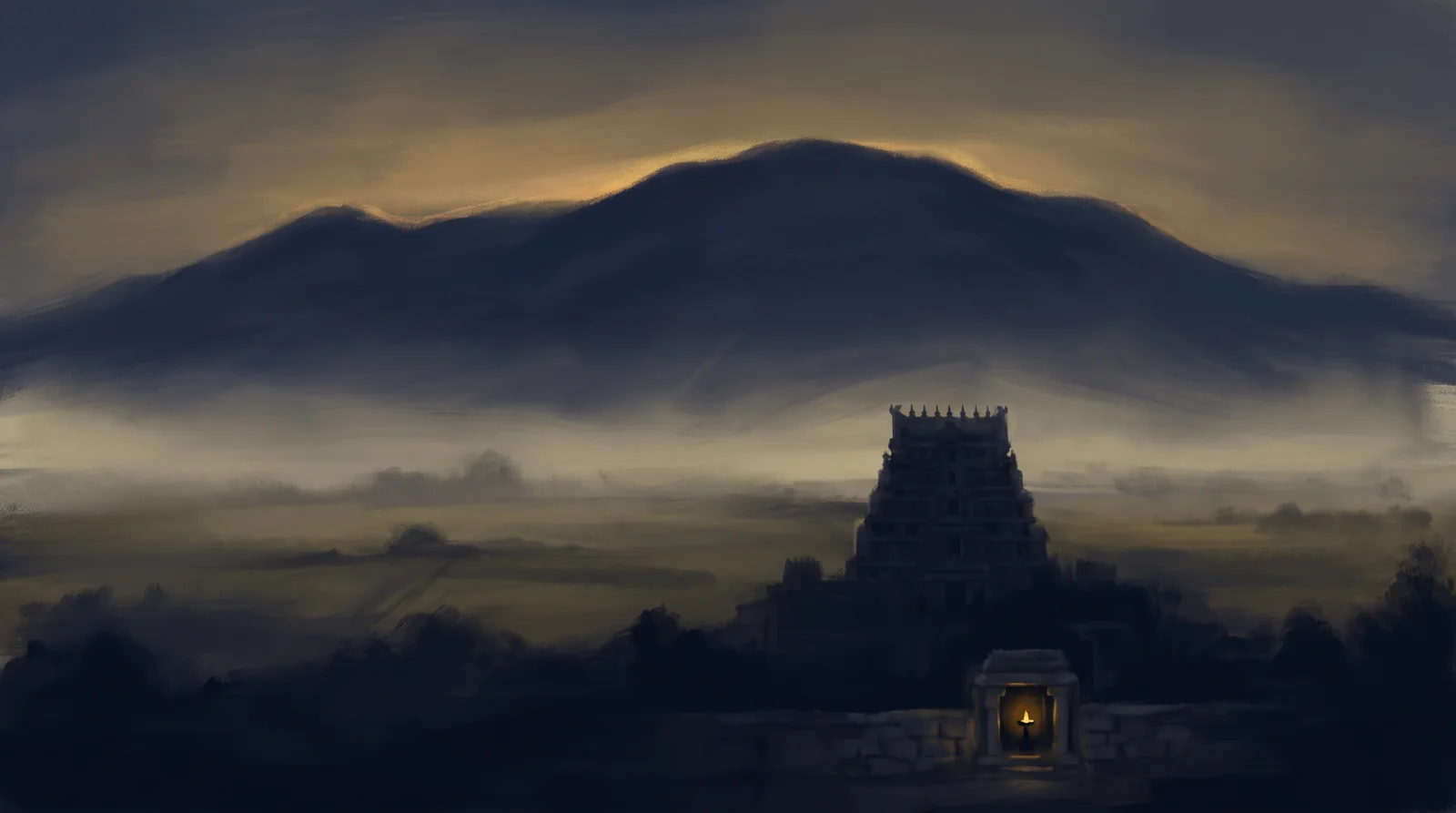
No portrait of him is used on this page. Photographs exist; The Mountain Path printed three with the memorial articles, and the ashram and Michael James’s sites reproduce others. This site uses only pictures that are in the public domain or under a free licence, and it has found none of him that is; but there is a better reason in his case, which is that when a devotee wrote asking for his photograph he replied that his guru’s name and form alone were to be glorified and his own photograph was “therefore immaterial”. The lamp stands in its place, as it does for the other teachers of whom no free portrait exists, and here it stands with his permission.
The dates are as the sources give them and no further. The day, hour and circumstances of his death, 17 March 1985 at 9.05 a.m., are from Michael James’s first-hand account in the July 1985 memorial; the age, sixty-three, from Professor Swaminathan’s, and the birth year of 1922 that follows from it is the one later accounts give, with 1921 not excluded. The year of his arrival at Tiruvannamalai is given as 1945 by both 1985 memorials and by the journal’s 2004 note, and as July 1946 by the 1990 preface to his own book; this page reports both. The years of his residence in the ashram, 1955 to 1960, are V. Ganesan’s. The publication dates of his books are from the prefaces to them. His birth name, village and parentage are not given in any source used here and are not given on this page. The map is drawn on present-day coordinates and pins the district town of Thanjavur because the sources name only the district.
The timeline, plainly
- 1921 or 1922 — born in the Thanjavur district of Tamil Nadu; the memorial gives only his age at death, sixty-three. About 1935 — Tamil verses begin “in his fourteenth year”.
- 1945 (or July 1946) — comes by train from Tanjore to Tiruvannamalai, composing Kuyilodu Kooral on the way; Sri Ramana sends him on the first day to Sri Muruganar with the song; the friendship of “one for tapas, two for Tamil” begins. The two dates are as the sources give them.
- April 1950 — Sri Ramana dies; four or five years in his presence, of which he said five seconds should have sufficed.
- 1955–60 — lives in the ashram, working in the bookstall and dispensary; thereafter more than twenty years in a house near the ashram at Ramananagar; giri-pradakṣiṇa two or three times a week; proofs of the ashram’s publications.
- 1967 — Sri Ramana Vazhi, Part One, in Tamil, edited from his letters and replies gathered by Dr R. Santanam. 1971 — English, The Path of Sri Ramana, Part One. 1973 — Sri Muruganar dies; his manuscripts pass to Sri Sadhu Om. 1976 — Part Two in English. About 1977 — Michael James comes to live with him.
- 1983 — Sadhanai Saram in Tamil; “And I am in minus two.” January 1984 — “Sadhana and Work” in The Mountain Path. 1984–85 — revises both parts for the third Tamil edition; four of the nine volumes of Muruganar’s Sri Ramana Jnana Bodham published.
- Thursday 14 March 1985 — giri-pradakṣiṇa in the evening; cerebral haemorrhage in the night. 15 March — Jipmer hospital, Pondicherry. 16 March — brought back, at his wish, to Tiruvannamalai. Sunday 17 March 1985, 9.05 a.m. — dies in the hall of Michael James’s house facing Arunachala, as the refrain “Arunachala Siva” is sung; aged sixty-three.
- 24 March 1985 — the Ramana Kendra, Delhi, records its appreciation. 3 May 1985 — maṇḍala-abhiṣeka at his samādhi; the revised combined Sri Ramana Vazhi released. 5 May — Professor Swaminathan’s talk in Delhi. July 1985 — the three memorial articles.
- 2005 — the Guru Vācaka Kōvai in English, his translation with Michael James, published. 2023 — a thoroughly revised single-volume translation of The Path of Sri Ramana published by the Sri Ramana Center of Houston.
Read the originals
Primary texts and the records kept by the teacher's own institution.
- The Path of Sri Ramana, Part One — his exposition of self-enquiry, in Michael James’s edition (PDF)
- The Path of Sri Ramana, Part Two — on God, the world, love and karma (PDF)
- Michael James’s page on The Path of Sri Ramana, with a summary of both parts
- Guru Vācaka Kōvai — Sri Muruganar’s verses with his Tamil commentary, translated by him and Michael James
- Sādhanai Sāram — the essence of spiritual practice, on Michael James’s site
- All his books, listed on Michael James’s site
- Michael James — on his eight years with Sri Sadhu Om
- Guru Vācaka Kōvai in English — on Arunachala Ashrama’s site
- The Path of Sri Ramana, Part One — full scan on the Internet Archive
- The Path of Sri Ramana, Part Two — full scan on the Internet Archive
- The Mountain Path, July 1985 — the three memorial articles by K. Swaminathan, V. Ganesan and Michael James (PDF, pages 195–205)
- The Mountain Path, January 2004 — the journal’s note on him with his commentary (PDF, page 53)
Every daily message names the teacher it came from. Read the messages, or see the whole line this teacher stands in: all fifty-one teachers.