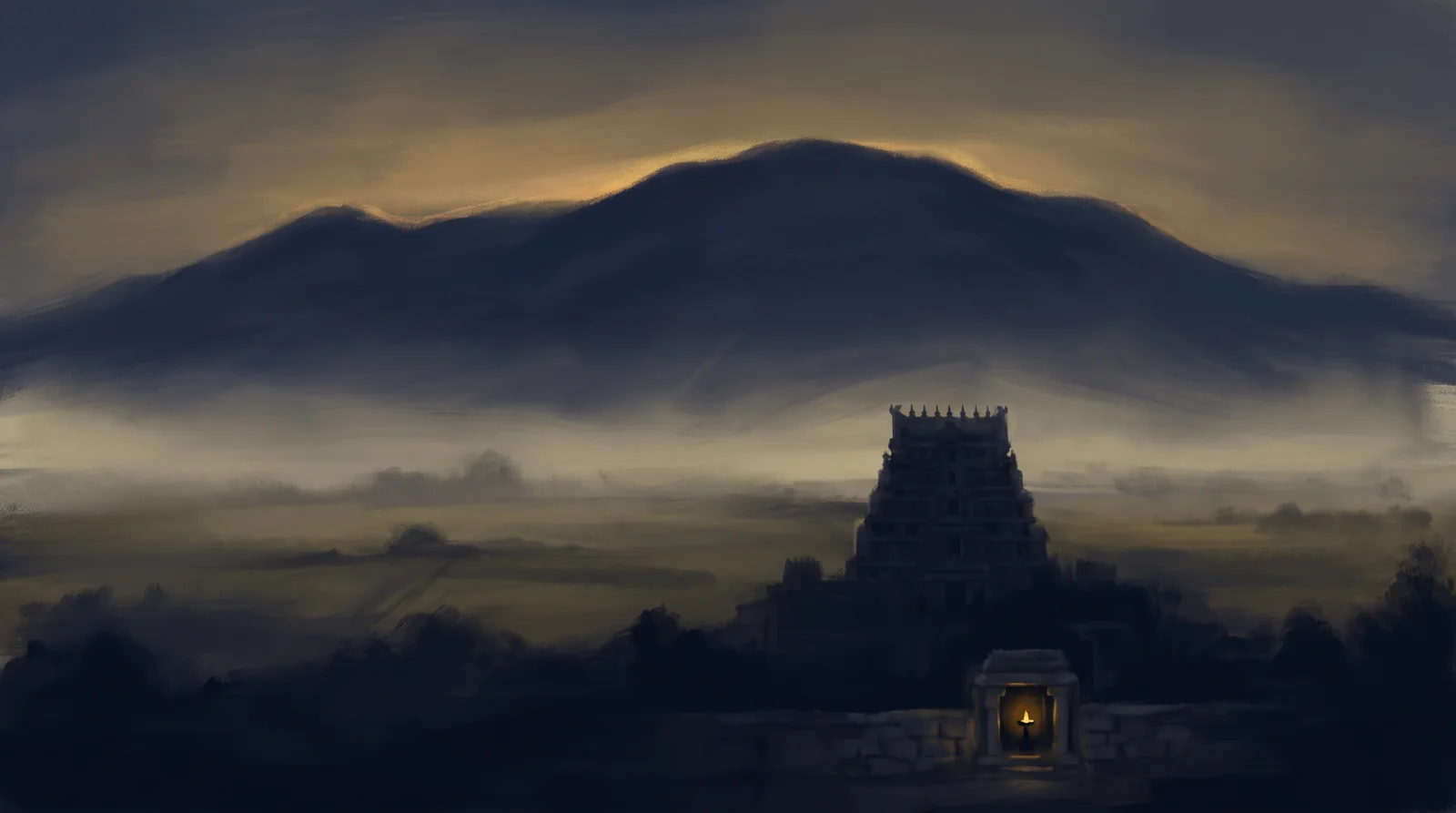
Sri H. W. L. Poonja (Papaji)
Disciple of Sri Ramana; the teacher of Lucknow
1910–1997 · The Sri Ramana Lineage
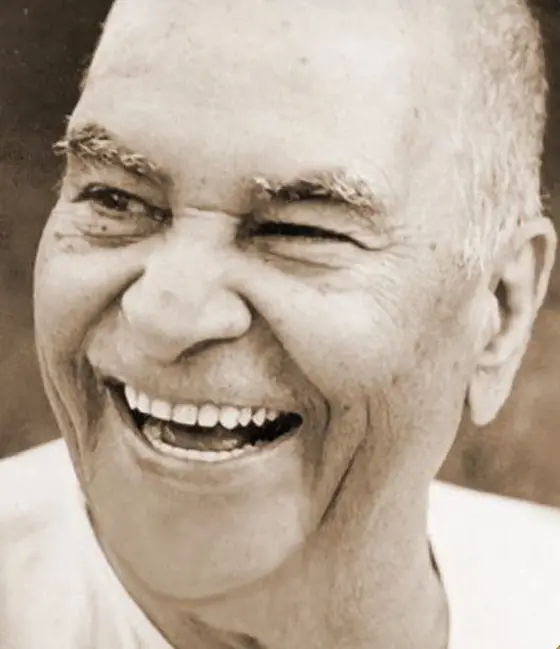
- When
- 13 October 1910 – 6 September 1997
- Born
- Western Punjab, now Pakistan — Gujranwala by the Foundation’s and the Satsang Bhavan’s account, Lyallpur (Faisalabad) by the ashram’s; the family home was Lyallpur; named Hariwansh Lal Poonja; the year is 1910 by the Satsang Bhavan, about 1913 by the biography’s arithmetic
- Where the life was lived
- Lyallpur and Lahore until 1947, with childhood summers at Hardwar; Dehra Dun and Rishikesh in 1942; Madras and Tiruvannamalai 1944–47; Lucknow from August 1947 for the rest of his life, with about thirteen years from 1952 running mining camps in the Vidyāraṇya forest and elsewhere in Karnataka and Goa, caves at Rishikesh after 1967, and visits to Europe and America in the 1970s and 80s; Lucknow, Indira Nagar, from 1990, where he died.
- What is left of it
- Papaji Interviews, with his own account of his life; Nothing Ever Happened (1998), the three-volume biography by David Godman; Wake Up and Roar; The Truth Is; The Fire of Freedom; the satsang films of the 1990s; the house in Indira Nagar, Lucknow, where his samādhi is, and the Satsang Bhavan a kilometre away; and the Avadhuta Foundation, which keeps his archive.
Carried Sri Ramana's enquiry to a generation of visitors from Europe and America, and left a careful account of his own meetings with his teacher.
The man who asked one question
For most of his life he asked the same question of everyone he thought might be able to answer it. The ashram’s journal, The Mountain Path, put it near the head of his obituary in December 1997: “Papaji was precocious in the spiritual sense. He used to put one constant question to the saints he met. This was: ‘Have you seen God? And, can you show me God?’” He put it, by his own account, to Swami Sivananda at Rishikesh while still in army boots; to Swami Ramdas, to Anandamayi Ma, to Swami Tapovanam, to two of the Śaṅkarācāryas; to a beggar at his father’s door in the Punjab; and finally, in 1944, in an empty hall after lunch, to a man on a couch at Tiruvannamalai who declined to answer it and answered something else instead. “‘No,’ he answered, ‘I cannot show you God or enable you to see God because God is not an object that can be seen. God is the subject. He is the seer. Don’t concern yourself with objects that can be seen. Find out who the seer is.’” The rest of his life — fifty-three years of it, most of them spent supporting a very large family, running mines in a forest, and sitting by the Ganga — was what followed from that reply. In the last seven of those years, in a rented house in a suburb of Lucknow, hundreds of people from India and abroad came to sit with him, and what he told them was, in the journal’s summary, one thing: “His basic instruction to his followers was ‘Keep quiet’.”
He is the last of the direct disciples of Sri Ramana Maharshi treated on this site, and in some ways the most unusual. He was not a Tamil, not a scholar, not a monk and not a poet. He was a Punjabi Brahmin from the far north-west of undivided India, a former army officer, a married man with children, a saboteur in the 1930s, a devotee of Kṛṣṇa who, by his own account, saw his God in bodily form and was not satisfied even then. He visited his teacher at weekends and on leave between 1944 and 1947, and never saw him again after August 1947. He wrote no books; what exists in his words was spoken, or written in letters, and put into print by others. And the account of his life on which everything else rests was dictated by him, in old age, in English, to an Englishman who had come to Lucknow to interview him, and then checked by him. This page follows that account closely, says where the other sources add to it or differ from it, and does not go beyond them.
The sources, and how this page uses them
There is one primary source and several that depend on it. In the early 1990s David Godman — the English writer on Sri Ramana and his devotees, whose memoir of Sri Annamalai Swami is used on this site’s page about him — sat with Papaji in Lucknow and recorded the story of his life. The result was published, while Papaji was alive, as the first chapter of Papaji Interviews. The Satsang Bhavan in Lucknow, the hall where he taught, has placed the whole of that chapter on its website in twenty-one short sections, with the note that it “was written by David Godman and was approved by Papaji himself”. It is written in the first person, and it is quoted here as his own account. Godman then spent several more years in Lucknow and produced a biography in three volumes, Nothing Ever Happened, published in 1998 by the Avadhuta Foundation of Colorado, which publishes his teaching; Godman’s book page describes it as “A massive (over 1,200 pages) biography of Papaji, a disciple of Ramana Maharshi and one of the most influential advaitic teachers of modern times”. That book is not freely available online, but the Foundation has placed some forty substantial extracts from it on its own website, each with the volume and page numbers, and Godman’s own site carries others: the closing interview of 1993, a chapter of the third volume on the guru and the disciple, and an essay on the power to enlighten. The quotations below from Nothing Ever Happened are from those extracts.
The ashram’s side is represented by the obituary in The Mountain Path of December 1997 and by the ninetieth chapter of Face to Face with Sri Ramana Maharshi, the collection of devotees’ reminiscences published by the Sri Ramana Kendram of Hyderabad in its second edition of 2009 and placed on Sri Ramanasramam’s own archive site; that chapter is an abridgement of his account with a few sentences of its own. The earliest account of him by anyone else was written by a French Benedictine monk, Henri Le Saux, who met him in a cave on Arunachala in 1953 and put the conversation into a book, Souvenirs d’Arunachala, later published in English as The Secret of Arunachala; Godman reproduced the passage in his first volume, and it is quoted from there. The Satsang Bhavan’s pages on his house and his dates, and the Foundation’s short life of him, give the framework of dates that the narrative itself often leaves vague. Where those dates disagree with one another — and they do, about the year of his birth, the town, the age at which the first experience came, and the length of a stay on the far side of a hill — the disagreement is reported and not resolved. This page does not use the many summaries of his life on websites that give no source, and does not quote from the books of his talks — Wake Up and Roar, The Truth Is, The Fire of Freedom — except where a passage from them appears in the sources named. The reading list at the foot of the page points to where the rest can be found.
Where the life was lived
The map has two halves and a long line between them. The first half is the western Punjab of British India, now in Pakistan: Gujranwala or Lyallpur, where he was born, depending on the source; Lahore, where the first experience came in 1919; Lyallpur again — the present Faisalabad — the family home, where he grew up and to which he came back in August 1947 to take thirty-four relatives out on the last train; Dehra Dun, where he trained as an officer in 1942, and Rishikesh, where he walked in on Swami Sivananda in his boots. The second half is the South: Madras, where he worked from 1944 to 1947 and did fifty thousand repetitions of the name a day in a locked room; Tiruvannamalai, where he sat with his teacher; Bangalore and the forests of Karnataka and Goa, where he ran mining camps for about thirteen years and made the devotees — at Londa, Belgaum, Bombay — he later calls his “old devotees”. The long line between the halves is the railway from Lahore to Lucknow in August 1947, and Lucknow — first a house in Narhi from 1947, then a house in Indira Nagar from September 1990, and a rented hall nearby called Satsang Bhavan — is where the life came to rest and ended. Hardwar and Rishikesh, on the Ganga where it leaves the hills, are the other fixed point: his parents took the family there for the summers when he was a child, he lived in caves there after 1967, he had the vision there that gave Godman’s book its title, and his ashes were put into the river there at Har-ki-Pairi in September 1997. Beyond India the map is thin and late: Paris and Switzerland in the 1970s, Berlin, New York and Hawaii in 1986–87, all as a visitor.
Present-day coastlines; no border but India’s is drawn, and the neighbouring coast is shown faintly so that the western Punjab, now in Pakistan, can be pinned honestly. Numbered pins are places named in his own account of his life (Papaji Interviews), in the Avadhuta Foundation’s biography and in the ashram’s chapter in Face to Face; the dotted line joins the main stations of the life in order — the Punjab, Dehra Dun and Rishikesh, Arunachala and Madras, Lahore again for the family in August 1947, Lucknow, the Karnataka forest, Rishikesh, and Lucknow to the end — and is not a surveyed route. The birthplace is pinned at Gujranwala on the Foundation’s and the Satsang Bhavan’s authority; the ashram gives Lyallpur. The mining camps are pinned approximately. Paris, Saanen, Berlin, New York and Hawaii, visited in the 1970s and 80s, lie beyond the frame.
- 1Gujranwala (Punjab, Pakistan) — Born 13 October 1910 by the Satsang Bhavan’s date, at Gujranwala by the Foundation’s and the Satsang Bhavan’s account; the ashram’s chapter in Face to Face gives Lyallpur, and the text reports both
- 2Lahore (Punjab, Pakistan) — Summer 1919, aged about eight, at his mother’s sister’s house: the mango drink and two days of unbroken peace; the last train out of Lahore with thirty-four relatives in August 1947
- 3Lyallpur (Faisalabad) (Punjab, Pakistan) — The family home, where he grew up, read the Yoga Vāsiṣṭha from a lending library and worshipped Kṛṣṇa; the sadhu at the door in 1944; the house he came back to in August 1947, at Sri Ramana’s order, to bring the family out
- 4Dehra Dun (Uttarakhand) — The Indian Military Academy, April–September 1942; the nightly worship of Kṛṣṇa dressed as Rādhā; the commission he resigned
- 5Rishikesh (Uttarakhand) — Swami Sivananda’s ashram, visited in his boots in 1942; the caves he lived in after leaving his household in January 1967; the vision by the Ganga: “Nothing has ever come into existence”; the banyan tree where the first Westerners found him
- 6Hardwar (Uttarakhand) — Childhood summers by the Ganga; the Kumbha Mela and the goddess he says he saw there; his ashes given to the river at Har-ki-Pairi by his son Surendra, three days after his death in September 1997
- 7Delhi (Delhi) — One of the two weddings of January 1967, of his son and daughter, after which he left the household
- 8Agra (Uttar Pradesh) — The other wedding of January 1967
- 9Lucknow (Uttar Pradesh) — The house in Narhi where he settled the family in 1947 and worked for Allis Chalmers; the meteor of 14 April 1950; the house in Indira Nagar from September 1990, where his samādhi is; the rented hall a kilometre away that became Satsang Bhavan; died about 11 p.m. on 6 September 1997 and was cremated on the Gomti
- 10Bombay (Maharashtra) — The householder devotee to whom the letters of 1968–69 were written: “Live like a true rishi in the house”; old devotees from the mining years
- 11Londa (Karnataka) — One of the towns of the mining years where the “old devotees” he later returned to were made
- 12Vidyāraṇya forest (approx.) (Karnataka) — The mining camps he ran for Krishna Lal Poddar for about thirteen years from 1952, in the forest named for Vidyāraṇya, a six-hour drive from Bangalore; the tigress and the bear; pinned approximately, since the sources give only the forest’s name
- 13Bangalore (Karnataka) — The Lalbagh glasshouse, 1952, where Krishna Lal Poddar offered him a job unasked; the payroll office through which Rs 500 a month reached his wife for years without his knowing
- 14Madras (Tamil Nadu) — The army canteen job, 1944–47; the locked room and fifty thousand repetitions of the name a day; the vision of Rāma, Sītā, Lakṣmaṇa and Hanumān; the day the name stopped; the train to Tiruvannamalai
- 15Tiruvannamalai (Tamil Nadu) — Sri Ramanasramam: the first meeting of 1944 — “Find out who the seer is”; the far side of the hill; the bullock cart and “You have arrived”; weekends and leave until July 1947; the cave where Henri Le Saux found him in 1953
The map is drawn on present-day coordinates; only India’s outline is drawn, with the neighbouring coast faint behind it, and the places now in Pakistan are pinned where they are, though the border did not exist for the first thirty-seven years of the life. The birthplace is pinned at Gujranwala, as the Foundation and the Satsang Bhavan give it, and the note on the pin says that the ashram’s chapter gives Lyallpur, which his own account calls his home town. The mining camps in the Karnataka forest are pinned approximately, because the sources give only the name of the forest and a six-hour drive from Bangalore.
The name, the town, and the year
He was Hariwansh Lal Poonja — H. W. L. Poonja on the covers of his books, “Poonjaji” to Indian devotees, and from the 1980s “Papaji”, a Hindi word of affection for a father, which is the name the sources and this page use for him. Abhishiktananda, in 1953, called him Harilal; his parents called him Harbans. His father was Parmanand, who “worked for the railways” and at one period was “working in Baluchistan as a stationmaster”; his mother, as will be seen, was the sister of a famous man. The family were Saraswat Brahmins, in the Avadhuta Foundation’s account.
The town and the year need a paragraph, because the sources do not agree. The Foundation’s short life says “H. W. L. Poonja was born in Gujranwalla, in western Punjab, now in Pakistan, in a family of Saraswat Brahmins”; the ashram’s chapter in Face to Face says “Papaji (Hariwansh Lal Poonja) (1910-97), an Indian Army officer, was born at Lyalpur, West Punjab.” His own account does not name his birthplace at all; it says that the boyhood begging rounds were “up and down the streets of Faisalabad” — the present name of Lyallpur — and that his home town in 1947 was “a town about 200 miles to the west of Labore” (the misprint is the website’s). Both may well be true, a birth in one town and a childhood in another; this page pins Gujranwala and says so. The year is harder. The Satsang Bhavan gives 13 October 1910, and observes the day. The Mountain Path wrote that “In another five weeks (that is on October 13, precisely) he would have been 88” — which puts the birth in 1909. His own account, in the version he approved, says of the first journey to Tiruvannamalai, “It was 1944 and I was thirty-four years of age”, which agrees with 1910; but the same sentence in Nothing Ever Happened, five years later, reads “It was 1944 and I was thirty-one years of age”, and the Foundation’s life follows it, which would put the birth about 1913. This page uses 1910, the date his own house keeps, and asks the reader to hold it loosely.
Lahore, 1919: the mango drink
The first thing he remembered, and the thing everything else in his account is measured against, happened in the summer of 1919, when the schools had been given a month’s holiday for the victory in the war. “My earliest memory is of a striking experience which occurred when I was about eight years old.” His mother took him to relatives in Lahore, and he remembered that mangoes were in season. One evening someone made a drink of mango, milk and almonds and handed the boy a glass. “It should have been a mouth-watering treat for a boy of my age, but when a glassful of it was offered to me, I made no attempt to stretch out my hand to receive it. It was not that I didn’t want to drink it. The truth was, I had just been consumed and engulfed by an experience that made me so peaceful and happy, I was unable to respond to the offered glass.” The women shook him, slapped him, pinched him and lifted him up; nothing produced a response. They concluded he was possessed, and — “even though I came from a Hindu family” — carried him to the local mosque, where the mullah ran metal tongs over his body and chanted. That did nothing either. “For two full days I stayed in this peaceful, blissful, happy state, unable to communicate with anyone, but still fully aware of the various things that were going on around me.”
When he opened his eyes his mother, an ardent devotee of Kṛṣṇa, asked him whether he had seen Kṛṣṇa. “‘No,’ I replied, ‘all I can say about it is that I was very happy.’” She fetched a picture of the child Kṛṣṇa and asked whether he had seen anyone like that; again, no. And then the sentence on which, by his own later reading, a quarter of a century turned: “Although it did not tally with my own direct experience, my mother somehow convinced me that the happiness had been caused by coming into contact with Krishna. She encouraged me to become a devotee of Krishna, saying that if I meditated on Krishna and repeated His name, the experience I had had of Him would sooner or later return.” He did as she said, for twenty-five years.
How old was he? The account approved by him says “about eight”; the Foundation’s life says “At the age of eight”. But in a dialogue in the third volume of Nothing Ever Happened he said, “The same thing happened to me when I was six years old. I had a direct experience, but no one there was able to tell me, ‘This is the truth. You don’t need anything else.’” And the Satsang Bhavan’s page says he “had his first direct experience of the Self at the age of nine”. A boy born in October 1910 would have been eight in the summer of 1919, and this page says eight; but the point of the story for him was never the age. “There has been no change in my understanding, my experience and my conviction since I was six years old. From the age of six till now, when I am over eighty years old, there has been no change, but this truth, this understanding, was not fully revealed to me till I met the Maharshi.”
The mother, and the uncle who died at thirty-four
His mother is the second person in the story and in some ways its author. “My mother used to sing Krishna bhajans in our house. She had married when she was sixteen and given birth to me when she was eighteen. So, when all this happened, she was still a young woman. Since both her face and her voice were extremely beautiful, her bhajans attracted many people to our house.” “Because she had been so young when I was born, we behaved with each other as if we were brother and sister, rather than mother and son.” Kṛṣṇa, in his account, appeared to him through his childhood and played with him; he took the appearances as facts and says so; this page reports them as his account and leaves the reader to weigh them, as he himself, in the end, was taught to. Godman adds, from his own years of watching him: “Throughout his life Papaji has had an ability to experience words, rather than merely think about them. This unusual faculty manifested on many occasions, and it partly explains why gods kept appearing to him.”
His mother’s brother was Swami Rama Tirtha, the mathematics lecturer from Lahore who became a monk, taught in America and Japan, and died in the Ganga in 1906, and who has his own page on this site. Papaji never met him, but the shadow was there. His mother, he says, “had a Guru who was a well-known teacher of Vedanta”, and that man encouraged the boy to read. “My mother’s Guru encouraged me to join a local lending library which had a good selection of spiritual books. I started to read books on Vedanta and Hindu saints. It was this library which introduced me to Yoga Vasishta, a book I have always enjoyed. One day I tried to borrow a book about Swami Ram Tirtha, a Hindu saint who went into seclusion in the Himalayas in his twenties and who died there when he was only thirty-four. I had a special reason for borrowing this book: he was my mother’s elder brother, so I naturally wanted to find out more about him.” The librarian refused him the book and warned his mother that the boy might end like his uncle. “My mother paid no attention. Because her own life revolved around her sadhana, she was delighted to have a son who seemed to be displaying a similar inclination.” One detail in this part of the account matters for the whole page. The mother’s Guru “knew many vedantic works and could lecture on them all with great authority. His favourite was Vichar Sagar by the Hindu saint Nischaldas. My mother could recite large portions of it by heart. Many years later, when I became acquainted with Sri Ramana Maharshi, I found that he too liked it and that he had even made a Tamil abridged rendering of it under the title Vichara Mani Mala.” The boy who was to meet Sri Ramana had, in a sense, the same book in the house. He did not like it. His mother chanted the traditional negations — I am not the body, I am not the blood — and he made fun of her: “I was, at heart, a bhakta. I could appreciate any sadhana which generated love and devotion towards God, but I couldn’t see the point of these practices which merely listed, in endlessly trivial ways, what one was not.” That the man who ridiculed the Vichar Sagar would spend the last years of his life reading the Yoga Vasishta and the Panchadasi aloud to a hall full of Westerners is one of the shapes of this story.
The boy who wanted to be the Buddha
He tells the stories of his childhood with a relish that the reader should be allowed to share, because the man in the Lucknow hall in the 1990s, laughing at his visitors, is already in them. At about eleven he tried to run off with a party of sādhus, telling them his parents were dead. “My next major spiritual adventure occurred when I was about thirteen. It started when I saw a picture of the Buddha in a history book at school. This picture illustrated the period of his life when he tried to live on only one grain of rice a day. The face was very beautiful but the body was skeleton-like, all skin and bone. I immediately felt a great attraction to him, even though I didn’t then know anything about his teachings.” He set about making his body match the picture: he gave his meals to the dogs in the street, stopped eating, and grew so thin that his classmates nicknamed him “the Buddha”. His father, home on leave from Baluchistan, took him to doctors, none of whom suspected a fast; his mother, told to feed him butter, fed him butter, and “The dogs on the street got very fat and happy because the new diet went the same way as the old one.” Then, learning from the same book that the Buddha wore ochre and begged, he took one of his mother’s three saris, dyed it, and went begging in disguise through the streets of Faisalabad; and finally, learning that the Buddha preached, he climbed the politicians’ platform by the clock-tower in the centre of town and harangued the passers-by. A neighbour recognised him; his mother found the parcel of dyed sari among his schoolbooks; “The game was over, for that discovery effectively ended my brief career as an imitation Buddha.”
He did not, in old age, treat this as a prank. “I wasn’t being mischievous. I never regarded it as some kind of childhood prank. Some power was compelling me to do it. Some old samskaras were coming up and compelling me towards reality, towards the truth of the Self. It was a serious attempt on my part to find my way back to the state of happiness and peace that I had once experienced and known as my own inner reality.” The pattern is worth noticing. Each time, a word or a picture produced not a thought about the thing but the thing itself: the Buddha read about became the Buddha imitated; Kṛṣṇa sung to became Kṛṣṇa in the room. He did not want to be told about God, and he did not want a method; he wanted the thing, now, and would pay for it. The teachers he met before 1944 were, on his own showing, mostly right to tell him that this was not how it worked. The one who did not tell him that told him instead that he had the question upside down.
Two more episodes belong here. At about fifteen, at a friend’s house at Holi, he was given pakoras that turned out to contain bhang; at midnight he sat up in the padmāsana and called out, “You are not my father! You are not my mother!”, and sat for a night and a day uttering sounds nobody understood, until a passing pandit said: “‘This boy is chanting portions of the Yajur Veda in Sanskrit. Where and when did he learn to chant like this?’” “At the time I knew Punjabi, my native language, Urdu, the language of the local Muslims, and a little Persian. I knew no Sanskrit and had never even heard of the Yajur Veda.” His own explanation was a previous life; the reader may take the story as he took it, or otherwise. And at about sixteen, at the Ārya Samāj boarding school he attended, the morning prayer ending “Om shanti shanti” “caused my whole body to go numb. I became paralysed in much the same way that I had been when, as an eight-year-old boy, I had been offered the mango drink in Lahore. I was aware of everything that was going on around me, there was a great feeling of peace and happiness inside, but I couldn’t move any of my muscles or respond to what was going on around me.” The supervising teacher put him down for a caning; the other boys staged a mock funeral and dumped him on his bed, where he lay all day; the headmaster, told what had happened, “recognised the absurdity of punishing me for having had a mystical experience as a consequence of listening to a Hindu prayer. He let me off and in later years we became quite good friends.” He tells it as comedy, but it is the mango drink again: peace, paralysis, and a world around him that had no category for it except disobedience or possession.
Salesman, husband, saboteur
“Because of my continuing interest in Krishna, I didn’t do well enough in school to go to college. Instead, at the age of eighteen, I got a job as a travelling salesman. I enjoyed the work very much because it gave me the opportunity to travel all over India.” “Then, in 1930, when I was twenty years old, my father decided that it was time for me to get married. I didn’t like the idea at all, but to avoid a big family argument I agreed to marry the woman my father selected for me. I became a householder and in due course fathered a daughter and a son.” His wife is not named in any source used here; his children — the daughter who went into a trance in front of Sri Ramana, the son Surendra who put his ashes in the Ganga — appear later. It should be said now, because he said it himself and did not hide it, that his family did not come first with him for most of the next forty years, and that his father told him so repeatedly.
The 1930s in the Punjab were, in his words, “a time of great political unrest”, and he was drawn in, though not on Gandhi’s side. “I didn’t accept this theory at all. I was and am a great believer in direct action and I felt that we should confront the British with a show of force.” He joined a group of saboteurs and learned to make bombs. “Although I was not directly involved, our group was responsible for blowing up the Viceroy’s train as he was travelling to Peshawar. Our equipment was a bit primitive, for we had to rely on a fuse rather than detonation by remote control. The timing was not quite right and we ended up blowing up the carriage that was adjacent to the one which the Viceroy was occupying. The Viceroy escaped unhurt.” This page has no means of checking the story against the record of the period and does not try; it is reported because he told it, and because the man who, decades later, ordered five devotees off a bus at Hardwar without giving a reason was, on his own account, once a man who believed in force. Of Gandhi himself he would later speak very differently, as will be seen.
The officer who dressed as Rādhā
The account, as he approved it, places his army service before his years as a freedom fighter, though the one firm date it gives — officer training at the Indian Military Academy at Dehra Dun in 1942 — comes after the bombs of the 1930s; the chapters were arranged by theme, and this page follows the dates. Nothing Ever Happened puts him at the Academy between April and September 1942. What he wanted from the army was somewhere to be alone with Kṛṣṇa. “By day I played the officer-sahib, complete with stiff upper lip. At night, behind locked doors, I would transform myself into a Krishna gopi.” “I pretended I was Radha, the consort of Krishna, because I thought that if I imitated her in every way, Krishna would come and appear before me. I dressed myself in a sari, decorated my body with bangles and women’s jewelery, and even put make-up on my face. I got into the bhava that I really was Radha, pining away for her divine lover. It worked. Krishna would appear and I would pour out my heart to Him.” A superior officer, seeing his face the next morning, took him for a drunk and rationed him to three small drinks a day; the mess barman, who knew he never drank at all, was not believed.
The army, he says, killed his nationalism and fed his devotion, until there was room for nothing else. “The army was not a congenial place for a bhakta who only wanted to indulge in his obsession for Krishna, so I resigned my commission. It was a difficult thing to do during wartime, but with the assistance of a sympathetic commanding officer, to whom I explained my predicament, I managed to free myself from my military obligations.” He went home to his father, who had a wife and two children to feed on his son’s behalf. “It was true—I could have had a glittering career in the army. All my classmates from the officer’s training school who made the military their career went on to occupy all the senior positions in the army in the years that followed independence in 1947. I didn’t care. Nothing mattered to me anymore except finding God and holding on to Him.” The reader should hold on to that sentence too. The Advaita this man came to teach was not the conclusion of a philosophical argument. It was what happened to a man who wanted God so badly he threw away a commission in wartime to look for Him.
“Have you seen God?” — the tour of India, and the sādhu at the door
What he did next was, on its own terms, entirely logical. “After leaving the army, I had no desire to get a job. I felt instead that I needed a spiritual Master who could help me to consummate my love affair with Krishna. I had been sporadically successful in getting Him to appear before me, but I wanted Him all the time.” The qualification he demanded of a Master was a single one: “he must have seen God himself, and he must have the ability to show Him to me. No other qualifications mattered. With this criterion in mind I began a tour of India which took me to almost every famous ashram and guru in the country. I went to see such well-known people as Swami Sivananda, Tapovan Swami, Ananda Mayi Ma, Swami Ramdas, two of the Shankaracharyas and a host of lesser-known spiritual figures.” Godman later asked him for a list and printed it, and it includes the Śaṅkarācāryas of Joshimath, Dwarka and Sringeri and Swami Purushottamananda of the Vasishta Guha. Several of these teachers have pages of their own on this site, and the reader who knows them will already see the difficulty. He was asking people whose whole teaching was that God is not an object to produce God as an object. “All of them responded in much the same way. They tried to give me a mantra, or they tried to make me meditate. All of them made a point of saying that God could not be produced like a rabbit out of a conjuror’s hat, and that if I wanted to see Him I would have to undergo years of strenuous sadhana. This was not what I wanted to hear.” His reply, everywhere, was the same: “I want to see God now. If you can’t show Him to me right now, I will look for someone else who can.”
The one encounter he described in detail was at Rishikesh, on a Sunday off from the Academy, and he told it against himself. “I had my army uniform on, which probably didn’t make a good impression on all the swamis I found meditating there. Also, I had something of a superiority complex in those days. I didn’t even take my boots off when I walked in to see him.” Swami Sivananda did not answer; his disciples did — “Some of us have been sitting here meditating for forty years. Our beards have gone grey in our constant search for God. Do you think He will show Himself to someone who walks in with muddy boots and demands an instant darshan?” — and when he compared seeing God to buying a bag of rice from a shopkeeper who either has it or does not, “They pushed me out of the hall and wouldn’t let me back in.” This site has a page on Swami Sivananda, and the reader will find there a man of great generosity; the story is told here because Papaji told it, and because he was honest enough to keep the boots in it. “Since none of the people I met claimed they could show me God, I eventually had to return to my father’s house, disillusioned and dispirited.”
What happened next is the hinge of the life. “Shortly after my return a sadhu appeared at our door, asking for food. I invited him in, offered him some food and asked him the question that was uppermost in my mind. ‘Can you show me God? If not, do you know of anyone who can?’ Much to my surprise, he gave me a positive answer. ‘Yes, I know a person who can show you God. If you go and see that man, everything will be all right for you. His name is Ramana Maharshi.’” He had never heard of the man or the town. The sādhu gave him directions of a precision he remembered fifty years later: the train to Madras, Egmore station for the metre gauge, change at Villupuram, on to Tiruvannamalai. He had no money to use them; the army savings had gone on the pilgrimage, and his father, asked to fund one more swami, “exploded with anger. ‘What about your wife and children?’ he demanded.” Then, in a tea-stall in town, he opened a newspaper at the job advertisements. “One vacancy seemed to be tailor-made for me: ‘Ex-army officer required in Madras.’” The contractor, in Peshawar, engaged him by post, sent him money for the fare and told him not to report for a month. “I thus got money to go to the Maharshi and an opportunity to spend time in his presence before I reported for work. It was 1944 and I was thirty-four years of age.” He took the trains the sādhu had named, hired a bullock cart from Tiruvannamalai station, and went to look in at the window of the hall. “I peeped in through his window and saw, sitting on a sofa inside, the same man who had visited my house in the Punjab. I was disgusted. ‘This man is a fraud,’ I said to myself. ‘He appears in my house in the Punjab, tells me to go to Tiruvannamalai, then hops on the train so that he can get there before me.’” A resident, Framji, who owned a cinema in Madras, told him the Maharshi “has not moved out of this town in the last forty-eight years”. He stayed, he says, only because he wanted to confront the man in private. This page reports the sādhu at the door as Papaji reported him; the ashram’s chapter says, more cautiously, “a sadhu resembling Sri Ramana appeared at his door asking for food”.
The first meeting: “Find out who the seer is”
There was an unofficial rule that nobody disturbed the Maharshi between 11.30 and 2.30. He did not know it. After lunch he followed him into the empty hall. “The Maharshi’s attendant, a man called Krishnaswami, tried to discourage me. ‘Not now,’ he said. ‘Come back at 2.30.’ The Maharshi overheard the exchange and told Krishnaswami that I could come in and see him. I approached him in a belligerent way. ‘Are you the man who came to see me at my house in the Punjab?’ I demanded. The Maharshi remained silent.” So he put the question. “‘Have you seen God?’ I asked. ‘And if you have, can you enable me to see Him? I am willing to pay any price, even my life, but your part of the bargain is that you must show me God.’” The reply has been quoted at the head of this page. “He also added, ‘You alone are God,’ as if to rebuke me for looking for a God who was outside and apart from me. His words did not impress me. They seemed to me to be yet one more excuse to add to the long list of those I had heard from swamis all over the country.”
He would, he says, have dismissed the man and left, “had it not been for an experience I had immediately after he had told me to find out who this ‘I’ was who wanted to see God. At the conclusion of his words he looked at me, and as he gazed into my eyes, my whole body began to tremble and shake. A thrill of nervous energy shot through my body. My nerve endings felt as if they were dancing and my hair stood on end. Within me I became aware of the spiritual Heart. This is not the physical heart, it is, instead, the source and support of all that exists. Within the Heart I saw or felt something like a closed bud. It was very shining and bluish. With the Maharshi looking at me, and with myself in a state of inner silence, I felt this bud open and bloom.” He is careful, even here, about words: “This Heart, this Heart of my Heart, was neither inside the body nor out of it.” And then — this is what makes the account believable as a human document — it changed nothing. “My inclination to seek a God outside me was not dispelled either by his words or by the experience I had had with him. I thought to myself, ‘It is not good to be chocolate, I want to taste chocolate’. I wanted to remain separate from God so that I could enjoy the bliss of union with Him.” The line about chocolate is an old one among devotees of Kṛṣṇa — the lover does not wish to become the beloved — and he meant it. He looked round the hall with “the rather prejudiced eye of a fanatical Krishna bhakta”, saw nobody with a rosary, nobody chanting, a teacher sitting silent, and concluded that the whole place was spiritually lazy.
The far side of the hill
“I took off to the other side of Arunachala, a few kilometres away, found a nice quiet spot in the forest on the northern side of the hill, and settled down there to do my Krishna japa, alone and undisturbed. I stayed there for about a week, immersed in my devotional practices. Krishna would often appear before me, and we spent a lot of time playing together.” In the 1993 interview he gave the stay as “about four days in Adi-annamalai on the other side of the mountain”; the sources differ and the reader may choose. On his way out of town he called at the ashram “partly to say goodbye, and partly to tell the Maharshi that I didn’t need his assistance for seeing God because I had been seeing Him every day through my own efforts”. The exchange that followed is the one that people who know nothing else about him tend to know. “‘I was playing with my Krishna,’ I said, in a very smug tone of voice. I was very proud of my achievement and felt superior to the Maharshi because I was absolutely convinced that Krishna had not appeared to him during that period. ‘Oh, is that so?’ he commented, looking surprised and interested. ‘Very good, very nice. Do you see Him now?’ ‘No sir, I do not,’ I replied. ‘I only see Him when I have visions.’” “‘So Krishna comes and plays with you and then He disappears,’ said the Maharshi. ‘What is the use of a God who appears and disappears? If he is a real God, He must be with you all the time.’” In the 1993 telling the words are a little different and the effect is stated: “Then he said, ‘What appears and disappears is not real. The seer remained. You saw him, he disappeared. He remained, the same seer. Now you are here also, the seer remained. Now, find out who the seer is.’ This ‘seer’ was just a word, but it struck me with such an impact that I became the seer. I became the seer.”
The reader should notice what Sri Ramana did not do. He did not say the visions were false, or that devotion to Kṛṣṇa was a lower path, or that the man in front of him should give up his God. He asked one question about permanence. On this site’s own standpoint, which is Advaita, that is the whole of the method: not to belittle the form, but to ask what is there when the form has gone. Papaji, at the time, was not ready to hear it. “A lifetime of devotion to Krishna had left me incapable of conceiving the spiritual quest in any other terms than that of a quest for a personal God.” He asked for a mantra, and was refused; he asked to be given sannyāsa so that he need not take up the job, and was refused that too. “Having therefore got, in my own jaundiced opinion, nothing from the Maharshi except a good experience and some bad advice, I returned to Madras to take up my new job.”
Madras: fifty thousand names a day
He found a house big enough for his family, brought them down from the Punjab, and did his work at the canteen stores “dutifully and to the best of my ability, because I had a wife and children to support”. Everything else went into a room. “I made a puja room in my house, informing my wife that when I was in it, I was never to be disturbed. At 2.30 each morning I would get up and begin my sadhana.” He worked out that he breathed about 24,000 times a day and resolved to say the name once for every breath; then, reckoning that all the breaths of his unbelieving years had been wasted, “If I increase my recitations to 50,000 a day, I can make up for all those breaths I wasted when I was young.” He did fifty thousand a day, before and after work, and he slept in the room. “I also slept in the puja room, thus effectively cutting myself off from all interaction with my family. I even stopped speaking with them.” The reader is asked to keep this in view when the teacher of Lucknow says, forty years on, that no practice is necessary. He had done more of it than almost anyone he ever spoke to.
Then one night, at about two, he heard voices outside the door and assumed relatives had come off a late train. “Imagine my astonishment, on opening the door, when I saw not a group of relatives but the shining forms of Rama, Sita, Lakshmana and Hanuman standing outside. I couldn’t understand what they were doing there. I had spent most of my life calling on Krishna, never feeling much attraction to Rama, or any interest in Him. Nevertheless, I prostrated to them all with great awe and reverence.” He could see through their bodies to the wall behind; the vision ended when his wife called that he would be late for work, and it was the first day he failed to reach his quota. What followed was worse than guilt. “Later that day, when I tried to resume my chanting, I found that I could not repeat the name of Krishna any more. Somehow, my mind refused to cooperate. I couldn’t read any of my spiritual books either. My mind, thought-free and quiet, refused to concentrate on or pay attention to any of the spiritual objects I tried to put in front of it. It was all very mystifying. For a quarter of a century the divine name had been flowing effortlessly through my mind; now I couldn’t even utter it once.” He went to the head of the Ramakrishna Mission in Madras, Swami Kailasananda, who told him this was what Christian mystics called the dark night of the soul, and to keep trying. He went to other swamis in Madras and was told the same. “Though I could see that they were quite good sadhaks, I also felt that they had not had a direct experience of God, an experience which would, in my opinion, have made them more qualified to pass judgement on my case.” This site, which has pages on the Ramakrishna Order’s teachers too, records the judgement as his. He remembered that the Maharshi had recently appeared to him, smiling and silent, in the pūjā room; and he had a Saturday half-holiday coming.
The train and the bullock cart: “You have arrived”
He took the Saturday train, used the same ruse — after lunch, when the hall was empty — and again the Maharshi let him in. “‘For twenty-five years I have been doing sadhana, mostly repeating the name of Krishna. Up till fairly recently I was managing 50,000 repetitions a day. I also used to read a lot of spiritual literature. Then Rama, Sita, Lakshmana and Hanuman appeared before me. After they left, I couldn’t carry on with my practice. I can’t repeat the name any more. I can’t read my books. I can’t meditate. I feel very quiet inside but there is no longer any desire in me to put my attention on God. In fact, I can’t do it even if I try. My mind refuses to engage itself in thoughts of God. What has happened to me and what should I do?’” The answer began with a question about transport. “The Maharshi looked at me and asked, ‘How did you come here from Madras?’ I didn’t see the point of his question but I politely told him the answer: ‘By train.’ ‘And what happened when you got to the station at Tiruvannamalai?’ he inquired. ‘Well, I got off the train, handed in my ticket and engaged a bullock cart to take me to the ashram.’ ‘And when you reached the ashram and paid off the driver of the cart, what happened to the cart?’ ‘It went away, presumably back to town,’ I said, still not clear as to where this line of questioning was leading.” Then: “‘The train brought you to your destination. You got off it because you didn’t need it anymore. It had brought you to the place you wanted to reach. Likewise with the bullock cart. You got off it when it had brought you to Ramanasramam. You don’t need either the train or the cart any more. They were the means for bringing you here. Now you are here, they are of no use to you.’That is what has happened with your sadhana. Your japa, your reading and your meditation have brought you to your spiritual destination. You don’t need them anymore. You yourself did not give up your practices, they left you of their own accord because they had served their purpose. You have arrived.’”
It is worth pausing on how orthodox this is. The Advaita texts on this site say the same thing about practice: that it purifies and steadies the mind, that it cannot itself produce knowledge, and that when knowledge comes the practice falls away like a scaffold. Sri Ramana did not tell him his twenty-five years of japa had been a mistake. He told him they had worked. Then he looked at him. “Then he looked at me intently. I could feel that my whole body and mind were being washed with waves of purity. They were being purified by his silent gaze. I could feel him looking intently into my Heart. Under that spellbinding gaze I felt every atom of my body being purified. It was as if a new body were being created for me. A process of transformation was going on—the old body was dying, atom by atom, and a new body was being created in its place. Then, suddenly, I understood. I knew that this man who had spoken to me was, in reality, what I already was, what I had always been. There was a sudden impact of recognition as I became aware of the Self.” And the word he chose: “I use the word ‘recognition’ deliberately, because as soon as the experience was revealed to me, I knew, unerringly, that this was the same state of peace and happiness that I had been immersed in as an eight-year-old boy in Lahore, on the occasion when I had refused to accept the mango drink. The silent gaze of the Maharshi re-established me in that primal state, but this time it was permanent.”
His own summary of what he had been told, and had refused to hear, is the plainest statement of the teaching on this page. “None of them had said, ‘God is within you. He is not apart from you. You alone are God. If you find the source of the mind by asking yourself “Who am I?” you will experience Him in your Heart as the Self.’ If I had met the Maharshi earlier in my life, listened to his teachings and put them into practice, I could probably have saved myself years of fruitless external searching.” He also drew a general lesson, in the chapter he called “The Process”, that this page records as his account of how the thing happens and not as a claim of its own: that there must first be an overwhelming desire for God or for freedom; that this desire, fanned long enough, consumes every other desire and finally itself; that what is left is a silence of no thoughts, which is not yet the end; and that the last step is the Master. “I needed the grace of my Master; I needed to sit before him; I needed to have him tell me, ‘You have arrived,’ and I needed to believe him; and I needed to have him transmit his power and grace via his divine look.”
After: “I didn’t have a single thought”
Nothing outward changed. “I went back to Madras, carried on with my job, and supported my family to the best of my ability. At weekends, or when I had accumulated enough leave, I would go back to Tiruvannamalai, sit at the feet of my Master and bask in his radiant presence. The cynical, sceptical seeker who had aggressively confronted the Maharshi on his first visit, had gone for good. All that remained was love for him.” Inwardly: “In the first few months after my realisation, I didn’t have a single thought. I could go to the office and perform all my duties without ever having a thought in my head.” He brought his family to the ashram at weekends. His daughter, who had picked up Tamil in Madras and could joke with the Maharshi in his own language, sat down in front of him one day and did not get up. “When the bell for lunch went, I was unable to rouse her. The Maharshi advised me to leave her in peace, so we went off to eat without her. When we came back she was still in the same place in the same state. She spent several more hours in this condition before returning to her normal waking state. Major Chadwick had been watching all this with great interest. After her experience ended, he approached the Maharshi and said, ‘I have been here for more than ten years, but I have never had an experience like this. This seven-year-old girl seems to have had this experience without making any effort at all. How can this be?’ The Maharshi merely smiled and said, ‘How do you know that she is not older than you?’”
He questioned the Maharshi too, “quite vigorous and fearless in my questioning because that was the method I had been taught in the army”. Hearing Sri Ramana tell a visitor that the Heart was on the right side of the chest, he objected that his own experience had been of something neither inside nor outside the body: “Why not say it is everywhere? How can you limit the truth to a location inside the body?” The answer he records is that the right-side Heart is taught to those who still take themselves to be the body, as a place to watch the “I” rise and subside, and that “The Heart is another name for the Reality and it is neither inside nor outside the body; there can be no in or out for it, since it alone is”. It satisfied him; readers of the letters he wrote to devotees twenty years later will find him teaching the right-side Heart himself, to people who needed it. He also watched the Maharshi decline to raise a dead boy brought by his mother, and decline to take credit when a snake-charmer at the gate revived him: “The only ‘miracles’ he indulged in were those of inner transformation. By a word, a look, a gesture, or merely by remaining in silence, he quietened the minds of people around him, enabling them to become aware of who they really were. There is no greater miracle than this.” Of all the men he met in his life, he says, three convinced him that they had realised the Self — a Muslim pīr from Baghdad whom he brought to the hall, a sādhu with maggots in his wounds met at a bus stop near Krishnagiri, and his Master — and “it was the Maharshi alone who made himself available, twenty-four hours a day, to anyone who wanted to see him”.
“I am with you wherever you are”: July 1947, and the last train from Lahore
He did not read newspapers. In July 1947, a month before independence, Devaraja Mudaliar — the compiler of Day by Day with Bhagavan — asked him which part of the Punjab he came from, and told him that his father’s house was about to be in Pakistan and that trains of Hindus were being stopped and their passengers killed. “‘I’m not going,’ I told him. ‘I cannot leave the company of the Maharshi.’ This was not an excuse; I felt it was quite literally true.” Godman records a story he told in 1994 that gives the measure of it: when the hall was locked for the Maharshi’s rest periods, he would sit outside the window all day, and sleep there, for the chance of seeing a foot or an elbow move. Mudaliar raised it on the evening walk. “The Maharshi agreed with him that my place was with my family. He told me, ‘There will be a lot of trouble in the area you come from. Why don’t you go there at once? Why don’t you go and bring your family out?’” He argued. “‘That old life was only a dream,’ I said. ‘I dreamed I had a wife and a family. When I met you, you ended my dream. I have no family any more, I only have you.’ The Maharshi countered by saying, ‘But if you know that your family is a dream, what difference does it make if you remain in that dream and do your duty? Why are you afraid of going if it is only a dream?’” This is the whole of Advaita’s answer to the charge that it makes people indifferent, and it was given as an order to a man who wanted to use the doctrine as an excuse. Then he gave the real reason: “‘I am far too attached to your physical form. I cannot leave you. I love you so much I cannot take my eyes off you. How can I leave?’” And the Maharshi’s reply: “‘I am with you wherever you are,’ was his answer.” (The Foundation’s short life gives it as “I am with you wherever you go”; the words on the Satsang Bhavan’s page are the ones quoted here.) “I immediately understood the deep significance of his remark. The ‘I’ which was my Master’s real nature was also my own inner reality. How could I ever be away from that ‘I’?” He prostrated and, for the only time in his life, touched the Maharshi’s feet, and asked for a blessing, “because I had an intuition that this was our final parting. I somehow knew I would never see him again.” He was right.
At Lahore station he found the Hindu carriages nearly empty, and was told why. “And then an inner voice, the voice of my Master, said to me, ‘Go and sit with the Muslims in their compartment. Nothing will happen to you there.’” He tells the reader exactly why that was not simple. “I dressed very differently and I had a highly visible ‘Om’ tattooed on the back of one of my hands. I came from a community of brahmin Hindus which thought that all Muslims were polluted and impure because they ate beef. Anyone who wanted to come into our house had to show the back of his hand first. All the local Hindus had an ‘Om’ tattooed there; the Muslims did not. The Hindus were allowed in, the Muslims were excluded.” He sat with the Muslims. “Somewhere in the countryside the train was stopped by Muslims and all the passengers in the Hindu carriages were gunned down. No one paid any attention to me, even though, to my own eyes at least, I was clearly a Hindu.” This page has no way to verify the massacre; it is his account. At Lyallpur the family house was locked and barred and his father appeared on the roof demanding to know who it was. “He recognized me and showed his astonishment at my return. He knew that my family obligations had never rated highly in my priorities before.” His father, a railwayman, could get passes. “The following day, equipped with the relevant passes, I took thirty-four members of my family, virtually all of them women, out of Western Punjab into India. The train we took from Lahore was the last one to leave that city for India. After partition, the trains never crossed the border again.” Whether it was literally the last train is beyond this page’s power to check; the sentence is his, and the ashram’s chapter repeats it. He drew the lesson himself, and it is the lesson of the whole page about what Advaita asks of a householder. “The Maharshi had sent me to the Punjab to do my duty. That was typical of him because he never permitted his devotees to abandon their family responsibilities. Telling me, ‘I am with you wherever you are,’ he sent me off to fulfil my obligations. When I first heard this remark, I only appreciated its philosophical significance. It did not occur to me that physically I would also be under his care and protection.” He took the thirty-four to Lucknow, because an army friend lived there, and stayed for the rest of his life.
Lucknow, and the meteor of 14 April 1950
He had come to India “with little more than the clothes we were wearing”, and with thirty-four dependants. The house was in Narhi, a bazaar quarter in the middle of the old city, where his family would live for the next forty-three years. He found work with the Indian agency of Allis Chalmers, the American maker of tractors and earth-moving equipment, and in his spare time, Godman writes, “he gave satsangs in Lucknow and visited some of his new devotees in various parts of Uttar Pradesh”. He did not go back to Tiruvannamalai. “As he had foreseen when he left Ramanasramam in August 1947, Papaji never managed to see Ramana Maharshi again. His family obligations kept him confined to Uttar Pradesh.” The end came to him in the street. “At 8.45, on the evening of April 14th, 1950, I was walking down a street in Lucknow. I suddenly felt an enormous spasm in my chest that nearly knocked me to the ground. I thought it must be some sort of heart attack. A few seconds later I saw a few people pointing up to a large meteor which was trailing across the sky. This was the meteor that thousands of people all over India saw in the first few seconds after the Maharshi’s death. Many people have said that they knew instinctively that the appearance of the meteor signified that the Maharshi was dead. This never occurred to me at the time. I only found out about his death when I listened to the news on the radio the following day.” The ashram’s chapter gives the time as 8.47; the biography, quoted here, says 8.45.
Godman records what the Maharshi’s death still did to him more than forty years later. “I was sitting with him in 1992, having just finished interviewing him on the subject of the events that happened when he was at Ramanasramam in the 1940s. ‘You’ve told me all the facts,’ I said. ‘As a conclusion would you like to make a few remarks about how you feel towards the Maharshi today? It would make a nice ending if you could just say a few words of gratitude or appreciation, summarising what the Maharshi did for you.’ He opened his mouth to speak but no words came out. After two or three seconds tears started to flow down his cheeks. He turned his head to hide his tears. ‘I can’t answer that question,’ he said. ‘I can’t speak about it. No words can ever express it.’” Godman found the nearest thing to an answer in a letter Papaji had written to a devotee in 1982: “My Master spoke in silence. My Master spoke through his eyes. My Master spoke through words. All the three languages I have heard.”
The industrialist in the glasshouse, and the forest of Vidyāraṇya
By 1952 the satsangs in Lucknow had got into the newspapers and out of hand. “When the number of people reached forty or fifty, I had no choice but to run away to the south where I had lived before.” He resigned, went to Tiruvannamalai meaning to live there quietly, and was taken off within a few weeks by old friends to Bangalore, where his host walked him through the Lalbagh gardens and, in the great glasshouse, introduced him to a man called Krishna Lal Poddar, “a prominent industrialist who had extensive business interests in Assam, Bengal and Bihar”, who had just got permission to mine manganese and iron in the forests nearby. “‘What financial arrangements have you made for your family?’ he enquired. ‘Who is looking after them while you spend your days in an ashram?’ ‘God is looking after them,’ I replied. I didn’t feel that I was being irresponsible. I really did have the conviction and the faith that it was God’s job to look after the world, including all the members of my family whom I was formerly supporting. Mr Poddar didn’t see it that way. ‘You can’t sit around doing nothing and expect God to look after your family. You have a wife and children to support. I can offer you a very good job.’” The job was to run the whole labour force of the new mines, and it was offered, Papaji says, to a stranger with one dhoti and one vest. What decided him was the place, a camp six hours’ drive from Bangalore with a bulldozer still clearing the trees. “During our brief tour I was also shown a small temple in which it was said that Vidyaranya Swami had composed his famous work, Panchadasi. The whole forest, in fact, was called the Vidyaranya State Forest. In addition to being a famous teacher, Vidyaranya was the prime minister of Vijayanagar, an empire which flourished in that area several hundred years ago.” Readers of this site will recognise the name: Vidyāraṇya, the fourteenth-century Advaita teacher of Sringeri, has his own page here, and the Pañcadaśī is one of the texts Papaji would read aloud in his hall forty years later. He accepted, and Poddar handed him a hundred thousand rupees in cash for the next day’s payments without waiting for him to fetch his clothes. And then this: “Mr Poddar took the address of my wife in Lucknow. Without telling me, he began to send her Rs 500 a month so that she could look after all my family’s expenses. I had told him that God was looking after my family. Mr Poddar didn’t believe me, but unwittingly he became God’s agent.” “I stayed in Karnataka and the neighbouring state of Goa for the next thirteen years, working in this and other mining camps as an administrative manager.”
He rarely spoke of the work and often of the animals: the tigress playing with her cub on the road at dusk who would not move for the jeep, and at a lake on the Bangalore road a snake half in its hole with a live frog in its mouth, and the frog still catching flies. “‘This is how samsara works. Everyone is already in the jaws of death. No escape is possible, but who struggles? Who cares? No one. Everyone carries on eating as if nothing has happened.’” And the teaching he drew from it, which is the whole of what he would say to the dying: “There is something inside us that death cannot reach. Snakes cannot bite it and swallow it. Once you know who you really are, death can never touch you again.”
1953: the French monk in the cave
The earliest description of him by anyone else was written by a man who did not become his disciple and never accepted his teaching. In 1953, on a visit to Tiruvannamalai from the mines, he walked up the hill towards Skandāśramam and, on a goatherd’s advice, looked into a cave where a foreigner was living, cooking a meal, who covered his mouth with his palm and wrote on a piece of paper that he was observing mauna. Papaji was unimpressed. “‘You have gone through so much activity just to tell me that you are observing mauna. You put your hand on your mouth; you went off for a piece of paper and a pen; you wrote me a message and gave it to me. Wouldn’t it be simpler for you just to move your tongue a little bit and speak to me? You think that you are keeping silence, but it is only vocal silence. Your mind is still working. You had to use your mind to look for the paper and pen, and you had to use your mind to write that you are keeping silence. Real silence is when you have a silent mind, even when you are speaking.’” The man gave up his silence. He was Henri Le Saux, a Benedictine of Kergonan in Brittany, in India since 1948 with his order’s permission, wearing the ochre of a sannyāsin and calling himself Abhishiktananda; he was living in a cave on Arunachala because the Maharshi, whom he had seen in 1949, had overwhelmed him.
What Le Saux wrote of the meeting is the first record of Papaji as a teacher, and the man in it is already the man of Lucknow. He asked how the visitor had found his cave. “‘You called me,’ he [Papaji] replied, looking me straight in the eye; ‘and here I am.’ At this I gave a rather skeptical smile, but he continued in all seriousness: ‘Let me say it again: it was You who called me. The Self attracts the Self. What else do you expect?’” The monk reached for a book, and said he was learning Sanskrit. “‘And what is the use of all that?’ asked Harilal [Papaji] bluntly. ‘All your books, all the time lost in learning different languages! Which language do you use to converse with the atman? [Self]’” Of his own past: “‘I don’t meditate any more either – the atman is nothing to do with meditation. It is the same with japa, the repetition of divine names, with mantras, litanies, bhajans, every kind of devout prayer and lyric. At one time I quite naturally made use of all these – with great fervour! Of course, I used them with my children, and still do on occasion; but only for their sake, because at their age they need such things.’” The monk objected, as any reader may, that so long as one has not realised the Self it is unreasonable to act as if one had. The answer is Papaji’s teaching entire: “‘Who realises, or has realised the Self?’ he replied. ‘That is all a matter of words. The atman cannot be reached. Apart from the Self, what else is there? Who reaches the Self, except the Self? “Non-realisation” is simply an excuse that one gives for trying to escape from the Real and continuing to lead with a clear conscience a stunted life of prayers, devotions and even asceticism, all no doubt very satisfying to the little ego but in fact utterly useless. Has the sun really set, merely because I have closed the shutters? The fundamental obstacle to realisation is precisely the notion that this realisation is still awaited.’”
Two things in the record should be set beside that. One is that he immediately qualified it: “‘Of course,’ he conceded, ‘reading is not to be entirely rejected. It is better to read than to day-dream or gossip. And meditation is better than reading. However it is only in the ultimate silence that the atman is revealed, if one may so speak.’” The other is what he said when the monk complained of the peddlers of Advaita who possess the truth and call everyone else a fool. “‘You are perfectly right,’ replied Harilal. ‘As soon as advaita is presented as a religion, it ceases to be advaita. The Truth has no “Church”. The Truth is the Truth, and it cannot be passed onto others by anyone at all. The Truth shines with its own light. He who claims to possess the Truth, or else says that he has received it or that he can hand it on, is either stupid or a charlatan.’” This site takes the Advaita standpoint and tries not to belittle any other; it could not ask for a better sentence from one of its own teachers. When the monk called himself a Christian, Papaji said, “‘It is I who am the Christian, and you are the Hindu. For anyone who has seen the Real, there is neither Christian, Hindu, Buddhist or Muslim. There is only the atman, and nothing can either bind or limit or qualify the atman.’” The monk asked why, if he was ready, Papaji did not awaken him. “‘There is no question of awakening anyone at all. Who indeed is the sleeper? How could one awaken that which does not sleep and has never fallen asleep?’” Le Saux’s verdict was, “I had certainly never before met an advaitin who was so sincere and authentic.” They remained friends for twenty years, though “Harilal found it very difficult to understand why I should still feel myself bound by the ritual and other obligations of my Christian faith. ‘The atman, the Self, is bound by nothing,’ he often said.”
The friendship had a strange coda, which the sources give and this page reports as they give it. On 23 November 1970 Papaji wrote to the monk: “…I wanted to read Bhagwat, but somehow I couldn’t start. I left it and I saw Lord Christ standing in front of me physically, feet on the ground, but head extending beyond the skies. First his hands were resting on his chest, and then they extended at full length, beyond full length. Then he again folded them, bending them at the elbows. Finally, he moved forward to hold me. This lasted for about one hour. Afterwards I got up and went to the jungle, but the image persisted in my heart. Please explain in your own way.” And in the same month: “I myself don’t find any difference between a Christian thought and an upanishadic truth. I find an absolute parallel between shlokas from the Upanishads and verses from the Bible. But why even call them parallel? There must be two different things to be parallel. In truth, there is only one Divine thought whether it is Krishna speaking or Christ talking. They both spoke of ONE Father. AUM or AMEN.” Godman notes that the monk’s biographer, Father James Stuart, records his bewilderment at the report. Le Saux died in 1973. The reader will notice that the boy who could not hear a name without seeing its owner had not, in old age, changed.
Devotees, letters, and the goddess at the Kumbha Mela
During the mining years and after them he was teaching — not in a hall, but in the way one anonymous devotee of the 1950s and 60s describes: “Formal satsangs were irregular and might happen at any time of the day. They might suddenly happen while we were out walking, or after tea in the afternoon, or while we were taking a bath in the Ganga, or even while we were travelling on a bus. The spontaneity of these satsangs was their best feature.” The same man: “It is my experience that he never imposed anything on his devotees. He never made them live a particular way or practise any particular sadhana.” And a sentence this page must record because the devotee wrote it and his father, as will be seen, would have agreed: “It seemed to me that he loved and respected his devotees more than his own children and family members.” The devotees of these years were mostly from Karnataka, Goa and Bombay — a doctor at Londa, a forest contractor at Belgaum, a hotel accountant in Bombay — and he kept them for life, partly by post. One of them, Sri Desai, kept about 150 of his letters, and Godman printed a sequence from 1968–69 which shows a side of him that the Lucknow hall never saw: a teacher giving a householder practical, traditional instruction. “You have a good wife and a sweet child. Live like a true rishi in the house. I don’t encourage people to give up their positions in life and instead go off into the jungles. If your seeking is keen, you will have mahatmas [great beings] at your door. This is the Divine Law. If there is heat, the fresh breeze comes by itself. Obliterate the incoming thoughts and keep still. Witness the Self realising the SELF.” In the next letter he teaches the Heart on the right, exactly as the Maharshi had taught it to him — “It is on the right side, two inches to the right of the median [the breastbone]. With some practice you can visualise it most clearly.” — and permits the name of Nārāyaṇa, adding, “If you can keep still in your own being, none of the rest is needed.” When Desai called his own mind crooked, the reply was: “Is it not the same mind which has taken you to good places and made you associate with good men? Make friends with it.” Godman’s comment is that “Some of the older letters are especially valuable since they contain traditional Hindu teaching instructions that he rarely recommends nowadays.” The man who told the French monk that meditation had nothing to do with the ātman told an accountant in Bombay to sit still and see the Heart. He gave, that is, what each could take.
The visions did not stop. At a Kumbha Mela at Hardwar he walked five kilometres downstream to be alone, and a girl of about seventeen fell at his feet, with eyes that “looked more fish-like than human”. She told him she was Gaṅgā, that eight million people had washed their sins into her that month, and that she had been searching seven days for a realised sage to lay them on. “At the river bank she kept on walking, not into the water, but across the surface of it. After taking a few steps along the surface she slowly subsided into the river and became one with its waters again.” This page has said what it does with his visions. It adds only that he told this one, as he told the others, as a plain fact, and that the reader should decide what he makes of a man who tells such things and also says, of the same river, “Nothing has ever come into existence”.
Retirement, two weddings, and the caves at Rishikesh
“After his retirement in 1966, Papaji travelled extensively all over India, rarely staying in one place for more than a few weeks. However, once he had arranged and attended the marriages of his children in January, 1967, he felt an urge to spend more and more time in Rishikesh and Hardwar”, Godman writes. In his own words: “After performing the marriages of my son and daughter at Agra and Delhi, I decided to leave my family and relatives once and for all. It was clear that my duties had been fulfilled. I felt no desire to continue the role of a householder. I decided to go to Rishikesh and live the life of a sadhu. I wanted to live by the Ganga, and I wanted to be alone.” He was fifty-six. He moved into a cave so close to the water that the river flooded it, then a cave by a waterfall in the forest where the animals came to drink: “The elephants used to come and bathe under the waterfall because they liked the pressure of the falling water on their backs. They would suck up vast amounts of water with their trunks and then squirt it against their bodies. Sometimes they would shake their trunks as they were blowing out the water. When this happened, I would also get a shower while I was sitting in my cave.” One tiger came to the pool, looked at him with curiosity, and drank. “I got the feeling that he had just had a good meal, so he was more interested in drinking than in eating me.”
It was there, sitting by the Ganga between the two footbridges, that he had the experience which gave Godman his title. “As I sat there I had an extraordinary vision of myself, the self that had been ‘Poonja’, in all its various incarnations through time. I watched the jiva [reincarnating soul] move from body to body, from form to form. It went through plants, through animals, through birds, through human bodies, each in a different place in a different time. The sequence was extraordinarily long. Thousands and thousands of incarnations, spanning millions of years, appeared before me. My own body finally appeared as the last one of the sequence, followed shortly afterwards by the radiant form of the Maharshi. The vision then ended.” What it meant to him is stated in the plainest Advaita: “One may dream a whole lifetime but when one wakes up one knows that the time that elapsed in the dream was not real, that the person in the dream was not real, and that the world which that person inhabited was not real. All this is recognised instantly at the moment of waking. Similarly, when one wakes up to the Self, one knows instantly that time, the world, and the life one appeared to live in it are all unreal.” And: “Now, freed from that ridiculous samsara, and speaking from the standpoint of the Self, the only reality, I can say, ‘Nothing has ever come into existence; nothing has ever happened; the unchanging, formless Self alone exists’. That is my experience, and that is the experience of everyone who has realised the Self.” The reader who knows Gauḍapāda’s Kārikā on the Māṇḍūkya, which is on this site, will recognise the doctrine of non-origination; Papaji did not arrive at it from Gauḍapāda, and did not, so far as the sources show, ever cite him. He arrived at it watching fish.
One matter from these years must be stated, and the sources state it in a sentence. The Avadhuta Foundation’s short life says: “In the late 1960s H.W.L Poonja formed a new family with his Belgian disciple, Ganga Mira and their daughter, Mukti.” In Godman’s volumes she is Meera, and she is the eyewitness for much of the Hardwar and Rishikesh period. His first wife and his children by her are not mentioned in the sources in connection with this, and this page says no more than the sources do. It notes only that the man who had told the Maharshi his family was a dream, and had been sent back into it, did not present his life after 1967 as a renunciation in the usual sense, and that his devotees and his publishers have never pretended otherwise.
The bus to Badrinath, and his father’s death
He had not abandoned the old devotees. Five of them came north to go to Badrinath with their Guru; they waited a week in Hardwar for seats, bought boots and coats and altitude medicine, tied everything to the roof, and sat down. “After a few minutes I announced to everyone, ‘We are not going to Badrinath. Everybody get off the bus. We are staying here.’ The others were shocked. They had spent a week waiting for this bus, and within a few minutes of its departure I was telling them that I didn’t want any of us to go on the trip. They all wanted to know why, but I wouldn’t give them any reason.” A bearded swami on the bus told them, “‘Don’t believe him, he’s a lunatic! What kind of Guru would prevent you from going to a holy place like Badrinath? He’s not a Guru, he’s a fraud!’” He took the disappointed party to Amritsar by train instead. “One of them bought a newspaper, The Tribune, and immediately found a story about a bus crash. It was the bus that we had been booked on. Forty miles out of Hardwar it had fallen into the Ganga, killing the thirty-eight people who were on board.” The story is his; the newspaper is not a source this page has been able to check. It is included because it is the kind of thing his devotees remembered about him, and because he never, in the account, claimed to have known why.
His father Parmanand had spent his life repeating “Sitaram” for a vision of Rāma, and his son, Godman says, “had repeatedly told him not to look for images of gods that would appear and disappear” — the Maharshi’s own words to him in 1944, handed on. The first death was a false one: the family had already laid the old man on the floor with the lamp on his palm when he sat up in bed, “shaking his walking stick in a very vigorous way. He seemed to be engaged in a fight with some invisible person. He was shouting, ‘Go away! Go away! I won’t come with you! I am going to stay here!’” The gods and his forefathers, he explained, had come with a chariot to take him to the heavens, and he had told them, “‘My son told me not to go to any heavens because, after one has spent a long time in these places, one has to incarnate again on this earth and perform tapas to get enlightened.”’” The real death was in a Lucknow hospital in 1971, and the account is that of Om Prakash, the one devotee who was in the ward at half past two in the morning. “‘Father,’ he said, ‘I have the feeling that you are experiencing a lot of pain. This horse you have been riding all your life is very old and weak now. You must leave this horse and go. If you want, I can give you a new horse right now. It is no problem. There is nothing to be afraid of.’” The father, who had spent thirty years telling this son he was a wastrel, answered: “‘I am not a coward,’ answered his father. ‘There is nothing for me to be afraid of. I don’t want a new body, but I know that I will have to leave this one soon. I know that I am on my way to see God, but I am not going there with any fear. When my time comes I will stand before him and say, “I am the father of that enlightened man who is now walking the earth.”’” This page records that he said it, and that the son who had never, on his own account, put his family first was there at the end.
Gandhi, the chappal, and the sound from the pores
He had rejected Gandhi’s politics as a young man. In the months before Partition, when the leaders had abandoned him because he opposed it, Papaji went to his evening meetings for the communal chanting of the name of Rāma and, he says, “became an unofficial attendant. Because he was quite old and frail, I would help him to and from the platform, and if there were any announcements to be made, I would make them at the end of the meeting.” One evening a newcomer prostrated and ran off with one of Gandhi’s sandals. “I wanted to run after him and catch him, but Gandhi stopped me by saying, ‘No! No! Stay here. One is enough.’” And then this, which is not a political judgement but the judgement of a man who, by his own account, could see such things: “He was a great saint. I could see that just by looking at his body. I didn’t need to look into his eyes. He had the most sattvic body I have ever seen. It was copper-coloured, and on a subtle level it was glowing with the light of Brahman. He had a beautiful body. The only body that I have seen that was as beautiful as his was the Maharshi’s. Both of their bodies used to shine.” “I was once sitting with Gandhi when I heard the sound of ‘Ram, Ram’ coming from him. His lips were not moving, so I looked to see where the sound was coming from. As I focussed on the source of the sound, I realised that it was emanating from his body. The sound was coming out of the pores of his skin. He didn’t need to repeat the name anymore. It was going on continuously inside him and flowing outwards through his skin.” The former bomb-maker had, it seems, changed his mind about the man; or rather, he had stopped judging him as a politician at all.
The West comes to him, and he goes to the West
Foreigners had been finding him since the 1950s, many of them sent by Abhishiktananda; by the late 1960s there were young Europeans camping with him under the banyan tree at Rishikesh, and in the 1970s and 80s he began, occasionally, to go to them. Of the Western visitor he said, without contempt: “Westerners want intellectual understanding. They are very happy when they understand. That’s all the West wants: knowledge through the intellect. Everyone knows that there is something ‘beyond’. But when I talk about it the Westerners say, ‘I don’t understand, I don’t understand’. So I say to them, ‘You don’t need to understand at all’.” To a friend in Paris who had followed another teacher for thirty-five years and kept saying he did not understand: “I told him, ‘You are not to understand this. This is not something to be understood. You have to be it.’” In Berlin, late one night, he stopped on a pavement and pointed out a girl waiting at a food stall — “‘Look at that girl standing there. What a beautiful, innocent face she has!’” — and looked at her; a few steps on, Meera says, the girl began to smile, then to giggle, and finally “abandoned herself to the full ecstatic laughter that Papaji describes whenever he tells this story”, until a police van took her away. He told the story often, Godman notes, and usually offered no explanation.
The one long visit to America began on 29 December 1986, when a devotee called Raj, worried about his health, brought him to New York and put him up at 69 Bank Street in Greenwich Village. At five in the evening “we would have small satsangs. One or two people who had known Papaji in India would come, along with a few new people who had never seen him before. Perhaps five or six people would come every day.” One of them, Arthur, talked for a long time about the total darkness in his life and the people persecuting him. “Papaji listened to the long litany of complaints. At the end of it he remarked, ‘If you see darkness, you yourself must be the light. Darkness cannot exist without light. The subject who sees must be different from the object that is seen. If the object is darkness, then you yourself must be the light.’” It is the Maharshi’s reply of 1944 — find out who the seer is — given to a troubled man in a Manhattan apartment. In March 1987 he wrote from Hawaii, having been driven to the top of the volcano: “On the summit the wind was nearly ninety miles per hour and the temperature was below zero. We could only get out of the car for a few minutes.” He was seventy-six.
Lucknow, 1990–1997: the house in Indira Nagar and the hall
The last phase was forced on him by his body. Godman: “In the early 1980s he was still capable of enjoying an eight-mile walk. By the early 1990s he was down to one or two miles and in the months preceding his passing away, he was finding it a struggle to complete any distance longer than 100 yards. In 1989 he went into a diabetic coma and had to be hospitalised.” “For the first time in his life he allowed visitors to come to see him without a prior invitation, and he also permitted them to stay as long as they wished. His forced immobility and the relaxed visiting rules inevitably resulted in a major new influx of visitors, some of whom ended up staying in Lucknow for years.” “In September, 1990, he moved from Narhi to Indira Nagar, a suburb of Lucknow, occupying a house that was owned by Usha, his daughter-in-law.” The family still lives there, and the Satsang Bhavan’s page on the house says that “Where his ‘samadhi’ is now, that was the place where he used to sit and give satsang.” Within eighteen months the front room was too small, and the meetings moved to “another rented house, located about one kilometre away, that eventually became known as Satsang Bhavan”. “By the middle of 1992 the large L-shaped living room could no longer contain the crowds, many of whom were current or former Osho sannyasins from Pune. A new annex was added to Satsang Bhavan that accommodated about 200 people comfortably.” He gave satsang there six mornings a week, then, from early 1993, five. That the hall filled with people who had come from the ashram of another teacher is stated here because Godman states it; this site has nothing to say about that teacher, and Papaji, on the evidence, asked nobody where they had been before. The ashram’s obituary, from the other end of India, put it soberly: “Hundreds of seekers, Indian as well as Western, saw in him a competent, kindly and considerate spiritual master who could transform their lives. His satsangs held at Satsang Bhavan, Indira Nagar, Lucknow were lively and purposeful.” It also said: “On account of his simple and unostentatious ways Papaji might have remained obscure. But, thanks to the efforts of Swami Abhishiktananda in the 1970s towards bringing him to limelight, his spiritual stature was made known to the outside world.” The Catholic monk who could not accept his teaching was, in the ashram’s view, the man who made him known.
What went on in the hall? The 1993 interview, filmed in the Botanical Gardens, gives the flavour. Godman asked how one could make a film about the teachings of a man who said he had none. “To have any teaching is preaching. A real teacher has no teaching, no method, no way. To know your own Self, you don’t need any teaching. What you really are, always you are That itself. No one is going to teach you. You have to realise who you are, here and now, in this moment.” A Japanese professor with one lung, forbidden by his doctor to climb stairs or laugh, climbed the stairs to the satsang room and found everyone laughing; “During all the time he was with me, he never asked any questions. He only laughed and laughed and laughed.” There were also, for some months in the middle of 1995, readings: “Yoga Vasishta, Panchadasi, Advaita Bodha Deepika, Ashtavakra Gita, and Ribhu Gita were read in their entirety. For the most part, he read them without comment, even though many of the teachings on sadhana seemed to be directly opposed to his own ‘no method, no practice’ approach.” The boy who had joined a lending library to read the Yoga Vāsiṣṭha, and the man who had run mines in Vidyāraṇya’s forest, was reading them to two hundred Westerners in Lucknow. Every one of those five books is discussed elsewhere on this site.
“Keep quiet”: what he meant by it
The Mountain Path was right that his basic instruction was two words, and the words were his Master’s. “He would tell people, ‘Keep quiet, keep quiet,’ but most people didn’t understand the import of what he was trying to say. Even today people still don’t understand what he was trying to say. He would talk about many things: how to be free, how to get enlightened, and sometimes he would say things like, ‘You need grace’. But most of the time he said in Tamil, ‘Summa iru,’ which means, ‘Keep quiet’.” What he meant by it is not silence of the mouth — he had told the French monk that in 1953 — and not meditation. “I never advise anyone to renounce the world. This is not the way to get enlightenment. It has been tried both in the West and the East for thousands of years, but it has not given any good results. My advice is different. I simply say, ‘Keep quiet. Stay wherever you are. Don’t reject your worldly activities. Simply keep quiet for a single second and see what happens.’” It is an instruction to the mind to stop looking. “‘Don’t look here, there, anywhere. Peace is within you and within the Heart of all beings. So keep quiet, don’t look anywhere, don’t allow your mind to abide anywhere, and you will see that it is peace, happiness itself. That is the fundamental truth. Every being in the world is happiness itself.’”
The self-enquiry of his Master he kept, but with a twist that is entirely his own. Asked whether people who had asked “Who am I?” without result should keep asking: “No, only once. If you do it properly, you only need to ask once. If you do it properly, it will strike at the right place. When you ask ‘Who am I?’ don’t expect any answer. You must get rid of the expectation that you will get an answer. You must not do the enquiry with the intention of getting somewhere, of getting an answer. The purpose of this question is not to get an answer. Rather it is to merge, in the same way that a river merges into the ocean. It doesn’t go to the ocean to remain a river, it goes there to lose itself.” Why, if it is so easy, do so few succeed? “It is so easy because you don’t have to work for it. It is so easy because you don’t have to go anywhere to get it. All you have to do is keep quiet. Attaining freedom is therefore a very easy thing. People say that it is difficult only because their minds are always engaged with something else. Freedom itself is not difficult. It is giving up the attachment to other things that is difficult.” And how is one to know a teacher? “So, when you go to a teacher, just keep quiet. You need not give any question. Don’t expect any answers from him. Sit quietly, and feel if your mind is quiet or not. If it is quiet, then you can conclude that this is the man who can teach you, that this is the man who is worth staying near.” That is the test he had failed to apply at Rishikesh in his boots, and the test that the Maharshi, in an empty hall after lunch, had passed without his noticing.
A reader trained in the classical texts of this site will want to know how this stands to them. The honest answer is: closer than it sounds. He did not deny that hearing, reflection and abiding — śravaṇa, manana, nididhyāsana — were the traditional path; he read the texts that teach them aloud without objection, and when a boy told him of an experience at ten that had faded, he stopped mid-reading and said, “‘You should have done this when you were ten. If you had done this, the experience would not have left you.’” He was candid about the results in his own hall. “This quietness can only be preserved and maintained by not thinking about it in any way. Only a few people have managed to keep this quietness that they experienced here because most people try to hold onto it with their thoughts.” What he refused was the notion that the Self is far off and must be earned by years of work; the texts, read carefully, refuse it too. What he added, and what the texts do not quite say in his way, was that the last step was not a step at all, and that it happened in the presence of someone in whom it had already happened.
“In fact I do nothing to anyone”
People came to Lucknow because of what was said to happen there, and whether a man can give another the experience of the Self is a question this site cannot settle. What can be reported is what he said about it. In a journal entry of 1983, which Godman reproduced in facsimile: “In fact I do nothing to anyone. Every soul receives what it deserves. Since I am the source of consciousness, I allow its desires to be fulfilled.” Asked directly, he pointed back to 1944: “Whenever you go near a saint, whatever desire you have in your mind will be fulfilled. If your desire is for liberation, and if you have that desire in the sannidhi, the presence of the Guru, it has to be fulfilled. But it will only work if you are in the presence of a man who is himself completely desireless.” “When I was at Ramanasramam in the 1940s I used to spend hours looking at the Maharshi’s eyes. They would be open and staring, but not focused on anything. Though his eyes were open, they were not seeing anything. Those eyes were completely free of thoughts and desires. The mind is revealed very clearly in the eyes, but in those eyes there was nothing at all to see. In all the hours that I concentrated on those eyes I didn’t once even see a flicker of a thought or a desire. I have not seen utterly desireless eyes like his on any other face.” His own version of the doctrine that the presence does the work and the person does nothing he put as a joke: “I have a very efficient secretary. I call her ‘Miss Peace’. When people come to satsang, she inspects their minds as they sit there. She finds out what they want or need, and arranges for them to get it. Though she can help anyone with their desires, she is actually looking for pure minds to give herself to. If she finds worthy people, those people experience peace and even become peace itself. She doesn’t bother to tell me what she is doing. She doesn’t need to. She just gets on with her work.”
The account he approved ends not with Lucknow but with the Maharshi, and this page will follow it. Someone in the hall handed him a note that ended with thanks “especially to one who was a disciple of Ramana Maharshi”. “I couldn’t let this pass. ‘Why do you say “was”?’ I exclaimed. ‘Please correct your grammar! Please correct your grammar! I am his disciple! He is my Master. How can I throw him away into the past? There is no past and no future for the Master. There isn’t even a present because he has transcended time.’” And then the sentences that are, as near as anything, his testament: “When I left him physically in 1947 he told me, ‘I am with you wherever you are’. That was his promise and that is my experience. There is no one called Poonja left anymore. There is only an emptiness where he used to be. And in that emptiness there shines the ‘I’, the ‘I’ that is my reality, the ‘I’ that is my Master, the ‘I’ that he promised would be with me wherever I am.”
The difficulties, stated plainly
A page that honours a teacher owes its readers the difficulties, and this one has several. The first is the family. By his own account he left the army in wartime with a wife and two children and no income; locked himself in a room in Madras and stopped speaking to them; refused, until ordered, to fetch his parents out of the Punjab in 1947; told a stranger in Bangalore that God would look after his wife; and after 1967 lived apart from his first family, and later with a second. His father’s rebukes are recorded in the sources because he recorded them; a devotee’s remark that he seemed to love his devotees more than his children is recorded because the devotee wrote it. The page has not softened any of this, and it notes that he did, in the end, go to the Punjab, did feed the thirty-four for twenty years, did marry off his son and daughter before he went to the caves, and was in the ward at half past two in the morning when his father died. What Sri Ramana told him — that the householder’s duty is not cancelled by the knowledge that the world is a dream — he obeyed, though not, on his own showing, gladly or completely.
The second is the manner. Godman, who admired him, writes that “when he deals with seekers, he is direct, challenging and confrontational in his approach. He will tell everyone who is willing to listen that no practice is necessary to understand or know what one already is, and that any effort to find the Self is counterproductive since it takes attention away from what one already is.” He walked in on Swami Sivananda in his boots; he told a monk who had taken a vow of silence that his silence was worthless; he mocked his own mother’s practice. Whether this was the ruthlessness of a good physician or a temperament is for the reader; the sources show both readings were held by people who knew him. The third is the visions — Kṛṣṇa in the bedroom, Rāma and Sītā at the door, Gaṅgā walking on the water, Christ with his head beyond the skies. This page has reported every one of them as his account, or as the account of a named witness, and has not asserted any of them as fact. The teaching he received, and the teaching he gave, is that what appears and disappears is not the point; the reader is free to apply the principle to the visions too. The fourth is the record itself. The one full account of his life is his own, dictated in old age and approved by him; its dates are few and not always consistent with one another or with the ashram’s; the bombed train, the last train from Lahore, the bus in the Ganga, cannot be checked from here; his teaching is in books edited by devotees; and there is no hostile source in the record used here. What there is, is a man who told his own story against himself as often as for himself, and a body of teaching that is unusually consistent from the cave on Arunachala in 1953 to the hall in Lucknow in 1997.
6 September 1997
He gave his last public satsang on 25 August 1997, Kṛṣṇa’s birthday, the Satsang Bhavan says. The sources differ by two days on the hospital. Godman: “On August 31st, Papaji experienced severe breathing difficulties and when he didn’t respond to treatment at home, he was taken to Sanjay Gandi Hospital in Lucknow.” The Satsang Bhavan: “a severe attack of viral fever, bronchitis and asthma forced his admission to hospital on 2nd September”. Both agree on the end. “Although the doctors put him on ventilators and breathing machines as well as medications, his condition worsened. Papaji died around 11 p.m. on 6th September, 1997.” The cause given was “acute respiratory failure”. “It was brought to Satsang Bhavan where it was laid out in front of the chair in which Papaji usually gave satsang. It remained there from about 1.30 a.m. until noon the following day, when it was taken to his Indira Nagar home for a ceremonial bath. Shortly afterwards it was carried in a procession to Satsang Bhavan, and then driven to the cremation ghat on the banks of the River Gomti. At 2 p.m. his body was cremated. Three days later some of his ashes were taken to Hardwar and ceremonially immersed in the Ganga at Har-ki-Pairi by Surendra, his son.” The Ganga at Har-ki-Pairi is where his parents had taken him for the summer as a child; the ashram journal, in the language it uses for all its devotees, wrote that he “was absorbed at the Lotus Feet of Sri Bhagavan on September 6”.
What is left of it
There is no ashram in the usual sense, and he wanted none. There is the house in Indira Nagar, where his family lives, where his samādhi is on the spot in the living room where he sat, and where, the family’s page says, “Puja and bhajans are sung to commemorate special days like: Guru Purnima – full moon in July Mahanirvana day – September 6 Papaji’s birthday – October 13”. There is the Satsang Bhavan a kilometre away, which “remains open for devotees who wish to visit and sit in the meditation hall where Papaji taught”. There is the Avadhuta Foundation in Colorado, which holds his archive of recordings and letters and publishes the biography. There are the books: Papaji Interviews, with his own account of his life; Nothing Ever Happened, the three volumes; Wake Up and Roar, dialogues edited by Eli Jaxon-Bear; The Truth Is, dialogues from 1990–96 arranged by topic by Prashanti de Jager; The Fire of Freedom, Godman’s edition of satsangs from 1991; and hundreds of hours of film from the hall, which the Satsang Bhavan has restored. There are the people, in several countries, who sat with him in the 1990s and now teach; this page does not name them or judge them, because he did not name a successor and the sources do not. And there is the sentence with which the ashram journal ended its notice, quoting his own words on the flute of Kṛṣṇa: “‘What was the beauty of this boy . . . ? Only he was empty inside, and this emptiness was blown through the hollow bamboo stick and shot into the inner core of the hearts of the gopis, driving them mad”. The journal added: “Under his guidance the followers of Papaji have been enabled to develop such ecstatic devotion to the Divine.” That an Advaita teacher’s obituary in an Advaita journal should end on devotion is not an accident, and it is the right note on which to leave him.
For the seeker now
From the standpoint of Advaita, which is this site’s, what does this life teach? Three things, none of which belittles any other path, since he himself came by another path. First, that devotion is not the enemy of knowledge but very often its road. He was a bhakta for twenty-five years, and Sri Ramana did not tell him to stop; he asked him what remained when the vision ended. The Vedānta on this site says the same in its own idiom: the form is a door, and one does not despise a door for not being the room. Second, that practice is real and finite. His fifty thousand repetitions a day were not wasted; they were the train and the bullock cart, and they stopped of themselves when they had done their work. The seeker who is told that effort is useless should read the Madras chapter first, and notice how much effort preceded the sentence “You have arrived.” Third, that the last step is not a step. On this, he and his Master and the Māṇḍūkya Kārikā and the Yoga Vāsiṣṭha he read aloud all say the same thing in different tones: what is sought is the seeker, and the seeking ends not when something is found but when the looking stops. “Keep quiet” is not a mood or a technique. It is the instruction to stop, for one second, treating the Self as an object; and his claim, which the reader may test for a second at no cost, is that one second is enough. For the reader who wants a practice, he left one, in a letter to a householder in Bombay in 1968: “Live like a true rishi in the house.”
A note on the pictures and the dates
The portrait at the head of this page shows him at Lucknow in old age; it is a photograph released by a devotee under a free licence and is credited on the credits page. It is one of the few teachers on this site of whom a genuine, freely licensed photograph exists, and it is used with gratitude. The map is drawn on present-day coordinates; the birthplace is pinned at Gujranwala on the authority of the Foundation and the Satsang Bhavan, with the ashram’s alternative, Lyallpur, noted; the mining camps in the Vidyāraṇya forest are pinned approximately. The dates on this page are those of the Satsang Bhavan where the sources disagree — born 13 October 1910, died 6 September 1997 — and the disagreements (1909 by the ashram journal’s arithmetic, about 1913 by the biography’s “thirty-one”; eight, six or nine years old at the mango drink; a week or four days on the far side of the hill; 8.45 or 8.47 for the meteor; 31 August or 2 September for the hospital) have been stated in the text where they arise. Nothing on this page is quoted from any source not named in the text or the reading list. Nothing he is reported as saying has been paraphrased inside quotation marks; where this page summarises, it says so.
The timeline, plainly
- 13 October 1910 (Satsang Bhavan; the ashram journal’s arithmetic gives 1909, the biography’s “thirty-one” in 1944 about 1913) — born Hariwansh Lal Poonja, at Gujranwala (Foundation, Satsang Bhavan) or Lyallpur (ashram), western Punjab, to Parmanand, a railwayman, and a mother who was the sister of Swami Rama Tirtha.
- Summer 1919 — at Lahore, aged about eight, the mango drink: two days of unbroken peace; his mother persuades him it was Kṛṣṇa.
- c. 1921–1926 — runs off with sādhus at about eleven; imitates the Buddha at about thirteen; Holi bhang and the Yajur Veda at about fifteen; paralysed by “Om shanti shanti” at school at about sixteen.
- 1928–1930 — travelling salesman from eighteen; married at twenty at his father’s insistence; a daughter and a son.
- 1930s — a saboteur against British rule, by his own account.
- April–September 1942 — officer training at the Indian Military Academy, Dehra Dun; the visit to Swami Sivananda in boots; the nightly worship of Kṛṣṇa as Rādhā; resigns his commission.
- 1943–44 — the tour of India asking “Have you seen God?”; the sādhu at the door; the advertisement for an ex-officer in Madras.
- 1944 — first meeting with Sri Ramana Maharshi: “Find out who the seer is”; a week (or four days) on the far side of the hill; Madras, fifty thousand names a day; the vision of Rāma, Sītā, Lakṣmaṇa and Hanumān; the name stops; the train and the bullock cart: “You have arrived.”
- 1944–1947 — weekends and leave at the ashram; his daughter’s trance; the argument about the Heart; attends Gandhi’s evening prayers in the months before Partition.
- July–August 1947 — sent by Sri Ramana to the Punjab: “I am with you wherever you are”; sits with the Muslims on the train; takes thirty-four relatives out on the last train from Lahore; settles them at Narhi, Lucknow. Never sees the Maharshi again.
- 14 April 1950 — the spasm in the chest and the meteor over Lucknow; learns of the Maharshi’s death on the radio next day.
- 1947–1952 — works for Allis Chalmers in Lucknow; satsangs at home; the newspapers; resigns and goes south.
- 1952–c. 1966 — meets Krishna Lal Poddar in the Lalbagh glasshouse, Bangalore; manages mining camps in the Vidyāraṇya forest and elsewhere in Karnataka and Goa for about thirteen years; Poddar quietly sends Rs 500 a month to his wife.
- 1953 — meets Henri Le Saux (Abhishiktananda) in a cave on Arunachala; the first written account of his teaching.
- 1966 — retires; travels constantly.
- January 1967 — marries off his son and daughter at Agra and Delhi; leaves the household and lives in caves at Rishikesh; the vision by the Ganga: “Nothing has ever come into existence.”
- Late 1960s — a second family with his Belgian disciple Ganga Mira (Meera), and a daughter, Mukti (Foundation); Western seekers begin to arrive; letters to Desai (1968–69); the bus to Badrinath.
- 23 November 1970 — writes to Abhishiktananda of the vision of Christ.
- 1971 — his father dies in a Lucknow hospital.
- 1970s–80s — travels to Europe (Paris, Saanen, Berlin); a journal entry of 1983: “In fact I do nothing to anyone.”
- 29 December 1986 – March 1987 — New York, 69 Bank Street; small evening satsangs; Hawaii.
- 1989 — diabetic coma; the travelling stops.
- September 1990 — moves to Usha’s house in Indira Nagar, Lucknow; satsang in the front room, then in the rented hall a kilometre away that becomes Satsang Bhavan; annex for 200 by mid-1992.
- Early 1990s — dictates his life to David Godman; Papaji Interviews published with his approval; the 1993 “Summa Iru” interview; readings of the Yoga Vāsiṣṭha, Pañcadaśī and other texts in 1995.
- 25 August 1997 — last public satsang (Satsang Bhavan); admitted to hospital 31 August (Godman) or 2 September (Satsang Bhavan).
- 6 September 1997, about 11 p.m. — dies at Sanjay Gandhi Hospital, Lucknow; cremated on the Gomti at 2 p.m. next day; ashes given to the Ganga at Har-ki-Pairi, Hardwar, three days later by his son Surendra.
- 1998 — Nothing Ever Happened, three volumes, published by the Avadhuta Foundation.
Read the originals
Primary texts and the records kept by the teacher's own institution.
- Papaji Interviews, chapter one — his own account of his life, dictated to David Godman and approved by him; the Satsang Bhavan’s edition, chapter by chapter
- The Satsang Bhavan, Lucknow — the family’s and devotees’ own site: his life, the house in Indira Nagar, his books, the satsang films
- The house in Indira Nagar, where his samādhi is, and the days the family keeps
- His books, listed by the Satsang Bhavan
- Nothing Ever Happened — the Avadhuta Foundation’s biography by David Godman, published in extracts chapter by chapter on the Foundation’s site
- The Avadhuta Foundation — who he was, in the Foundation’s words
- The Foundation’s account of his last days, September 1997
- The Foundation on his uncle, Swami Rama Tirtha
- The Foundation’s list of his books
- Face to Face with Sri Ramana Maharshi, chapter 90 — the ashram’s own account of his meetings with Sri Ramana (Sri Ramana Kendram, Hyderabad, 2nd edition 2009), on Sri Ramanasramam’s archive
- Face to Face with Sri Ramana Maharshi — the whole book on the ashram’s archive
- The Mountain Path, 1997 Jayanthi issue — the ashram journal’s obituary (PDF, page 210)
- The Mountain Path archive on the ashram’s resources site
- “Summa Iru — Keep Quiet”: David Godman’s filmed interview with him, Lucknow 1993, transcribed
- “The Power to Enlighten” — David Godman on what he said about the presence of the teacher
- Nothing Ever Happened — an excerpt on David Godman’s site
- Nothing Ever Happened, volume two — an excerpt
- Nothing Ever Happened — David Godman’s page on the three volumes
- Papaji Interviews — David Godman’s page on the book
- Papaji Interviews — an excerpt
- The Fire of Freedom — satsangs of 1991 edited by David Godman; the book’s page
- The Fire of Freedom — an excerpt
- David Godman interviewed on his years with Sri Ramana’s devotees and with Papaji
- Nothing Ever Happened — borrowable scan on the Internet Archive
- The Truth Is — borrowable scan on the Internet Archive
- Wake Up and Roar — borrowable scan on the Internet Archive
Every daily message names the teacher it came from. Read the messages, or see the whole line this teacher stands in: all fifty-one teachers.