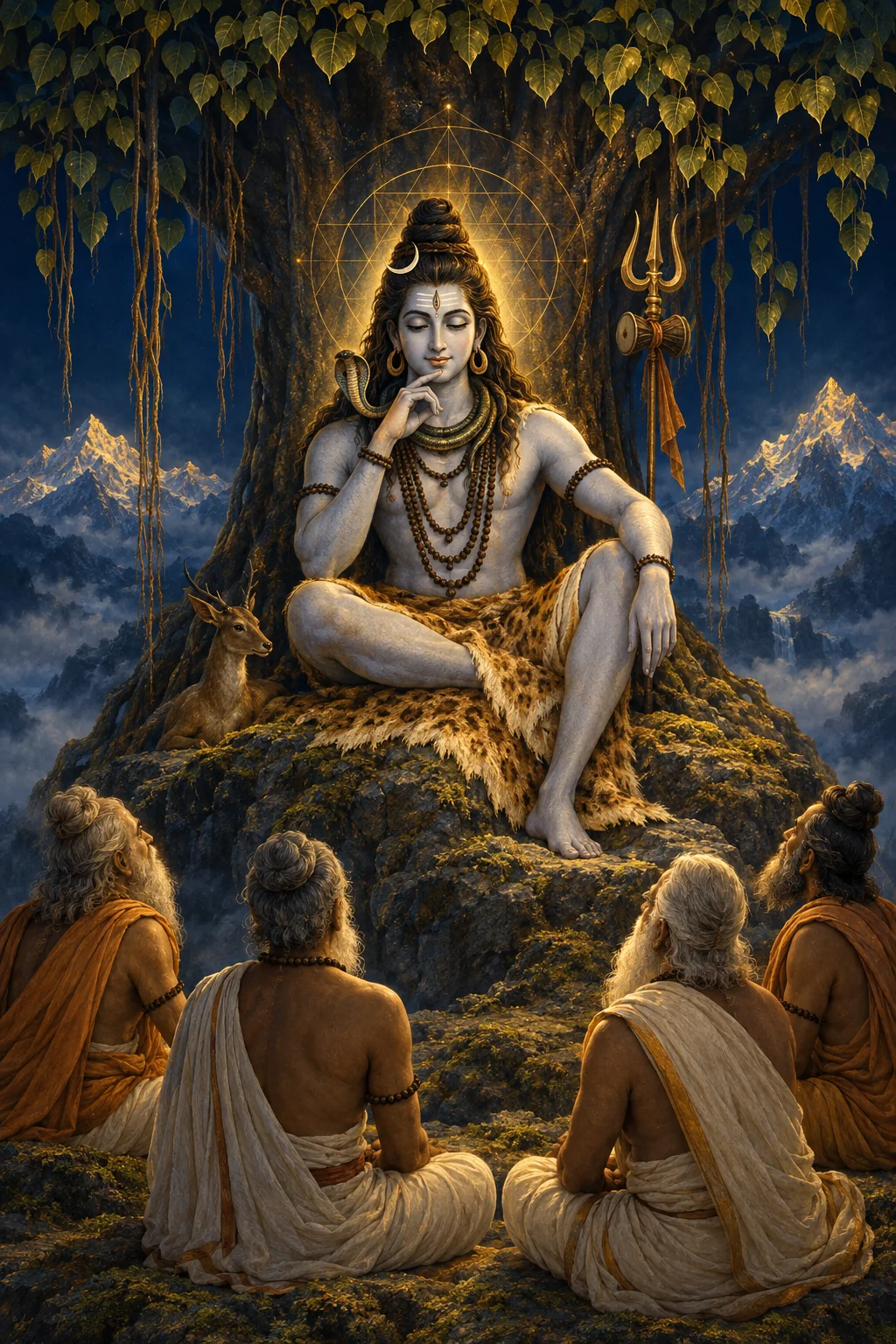
Swami Brahmānanda Saraswatī
Śaṅkarācārya of the Jyotir Maṭha, Joshimath
1871–1953 · The Shankara Lineage
- When
- 1871 to 1953
- Born
- Surhurpur, near Ayodhya, in what is now Uttar Pradesh
- Where the life was lived
- From a village near Ayodhya in the Ganges plain to the Himalaya, and from 1941 to the Jyotir Maṭha at Joshimath in Uttarakhand, on the pilgrim road to Badrīnāth. He died at Calcutta in 1953.
- What is left of it
- He is remembered for his teaching in person and for restoring the northern seat, rather than for books.
Brought the Jyotir Maṭha, the northern one of the four seats, back into unbroken function in the twentieth century.
The full-length study of this teacher is still being written. What is below is the complete short life, and it is accurate as far as it goes.
The life
The geography is the story here. The Jyotir Maṭha stands at Joshimath in the Garhwal Himalaya, on the road pilgrims take to Badrīnāth, at the altitude where the deodar forest gives out — the northern one of the four seats Adi Shankara is said to have established at the corners of India, and the one whose line had lapsed for long stretches. He was born Rajaram Mishra in 1871 at Surhurpur, near Ayodhya, in the flat Ganges plain, and by the tradition's account he left home at nine for the spiritual life. What followed was not a career: decades in the Himalayan forests and caves, under his teacher Swami Kṛṣṇānanda Saraswatī, with none of the institutional visibility that usually precedes high office. He was asked repeatedly to take the seat and refused for years, accepting only in 1941, when he was seventy. He held it for twelve years, gave initiation to students who later carried Vedānta far beyond India, and died at Calcutta in May 1953, aged eighty-one. There is a reason to keep him on a page like this. The order of events matters: solitude first, for as long as it takes, and the chair afterwards — and only because others insisted.
The turn it rests on
He accepted the seat reluctantly and late, having already spent the years of a whole career in solitude; he died in Calcutta in 1953, aged eighty-one.
What was taught
Held the northern seat Śaṅkara had founded in the Himalaya, after most of a lifetime spent in the forests and caves of that same range.
Read the originals
Primary texts and the records kept by the teacher's own institution.
Every daily message names the teacher it came from. Read the messages, or see the whole line this teacher stands in: all fifty-one teachers.