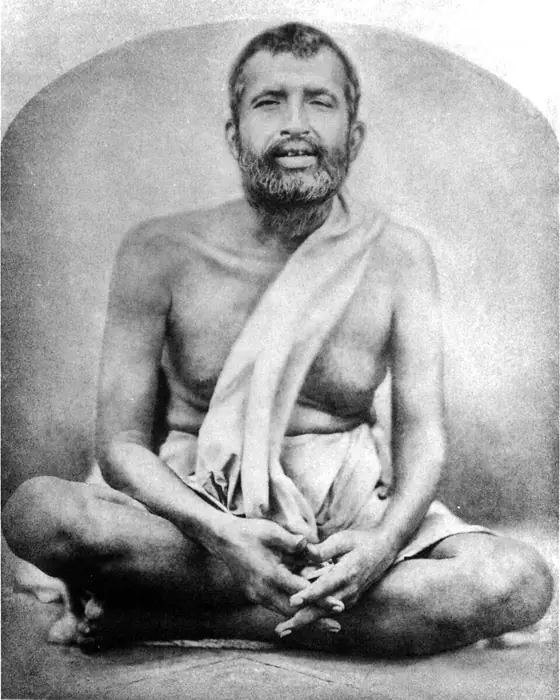
Sri Ramakrishna Paramahamsa
Mystic of Dakshineswar
1836–1886 · The Ramakrishna Lineage
- When
- 1836–1886
- Born
- Kāmārpukur, Bengal
- Where the life was lived
- Born at Kamarpukur, a village about sixty miles north-west of Kolkata; from 1855 priest of the Kālī temple at Dakshineswar on the Ganga, where he spent nearly his whole adult life.
- What is left of it
- He wrote nothing. His conversations were recorded by Mahendranath Gupta as the Śrī Śrī Rāmakṛṣṇa Kathāmṛta, translated into English in 1942 as The Gospel of Sri Ramakrishna.
Practised within several religious traditions in turn and reported the same goal in each; taught a small group of young men who became the Ramakrishna Order; left his body in the early hours of 16 August 1886.
Kamarpukur
He was born on 18 February 1836 in Kamarpukur, a village about sixty miles north-west of Kolkata, and named Gadadhar. His parents, Kshudiram Chattopadhyaya and Chandramani Devi, were poor, devout and locally respected. The village liked the boy. He sang well, drew well, mimicked people mercilessly, learned the epics by ear from travelling performers, and would not be made to study — an aversion to formal schooling and to what he later called bread-winning education that never left him.
Two events from the childhood are worth having exactly. At about six, walking along a field, he looked up at a flight of white cranes crossing a black storm cloud and lost outward consciousness altogether; that was the first of the states that would define his life. At seven, his father died, which he later said drove him inward and loosened whatever hold the world had on him.
Dakshineswar
At sixteen he was taken to Kolkata by his elder brother Ramkumar to help in his priestly work. In 1855 the Kālī temple at Dakshineswar, built on the bank of the Hooghly by Rani Rasmani, was consecrated; Ramkumar became its chief priest and the younger brother assisted him. Within months Ramkumar died, and the priesthood of the temple fell to Gadadhar, who was not yet twenty.
What happened over the next twelve years is the part that has no parallel in the modern record of any tradition.
He took the worship of the Mother literally. Not as symbol, not as devotional exercise: he wanted to know whether there was anyone there. He would spend the whole night in the woods beside the temple, weep openly through the day, forget the sequence of the ritual, feed the image and refuse to eat until it had eaten. Everyone concerned thought he was ill, and several doctors were called. His account of the end of that phase is well known and entirely unsentimental: driven past bearing, he reached for the sword hanging in the shrine, intending to end a life that had not produced the one thing he wanted, and at that instant, he said, the ordinary room went and there was nothing but a shoreless light. He called it the Mother.
His relatives, alarmed by the state he was in, arranged a marriage, on the reasonable village theory that responsibility settles a young man. The girl was Saradamani, from the neighbouring village of Jayrambati. The marriage held for the rest of his life, and it was never consummated; that is not a private inference but something both of them stated plainly.
The unrepeatable experiment
From 1861 a series of teachers came to Dakshineswar, and this is where his life stops resembling anyone else's.
The first was a woman: the Bhairavī Brāhmaṇī, an accomplished adept, learned in the texts, who recognised what was happening to him and put him through the difficult disciplines of the Tantric path. He completed them all. Three years later the wandering monk Totāpurī arrived — a strict non-dualist with no time for images, worship or the Mother. Under him, in a matter of days, Ramakrishna entered the state the texts call nirvikalpa samādhi, awareness with no division left in it at all, and then remained in it for six months, unaware even of his own body and kept alive by others. Totāpurī, who had taken eleven years over it, stayed for months instead of days and, by his own admission, learned something at Dakshineswar he had not come to learn.
Then he went further out. He practised as a Muslim, and as a Christian, and reported arriving in each case at the same terminus. He venerated Jesus and the Buddha as embodiments of God and honoured the ten Sikh Gurus. The whole extraordinary programme produced one short sentence that is now quoted everywhere, usually without the twelve years behind it: yato mat, tato path — as many faiths, so many paths.
Notice what the sentence is and is not. It is not the modern liberal claim that all religions say the same thing, which is obviously false and which he never made. It is the report of somebody who ran the experiment from inside each path in turn and found they converged at the far end, while remaining quite different in the middle.
The Mother, and a woman on a stool
In 1872 Sarada, then nineteen, came from Jayrambati to Dakshineswar. He received her warmly and taught her how to run a household while living an intensely spiritual life. One night that year, in his room, he seated her and worshipped her formally as the Divine Mother, dedicating the fruit of all his practice at her feet.
It is worth pausing on that act, because it is easy to file as picturesque and it is nothing of the kind. In nineteenth-century Bengal a wife was a dependant. He worshipped his own wife as God, in private, with nobody watching, at the end of the most intense spiritual career of the century. And he then let her carry the results: after his death Sri Sarada Devi became the authority to whom his monastic disciples deferred, and there was no argument about it.
The teaching, and the classroom
He wrote nothing and never lectured. What survives is conversation, recorded by devotees — above all by Mahendranath Gupta, who kept a diary of what he heard and published it as the Kathāmṛta, translated as The Gospel of Sri Ramakrishna. It is unusual among scriptures in that it reads like a transcript, including the interruptions, the laughter and the singing.
He taught in parables, drawn from the village and the kitchen rather than the library, and this is why the stories outlive the arguments:
- The salt doll walks into the sea to measure its depth, dissolves on entering, and can never come back to report. That is his answer to the demand that liberation be described.
- A tiger cub raised by sheep bleats and eats grass until an older tiger drags it to the water and makes it look at its own reflection. Nothing is added; a mistake about identity is removed.
- The mind is like a jar of water with sediment; stop shaking it and it clears on its own. He would not let people treat clarity as something to be manufactured.
- Two men in a mango orchard: one counts the trees and estimates the yield, the other eats the mangoes. He had a low opinion of theology conducted at a distance from experience.
On money and possessiveness he was physically incapable of pretence. His own hand would not close on a coin, and he was constitutionally unable to hold one. He called the double grip of money and craving the thing that keeps an ordinary life opaque, and he said it in front of wealthy patrons.
He divided those who came to him without ceremony. Householders he taught to find God while doing their duty and keeping their families, explicitly refusing to make monks of them. A small group of young men, mostly from educated middle-class Bengali families, he trained differently and deliberately, for renunciation and for service. The foremost of them was Narendranath Datta, who became Swami Vivekananda.
By then his reputation had spread, Rani Rasmani's son-in-law Mathur Nath Biswas had taken over the care of him, and an assembly of scholars convened at Dakshineswar had declared that he was not an ordinary man. He appears to have found that mildly embarrassing and entirely irrelevant.
The last year
In September 1885 the pain in his throat was diagnosed as cancer. He was moved to a house at Shyampukur and then to a rented villa at Cossipore, where the young disciples nursed him through the final months — Narendranath among them, penniless himself after his father's death, unable to find work, and leading the group anyway.
The illness was cruel in a specific way: a man whose whole life had been devotional singing and speech lost the use of his throat, and could barely swallow. He went on teaching in whispers. Near the end he distributed ochre cloth among the young men, sent them out to beg their food, and gave Narendranath instructions about the monastic order they were to form. He died in the small hours of 16 August 1886.
He was fifty. He had never travelled further than a few hundred miles from his birthplace, held no office, wrote no book, and left behind a movement that within twelve years was operating on several continents.
The timeline, plainly
- 18 February 1836: born at Kamarpukur, sixty miles from Kolkata.
- About 1842: the flight of cranes; the first ecstatic state. 1843: his father dies.
- 1852: taken to Kolkata by his brother Ramkumar.
- 1855: the Kālī temple at Dakshineswar is consecrated; Ramkumar is chief priest, and within months Ramakrishna succeeds him.
- Later 1850s: the years of extreme longing, the vision of the Mother, and the family's alarm; marriage to Saradamani of Jayrambati.
- 1861: the Bhairavī Brāhmaṇī arrives; the Tantric disciplines are completed.
- About 1864: Totāpurī arrives; nirvikalpa samādhi, followed by six months in that state.
- Following years: practice within Islam and Christianity; "as many faiths, so many paths."
- 1872: Sarada comes to Dakshineswar; he worships her as the Divine Mother.
- 1870s to 1880s: the householders and the young monastic disciples; Narendranath first comes in November 1881.
- September 1885: throat cancer; Shyampukur, then Cossipore.
- 16 August 1886: dies at Cossipore, aged fifty.
What he gives a reader who wants none of the ecstasy
Three things, and all of them survive translation into an ordinary week.
He is the empirical end of this tradition. He did not accept the non-dual teaching because the texts say it; he had it confirmed by a teacher who tested him, and he then went and checked it inside three religions. If you distrust doctrine, he is the one to read first.
He removes the excuse that this is for scholars. He could barely write. His images come from cooking, farming, ponds and animals, and they are why the stories stay with anyone who hears them once.
And he closes the gap between devotion and enquiry that is usually presented as a choice. The man who worshipped an image as a living Mother, and the man who sat for six months with no division left in awareness, were the same man in the same room, and he refused to rank the two.
Read the originals
Primary texts and the records kept by the teacher's own institution.
Every daily message names the teacher it came from. Read the messages, or see the whole line this teacher stands in: all fifty-one teachers.