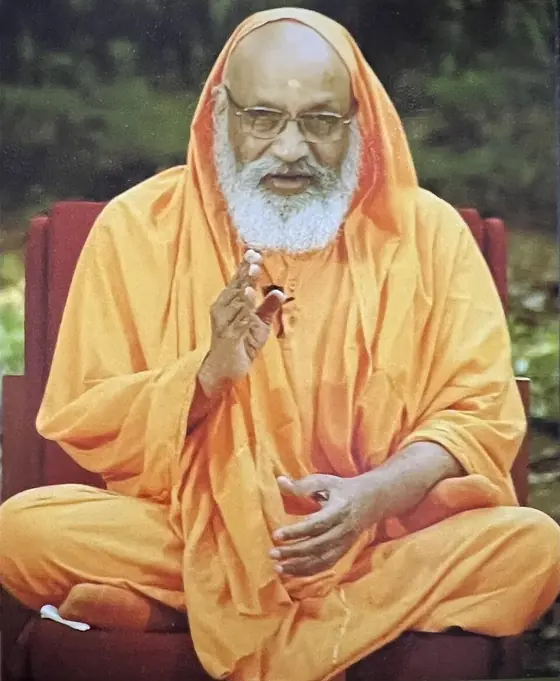
Swami Dayananda Saraswati
Teacher of teachers; Arsha Vidya
1930–2015 · The Chinmaya Lineage
- When
- 1930–2015
- Born
- Manjakkudi, Tamil Nadu
- Where the life was lived
- Born at Manjakkudi in Tamil Nadu; taught at the Sandeepany school in Mumbai, then founded gurukulams at Rishikesh on the Ganga, at Anaikatti near Coimbatore, at Nagpur, and at Saylorsburg in Pennsylvania; died at Rishikesh on 23 September 2015.
- What is left of it
- Commentaries on the Bhagavad Gītā and the Upaniṣads, and his Introduction to Vedanta.
Trained generations of teachers in long residential courses in Sanskrit and Vedanta, built a village school and hospital at his birthplace, and convened the first World Congress for the Preservation of Religious Diversity at Delhi in November 2001.
The full-length study of this teacher is still being written. What is below is the complete short life, and it is accurate as far as it goes.
The life
He was born in 1930 at Manjakkudi, a village in the Kāverī delta in Tamil Nadu, and worked in business before renouncing. Then he did what few do in either direction: he studied Sanskrit and Vedānta with complete rigour in the Śaṅkara tradition, and then chose to teach in English, word by word from the original texts rather than from summaries. His diagnosis of the problem was institutional. Students were not the bottleneck; qualified teachers were. So he built teachers — long residential courses, two and three years, in Sanskrit grammar and the Prasthānatrayī, which produced hundreds of teachers who now teach on several continents. He taught at Sandeepany in Mumbai, then founded gurukulams at Rishikesh on the Ganges, at Anaikatti in the hills near Coimbatore, at Nagpur, and at Saylorsburg in the Pocono mountains of Pennsylvania. He also built a school and a hospital at Manjakkudi, the village he came from, and in November 2001 convened the first World Congress for the Preservation of Religious Diversity in Delhi, arguing publicly that a tradition which holds reality to be one has a specific obligation to defend the plurality of religions. His Introduction to Vedanta and his commentaries on the Gītā and the Upaniṣads are still the clearest entry points many students find. He died at Rishikesh on 23 September 2015.
The turn it rests on
He decided the bottleneck was not students but teachers, and built teachers.
What was taught
Trained generations of Vedanta teachers through long residential courses and unmatched precision of language.
Read the originals
Primary texts and the records kept by the teacher's own institution.
Every daily message names the teacher it came from. Read the messages, or see the whole line this teacher stands in: all fifty-one teachers.