Swami Dayananda Saraswati
Teacher of teachers; Arsha Vidya
1930–2015 · The Sri Chinmaya Lineage
- When
- 1930–2015
- Born
- Manjakkudi, Tamil Nadu
- Where the life was lived
- Born at Manjakkudi in Tamil Nadu; taught at the Sandeepany school in Mumbai, then founded gurukulams at Rishikesh on the Ganga, at Anaikatti near Coimbatore, at Nagpur, and at Saylorsburg in Pennsylvania; died at Rishikesh on 23 September 2015.
- What is left of it
- Commentaries on the Bhagavad Gītā and the Upaniṣads, and his Introduction to Vedanta.
Trained generations of teachers in long residential courses in Sanskrit and Vedanta, built a village school and hospital at his birthplace, and convened the first World Congress for the Preservation of Religious Diversity at Delhi in November 2001.
The India he was born into
He was born on 15 August 1930 — seventeen years to the day before the country became independent — in Manjakkudi, a small village on a branch of the Kāverī in the rice delta of the Tamil country, in what is now Tiruvarur district. That spring Gandhi had walked to the sea at Dandi and picked up a handful of salt, and the jails were filling. But the delta had its own weather. The Thanjavur country had been for a thousand years the most densely Brahmin, most densely templed, most Sanskrit-saturated countryside in India: the land of the great Chola shrines, of Tyāgarāja's music at Tiruvaiyaru, of villages where the Vedas were still chanted from memory by men who farmed paddy. A boy born into an orthodox family there in 1930 learned Vedic chants before he learned to read.
The same countryside was also the front line of an attack on everything that culture stood for. E. V. Ramaswamy Naicker's Self-Respect movement was at its height in the Tamil districts of the 1930s and 1940s, campaigning against the Vedas, against ritual, against God, against Brahmins and against Sanskrit — and, as he remembered later, the boys who read its literature came to school ready with arguments. Nobody on this site grew up with the truth of Vedānta so directly contested, so early, by intelligent people. It marked him. Where Swami Sivananda's response to modernity was to embrace it, and Swami Tapovanam's was to walk away from it, his was to argue with it, on its own terms, for the rest of his life. He is the most rigorously logical teacher in this lineage because he had to be.
He is also the most recent. He died in 2015, and hundreds of the men and women he trained are teaching today. That means the record is unusually good — his own long account of his life, given in interviews, is published by his gurukulam and linked below — and it also means this study can be checked against living memory. It stays inside what his own institutions have printed.
Where the life was lived
Four geographies: the Kāverī delta of his childhood; Madras, Madurai and Bangalore, where he worked and studied as a young man; the Ganga at Rishikesh, where he studied twice and where he died; and the schools he founded — at Bombay, Rishikesh, Coimbatore and Nagpur in India, and at Saylorsburg, Pennsylvania, in the United States, which lies beyond this map.
Present-day locations. The dotted line follows the order of the recorded moves from the Kāverī delta to Rishikesh, not an exact road. The Arsha Vidya Gurukulam at Saylorsburg, Pennsylvania (1986), Sandeepany West in California, and the forums at the United Nations and The Hague lie beyond the map.
- 1Manjakkudi (Tiruvarur district, Tamil Nadu) — born 15 August 1930 on the Kāverī; school at nearby Kodavasal; later built the temple chariots at Thiruvidaimarudur, a few miles north
- 2Chennai (Tamil Nadu) — journalist, airman, election volunteer; hears Swami Chinmayananda in 1953; Madras secretary of the Mission
- 3Madurai (Tamil Nadu) — founds the Chinmaya Mission centre, mid-1950s
- 4Uttarkashi (Uttarakhand) — April 1955: types the Gītā commentary; Swami Tapovanam tells him to stay and study
- 5Bengaluru (Karnataka) — editor of Tyagi from March 1956; Sanskrit and bhāṣya study; the two lost years
- 6Gudivada (Andhra Pradesh) — learns from Swami Pranavananda that Vedānta is a pramāṇa
- 7Mumbai (Powai) (Maharashtra) — Sandeepany Sādhanālaya: Tapovan Prasad from 1963; designs and teaches the courses of 1972–75 and 1976
- 8Rishikesh (Uttarakhand) — Kailash Ashram and Purani Jhadi, 1965–68; Swami Dayananda Ashram (Arsha Vidya Pitham); died here 23 September 2015
- 9Anaikatti (near Coimbatore, Tamil Nadu) — Arsha Vidya Gurukulam, founded 1990
- 10Nagpur (Maharashtra) — the third Indian gurukulam
Natarajan of Manjakkudi
He was named Natarajan, the eldest of four surviving brothers, in the family of Gopala Iyer and his wife Balambal — the Rishikesh ashram spells her name Valambal. Two grandfathers shaped him, and he said so. His father's father was a rich and respected man whom some villagers thought "too simple, if not impractical." The tradition says one does not go empty-handed to a teacher or a king, so a poor man once brought him a single tender pumpkin, and the old man gave him a whole bag of paddy in return. When people protested he said: "I know that one pumpkin is not equal to a bag of paddy. But when that poor man plucks the pumpkin from the only creeper in his garden he feels a sense of loss. I compensate for that sense of loss, not for the value of the pumpkin." Sixty years later the grandson said, "This sense of justice went deep into me. It made me appreciate always the attitudes and sense of loss of others." His mother's father was a devotee of Śiva who said "Paramaśiva" whenever he was called, before he ate, and at the start of every conversation; the boy caught the habit of devotion from him.
He learned Tamil verses as a small child, and one of them, about death — though one may roll over and cry for years, will the dead return? — did something unexpected. His father died when he was eight. "I could not cry," he said. "I felt it was silly to cry. He would not come back. I tried telling others, but they would not listen, so I went out to play." An uncle found him playing and hit him for it. The boy had, at eight, drawn a logical conclusion from a verse and acted on it, and been punished for the logic. It is the whole of his later temperament in one scene.
In 1939 a well-known village storyteller, Manjakkudi Rajagopala Sastrigal, initiated him into the Gāyatrī. He performed Saraswatī pūjā every Friday — "I do not know why I did it. Perhaps I wanted to make up for not studying!" He was sent to Madras for schooling and sent back when the Japanese bomb threats began, and finished at the high school in Kodavasal. There, in the sixth grade, he had to choose a second language. Tamil was his mother tongue; Sanskrit was the language of the scriptures, and it was under public attack. He chose Sanskrit. He was one of five boys in the school who did. He studied it for six years and did very well, and he learned something else in those classrooms that he named exactly: "The atheistic movement used to bother me a lot. Students used to read that literature and come prepared with questions. I was ill equipped to argue with them, using only my wits. But my love for mathematics and my logical mind helped me. Even belief must rest on a logical basis, and I created such a basis in my mind about religion and God." A fifteen-year-old who decides that belief must rest on logic, and builds the logic himself, is already the teacher of the Gītā Home Study Course.
Madras: a young man with too many jobs
He went to Madras to live with an aunt and did what able young Tamil men of his generation did: he tried everything. He worked for a year on a weekly called Dharmika Hindu, set up to answer the atheist movement, and learned journalism. He decided to be a fighter pilot and joined the Indian Air Force, and left after six months — "I was a popular guy, but I could not stay for long, as I valued free thinking and felt regimented there." He joined a news agency that fed supplementary copy to papers across India, and liked it because it taught him about everything from sport to politics; he learned to select, edit and present news so well that his employer, by his own account, asked him to find another job. He was promised a sub-editorship, and was instead seconded to the Jail Reforms Commission to write its final report. He worked as a volunteer agent for a candidate in the first general election. He was twenty-two and could evidently do anything, and he had not yet found the one thing.
1953: a revelation in a lecture hall
In 1953 a young monk from the Himalaya named Swami Chinmayananda came to Madras to give a series of talks on the Upaniṣads. Natarajan went. "I found his talks fascinating," he said. "I had heard Purāṇic talks and read Swami Vivekananda's books and some portions of the Gītā, but I had never studied the Upaniṣads nor heard about them, though I was brought up in an orthodox and learned atmosphere. The Upaniṣads were a great revelation to me." When the monk went back to the mountains, some of the listeners formed a group to keep meeting and called it the Chinmaya Mission; Natarajan became its Madras secretary. Swami Chinmayananda sent him to Madurai to start a centre there, and it went well — the first real success, he said later, of that kind of organising work.
He also began to study, hard. He joined the Sanskrit classes of P. S. Subramania Iyer, a retired professor of English who had devised the method of chanting the Gītā that Mission members use to this day, and before long he was teaching Gītā chanting classes himself under the Mission's name. They were very popular. A young journalist who could chant, organise, edit and argue was exactly what a monk with a growing movement and no staff needed, and Swami Chinmayananda used him for all of it.
Uttarkashi, April 1955: "You have a duty to yourself"
In the spring of 1955 Swami Chinmayananda took him to Uttarkashi to help prepare the Gītā commentary for the press: the monk dictated and the young man typed, and in two months they finished ten chapters. In the same hut he met his teacher's teacher, Swami Tapovanam, then in his last years. When Natarajan was ready to go back to Madras, the old man asked him why. What he wanted, he admitted later, was to stay and study; but "a life of sannyāsa is not liked by those close to you. It represents a complete break from the family. I wanted to prepare them slowly for that, but I did not want to describe all this to Swamiji. So I said that I had some duty to the family." Swami Tapovanam laughed. "You have a duty to yourself which is also important," he said. "Stay here. Do japa, meditate and study." Natarajan promised to come back the following year.
He went down and became editor of Tyagi, the Mission's fortnightly. When word came that the old teacher had died, he wrote to Swami Chinmayananda saying he intended to leave his job and Madras for good, and reminded him of the promise. The reply was characteristic: move the Tyagi office to Bangalore and run it from there. He did, in March 1956, and in Bangalore, alongside the Mission work, he studied Sanskrit, read the bhāṣya on the Upaniṣads with Professor Vijayaraghavachariar, learned some Sāma Veda, and read every book on sādhana he could find.
Two years of getting nowhere
Then he did what almost every serious seeker does, and he described it with a candour that is itself a teaching. "I thought that I could figure things out all by myself by reading books. I wanted to gain self-realisation by doing things — by breathing exercises, fasting, yoga practices, meditation — but in spite of trying for two years, spending little time in sleep, I got nowhere! I lost trust even in Vedānta. I gave away my entire collection of books on Vedānta. I did not talk to anybody about my problem, including Swamiji." A disciple of Sri Ramana Maharshi, Yajnaramayya, gave him hints on the "Who am I?" inquiry; it did not settle him.
Swami Chinmayananda found out, and did the right thing. He sent him to a traditional teacher, Swami Pranavananda, at Gudivada near Vijayawada in the Andhra country. What happened there is the hinge of the whole life, and he put it in one paragraph: "Swami Pranavananda influenced me profoundly and solved all my problems. This was a great blessing to me. During my stay I learned one thing clearly: Vedānta is a pramāṇa, a means of knowledge. I saw the Swami giving direct knowledge to the people he was teaching. This resolved all my conflicts. My problems with Vedānta had been my mistaken notion that it was a system."
It is worth stopping on this, because everything he taught for the next fifty years is in it. A system is something you adopt and then try to make true by effort — breathing, fasting, meditating until an experience arrives. A pramāṇa is an instrument of knowledge, like the eyes. You do not make sight true by trying; you open your eyes and see. The Upaniṣads, in his understanding, are a means of knowledge for the one thing no other instrument can reach — the nature of the knower — and they work by being unfolded, word by word, by someone who has already seen through them. The seeker's job is not to manufacture an experience but to remove the errors that prevent the words from doing their work. He also said, of the two lost years: "Even while I had conflicts, I had śraddhā in the teacher and the teaching. I had great respect for Swamiji as my guru and was ready to serve him always. It is the grace of the guru that helped me. I did get the right type of help at the right time."
Sannyāsa, a fire, and a school that makes teachers
On Mahāśivarātri 1962 Swami Chinmayananda gave him sannyāsa and the name Dayananda Saraswati — "the bliss of compassion." He spent some time in the Himalaya and then travelled India giving talks. In September 1963 Swami Chinmayananda founded Sandeepany Sādhanālaya at Powai in Bombay as an academy of Vedānta, and Swami Dayananda settled there to launch and edit the Mission's new monthly, Tapovan Prasad, named for the teacher who had told him to stay.
In 1965 he went back to the Ganga. For three years he studied at Kailash Ashram in Rishikesh under Swami Tarananda Giri — the Brahmasūtra above all — while living at Purani Jhadi, the grove of the strictest ascetics, where the monks would not let anyone stay whom they did not think fit. He was accepted. He taught classes there for other sādhus and for the few visitors who could stand the conditions, and he wrote a detailed work on Sri Śaṅkara's commentary on the Brahmasūtra. Then his cottage caught fire, and the manuscript burned with every book he owned. He did not rewrite it. It is a curious fact that the most prolific teacher of Vedānta of his generation left almost nothing composed as a book: nearly everything in print under his name is a transcript of teaching.
In 1968 he returned to Bombay and began conducting yajñas, the Mission's public lecture series. Sandeepany, meanwhile, was about to be handed over to a cultural body; the school had been founded to train teachers, and had not yet done so. Swami Chinmayananda asked him to design a course. The first residential brahmacārī course at Sandeepany began on 14 September 1972 and finished in April 1975. "At Sandeepany the teaching is traditional and rigorous," he said, and put the measure plainly: what would take a sādhu in the Himalaya nine years to learn, the students at Sandeepany learned in two and a half. The second course began in January 1976 with sixty-five students, twenty-five of them from the West. The graduates of those two courses — Swami Tejomayananda among them — became the teaching body of the Chinmaya Mission, and he then took the same design to California, to a school called Sandeepany West, and taught there.
Arsha Vidya: the gurukulams
By the mid-1980s he was teaching independently of the Mission, and the shape he chose was the oldest one in India: a gurukulam, where students live with the teacher and learn as much from the living as from the classes. He had an ashram on the Ganga at Rishikesh from the 1960s, at Purani Jhadi itself, which became Arsha Vidya Pitham, the Swami Dayananda Ashram. In 1986, under that Pitham's auspices, he founded the Arsha Vidya Gurukulam at Saylorsburg in the Pocono mountains of Pennsylvania, and lived there for long stretches in a cottage called Ganga, later renamed Dayalayam, "the abode of compassion." In 1990 he founded a second Gurukulam at Anaikatti, twenty-five kilometres from Coimbatore where the Nilgiri foothills begin, and later a third at Nagpur. "Arsha Vidya" means the knowledge of the ṛṣis; the name was a claim that what was being taught was not his but theirs.
The curriculum was the same everywhere: three-year residential courses in English, Sanskrit grammar in the Pāṇinian style, the Bhagavad Gītā, the ten principal Upaniṣads with Sri Śaṅkara's commentary, the Brahmasūtra, and the smaller texts of the tradition, taught to Indians and Westerners together, "true to the sampradāya" and in a setting, as the Anaikatti school says of itself, "as modern as it is traditional." He ran these courses himself for decades, and hundreds of his students now teach on their own. He refused to build a centralised organisation around them. He wanted, the Arsha Vidya UK profile says, his students "to think for themselves, to be who they are," and he gave the reason in one line: "Only when we give freedom to others, are we really free."
Beyond India: the gurukulams abroad, mapped
Two of the places that mattered most lie outside the map of India: Sandeepany West at Piercy, in the redwoods of northern California, where he taught the Mission's residential course; and the Arsha Vidya Gurukulam he founded at Saylorsburg, Pennsylvania, in 1986, which is still the largest of his gurukulams outside India. The two public forums — the United Nations summit of August 2000 in New York and the Faith in Human Rights conference at The Hague in December 2008 — are marked with them.
Pins, not a route: from 1986 he taught at Saylorsburg season after season while keeping his gurukulams in India, and no single line between them would be honest. Coastlines only; no borders.
- 1Rishikesh — Swami Dayananda Ashram on the Ganga — the home he returned to between every American season; he died here on 23 September 2015
- 2Mumbai — Sandeepany Sadhanalaya, where he designed and taught the courses of 1972–75 and 1976
- 3Piercy — Sandeepany West, California: he taught the Mission's residential course here in the redwoods; the Arsha Vidya account gives no years
- 4Saylorsburg — Arsha Vidya Gurukulam, Pennsylvania, founded 1986 — his principal gurukulam outside India, in the Pocono hills
- 5New York — the Millennium World Peace Summit of Religious and Spiritual Leaders at the United Nations, August 2000
- 6The Hague — the Faith in Human Rights conference of December 2008, where he represented the Hindu faith
Sources: Arsha Vidya Gurukulam, Saylorsburg and the Arsha Vidya account of his life and work. Years for Piercy are not given in those accounts and are not invented here.
The public man
In his last two decades he did something none of the other teachers on this site attempted: he spoke for Hindu dharma in the world's forums, without softening the Advaita. In July 1999 he declared that religious or cultural conversion, in any form, is violence — an act against the very structure of a person's self-understanding — and the statement was taken up by scholars and religious leaders internationally. In 2000 he spoke at the United Nations Millennium World Peace Summit of religious leaders. In November 2000 he founded the All India Movement for Seva, to bring schooling and healthcare to the most neglected rural and tribal children; by the time of the profile below it ran ninety-five free student hostels and had reached more than ten million people across fifteen states. His reason was the Advaitin's: "A person who consumes the least and contributes the most is a mature person, for through giving lies self-growth."
He then travelled across India, personally, to the heads of the ancient monastic seats — the Śaṅkarācāryas and the chiefs of every major sampradāya — to persuade them to sit together, for the first time in the history of the tradition, as one body. The Hindu Dharma Ācārya Sabhā was formed in 2002, and grew to more than a hundred and twenty-five ācāryas. He was its convener. At its first meeting he made sure the heads of the maṭhas had their seats on the dais, and sat below it himself, taking the minutes. At the Faith in Human Rights conference at The Hague in December 2008 he represented the Hindu faith and secured a clause, signed by the leaders of all the major religions, that "the freedom to have, to retain and to adopt a religion or belief of one's personal choice, without coercion or inducement" is an undeniable right.
He was also, less publicly, a composer — his "Bho Śambho" is sung in concert halls and danced in Bharatanāṭyam recitals across India — and a restorer of festivals: he built a great temple chariot for Mahāliṅgaswāmī at Thiruvidaimarudur in the Kāverī delta, and four more for the temple's other deities, to bring back a festival that gathers every community in the town. In 2013 the Śaṅkarācārya of Sringeri, Sri Bhāratī Tīrtha, gave him the Shankara Award for his contribution to Advaita Vedānta. The Government of India awarded him the Padma Bhūṣaṇ after his death.
What he actually taught
He taught Advaita as Sri Śaṅkara taught it, from the texts, in their order, with the words in Sanskrit on the board and their meaning unfolded in plain English, for as long as it took — his Gītā course ran to three hundred and sixty-three talks over three years. Within that, five emphases are his own.
The first is that Vedānta is a pramāṇa. This is the Gudivada insight, and he never let go of it. You are not asked to believe the Upaniṣads or to verify them by an experience; you are asked to let them show you what you already are, as a mirror shows a face. "You are the whole," the UK profile quotes him. "Yet you feel small, limited and insignificant. This is only because you may know that you are, but do not know what you are. Knowledge is the only remedy for this ignorance. For this you need a teacher who is versed in scripture and established in the vision of the unity that is reality." The Saylorsburg newsletter puts the vision itself in a sentence: "the reality of the self, the world and God is one non-dual consciousness that both transcends and is the essence of everything. Knowing this, one is free from all struggle based on a sense of inadequacy."
The second is the place of Īśvara. Many modern presentations of Advaita drop God as a concession to beginners. He did the opposite: "We do not say there is only one God, we say there is ONLY God. Nothing is secular, all that is here is Īśvara, the Lord." The whole order of the world — physical, biological, psychological, moral — was for him Īśvara, not as a person up there but as the intelligence and law that everything here is. Prayer, ritual and devotion were therefore not stages to be outgrown but ways of relating to the total, and a person who could not relate to the total was not ready to be told that he was it.
The third is the teacher and the method. "Listening to the words of the scriptures, unfolded by a qualified teacher is the highest discipline." Not meditation, not service, not austerity — though he asked for all three as preparation — but śravaṇa, hearing the words handled by someone who knows what they point to, is the means. The teacher's role, he said, is simply to share his vision so that it becomes the vision of the student.
The fourth is clarity as a value in itself: "There is nothing more fascinating than clarity, whether it is in precious stone or an idea. The crystalline clarity does attract. We need clarity in terms of priorities in life, values, attitude and finally of what IS." He held that most spiritual confusion is verbal, and that a person who could define his terms was halfway free.
The fifth is freedom. He would not centralise, would not command, would not bind his students to himself, and he framed the refusal not as modesty but as doctrine: a teaching whose whole content is that you are already free cannot be delivered by an institution that makes you dependent.
The sayings, and what they were for
"Vedānta is a pramāṇa, a means of knowledge. My problems with Vedānta had been my mistaken notion that it was a system."
On what he learned from Swami Pranavananda at Gudivada, in his own account of his life.
"We do not say there is only one God, we say there is ONLY God. Nothing is secular, all that is here is Īśvara, the Lord."
Quoted in the Arsha Vidya UK profile.
"You are the whole. Yet you feel small, limited and insignificant. This is only because you may know that you are, but do not know what you are. Knowledge is the only remedy for this ignorance."
Quoted in the Arsha Vidya UK profile.
"Only when we give freedom to others, are we really free."
On why he built no centralised organisation.
"A person who consumes the least and contributes the most is a mature person, for through giving lies self-growth."
On founding the All India Movement for Seva, November 2000.
"Even belief must rest on a logical basis."
On arguing with the atheist movement as a schoolboy in the 1940s.
Set the first and the last side by side and you have the man: a boy who decided that even faith must be reasoned, and a teacher who discovered that the reasoning was not his to do — that the text, properly heard, does it. The distance between the two is the two lost years in Bangalore, and he spent the rest of his life saving other people that time.
The books, and how to read them
He wrote almost nothing as a book. What exists under his name — and there is a great deal — is teaching, transcribed and edited by his students and published mainly by the Arsha Vidya Research and Publication Trust in Chennai, founded in 2005 for the purpose, and by the Rishikesh ashram's own press. The centrepiece is the Bhagavad Gītā Home Study Course: nine volumes, over four thousand pages, the edited transcript of the three hundred and sixty-three classroom talks in which he took the Gītā verse by verse with Sri Śaṅkara's commentary. For a reader who wants to know what "unfolding" a text means in this tradition, there is no better demonstration in English. Around it stand transcripts on the principal Upaniṣads — the Muṇḍaka, Kena, Kaṭha and Īśāvāsya among them — on Tattvabodha and the other introductory texts, on the Vivekacūḍāmaṇi, and dozens of short books of talks with titles like The Value of Values and Freedom from Helplessness that are the gentlest way in.
In the last year of his life he launched a website, Arsha Avinash, to give away books on Vedānta, chanting and Sanskrit as free downloads; it opened on 31 December 2014 and carries, among much else, his students' biography of him and many of his own transcripts. It is linked below, with the publisher, the Rishikesh ashram and the Saylorsburg and Anaikatti gurukulams. For the seeker with no Sanskrit, start with Tattvabodha in his unfolding, then the Gītā course from volume one; it was designed to be studied at home by exactly such a person.
Rishikesh, 23 September 2015
He taught until the end — the Saylorsburg newsletter says simply that he "taught Vedānta tirelessly for five decades" — and he died at his own ashram on the Ganga at Rishikesh, at Purani Jhadi, where he had studied as a young monk and where the manuscript had burned, on 23 September 2015, at eighty-five. The gurukulams observe his birthday and his passing every year, and the Ācārya Sabhā he convened still meets. The Government of India's Padma Bhūṣaṇ followed within months.
The historian will count the institutions: four gurukulams, a publication trust, a national service movement, a council of the ācāryas. The tradition counts something else. In five decades of teaching he produced, by his own institutions' count, hundreds of independent, qualified teachers of Sri Śaṅkara's Vedānta, and he did it without asking one of them to belong to him.
The timeline, plainly
- 15 August 1930 — Born Natarajan at Manjakkudi, on the Kāverī, Tiruvarur district, Tamil Nadu; eldest of four brothers.
- c. 1938 — Father dies when he is eight.
- 1939 — Initiated into the Gāyatrī by Manjakkudi Rajagopala Sastrigal.
- Early 1940s — High school at Kodavasal; chooses Sanskrit as second language, one of five boys to do so, amid the atheist campaign.
- c. 1948–1953 — Madras: Dharmika Hindu weekly; six months in the Indian Air Force; news agency; Jail Reforms Commission; election volunteer.
- 1953 — Hears Swami Chinmayananda on the Upaniṣads in Madras; becomes Madras secretary of the new Chinmaya Mission; founds the Madurai centre; teaches Gītā chanting.
- April 1955 — Two months at Uttarkashi typing the Gītā commentary; Swami Tapovanam tells him to stay and study.
- March 1956 — Moves the Mission's Tyagi to Bangalore as editor; studies the Upaniṣad bhāṣya with Professor Vijayaraghavachariar.
- c. 1957–1959 — Two years of unsuccessful self-effort; gives away his Vedānta books; sent to Swami Pranavananda at Gudivada, where he learns that Vedānta is a pramāṇa.
- Mahāśivarātri 1962 — Sannyāsa from Swami Chinmayananda; named Dayananda Saraswati.
- September 1963 — Sandeepany Sādhanālaya founded at Powai, Bombay; he launches Tapovan Prasad.
- 1965–1968 — Studies the Brahmasūtra under Swami Tarananda Giri at Kailash Ashram, Rishikesh; lives at Purani Jhadi; his Brahmasūtra manuscript is destroyed in a cottage fire.
- 14 September 1972 – April 1975 — Designs and teaches the first residential Vedānta course at Sandeepany.
- January 1976 — Second course: sixty-five students, twenty-five from the West. Later teaches at Sandeepany West, California.
- 1986 — Founds the Arsha Vidya Gurukulam at Saylorsburg, Pennsylvania, under the Arsha Vidya Pitham of Rishikesh.
- 1990 — Founds the Arsha Vidya Gurukulam at Anaikatti, near Coimbatore; later a third at Nagpur.
- July 1999 — Declares that conversion in any form is violence.
- 2000 — Speaks at the United Nations Millennium Summit of religious leaders; founds the All India Movement for Seva in November.
- 2002 — Convenes the Hindu Dharma Ācārya Sabhā.
- December 2008 — Represents the Hindu faith at The Hague and secures the clause on freedom of religion without coercion or inducement.
- 2013 — Shankara Award from the Sringeri Śāradā Pīṭham.
- 31 December 2014 — Launches the Arsha Avinash free-books website.
- 23 September 2015 — Dies at his ashram at Rishikesh. Padma Bhūṣaṇ awarded posthumously.
For the seeker now
He is the teacher on this site most directly useful to a modern, educated, sceptical reader, because he was one.
First, take his two lost years seriously. Almost everyone who comes to Vedānta today comes as he did in Bangalore — with a shelf of books, a meditation app, a breathing technique and the expectation that enough effort will produce an experience that settles the matter. He tried it harder than you will, for two years on little sleep, and got nowhere. His diagnosis was not that he lacked effort but that he had mistaken an instrument of knowledge for a system of practice. If you are stuck, the likelihood is that you are stuck in the same place, and the way out is the same: find a qualified teacher and listen to the text unfolded, rather than trying to make it come true by yourself.
Second, keep God. The fashionable Advaita of the internet is Vedānta with Īśvara removed — consciousness, awareness, "you are already that," and no one to bow to. He would say that a person who cannot relate to the whole is not yet ready to hear that he is the whole, and that prayer is not the opposite of knowledge but its preparation. It is a hard saying for a certain kind of reader, and it is meant to be.
Third, notice how he treated disagreement. He grew up argued at by atheists and spent his adult life arguing with everyone from missionaries to monks, and his method throughout was clarity — define the term, state the claim, follow the logic. He never asked anyone to stop thinking. His schools do not ask you to join anything. If Vedānta on this site ever begins to feel like a club, he is the corrective.
A note on the pictures
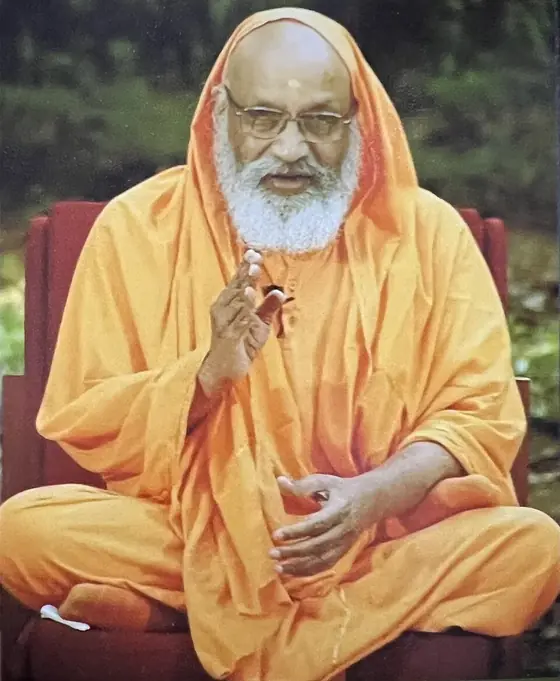
He lived into the age of the smartphone, and there are thousands of photographs and hundreds of hours of video of him teaching, held by the gurukulams and freely available on their sites. The portrait at the head of this page is one such photograph, published under a free licence that permits reuse and credited on the credits page; beyond it this site does not reproduce the gurukulams' archive, and it will not generate imitations of a real man's face. The map above is drawn from present-day coordinates. For his face and his voice, go to the Arsha Vidya links below; the recordings of the Gītā course are the closest thing to sitting in his class.
Read the originals
His gurukulams, his ashram and his publication trust keep his teaching, most of it as transcripts of his classes. Every link below goes to one of them, not to a general encyclopaedia.
- His life and work, largely in his own words (Arsha Vidya newsletter, PDF)
- Swami Dayananda Ashram, Rishikesh (Arsha Vidya Pitham): biography and bookstore
- Arsha Vidya Gurukulam, Saylorsburg: the school he founded in 1986
- Arsha Vidya Research and Publication Trust: the Bhagavad Gītā Home Study Course and his other transcribed teaching
- Arsha Avinash Foundation: free downloads of his teaching and his students' biography of him
- Arsha Vidya UK: a profile with his sayings and public work
- Saylorsburg Gurukulam newsletter on his vision and the "Dayalayam" cottage (PDF)
Every daily message names the teacher it came from. Read the messages, or see the whole line this teacher stands in: all fifty-one teachers.