Sri Annamalai Swami
Disciple and ashram worker
1906–1995 · The Sri Ramana Lineage
- When
- 1906 – 9 November 1995
- Born
- Tondankurichi, a village of about two hundred houses in the Tamil country near Vriddhachalam; named Sellaperumal
- Where the life was lived
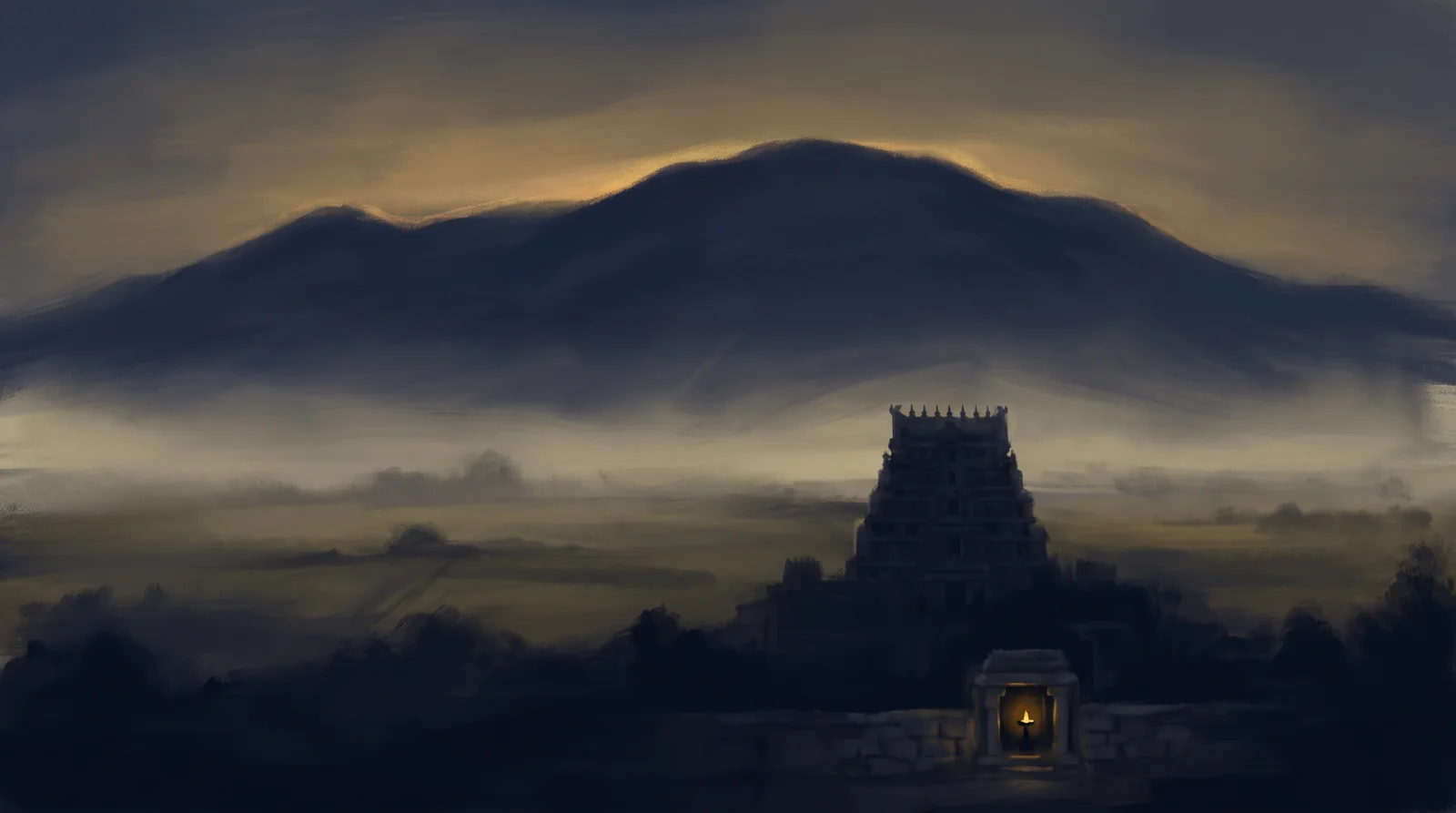
- Tondankurichi and the villages round it until 1928; then Tiruvannamalai for the rest of his life — Sri Ramanasramam from 1928, where he supervised the building work under Sri Ramana’s direction, and from 1938 one room in Palakottu, just west of the ashram at the foot of Arunachala, which he did not leave until his death.
- What is left of it
- Living by the Words of Bhagavan (1994), his memoir told to David Godman; Words of Grace (1996); Final Talks (2000); the diary of Bhagavān’s sayings; the ashram buildings of the 1930s; and the small ashram and samadhi shrine at Palakottu.
Left an unusually detailed first-hand record of what it was like to be given work by Sri Ramana day after day, and taught the same enquiry, plainly, to visitors for decades.
The village he was born into
He told his own story, late in life, to the people who came to sit with him, and it was written down and checked with him before it was printed. That is unusual among the teachers on this site, most of whom are known through disciples’ memories, and it means that the first person can be used on this page with some confidence: nearly everything here is what he said about himself, in the memoir David Godman compiled from several weeks of interviews with him in 1987 and published as Living by the Words of Bhagavan — Godman writes that Annamalai Swami “subsequently read my account to make sure that all his stories had been accurately recorded” — and in the ashram’s own account, which reproduces the same narrative. “I was born in Tondankurichi, a small village of about 200 houses, in 1906. My father, a man of many talents, was an important person in the village. In addition to being a farmer, an astrologer, a painter and a builder, he also knew how to construct statues and make gopurams.” Tondankurichi is in the Tamil country south of Pondicherry, in the flat rice-growing land between the Vellar and Ponnaiyar rivers, and its nearest town of any size in his account is Vriddhachalam. It was a village in which a boy would be asked to touch the Gaṇapati statue at the start of a wedding, and in which a father who could read a horoscope would act on what he read.
He read it soon after the birth, with another astrologer, and both concluded that the boy was likely to become a sannyāsin. “My father, who was not pleased by this prediction, decided to try to avert the possibility by denying me a proper education. He had the notion that if I never learned to read and write properly, I would never read the scriptures and never develop an interest in God. Because of my father’s belief in this prediction I only received a very rudimentary education at the local village school. When I had just about mastered the alphabet I was taken out of school and set to work assisting my father in his fields.” It did not work, and the father, he says, put many obstacles in his way before finally conceding, years later, that his son was destined to be a sādhu. There is no bitterness in the telling. He records, in the same breath, that the villagers had adopted him while he was still quite young as a kind of good-luck mascot: he was asked to put in the first frame when a house was begun, to pull the first weed when weeding started, to touch the Gaṇapati at marriages, and to come and share the sweets whenever a family made them. “I don’t know when the villagers first came to believe that I was a lucky person to have around.” An unlettered boy whom the whole village thought auspicious, kept from books by a father who feared where they would lead: that is where the life begins, and the shape of what follows is already in it, because he became one of the very few disciples of Sri Ramana Maharshi to realise the Self by doing exactly what he was told, and he never became a scholar.
Where the life was lived
There is almost nothing to draw. The life has two places: the village where he grew up, and the small piece of ground called Palakottu, immediately to the west of Sri Ramanasramam at the foot of Arunachala, where he lived from 1938 until he died in 1995 and, the ashram says, never once left his house in his last fifty years. Between them is a single journey, made in 1928 at the age of twenty-one, by way of Vadalur, where he had gone earlier to the shrine of Ramalinga Swami, and Tiruvannamalai town, where he sought out Seshadri Swami before walking on to the ashram. Everything else on the map is a place he did not go: he refused, in old age, to travel even into the town for an eye operation, and had it done in his room.
Present-day India; no border but India’s is shown. Numbered pins are the places named in his memoir Living by the Words of Bhagavan and in the ashram’s own account; the dotted line is the single journey of his life, made in 1928 at the age of twenty-one, by way of Vadalur, and is not a surveyed route. Tondankurichi is pinned approximately, near Vriddhachalam, since the sources do not give its position more exactly. Everything from 1928 to 1995 happened within a mile of the last pin.
- 1Tondankurichi (Tamil Nadu) — Born Sellaperumal in 1906 in a village of about two hundred houses, pinned approximately near Vriddhachalam, the nearest town of any size in his own account; the village school, the karnam’s library, the Sivaram Bhajan Math, the marriage refused and the village’s “cure”
- 2Vadalur (Tamil Nadu) — The shrine of Ramalinga Swami, whose photograph in a book first turned the boy’s mind; visited as a child and again on the journey of 1928
- 3Thellar (Tamil Nadu) — The village of the three devotees who supported him through the decades in Palakottu when almost no one else knew he was there
- 4Tiruvannamalai (Tamil Nadu) — Seshadri Swami’s darśan in the town, then Sri Ramanasramam, 1928: “I was waiting for you”; ten years supervising the ashram’s building; from 1938 the one room in Palakottu, west of the ashram at the foot of Arunachala, which he never left; died there 9 November 1995, 4.45 a.m.; his samadhi shrine, built in 1985 on his instructions, is beside it
The map is drawn on present-day coordinates from the place-names in the memoir; the village is pinned near Vriddhachalam, the town his own account names nearest to it, and the pin’s note says the position is approximate.
The boy who wanted to be a sādhu
What the boy could not get from books he got from pictures and from people. “In my youth I was very keen on maintaining an outward show of piety to demonstrate my commitment to the religious life. I wore a white dhoti, covered my head in imitation of Ramalinga Swami, and put a lot of vibhūti on my forehead and body. I was quite attached to Ramalinga Swami at the time: I had seen a photo of him in the village which impressed me enough to visit Vadalur, the place of his samadhi.” Ramalinga Swami, the nineteenth-century Tamil saint and poet, is one of the great devotional figures of the region, and the boy’s attachment to him shows the religion he grew up in: a Tamil Śaiva piety of saints, shrines and ash, not of Sanskrit texts. In his early teens he did acquire a book, the tenth part of a Tamil work called Jīva Brahma Aikya Vedānta Rahasya, and taught himself breathing exercises from it in a temple in the forest. The title means “the secret of the Vedānta of the oneness of the soul and Brahman”, and it is worth noticing that the first book a half-literate farm boy chose for himself was one about non-duality. It made him want to read more, and the means appeared: the village karnam, the government accountant, owned a library of religious books inherited from his father and had no time to read them, and his wife, a devout woman from Tiruvarur, let the boy come and read, fed him each day with food first offered to the Gaṇapati in her house, and would not eat until he had. He moved into the karnam’s house. “Since my parents disapproved of my religious zeal, I completely stopped going to my family home.” The estrangement, he says, lasted three years. Among the books were the Kaivalya Navanītam, the Tamil classic of Advaita, books on Sri Ramakrishna, the Tēvāram hymns of Appar and Jñānasambandhar, and the Bhakta Vijayam. He began reading aloud from them each evening, from about six until ten, to a group of ten or so villagers who came to listen and discuss. His father, told that the boy he had kept from school was expounding scripture, came and listened secretly to one of the evening sessions, and afterwards, he was told, said: “I cannot make him obey me any more. So, I will just give him to God.”
The karnam eventually turned him out, complaining that his wife had become “like a swami” and lost all worldly desire, and the group built themselves a small maṭh, the Sivaram Bhajan Math, into which he moved; he added a tannīr pandal on the main road, where rice gruel was served every day to sādhus and travellers. When he was about seventeen his parents made one last attempt, arranged a marriage without consulting him, and bought the provisions for the wedding; he told them to stop. The village concluded he was mad, and the memoir tells, without heat, what was done about it: he was taken from the maṭh to a lake, a cut made in the top of his head and lemon juice rubbed in, about fifty buckets of cold water poured over him while he kept quiet and practised his breathing, and then a bitter-gourd sambar fed to him as a further cure, before a crowd of about a hundred. “While I was eating one of them said to me, ‘You are a good boy, born in a good family, but you have gone mad’.” His parents, he is careful to record, were not among those who did this. He was candid, all his life, about his own faults, and the memoir records the tobacco he chewed to keep awake on his all-night ekādaśī vigils and his young man’s vanity about looking holy; he is equally candid about what the village did to him, and blames no one. In the end he left home properly. He performed pāda pūjā, the ritual washing of the feet, to his parents, formally asked their permission to become a sādhu, and asked for their blessing; and “they both gave me their permission and they both blessed me. Neither of them ever again tried to dissuade me from following the spiritual path.” Then he went in search of a guru in the way a village boy of his time would: he heard that the Śaṅkarācārya of Kanchipuram was to pass through on tour, sought him out, and asked for initiation. “He gave me the mantra ‘Sivaya Namah’ to repeat and also told me to write it one lakh times. Having succeeded in my mission I returned to my village and began to follow his advice. I bought several notebooks and filled them with the mantra. After that I did japa of the mantra and also started to meditate on it.” The memoir notes that this was the same Śaṅkarācārya who later sent Paul Brunton to Sri Ramana. A hundred thousand repetitions of “salutation to Śiva”, written out in notebooks by a boy who could barely write, is the first recorded discipline of his life, and it was finished before he had heard the name of the man who would be his guru.
The book with the photograph
“Sometime in 1928, when I was twenty-one years old, a wandering sādhu passed through the village. He gave me a copy of Upadesa Undiyar which contained a photo of Sri Ramana Maharshi. As soon as I saw that photo I had the feeling that this was my Guru. Simultaneously, an intense desire arose within me to go and see him.” Upadeśa Undiyār is Sri Ramana’s thirty-verse Tamil poem on the essence of the teaching, better known outside the Tamil country in its Sanskrit form as Upadeśa Sāram; the memoir notes that it had been printed for the first time in 1927, about a year before the copy reached him. The wandering sādhu’s name is not recorded; nobody knew it mattered. That night, he says, he dreamed that Sri Ramana walked from the lower slopes of the hill to the old hall, washed his feet at the threshold with water from his pot, and that he himself prostrated and fainted from the shock of the darśan. “As I was lying on the ground with my mouth open, Bhagavan poured water from his pot into my mouth. I remember repeating the words ‘Mahadeva, Mahadeva’ as the water was being poured in. Bhagavan gazed at me for a few seconds before turning to go into the hall.”
He set out. On the way he stopped for the blessing of a holy man in another village, and at Tiruvannamalai was told that there was a second great saint in the town, Seshadri Swami, whose darśan he should have before going on to the ashram. The memoir describes Seshadri Swami as the eccentric, wandering, miracle-working saint of the town, whom many thought mad, and who had come to Arunachala in his youth, like Sri Ramana, and stayed till death. The young man saw him, and then walked out to Sri Ramanasramam at the foot of the hill; when he arrived, he says, Bhagavān was living in the old hall, which had only recently been completed. This page reports the dream as he reported it; what can be said without hedging is that he arrived in 1928 with a mantra, a book of thirty verses, and no education, and that he stayed.
“I was waiting for you”
He asked Chinnaswami, Sri Ramana’s younger brother and the manager of the ashram, whether he could work there, and was made an attendant alongside Madhava Swami, who was then doing the job alone. Ten days after his arrival he asked his first question. “About ten days after my arrival I asked Bhagavan, ‘How to avoid misery?’ This was the first spiritual question I ever asked him. Bhagavan replied, ‘Know and always hold on to the Self. Disregard the body and the mind. To identify with them is misery. Dive deep into the Heart, the source of being and peace, and establish yourself there.’” He asked how he could attain Self-realisation and got a similar answer: give up identifying with the body and meditate on the Self, which you already are. And then, he says, “As I was pondering on these remarks Bhagavan surprised me by saying, ‘I was waiting for you. I was wondering when you would come.’” He was too afraid, as a newcomer, to ask how the Maharṣi knew or how long he had waited. He never did ask.
His name was changed almost at once. “My original name had been Sellaperumal. One day Bhagavan casually mentioned that I reminded him of a man called Annamalai Swami who had been his attendant at Skandashram. He started to use this name as a nickname for me. When the devotees heard this they all followed suit and within a few days my new identity was firmly established.” The memoir adds that the first Annamalai Swami had died at Skandāśramam in the plague of 1922. So the name by which he is known, and by which this page calls him, was another man’s, given to him in passing because he reminded his guru of someone; and Aṇṇāmalai is also one of the Tamil names of Arunachala itself. He took it as he took everything, without argument.
The attendant’s duties were humble and he loved them. One story from those first weeks is worth telling because of the answer it drew. He had overslept, dreamed that he was doing all his usual morning services for Bhagavān, and gone back to sleep satisfied; when Bhagavān came back to the hall alone he apologised and confessed the dream. “Bhagavan laughed and said, ‘The services you did for the dream Swami are for me only’.” The remark is light, and it is also the whole doctrine of the guru as the Self, given to a frightened new attendant as a joke about oversleeping. The memoir has many such moments; the leopard that frequented Bhagavān’s night-time path and was told to go away, and went, is on the same page.
The builder
The attendant’s job lasted about a month. Then, he says, Bhagavān decided he would be better employed supervising construction, and told him so in the most indirect way possible: “Bhagavan suddenly turned to me and said, ‘A man is building a wall near the water tank. Go and see what he is doing.’” He went and watched the mason, and found himself, without ever being appointed, in charge of the ashram’s building work. He stayed in charge of it for ten years. “Throughout the 1930s, up till 1938, I was engaged more or less full-time on building work. The biggest job that I undertook during this period was supervising the construction of the new dining room and kitchen. About 30–40 masons were working there every day on a building that was about twenty-five yards square.” The revetment wall, the storeroom opposite the kitchen door, the building that was meant to be a cowshed and became a store, the steps by the dispensary, the dining hall: much of the ashram that visitors walk through today was built under the supervision of a farm boy with no training, taking his instructions from a guru who, the memoir shows on page after page, cared intensely about the placing of every stone and came himself to inspect and correct.
The memoir is a builder’s memoir as much as a disciple’s, and that is its distinction. It records the quarrels as faithfully as the graces, and most of the quarrels were with Chinnaswami, the manager, who had one set of plans and received from Bhagavān, through his builder, another. The most dramatic came when Annamalai Swami, acting as he believed on Bhagavān’s wishes, began cutting down trees to make room for a hospital, and a crowd gathered, and Chinnaswami demanded by what authority he was acting. “When Chinnaswami finally came to the conclusion that I was acting on my own authority, and that I intended to carry on, he roared at me, ‘How dare you disobey me like this? What authority do you have here? Do you know who I am?’ I replied, as calmly as I could, ‘You do not know who you are and I do not know who I am. That is why we are fighting like this.’” The crowd, he admits, sided with Chinnaswami, because he could give no satisfactory account of himself. The answer he gave is the only piece of Advaita in the scene, and it was spoken in the middle of a row about trees by a man who knew he was in the wrong on the point of authority and right on the point of philosophy. It is the kind of thing the memoir preserves and a hagiography would not.
The hardness of the work told on him. Late in the 1930s, he says, Bhagavān found him digging with a crowbar and asked whether he had chosen the work himself or been given it by Chinnaswami; when he said the latter, Bhagavān was not pleased: “So, he has given you work. So, he has given you work. Why is he giving you work like this?” A little later, when Yogi Ramaiah remarked that Annamalai Swami was working very hard and his body had become weak and he should be given rest, Bhagavān agreed: “Yes, we have to give him some rest. We have to give freedom to him.” In retrospect, he said, this was the sign that his time as a worker was ending. He did not understand it at the time.
1938: the embrace
What ended it happened in the bathroom, a few days later, during the morning oil-bath, and he told it many times, always the same way. Madhava Swami had asked whether the bliss that people who eat gañjā experience is the same as the bliss the scriptures speak of. “‘Eating this ganja is a very bad habit,’ replied Bhagavan. Then, laughing loudly, he came over to me, hugged me and called out, ‘Ananda! Ananda! This is how these ganja-taking people behave!’ It was not a brief hug. Madhava Swami told me later that he held me tightly for about two minutes. After the first few seconds I completely lost awareness of my body and the world. Initially, there was a feeling of happiness and bliss, but this soon gave way to a state in which there were no feelings and no experiences. I did not lose consciousness, I just ceased to be aware of anything that was going on around me.” When he came to himself, about fifteen minutes later by his estimate, he was standing alone in the bathroom; Bhagavān and Madhava Swami had gone to breakfast, and he had heard neither the door nor the bell.
“This experience completely changed my life. As soon as I recovered normal consciousness I knew that my working life at Sri Ramanasramam had come to an end.” The ashram’s rule was that only workers could live there full-time; those who wanted to meditate had to live elsewhere. He ate his last breakfast, went up the hill, found Bhagavān sitting on a big rock, and told him he had decided to leave the ashram and go to Palakottu to live alone and meditate. “‘Ah! Very good! Very good! Very good!’ exclaimed Bhagavan. The decision clearly had his approval. How could it be otherwise since it was Bhagavan himself who gave me the experience which precipitated the decision?” He handed the ashram’s keys to Chinnaswami and went to live in a hut two hundred yards from the gate. The ashram’s account, and the introduction to his last talks, date this to 1938, ten years after his arrival; the memoir itself says his building work ran “up till 1938”. He was thirty-two.
He had no income and no plan for food, and the memoir records how the problem was solved by what he understood as his guru’s arrangement. Major Chadwick, the English devotee who lived in the ashram, had that morning been unable to meditate because images of Annamalai Swami kept rising in his mind; when he came out and heard that the builder had gone to Palakottu he understood the images as a message, sent his servant with food and a stove, and came himself: “‘For several years I have watched you carry out Bhagavan’s building plans,’ he said. ‘Now that the ashram is no longer supporting you I will take care of all your needs. I will make sure that it will not be necessary for you to go anywhere in search of food.’” Chadwick checked his supplies himself on every visit and never asked whether anything was needed; he looked. The ashram’s later account says this support lasted eight to ten years and was then taken up by three devotees from the village of Thellar near Vandavasi, whom Annamalai Swami called the Mummūrtigaḷ, the three gods, and who came with rice and lentils and stayed a few days in the one room. All of this fitted the instruction Bhagavān had given him shortly after he moved: “Don’t ask anyone for anything. You should live on whatever God decides to send you, so long as it is sattvic food. Keep aloof from the things that are going on around you. Stay in your own hut as much as possible and don’t waste your time visiting other people.” He kept it for fifty-seven years.
The 1940s: the face covered
He still went to the hall in the evenings. Then, one day in the 1940s — he never gave the year, and this page does not supply one — Bhagavān covered his head and face with a cloth when he came in and refused to look at him, and did the same on the two following nights. On the third day he asked why Bhagavān was covering his face “like a Muslim woman” whenever he entered, and whether it meant he should not come any more. The answer was cryptic; he walked out and stood under a tree; and after a while he was called back into the empty hall and asked whether he was an atheist with no belief in God. He was too puzzled to reply. “‘If one has no faith in God,’ Bhagavan eventually continued, ‘one will commit a lot of sins and be miserable. But you, you are a mature devotee. When the mind has attained maturity, in that mature state, if one thinks that one is separate from God, one will fall into the same state as an atheist who has no belief in God. You are a mature sadhaka. It is not necessary for you to come here any more. Stay in Palakottu and do your meditation there. Try to efface the notion that you are different from God.’”
“I left the ashram and never went back again. Although my room is only about 200 yards from the ashram gate, I have not visited the ashram once since that fateful day in the 1940s.” Twenty days later, as Bhagavān walked in Palakottu on his daily round, he came up to him, smiled and said, “I have come for your darshan”, and when asked what he meant, said: “You have obeyed my words. You are living simply and humbly as I have taught. Is this not great?” Annamalai Swami took this to mean that he might still speak to Bhagavān when they met outside the ashram. He was wrong, and the correction, given on the hill shortly afterwards, is the last thing his guru ever said to him: “You are happier than I. What you had to give you have given. What I had to give I have given. Why are you still coming to me?” “These were his last words to me. I obeyed his instructions and never approached him again. I still had Bhagavan’s darshan when he came on his daily walk to Palakottu but we never spoke to each other again. If we met accidentally he would walk past me, without acknowledging my presence.”
He understood it, and said so, in the light of something Bhagavān had told him before: “Do not cling to the form of the Guru, for this will perish; do not cling to his feet for his attendants will stop you. The true Bhagavan resides in your Heart as your own Self. This is who I truly am.” “By severing the personal link between us, Bhagavan was trying to make me aware of him as he really is.” A reader should sit with how hard this was. He had come at twenty-one on the strength of a photograph and a dream; he had bathed and fed this man, built his ashram, quarrelled for him, and been embraced by him into a state without experiences; and for the last several years of his guru’s life he watched him walk past on the path each day without a word, and did not approach, because he had been told not to. The ashram’s account calls this Bhagavān’s final lesson to him. He himself called it grace, and said the bond of love was not broken but restricted to the mind and the Heart. This page does not soften it, because he did not.
Fifty years in one room
Sri Ramana died in April 1950. Annamalai Swami stayed where he had been put. “When I moved to Palakottu I found it far easier to practise Bhagavan’s teachings. After a few months of meditation in Palakottu my mind became relatively quiet and still. A wonderful coolness pervaded my body. In the course of time, after many years of practice, both of these conditions became permanent.” Asked late in life whether his own realisation had been a single explosion of knowledge or something gradual, he answered: “It was my experience that through continuous sadhana I gradually relaxed into the Self. It was a gradual process.” Both sentences are as he gave them to the devotees who recorded him, and the ashram prints them. He did not describe a date of enlightenment, and none is given here.
For most of those years he was unknown. The ashram’s account says he never left the house that had been built for him in Palakottu, and tells the story of the cataract: in old age, when his sight was failing and the doctor recommended surgery in the town, he refused to go, saying that if that was the choice “the vision of Jnana is enough for me”, and the doctor gave in and operated in his room. Devotees from the villages came once a month or so with groceries. In 1971 some of them recorded his teachings, which were published in Tamil in 1978 and in English, as Words of Grace, in 1996; a Tamil journalist, Sri Baranidharan, wrote a short life of him for the weekly Ananda Vikatan in 1971, which the ashram translated in 1972. In 1974 a young state-government employee from Salem named Sundaram read of him in a serial publication on the saints of Arunachala, came to see him — the old man, then sixty-nine and living entirely alone, talked to him for three hours — and began visiting monthly. On 12 February 1976 Sundaram received a handwritten letter in Tamil: “Please resign your job and leave immediately to come here and serve me – Annamalai Swami.” He resigned the same day and came, and when he prostrated was told: “Think of your life until this moment as a dream and forget it.” Sundaram Swami served him for twenty-one years; his recollections are the source for most of what is known of the last two decades, and are on the ashram’s website.
In 1978 a room was built for the caretaker, and a small kitchen. From 1982 Western visitors began to find him — the ashram names Mira from Japan, David Godman from England and Parmar from Canada among the first — and he decided to help them. “Daily from 3:30 to 5 PM he would conduct Satsang to help them. I became the translator for Swami, whenever he spoke to them. Swami’s teachings and advice were entirely based on what he learned from Bhagavan.” He would set them Sri Ramana’s Nāṉ Yār, the Yoga Vāsiṣṭha, the Ribhu Gītā, the Kaivalya Navanītam and the Aṣṭāvakra Gītā, and he would say, as Sundaram Swami remembers it: “The only thing blocking you from realizing the Self is the idea, that you are the body; your identification with it. In deep sleep this identification is totally gone. And yet ‘you’ did not disappear. This is your Swaroopam. As soon as you wake up you take on the identity that I am this body and mind. So drop this identity and sit quietly now for 45 minutes without this identification. Then if there are any doubts in this practice ask me. Anything else don’t ask me. Go ask someone else.” Then he would bless them and give them tea. A satsang hall was built as funds came in, and a small room for his meals, and a smaller storeroom with a row of pots for rice and lentils. It was in these years, in several weeks of interviews in 1987, that David Godman gathered the memoir, which Annamalai Swami read through for accuracy and which the ashram trust published in 1994, when he was eighty-eight.
The last year
The teachings published as Final Talks were given between March and October 1995, the last six months of his life, to visitors in the satsang hall, and edited by David Godman for the ashram trust, which published them in 2000. They are the record of a man of eighty-nine, in failing health, answering the same questions he had been asked for thirteen years with undiminished directness. Asked what the right attitude was when sitting in the presence of a jñānī, he said: “Just keep quiet. Make contact with the silence of the Self within. This is the way of making contact with your Guru, and it is also the best attitude to have when you are sitting in his presence.” Asked how to stabilise an experience of the Self that comes and goes, he answered with the image that gives this site its lamp a second meaning: “A lamp that is lit may blow out if the wind is strong. If you want to see it again, you have to relight it. But Self is not like this. It is not a flame that can be blown out by the passing winds of thoughts and desires. It is always bright, always shining, always there. If you are not aware of it, it means that you have put a curtain or a veil in front of it that blocks your view. Self does not hide itself behind a curtain. You are the one who puts the curtain there by believing in ideas that are not true.”
Sundaram Swami’s account of the end is on the ashram’s site and is followed here. He had had asthma for some time, worse in the cold months, and the eighty-nine-year-old body had become very weak; the caretaker and a Swiss devotee, Gabriel Baechler, took turns to sit up with him through the nights. On the evening of 7 November, Gabriel asked him whether the pain his body had visibly been in for twenty-five days was bothering him and how it felt inside. He had been lying down a long time; he sat up on the bed and answered by singing a verse of the Tamil saint Pattinathar, that a liberated man’s body may be in any amount of suffering while his state remains ever in silence, and explained it: “In an ocean you’ll see a lot of waves but deep down there is a constant peace. Like that there is no suffering inside.” The 8th passed mostly in silence. Around half past four on the morning of 9 November 1995 he pointed to the chair beside his bed and indicated that he wished to sit in it; they helped him up, Sundaram Swami holding his head and chest from behind, Gabriel in front. “A few minutes passed in silence. Around 4:45 a.m. Sri Annamalai Swami attained mahāsamādhi, on November 9th, 1995. He had remained conscious till the last breath.” His body was placed in the samādhi shrine that devotees had built, on his instructions, ten years before, in 1985, inside his small ashram in Palakottu. He was eighty-nine.
The difficulties, which he did not hide
He is the least evasive of witnesses, and the difficulties are on the record in his own words. He was kept from school by his father; he says so without complaint but also without pretending it did not happen. He was estranged from his family for three years as a boy, and was held down by his own villagers and cut and drenched as a madman for refusing a marriage; he tells it without rancour and takes care to say his parents were not among them. He came to the ashram unlettered and was given work, not teaching, and for ten years his practice was masonry, night instructions, and quarrels with the manager in which he was often out of order and knew it. He records that he chewed tobacco, that he showed off his piety as a young man, that he cut down trees without authority and could not justify it to the crowd. He records the long hard labour that made his body weak enough for a visitor to plead for him. And he records the two dismissals: the first, in 1938, which he received with joy because it came with an experience; the second, in the 1940s, which came with nothing but the instruction to stay away, and which he obeyed for the rest of his guru’s life while watching him pass on the path.
Then there was the poverty and the solitude. He had, after 1938, no means, and lived on what an Englishman and then three villagers brought; for decades almost no one came; he was, the ashram says, unknown to the world. He did not leave his room in fifty years, and this page does not present that as an achievement without cost. And at the end there was the body: asthma, twenty-five days of visible pain, a chair in the small hours. None of this is hidden, and what makes him useful is precisely that it is not. He did not describe a life without difficulty; he described a life in which the difficulty was met with one instruction, followed exactly.
What he taught
He taught nothing of his own, and was insistent on it: his teaching was Bhagavān’s, and the caretaker who translated for him says the same. The content is simple enough to state in a paragraph and hard enough to occupy a life. You are not the body or the mind; the belief that you are is the only obstacle; that belief is absent in deep sleep and you do not cease to exist, which shows that it is not what you are; therefore, in waking, hold on to the Self and let the identification with body and mind drop, and when attention wanders, bring it back. “You have forcibly to drag your wandering attention back to the Self each time it shows an interest in going anywhere else. Don’t be interested in the words that the mind is serving up for you. It is putting them there to tempt you into a stream of thoughts that will take you away from the Self.” That is from the last talks, and it is the answer he had been given at twenty-one: Know and always hold on to the Self. Disregard the body and the mind.
What he added was the testimony of a practitioner. He did not speak of realisation as a bolt from the sky, but as the gradual settling of a mind kept still for years, and he was willing to say that the quiet came first, then the coolness, then permanence, and that it was gradual. He insisted on continuity: not meditation for an hour but the maintenance of the awareness “I am not the mind, I am the Self” through the day, against the pull of vāsanās that lead attention elsewhere. He insisted on the guru as the Self within, not the form, because that was the lesson he had been made to learn at such cost; and he insisted, from his own experience of being embraced, that the guru’s grace is real and does the work, but does not excuse the disciple from the practice. He would not answer questions that were not about practice. Anything else don’t ask me. Go ask someone else.
His Advaita was therefore of the plainest kind. It had no interest in the schools, no quarrel with devotion — he had come by way of Ramalinga Swami and a mantra to Śiva, and he sent his visitors to the Ribhu Gītā and the Kaivalya Navanītam, which are devotional texts of non-duality — and no philosophy beyond what was needed to point at the Self. He was not a teacher for those who wanted to understand Vedānta. He was a teacher for those who wanted to do what Sri Ramana said, and who wanted to know, from someone who had done it for sixty years, what happens when you do.
The sayings, and what they were for
He was not a maker of aphorisms; most of the sayings on this page are his guru’s, and he would have wanted it so. But four of his own carry his mind, and each was said for a reason.
“You do not know who you are and I do not know who I am. That is why we are fighting like this.” Said to the ashram manager, in front of a hostile crowd, in the middle of a quarrel about trees. It was said to end the quarrel, and it did not. Its use is as the plainest statement anywhere of what Advaita thinks conflict is.
“Think of your life until this moment as a dream and forget it.” Said to a young man who had resigned his job that morning and walked in to serve him. It was said to release him from what he had left. Its use is as the instruction anyone beginning again could take.
“It was my experience that through continuous sadhana I gradually relaxed into the Self. It was a gradual process.” Said in answer to a devotee who wanted to know whether enlightenment is an explosion. It was said to tell the truth about his own case. Its use is as a corrective to the hope for a single event and the despair when it does not come.
“In an ocean you’ll see a lot of waves but deep down there is a constant peace. Like that there is no suffering inside.” Said two nights before he died, sitting up in bed, to a devotee who had watched him in pain for twenty-five days. It was said to answer a kind question honestly. Its use is that it is the last thing recorded of him, and it is about the difference between the body and the Self, which is the only thing he ever taught.
The books, and how to read them
Living by the Words of Bhagavan (Sri Annamalai Swami Ashram Trust, 1994; a scan is on the Internet Archive) is the essential book, and there is nothing else quite like it in the literature of Sri Ramana. It is his life to the 1940s in his own words as recorded and arranged by David Godman, followed by extracts from the diary he kept in the 1930s and a long section of his conversations with visitors. Read it as a memoir, not a treatise: the teaching is in the incidents, and the incidents are told with a builder’s eye for what was actually said and done. The instructions Bhagavān gave him — about work, food, solitude, the guru’s form — are the practical heart of Sri Ramana’s teaching as applied to one man, and a reader who wants to know what it looked like to live under that teaching will find it here and nowhere else in such detail.
Final Talks (Sri Annamalai Swami Ashram Trust, 2000; second edition 2002; scan on the Internet Archive) is short, and is the teaching stripped of everything but practice. Read it after the memoir, so that the voice is already known, and read the answers slowly; they repeat, because the questions repeat, and the repetition is the point. Words of Grace (1996) is the English version of the Tamil teachings recorded in 1971, with a short life; it is a slighter book. The ashram’s official website tells the story in sixteen chapters drawn from the memoir with the caretaker’s recollections of the later years, prints pages of his diary, and has photographs and video; it is the right place for a reader who wants to see his face and hear his voice, since this page, for reasons given below, shows neither.
For the seeker now
Three things follow for a reader who is not a scholar and is not going to become a monk. The first is that education is not the entry ticket. He came with the alphabet and a mantra, and the man who said “I was waiting for you” did not ask what he had read. The tradition on this site is full of learned men; this page is here to say that the same teaching was given, and taken to its end, by a man kept from books by his own father.
The second is that the practice can be done inside work. For ten years his sādhana was supervising masons under a guru who would send him out at midnight to inspect a wall, and his diary of those years is full of the teaching. When the time came to stop, he was told to stop; but he was not told, in 1928, to go and meditate. He was told to go and see what a man was doing near the water tank. A seeker with a job may take that as permission.
The third is the hardest and he would have insisted on it. The guru’s form is not the guru. He was made to learn it by being turned away, and he taught it to everyone who came, from the first joke about the dream Swami to the last talks. A seeker who has attached to a teacher, a place, a photograph or a memory of an experience should hear him: Do not cling to the form of the Guru, for this will perish. The true Bhagavan resides in your Heart as your own Self. And a seeker who finds that hard should know that he found it hard too, and did it anyway, for fifty-seven years, in one room, two hundred yards from the gate.
A note on the pictures and the dates
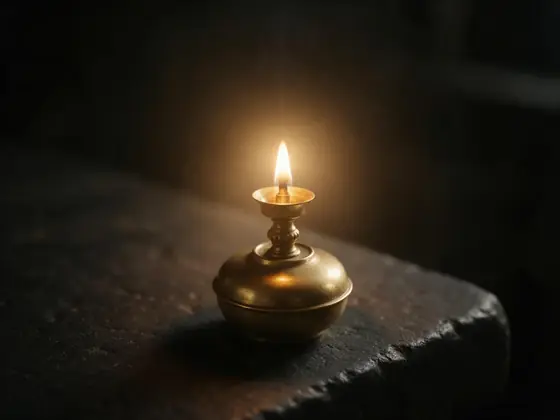
No portrait of him is used on this page. Photographs of Sri Annamalai Swami exist in plenty, from his youth at the ashram to his last years in Palakottu, and the ashram’s website has a gallery of them; but none that this site has found is released under a licence that allows it to be reproduced here, and this site does not use a picture it has not the right to use, nor a generated face in place of a real one. The lamp stands where his face would be, and a reader who wants to see him should go to the ashram’s gallery, which is linked below. The dates are his own where he gave them — born 1906, came to Bhagavān in 1928 at twenty-one, building work “up till 1938”, the final dismissal “in the 1940s” — and the ashram’s where he did not: the move to Palakottu in 1938, the caretaker’s arrival in 1976, the Western visitors from 1982, the death at 4.45 in the morning of 9 November 1995. The ashram’s introduction says he came “at the age of 22”, which is a reckoning from a 1906 birth to 1928 that differs from his own “twenty-one” by the unknown month of his birth; both are given. Where the memoir and the ashram tell the same incident in slightly different words, the memoir’s wording has been preferred and the ashram’s reported. The map is drawn on present-day coordinates, and the village is pinned approximately.
The timeline, plainly
- 1906 — born Sellaperumal at Tondankurichi, a village of about two hundred houses in the Tamil country; his father a farmer, astrologer, painter and builder of temple towers; the horoscope read, and education withheld.
- Childhood — taken from the village school on mastering the alphabet; the village’s good-luck mascot; the photograph of Ramalinga Swami and the visit to Vadalur. Early teens — the tenth part of Jīva Brahma Aikya Vedānta Rahasya; breathing exercises learnt from it; the karnam’s library and three years away from home; evening readings to the villagers; “I will just give him to God.”
- About seventeen — the Sivaram Bhajan Math and the tannīr pandal; the marriage arranged and refused; the village’s “cure”: the cut, the lemon juice, fifty buckets of water. Youth — pāda pūjā to his parents and their blessing; the Śaṅkarācārya of Kanchipuram gives him “Sivaya Namah” to write a hundred thousand times; the notebooks filled.
- 1928 — a wandering sādhu gives him Upadeśa Undiyār with Sri Ramana’s photograph; the dream of water poured into his mouth; the journey to Tiruvannamalai; Seshadri Swami’s darśan; arrival at Sri Ramanasramam aged twenty-one; attendant with Madhava Swami; “How to avoid misery?” and “I was waiting for you”; renamed Annamalai Swami.
- c. 1928–38 — “Go and see what he is doing”: ten years supervising the ashram’s building work; the dining hall and kitchen; the quarrels with Chinnaswami; “You do not know who you are and I do not know who I am”; the diary of Bhagavān’s sayings.
- 1938 — “We have to give freedom to him”; the embrace in the bathroom, “Ananda! Ananda!”; fifteen minutes without body or world; “Ah! Very good! Very good! Very good!”; to Palakottu; Chadwick’s stove and food; “Don’t ask anyone for anything.”
- 1940s — the face covered for three nights; “You are a mature sadhaka. It is not necessary for you to come here any more”; twenty days later, “I have come for your darshan”; then “You are happier than I”, the last words; never approached again.
- 14 April 1950 — Sri Ramana dies. 1950s–70s — continuous sādhana in the one room; quiet, coolness, permanence; support from the three devotees of Thellar; unknown to the world.
- 1971 — village devotees record his teachings; Sri Baranidharan’s life in Ananda Vikatan. 1974 — Sundaram’s first visit; three hours’ talk. 12 February 1976 — “Please resign your job and leave immediately to come here and serve me”; “Think of your life until this moment as a dream and forget it.”
- 1978 — a room for the caretaker; the Tamil teachings published. 1982 onward — Western visitors; daily satsang 3.30 to 5; “sit quietly now for 45 minutes”. 1985 — the samādhi shrine built on his instructions.
- 1994 — Living by the Words of Bhagavan published. March–October 1995 — the final talks: “Just keep quiet”; the lamp that cannot be blown out; the curtain.
- 7 November 1995 — sits up and sings Pattinathar: “deep down there is a constant peace”. 9 November 1995, 4.45 a.m. — dies in the chair beside his bed, conscious to the last breath, in his room in Palakottu; laid in the shrine built ten years before. 1996 — Words of Grace; 2000 — Final Talks.
Read the originals
Primary texts and the records kept by the teacher's own institution.
- Living by the Words of Bhagavan — his memoir, told to David Godman (1994); full scan
- Annamalai Swami: Final Talks — the conversations of 1995, edited by David Godman; full scan
- Words of Grace — his teachings recorded by devotees; full scan
- Sri Annamalai Swami Ashram — the ashram’s own site
- The ashram’s account of his last days and mahāsamādhi, 9 November 1995
- The ashram’s account of the later years in Palakottu
- The ashram on the diary he kept of Bhagavān’s sayings
- The ashram on the experience of 1938
- The ashram on the separation of the 1940s
- The ashram’s gallery of photographs — where a reader may see his face
- The ashram’s list of his books
- David Godman — his page on Sri Annamalai Swami
- David Godman — an excerpt from Final Talks
Every daily message names the teacher it came from. Read the messages, or see the whole line this teacher stands in: all fifty-one teachers.