
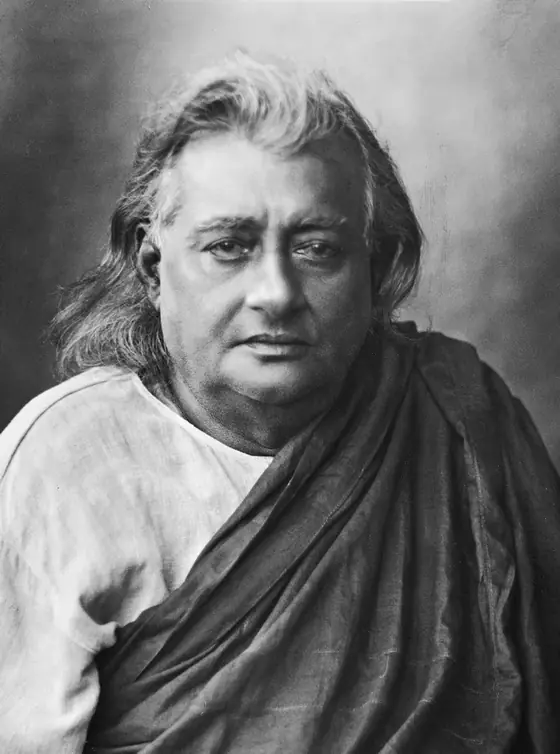
Swami Akhandananda
Direct disciple; 3rd President
1864–1937 · The Ramakrishna Lineage
- When
- 1864–1937
- Born
- Calcutta, Bengal
- Where the life was lived
- Born Gangadhar Gangopadhyay in Calcutta; travelled on foot through the Himalaya, Tibet and Rajputana; opened famine relief at Mahula and Sargachhi in Murshidabad district, Bengal, where he settled; died at Belur Math in 1937 at seventy-two.
- What is left of it
- Three Years in Tibet, serialised in Udbodhan, and reminiscences left unfinished.
Began the Ramakrishna Mission's famine relief and orphan work in 1897 in Murshidabad — the start of the Order's organised service — and became its third President.
The full-length study of this teacher is still being written. What is below is the complete short life, and it is accurate as far as it goes.
The life
Born Gangadhar Gangopadhyay in Calcutta in 1864, he was the wanderer of that generation. He walked — through the Himalaya, into Tibet, across Rajputana — in an era when that meant passes above eighteen thousand feet, no maps worth the name, and the charity of villages. He wrote some of it up as Three Years in Tibet for the Order's Bengali journal. Then, in the 1890s, on the road in the Murshidabad district of Bengal, he walked into a famine. Children were dying by the roadside. He stopped walking. He opened relief at Mahula and then at Sargachhi, fed people, and began housing and educating orphaned children — and that improvisation became the template for the Ramakrishna Mission's entire service arm, which now runs hospitals, schools and disaster relief across the subcontinent. He settled at Sargachhi and stayed, the pilgrim turned farmer, teacher and guardian. He became the Order's third President, and died at Belur Math in 1937, aged seventy-two. The turn in his life is the cleanest illustration this lineage offers of Vivekananda's argument. He had gone to the Himalaya for the practice, and found that the practice was waiting in a famine district in the plains — not as a substitute for contemplation, and not as charity, but as the same recognition applied where it happened to be needed.
The turn it rests on
He found that the practice he had sought in the Himalayas was waiting in a famine district.
What was taught
Pioneered the Order's famine relief and orphanage work — service as worship in practice.
Read the originals
Primary texts and the records kept by the teacher's own institution.
Every daily message names the teacher it came from. Read the messages, or see the whole line this teacher stands in: all fifty-one teachers.