Swami Ranganathananda
13th President of the Ramakrishna Order
1908–2005 · The Sri Ramakrishna Lineage
- When
- 15 December 1908 – 25 April 2005
- Born
- Trikkur, a village in the Thrissur district of Kerala; known before sannyāsa as Shankaran
- Where the life was lived
- Trikkur, Ollur and Thrissur; Ooty and Mysore, where he was cook for nine years from 1926; Bangalore; Rangoon from 1939 and the walk out of Burma in 1942; Karachi 1942–48; New Delhi 1949–62; Calcutta’s Institute of Culture 1962–67; Hyderabad 1973–93; Belur Math as Vice-President and President from 1989; and fifty countries on the annual lecture tours.
- What is left of it
- The Message of the Upanishads; Eternal Values for a Changing Society; the Universal Message of the Bhagavad Gita in three volumes; the Universal Temple at Hyderabad and its institute; more than sixty thousand people initiated; the phrase “Godward passion transmuted into manward love”.
Shipped 1,250 tons of rice from Karachi during the Bengal famine of 1943; served Partition refugees near Delhi; lectured for decades to civil-service and defence trainees; became the thirteenth President of the Ramakrishna Order.
The Kerala he was born into
He was born on 15 December 1908 at Trikkur, a quiet village near Thrissur in Kerala, on the bank of the river Manalipuzha. The Order’s biography notes, with a satisfaction it does not try to hide, that the day happened that year to be the birthday of the Holy Mother, Sri Sarada Devi. His parents, Neelakantha Shastri and Lakshmi Kutty Amma, were well-to-do on their agricultural income, and named their second son Shankaran; at home he was Kochappan. The father was a pious Brahmin. The mother was pious too, a woman of strong character whose influence on the boy the biography treats as decisive, and its first story about him is hers. When he was twelve or thirteen he used some foul words against someone in her presence. She reprimanded him lovingly: “My boy, your tongue is the abode of Vāni or Saraswati, the Goddess of knowledge and wisdom. Don’t soil it by using foul language against others.” The advice, he said, went straight to his head and heart. He would speak in public for more than eight decades, and the Order’s comment is that the Goddess was truly seated on his tongue.
The Malabar of his boyhood was a place of strict caste, where untouchability was, the biography says, ubiquitous. The boy reacted early. He made it a point to break caste distinctions, and did not hesitate to eat fruit from the hands of a pariah tenant couple; when he left home, the couple wept. He grew up by a river and swam like a fish; at ten, when his mother fell ill and medicine had to be fetched from the far bank in heavy rain, he volunteered to row the cook across, for love of her and love of adventure, and years later at Belur Math, seeing him spend hours in the Ganga, his guru said: “Tell the fellow, this is not Kerala; he will catch a cold if he stays too long in the water.” He was, he said, always bubbling with energy, and he described his own temperament with a borrowed phrase: “Love of adventure and dislike for an easy life, and the German philosopher Nietzsche’s dictum ‘live dangerously’ has been with me ever since childhood.” He would go with his mother to the Śiva temple near the house, and once dreamed, as a small boy, that a bright light came out of that temple and engulfed him.
Two things about the setting matter for what follows. The first is that he came to the Ramakrishna Order from the far south, from a Kerala village, with a schooling that ended at the high school in the next village — and became the most travelled and most widely heard of all the Order’s monks, the speaker before Presidents and Prime Ministers, administrators and prisoners, on five continents. The second is that the caste-breaking boy of Trikkur became the man who coined the phrase by which his whole life is usually summed up: “Godward passion transmuted into manward love.”
Where the life was lived
The life has more geography than any other on this site. It begins in the small triangle of Trikkur, Ollur and Thrissur. It moves in 1926, on seven rupees, over the Nilgiris to Ooty and down to Mysore, where he was cook for nine years, and to Bangalore. It goes to Belur Math for the vows of 1929 and 1933, and to Sargachhi and Allahabad for the blessings of the last direct disciples. Then it goes abroad and comes back on foot: Rangoon from 1939, and the walk out of Burma to Dhaka in 1942; Karachi from August 1942 to August 1948, where Partition ended the work; New Delhi from 1949 to 1962, where the auditorium was packed with the city’s elite; Calcutta’s Institute of Culture at Gol Park from 1962 to 1967; and Hyderabad from 1973 to 1993, where the Universal Temple was built. The last sixteen years were spent as Vice-President and President at Belur Math, with journeys to Cossipore, Pune, Chennai, and to Swami Vivekananda’s birthplace in Calcutta for the inauguration he had promised to attend.
Present-day India, with the coastlines of its neighbours faintly drawn so that Dhaka, now in Bangladesh, can be pinned honestly; no border but India’s is shown. Numbered pins are places named in the Ramakrishna Order’s detailed biography; the dotted line joins the main stations of the life in order and is not a surveyed route — it breaks where the story leaves India for Rangoon (1939–42) and again for Karachi (1942–48), both of which lie beyond the edges of this map and are on the world map further down the page. The walk out of Burma in 1942 — five and a half days on foot, then four nights by boat, with relief at Kyaukpyu — ended at Dhaka.
- 1Trikkur (Kerala) — Born Shankaran, 15 December 1908, in a village of the Thrissur district; the boy who ate with the villagers — the caste-breaking begins here
- 2Ollur (Kerala) — High school in the neighbouring village — the end of his formal schooling; The Gospel of Sri Ramakrishna at fourteen
- 3Thrissur (Kerala) — The typewriting institute, 1926; three rupees and a pair of ear-rings; the prayer at the Sri Ramakrishna shrine of the Vivekodayam High School
- 4Ooty (Tamil Nadu) — Ootacamund, 30 June 1926: initiated by Swami Shivananda, Mahapurush Maharaj, on the way to Mysore; the mangoes given back; “Serve Gopal”
- 5Mysore (Karnataka) — Sri Ramakrishna Ashrama, 1926–35: cook for nine years; Sri Śaṅkara learned from a doorway; a chapter of the Gītā a month; the prisoners of Mysore
- 6Bangalore (Karnataka) — The ashrama, 1935–38, among the young
- 7Belur Math (West Bengal) — Brahmacarya 1929; sannyāsa on Swamiji’s birthday, 1933, in Mahapurush Maharaj’s room; Vice-President from 1 April 1989 and thirteenth President from September 1998; his home for the last sixteen years; died in Kolkata, 25 April 2005
- 8Sargachhi (West Bengal) — Swami Akhandananda’s hands on his head, 1933: “I bless you, I bless you!”
- 9Allahabad (Uttar Pradesh) — Swami Vijnanananda, 1933: “You have seen me, now go and take drinking water from the tap”
- 10Dhaka (Bangladesh) — Where the walk and boat journey out of Burma ended, 1942 — a skeleton of eighty pounds
- 11Kankhal (Uttarakhand) — The Sevashrama near Haridwar, 1942: four months to recover — “Take care of him; he is a precious monk”
- 12New Delhi (Delhi) — Secretary of the Delhi centre, 1949–62: the Sunday lectures to a packed auditorium, the Gītā verse by verse, Partition refugees, the trainees of the National Academy of Administration
- 13Mussoorie (Uttarakhand) — The yearly talks to the National Academy of Administration after it moved to the hills
- 14Calcutta (West Bengal) — The Institute of Culture at Gol Park, 1962–67: the Saturday lectures that became The Message of the Upaniṣads; the University convocation of February 1966
- 15Cossipore (West Bengal) — The garden-house where Sri Ramakrishna died: his first initiations, thirty-five candidates, 9 May 1990
- 16Jayrambati (West Bengal) — The Holy Mother’s village: the eighty low-cost toilets he had built from his own gift-fund
- 17Bombay (Maharashtra) — The Tata Institute of Social Sciences lecture on the Indian philosophy of social work, June 1967
- 18Hyderabad (Telangana) — President of the Hyderabad Math, 1973–93: the Universal Temple, the Vivekananda Auditorium and Library; the Vivekananda Institute of Human Excellence inaugurated by him, 10 September 2000
- 19Ongole (Andhra Pradesh) — The eight-or-nine-lecture day that ended with the station-master’s neighbours and the late night train
- 20Pune (Maharashtra) — Consecrated the temple of Sri Ramakrishna as President
- 21Chennai (Tamil Nadu) — Consecrated the temple of Sri Ramakrishna as President; the woman in the slum whose husband needed an eye operation
Rangoon and Karachi lie beyond the edges of the India map above and are on the world map further down the page, together with the fifty countries of the lecture tours; Dhaka, where the walk out of Burma ended, is pinned above on present-day Bangladesh. The map is drawn on present-day coordinates from the place-names in the Order’s biography.
The boy with three rupees: Ollur, the Gospel and Ooty
He finished his high-school education in the neighbouring village of Ollur, and that was the end of his formal schooling. When he was about fourteen, the biography says, Sri Ramakrishna entered his life through a book. He was asked whether he had read it; the book was The Gospel of Sri Ramakrishna, and he could put it down only after almost the first hundred pages. “The appeal of Sri Ramakrishna to my heart was simply instantaneous and tremendous,” he said. Three or four volumes of Swami Vivekananda’s Complete Works followed, and Sister Nivedita’s The Master as I Saw Him. About the same time he memorised Swami Abhedananda’s hymn to the Holy Mother, Prakṛtiṁ paramām abhayāṁ varadām, and the Order dates to these years the seed of the phrase he would coin, “Godward passion transmuted into manward love”. He conceived a great love for ‘M’, Mahendranath Gupta, the Gospel’s chronicler; when he came to Belur in 1929 for his brahmacarya vows he sought M out, and once spent three hours at his house with other sādhus, hearing him speak, he remembered, only about Sri Ramakrishna.
The rest is in his own words, which the biography quotes at length. “That was in 1924. I was only fifteen and a half years old then, and was waiting for an opportunity to join the Ramakrishna Order. In 1926, after finishing my school final examination, I joined a typewriting Institute in Thrissur to learn shorthand and typewriting. Some fee had to be paid. I took Rs.3 from home and came to Thrissur. From there I wrote to Ramakrishna Math, Madras, that I wanted to join the Ramakrishna Order. A brahmachari replied that since there was no room in the Madras Math then, I should join the newly started Ashrama at Mysore!” He wrote to Gopal Maharaj — Swami Siddheshwarananda, head of the Mysore ashrama, who would later found the Order’s centre in France — who by good fortune came to Thrissur on personal business, heard him out, consented, and asked whether the boy had the fare to Mysore by way of Ooty. He had three rupees and a pair of gold ear-rings, which boys in the Kerala of those days still wore; he offered to sell them, but it was a Sunday and the shops were shut. One person gave him two rupees and Swami Siddheshwarananda two more. Seven rupees was not enough, and he was greatly disturbed. “I was very young then, only seventeen and a half years old,” he recalled. “I went to Sri Ramakrishna shrine in Thrissur Vivekodayam High School to pray for Thakur’s grace. I often used to bring flowers from my house for worship in that shrine. With tears in my eyes, I prayed to Thakur to arrange for my renunciation and departure to Mysore with Swami Siddheshwaranandaji.” The prayer was answered the same evening: at half past eight that night, the biography says, he and Swami Siddheshwarananda got into the train, and reached Ooty the next morning. He was still telling the story at Belur Math in 1995, and said the memory of that shrine stirred him after seventy years.
The road to Mysore ran through Ootacamund, and there, on 30 June 1926, the boy was initiated by Swami Shivananda, Mahapurush Maharaj, the direct disciple of Sri Ramakrishna who was then President of the Order and was staying in a rented house in the hills while the Ooty Math was being built. For a week the boy had his breakfast in the guru’s room and bought his own lunch and dinner outside. The Order records that he had earlier had a dream of the guru he had never seen, and that the meeting confirmed it. His account of the ceremony is precise to the point of comedy. He entered the room where Mahapurush Maharaj was sitting, took the seat to his left, and looked at the whole scene. The guru gave him the mantra and asked whether he had brought any guru-dakṣiṇā. “‘Nothing,’ I said. Only one shirt, one dhoti, and one towel — that was all I had brought from my house. He took two or three mangoes from his right side and gave them to me and said, ‘Now give them back to me as guru dakshina.’ I offered them back to him, made pranams to him and came out of the room.” A couple of days later, going to take leave before Mysore, he received the only instruction his guru ever gave him: “Serve Gopal.” He served Swami Siddheshwarananda, at Mysore and then Bangalore, for nine years, until the Swami left India to found the centre in France.
The cook of Mysore, who learned Śaṅkara through a doorway
He reached the Mysore ashrama on 2 July 1926, and remembered seventy years later the taste of his first meal there, bread and milk. On 3 July his long hair was cut and his ear-rings were removed. He was made the cook. He also did gardening and looked after the hostel for school and college students, and the biography’s summary of these nine years is that he was jolly outwardly and growing inwardly the whole time. Mahapurush Maharaj allowed him to wear the ochre cloth from 1927, four or five months after he joined, so that he went about in gerua as a brahmacārin for six years before he was formally a monk.
How a cook with a village high-school education became one of the great expositors of the Upaniṣads in English is a question he was asked, and the answer is one of the best-known passages in the Order’s life of him. A study circle for monks was running at the Mysore ashrama, in which Professor Subramanya Iyer — “uncle”, as he was called — taught Śaṅkara’s and Rāmānuja’s commentaries on the Brahma-sūtra to, among others, Swamis Vimurtananda, Bhuteshananda and Tapasyananda. The brahmacārin Shankar was not a member; one of those inside the room, Swami Bhuteshananda, would be President of the Order immediately before him. “At Mysore Ashrama I would keep rice, vegetables, etc on the stove for boiling. Then I would go and stand near the room where Vedanta classes were being held by Prof. Subramanya Iyer. In this way I slowly picked up both Sanskrit and the Shastras.” He learned the Gītā the same way, by main force. “Whatever Swami Vivekananda said is law to me. Since Swamiji said that the Gita should be memorised, I started to commit the Gita to memory. I was then in Mysore. There was so much work. Still I decided I must fulfil Swamiji’s instruction. I decided to commit to memory one chapter every month. In this way I could memorise 18 chapters in 18 months. Sometimes 5 to 6 shlokas would remain on the 30th or 31st of a month. But since I had taken a vow to complete the chapter in one month, I would not sleep until I had committed to memory the remaining shlokas. Then only I would go to sleep.”
He read widely and in English. At Mysore he enjoyed William McDougall’s Character and the Conduct of Life, then a popular book by a Harvard professor, and one sentence of it stayed with him for life: “Young people seek praise; but it is better to seek to be praise-worthy.” As a brahmacārin he felt acutely the need to own books he could mark and annotate, and in later years he made sure other brahmacārins and students did not go without personal books. From 1933 he began addressing the prisoners of Mysore Jail on ethical and spiritual life. It is worth noticing what the cook of Mysore did not have: no university, no Sanskrit college, no Western travel, and no teacher who took him formally in hand. What he had was the doorway, the stove, a vow, and the Gospel.
Yati Chaitanya to Ranganathananda: Belur, 1929 and 1933
On Buddha Pūrṇimā, 23 May 1929, at Belur Math, Mahapurush Maharaj gave him the vows of brahmacarya and the name Yati Chaitanya. He stayed about four months, and would have stayed happily longer but for Swami Shuddhananda’s reminders to go back to Mysore. The food at Belur then, he remembered, was tea and a slice of bread “as thin as the knife blade” with a little butter, one glass of milk going into the tea for the whole household; he filled up on puffed rice. On Swami Vivekananda’s birthday, 23 January 1933, Mahapurush Maharaj gave nine monks sannyāsa. Too ill to come to the old shrine for the ceremony proper, the guru gave the sannyāsa mantras, the ochre cloth and the monastic names in his own room; Yati Chaitanya became Ranganathananda. Since he had worn gerua for six years already, the biography observes, sannyāsa was for him a matter of inner transformation.
With his guru’s blessing he went to Sargachhi, in Murshidabad, to pay his respects to Swami Akhandananda, Sri Ramakrishna’s disciple who had begun the Order’s famine and orphanage work there in 1897. A weekend-return railway ticket made it cheap, and he had, the biography says, a wonderful weekend. When the time came to leave he made his prostration and said: “Maharaj, I want your blessings. I am working with the people, especially young people. Bless me that I become an instrument of Swamiji for inspiring our young people with Swamiji’s ideas. With your blessing, I am sure, I will get that capacity. I have not seen Swamiji, but I have met you, and he loved you very much.” Akhandananda became very grave, placed both palms on the young monk’s head, and said: “I bless you, I bless you!” He felt, he said, a tremendous elevation within, a new power arising. He also went to Allahabad to Swami Vijnanananda, who accepted his prostration and said, “You have seen me, now go and take drinking water from the tap and you can go back.” He enjoyed that remark. He met Swami Abhedananda at his Calcutta ashrama and heard his Town Hall lecture during the Master’s birth centenary in 1937, and heard Rabindranath Tagore lecture at the Calcutta University Institute. He had thus, by his thirtieth year, received the touch of four of Sri Ramakrishna’s own disciples, and it is characteristic that the blessing he asked for was not for himself but for the young people he meant to serve.
Bangalore, Rangoon, and the walk out of Burma
He moved to Bangalore in 1935, continuing among its young people the work he had begun with the prisoners of Mysore, and remained there until 1938. Then, at the age of thirty-one, the senior monks at Belur, who had noticed the leadership in him, chose him to head the Mission’s Rangoon Society, and he went to Burma as its secretary and librarian. The Order’s summary gives the dates as 1939 to 1942; its detailed account prints “1933”, but his age of thirty-one fixes the year as 1939, and this page uses it. It was in Rangoon, the biography says, that he blossomed as a speaker. His weekly classes on the Gītā and the Upaniṣads and his occasional lectures on philosophy, culture and education drew record audiences, and there, in the Order’s cheerful phrase, were put together the chemicals of what he himself called his “Vedantic Thought Bombs”, to be thrown for the next sixty years at audiences the world over regardless of religion or caste, gender or nationality, civilian or military, young or old.
The Rangoon years were not only lectures. He organised flood relief in 1939. A two-hundred-bed hospital began to function, of which he would say, “Ministers came to our hospital for treatment; they would not go to government hospitals.” Mahatma Gandhi and Pandit Nehru visited him there — he had met Gandhi before, at Mysore and Bangalore — and Gandhi wrote in the visitors’ book: “I see here the successful combination of dexterity in work and service.”
In 1942 Japan bombed Burma and the centre had to be wound up. He chose, the Order says, to return to India on foot with thousands of other refugees, braving untold dangers and helping many on the way. A letter to a friend in Mysore, written within a couple of days of reaching Dhaka, survives, and the biography quotes it: “We left Prome in Central Burma on 22 February 1942. At Paduang village, on the other side of the Irrawady river, we had to halt for a day, as bullock carts were not available…. From here began an informal life, in the fashion of homeless nomads…. We left Paduang for Tungup…. The journey took five and a half days through a waterless and mountainous track of about 100 miles. Hundreds of refugees, poor and rich, men and women, as also babies a few days old were also moving along, enduring all sorts of hardships….” Then four nights and five days by boat on what he called uncharted waters, refusing the offers of a plane or steamer from Rangoon itself because otherwise, he wrote, a rich experience would have been denied him; a halt at Kyaukpyu, where a young Gujarati, hearing he was of the Ramakrishna Mission, asked him to stay and help with refugee relief, and he did for a short period, so that the tired and depressed refugees met there, for the first time since leaving their homes, warmth and welcome and help; and on to Bengal. “I did most of the cooking for the party of five, on the way. We were a joyous and cheerful group…” When he reached Dhaka he was, the biography says, a mere skeleton weighing eighty pounds. He was sent to the Kankhal centre near Haridwar to recover, and the Belur authorities wrote ahead: “Take care of him; he is a precious monk.” In four months he was himself again and wanted to play volleyball. The order came from headquarters: “Go and take charge of Karachi centre.”
Karachi, 1942–48: rice for Bengal, and the watchman who wept
He became head of the Karachi Math on 9 August 1942 and stayed six years to the day. The work that the Order singles out is the rice. During the Bengal famine of 1943 he collected substantial donations and shipped over 1,250 tons of rice by special steamer from Karachi to Calcutta — a unit of rice then cost nine rupees in Karachi against a hundred in Bengal. He raised, the summary adds, over a lakh and a half of rupees for the Mission’s relief among the victims of civil strife in Bengal and Bihar and of cholera in Kerala. His Sunday lectures were attended by every section of the city. When Swami Madhavananda, the General Secretary, visited and asked why he had not been invited to a lecture, the young head replied, “You are my senior. How can I ask you to come?” Madhavananda came, and said afterwards to another monk, in Bengali: “Taking Shankar on his lap, Thakur is playing.”
Partition ended it. After 15 August 1947 the exchange of populations across the Punjab began, the Mission opened its great refugee relief at Kurukshetra, and it became difficult for the Karachi centre to carry on. He and five other monks stayed on under very risky conditions. In January 1948 the Math building was vandalised and forcibly occupied by a high official who had opted for Pakistan; the monks moved to a nearby bungalow offered by a friend, and finally wound up the work and left Karachi on 9 August 1948. He remembered the leaving in a sentence that the biography rightly preserves: “My old Pathan watchman and two Sindhi Muslim youths working as cook and housekeeper wept when I took final leave of them in 1948 to take charge of our Delhi centre. It is a great experience to give love to and receive love from men, women, and children of all communities and races.” That sentence is the whole of his position on other faiths, and this site, which promises never to belittle another path, has nothing to add to it.
Delhi and Calcutta: the auditorium and the Saturday lectures
From 1949 to 1962 he headed the Ramakrishna Mission in New Delhi, and the Order calls the period the most fruitful in that centre’s history. Besides helping Partition refugees sheltered near the city, he built a temple, a students’ library and an auditorium, and the auditorium was packed with the capital’s elite for his lectures, with the overflow sitting on the lawns outside. High officials, bureaucrats, businessmen, ambassadors and embassy staff came; the American ambassador, Chester Bowles, attended regularly. At the Government’s urging he began in 1956 to give yearly talks to the trainees of the National Academy of Administration, first at Delhi and then at Mussoorie, and continued for many years; he regularly addressed the National Defence College. Generations of the administrators who would run independent India heard from a Kerala monk with no degree what Indian values might mean in the administrative field. He served on the Indian National Commission for co-operation with UNESCO from 1964 to 1967.
The Delhi years also gave the biography one of its best stories about money, which he did not carry. Invited to Afghanistan, he was told at Delhi airport that entry required at least five hundred rupees in one’s pocket. He went to a devotee’s house near the airport; the lady of the house gladly gave him the sum; when someone from the centre later went to return it, she refused to take it back. It is a small story, and it recurs in other forms across the life — a fifty-cent coin for a telephone at Sydney airport when nobody came to meet him — because he had settled the question early and never reopened it.
In 1961 he was elected a Trustee of the Ramakrishna Math and a member of the Governing Body of the Mission. In 1962 he was transferred to Calcutta as Secretary of the Ramakrishna Mission Institute of Culture at Gol Park and Director of its School of Humanistic and Cultural Studies, and there, from 2 May 1962 to 19 January 1963, he gave the Saturday-evening lectures in the Vivekananda Hall that became The Message of the Upanisads. The book’s publisher records that attendance began at about a thousand and rose steadily to over sixteen hundred as the weeks passed, a cross-section of the cosmopolitan city with a large number of young people, and that when the Īśā, Kena and Kaṭha were done he went straight on, week by week, to the Gītā verse by verse. He gave broadcast talks for All India Radio. In February 1966 he became the first monk of the Order to give the convocation address of the University of Calcutta, on India’s educational vision; another followed at the Tata Institute of Social Sciences in Bombay in June 1967, on the Indian philosophy of social work.
Fifty countries: the journeys, mapped
The Order gives the travel in two overlapping summaries, and this page gives both. One says that between 1956 and 1972 he went on several world tours as an ambassador of religion and Indian culture, travelling to over fifty countries in North and South America, Asia, Africa and Europe, including the then Communist states of the USSR, Poland and Czechoslovakia, on government-sponsored tours in which he lectured to universities, colleges, schools, cultural institutions, clubs and small groups. The other says that his extensive lecture tours ran from 1946 to 1972, covering Japan and several South-East Asian countries and seventeen European countries, including five Communist countries: Czechoslovakia, Yugoslavia, Poland, the USSR and Cuba. From 1973 to 1986 he visited Australia, the United States, Holland and Germany every year; his own recollection adds Singapore, and says that for nearly fifteen years the people of those countries treated him as belonging to them, and that the one parting sentence after every programme was “Please come again!”
The Order gives the world tours in two overlapping summaries — over fifty countries between 1956 and 1972, or between 1946 and 1972, in North and South America, Asia, Africa and Europe — and then the annual visits of 1973–1986 to Australia, the United States, Holland and Germany. Only the places the Order’s account names are pinned; Africa and South America are named only as continents, so nothing is pinned there. The walk out of Burma in 1942 — Prome, Paduang, Tungup, and the boat to Kyaukpyu — lies between Rangoon and Dhaka and is told in the text. The European stops are on the second map below. Coastlines only; no borders.
- 1Rangoon — Yangon, 1939–42: secretary and librarian of the Mission’s Rangoon Society; record audiences; the 200-bed hospital; Gandhi and Nehru; wound up when Japan bombed Burma in 1942
- 2Dhaka — the end of the walk out of Burma, 1942, at eighty pounds — “he is a precious monk”
- 3Karachi — 9 August 1942 – 9 August 1948: head of the Karachi Math; 1,250 tons of rice to famine-struck Bengal, 1943; Partition, and the watchman who wept
- 4Afghanistan — invited from Delhi; the five hundred rupees at the airport; no town is named, so the pin marks the country
- 5Japan — on the tours the Order dates 1946–72; no town is named, so the pin marks the country
- 6Singapore — named in his own recollection of the annual tours
- 7Fiji — on the tour of 1956; he was returning from Fiji when he waited twelve hours at Sydney airport
- 8Sydney — 14 October 1956: cooked at the home of Marie Byles at Cheltenham, New South Wales; Australia every year, 1973–86
- 9United States — every year, 1973–86, and on the earlier tours; no city is named, so the pin marks the country
- 10Havana — Cuba, one of the five Communist countries of the tours; no city is named, so the pin marks the capital
The Order counts seventeen European countries on the tours of 1946–1972, five of them then Communist — Czechoslovakia, Yugoslavia, Poland, the USSR and Cuba, which is on the world map above — but names only these; where a country is named without a city, the pin marks its capital or its centre and the key says so. Coastlines only; no borders.
- 1London — Britain, second tour, 1976: the Dean of Westminster and his wife, reading the Gospel with delight; forty minutes to the pupils of Westminster High School
- 2Holland — every year, 1973–86; no town is named, so the pin marks Amsterdam
- 3Germany — every year, 1973–86; no town is named, so the pin marks the middle of the country
- 4Prague — Czechoslovakia: at the house of Helena Dvorak he was shown a gerua cloth once worn by Swami Vivekananda, given her by Josephine MacLeod; the city is not named, so the pin marks the capital
- 5Warsaw — Poland: no city is named, so the pin marks the capital
- 6Belgrade — Yugoslavia: no city is named, so the pin marks the capital
- 7Moscow — the USSR, on government-sponsored tours, lecturing to universities, schools and small groups; no city is named, so the pin marks the capital
Two moments from the tours are recorded. On 14 October 1956, returning from Fiji with twelve hours to wait at Sydney airport, he went at the request of a devotee, Marie Byles — conservationist, pacifist, and Australia’s first woman solicitor — to her home at Cheltenham in New South Wales, and while she asked him to rest, he cooked. In Czechoslovakia he went to the house of Helena Dvorak, sister of Frank Dvorak, whose painting of Sri Ramakrishna and the Holy Mother is dear to devotees, and she showed him a gerua cloth once worn by Swami Vivekananda, which she had received from Josephine MacLeod. On his second tour of Britain, in 1976, the Dean of Westminster and his wife invited him to visit, and at their request he spoke for forty minutes to the pupils of classes eight to ten at Westminster High School. “The students listened with rapt attention and the headmaster remarked that they were difficult to control in their classroom but they heard the lecture with perfect attention,” he recalled; the Dean and his wife told him they were reading The Gospel of Sri Ramakrishna with great delight.
He travelled, including by air, with a cotton sling-bag. When an attendant showed him a new leather one and asked him to use it, he said: “This fellow has travelled with me for many years, but has never asked me for food or water. I cannot leave it.” And at the end of all the travel his summary was not about himself: “One important thing which life has taught me is that India’s Vedānta and Sri Ramakrishna appeal directly to many thinking minds in the West through books, without the intervention of any Indian teacher.”
Hyderabad, and the years of the annual tours
From 1973 to 1993 he was President of the newly affiliated Math at Hyderabad, which moved to its present site in 1978. Under him the Universal Temple of Sri Ramakrishna was built, with the Vivekananda Auditorium seating about a thousand, the Vivekananda Library and Reading Room, and the Vivekananda Health Centre; the Order says the Math became a landmark of the twin cities largely through his indefatigable energy. He was particular that perfect silence be kept in the temple, and the biography’s story about it is not what one expects. Some devotees were talking loudly in the hall; the pūjārī came out and asked them to be quiet, and, when they answered back, spoke to them harshly. The matter came to Ranganathananda. Having heard the pūjārī out, he took a paper from a file and asked him to read it. It was a poem, ‘Speak Gently’, by David Bates. The rebuke went to the priest, not the devotees.
These were also the years of the annual tours abroad, and of the eight-or-nine-lecture days at home. One monk who accompanied him recorded such a day: they left a centre at five in the morning to visit several private ashramas and were to board the night train at Ongole at eleven. He gave eight or nine lectures without a trace of fatigue, content with a glass of milk, though at one o’clock he noticed that his companion must be hungry and arranged a meal; at Ongole at half past ten the station-master, told that the train was an hour late, took them home to eat, and, with permission, had invited the neighbours for a lecture, which the exhausted companion had to translate into Telugu until a quarter to midnight. The Order’s comment is that his lectures were not intellectual exercises but outpourings of his soul; that whatever he gave had become part of his own deepest conviction; and that, like the speaker Swami Vivekananda described to Sister Nivedita, it was the character and not the words that made the impact. He was, the biography says, established in what Swamiji called samadarśitva, same-sightedness; another swami recalled that he never criticised anyone, in their presence or otherwise. Swami Yatiswarananda, an earlier Vice-President, put it more simply: “Ranganathananda knows how to make friends and keep them.”
In 1985 he received the first Indira Gandhi Award for National Integration; the Jamnalal Bajaj Foundation, at whose 1989 awards he was chief guest, dates the award to 1987, and both dates are given here. The same Foundation records the principle he applied to honours: he accepted that award and the Gandhi Peace Prize because both were conferred on the Ramakrishna Mission; and he declined the Padma Vibhushan, which the Indian Express dates to 2000, because it was conferred on him as an individual and not on the Mission. Belur Math’s own record of the Order’s honours fills in the Gandhi Peace Prize: it was the prize for 1998, given to the Mission for exemplifying the Gandhian spirit of selfless service and for promoting communal harmony by preaching and practising the harmony of religions — the first time it had gone to an institution — and the President of India, K. R. Narayanan, presented it to him as the Order’s President at Raj Bhavan, Kolkata, on 13 February 1999; seven years earlier, on 20 April 1992, he had likewise received for the Mission the G. D. Birla International Award for Outstanding Contribution to Humanism. Asked why he did not have a car, he said devotees sent theirs when he needed one and taxis were cheap, and then: “I have always maintained that I am a Swami of the Ramakrishna Order. Nothing more can be added to that. It is the biggest title.”
The difficulties, which he did not hide
He was so cheerful a man that it is easy to miss what the life cost, and the biography, to its credit, does not let the reader miss it. The first difficulty was the beginning: a boy of seventeen with seven rupees and no room at Madras, sent to a new ashrama in a strange language, made the cook, and left to learn Sanskrit from a doorway. He never spoke of this as hardship. But the vow that would not let him sleep until the month’s chapter of the Gītā was memorised tells its own story about how much he wanted what he had not been given.
The second was the body, twice. In 1942 he walked and boated out of Burma with a party of five, cooking for them, and reached Dhaka at eighty pounds; the Order’s letter to Kankhal — “he is a precious monk” — tells how near it came. In 2001, at ninety-two, he suffered a partial brainstem stroke; the doctors were amazed at his recovery, and he regained most of his speech and could walk with support. Early in 2005 came gastro-intestinal bleeding and repeated transfusions, a chest infection in March, fever with rigor in April, and finally the kidneys. He was fully alert to the end.
The third was Partition. He built a centre in Karachi for six years, fed Bengal from it, lectured to every community in it, and watched it vandalised and occupied; he left with his Pathan watchman and his Sindhi Muslim cook and housekeeper in tears. That he drew from this not bitterness but the sentence about giving and receiving love from all communities and races is the most remarkable thing in the biography, and the Order does not embellish it.
The fourth is one the Order mentions only in passing: he was not a scholar of the kind that footnotes, and he knew it. He had no Sanskrit degree, no university, and his books are lectures taken down and edited — the Message of the Upanisads says so on its first page. Readers who want the commentaries sentence by sentence will find them in Swami Gambhirananda; what Ranganathananda gave was the Upaniṣads and the Gītā spoken to a hall of sixteen hundred people, in a modern idiom, with the sciences and the West in the room. Those are different gifts, and the Order, which made both men President within a few years of each other, seems to have understood that it needed both.
What he taught
He taught three things, over and over, for eighty years, and each can be stated in his own words. The first is what Vedānta is. “Vedanta is thus both religion and philosophy,” he told the Calcutta audience in the lectures that became The Message of the Upanisads: as religion, it discovers the truths of the inner world and fosters the same discovery by others; as philosophy, it synthesises this science of the inner world with the sciences of the outer, to present a unified vision of total reality. That is why the sciences are always in his lectures. He did not think Vedānta needed physics to be true; he thought a modern listener needed to see that the two were not enemies. “Religion without science is helpless, while science without religion is risky,” he said in a lecture collected in Eternal Values for a Changing Society, and set himself, in the Calcutta of the 1960s, to make the Upaniṣads intelligible to people who had read Darwin and Einstein.
The second is who Vedānta is for. “The objective of Vedanta is the happiness and welfare of man; not man as divided into sects, creeds, castes, and classes, but man as man wherever he may be found.” This is the caste-breaking boy of Trikkur grown up, and it is the reason he lectured to prisoners in Mysore, cadets at the Defence College, administrators at Mussoorie, communists in Czechoslovakia and Cuba, schoolchildren at Westminster and the neighbours of a station-master at Ongole with exactly the same seriousness. It is also the root of the phrase he coined, “Godward passion transmuted into manward love” — the Advaita of the one Self in all, turned outward into service, which he applied not only in relief camps and dispensaries but, the Order says, in scores of instances in his personal life: money to a woman in a Chennai slum whose husband needed an eye operation — and, when told she might not manage to cash a draft, a letter to the Chennai Math to take it to her door, where she wept; eighty low-cost toilets at Jayrambati, because he wanted no woman there to suffer for want of what the Holy Mother had lacked in her lifetime; support from his own gift-fund for several centres of the Sri Sarada Math and its Mission, of which he was a staunch supporter.
The third is the harmony of paths, which he stated as a fact of Indian experience rather than a pious hope: in the light of its philosophy of all-comprehending unity, India upholds harmony not only between science and religion but between religion and religion, “as between people wending their way to the same goal. For the goal is one, but the paths are many.” He had learned that not from a book but from Karachi, and from a Dean of Westminster reading the Gospel with delight.
Under the three lay a discipline he called by an old name. “There is no holiday in spiritual life,” he liked to say, and in his ninety-seventh year his day still ran: japa at six, a little cottage cheese, exercise and walking, devotees’ prostrations, books, lunch at noon (“I take food only for the sake of routine!”), books again, exercise at half past four, the Kathāmṛta in Bengali, prostrations, japa sitting up — “No no, I shall do japa sitting” — food at nine and bed at a quarter to ten. The Order says he followed the regimen like a novice. That is what he taught by being seen.
The sayings, and what they were for
He was a speaker, not an aphorist, and his sayings are best given with their occasions.
To his guru, at Ooty in 1926, when asked for guru-dakṣiṇā: “Nothing.” He had one shirt, one dhoti and one towel. The mangoes were given him to give back.
To Swami Akhandananda at Sargachhi in 1933, aged twenty-four: “Bless me that I become an instrument of Swamiji for inspiring our young people with Swamiji’s ideas.” The blessing came twice over.
To the General Secretary at Karachi, who asked why he had not been invited to a lecture: “You are my senior. How can I ask you to come?”
On his return from the world: “One important thing which life has taught me is that India’s Vedānta and Sri Ramakrishna appeal directly to many thinking minds in the West through books, without the intervention of any Indian teacher.” It is a sentence that abolishes the speaker’s own importance, and he meant it to.
To an attendant, about a bag: “This fellow has travelled with me for many years, but has never asked me for food or water. I cannot leave it.”
To those who asked about a car, and about titles: “We sadhus have no such status. With our ideal of poverty, we have a very high status. People come to us, the top people, because we are poor, because we have renunciation. I have always maintained that I am a Swami of the Ramakrishna Order. Nothing more can be added to that. It is the biggest title.”
To the Vice-President who came to the nursing home in September 1998 to tell him he was President of the Order: “What! The cook of Mysore ashrama to be the President of the Sangha?”
To the monk in charge of the project at Swami Vivekananda’s birthplace, in the weeks before 26 September 2004, when his health was failing: “Don’t worry; I’ll keep my word. I will come.” He came.
His favourite expression: “There is no holiday in spiritual life.” And his last words, on 25 April 2005: “Lift me up; I want to sit up. Lift me up.”
What the sayings were for is plain. Each one turns attention away from himself — to the guru, to Swamiji, to the young, to the books, to the Order, to the promise — and the last one asks only to be upright. A man who did japa sitting at ninety-six died asking to sit up.
The books, and how to read them
His books are lectures, and should be read as such: aloud if possible, a chapter at a sitting, and with the knowledge that a hall of a thousand people was in front of him when he said these things. Begin with The Message of the Upanisads, the Calcutta lectures of 1962–63 on the Īśā, Kena and Kaṭha, published by the Bharatiya Vidya Bhavan and free to read at the Internet Archive. Its opening chapter, ‘The Charm and Power of the Upaniṣads’, is the best short introduction in English to why these texts matter, and the verse-by-verse exposition of the Kaṭha that follows is the one this site would put in a beginner’s hands before any commentary. Then go to The Universal Message of the Bhagavad Gita, three volumes, the fruit of the weekly Gītā lectures that followed the Upaniṣads at Gol Park and were continued for decades; when the volumes were released at the Raj Bhavan in Mumbai in February 2001, Rafiq Zakaria, the Muslim scholar from Mumbai, said he had read the English Gītās from Edwin Arnold and Annie Besant to Gandhi, Vinoba and Radhakrishnan and found this exposition “in many respects unique”, for the way it brought Einstein, Sherrington, Wordsworth, Shelley, Julian Huxley and Bertrand Russell to bear on the meaning of the verses. Read it after the Upaniṣads, not before, because that is the order he taught them in.
Then the collections. Eternal Values for a Changing Society, in four volumes, gathers the lectures on science and religion, education, administration and citizenship that he gave to the Academy at Mussoorie and to audiences abroad; the fourth volume, free at the Internet Archive, contains the passages on Vedānta and universal welfare quoted above. A Pilgrim Looks at the World, two volumes, is the record of the tours. The Message of the Brihadaranyaka Upanisad and The Central Theme of Srimad Bhagavatam complete the scriptural expositions; Vedanta and the Future of Mankind, Enlightened Citizenship and Our Democracy and Spiritual Life of the Householder are the small books he wanted in ordinary hands — shortly before his death, the Order records, he sent Enlightened Citizenship, with a booklet of Swami Vivekananda’s call to the nation, to every newly elected member of Parliament and the State Assemblies. The Order also counts some six hundred audio tapes and fifty video tapes of his talks.
A caution, matching the one on Swami Gambhirananda’s page. These books will not give you Śaṅkara’s commentary sentence by sentence; they give you a modern monk standing in front of the text and the century at once. Read Ranganathananda to want the Upaniṣads; read Gambhirananda to have them. The Order made the two men its eleventh and thirteenth Presidents, and a reader who takes both has taken the Order’s own advice.
Vice-President and thirteenth President: sixty thousand initiations
On 1 April 1989 he was elected a Vice-President of the Order, and it was as Vice-President that he began to give mantra-dīkṣā, spiritual initiation: the first batch, thirty-five candidates, at the Cossipore garden-house on 9 May 1990, in the house where Sri Ramakrishna had died. Over the next sixteen years, the Order records, more than sixty thousand people were initiated by him. He came to Belur Math in July 1998 for the four-monthly meeting of the Trustees and Governing Body and could not attend a single session; he was rushed to hospital. Swami Bhuteshananda, the twelfth President, who had sat inside the Mysore classroom while he listened from the doorway seventy years before, was also in hospital, and died on 10 August 1998; and on 7 September 1998 Ranganathananda became the thirteenth President of the Ramakrishna Math and Ramakrishna Mission. One of the Vice-Presidents went to the nursing home to tell him. “What! The cook of Mysore ashrama to be the President of the Sangha?” He was then recuperating at the Institute of Culture at Gol Park; the first person he initiated as President there was an American married to a Hindu woman who was his disciple. From 1998 he lived at Belur Math.
He was President for about six and a half years. When health permitted he went to New Delhi, Chennai, Bangalore, Mysore and Hyderabad for initiations; he consecrated the temples of Sri Ramakrishna at Pune and Chennai; he gave brahmacarya to seven batches of probationers and sannyāsa to seven batches of brahmacārins at Belur. He was very keen that the project at Swami Vivekananda’s birthplace in north Calcutta be completed in his lifetime. His health kept him from the foundation-stone ceremony on 10 April 2001, but he promised the monk in charge that he would be present at the inauguration, fixed for 26 September 2004. In the weeks before, with his health playing truant, he repeated it — “Don’t worry; I’ll keep my word. I will come” — and came, and blessed the function. On 10 September 2000, as President, he inaugurated the Vivekananda Institute of Human Excellence in the precincts of the Hyderabad Math he had built.
A dream he recorded on 2 June 1968 and never spoke of was found among his papers after his death. He wrote that at half past four in the morning he had a vivid dream of going with monastic brothers to an ashrama where a special pūjā was being arranged; the biography gives the whole of it, and it concerns the Holy Mother. This page does not paraphrase what he chose to keep private; it notes only that his love for her was the root, the Order says, of his staunch support for the Sri Sarada Math, and of the eighty toilets at Jayrambati.
The last years
He suffered a partial brainstem stroke in 2001 and recovered, to the doctors’ amazement, most of his speech and the ability to walk with support. In January 2005 nearly ten thousand delegates came to Belur Math for the concluding celebration of the Holy Mother’s 150th birth anniversary, from the 4th to the 6th, and he gave a short, forceful benedictory address at the opening session on the need to put her teachings into practice. On Swami Vivekananda’s birthday, 1 February 2005, he gave brahmacarya to forty-five candidates, his last; on Sri Ramakrishna’s birthday, 12 March 2005, sannyāsa to forty-five, his last; and on 8 March he gave mantra-dīkṣā to four people, the last batch he initiated. Early in the year there was gastro-intestinal bleeding and repeated transfusions. He was admitted to the Woodlands Medical Centre in Kolkata on 28 March with a chest infection, returned to Belur on 8 April, developed fever with rigor on 17 April and was readmitted the same day. The infection was brought under control; the kidneys began to fail. On 25 April 2005 at about twenty past two in the afternoon he had difficulty breathing, and the doctors could not bring him back from the cardiac arrest that followed. He died at 3.51 p.m., fully alert to the end, aged ninety-six years, four months and eleven days. His last words were “Lift me up; I want to sit up. Lift me up.”
The Chief Minister of West Bengal, Buddhadeb Bhattacharjee, sent a wreath to the hospital as soon as he heard. The body reached Belur Math at 6.40 that evening and lay in the cultural hall beside the President’s quarters while monks, the nuns and brahmacāriṇīs of the Sarada Math, and thousands of disciples and devotees came through the night and the next day. On the morning of 26 April it was carried in procession to the courtyard before the Math office and kept on a high platform under a decorated canopy until ten past twelve; the cremation began at 12.40 and was over by 3.15. The President of India, A. P. J. Abdul Kalam, called him “a swamiji of indomitable spirit and a great spiritual leader”. The Prime Minister, Manmohan Singh, said: “In the passing away of Swami Ranganathananda, the world has lost a true Sannyasi, in every sense of that term. We are all poorer today.” One published report of his death gives the hour as 3.51 in the morning; the Order’s biography twice gives 3.51 in the afternoon, and this page follows the Order.
For the seeker now
Swami Ranganathananda is the teacher on this site for the seeker who is not sure Vedānta is for them: too modern, too educated in the sciences, too committed to a working life in the world, too attached to fairness between faiths to accept a doctrine that seems to belong to one. He spent eighty years answering exactly that seeker, and three of his answers are worth carrying away.
The first is that Vedānta is both religion and philosophy — a discovery of the inner world that can sit beside the sciences of the outer without either being diminished — and that a person who has read Darwin has lost nothing they need in order to read the Kaṭha Upaniṣad. He proved it on a thousand Saturday evenings in Calcutta to an audience that kept growing.
The second is that the Advaita of the one Self is not an excuse for withdrawal but the ground of “manward love”. The boy who ate from a pariah couple’s hands, the monk who fed Bengal from Karachi and wept with his Pathan watchman, the President who built toilets at Jayrambati, were the same man, doing the same thing: treating the Self in the other as real. A seeker who cannot yet sit in meditation can begin there, and he would have said so.
The third is that none of it requires credentials. He had a village high-school, a doorway and a stove. He memorised the Gītā a chapter a month while cooking for an ashrama. He asked an old monk to bless him, not for realisation, but to be of use to the young. And he ended, at ninety-six, with a routine a novice would find hard, the Kathāmṛta open on his desk, and the plain wish to be sitting upright. The seeker now can take from him what he took from his own mother: that the tongue is the seat of Saraswati, and the day has no holidays.
A note on the pictures and the dates
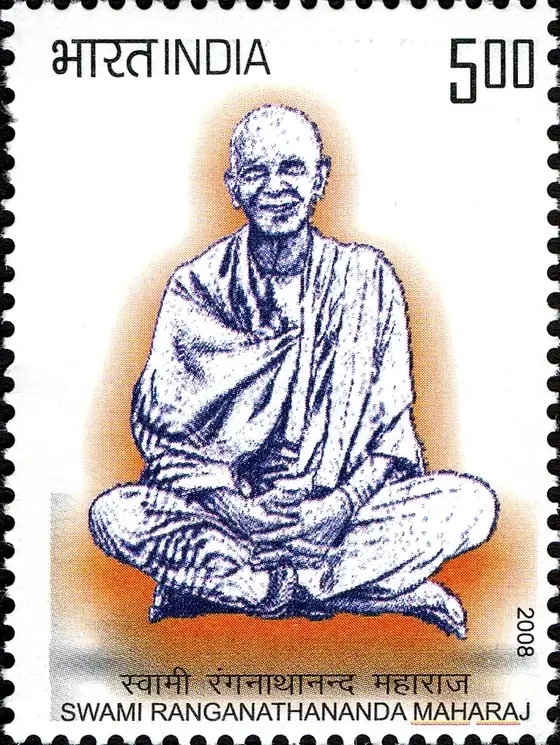
The portrait at the head of this page is taken from the commemorative postage stamp that India Post issued in his honour in 2008, published under the Government of India’s open data licence and credited on the picture credits page; it is not a generated image. Dates, offices and quotations follow the Ramakrishna Math and Mission’s own published biography of him, which combines a short official summary with a detailed life drawn from his recorded recollections and those of his colleagues; the quotations from his books are taken from the first editions as digitised at the Internet Archive, and the publisher’s account of the Calcutta lectures from the front matter of The Message of the Upanisads. Where sources differ, both are given: the Order’s summary puts the Rangoon years at 1939–42 and its detailed account prints 1933, which his stated age of thirty-one rules out; the Order dates the Indira Gandhi Award to 1985 and the Jamnalal Bajaj Foundation to 1987; the Order describes the tours once as 1956–72 and over fifty countries, and once as 1946–72 and fifty countries; one report of his death gives 3.51 a.m. against the Order’s 3.51 p.m. The declined Padma Vibhushan and the reason for accepting the Gandhi Peace Prize are from the Bajaj Foundation’s page and the Indian Express, not from the Order’s detailed biography, which does not mention them; the date and terms of the Gandhi Peace Prize, and the Birla award of 1992, are from Belur Math’s own list of the Order’s honours. The maps are drawn on present-day coordinates from place-names in the biography and not from any historical map; on the world map the Communist countries of the tours are pinned at their capitals, since the biography names no cities, and the “seventeen European countries” and “South-East Asian countries” it does not name are not pinned.
The timeline, plainly
- 15 December 1908 — born Shankaran, “Kochappan”, at Trikkur near Thrissur, on the Manalipuzha; the Holy Mother’s birthday that year; parents Neelakantha Shastri and Lakshmi Kutty Amma.
- c. 1920–23 — his mother: “your tongue is the abode of Vāni”; breaks caste by eating from a pariah couple’s hands; reads The Gospel of Sri Ramakrishna at about fourteen; the Complete Works, Nivedita; memorises Abhedananda’s hymn to the Holy Mother.
- 1924 — at fifteen and a half, resolves to join the Order. 1926 — school final; three rupees, gold ear-rings, seven rupees in all; prayer at the Vivekodayam shrine; meets Swami Siddheshwarananda.
- 30 June 1926 — initiated at Ootacamund by Swami Shivananda; the mangoes given back as guru-dakṣiṇā; “Serve Gopal.” 2–3 July 1926 — reaches Mysore; bread and milk; hair cut, ear-rings removed; made cook.
- 1926–35 — Mysore: nine years’ service to Siddheshwarananda; Śaṅkara and Rāmānuja heard through the classroom doorway while the rice boiled; the Gītā in eighteen months; gerua from 1927; prisoners of Mysore Jail from 1933.
- 23 May 1929 — brahmacarya at Belur Math on Buddha Pūrṇimā as Yati Chaitanya; four months at the Math; meets M.
- 23 January 1933 — sannyāsa on Swamiji’s birthday, given in Mahapurush Maharaj’s room to nine monks; the name Ranganathananda; Sargachhi: Akhandananda’s “I bless you, I bless you!”; Allahabad: Vijnanananda and the tap.
- 1935–38 — Bangalore, among the young. 1937 — hears Abhedananda at the Town Hall and Tagore at the University Institute, Calcutta.
- 1939–42 — Rangoon: secretary and librarian; record audiences; “Vedantic Thought Bombs”; flood relief 1939; the 200-bed hospital; Gandhi and Nehru visit; Gandhi’s entry in the visitors’ book.
- 22 February 1942 — leaves Prome; Paduang, Tungup, five and a half days and a hundred miles on foot; four nights and five days by boat; relief at Kyaukpyu; Dhaka at eighty pounds; Kankhal: “he is a precious monk.”
- 9 August 1942 – 9 August 1948 — head of the Karachi Math; 1,250 tons of rice to Bengal in the famine of 1943; Madhavananda: “Taking Shankar on his lap, Thakur is playing”; Partition; building vandalised and occupied, January 1948; the watchman who wept.
- 1949–62 — New Delhi: temple, students’ library, auditorium; Chester Bowles in the audience; National Academy of Administration from 1956; National Defence College; the five hundred rupees for Afghanistan.
- 1956–72 / 1946–72 — world tours: over fifty countries; Fiji and Sydney, 14 October 1956; Japan, South-East Asia, seventeen European countries including Czechoslovakia, Yugoslavia, Poland, the USSR and Cuba; Helena Dvorak and Swamiji’s gerua.
- 1961 — Trustee of the Math and member of the Mission’s Governing Body.
- 1962–67 — Secretary, Ramakrishna Mission Institute of Culture, Gol Park, Calcutta; Saturday lectures on the Upaniṣads, 2 May 1962 – 19 January 1963, a thousand rising to sixteen hundred; then the Gītā verse by verse; UNESCO National Commission 1964–67; Calcutta University convocation, February 1966; Tata Institute, June 1967.
- 2 June 1968 — the dream of the Holy Mother, written down and kept private.
- 1973–93 — President, Ramakrishna Math, Hyderabad (present site from 1978): the Universal Temple, the thousand-seat auditorium, library, health centre; annual tours to Australia, the United States, Holland and Germany, 1973–86; Britain 1976, the Dean of Westminster and the school.
- 1985 (or 1987) — first Indira Gandhi Award for National Integration, accepted for the Mission.
- 1 April 1989 — Vice-President. 9 May 1990 — first initiations, thirty-five candidates, at the Cossipore garden-house; more than sixty thousand initiated over sixteen years.
- July 1998 — taken ill at Belur; 10 August 1998 — Swami Bhuteshananda dies; 7 September 1998 — thirteenth President: “What! The cook of Mysore ashrama…?”; lives at Belur Math thereafter.
- 13 February 1999 — receives the Gandhi Peace Prize for 1998 on the Mission’s behalf from President K. R. Narayanan at Raj Bhavan, Kolkata; 2000 — declines the Padma Vibhushan, offered to him as an individual; 10 September 2000 — inaugurates the Vivekananda Institute of Human Excellence, Hyderabad.
- 2001 — partial brainstem stroke; recovery; Gītā volumes released at Raj Bhavan, Mumbai, February 2001; foundation stone at Swamiji’s birthplace, 10 April 2001, in his absence; temples consecrated at Pune and Chennai.
- 26 September 2004 — keeps his word and inaugurates the completed project at Swami Vivekananda’s birthplace.
- 4–6 January 2005 — benedictory address at the Holy Mother’s 150th birth anniversary celebration, Belur. 1 February, 8 March, 12 March 2005 — last brahmacarya, last initiation, last sannyāsa.
- 28 March – 25 April 2005 — Woodlands Medical Centre; dies 25 April 2005 at 3.51 p.m., aged 96 years, 4 months and 11 days: “Lift me up; I want to sit up. Lift me up.” 26 April — cremation at Belur Math, 12.40 to 3.15.
Read the originals
Primary texts and the records kept by the teacher's own institution.
- The Ramakrishna Order’s own detailed biography of Swami Ranganathananda
- Belur Math — the Order’s Holy Lives pages
- Belur Math — the Order’s record of its awards and honours, including the Gandhi Peace Prize he received for the Mission on 13 February 1999
- Ramakrishna Math, Thrissur — the Math of his home district on its thirteenth President
- The Message of the Upanishads (1968) — the Gol Park lectures; full scan
- Eternal Values for a Changing Society, volume 4 — full scan
- Vivekananda Institute of Human Excellence, Hyderabad — the institute he inaugurated on 10 September 2000
- Jamnalal Bajaj Foundation — its note on him as chief guest of the 1989 awards, with his rule on honours
- The Indian Express on the history of declined honours, including his Padma Vibhushan of 2000
- Hinduism Today’s report of his passing, 26 April 2005
- Belur Math’s media gallery — photographs of Swami Ranganathananda
Every daily message names the teacher it came from. Read the messages, or see the whole line this teacher stands in: all fifty-one teachers.