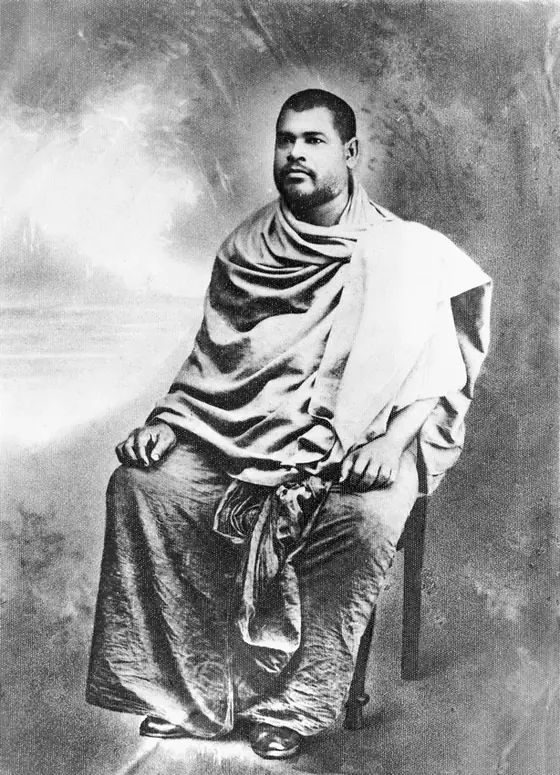
Swami Ramakrishnananda
Direct disciple; founder of the Madras centre
1863–1911 · The Ramakrishna Lineage
- When
- 1863–1911
- Born
- Ichapur, Bengal
- Where the life was lived
- Born Shashi Bhushan Chakravarti in the Hooghly district of Bengal; served at Dakshineswar, Shyampukur, Cossipore and Baranagore; sent to Madras in 1897, from where he opened the Order's work across south India, Bangalore, Mysore, Trivandrum and Burma.
- What is left of it
- A life of Rāmānuja in Bengali; The Universe and Man; The Soul of Man; Sri Krishna, the Pastoral and Kingmaker.
Carried the Order into southern India almost single-handed, and kept the daily worship of his teacher's shrine for years with the exactness of a temple priest; died at the Baghbazar monastery in Calcutta in 1911.
The full-length study of this teacher is still being written. What is below is the complete short life, and it is accurate as far as it goes.
The life
He was Shashi Bhushan Chakravarti, born in 1863 in the Hooghly district of Bengal, and a brilliant mathematics student — the kind of mind that could have had a university career in a colonial system that had very few places to offer. He spent it on a shrine. Through the last illness at Shyampukur and Cossipore he nursed; after 1886, at the Baranagore monastery, he took charge of the worship of his teacher's relics and did it every single day for twelve years without one break, with the exactness of a temple priest — the offerings on time, the lamp, the food, in a house where there was often no food for the monks themselves. He did not treat it as symbolism. He treated it as attendance on someone present. In 1897 he was sent to Madras, and from there, largely alone, he opened the Order's work across the whole of southern India — Bangalore, Mysore, Trivandrum, and as far as Burma. He wrote a life of Rāmānuja in Bengali, and books in English on the soul and the universe. He died in 1911 at the Baghbazar monastery in Calcutta, at forty-seven, worn out. He is the answer to a question people often ask about non-duality: what happens to devotion once you have concluded that there are not two? In him, nothing happened to it. It got more exact.
The turn it rests on
He treated the shrine as a living presence and never once treated the duty as routine.
What was taught
Carried the Order into South India almost single-handed, with extraordinary personal discipline.
Read the originals
Primary texts and the records kept by the teacher's own institution.
Every daily message names the teacher it came from. Read the messages, or see the whole line this teacher stands in: all fifty-one teachers.