Swami Akhandananda
Direct disciple; 3rd President
1864–1937 · The Sri Ramakrishna Lineage
- When
- 1864–1937
- Born
- Calcutta, Bengal
- Where the life was lived
- Born Gangadhar Gangopadhyay in Calcutta; travelled on foot through the Himalaya, Tibet and Rajputana; opened famine relief at Mahula and Sargachhi in Murshidabad district, Bengal, where he settled; died at Belur Math in 1937 at seventy-two.
- What is left of it
- Three Years in Tibet, serialised in Udbodhan, and reminiscences left unfinished.
Began the Ramakrishna Mission's famine relief and orphan work in 1897 in Murshidabad — the start of the Order's organised service — and became its third President.
The Calcutta he was born into
He was born Gaṅgādhar Gaṅgopādhyāy on 30 September 1864, in Calcutta. The city was the capital of British India, a place of counting-houses and jute presses, of the new University turning out its first English-educated graduates, and of old Hindu households in the northern quarters where the day still ran to the temple bell and the rules of ritual purity. Belur Math, whose account of his life this page follows, gives no family details, and does not describe his schooling. It describes the boy instead, and the description is exact: he was of a deeply religious turn of mind and had extremely orthodox habits. He bathed several times a day. He cooked his one daily meal himself. He read the Gītā and other scriptures, and he regularly practised meditation.
That is a portrait of a young Brahmin of the strictest observance, and it matters, because the whole shape of the life is a movement away from it — not away from religion, but away from a religion of self-protection towards a religion that could put its hands into a cholera patient's bedding and feed a starving Muslim child from a purse of four annas. Two forces would work that change. One was Sri Ramakrishna, whom he had already seen once as a small boy, at the house of a devotee named Dīnānāth Bose at Bāgbāzār, without knowing who he was. The other was Narendranāth Datta, later Swami Vivekananda, whom the Master would send him to find.
The India of his boyhood was also an India of famine. The scarcity years came round with the failed monsoons, and the machinery for meeting them was thin. No religious order in Bengal then fed the hungry as a matter of vocation. The man who would begin that work for the Ramakrishna Order, on 15 May 1897 in a village of Murshidabad, was at this stage a fastidious boy who would not eat what another hand had cooked.
Where the life was lived
The life has three geographies. The first is the small circle of Calcutta and its river — Dakṣiṇeśvar, Cossipore, the Baranagore and Ālambāzār monasteries, Belur Math — where it began and where it ended. The second is the enormous arc of the wandering years: the Himalaya and Tibet, three times crossed, between 1887 and 1890; the pilgrim road with Swami Vivekananda through Almora, Karṇaprayāg, Tehri, Dehradun and Meerut; the pursuit of him across the provinces to a port in Kutch; and the years of educational work in the princely states of Rajputana. The third is the smallest of all and the most important: a few villages in the district of Murshidabad, two hundred kilometres north of Calcutta, where he stopped in 1897 and, in effect, never left. The map below shows these places on present-day coordinates. Tibet, where the Order names no town, is described in the text rather than pinned.
Present-day India. Numbered pins are places named in Belur Math’s account of his life and in the Sargachhi ashrama’s own history; the dotted line joins them in the order they occur in the story and is not a surveyed route. Tibet, which he entered three times between 1887 and 1890, lies off the map to the north and no town there is named by the Order, so none is pinned; Murree, in the Punjab hills, from where Swami Vivekananda wrote to him on 10 October 1897, lies off the map to the north-west. Mahulā and Pāñchgāon, the famine villages of 1897, and Kedārmāṭhī, where the orphanage began, are within a few miles of Sargachhi and are named in the text rather than pinned separately.
- 1Calcutta (West Bengal) — Born Gaṅgādhar Gaṅgopādhyāy, 30 September 1864; an orthodox, meditative boy who cooked his own single meal
- 2Dakṣiṇeśvar (West Bengal) — First came to Sri Ramakrishna in 1883 with Harināth (Swami Turiyananda); stayed the night; was sent to meet Narendranāth
- 3Cossipore (West Bengal) — Served the Master through his last illness, 1885–86
- 4Baranagore (West Bengal) — The first monastery; sannyāsa as Swami Akhaṇḍānanda; a few happy months here after Tibet, 1890; Ālambāzār Math from 1892
- 5Belur Math (West Bengal) — Vice-President 1922, President from March 1934, the third after Swamis Brahmananda and Shivananda; died here 7 February 1937
- 6Almora (Uttarakhand) — With Swami Vivekananda in the hills, July 1890; the two letters of June and July 1897 were written from here
- 7Karṇaprayāg (Uttarakhand) — On the pilgrim route to Badrīnāth with Swami Vivekananda, 1890
- 8Tehri (Uttarakhand) — The return from Karṇaprayāg came back by Tehri, 1890
- 9Dehradun (Uttarakhand) — With Swami Vivekananda on the way down from the hills, 1890
- 10Meerut (Uttar Pradesh) — Went here for treatment; five months with Swami Vivekananda and the brothers, 1890–91
- 11Māṇḍvī (Gujarat) — A port in distant Kutch, where he found Swami Vivekananda after following him across India — and let him go
- 12Mount Abu (Rajasthan) — 1893, after Swami Vivekananda had sailed: learned here from Swamis Brahmananda and Turiyananda the real purpose of the journey — bread for the hungry
- 13Khetri (Rajasthan) — Six months with Maharaja Ajit Singh, 1893–94: the high school raised from 80 to 257 pupils, five village primary schools, an annual grant of Rs 5,000 for education, a Vedic school, and the durbar opened to the poor
- 14Udaipur (Rajasthan) — 1895: had the Bhils fed for a day — the first recorded feeding of the hungry by the Order
- 15Nāthdwārā (Rajasthan) — Took pains to start a Middle English School, 1895
- 16Alwar (Rajasthan) — Founded societies for discussion of social, religious and educational questions
- 17Berhampore (West Bengal) — Murshidabad, early 1897: the girl with the broken pitcher, about twenty miles from here
- 18Sargachhi (West Bengal) — Mahulā, 15 May 1897: the Mission’s first famine relief; 31 August 1897: the two orphans in a hut at Kedārmāṭhī; the Ramakrishna Mission Ashrama, his home for forty years
- 19Bhāgalpur (Bihar) — The Ghoghā flood relief on the Ganga, fifty villages for ten weeks; the 1934 earthquake inspection at sixty-nine
- 20Monghyr (Bihar) — Inspected the earthquake damage in person, 1934
The boy who had seen him before
He probably first came to Sri Ramakrishna in 1883, going up to the temple garden at Dakṣiṇeśvar with his friend Harināth — the future Swami Turiyananda. Belur Math preserves the first exchange. The Master received him cordially and asked whether he had seen him before; and Gaṅgādhar answered that he had, when he was very young, at Dīnānāth Bose's house in Bāgbāzār. Sri Ramakrishna made him stay the night. When the young man took his leave the next morning, he was asked to come again. That, the Order says, was the beginning of a close association which developed, on Gaṅgādhar's side, into a strong urge for renunciation of the world, and, later, into his dedication to the service of God in man.
Every time he came, the Order records, he saw a new phase of the Master's God-intoxicated life, and felt the silent transforming influence of his love. He received practical instructions on spiritual life. And, gradually, under that tutelage, he dropped his over-orthodox observances — the several baths, the self-cooked meal, the fear of contamination. Sri Ramakrishna's word for these observances was “oldish”; the Master did not despise the boy's scruples, but he saw that they were a fence around the self, and he took the fence down gently.
Then he sent him to Narendranāth. The words are recorded: “Look at Naren. He has such prominent eyes! He chews a hundred betel rolls a day and eats whatever he gets. But his mind is deeply introspective. He goes along the streets of Calcutta seeing houses and chattels, horses and carriages, and everything as full of God! Go and see him one day. He lives at Simla.” Simla is a quarter of north Calcutta. Gaṅgādhar went the next day. He found the prominent eyes, and a young man reading a voluminous English work in a room full of dirt of which he scarcely noticed anything; the mind, Gaṅgādhar felt, seemed to be away beyond this world. Belur Math calls that meeting the foundation of his abiding devotion and allegiance to Swami Vivekananda. It was the Master's doing, and it was one of the most consequential introductions he ever made: the fastidious Brahmin boy and the omnivorous, untidy, God-seeing student would between them invent the Ramakrishna Mission's work among the poor.
Both sayings are quoted on Belur Math's own life of Swami Akhandananda, from which every quotation on this page is taken unless another source is named. In the Master's saying the Order adds, in brackets, that Naren is Swami Vivekananda and that Simla is a district of Calcutta.
He went often to Dakṣiṇeśvar and then to the garden house at Cossipore, where the Master lay dying of cancer of the throat, and he served him there until the end, in August 1886. When the young disciples gathered in the ruined house at Baranagore that autumn and began to live as monks, he did not at first join them. He kept in close touch, and he was particularly close to Narendranāth, whom he loved dearly; but his own road, for the moment, ran north.
Tibet, three times
In February 1887 he set out on a long pilgrimage to the Himalaya and to Tibet. He was twenty-two. Belur Math gives the outline and nothing more: he crossed over into Tibet three times, he learned the language, and he finally returned to India in 1890. The Order does not name the passes he used or the monasteries he stayed in, and this page does not invent them. What it does record is the result. He had visited Tibet long before Rai Bahadur Sarat Chandra Das, the celebrated Bengali explorer of that country, and his knowledge of the language gave him opportunities to study the Tibetan people at close quarters; he later became, the Order says, an authority on Tibet. Years afterwards he began to set the experience down in Udbodhan, the Order's Bengali monthly, as a series of articles called Three Years in Tibet. He never finished it.
Three years in the high country, alone, at that age, is itself a spiritual practice, and a severe one; but there is a second thing to notice. The boy who bathed several times a day and cooked his own meal spent three years among a people whose food, whose customs and whose faith were entirely unlike his own, and came back not scandalised but curious — enough of a Tibetan to be an authority. The orthodoxy had become something else. It had become the habit of taking other people seriously on their own terms. That habit would show itself again, thirty years later, when he insisted that the Muslim orphans in his ashrama be brought up in their own religion and not in his.
After his return he corresponded frequently with Swami Vivekananda, who was then at Ghazipur, and it was at Vivekananda's urging that he came at last to the Baranagore monastery and spent, the Order says, a few happy months there with his brother disciples, sharing his experiences with them.
On the road with Narendranāth
In July 1890 the two of them left Baranagore together on a pilgrimage to the Himalaya. Belur Math gives the stages: Almora; then Karṇaprayāg, on the pilgrim route to Badrīnāth; then back by Tehri to Dehradun; then Meerut. They did not reach Badrīnāth. Illness of one or the other — the Order does not say which, and probably it was both in turn — prevented them from going farther, and after some weeks they came down. Gaṅgādhar went to Meerut for treatment. Vivekananda, who had himself been taken seriously ill while practising austerities at Rishikesh, the great resort of monks at the foot of the hills, joined him there, and brought some of the other brothers, Swami Brahmananda among them. For five months they lived together at Meerut.
Then Vivekananda left them. Belur Math gives the reason plainly: an inner hankering to remain alone, and the beginning of the years in which he walked the length of India as an unknown monk. Gaṅgādhar would not accept it. He followed him from province to province, determined to find him; at every place he arrived to learn that the Swami had left a few days before. He kept on. He found him at last at Māṇḍvī, a port in distant Kutch, on the far western edge of India — and there, having found him, he did the hardest thing in the story. He yielded to Vivekananda's earnest desire to be left alone, and let him go. They continued their pilgrimages separately.
It is worth pausing on that. The Order calls Vivekananda his closest and most beloved brother disciple, and the affection ran both ways: Vivekananda called him “Ganges”, the English of Gaṅgā, loved him particularly, and, being Vivekananda, played practical jokes on him. The pursuit across India is the measure of one side of that love; the letting-go at Māṇḍvī is the measure of the other. A man who can chase his friend across a subcontinent and then leave him alone because his friend asks it has learned something about love that most people never learn.
Khetri, and the discovery of the poor
In May 1893 Vivekananda sailed for America. Shortly afterwards, at Mount Abu in Rajputana, Gaṅgādhar learned from Swamis Brahmananda and Turiyananda what the journey was really for: not to win debates at a Parliament of Religions, but to find bread for the hungry masses of India. He had not understood this before. Then he fell ill, and went for a change of air to Khetri, the small princely state whose Maharaja, Ajit Singh, was a devoted disciple of Vivekananda; and there, for six months, resting and under treatment in the Maharaja's care, he came into close contact with all sections of the people — high and low, rich and poor. Belur Math records the result in one sentence: he then realised the truth of Swami Vivekananda's words about the condition of India's poor.
He wrote to America asking permission to serve them. The answer survives, in the Complete Works, dated only “March or April? 1894”, and it is one of the letters on which the whole later Ramakrishna Mission stands. Vivekananda was glad to hear that Khetri had restored his health, and then he gave orders. “Go from door to door amongst the poor and lower classes of the town of Khetri and teach them religion. Also, let them have oral lessons on geography and such other subjects. No good will come of sitting idle and having princely dishes, and saying ‘Ramakrishna, O Lord!’ — unless you can do some good to the poor.” And, a few lines on, the sentence that named the vocation: “The Geruâ robe is not for enjoyment. It is the banner of heroic work. You must give your body, mind, and speech to ‘the welfare of the world’. You have read — ‘Look upon your mother as God, look upon your father as God’ — but I say ‘The poor, the illiterate, the ignorant, the afflicted — let these be your God.’ Know that service to these alone is the highest religion.”
From Swami Vivekananda's letter to Swami Akhandananda of 1894, translated from Bengali, in the Complete Works, volume 6, Epistles — Second Series, letter LV; the Sanskrit of the two maxims (mātṛdevo bhava, pitṛdevo bhava and daridradevo bhava, mūrkhadevo bhava) is given in the original alongside the English.
Belur Math says that this encouraging reply impelled him to begin, in 1894, his campaign against poverty and ignorance; and it records that he concluded almost at once that the poverty of the masses could not be removed without education, which therefore became his first objective. What he then did at Khetri is set out in the Order's account with the precision of a report, and deserves to be read that way. He talked to the Maharaja and his courtiers about the need to educate their children. He raised the strength of the local high school from eighty pupils to two hundred and fifty-seven, and improved its teaching staff. He went round the villages of the state and started five primary schools for village boys. He induced the Maharaja to make an annual grant of five thousand rupees for education in his territory, and to convert the Sanskrit school at Khetri into a Vedic school. He raised subscriptions to buy books for poor students, and had them distributed free by the Political Agent. And he persuaded the Maharaja to lift the ban that had kept his poorer subjects from seeing him on durbar days — a piece of practical reform that had nothing to do with schools and everything to do with the dignity of the poor.
The following year he went to Udaipur, and was pained by the condition of the Bhils, the aboriginal people of the country; with a friend's help he had them sumptuously fed for one day — a small thing, and he knew it, but it is the first recorded instance of the Ramakrishna monks feeding the hungry as an act of religion. He took great pains to start a Middle English School at Nāthdwārā. He founded societies at Alwar and elsewhere in Rajputana for the regular discussion of social, religious and educational questions. In the midst of all this he mastered, the Order says, the intricacies of Hindi grammar. At the end of 1895 he came back to the monastery, which had by then moved from Baranagore to Ālambāzār; and there, whenever a case of cholera was reported in the neighbourhood, he went to the house and nursed the patient towards recovery without regard for his own safety.
The broken pitcher: Mahulā, 1897
At the beginning of 1897, while Calcutta prepared to welcome Vivekananda home from the West, he set off northwards on foot along the Ganga. Belur Math tells what happened with a plainness that no retelling should disturb. He reached a village about twenty miles from Berhampore, in the district of Murshidabad. There he met a poor Muslim girl who was weeping because she had broken her family's only water pitcher and had no means to replace it. He had four annas in his possession. He bought her a pitcher, and gave her half an anna's worth of popped rice to eat. While he rested, a dozen emaciated old women in rags gathered round him asking for food, and he spent the rest of his money on food for them. Then he learned that a famished old woman was lying sick and helpless in the village, and he went to her and did what he could. This, the Order says, was his first contact with famine.
As he went on, the scenes grew more frightful. At Mahulā he stopped, and resolved not to leave until he had relieved the famine-stricken people. He wrote to the Ālambāzār Math for help. Vivekananda, home about three months, sent two monks with money; the Sargachhi ashrama's own history names them as Swami Nityananda and Swami Sureshwarananda, and puts the sum at one hundred and fifty rupees. On 15 May 1897 the first famine-relief work of the Ramakrishna Mission was inaugurated, at Mahulā and Pāñchgāon. It continued for about a year. The Mission itself had been founded in Calcutta only a fortnight earlier, on 1 May 1897; among its first acts in the world was the distribution of rice in Murshidabad, and the man who brought it there had set out with four annas.
Vivekananda's letters from the hills that summer are the counterpart to that walk, and they should be read with it. From Almora, on 15 June 1897: “I am getting detailed reports of you and getting more and more delighted. It is that sort of work which can conquer the world. What do differences of sect and opinion matter? Bravo! Accept a hundred thousand embraces and blessings from me. Work, work, work — I care for nothing else. Work, work, work, even unto death!” And further down the same letter, the sentence in which the leader of a philosophical movement set philosophy in its place: “It is the heart, the heart that conquers, not the brain. Books and learning, Yoga and meditation and illumination — all are but dust compared with love.” From Almora again, on 24 July 1897, when Gaṅgādhar had written of his wish to found an orphanage: “Your wishes about the orphanage are very good and Shri Maharaj will not fail to fulfil them at an early date. Try your best to found a permanent centre. … Never worry about money.” And: “Let not the work of preaching, too, be at a standstill, and greater even than preaching, is the work of imparting education.”
The two letters are in the Complete Works, volume 6, Epistles — Second Series, letters CXXVIII and CXXXI, both translated from Bengali. “Shri Maharaj” is Sri Ramakrishna, as the Order's editors note. The ellipsis in the second letter is the editors' own.
Two orphans, and what he built
During the relief work he took charge of two orphaned boys. The Sargachhi ashrama, which keeps its own founding story, names them — Nutubihārī Dās and Pāthakārī, later called Vīrabhadra — and dates the day he took full responsibility for them, 31 August 1897, as the day the ashrama began, in a thatched hut belonging to one Mṛtyuñjay Bhaṭṭāchārya at Kedārmāṭhī in Mahulā village. Belur Math tells the same story with a different emphasis: the idea of an orphanage first entered his mind with those two boys; with encouragement from the district officers he cared temporarily for several more; and in May 1898 he founded at Mahulā the orphanage he called the Ramakrishna Ashrama. The two accounts are not in conflict. One dates the deed; the other dates the institution.
The institution moved. In October 1898 — the Sargachhi history gives the month — it went into a rented two-storey kāchārī, or estate office, belonging to a landholder named Madhusundarī Barmaṇī, beside the Sargachhi–Krishnanagar road. It stayed there thirteen years. In March 1913 it moved to its own land in the same village: fifty bighās, secured, the ashrama records, from two local landlords, Hājī Muharram Alī and Hājī Abdul Azīz, through the efforts of Rāi Bahādur Vaikuṇṭhanāth Sen. That is the site of the Ramakrishna Mission Ashrama, Sargachhi, today, and it is the first branch centre of the Ramakrishna Mission ever founded.
What kind of place it was to be, Vivekananda had settled in a letter from Murree, in the Punjab hills, on 10 October 1897. “You need not make a big plan for the present, but do only what is possible under existing circumstances. Gradually the way will open to you. We must certainly have the orphanage, no hesitating in that. We must not leave the girls in the lurch either.” Then, in a postscript that is one of the founding documents of the Order's whole approach to other faiths: “You must admit Mohammedan boys, too, but never tamper with their religion. The only thing you will have to do is to make separate arrangements for their food etc., and teach them so that they may be moral, manly, and devoted to doing good to others. This indeed is religion.” And: “Shelve your intricate philosophical speculations for the present. In our country we at present need manhood and kindness.”
Complete Works, volume 6, Epistles — Second Series, letter CXXXVI, translated from Bengali.
He did as he was told, and Belur Math records that he went on doing it for forty years. Orphans were admitted without distinction of caste or creed. Several Muslim boys were maintained at the ashrama for years and were trained, the Order says, so that they might develop faith in their own religion. The spiritual training of the house was the chanting of prayers morning and evening, and the reading and explanation of selected passages from the Rāmāyaṇa and the Mahābhārata. Around the orphanage he built the rest. A day school and a night school for village boys and adults; the Sargachhi history dates the first lower primary school and the night school to 1900. An outdoor dispensary, later much enlarged, which came to treat thousands of the sick every year; its permanent building of 1933 was paid for, the ashrama records, by Hājī Muhammad Yūsuf of Beldāngā. From 1900 to 1910 a vocational school taught weaving, sewing, carpentry and sericulture, and the boys' handicrafts won first prizes for several successive years at the Banjetiā Industrial Exhibition organised by the Maharaja of Cossimbazar, Maṇīndra Chandra Nandī, a staunch patron of the house; the school had to be given up for want of room. The first substantial brick building went up in 1918, the two-storey temple of Sri Ramakrishna in 1929.
And he taught the boys to do what he had done. Belur Math records that he encouraged them to serve during outbreaks of pestilence and other calamities; that hundreds of cholera patients were nursed by the boys and saved from untimely death; that preventive measures were carried into many villages with good results. When the Ganga flooded at Ghoghā in the Bhāgalpur district of Bihar, he started relief work that helped fifty villages for ten weeks, and personally nursed many cholera patients in the course of it. In the Bihar earthquake of 1934, at the age of sixty-nine and already infirm, he went himself to inspect the destruction at Monghyr and Bhāgalpur and gave impetus to the Mission's relief there. The orphanage, in other words, was never only a shelter. It was a school of service, and its graduates were meant to be the kind of people who went towards a cholera village rather than away from it.
The difficulties, which he did not hide
The Order's account, and his own letters as they are reflected in Vivekananda's replies, are candid about how hard it was. The first difficulty was money, and the manner of its coming. He began with four annas. The relief of 1897 started on one hundred and fifty rupees. Vivekananda's letters return to the subject again and again — “never mind money, it will drop from the heavens”; “Let them whose gifts you will accept, give in their own name if they like, no harm. Whose name, and what is it worth?” — and a man does not need to be told so often that money will come unless he has been writing to say that it has not. The ashrama lived in borrowed and rented premises for its first fifteen years. Its vocational school, which was winning prizes, was closed for lack of a building to hold it.
The second difficulty was the coldness of the world. In February 1900 Vivekananda, writing from California, answered a letter in which Gaṅgādhar had evidently described the unnatural cruelty of a family towards its own, and the scepticism of the English district officials about his work. The reply is bracing and not consoling: “It is the same story all over the country. But then, it is not as a result of pure wickedness that the selfishness commonly met with in our country has come. This bestial selfishness is the outcome of centuries of failure and repression. It is not real selfishness, but deep-rooted despair. It will be cored at the first inkling of success.” And of the officials: “so how can they have faith at the very outset?” The letter ends with a demand for infinite patience and perseverance. He supplied them, for forty years, in a village where nothing happened quickly.
Complete Works, volume 6, Epistles — Second Series, letters CXXVIII (15 June 1897) and CLIV (21 February 1900), translated from Bengali.
The third difficulty was his body. He fell ill on the Himalayan road in 1890 and had to go to Meerut for treatment; he fell ill again after Vivekananda sailed in 1893, and needed six months at Khetri; and Belur Math says that he carried on the village work at Sargachhi despite indifferent health, and that in old age he suffered from infirmities and needed loving service from attendants. The Order adds something that most biographies would leave out: he disliked the idea of suffering long on his deathbed, and sometimes wished to break away from dependence on his attendants and wander alone, as he had when he was twenty-two. It is the note of a man who found being cared for harder than caring.
The fourth difficulty was temperament. He was, by the Order's account, a first-rate conversationalist, with a prodigious memory and a dramatic sense; but he was extremely reluctant to appear on a public platform, and did so rarely — his impromptu speech at the memorial meeting for Nafar Chandra Kuṇḍu, a Calcutta man who died saving two sweeper boys from a manhole, was much appreciated precisely because it was so unusual. When the presidency of the Order came to him in 1934 he showed the same reluctance about giving initiation, and had to be prevailed upon. And the presidency itself was a difficulty: it required his presence at Belur Math, and he preferred Sargachhi, where he supervised the farming and cared for the collection of trees and plants in the orchard. He did not resolve that tension by pretending to like Calcutta. He resolved it by staying, as much as he could, where his work was.
What he taught
He wrote no treatise, and the Order records that he was a forceful writer in Bengali rather than in English; so his teaching has to be read in what he did and in the few sentences of his that were kept. The centre of it is a single equation, which Belur Math's own online anthology of the Order's teachers attributes to him: “I see God living in all human beings, and I have realized that service to man is service to God.” It is important to read the sentence in the right order. He does not say that service is a good deed which God will reward. He says that he sees God in human beings, and that the service follows from the seeing. That is Advaita Vedānta put to work: if the one Self is in all, then the hungry child at the well is not an occasion for charity but an appearance of the Reality one has been meditating upon, and to feed her is worship in the strictest sense. Vivekananda gave the doctrine its words; Gaṅgādhar gave it its first institution.
The saying is quoted on Belur Math's media site, in its “Inspiration” page on Swami Akhandananda, which gives the Order's life of him as its source.
The second thing he taught was that service must respect the served. The Muslim boys at Sargachhi were taught to be faithful Muslims. The orphans were admitted without regard to caste. The girl with the broken pitcher was not preached to; she was given a pitcher. In this he was carrying out his leader's instruction — “never tamper with their religion” — but he carried it out for forty years, which is what turns an instruction into a teaching. Nothing in the Order's account suggests that he thought the truth of Advaita entitled him to overrule anyone's faith. He thought it obliged him to feed them.
The third was education, which he put before preaching because Vivekananda had, and because Khetri had taught him that the poor stayed poor for want of it. Schools, night schools, books distributed free, a vocational course in weaving and carpentry, the reading of the epics aloud to boys who could not yet read them: this was the substance of his religion as practised, and he did not regard it as a preliminary to something more spiritual. He was also, the Order records, a Vedic scholar of a particular kind — he could recite and explain selected passages of the Saṁhitās, and once tried to found institutions in Bengal for the study and propagation of Vedic culture, going round the scholars and men of standing to enlist them. The two interests were not in tension. The Veda, for him, was the ground; the orphanage was the fruit.
The last thing he taught was a standard. When he did at last begin to initiate disciples, in the final three years of his life, Belur Math records that he insisted they observe a high standard of purity and moral excellence in everyday life. The boy who bathed several times a day had not thrown away his orthodoxy; he had relocated it, from the surface of the body to the conduct of the life.
The sayings, and what they were for
Few of his own words survive in English. He wrote in Bengali, he distrusted platforms, and his reminiscences were left unfinished. What follows is therefore short, and it is followed by the sayings he lived by, which were his leader's. Every quotation is verbatim from the source named; nothing is paraphrased.
- “I see God living in all human beings, and I have realized that service to man is service to God.” — the sentence the Order chooses to stand for him. Note that it is in the first person and the past tense: not a doctrine, but a report.
- “If I do not live to see the worship, at least I have the satisfaction of raising this Mandapa for the Mother. You will do the rest.” — at Sargachhi, in his last months, of the shed he had built for the spring worship of Durgā, which he doubted he would live to see. Two of his predecessors as President had died before their planned worship could be performed, and he said so. The saying is a whole theology of work: build the shed, and let the rest be done by others.
- “I do not covet earthly kingdom, or heaven, or even salvation. The only thing I desire is the removal of the miseries of the afflicted.” — not his own words, but the Sanskrit couplet whose exact wording he wrote to the Advaita Ashrama at Mayavati to ask for, a month before he died, having seen it in the Prabuddha Bharata of April 1927. That a dying man should want to get that verse exactly right tells you what he thought his life had been about.
All three are from Belur Math's life of Swami Akhandananda, which prints the couplet in Sanskrit (na tvahaṁ kāmaye rājyaṁ na svargaṁ nāpunarbhavam / kāmaye duḥkhataptānāṁ prāṇinām ārtināśanam) with the English given here.
And these are the words that were written to him, which he made his own by obeying them:
- “The Geruâ robe is not for enjoyment. It is the banner of heroic work.” — Khetri, 1894. The ochre cloth, which in the old understanding was a licence to withdraw, became under this sentence a commission to act.
- “The poor, the illiterate, the ignorant, the afflicted — let these be your God. Know that service to these alone is the highest religion.” — the same letter. This is the saying that Sargachhi exists to embody.
- “It is the heart, the heart that conquers, not the brain. Books and learning, Yoga and meditation and illumination — all are but dust compared with love.” — Almora, 15 June 1897, on hearing of the relief at Mahulā. Written by the most learned monk of his generation to one of the most travelled, it puts both learning and travel in their place.
- “We must certainly have the orphanage, no hesitating in that. We must not leave the girls in the lurch either.” — Murree, 10 October 1897. Notice the second sentence, which is easy to pass over: the girls were in the plan from the start.
- “You must admit Mohammedan boys, too, but never tamper with their religion.” — the same letter's postscript. The founding rule of the ashrama's relation to other faiths, kept for forty years.
- “Learning and wisdom are superfluities, the surface glitter merely, but it is the heart that is the seat of all power.” — California, 21 February 1900. The theme of 1897 restated, three years into the work, when the novelty had worn off and the difficulties had not.
All from the Complete Works of Swami Vivekananda, volume 6, Epistles — Second Series, letters LV, CXXVIII, CXXXVI and CLIV, in the Advaita Ashrama text as published online by the Vedanta Society of Southern California's Ramakrishna–Vivekananda site. The letters are translated from Bengali; the phrase “Geruâ” keeps the editors' spelling.
The books, and how to read them
He left one book of his own, and it was made from his talk. His reminiscences of the wandering years and of the beginnings of the service work were published in English by Sri Ramakrishna Math, Chennai, under the title From Holy Wanderings to the Service of God in Man, and are also issued by Advaita Ashrama, Belur Math's publishing house, as Service of God in Man, together with a Bengali memoir the publisher lists as Smriti-Katha. This is the book to begin with. It is the only place where the Tibet years and the walk along the Ganga are told in his own voice, and the voice, by all accounts, was that of the conversationalist the Order describes — observant, humorous, exact about places and people. Read it after the letters, not before: the letters tell you what he was asked to do, and the book tells you what it was like to do it.
His two other pieces of writing were never finished. Three Years in Tibet appeared as a series in Udbodhan and stopped; his reminiscences in the Bengali monthly Basumatī were cut short by his death. Neither is easily found in English, and this page makes no claim about their contents beyond what Belur Math says of them.
For the rest, read what was written to him and about him. The eleven letters of Vivekananda to him in the Complete Works, volume 6 — from Khetri in 1894 to California in 1900 — are among the most direct statements of the Order's purpose anywhere, and they are addressed to a man on the ground with a famine in front of him, which keeps them honest. Advaita Ashrama's compilation Swami Akhandananda as We Saw Him gathers the recollections of those who knew him at Sargachhi. And the ashrama's own online history, with its dates, its donors' names and its list of buildings, is the best short account of what the four annas became.
A caution about all of it. The story lends itself to sentiment, and he was not a sentimental man; the Order describes a strict disciplinarian who demanded purity of his disciples and ran a farm. Read the sources for the numbers — eighty pupils to two hundred and fifty-seven, fifty villages for ten weeks, thirteen years in a rented office — and let the numbers carry the feeling.
The President who stayed at Sargachhi
He was made a Vice-President of the Ramakrishna Mission in 1922, and in March 1934, on the passing of Swami Shivananda, he became its President — the third, after Swami Brahmananda and Swami Shivananda, and the last of the Master's direct disciples but one to hold the office. Belur Math records what this meant to him with unusual frankness. The duties required his presence at Belur; he preferred to remain at Sargachhi, supervising the agricultural work and caring for the orchard's collection of trees. As President he was called upon to initiate disciples, and at first he was reluctant; but during the last three years of his life, the Order says, he blessed many earnest seekers of both sexes, and insisted that they observe a high standard of purity and moral excellence in everyday life.
The picture that comes through the Order's account of these years is of a man of enormous accumulated knowledge who wore it lightly. He loved books all his life and gathered, the Order says, extensive knowledge of diverse subjects; his memory was prodigious; he had a special aptitude for languages — Tibetan in the 1880s, Hindi in Rajputana, Sanskrit and English throughout — and his particular love was the Veda, of which he could recite and expound the Saṁhitā passages. Yet he would not lecture, and his one remembered public speech was made unprepared, at a memorial meeting for a man who had died saving two sweeper boys. He was, in short, the opposite of the type he might have become: not a scholar-monk holding forth in Calcutta, but a farmer-monk in Murshidabad who happened to be an authority on Tibet.
The last years
About a year before his death, Belur Math records, he had a premonition of his approaching end, and told some of his disciples of it. He arranged for the Rāmāyaṇa and the Mahābhārata to be recited in his presence — the same two books he had read to his orphans for forty years. Towards the end he wished to celebrate the Vāsantī Pūjā, the spring worship of the Divine Mother Durgā, at the ashrama, and had a shed erected for it; and he said, with the dryness of a man who had buried his brothers, that he doubted he would live to see it, since two of his predecessors had died without seeing their planned worship performed. The sentence he spoke over the shed is given above: the satisfaction of having raised it, and the rest left to others.
He loved Sargachhi dearly and did not like to be away from it. But he wished to give up his body at Belur Math, on the bank of the Ganga, in the place sanctified, as the Order puts it, by the memories of his brother disciples “from the great Swami Vivekananda downwards”. A couple of days before the end he was taken to Calcutta for better medical treatment, and so the wish was fulfilled. A month earlier he had written to the Advaita Ashrama at Mayavati asking for the exact wording of a Sanskrit couplet he had seen in the Prabuddha Bharata of April 1927, in an article called “Neo-Hinduism”: the verse about coveting neither kingdom nor heaven nor liberation, but only the removal of the miseries of the afflicted. He died at Belur Math on 7 February 1937, aged seventy-two.
For the seeker now
He is the teacher on this site for people who suspect that the non-dual teaching is a private consolation — a way of feeling that all is one while doing nothing about anyone. His life is the standing refutation. He took the doctrine that the one Self is in all beings and asked what it obliged him to do about a weeping child with a broken pitcher; the answer was a pitcher, and then a famine relief, and then an orphanage, and then forty years. He did not arrive at service by abandoning Vedānta. He arrived at it by taking Vedānta literally.
His practical counsel, as it comes down through the Order and through the letters he obeyed, is uncomfortable and clear. Start with what is in your hand; he had four annas. Put education before preaching, and food before either. Serve people in their own faith and do not tamper with it. Do not wait for money, or for the approval of officials, or for your health to be good. Prefer the village where the work is to the headquarters where the honour is. And hold yourself, in daily conduct, to a standard stricter than the one you hold others to — the orthodoxy of the boy, transferred from the bath to the character.
A note on the pictures and the dates
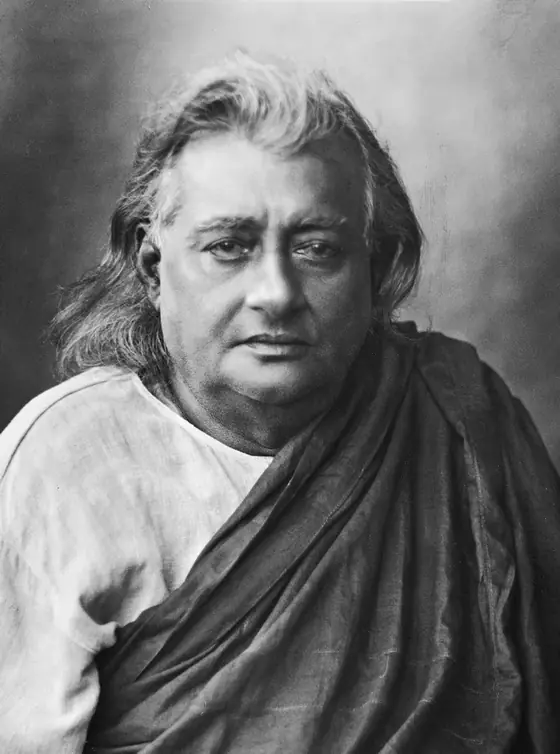
Photographs of Swami Akhandananda survive from his later years. The portrait at the head of this page is one of them, from the Ramakrishna Order's archives, published under a free licence and credited on the picture credits page; it is a photograph, not a painting or a generated image. Dates and places follow Belur Math's own life of him, supplemented by the Ramakrishna Mission Ashrama, Sargachhi's published history of its founding, and by the dated letters of Swami Vivekananda in the Complete Works. Where the two institutional accounts differ — Sargachhi dates the beginning of the orphanage to 31 August 1897, when he took charge of the two boys, and Belur Math to May 1898, when the Ramakrishna Ashrama was formally founded at Mahulā — both dates are given. Belur Math gives no family details and no formal schooling, and this page adds none. The map is drawn on present-day coordinates, not from any historical source. Tibet, where the Order names no town, is not pinned; Mahulā and Pāñchgāon, the two relief centres of 1897, lie in the same part of Murshidabad as Sargachhi and are named in the text rather than pinned separately; Murree, from which the orphanage letter was written, is in present-day Pakistan and is off the map.
The timeline, plainly
- 30 September 1864 — born Gaṅgādhar Gaṅgopādhyāy, Calcutta; an orthodox, meditative boy who cooks his own single meal.
- 1883 — first visit to Sri Ramakrishna at Dakṣiṇeśvar with Harināth (Swami Turiyananda); stays the night; is sent to meet Narendranāth at Simla.
- 1885–86 — serves the Master at Dakṣiṇeśvar and Cossipore until his passing in August 1886.
- February 1887 – 1890 — pilgrimage in the Himalaya; crosses into Tibet three times; learns the language.
- July 1890 — leaves Baranagore with Swami Vivekananda: Almora, Karṇaprayāg, Tehri, Dehradun, Meerut; illness; five months together; then follows Vivekananda across India to Māṇḍvī in Kutch and lets him go.
- May 1893 — Vivekananda sails for America; at Mount Abu, Gaṅgādhar learns the real motive; falls ill; six months at Khetri under Maharaja Ajit Singh.
- 1894 — Vivekananda's letter: “The poor, the illiterate, the ignorant, the afflicted — let these be your God.” Educational campaign at Khetri: high school 80 to 257 pupils; five village primary schools; Rs 5,000 annual grant; Vedic school; free books; durbar ban lifted.
- 1895 — Udaipur, the Bhils fed; Middle English School at Nāthdwārā; societies at Alwar; returns to Ālambāzār Math at the year's end; nurses cholera patients.
- Early 1897 — walks north along the Ganga; the broken pitcher, twenty miles from Berhampore; resolves to stay at Mahulā.
- 15 May 1897 — the Ramakrishna Mission's first famine relief opens at Mahulā and Pāñchgāon; two monks and Rs 150 from Vivekananda; about a year's work.
- 31 August 1897 — takes full charge of two orphans in a thatched hut at Mahulā (Sargachhi's founding date); May 1898 — the Ramakrishna Ashrama formally founded (Belur Math's date); October 1898 — moves to a rented estate office at Sargachhi.
- 1900–1910 — lower primary and night schools; vocational school in weaving, sewing, carpentry and sericulture; prizes at the Banjetiā exhibition.
- March 1913 — the ashrama moves to its own fifty bighās at Sargachhi; first brick building 1918; temple 1929; dispensary building 1933.
- 1922 — Vice-President of the Ramakrishna Mission.
- Undated — flood relief at Ghoghā, Bhāgalpur district: fifty villages for ten weeks.
- 1934 — inspects the Bihar earthquake damage at Monghyr and Bhāgalpur; March 1934 — President of the Ramakrishna Order on the passing of Swami Shivananda.
- 1934–37 — initiates disciples, at first reluctantly; remains at Sargachhi as much as he can.
- Early 1937 — builds the shed for the Vāsantī Pūjā; asks Mayavati for the couplet's exact wording.
- 7 February 1937 — dies at Belur Math, aged seventy-two.
Read the originals
Primary texts and the records kept by the teacher's own institution.
- Belur Math — the Order’s own life of Swami Akhandananda
- Ramakrishna Mission Ashrama, Sargachhi — the ashrama’s own history, from the two orphans of 1897
- Service of God in Man — his reminiscences in English; Advaita Ashrama
- From Holy Wanderings to the Service of God in Man — the Chennai Math’s translation of his memoirs
- Swami Vivekananda’s letter to him from Almora, 15 June 1897 — “Work, work, work, even unto death!” (Complete Works, vol. 6)
- Swami Vivekananda’s letter to him from Almora, 24 July 1897 — on the orphanage and “the work of imparting education”
- Swami Vivekananda’s letter to him from California, 21 February 1900 — “infinite patience and perseverance”
- Belur Math media — a short inspirational note on Swami Akhandananda from the Order
Every daily message names the teacher it came from. Read the messages, or see the whole line this teacher stands in: all fifty-one teachers.