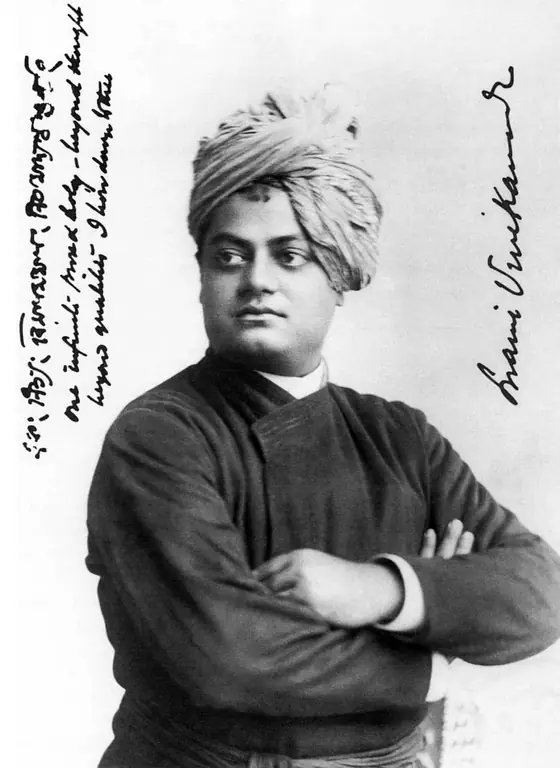
Swami Vivekananda
Founder of the Ramakrishna Order
1863–1902 · The Ramakrishna Lineage
- When
- 1863–1902
- Born
- Calcutta, Bengal
- Where the life was lived
- Born Narendra Nath Datta in Kolkata; met his teacher at Dakshineswar in November 1881; wandered India from 1890 and meditated on the rock at Kanyakumari; sailed from Mumbai on 31 May 1893 for America, spoke at Chicago that September, taught for years in the eastern United States and London, and returned to Kolkata in January 1897.
- What is left of it
- Karma Yoga, Jnana Yoga, Bhakti Yoga and Raja Yoga; Complete Works in nine volumes; the poem The Song of the Sannyāsin.
Presented Vedanta at the World's Parliament of Religions in Chicago in 1893, founded the Vedanta Society of New York in 1894, and founded the Ramakrishna Mission and the monastery at Belur on the Ganga in 1897–1898.
A Kolkata boy who argued with everyone
He was born Narendranath Datta on 12 January 1863 in Kolkata, into a comfortable family: his father Vishwanath Datta was an attorney with a taste for Persian poetry and a scepticism he passed on, and his mother Bhuvaneshwari Devi could recite the epics from memory. The boy was physically restless, exceptional at music and gymnastics, and academically strong enough to graduate from Calcutta University with a wide command of Western philosophy and European history.
He was also, from boyhood, two things that rarely sit together. He meditated — by his own later account, before he had any idea what it was — and he refused to accept a claim on anyone's authority. For a time he was involved with the Brahmo movement, the reforming, image-rejecting current of educated Bengal. What he could not get from it, or from the philosophy he had read, was an answer to the only question he actually cared about, and at the threshold of adulthood he went through a serious crisis of doubt about whether God existed at all.
He heard of Sri Ramakrishna first from one of his English professors at college, and in November 1881 he went to Dakshineswar and asked the question he had put to every religious person he had met: Sir, have you seen God? Every one of them had equivocated. This one said: yes, as clearly as I see you, only in a much more intense sense.
That reply is the hinge of his life, and it is worth noting what it consists of. Not an argument. Not scripture. A report, offered for testing, by a man who was unbothered about whether a sharp young sceptic believed him.
Five years, and then poverty
He became a frequent visitor. He did not surrender easily; the record from both sides shows years of testing, mockery and resistance before he accepted anything. In 1884 his father died suddenly, the family was left penniless, and the responsibility for his mother, brothers and sister fell on a graduate who could not find work. He went hungry and told nobody, sometimes pretending he had eaten so that the others could.
In September 1885 Ramakrishna's illness was diagnosed as throat cancer. Narendranath led the group of young men who nursed him through the last months at Shyampukur and then at Cossipore. Ramakrishna distributed ochre cloth among them, sent them out to beg for food, and left Narendranath specific instructions about a monastic order. He died on 16 August 1886.
Fifteen young men, one more joining later, then did something with no institutional backing whatsoever: they moved into a dilapidated house at Baranagar in north Kolkata and lived as monks on alms. In 1887 they took formal vows and new names. Narendranath eventually became Vivekananda, though the name itself came later.
The wandering, 1890 to 1893
In the middle of 1890 he left the monastery. He took the blessing of Sri Sarada Devi, then in Kolkata, and walked out into the country as an unknown monk with no fixed name, no money and no destination. He spent close to three years crossing India on foot and by third-class rail, staying with pandits, cobblers, sweepers, princes and station masters.
This is the period that made him, and it is often skipped. What he saw was not spiritual India; it was destitution. He concluded that the country's collapse had one central cause — the long neglect of the mass of its people — and that the neglect was religious as well as economic: a tradition of infinite subtlety had been kept from the people whose lives most needed it, while ritual purity was policed with great care. His formula for what was needed was concrete and quite unmystical: food first, then better agriculture and village industries, then secular education, then spiritual knowledge. And underneath all of it, the one thing he thought could not be imported — the conviction that one is not contemptible, which he grounded in the Vedantic teaching that what you essentially are is divine and cannot be degraded.
He called the result Practical Vedanta. It is not a dilution. It is the claim that a teaching about the identity of the self, if true, has consequences for how you treat the person in front of you, and that serving them is not charity from above but worship of the same reality.
At the southern tip of the country, at Kanyakumari, he swam to the rock offshore, sat there, and came away certain of the mission. Funds were collected by disciples in Chennai and supplemented by the Raja of Khetri, and on 31 May 1893 he sailed from Mumbai.
Chicago, September 1893
He arrived without an invitation, without credentials, and nearly missed the World's Parliament of Religions entirely; the delegate registration had closed and he had no organisation to vouch for him. He spoke in September 1893, opening by addressing the audience as sisters and brothers of America, and the hall — several thousand people — applauded for minutes before he could continue.
The substance, once they let him speak, was uncompromising: that the religions of the world are not competitors to be ranked, that a tradition claiming exclusivity is describing its own limits, and that India had not come to convert anyone. He also said, to a Parliament convened in part to display Christian civilisation, that it was a monstrous thing to bring religion to people who were starving. He was thirty.
He stayed nearly three and a half years, mostly in the eastern United States and also in London, teaching small classes as often as large halls, and it is out of those classes that the four books came — the lecture cycles on work, devotion, meditation and knowledge, of which the volume on knowledge is where a reader will find his clearest statements of Advaita. Those lectures, with his letters and conversations, are collected in the Complete Works, which are online in full and free.
The difficulties, which he did not hide
He was not a triumphal figure, and pretending otherwise falsifies him.
Money and racism dogged the American years; he was refused rooms, stared at, and lectured about his own country by people who knew nothing of it, and he fell out with the lecture bureau that was booking him as an exotic attraction. He was criticised at home too: by conservatives for crossing the ocean and eating with foreigners, and by reformers for defending the tradition they wanted dismantled. Some of his own brother monks initially doubted whether public work of this kind was compatible with monastic life at all.
His health broke early. Diabetes, asthma and the aftermath of years of irregular living caught up with him in his thirties, and he knew he would not last long; he said so more than once, without drama. And he carried, throughout, a constitutional impatience with his own fame, which he described as a nuisance and a cage.
What he built
He returned to India in January 1897 to an enormous welcome and immediately spent it, delivering lectures across the country designed to do three things at once: restore pride in what the tradition actually contained, unify a Hinduism fragmented into sects by naming the common ground beneath them, and turn the attention of educated Indians towards the condition of the poor.
On 1 May 1897 he founded the Ramakrishna Mission, on the principle that monks and lay people would work together in propagating Practical Vedanta and in social service — not as two departments, but as one activity. In 1898 the monastery moved to Belur on the Ganges, which remains the headquarters of the Order. Famine relief, plague work in Kolkata, hospitals, schools and the education of women followed. When plague broke out and the Mission had no money for relief, his answer was that they would sell the newly acquired Belur land if necessary; they did not need to, but he meant it.
He went West a second time in 1899 and returned in 1900. He died at Belur on 4 July 1902, aged thirty-nine, having done all of it in about nine working years.
The timeline, plainly
- 12 January 1863: born in Kolkata as Narendranath Datta.
- Early 1880s: graduates from Calcutta University; involvement with the Brahmo movement; a crisis of doubt about God.
- November 1881: first meets Sri Ramakrishna at Dakshineswar and asks whether he has seen God.
- 1884: his father dies; the family is left in poverty.
- September 1885 to August 1886: nurses Ramakrishna at Shyampukur and Cossipore; Ramakrishna dies on 16 August 1886.
- 1886 to 1887: the Baranagar monastery; formal vows of renunciation.
- Mid-1890: leaves the monastery, with Sri Sarada Devi's blessing, and wanders India for nearly three years.
- Late 1892: Kanyakumari, and the decision.
- 31 May 1893: sails from Mumbai. September 1893: the World's Parliament of Religions in Chicago.
- 1893 to 1896: teaching in the eastern United States and London; the four lecture cycles.
- January 1897: returns to India. 1 May 1897: founds the Ramakrishna Mission.
- 1898: Belur Math established on the Ganges.
- 1899 to 1900: second visit to the West.
- 4 July 1902: dies at Belur, aged thirty-nine.
Why read him now
Because he is the bridge, and most readers need one. He had read the same philosophy a modern reader has read, he argued in the same register, and he took the tradition's central claim and put it in language that assumes no Sanskrit and no belief: that what you are is not small, not shameful and not in need of rescue, and that the practical consequence is how you treat the next person you meet.
Because he is the antidote to a particular misreading of Advaita — the one where the world is unreal, so nothing matters, so nothing need be done. He is the teacher who said that talking to a starving person about the unreality of the world is an obscenity, and who then went and organised famine relief.
And because of the tone. He is bracing rather than soothing. He tells you not to whine, not to call yourself a sinner, and not to accept anything, including his own words, that does not stand up when you test it. That is an unusual note in religious writing, and it is the note that has made him readable for a hundred and twenty years.
Read the originals
Primary texts and the records kept by the teacher's own institution.
Every daily message names the teacher it came from. Read the messages, or see the whole line this teacher stands in: all fifty-one teachers.