Swami Turiyananda
Direct disciple; teacher in California
1863–1922 · The Sri Ramakrishna Lineage
- When
- 1863–1922
- Born
- Calcutta, Bengal
- Where the life was lived
- Born Harinath Chattopadhyay in north Calcutta; practised austerities across northern India — Rishikesh, Hardwar, Uttarkashi, Almora; went to New York and California in 1899, where he led the Shanti Ashrama in the San Antone Valley; died at the Ramakrishna Mission Sevashrama in Varanasi on 21 July 1922.
- What is left of it
- His talks and letters, published by the Order as spiritual instruction.
Established and ran the Shanti Ashrama in California, one of the first places of Vedantic practice in the United States, having been sent there by Swami Vivekananda.
The Calcutta he was born into
He was born Harināth Chaṭṭopādhyāy on 3 January 1863 in north Calcutta, into a Brahmin family, and lost both parents while he was still a small child. His elder brother brought him up. It was the same city and almost the same year as Narendranāth Datta, the future Swami Vivekananda, who was born nine days later a mile or two away; the two boys would spend their lives together and apart, and the younger would one day weep in front of the older to make him cross an ocean. Calcutta in 1863 was the capital of British India, a city of new colleges, new newspapers and old temples, where a young Bengali could read John Stuart Mill in the morning and hear the Caṇḍī recited at night.
What is unusual about Harināth is how early and how completely he chose the second. Belur Math's account, on which this page rests, says that he could not carry his schooling beyond the Entrance class "because his interest lay in another direction", and describes the direction: from a very young age he lived like an orthodox brahmacārin, bathing three times a day, cooking his own food, and reciting the whole of the Bhagavad Gītā before daybreak. He read the Upaniṣads and the works of Śaṅkara. His ideal, formed in boyhood, was to become a jīvanmukta — one liberated while still alive. Late in life he remembered the moment he first met the idea in a book: "When I first read the verse in which it is said that life is meant for the realisation of Jivanmukti (freedom in this very life), I leapt in joy, for that indeed was the purpose of my life."
All quotations on this page are taken verbatim from Belur Math's own life of Swami Turiyananda, unless another source is named.
Two things about that world bear on what follows. The first is that the Advaita Vedānta he was reading as a teenager was, in the Calcutta of the 1870s, a philosophy of books — a system to be studied, admired and argued over, not a thing anyone expected to see lived. The second is that a few miles up the river a man was living it, and the boy was about to meet him.
Where the life was lived
The map below shows the Indian places on present-day coordinates. The life has a clear shape: Calcutta and its river until his mid-twenties; the long years on foot across the north — the Himalayan shrines, the Doab, Vṛndāvan, Purī, Ujjain, Bombay — through his late twenties and early thirties; three years in America; then eight more years of solitary austerity in the north, and a last three and a half years at Vārāṇasī. The American years are drawn on a separate map further down.
Present-day India. Numbered pins are places named in Belur Math’s account of his life; the dotted line joins them in the order they occur in the story and is not a surveyed route. Nangal, “about sixty miles below Hardwar”, cannot be located precisely enough to pin and is named in the text. The American years, 1899–1902, are on the second map further down the page.
- 1Calcutta (West Bengal) — Born Harināth Chaṭṭopādhyāy, 3 January 1863, in the north of the city; public classes there in the Ālambāzār years
- 2Dakṣiṇeśvar (West Bengal) — First saw Sri Ramakrishna at thirteen or fourteen; a regular visitor from about 1879–80
- 3Baranagore (West Bengal) — Joined the monastery 1887 and took sannyāsa; trained the novices at Ālambāzār Math, c. 1895–99
- 4Belur Math (West Bengal) — Returned here from America in June 1902 to learn of Swami Vivekananda’s death
- 5Purī (Odisha) — The Jagannāth temple in the wandering years; gravely ill here later, when Swami Saradananda came to him
- 6Vārāṇasī (Uttar Pradesh) — The last three and a half years at the Ramakrishna Mission Home of Service; died 21 July 1922
- 7Vṛndāvan (Uttar Pradesh) — Wandering years; after 1902, austerity here with Swami Brahmananda
- 8Delhi (Delhi) — Wandering years
- 9Meerut (Uttar Pradesh) — Winter 1890–91 with Swami Vivekananda and the brothers
- 10Garhmukteshwar (Uttar Pradesh) — Solitary austerity on the Ganga, in the eight years after 1902
- 11Kankhal (Uttarakhand) — The letter of 10 September 1914, “We think we are the doers”
- 12Rishikesh (Uttarakhand) — With Swami Vivekananda after their meeting at Rajpur
- 13Rajpur (Uttarakhand) — Near Dehradun; the astrologer’s prediction, and Swami Vivekananda arrived within a day or two
- 14Uttarkāśī (Uttarakhand) — Solitary austerity in the eight years after 1902
- 15Kedārnāth (Uttarakhand) — Kedārnāth and Badrināth on foot in the wandering years
- 16Srinagar (Uttarakhand) — Srinagar in Garhwal, where he learnt the Upaniṣads by heart
- 17Almora (Uttarakhand) — The ashrama he built with Swami Shivananda; the recorded conversations of summer 1915
- 18Ujjain (Madhya Pradesh) — Wandering years
- 19Abu Road (Rajasthan) — Travelled here with Swami Vivekananda from Bombay, 1893
- 20Bombay (Maharashtra) — With Swami Vivekananda before his first voyage west, 1893
A man like Śukadeva
He was thirteen or fourteen when he first saw Sri Ramakrishna. He had heard that a paramahaṁsa — a saint of the highest kind — was to visit a neighbouring house, and he went out of curiosity. His own account of what he saw is one of the most vivid first sightings of the Master that survive:
"A hackney carriage with two passengers in it stopped in front of the house. A thin emaciated man got down from the carriage supported by another man. He appeared to be totally unconscious of the world. When I got a better view of him, I saw that his face was surrounded with a halo. The thought immediately flashed in my mind, 'I have read about Shukadeva in scriptures. Is this then a man like him?' Supported by his attendant, he walked to the room with a tottering gait. Regaining a little consciousness of the world, he saw a large portrait of Kali on the wall and bowed his head before it. Then he sang a song depicting the oneness of Krishna and Kali which thrilled the audience."
Śukadeva, in the Bhāgavata Purāṇa, is the boy sage who is born free and wanders the world unselfconscious of it; that this was the comparison a fourteen-year-old reached for tells you what he had been reading. Two or three years later he went to Dakṣiṇeśvar and met the man himself, and from then on went as often as he could. Sri Ramakrishna asked him to come on ordinary days rather than holidays, when the temple garden was crowded, so that they could talk alone. The Master was surprised to learn that the boy's favourite book was the Rāma Gītā, an Advaita treatise; most boys of seventeen did not have one.
What Sri Ramakrishna did with this precocious young Vedāntin is the heart of the story, because he did not simply approve. Harināth told him that he felt inspired at Dakṣiṇeśvar and miserable in Calcutta. The reply was: "Why, you are a servant of the Lord Hari, and His servant can never be unhappy anywhere." The boy objected that he did not know he was the Lord's servant. "Truth does not depend upon anybody's knowledge of it. Whether you know it or not, you are a servant of the Lord." When he asked how to get rid of sexual thoughts, he was told to think positively of God rather than to fight the thought. And when the Master learned that the boy, in the way of some young ascetics, had an abhorrence of women and would not let even little girls near him, he was sharp: "You talk like a fool! Look down upon women! What for? They are the manifestation of the Divine Mother. Bow down to them as to your mother and hold them in respect. That is the only way to escape their influence. The more you hate them, the more you will fall into their snare."
The exchange that turned him, by his own later account, was about Vedānta itself. "They say you are studying and meditating on Vedanta nowadays. It is good. But what does the Vedanta philosophy teach? 'Brahman alone is real and everything else is unreal' isn't that its substance, or is there anything more? Then why don't you give up the unreal and cling to the Real?" And then, when the young man had taken the point: "It is not easy to see the world of phenomena as unreal. This knowledge is impossible without the special grace of God. Mere personal effort is powerless to confer this realisation. A man is after all a tiny creature with very limited powers. What an infinitesimal part of truth can he grasp by himself!" Harināth, who had been trying to storm Brahman by study, wept, and learned to surrender. That combination — the uncompromising Advaita of his books and the devotion to the Mother that Sri Ramakrishna taught him — is the whole of his later character.
The Master loved him and told him so, in words the Order has preserved and which are worth reading whole, because they show why these boys kept coming back to a penniless priest: "Why don't you come here? I love to see you all because I know that you are God's special favourites. Otherwise what can I expect from you? You have not the means to offer me a pice worth of presents, nor have you a tattered mat to spread on the floor when I go to your house. And still I love you so much. Don't fail to come here, for this is where you will receive everything… But the Mother tells me that you will realize God without any effort if you only come here. So I insist upon your coming."
Baranagore, and the road
Sri Ramakrishna died in August 1886. In 1887, aged twenty-four, Harināth joined the young men living in the derelict house at Baranagore that had become the first monastery of the Order, took the formal vow of lifelong renunciation, and became Swami Turīyānanda — "he whose bliss is the fourth state", turīya, the Māṇḍūkya Upaniṣad's name for the consciousness beyond waking, dream and sleep. The brothers called him Hari Maharaj, and did for the rest of his life.
Then he walked. Belur Math describes the years on foot from one holy city to another with a plainness that is more telling than any adjective: he practised rigorous austerities, often had scarcely the barest necessities, sometimes not even a blanket, and passed the severe winter of northern India in a cotton chaddar, eating what chance provided. His own gloss on the period is characteristic, a monk's warning to monks: "Though I travelled much, I also studied much all along. At Vrindavan I studied a great deal of bhakti scriptures. It is not good to wander much if you do not at the same time continue your sadhana."
The places, in the order the Order gives them: Rajpur near Dehradun, where an astrologer told him he would soon meet the person he loved most, and within a day or two Swami Vivekananda arrived with other brothers; Rishikesh, where they practised austerities together and Vivekananda fell seriously ill with fever; Meerut and Delhi, in his company. Then, in 1893, from Bombay to Abu Road, seeing Vivekananda off on the journey that would end in Chicago; it was at Abu Road that the future world-teacher said to him, in words Turīyānanda remembered for the rest of his life: "Haribhai, I don't know what I have gained by austerities and spiritual practices, but this I find, that from the experience of travel throughout India my heart has expanded. I feel intensely for the poor, the afflicted, the distressed people of India. Let me see if I can do anything for them." Then Vṛndāvan and its devotional literature; Purī, where in the Jagannāth temple he heard a sound that filled him with joy — "my heart was filled with great joy so much so that I felt like walking in the air… I then remembered what I had heard of Anahata Dhvani (music of the spheres, as it is called), and I thought it must be that." Ujjain, where he was asleep under a tree in a storm when someone touched him and woke him, and a branch fell where he had been lying. Kedārnāth, Badrināth and Srinagar in Garhwal, where he committed eight Upaniṣads to memory — "I was continuously in an exalted mood. My only idea was to realize Him. I not only committed to memory eight Upanishads, but used to be absorbed in the meaning of each mantra." Then parts of the United Provinces and the Punjab with Swami Brahmananda, and back to the monastery, by now at Alambazar.
At Alambazar, at Vivekananda's suggestion, he trained the Order's novices in meditation and in the Gītā and the Upaniṣads, and held public classes in north Calcutta. Vivekananda, in America, wrote home in 1895: "Whenever I think of the wonderful renunciation of Hari, about his steadiness, of intellect and forbearance, I get a new access of strength!"
"Can't you see I have been laying down my life"
In June 1899 Swami Vivekananda sailed for the West a second time, and he was determined to take Turīyānanda with him. The man of meditation did not want to go; he had no taste for platforms. Every argument failed. Then, the Order records, Vivekananda put his arms round his brother's neck and wept like a child: "Dear Haribhai, can't you see I have been laying down my life, inch by inch, in fulfilling this mission of the Master, till I am on the verge of death! Can you merely look on and not come to my help by relieving me of a part of my great burden?" He went. To his American students Vivekananda had already said what he intended by sending him: "In me you have seen the expression of kshatriya power; I am going to send to you one who is the embodiment of brahminical qualities, who represents what a brahmin or the highest spiritual evolution of man is." And, in San Francisco: "I have only talked, but I shall send you one of my brethren who will show you how to live what I have taught."
They reached New York by way of England at the end of August 1899. Turīyānanda worked first at the Vedanta Society of New York and then also at Montclair, a country town in New Jersey an hour away; the Society's own history says that in both places he "made himself beloved of all", and describes him as "a fire of spirituality" whose very presence was an inspiration. From New York he went to Los Angeles, taught and held classes for a short while, and left despite the students' pleas, because he had come for another purpose; then to San Francisco, where a group of students had formed a Vedanta Society and he gave them their first impetus.
The phrases about New York and Montclair are from the Vedanta Society of New York's own history of its ministers; the dates and words of the Shanti Ashrama years are from the Vedanta Society of Northern California's history of the Ashrama.
The purpose was Shanti Ashrama. A Vedanta student, Minnie C. Boock, had offered Vivekananda a tract of land in the San Antone Valley of California — 160 acres by Belur Math's account, a hundred by the New York Society's — some forty miles from the nearest railway station and market; the Vedanta Society of Northern California, which keeps the Ashrama to this day, records that she deeded it to him in trust on 25 June 1900. When Vivekananda told him it was the Mother's will that he should go, Turīyānanda, the Society records, answered back: "Mother's will? Rather say it is your will. Certainly you have not heard the Mother communicate Her will to you in this matter." He went nonetheless. In San Francisco he told the Society: "I have come all the way from India to serve you, and I will do my best."
He reached San Francisco on 26 July 1900, and on 2 August set out for the valley with eight students; two more had gone ahead to prepare the ground. The first sight of the place, the Society records, drew from him the words "Mother, where have You brought us? What have You done!" There was one old log cabin; water had to be carried a long way; the first meal was boiled rice and brown sugar, because the rest of the provisions were still at the top of Mount Hamilton. They pitched tents, dug a well, built a cabin for meditation, and lived there. One of the students, Gurudas — later Swami Atulananda — arrived from New York that December and left the best description of the life: "Sometimes gentle, sometimes the 'roaring lion of Vedanta,' the swami was always fully awake. There was not a dull moment in the ashrama.… The swami was full of fire and the fire was communicated to the students." He stayed about two years, until his health broke: exhausted and ill, he left the valley in September 1901, returned in January 1902 still unwell, and in March 1902 Vivekananda himself wrote to Dr Logan, the President of the Society, asking that he be sent home. He sailed in June. He taught meditation and the scriptures and, above all, taught by how he lived; he refused to write rules. When the students asked for some, he said: "Why do you want rules? Is not everything going on nicely and orderly without formal rules? Don't you see how punctual everyone is, how regular we all are? The Divine Mother has made Her own rules, let us be satisfied with that. We have no organisation, but see how organised we are. This is the highest organisation: it is based on spiritual laws."
What he asked of them was not gentle. "Clench your fists and say: I will conquer! Now or never—make that your motto, even in this life I must see God." And: "That is the only way. Never postpone. What you know to be right, do that and do that at once, do not let any chance go by. The way to failure is paved with good intentions. That will not do. Remember, this life is for the strong, the persevering: the weak go to the wall. And always be on your guard. Never give in." He measured success in a way no institution would: "If I can put a single life on the path of God, I shall deem my work a great success." The map below shows the American years.
Coastlines only; no borders. The return voyage of 1902 is drawn as a straight line for want of a recorded route.
- 1Kolkata — sailed from Calcutta with Swami Vivekananda, 20 June 1899; back in India in 1902
- 2New York — arrived end of August 1899; Montclair, New Jersey, near by
- 3Los Angeles — classes with the Swami's Californian friends, 1899–1900
- 4San Francisco — 1900: the Vedanta Society's early days
- 5Shanti Ashrama — San Antonio Valley, Santa Clara County: founded August 1900 on 160 acres of hill and forest — "Hoist the flag of Vedanta there"
Eight years alone
He came home in 1902 because his health demanded a change, and because he longed to see Vivekananda. Before he reached Calcutta he learned that Vivekananda had died, on 4 July, at Belur. The Order says only that the news shocked him greatly. A few days after arriving at Belur Math he left again for the north, and for about eight years he practised severe spiritual discipline in four places: Vṛndāvan, where Swami Brahmananda, by then President of the Order, took leave from his duties to join him and the two lived together in intense practice; Garhmukteshwar on the Ganga in Bulandshahr district; Uttarkāśī, high up the river in Tehri State; and Nangal, about sixty miles below Hardwar. Except at Vṛndāvan he lived alone and begged his food. His health was poor. At Nangal a young brahmacārin was sent to look after him and he refused the help: "Ganga-water is my medicine, and Narayana is my doctor."
The only institution he ever built grew, the Order says, as a by-product: he and Swami Shivananda stayed at Almora for austerity, and the Almora ashrama grew up around them. Otherwise, after America, he did no organised work at all. His teaching in these years was given in conversation and in letters — letters about the difficulties of spiritual life, written to men and women in India and America who had known him, which the Order later collected; they are the nearest thing to a book he left. He described his own method of meditation in an image that has been quoted ever since: "When I sit down for meditation, I lock the entrances to my mind, and after that nothing external can reach there. When I unlock them, then only can the mind cognise things outside." And, more bluntly: "Write in big characters on the doors of your mind 'No Admission' and no outside disturbance will trouble you during meditation. It is because you allow outside things to disturb you that they have access to your mind."
What he taught
He was an Advaitin of the strictest kind who spoke constantly of the Mother, and he saw no contradiction, because Sri Ramakrishna had shown him none. The Brahman of the Upaniṣads, which he had memorised in the Garhwal hills, and the Divine Mother who "has made Her own rules" were for him one reality seen from two sides — the impersonal truth, and the personal power by which the truth is reached. "As long as we remain true to the Mother there is no fear that anything will go wrong. But the moment we forget Her, there will be great danger. Therefore I always ask you to think of the Mother." He spoke of his own experience with unusual directness: "At one time I felt that every footstep of mine was through Her power and that I was nothing. I clearly felt this. This feeling lasted for some days."
He distinguished two ways of answering a question — "one is to answer from the intellect, the other is to answer from within. I always try to answer from within" — and he was impatient of spiritual self-pity: "See how great you are, you are covering the whole world. Why do you think your life is useless? A grain of Truth will cover a whole world of delusion. Get up, be strong, and realize the Truth. That is the greatest life." Above all he insisted that the path Vivekananda had opened, of selfless work as a road to realisation, was real. He put it as strongly as anyone in the Order ever has: "If one serves the sick and the distressed in the right spirit, in one single day one can get the highest spiritual realisation." And near the end, to a young monk who doubted: "Don't doubt. Do the work started by Swamiji in the right spirit. From that itself will come samadhi or any other supreme spiritual attainment. Have no doubt. Plunge headlong into work. Swamiji once told me, 'Haribhai, I have chalked out a new path to God-realisation. So long people thought that salvation could be had only through prayer, meditation, and the like. But now my boys will attain the bliss of liberation-in-life by mere selfless work.' So have no doubt. It is his charge."
The difficulties, which he did not hide
He was a man of great natural strength — "I have had great blessing," he said at Almora, "I have had good health; the Lord purified my mind; and I had great forbearance" — and the difficulties of his life were mostly ones he chose. But not all. He was orphaned young. He did not want to go to America, and said so; the Order records him arguing to the end and going only because his brother wept. He did not want Shanti Ashrama when he saw it, and said that too. The valley broke his health inside eighteen months, and the man who had taught the students to say "Now or never" had to leave them twice, the second time for good, and to be sent home by a letter his brother wrote for him.
The years after America were his hardest. He returned in June 1902 to learn that Vivekananda was dead, and left Belur for the north almost at once. Belur Math records that in those years his health was poor and he needed help, and that when a brahmachārin went to Nangal to serve him he refused it. From about 1911 there was diabetes, and then the carbuncles, and the operations he insisted on undergoing without chloroform. He was gravely ill at Purī, so that Swami Saradananda came from Calcutta to him. He spent the last three and a half years of his life at the Order's Home of Service in Vārāṇasī, its hospital for the poor.
What he did not hide, either, was the difficulty of the inner life, and he spoke of it in the plainest terms the Order has recorded from any of the direct disciples. "There are evil tendencies in the mind," he said at Almora, "but we have to rise above them. We must keep our minds fixed in God. Struggle, struggle! Realize something! See Him, attain Him! Then do as you please." And of the danger that faces the successful monk: "If a monk thinks he has to be somebody and becomes self-centered, he is in great spiritual danger. Renounce the ego! Fix your gaze on the Lord!" He made no claim to be beyond the struggle. Asked whether the gap between saying "I am Brahman" and being it could be closed, he answered with a joke against himself and everyone in the room: "When a man like Swamiji says, 'I am Brahman,' he is immediately freed from physical consciousness, and when we say, 'I am Brahman,' we immediately feel weighed down by two hundred pounds of flesh."
The sayings, and what they were for
He wrote no books, and said so, and said what he had done instead: "Whatever I have to give to the world, that I have given through my letters." The letters are one record. The other is a set of conversations held at Almora in the summer of 1915, in the ashrama he and Swami Shivananda had built, written down by Swami Raghavananda, a senior monk of the Order, and translated from Bengali by Swami Prabhavananda; they were published by the Vedanta Society of Southern California in its magazine Vedanta and the West and then as a book. The quotations below are verbatim from those two sources and from Belur Math's life of him.
- On how he answered — of the letters: "When I receive a letter from you, I get a picture of your mental state, and I answer it through inspiration, without much thought." Of questions in the room: "There are two ways of answering a question—one is to answer from the intellect, the other is to answer from within. I always try to answer from within."
- On the mind (Almora, 1915) — quoting his brother: "Swamiji used to say: 'The mind has to be made malleable like clay. Just as clay sticks wherever you throw it, so the mind must be made to dwell upon whatever object you concentrate it.'" And in his own words: "One has to be as deep as the ocean, and calm—neither elated nor depressed."
- On assimilation: "The truth that you hear about is to be assimilated. Be pure as snow, and let your faith be as firm as a rock!"
- On injury: "If somebody harms us, the right attitude is to think that this is the effect of our own past karma. Why create new karma by reacting to it?" The worldly alternative, he said, is "I must retaliate, otherwise you will do me greater harm in the future."
- On realisation: "When one attains the vision of God one grows neither horns nor a tail. The inner nature becomes transformed, the inner vision changes; outwardly everything remains the same." And, on the illumined soul: "The nature of an illumined soul becomes like that of a child. There is no ulterior motive behind his actions."
- On Brahman and the personal God — his one-sentence reconciliation of the two sides of his own life: "There is the eternal union with Brahman, and there is also the divine play of the personal God. It is just like the ocean—underneath a few feet of water the ocean is one, calm, deep, and unrippled; while the waves are playing on the surface." And: "Know that all forms of God are the forms of your Chosen Ideal."
- On pain — quoting a devotional verse and then commenting: "'In one form the Lord hurts me and in another form that same Lord nurses me.' One must learn to see His hand in happiness and in misery.… You must walk the whole path. Do not fall by the wayside."
- On walking: "As long as we can keep our gaze fixed on the Lord, we shall be walking on air, as it were. No thorn can prick our feet."
- On his brother: "Swamiji surely has not merged himself in eternal union with Brahman. He is an ever-free soul. He will be born again and again to do the work of the Lord."
- On himself, near the end — the most complete statement he made about his own life: "I have done what one, being born a man, should do. My aim was to make my life pure. I used to read a great deal, eight or nine hours daily. I read many Puranas and then Vedanta, and my mind settled on Vedanta. When I first read the verse in which it is said that life is meant for the realisation of Jivanmukti (freedom in this very life), I leapt in joy, for that indeed was the purpose of my life."
What they were for is written into their form. Almost every one is an answer, and the answers are short, concrete and aimed at the person in front of him; he had said that he answered "from within" and not from the intellect, and the sayings read like that — a clay image, an ocean, a thorn, a child, two hundred pounds of flesh. The doctrine is the strictest Advaita: the one Brahman, the world as its play, freedom in this life as the only purpose worth having. But it is never delivered as doctrine. It is delivered as what to do next, and the letters especially were written, as he said of them, from a picture of the reader's state of mind. That is what a jñānī who had memorised the Upaniṣads in the hills, and then spent two years teaching Americans in a tent, had learnt to do with his knowledge.
The books, and how to read them
Since he wrote none, the books about him are the records of others, and three of them are primary.
- Spiritual Treasures: Letters of Swami Turiyananda — the letters, those written in English and those translated from Bengali, edited and translated by Swami Chetanananda and published by Advaita Ashrama; sold by the Vedanta Society of Northern California, which has also put a sample letter, written from Kankhal on 10 September 1914, on its site (both linked below). This is the book he would have pointed to.
- Conversations with Swami Turiyananda — the Almora talks of 1915, recorded by Swami Raghavananda and translated by Swami Prabhavananda; the Vedanta Society of Southern California has published the series on its site, and the fifth part is linked below.
- Swami Turiyananda: A Direct Disciple of Sri Ramakrishna, by Swami Ritajananda (Sri Ramakrishna Math, Madras, 1963) — the Order's full-length life, listed by the Northern California Society among its sources for the Ashrama's history, alongside Swami Atulananda's With the Swamis in America and India (Advaita Ashrama, 1988) and the Prabuddha Bharata series Early Days at Shanti Ashrama (1977–78).
How to read them: begin with the letters, because that is where he said his teaching was, and read them as letters — one at a time, noticing who is being written to and what state of mind he is answering. The Kankhal letter linked below is a good first one: a page long, written to a Western student, turning on two verses of the Gītā and on the sentence that gives it its title — we think we are the doers — and ending, "Not I, not I, but thou, thou." Then the Conversations, which are best read aloud, since they were spoken. Leave the biography to last; the life will mean more once the voice is familiar. A reader who wants the Advaita in its classical form can go from here to the Upaniṣads he learnt by heart, and to the works of Śaṅkara, of which Belur Math says he was a deep student from his youth.
The body, and its owner
Around 1911 he developed diabetes, which worsened year by year. A carbuncle formed on his back and had to be operated on several times, and he would not be given chloroform for any of the operations; the surgeons marvelled, and he explained that he could dissociate his mind from the body and so did not need it. Nitric acid was once applied to one of his eyes by mistake; the eye was saved. He remained, the Order records, physically erect through it all, even in an easy chair. His attitude to pain was a sentence: "Let pain and body look to themselves, but you, my mind, rest in the contemplation of God." And, when asked about his sufferings: "It is the will of the Mother."
He spent the last three and a half years of his life at the Ramakrishna Mission Sevashrama, the Order's hospital at Vārāṇasī. On 20 July 1922 he said suddenly, "Tomorrow is the last day. Tomorrow is the last day." On the morning of the 21st, when Swami Akhandananda came to see him, he said, "We belong to the Mother and the Mother is ours. Repeat, repeat," and repeated it several times, and bowed to the Divine Mother with the hymn that begins sarva-maṅgala-māṅgalye. He said it again at noon and in the afternoon. Then he insisted on being helped into the meditation posture; when his strength failed and he had to lie down, he said, "The body is falling off—the Pranas are departing. Make the legs straight and raise my hands." His hands raised, he joined his palms and saluted again and again with the name of Sri Ramakrishna. Then: "This creation is Truth. This world is Truth. All is Truth. Prana is established in Truth." He recited the Vedic sentences satyaṁ jñānam anantaṁ brahma; prajñānam ānandaṁ brahma — Brahman is truth, knowledge, infinity; Brahman is consciousness, bliss — and asked for them to be repeated. Akhandananda repeated them. "That is enough," he said, and died, as if passing into sleep, with no sign of pain. He was fifty-nine. Those who were in the room, the Order records, concluded that for such a man life and death were like moving from one apartment to another.
For the seeker now
He is the teacher on this site for people who have read the philosophy and want to know whether it can actually be lived — whether "Brahman alone is real" is a proposition or a way of being. He tested it on himself for fifty years, in cotton in the Himalayan winter, in a log cabin in California, in a hospital bed in Vārāṇasī refusing chloroform, and the answer he gave with his last breath was that it can. He also shows the correction the philosophy needs and that Sri Ramakrishna gave him: that the knowledge cannot be stormed by effort alone, that it comes by grace, and that the Advaitin who despises the world, or women, or the sick, has not understood a word of it.
His counsel, in his own words, is compact. Lock the doors of the mind when you sit; write "No Admission" over them. Never postpone what you know to be right. Do not wander if you are not also doing your practice. Serve the sick and distressed in the right spirit, and you may get in a day what years of sitting have not given. Think of the Mother. Clench your fists and say: I will conquer. And measure your life not by what you build but by whether you have put a single person on the path.
A note on the pictures and the dates
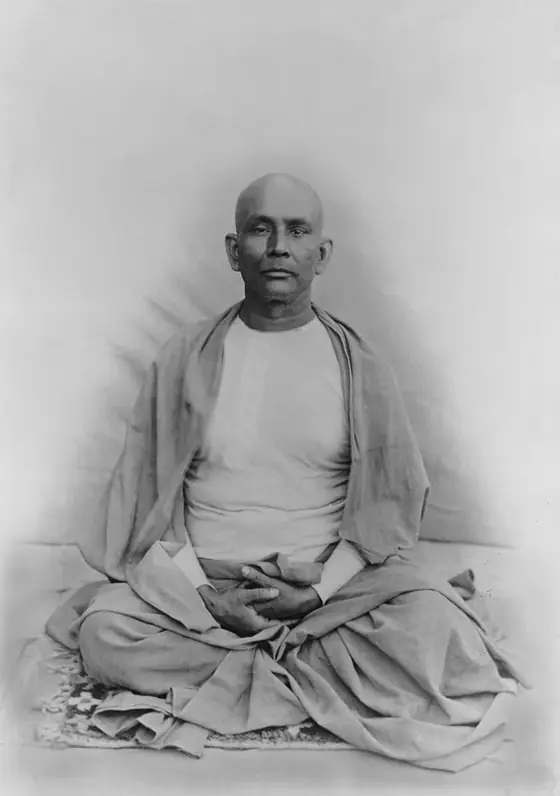
Photographs of Swami Turiyananda survive from his years in America and from India — the Vedanta Society of Northern California has two taken at Shanti Ashrama in 1900 and 1901. The portrait at the head of this page is a photograph from the Ramakrishna Order's archives, published under a free licence and credited on the picture credits page; it is not a painting or a generated image. Dates and places follow Belur Math's own account of his life; the account of his New York and Montclair work follows the Vedanta Society of New York's history of its ministers, which gives the Shanti Ashrama land as a hundred acres where Belur Math gives 160 — both figures are reported here. Belur Math does not give exact dates for his wandering years, and the map marks those places without them. Nangal, "about sixty miles below Hardwar", cannot be located precisely enough to pin and is named in the text. The maps are drawn on present-day coordinates, not from any historical source.
The timeline, plainly
- 3 January 1863 — born Harināth Chaṭṭopādhyāy, north Calcutta; orphaned young and raised by his elder brother.
- c. 1876–77 — aged thirteen or fourteen, first sees Sri Ramakrishna at a neighbour's house.
- c. 1879–80 — meets him at Dakṣiṇeśvar and becomes a regular visitor.
- 1887 — joins the Baranagore monastery, aged twenty-four; takes sannyāsa as Swami Turīyānanda.
- c. 1888–95 — the wandering years: Rajpur and Rishikesh with Swami Vivekananda; Meerut, Delhi; Bombay to Abu Road with him (1893); Vṛndāvan, Purī, Ujjain; Kedārnāth, Badrināth and Garhwal, where he memorises eight Upaniṣads; the United Provinces and Punjab with Swami Brahmananda.
- c. 1895–99 — trains the novices at Alambazar Math; public classes in north Calcutta.
- 1899 — sails with Swami Vivekananda; New York by the end of August; the Vedanta Society of New York and Montclair.
- 1900 — Los Angeles; the Shanti Ashrama land deeded to Swami Vivekananda in trust, 25 June; San Francisco, 26 July; sets out for the San Antone Valley with eight students, 2 August.
- 1901–02 — leaves the Ashrama exhausted and ill, September 1901; returns January 1902; Swami Vivekananda asks the Society to send him home, March 1902; sails in June.
- 1902 — returns to India to learn of Swami Vivekananda's death; leaves Belur for the north.
- c. 1902–10 — eight years of austerity at Vṛndāvan (with Swami Brahmananda), Garhmukteshwar, Uttarkāśī and Nangal; the Almora ashrama grows up around him and Swami Shivananda.
- 1914–15 — the Kankhal letter, 10 September 1914; the Almora conversations recorded by Swami Raghavananda, summer 1915.
- c. 1911 onward — diabetes begins; later the carbuncle operations, refused chloroform; gravely ill at Purī, where Swami Saradananda comes to him.
- c. 1919–22 — the last three and a half years at the Ramakrishna Mission Sevashrama, Vārāṇasī.
- 21 July 1922 — dies at Vārāṇasī, aged fifty-nine, reciting the Upaniṣads.
Read the originals
Primary texts and the records kept by the teacher's own institution.
- Belur Math — the Order’s own life of Swami Turiyananda
- Vedanta Society of Northern California — the history of Shanti Ashrama, with the dates and the students’ names
- Spiritual Treasures: Letters of Swami Turiyananda — translated and edited by Swami Chetanananda
- A letter from Kankhal, 10 September 1914 — “We think we are the doers”
- Conversations with Swami Turiyananda — the Almora talks of 1915, recorded by Swami Raghavananda; Vedanta Society of Southern California
- Vedanta Society of New York — its history of the swamis who led it, including his work in New York and Montclair
Every daily message names the teacher it came from. Read the messages, or see the whole line this teacher stands in: all fifty-one teachers.