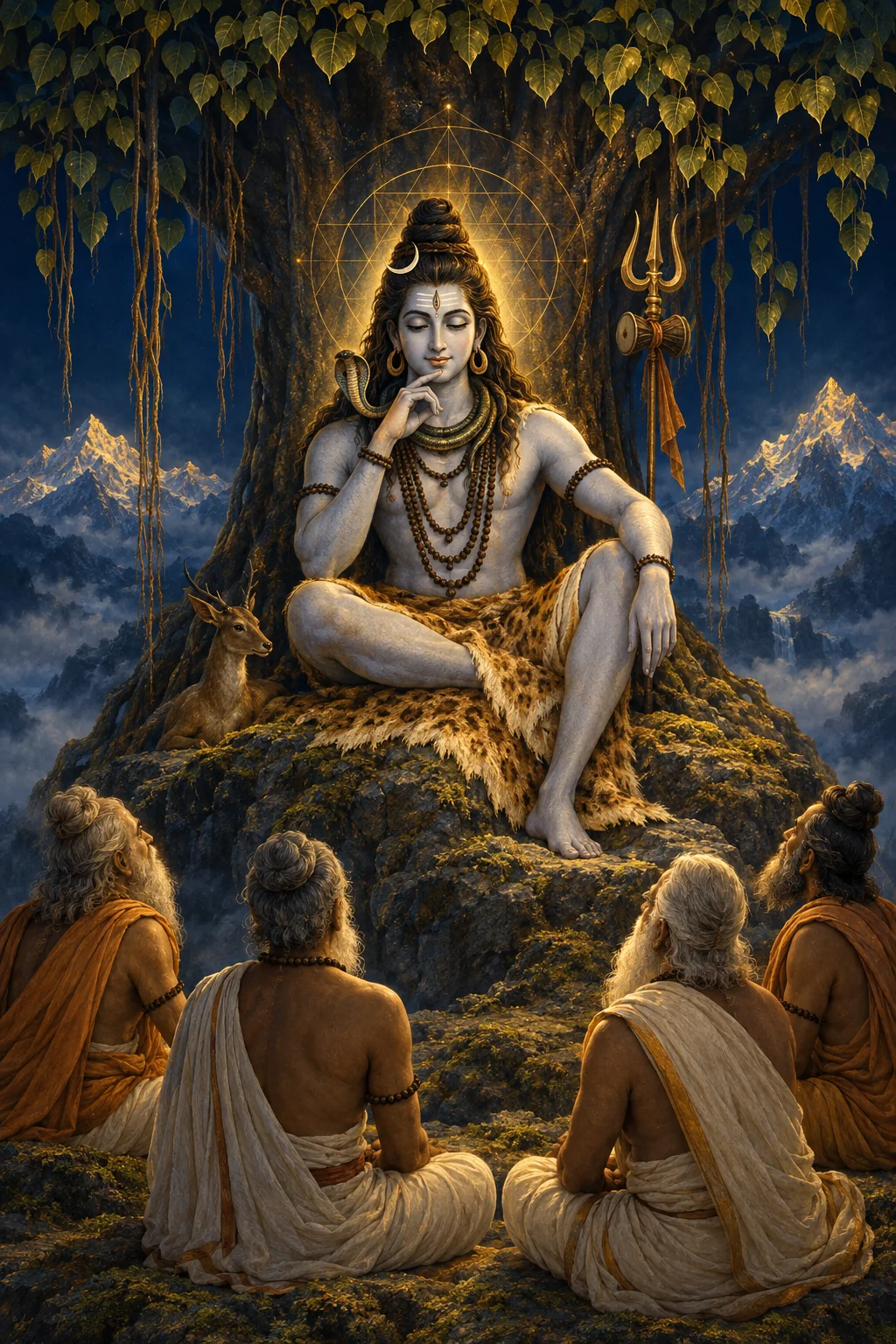
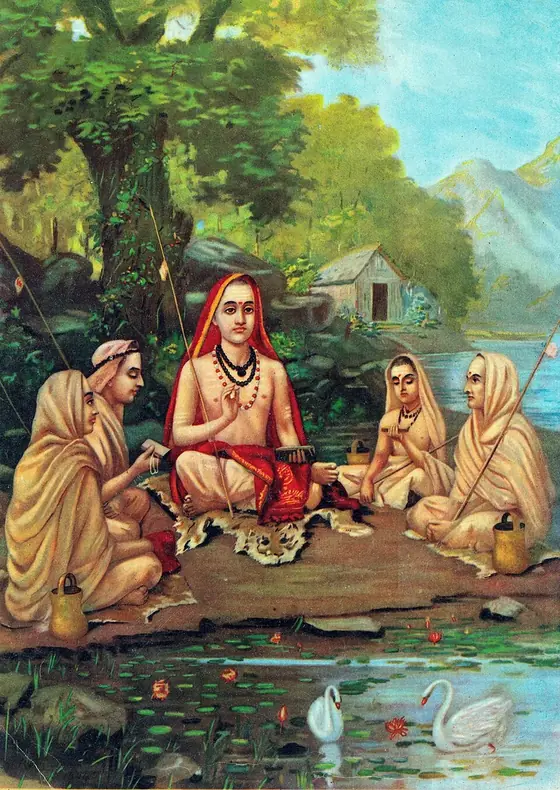
Adi Shankara
The pivotal exponent of Advaita Vedanta
c. 8th century CE · The Shankara Lineage
- When
- Traditionally 788–820, an active life of about sixteen years
- Born
- Kāladi, in present-day Kerala
- Where the life was lived
- Born in Kerala, by tradition at Kaladi; walked the length and breadth of India and founded monastic seats at its four corners — Śṛṅgeri in Karnataka, Purī in Odisha, Dvārakā in Gujarat and Badrinath in the Himalaya. He also settled priestly arrangements as far apart as Rameshwaram and Pashupatinath in Nepal.
- What is left of it
- Commentaries on the principal Upaniṣads, the Brahma Sūtras and the Bhagavad Gītā — together the Prasthānatrayī — along with Ātma Bodha, Vivekacūḍāmaṇi, Upadeśasāhasrī and hymns such as the Kanakadhārā Stotram.
Restated the whole Vedic teaching as one coherent position, debated its rivals in their own terms, established four monastic seats that still run, and left four disciples to head them.
A country arguing with itself
Picture a subcontinent in the eighth century with no shared school of thought and no shortage of confident ones. Buddhist universities were at the height of their intellectual reach. Jain logicians were formidable. Within the Vedic fold itself, ritualists held that the whole point of the scriptures was correct action, and that talk of liberation through knowledge was a distraction from the fire altar. There were sects organised around a single deity that regarded every other sect as mistaken, schools that argued the self was a momentary series with nothing continuous in it, and schools that argued there were countless separate selves each permanently sealed off from the others. All of them quoted texts. Many of them quoted the same texts.
Into that argument walked a man who, in about thirty-two years, restated the whole Vedic tradition as a single coherent position, wrote the commentaries that every later school of Vedanta would be obliged to answer, walked from one end of the country to the other to defend it in public debate, wrote hymns so simple that they are still sung by people who have never read a line of philosophy, and set up four monastic seats at the corners of India so that the work would outlive him. The Sringeri seat, which he established in the south, records his life as running from 788 to 820 of the common era, and has maintained an unbroken succession of teachers ever since.
His dates are genuinely contested. The Sringeri tradition gives the eighth to ninth century, which is also where most modern historians place him. Some of the other maṭhas preserve a far earlier dating. It is honest to say that the question is not settled from outside the traditions and that this site follows Sringeri, which is the seat whose records are most continuous.
Kaladi
He was born at Kaladi, a village on the bank of the Periyar river in what is now Kerala, to a Nambūdiri brahmin family. The accounts kept by the tradition agree on an unusual childhood: a boy who learned the Vedas early and fast, whose father died while he was very young, and who had decided on renunciation before he was ten.
The famous scene of his leaving is recorded in the traditional biography, the Śaṅkara Digvijaya, in the version preserved at Sringeri. The boy asks his mother for permission to renounce the world; she refuses, because he is her only child and her whole support. Some time later, bathing in the river, he is caught by a crocodile. He calls out that he is dying, and that if she will permit him to renounce he will at least die as a monk. She consents. The crocodile lets him go. Whatever one makes of the crocodile, the point the story is making about the boy is not subtle: he would not be managed.
He kept one promise, and it cost him. A monk is supposed to have no family obligations at all; he returned to Kaladi years later to perform his mother's final rites himself, and was censured for it by people who thought the rule mattered more than the mother. He did it anyway.
The teacher on the Narmadā
He went north, on foot, looking for a teacher. He found Govinda Bhagavatpāda on the bank of the Narmadā, and through him the line that runs back to Gauḍapāda — the first teacher we can name who set out this reading of the Upaniṣads in a systematic verse treatise. This matters for how the tradition understands itself. Śaṅkara does not present Advaita as his discovery. He presents it as what the Upaniṣads have always said, held by a succession of teachers, which he is restating because the statement has become obscured. The word for that succession is paramparā: not an appeal to authority so much as a claim about how this particular knowledge travels, which is person to person rather than book to reader.
From the Narmadā he went to Kashi, and it is around Kashi and Badari in the Himalaya that the tradition places the writing.
What he wrote, and how he argued
The core of the work is three commentaries: on the principal Upaniṣads, on the Bhagavad Gītā, and on the Brahma Sūtras. Sringeri names exactly these and calls them definitive. Together the three texts commented on are called the prasthāna-traya, the three points of departure, and after Śaṅkara no school of Vedanta could claim a hearing without commenting on all three. Rāmānuja did. Madhva did. Nimbārka did. They disagreed with him at length, and the fact that they had to structure their disagreement around his choice of texts is the measure of what he achieved.
The Brahma Sūtra commentary is the long one, and it is where the method is clearest. It is not a sermon. It is a legal argument. An opponent's position is stated fairly and at length, then answered from the texts and from reasoning, and the reader is left to judge. Whole sections exist only to demolish readings that nobody today has heard of. He is not writing to inspire. He is writing to close a loophole.
Underneath the argument there are a few moves that the rest of the tradition simply inherited.
The first is the distinction between what a text is trying to tell you and the picture it uses to tell you. Statements about the world are not descriptions of an independent reality to be catalogued; they are means of knowledge aimed at removing a specific error.
The second is the error in question. We do not begin life with a false belief we can find and correct. We begin with something more basic: a running confusion of the one who is aware with the thing being noticed — the body, the passing mood, the job title, the story about ourselves. Shankara's word for this mix-up is superimposition, and the standard illustration, so common in the tradition that it has become shorthand, is the rope taken for a snake at dusk. The fear is real. The sweating is real. The snake is not. And what removes the fear is not courage, and not a change in the rope, but light.
The third is his account of levels. He does not say the world is nothing. He says that as long as the mistake holds, the world behaves with complete regularity and the ordinary means of knowing it work perfectly well. Physics is not overturned; the fire still burns you. What is displaced is the assumption that the whole show, including the person you take yourself to be, is the final layer.
The fourth is how the teaching gets delivered. Knowledge, not effort. Practices do not manufacture what you are; they clear the interference well enough for a statement about it to land. Which is why his short manuals are structured the way they are: definitions first, distinctions second, and then a single sentence you are meant to sit with.
The walking
The tradition's picture of Śaṅkara is not of a scholar at a desk. Sringeri says plainly that he travelled the length and breadth of India on foot, and the geography of what he set up backs that up. He established four seats at the four directions: Śṛṅgeri in the south, Purī in the east, Dvārakā in the west, and the Jyotir seat at Badrinath in the north.
Then he did something that would be politically interesting in any century. He cross-posted the people. Sureśvara, from the north, went south to Śṛṅgeri. Toṭaka, from the south, went north to Badrinath. Sringeri's own record adds that he ordained that priests from Kerala should serve at Badrinath in the far north, brahmins from Karnataka at Paśupatinātha in Nepal, and priests from Maharashtra at Rāmeśvaram in the deep south. Read those four arrangements together and the intent is unmistakable: a country that had been arguing itself into fragments was to be stitched together by making each region's worship depend on another region's people.
What he was up against
Three kinds of resistance, and none of them trivial.
Outside the Vedic fold there were the Buddhist and Jain schools, at that point intellectually dominant in much of the country, with centuries of refined logic behind them. He engaged them directly and in detail.
Inside it there were the ritualists, who held that scripture exists to prescribe action, and that the knowledge sections at the end of the Veda were subordinate to it. This was the argument closest to home, and the tradition records it as personal as well as philosophical: he is said to have debated Maṇḍana Miśra, the most formidable exponent of that view, at length, and to have made a disciple of him. That disciple became Sureśvara and went to Śṛṅgeri.
And there was the ordinary human resistance of institutions to a young man in his twenties telling them they had missed the point. Consider also what a strictly non-dual teaching sounds like to anyone whose devotional life is the best thing in it — which brings us to the part of his output that is usually left out of the summaries.
The hymns
The same author wrote Bhaja Govindam, whose refrain is a plain instruction to worship; the Dakṣiṇāmūrti Stotram, addressed to Śiva as the teacher who teaches without speaking; and hymns to the Goddess, to the river Ganges, and to Annapūrṇā, the one who gives food. There is no inconsistency to resolve here, and the tradition never treated it as one. The arguments do a job that hymns cannot do: they close off wrong readings. The hymns do a job the arguments cannot do: they keep the enquiry warm, and they carry the teaching to people who will never read a commentary. Anyone who presents Advaita as cold has not read its founder's poetry.
The timeline, plainly
- Born at Kaladi, on the Periyar in present-day Kerala; the Sringeri tradition dates his life 788 to 820.
- Loses his father young; takes renunciation as a boy, against his mother's first refusal.
- Travels north and accepts Govinda Bhagavatpāda on the Narmadā as his teacher, in the line from Gauḍapāda.
- Writes the commentaries on the Upaniṣads, the Gītā and the Brahma Sūtras, together with the shorter manuals and the hymns.
- Debates across the country on foot, including the ritualist school on its own ground.
- Establishes four monastic seats at the four corners of India and installs his principal disciples across regions.
- Completes the work by about the age of thirty-two.
Why he still matters on an ordinary Tuesday
Two things, and neither of them requires any belief.
First, the method. He will not let you accept a conclusion you have not tested, and he will not let a technical term stand in for an experience. Every key move in his writing is put as an argument you are invited to attack. That is unusual in religious literature in any language, and it is the reason a sceptical reader can get further with Śaṅkara than with almost any devotional author.
Second, the diagnosis. His claim is that the trouble is not a shortage of achievements, health, money or approval, but a case of mistaken identity that no amount of those things can touch — which is why the next thing you get never settles it. You can check that against your own week. Notice how fast the relief from the last good thing wore off, and whether anything you have ever obtained stayed decisive. That observation is where his enquiry starts, and it does not ask you to take his word for anything.
Read the originals
Primary texts and the records kept by the teacher's own institution.
Every daily message names the teacher it came from. Read the messages, or see the whole line this teacher stands in: all fifty-one teachers.