Swami Sarvapriyananda
Minister, Vedanta Society of New York
Contemporary; a monk of the Order since 1994 · The Sri Ramakrishna Lineage
- When
- Contemporary. A monk of the Ramakrishna Order since 1994, with sannyāsa in 2004; Assistant Minister in Hollywood from December 2015; Minister of the Vedanta Society of New York since January 2017; Nagral Fellow at Harvard Divinity School, 2019–20. No institution of his Order has published his date of birth, and this page does not guess.
- Born
- Not stated. Neither the Ramakrishna Order nor the Vedanta Society gives a birthplace or a birth year, and he has not given one in any recording this page draws on; the year and the state formerly shown here came from unofficial websites that disagree with one another, and have been removed. By his own account he grew up near an ashrama of the Order, in a family attached to it.
- Where the life was lived
- Belur Math from 1994: the novitiate, then the Order’s school at Deoghar, its teachers’ college and university at Belur, and about eight years as ācārya of the probationers’ training centre. Hollywood from December 2015. New York, at 34 West 71st Street, since January 2017. Cambridge, Massachusetts, in 2019–20. Toronto in 2018 and Geneva in 2025 for the public forums; Portland, Dublin and Belur Math for the Order’s own occasions.
- What is left of it
- Mahavakya: The Essence of Vedanta (2025); Fullness & Emptiness: Vedanta and Buddhism (2025); Vedanta in Practice: Conversations; From Illusion to Infinity; Dakshinamurti Stotram: Reflections; Mind & Consciousness: Conversations; Moments of Awakening; Vedanta Yapan 1, in Bengali; papers in Prabuddha Bharata (January 2020) and the Vedanta Kesari (January 2023); and the Society’s archive of several hundred recorded classes on the Upaniṣads, the Gītā, Sri Gauḍapāda and Sri Śaṅkara.
Has made the Advaita texts followable by a worldwide audience with no Sanskrit, teaching them alongside the modern philosophy of mind; has spoken at Harvard, at the 2018 Parliament of the World’s Religions in Toronto, and, by the United Nations’ own record, at its Geneva offices in 2025.
The man
Swami Sarvapriyananda is the one living teacher on this site, and the page about him is built differently for that reason. He is a monk of the Ramakrishna Order and, in the words of the Society he leads, “has been the Minister and spiritual leader of the Vedanta Society of New York since January 2017” — the Society that Swami Vivekananda founded in 1894, the first of its kind in the West. He joined the Order in 1994, took his final vows in 2004, spent most of the next decade teaching in the Order's schools, its college for teachers and its own training centre for new monks at Belur Math, and came to America at the end of 2015. Within a few years his recorded classes on the Upaniṣads, the Bhagavad-gītā, the Māṇḍūkya Kārikā and the Dṛg-Dṛśya-Viveka had found an audience that no Advaita teacher before him had reached, and had drawn him into public conversation with philosophers of mind, physicists and the leaders of other faiths.
The Society describes his teaching as “rigorous yet accessible, weaving classical Vedantic texts with contemporary questions about identity, ethics, suffering, attention, and the nature of experience”, and says that his work “is guided by a single central inquiry: “What am I?”” That is a fair description of what a reader will find below. What a reader will not find is anything about his birth, his family or his life before the Order beyond what he has said of it himself in public, because no institution he belongs to has published those things, and this site does not fill such gaps from unofficial sources. The pages on the other teachers of the Sri Ramakrishna lineage on this site — Swami Vivekananda, Swami Turiyananda, Swami Abhedananda, Swami Nikhilananda and Swami Ranganathananda — are the background to this one, and each is linked where it is needed.
The sources for this page, and what each can bear
Because the subject is alive and teaching, every fact on this page comes from an institution that speaks for him or from his own published or recorded words, and each is named where it is used. The Vedanta Society of New York's page on its resident minister and its media kit are the Society's own account of his career, and they are cautious documents: they give the year he joined, the year of his vows, the posts he held and the year he came to New York, and they give no birth date, no birthplace and no name other than his monastic one. Belur Math's page on the New York Society confirms the appointment. A flyer of the Order's own university, for a webinar of July 2020, carries a short official biography that names his posts in India more exactly than the New York page does.
Two documents let him speak of his own life. On 4 November 2019 he was one of three Hindu monastics who spoke about their journeys at Harvard's Center for the Study of World Religions, and on 11 March 2020 he gave the opening lecture of an evening on “Vedanta in the 21st Century” at Harvard Divinity School. Harvard published a video of each, with a transcript. The transcripts were made by machine: they mis-hear proper names (his own name is once rendered “Savapriyananda”, and “Shankaracharya” and “Vivekananda” are both garbled once), they do not label the speakers, and they record laughter and inaudible words in square brackets. This page quotes from his lecture in each, where the speaker is not in doubt, and from three of his answers in the discussion that followed, where what is said — that the speaker taught novice monks for eight years, that he has lived in Hollywood, Manhattan and Harvard, that he had not been to school in twenty-five years — identifies him. Where a machine mis-hearing would have fallen inside a quotation it has either been avoided or restored, and every restoration is listed in the closing note.
For his teaching in his own written words there are three texts. The Ramakrishna Vedanta Centre in Dublin carries his essay Fighting Anxiety and Depression: Four Great Vedantic Practices, posted on 13 January 2025 and evidently written during the pandemic; the Dublin page does not say where the essay first appeared, and this page does not guess. The January 2023 Vedanta Kesari, the Order's English monthly from Chennai, carries the first part of his paper Chandrakirti's Chariot: Self in Madhyamaka Buddhism and Advaita Vedanta, which ends “To be continued”; the continuation has not been found on the journal's site and is not quoted. His paper Consciousness and Self in Advaita Vedanta in the January 2020 Prabuddha Bharata is cited by name only, because the issue could not be opened. His books are listed from the publishers' own pages. Nothing on this page comes from an encyclopaedia, a fan site, a news report or a video platform.
A word on what is missing. Third-party websites give a birth year, a birthplace and a birth name for him, and they do not agree with one another. None of those details appears on any page of the Ramakrishna Order or the Vedanta Society, and he has not, in the recordings this page draws on, given them himself. They are therefore left out, and the short card for him on this site, which once carried a birth year and a birthplace taken from such sources, has been corrected to match this page.
Where the life was lived
Two maps, because the life has two halves. The first shows India: Belur Math on the Hooghly, the headquarters of the Order, where he trained, took his vows, taught the probationers and served the Order's university, and Deoghar in the hills of what is now Jharkhand, where the Order's Vidyapith school stands and where he was vice-principal. The second shows the world he has lived and taught in since December 2015: Hollywood, New York, Cambridge in Massachusetts, Toronto and Geneva, with the ringed pin on New York, where he is based today.
Present-day coastlines; no border but India’s is drawn. Every pin is a claim and the caption says whose. Belur Math is where the Order’s university and the Society place his training, his sannyāsa and his teaching posts; Deoghar is the Order’s school where he was Vice-Principal; Gangotri is where, by his own account, he sat with the sadhu who taught the Aṣṭāvakra. His birthplace is not pinned, because no institution of his Order has published it, and this page does not guess. The places outside India are on the world map below.
- 1Belur Math, on the Ganges above Calcutta (West Bengal) — Headquarters of the Ramakrishna Math and Mission: joined the Order in 1994; the two years of intensive study of the Upaniṣads, the Brahma-sūtra and the Gītā as a novice; sannyāsa in 2004; Principal of the Shikshana Mandira and first Registrar of the Vivekananda University here; then ācārya of the monastic probationers’ training centre for about eight years
- 2Deoghar, in the Santhal Parganas (Jharkhand) — The Ramakrishna Mission Vidyapith, the Order’s school, where he was Vice-Principal of the higher secondary school (the Order’s university, 2020; Harvard’s introduction, 2019)
- 3Gangotri, at the source of the Ganges (Uttarakhand) — Where, by his own account, an old Punjabi sadhu taught the Aṣṭāvakra Saṃhitā to visiting monks of the Order for half an hour each evening, some fifteen years before the pandemic essay in which he tells the story
The ringed pin marks where he is based today. Coastlines only; no borders. Each pin is a place named by the Society, Harvard, the Parliament or the United Nations, as the page beside it says.
- 1Kolkata — Belur Math: joined the Order in 1994, sannyāsa 2004; taught the probationers here for about eight years
- 2Hollywood, Los Angeles — Assistant Minister, Vedanta Society of Southern California, from December 2015
- 3New York — Minister of the Vedanta Society of New York since January 2017 — currently based here
- 4Cambridge, Massachusetts — Harvard Divinity School: Nagral Fellow, 2019–20
- 5Toronto — the Parliament of the World’s Religions, November 2018
- 6Geneva — Palais Wilson: keynote at the OHCHR peer-learning dialogue, 25 August 2025 (the United Nations concept note)
Nothing before 1994 is placed on either map. He has said in public that he grew up close to one of the Order's ashramas and that his parents and grandparents were associated with it, and he has said no more than that; no institution has published his birthplace, and a pin without a source would be a guess.
Growing up near an ashrama: the early life in his own words
At Harvard in November 2019 he was asked, with two other monastics, to speak about his own path. He began, as he usually does, with Swami Vivekananda — the Parliament of 1893, the return to India, the founding of the Order — and then, without warning, arrived at himself:
“And one of them was close to the place I lived when I was growing up. So my parents were— and my grandparents were closely associated with this tradition. And I used to go to the ashram which was close to our house.”
The order in question had, he said, “about 180 centers now”. He went on:
“And I grew up, maybe the last generation before internet and cable TV. And so I grew up reading a lot of books. And a lot of books in the house were literature written by Swami Vivekananda. And then what appealed to me was, is this really true, that god really does exist, self-realization is actually possible, and I can do it? Too and so that sort of— I really hoped it was true because I really wanted to do that.”
Then the monks themselves, seen by a schoolboy:
“And even when I was a little schoolboy, I always felt that this is what I should do in life. I didn’t know too much about monasticism. But as I kept on visiting the monastery, I began to understand. Looking at these monks, I felt, wait a minute. These people, they’re not— I mean, my parents, they have jobs, and money, and the house, and cars, and a family, and people, and things to do in life. And these people have nothing, none of these. And they are so happy. And they are at peace. So that really attracted me.”
That is the whole of what he has said in public, in the recordings this page draws on, about his childhood: a house near an ashrama of the Order, a family attached to it, a great many books, and a boy who wanted to know whether what Swami Vivekananda wrote was true. The region, the town, the family's name and occupations, his own name and his date of birth are not there, and they are not here.
The decision, and a question from a man in his nineties
He did not go straight from school to the monastery. By his own account he was in the middle of a management degree when the decision came, and the Order sent him back to finish it:
“At one point, I decided I am going to become a monk. I was doing my MBA.” … “I had become initiated into a mantra in this order by my guru, Swami Bhuteshananda-ji, who was the 12th president of our order. And I had sort of— halfway through my MBA, I’d gone to the main monastery, asking, can I become a monk? And he very gently— he was in his 90s. He very gently said, what are you doing now? I said, I am studying. How long will it take to complete? Is it over? He said— I had to say, no, it’s one year. One more year is there. And very, very, very gently, he said, is it good to give up something halfway?”
Swami Bhuteshananda was the twelfth President of the Ramakrishna Math and Mission, and Belur Math's archive holds his photographs. The young man took the old President's advice: “So I did go back and finished my studies. And then I became a monk in the order.” The remark that follows in the transcript — “A lot of people, at least some people want to become monks just before exams, you know?” — is the nearest he comes, in any source this page has read, to describing the temptation he was spared.
Speaking in the same discussion about the hundreds of young men whose motives he later examined as their teacher, he divided them into those who had always wanted the life and those who “were in school and college, just like everybody else, and then suddenly made a decision”, and added a saying of Sri Ramakrishna that he plainly applies to himself:
“Shri Ramakrishna used to say, whatever brings you to spiritual life, not just monastic life, spiritual life, it’s like taking a bath into the holy river Ganga. You may get ready, and put on your swimming clothes, and go into the river. Or somebody may push you in, or you will slip and fall into it. The result is you get wet.”
Belur Math, 1994: twenty-six bells in twenty-four hours
The official biographies agree on the dates. He “joined the Ramakrishna Math and Mission in 1994 and received sannyas, his full monastic life, in 2004”, as Harvard's host put it in introducing him; the Society's own words are that “He joined the Ramakrishna Math in 1994 and received sannyasa in 2004”. Between the two dates lies the long novitiate of the Order, which he described at Harvard with some affection:
“So in our order, to become a monk, one spends 10 years, or nine to 10 years, as a novice. You’d be dressed in white. And you have the sacred tuft of hair and the sacred thread.” … “And two years is spent in intensive training. And we study Vedanta intensively, the Upanishads, the Brahma Sutra, the Bhagavad Gita, with the commentaries of Shankaracharya and some other commentaries too.” “Plus, we study other philosophical texts, the introductions to the orthodox systems of philosophy, samkhya, and yoga, and all of that, And world philosophy, other religions, at least an acquaintance with other religions.”
The day at the training centre began early. “3:40 in the morning, the bell would ring. And believe me, you heard it.” The novices, he said, “counted. We had 26 bells in 24 hours. And the most disliked one was the one at 10:30 PM, which told you to go to sleep.” He told the story of the novice who hid the bell, and of the resourceful brother whose duty it was to ring it, “so he took out a big steel plate and a steel cup and banged it all over the monastery, which was worse, actually”.
What he says he found attractive in the Order is worth setting down in full, because it explains the teacher he became. First, freedom of reading:
“One is this beautiful balance of discipline and freedom. For example— and it’s important to me— there are no banned books. So I can read books of every tradition, whatever.” “I remember one of the first things that I asked one monk— when I joined the order, I went to the library. And I found this nice collection of PG Wodehouse.” … “I asked, can I read PG Wodehouse as a monk? I was a new monk. And the monk said something very interesting. He said, of course. You can read anything you want. But if I find you reading PG Wodehouse all the time, then there’s something wrong with you.”
Second, the harmony of religions, which he traced to the founder: “absolutely no criticism of other religions, Shri Ramakrishna said, as many faiths, so many paths to god”; and, he added, “not like an ivory tower separation from religions, but actually, learn from other religions and enrich our own spiritual path”. Third, an openness to the values of the modern world, for which his example was that “we have a separate order for women. Swami Vivekananda thought about it more than 100 years ago”. And fourth, the service that Swami Vivekananda made part of monastic life against, he said, “a lot of resistance from traditional, non-dualistic monks at that time” — a change so complete that a Śaṅkarācārya of one of the ancient seats, visiting Belur Math when he was a novice, asked the monks how such service could be started in his own tradition.
Sannyāsa, 2004, and the years as a teacher of teachers
He took his final vows in 2004, ten years after joining, which is the Order's usual span. Of the years that followed, the Society in New York says only that he “served as an acharya (teacher) of the monastic probationers’ training center at Belur Math, India. He also served in various capacities in different educational institutes of the Ramakrishna Mission in India”. The Order's university, in the biography on its 2020 flyer, is more exact:
“Before being posted to the VSSC’s Hollywood Temple, Swami served as an acharya (teacher) of the monastic probationers’ training center at Belur Math. He has served the Ramakrishna Math and Mission in various capacities including being the Vice Principal of the Deoghar Vidyapith Higher Secondary School, Principal of the Shikshana Mandira Teacher Education College at Belur Math, and the first Registrar of the Vivekananda University at Belur Math.”
Harvard's host in 2019 gave the same list — “being a vice-principal of the Deoghar Vidyapith Higher Secondary School, principal of the Shikshana Mandira Teacher Education College at Belur Math itself, and indeed, the first registrar of the Vivekananda University at Belur Math” — and added a detail that shows how small the world of the Order is: “We had a speaker here a few weeks ago from Bengal, who turned out to have been a student when Swami was there as the registrar.” The Vidyapith is the Order's school at Deoghar, in what is now Jharkhand, where his predecessor in New York, Swami Tathagatananda, had also served as a young monk; the Shikshana Mandira is the Order's college for the training of teachers at Belur; and the Vivekananda University is now the Ramakrishna Mission Vivekananda Educational and Research Institute, a deemed university whose Vice-Chancellor, the same flyer records, took charge in 2005, so that the registrarship falls in the years around his sannyāsa. None of the sources gives the dates of the three posts, and this page does not supply them.
The post that he speaks of most is the last in India. Harvard's host described it as that of “an acarya, teacher of the Monastic Probationers Training Center at Belur Math, the very headquarters of the Ramakrishna order”, and in the 2019 discussion he gave its length himself: “I’ve actually taught monastic novices for about eight years, so hundreds of young men who want to become monks.” It was the same training he had been through — the two intensive years on the Upaniṣads, the Brahma-sūtra and the Gītā with Sri Śaṅkara's commentaries — and the habits of the classroom that the world later saw on video were formed there, on novices, in Bengali and English, at Belur Math.
One glimpse of those years survives in his own writing. In the essay on the four practices he recalls “an incident that happened 15 years ago in Gangotri in the Himalayas at the height of 10,000 feet from sea-level. There we met an old Punjabi Sadhu, who would teach Ashtavakra Samhita to the monks, including some of us, from evening 4.00 to 4.30.” The story of what the old sadhu said is told below, in its place; what matters here is the picture of a young monk of the Order, some fifteen years before the pandemic, sitting on the ground at the source of the Ganges to be taught the Aṣṭāvakra Saṃhitā by a sadhu of no order at all. In the same discussion at Harvard he summed up the range of his monastic life before America: “I have lived in a monastery on the bank of the Ganga. I have lived teaching students in dorms and hostels. I have lived on mountain tops, actually, not literally in a cave, but in a hut, begging for my food, actually sleeping under a tree in the Himalayan mountainsides. And I have lived in Hollywood, Manhattan, and Harvard.”
Hollywood, December 2015
He came to the West at the end of 2015, to the Vedanta Society of Southern California and its temple in Hollywood. The New York page says only that he served “as the Assistant Minister of the Vedanta Society of Southern California”; Harvard's host in 2019 gave the dates: “he first served as assistant minister at The Vedanta Society of Southern California for 13 months, beginning in December of 2015”. (The host of the 2020 evening said “a number of months, about a year”; the two are the same period described twice.) The Southern California Society's own contact page still carries the notice it posted when he left: “Swami Sarvapriyananda no longer resides with us in Los Angeles, and is now the minister of the Vedanta Society in New York.”
It was in Hollywood that the recorded teaching began in earnest. Belur Math's media archive lists a twelve-class series in which, it says, “Swami Sarvapriyananda lucidly unfolds the fundamentals of Advaita Vedanta presented in” the Dṛg-Dṛśya-Viveka, “An Inquiry into the Nature of the Seer and the Seen”, and that “These talks were delivered at the Vedanta Temple in Hollywood, California, USA.” The Dṛg-Dṛśya-Viveka, a short text of forty-six verses on the distinction between the seer and the seen that the tradition attributes to Sri Bhāratī Tīrtha or Sri Vidyāraṇya, was a characteristic choice: a beginner's text, taught line by line, with the assumption that a general audience could follow a real argument if it was made carefully. The same archive page records the volume of questions that the classes produced and the arrangement he made to answer them in recorded sessions rather than by letter.
New York, January 2017: the Society Swami Vivekananda founded
The Vedanta Society of New York is, in its own words, “the Order’s first Center started by Swami Vivekananda, in 1894”; Belur Math's directory says the same: “This Vedanta Society, the first of its kind in the USA, was started by Swami Vivekananda in 1894. Swami Sarvapriyananda is the Minister-in-charge of this affiliate of the Ramakrishna Math.” Its history page traces the Society's homes from “two rented rooms at 54 West 33rd Street in Manhattan” through a dozen addresses to 34 West 71st Street, acquired in 1921, where it has been ever since, and lists the four ministers who have served there: Swami Bodhananda, Swami Pavitrananda, Swami Tathagatananda and Swami Sarvapriyananda. The Society's page on its ministers names seven before him — Swami Vivekananda himself, Swami Saradananda, Swami Abhedananda, Swami Turiyananda, Swami Bodhananda, Swami Pavitrananda and Swami Tathagatananda — and calls Swami Pavitrananda “the Sixth Resident Swami and Minister of Vedanta Society of New York”; by that count he is the eighth. His immediate predecessor had served the Society, the page says, “for nearly four decades” and died on 25 June 2016.
He took up the post in January 2017. His own description of the work, given at Harvard in 2019, is the plainest statement on record of what a Vedanta Society in America is for:
“Here, our service activity is basically teaching. Teaching, very interesting. The whole idea— there’s no idea of conversion, that you have to be converted from Christianity or Judaism into Hinduism. Absolutely nothing.” “I’m in that center, the first Vedanta Society, 125 years it’s been running there. And if today, somebody comes and asks me, I want to be converted into something else, I wouldn’t have the first idea to do.” … “So the idea is to teach these principles of harmony and high spirituality, and let people broaden their approach to spiritual life.”
The teaching took the form it had taken in Hollywood, multiplied. The Society's lecture archive is organised, on its own site, into introductory lectures, lectures on the scriptures — the Gītā, the Upaniṣads, the Gospel of Sri Ramakrishna — lectures by topic, and several hundred short recorded answers to questions; the page describing his books adds that he “has also contributed essays and research papers on the Upanishads, the Bhagavad Gita, and the philosophy of consciousness”. Of the audience the Society says that “his talks are extremely popular globally via the internet”; the concept note for a United Nations dialogue in 2025, discussed below, put a figure on it, describing him as a monk “with his YouTube channel having close to 50 million views”. That figure is the note's, not this site's, and it will be out of date by the time it is read.
Harvard, 2019–20: the Nagral Fellow
The Society records that “During 2019-2020 he was a Nagral Fellow at the Harvard Divinity School”, and both Harvard evenings this page draws on fall within that year. He spoke of it, when asked in November 2019 what had surprised him, with the candour of a man who had spent a quarter of a century on the other side of the lectern:
“Everything surprised me. I haven’t been to school in the last 25 years. And that was back in India. And here I am, at Harvard of all places.” … “One thing I did was, when I was in the United States, I made it a point to take every opportunity to visit university campuses. I never got to come to Harvard earlier, but other campuses. And I used to think that these are the temples of the United States. These are magnificent institutions.” … “I love libraries. So the Widener Library, they were telling me it’s the largest academic library in the whole world. The company of extraordinarily smart people, both teachers and students, from all over the world, that is something.”
The fellowship also produced the one sustained statement of his own position that exists in a transcript, the lecture of 11 March 2020, given a few days before the university closed for the pandemic. The next four sections follow it.
Not faith, and not mystical experience: the path of knowledge
He began the Harvard Divinity School lecture by saying what Advaita is not. The first thing it is not is the kind of religion a divinity school studies:
“Religion, the kind of religion we are most familiar with, and most of us we study here at the Divinity School, is faith based. So you are told by your tradition, by your books, by your teachers that God exists, and if you believe in God and surrender to God, and there are devotional practices. But notice, all of that is based on faith.” … “The only problem with this approach is it’s vulnerable to skepticism. It always has been, and especially in today’s age.”
The second thing it is not is a religion of extraordinary experience, though he was careful to say that the experience-based approach was “what made Swami Vivekananda so popular when he came to this country in the late 19th century to a land which thought of religion as faith”. Its weakness is different: such experiences can be dismissed as neurological, and, more simply, most people never have them.
“Advaita Vedanta often is confused with this, but it is not a path of mystical experience. Now, let me be clear. I am being too strict here. There is the room for faith in Advaita Vedanta. There is a room for mystical experience in Advaita Vedanta, but I want to get to the heart of Advaita Vedanta.” … “What is it a path of? It’s a path of knowledge.” … “What Advaita Vedanta says— not mystical experience, not faith, but take up experiences which are common to all of us. We all have these experiences. What experiences? Waking, dreaming, deep sleep.” … “But these are experiences we all have, every day, and that’s all that is needed for Advaita Vedanta.”
This is the teaching of the Māṇḍūkya Upaniṣad and Sri Gauḍapāda's Kārikā on it, which he has taught more often than any other text, put into a sentence: the evidence for the Self is not a vision granted to a few but the three states that every person passes through every day. He guarded the claim at once against the obvious misreading: “I am not saying Advaita says you can argue your way to God. Not that kind. But reason is it takes you to the very verge, after which there is an intuitive jump that has to occur.” And he summed up: “So this is Advaita Vedanta at its heart. Not a path of believing something. Not a path of seeking extraordinary mystical experiences, but a path of spiritual, philosophical inquiry.”
Not a journey in space, not a journey in time
The second movement of the Harvard lecture is the one that listeners most often carry away, and it is built on the advertising hoardings of American highways:
“The journey in Advaita Vedanta is not a journey in space. You are not going from here to there. Sometimes I see, driving around the United States, you find these huge posters— heaven is a place. Call 1-800, something like that. Now, what does that mean? It’s very interesting. It’s a place. That means it’s not this place. It’s that place, and you have to go there. Advaita Vedanta is not a journey in place. The Brahman which you are speaking about, the absolute reality, it’s there everywhere, it’s there here, and there too.”
“It’s not a journey in time. Again, some of the billboards will say after death— very ominous, big letters. After death, you will see God. Call 1-800, something, something. But what’s interesting is after. After is a time word. Not now, then. So you have to wait through time.” … “That reality which we are, which Advaita Vedanta is trying to point out about ourselves is a reality now, and then, and every when. All the time.”
“It’s not a journey from us to something else. The reality which Advaita Vedanta speaks about is not an other. Not something different from you. It’s our own reality. Not as we know ourselves because Advaita Vedanta claims that we are terribly, terribly mistaken about ourselves. Swami Vivekananda would often say, if only you knew yourselves as you really are.”
He said he was translating, as he spoke, a formula he had learned from the Hindi-speaking teachers of Advaita in India — not a journey in space, not a journey in time, not a journey from one object to another — and he gave the positive half of it in a single line: “What kind of spiritual journey does Advaita Vedanta speak about? It’s a journey from ignorance to knowledge. What kind of ignorance? Ignorance about our real nature.” A reader who has followed the pages on Sri Śaṅkara and Sri Gauḍapāda on this site will recognise the doctrine of the Brahma-sūtra commentary that liberation is not produced, reached, modified or purified but only known; what is new is the billboard.
The hard problem, and the first question of the Kena Upaniṣad
The third movement turned to the study of consciousness, which he has made his particular ground in conversation with philosophers of mind. He began by separating two kinds of inquiry:
“What is going on in our brain is correlated to our conscious experiences. So I feel a pin prick, maybe, a pain. And the brain scientist looks at what neurons are firing in my brain, and correlates, oh, those firing of those neurons is causing this pain. So it’s a science of correlations.” … “There is another kind. The hard problem of consciousness. How is it that we— all of us, sentient beings— have this inner movie playing within our heads all the time? Sights, and sounds, and smells, and touch, and thought.”
Of the popular articles announcing that consciousness had been explained he said, “I always call those articles consciousness explained away.” Then he did what he does in most of his classes: he set the modern question beside the ancient one and let the listener see that they are the same question.
“The Kena Upanishad, which we chant at the beginning, the first verse starts with impelled by what? Do our minds think? What is it? What shining do we see, do our eyes see, do our tongue speak? What is that one thing which gives us all these first-person experiences? See, the question of the hard problem of consciousness, which has been formulated or reformulated in our times by David Chalmers, thousands of years ago, this very question— the Upanishad begins with this question. Advaita begins with this question, and ends with its answer.”
The illustration that followed was a self-driving car turning the same corner as the listener's: everything the listener does, the machine also does, “but there’s something going on in your car, which is not going on there”. He was careful to note that “none of them ever claims that the machines are conscious in any sense that we use”, referring to the engineers across the street. The argument is the Upaniṣad's, but the choice of example is characteristic: he does not ask a modern audience to leave its world at the door.
“That”-centred and self-centred religions: a grand unified theory
The fourth movement is the boldest and, on his own admission, only an outline. It rests on the great sentence tat tvam asi, “That thou art”, and on the observation that the two words divide the religions of the world:
“There are the that centered religions. That centered means God centered religions. And Christianity, Islam, Judaism, Vaishnavism, Shaktism, Shaivism. These are basically God centered religions. There is a God. There is the self-oriented or self inquiry based religions. Buddhism comes to mind. Yoga comes to mind. Sankhya comes to mind. Jainism comes to mind.”
Each kind, he said, has a difficulty of its own. Of the God-centred: “God is fine, but the question is does God exist? That’s the whole question.” Of the self-centred: “Nobody doubts, including Descartes, that whether I exist or not. There’s a certainty about that. But the problem with the self-inquiry based approach is our existence is certain, but that’s the problem. Our certain existence is surrounded by suffering and sorrow.” And then the sentence on which the whole lecture turns:
“What Advaita Vedanta does is it relates the two. Our certain existence is shown to be infinite by the process of Advaita inquiry.”
Nothing in this is a claim of superiority over the religions named; the God-centred faiths are called, a few minutes earlier, “a very beautiful approach, and it’s the most common approach”, and the listener is told to read Dawkins and Hitchens as a cure for fanaticism. It is an account of where the great sentence sits among the ways human beings have sought freedom, offered in the spirit in which Sri Ramakrishna, whose saying he quoted at Harvard the previous autumn, held that as many faiths, so many paths.
Four practices for a time of crisis
His essay Fighting Anxiety and Depression: Four Great Vedantic Practices, written in the first months of the pandemic and carried by the Order's Dublin centre, is the longest piece of his own prose on the practical side of the teaching that this page has been able to read in full. It opens with a defence of the very idea of practising in a crisis — “Let us not forget that the Bhagavadgita was taught to Arjuna, not on a mountaintop or in an ashram. It was in the midst of a great crisis, on the battlefield” — and with a Buddhist image, which is characteristic of him:
“Lord Buddha speaks of the nature of suffering as a person who is hit by an arrow. Imagine the pain and shock of being hit by an arrow. And immediately after that, this unfortunate person is hit by a second arrow. The first arrow is what the world throws at us—coronavirus, pain, suffering, disease, disruption in life, and the like. And the second arrow is, our internal reaction to what is happening.” … “But the real suffering is the reaction that we have inside.”
The first practice is knowledge, “the path of Jnana of Advaita Vedanta, that is, an enquiry into the Self”. The enquiry is conducted on the reader's own experience of the pandemic: the same awareness that knew the ordinary life knows the disrupted one. “Are we aware of a mind that was free of depression? Yes. Are we aware of the mind in which there is depression and anxiety? Yes. So, that which comes and goes is not inextricably tied to ‘I’—the awareness which I call ‘this consciousness’.” He then brings in three verses of the Aṣṭāvakra Gītā, which he quotes in Sanskrit and translates, and which give the essay its central image. The first:
“मय्यनन्तमहाम्भोधौ विश्वपोत इतस्ततः । भ्रमति स्वान्तवातेन न ममास्त्यसहिष्णुता ॥ In me, the boundless ocean, the ark of the universe moves hither and thither impelled by the wind of its own inherent nature. I am not impatient. (7.1)”
His comment: “Notice that I am the ocean and this whole world with all lives is like a little boat in me. It is not that I am like a little spark in a vast and uncaring universe. Rather the whole universe appears in my consciousness.” The second verse makes the world a wave rather than a boat — “In me, the limitless ocean, let the wave of the world rise or vanish by itself. I neither increase nor decrease thereby. (7.2)” — and the third makes it less than a wave: “In me, the boundless ocean is the imagination of the universe. I am quite tranquil and formless. In this alone do I abide. (7.3)” He sets out the three as steps: “(i) The world appears to be awareness or consciousness. (ii) At a deeper level, the world appears in you, the consciousness. (iii) The world is nothing but you, the consciousness.”
To the first practice he attaches Sri Gauḍapāda's teaching that waking and dream are alike: “Gaudapada calls deep sleep to be actual sleep, and both waking and dreaming as the dream state! According to him, both waking and dreaming are to be called a dream. Then what is real waking? Real waking is becoming aware of the fact that ‘I am turiya, the fourth—that pure consciousness, which is the underlying shining Reality’.” And he insists on the practicality of it: “People may say it is theoretical, but it is the most practical. It gives peace, strength, and joy immediately.”
The second practice is devotion, introduced with a saying of Swami Turiyananda that he plainly loves: “Swami Turiyananda once said: ‘ “I am Brahman” —Vivekananda could say that. It does not come so easily to us. So I say, “Nahum-Tuhum; not I, but Thou my lord”.’” The essay refuses to choose between the two: “They are actually not contradictory but even if they were, so what? One can hold on to both.” For the devotional practice itself he quotes the Nārada Bhakti Sūtra, “devotees, being free from all cares and worries, should always worship the Lord alone with all their hearts”, and an old verse on the single dot that separates cintā, worry, from citā, the funeral pyre: “The worry burns one while living; while the funeral fire burns the dead body.”
The third practice is meditation, taken from Sri Patañjali and reduced to one principle: “the nature of the mind is such that it can think of only one thing at a time”. Hence, “for deep meditation, for prayer, and for being centred in God, all that we need to do is to take care of that one instant and one thought”. Sri Ramakrishna's dyer, who gives the cloth whatever colour it is dipped in, is the parable he attaches to it. The fourth practice is service, and for it he quotes his own senior in the Order, Swami Ranganathananda, the thirteenth President:
“‘What is spirituality? When I close my eyes I find peace within. When I open my eyes my attitude is, what can I do for you?’”
The essay closes with the four in a list — the knowledge that I am Brahman; the devotion that says not I but Thou; one thing at a time; the welfare of others before my own — and the promise that “These four great practices will definitely ennoble us and make our minds full of light and joy.” Nothing in it is new; that is its point. It is the four yogas of Swami Vivekananda, which the emblem of the Order was designed to hold together, applied to a locked-down world by a man who had taught them to novices for eight years.
“When do you go to a fire?”: the Gangotri sadhu
Two passages of the same essay say more about his manner as a teacher than any description could. The first answers the objection that Advaita is a fair-weather philosophy:
“Advaita Vedanta is not an intellectual game or a clever philosophy that we indulge in once a week when everything else is fine. If it is so, when things are disturbed and we are under stress and anxiety, we will have no time for it. No. Not at all. That is the time for Advaita. When do you go to a fire? Do you go to a fire thinking, ‘Let me first become warm; then I will go near a fire’? No. It is only when you are cold that you really need the fire. In the same way, we need Advaita when we are suffering.”
The second is the memory of Gangotri already mentioned: the old Punjabi sadhu who taught the Aṣṭāvakra Saṃhitā to the visiting monks of the Order for half an hour each evening, and who one day looked down at them and said:
“‘O Swamis! These verses of the Ashtavakra, are weapons. ’You are armed with a sword; the enemy comes and gives you a couple of slaps and you come back weeping. What is the fun in that?’”
And his own gloss: “Truly, we are armed with this knowledge, this great insight into our real Self. The enemies of fear, anxiety, terror, and depression—they beat us up and we weep helplessly. No. We are not helpless. We are heavily armed against these enemies.” The sadhu is not named and the year is given only as about fifteen years before the essay; the story is told here as he tells it.
Madhyamaka and Advaita: Candrakīrti's chariot
His most academic published work is the paper on the self in Madhyamaka Buddhism and Advaita, of which the first part appeared in the Vedanta Kesari for January 2023. It shows a side of him that the recorded classes only hint at: a reader of Nāgārjuna, Candrakīrti, Tsongkhapa and Mipham in translation, who takes the Buddhist critique of the self seriously enough to state it at length before answering it. He opens by placing the two schools side by side without ranking them:
“Madhyamaka Buddhism and Advaita Vedanta are among the most important developments of over two millennia of Buddhist and Hindu philosophy. In common with other such systems (darsanas), both are soteriological, aiming to overcome suffering. The understandings to which they come about the ultimate nature of the suffering self are sharply different and yet, eerily similar.”
He insists, before the argument begins, on the ethical purpose of the Buddhist dialectic — “Teachings on the emptiness of the self are given not for the sake of philosophical disputation but for removing the suffering of sentient beings.” “The motive is compassion, not winning debates.” — and then sets out Candrakīrti's sevenfold reasoning on the chariot, by which a self that exists in its own right is shown to be neither the same as the body-mind aggregates nor different from them, neither containing them nor contained by them, neither their possessor, nor their collection, nor their shape. The first alternative, he notes, “would be the view of the dualistic Hindu schools like Nyaya, Vaisesika and Sankhya”; and in a parenthesis that is the hinge of the whole paper he separates his own school from them: the Vaiśeṣika and Sāṃkhya reify the instinct of an inner self into “sophisticated Atman theories (Advaita is usually, and incorrectly, lumped in the same category)”.
The part that has been published ends with Candrakīrti's warning that disproving a philosopher's permanent self does not by itself loosen the ordinary grip of “I” and “mine” — “one might as well see a nest of snakes and try to find safety in the thought ‘There are no elephants, so there is no cause of fear!’” — and with the words “(To be continued...)”. The promised second and third parts, the Madhyamaka examination of the Advaitic Ātman and the comparison of the two, have not been found on the journal's site, and this page does not anticipate their conclusions. What can be said is that the same ground is covered, for a general reader, in his small book Fullness & Emptiness: Vedanta and Buddhism, published by the Ramakrishna Math in Chennai in 2025, whose publisher's description promises to show “how these paths lead to the highest truth”.
The public forums: Toronto, Geneva, and the philosophers of mind
The Society's summary of his public life is that he “has played a prominent role in organizing and participating in various interfaith panels and seminars, including speaking at the World Parliament of Religions in Toronto in 2018, and at the United Nations Headquarters in New York”. The first of these is documented by the Parliament itself. Announcing twelve new keynote speakers for its seventh meeting, held in Toronto from 1 to 7 November 2018, the Parliament of the World's Religions wrote:
“Honoring the legacy of Swami Vivekananda at the Parliament of the World’s Religions is the eminent Swami Sarvapriyananda, who travels from the Vedanta Society in New York–first established by Swami Vivekananda after his engagement at the 1893 Parliament. Swami Sarvapriyananda will speak in the Parliament’s Anniversary Banquet.”
The second needs a note. The Society says New York; the one United Nations document this site has found places him in Geneva. The concept note for a “Peer-learning Dialogue on “Diversity as Strength: A Human Rights Imperative””, held on “Monday, 25 August 2025” and “Hosted by: Office of the High Commissioner for Human Rights (OHCHR)” with the Dharma Alliance and Globethics as partners, names as its “Keynote Speaker: Swami Sarvapriyananda, Minister and Spiritual Leader, Vedanta Society of New York”, at the “OHCHR Offices (Palais Wilson meeting room 1.016, Rue des Pâquis 52, Geneva)”. The two statements are not in conflict — a man may speak at both — but this page has found the document for Geneva and not for New York, and it reports both as it found them. Geneva is on the map above for that reason.
The conversations with philosophers and scientists are the part of his public work that the Society describes most fully. Its media kit says that he “has participated in long-form dialogues with leading thinkers in the philosophy of mind and consciousness studies, including David Chalmers and Bernardo Kastrup, exploring questions of consciousness, idealism, and the limits of purely physicalist explanations of reality”, and that “In 2025, Swami Sarvapriyananda contributed to cross-disciplinary discussion on consciousness alongside Blaise Agüera y Arcas, a vice president and fellow at Google and CTO of Technology & Society, and Carlo Rovelli, a theoretical physicist known for his work in quantum gravity.” The resident minister's page adds Rupert Spira, Rick Archer and Sam Harris to the list of interlocutors, and the Society's conversations page gathers the recordings, including one with Professor Chalmers under the title of his book Reality Plus. The media kit also records “programs connected with the 60th anniversary of Nostra Aetate, the landmark Vatican II declaration on relations between the Catholic Church and non-Christian religions”. The claims that he “has been a speaker on various prestigious forums such as TEDx, SAND, Google Talk etc.” are the Society's and are repeated by the United Nations note and by Duke University Chapel, which in listing his talk on “Authentic Existence” for 2026 called him “A scholar of Hindu scriptures” who “has lectured at TEDx, Google Talk, Harvard University, World Parliament of Religions, and other institutions”; this site has not itself examined those recordings and lists them as reported.
Within the Order: Belur Math, Portland, Dublin
He remains, through all of this, a monk under obedience, and the Order's own records show him at its work. The Order's university invited him to an international webinar on ““CONSCIOUSNESS STUDIES AND RESEARCH: ANCIENT AND MODERN”” on 30 July 2020, held with the Centre for Consciousness Studies of the National Institute of Mental Health and Neurosciences in Bangalore. Advaita Ashrama, the Order's publishing house, announced a public conversation between him and the production editor of Prabuddha Bharata at its Kolkata house on 12 March 2022, in its series of talks with the journal's authors. Belur Math's media archive lists, under his name, a speech to the Bhava Prachar Parishads convention of December 2023, a Vedanta retreat in Dublin in November 2024, and a retreat with the Dublin centre's anniversary celebration in June 2025.
In the autumn of 2025 the archive records two more. The Vedanta Society of Portland “celebrated its Centenary on October 6, 2025, marking one hundred years of the Vedanta Movement in the Pacific Northwest. To commemorate this milestone, a three-day celebration of worship, music, and spiritual discourse was organized, featuring the esteemed Swami Sarvapriyananda.” He gave, the report says, “a public lecture on “The Light of Lights”” on the Saturday evening, at Taborspace, which the report describes as a local Presbyterian church, a day-long retreat on the Sunday, and on the centenary day a lecture on ““Ideal Guru-Disciple Relationship” at the Hindu Temple, Tigard”. A month later he was at headquarters: Belur Math records a “Speech অনন্তের পথে at Belur Math by Swami Sarvapriyananda, Minister-in-Charge, Vedanta Society of New York, USA, on 12 November 2025”. The Bengali title may be rendered “On the path of the infinite”, and the thirty-three photographs the archive holds of the occasion show a monk of the Order addressing his own community in his own language, which is a side of him the English-speaking internet does not see.
The books
For most of his time in New York the teaching existed only as recordings; the books are recent, and most are made from the talks. The Society's list of his books gives seven titles: Mahavakya: The Essence of Vedanta; Fullness & Emptiness: Vedanta and Buddhism; Vedanta in Practice: Conversations (the resident minister's page calls the same book Conversations on Vedanta in Practice and describes it as “a curated collection of question and answer sessions with the Swami, on topics of practical importance”); From Illusion to Infinity: Discovering the Self; Dakshinamurti Stotram: Reflections, on Sri Śaṅkara's hymn to the silent teacher; Mind & Consciousness: Conversations; and Moments of Awakening: Vedantic Stories That Stir the Soul.
Two of these are described by the Order's publishers. Mahavakya, published in 2025, is a study of the four great sentences based, its publisher says, on the fifth chapter of Sri Vidyāraṇya's Pañcadaśī; it “explores Prajñānam Brahma, Vedic hermeneutics, implied meanings, and the synthesis of Tat and Tvam approaches for spiritual realization” — the same synthesis of the “That” and the “thou” that the Harvard lecture sketched in a sentence. Fullness & Emptiness, published by the Ramakrishna Math in Chennai in 2025 in ninety-four pages, “addresses the Buddha’s central teachings, the concept of Pūrṇam (Supreme Fullness), and Śūnyam (Emptiness), illustrating how these paths lead to the highest truth”. There is also a Bengali book, Vedanta Yapan 1, roughly “Living Vedanta”, published by the Udbodhan Karyalaya in Kolkata in 189 pages.
Of his papers, the Society says that he “has also contributed essays and research papers on the Upanishads, the Bhagavad Gita, and the philosophy of consciousness”. Two can be named: Consciousness and Self in Advaita Vedanta, in the January 2020 Prabuddha Bharata, the Order's English monthly that Swami Vivekananda founded, which this page cites by title because the issue could not be opened; and the Vedanta Kesari paper on Candrakīrti described above. As for the recordings, the Society's own lecture archive lists more than four hundred lectures on the scriptures, more than a hundred by topic, and more than four hundred and fifty short recorded answers to questions, besides the introductory series.
A timeline
- Before 1994 — Grows up near an ashrama of the Ramakrishna Order, in a family attached to it, reading Swami Vivekananda; initiated by Swami Bhuteshananda, twelfth President of the Order; decides during a management degree to become a monk and is told to finish it first (his own account, Harvard, 2019). No official source gives his date or place of birth.
- 1994 — Joins the Ramakrishna Math and Mission (Vedanta Society of New York; the Order's university).
- 1994–2004 — The novitiate: white cloth, two years of intensive study of the Upaniṣads, the Brahma-sūtra and the Gītā with Sri Śaṅkara's commentaries at Belur Math, twenty-six bells a day (his own account).
- 2004 — Sannyāsa (Vedanta Society of New York; the Order's university).
- After 2004 — Vice-Principal of the Deoghar Vidyapith Higher Secondary School; Principal of the Shikshana Mandira Teacher Education College at Belur Math; first Registrar of the Vivekananda University at Belur Math; then, for about eight years by his own reckoning, ācārya of the monastic probationers' training centre at Belur Math (the Order's university; Harvard introductions). Dates of the posts not published.
- c. 2005–10 — Taught the Aṣṭāvakra Saṃhitā at Gangotri by an old Punjabi sadhu, “15 years ago” as of the pandemic essay.
- December 2015 — Assistant Minister, Vedanta Society of Southern California, Hollywood, for thirteen months (Harvard introduction, 2019); the Dṛg-Dṛśya-Viveka classes recorded there (Belur Math media archive).
- January 2017 — Minister and spiritual leader of the Vedanta Society of New York, the eighth by the Society's count, in succession to Swami Tathagatananda, who died in June 2016.
- 1–7 November 2018 — Keynote speaker at the seventh Parliament of the World's Religions, Toronto, at its anniversary banquet (the Parliament's announcement).
- 2019–20 — Nagral Fellow, Harvard Divinity School. 4 November 2019: speaks on his own path at the Center for the Study of World Religions. 11 March 2020: lecture “Vedanta in the 21st Century”.
- January 2020 — Consciousness and Self in Advaita Vedanta, Prabuddha Bharata.
- 2020 — The pandemic essay on the four practices (carried by the Dublin centre, 2025). 30 July: webinar of the Order's university with NIMHANS on consciousness studies.
- 12 March 2022 — Public conversation at Advaita Ashrama, Kolkata, in the Prabuddha Bharata authors' series.
- January 2023 — Chandrakirti's Chariot, part one, Vedanta Kesari. December: speech to the Bhava Prachar Parishads convention (Belur Math media archive).
- November 2024, June 2025 — Retreats at the Ramakrishna Vedanta Centre, Dublin (Belur Math media archive).
- 2025 — Mahavakya (Advaita Ashrama) and Fullness & Emptiness (Ramakrishna Math, Chennai) published; discussion on consciousness with Blaise Agüera y Arcas and Carlo Rovelli (media kit); 25 August: keynote at the OHCHR peer-learning dialogue, Palais Wilson, Geneva (UN concept note); 4–6 October: centenary of the Vedanta Society of Portland; 12 November: speech “অনন্তের পথে” at Belur Math.
- 2026 — Talk on “Authentic Existence” at Goodson Chapel, Duke University, presented by the Vedanta Society of North Carolina (Duke Chapel's announcement).
Questions a reader may have
When and where was he born? This page does not say, because no page of the Ramakrishna Order or the Vedanta Society says, and he has not said it in any recording this page draws on. Websites that give a year and a town do not agree with one another. The card for him on this site once carried a year and a state taken from such sources; both have been removed.
What did he do before he became a monk? By his own account he was studying for an MBA when he decided to join the Order, and he finished the degree on the advice of Swami Bhuteshananda before entering in 1994. Whether he worked between the degree and the monastery he has not said, and the description of him elsewhere as a former management professional is not supported by anything official.
Is he a guru who gives initiation? This page does not say. Who gives spiritual initiation in the Ramakrishna Order, and on what terms, is a matter for the Order, and this site does not speak for it.
What is his lineage? He is a monk of the Ramakrishna Order, which Swami Vivekananda founded in the name of Sri Ramakrishna, and his own initiation, by his account, was from Swami Bhuteshananda, the Order's twelfth President. The Society describes him as teaching “the nondual philosophy of Advaita Vedanta in the lineage of Sri Ramakrishna and Swami Vivekananda”. He holds none of the seats of Sri Śaṅkara's tradition and claims none; the page on Swami Vivekananda describes the Order he belongs to.
Does he belittle other schools or faiths? Not in anything this page has read. He told Harvard that “all religions are valid, and all religions are true and deserve respect” and that one should “learn from other religions and enrich our own spiritual path”; the Harvard lecture calls the God-centred faiths beautiful before it says where Advaita differs; the Madhyamaka paper states the Buddhist case at length and with evident respect before the comparison begins. He does distinguish Advaita sharply from the dualist schools of Nyāya, Vaiśeṣika and Sāṃkhya on the nature of the self, as every Advaitin since Sri Śaṅkara has.
Why is there so little here about his personal life? Because he is alive, because his institutions have published nothing about it, and because this site's rule for every teacher is to say only what a named, authentic source says. For the dead, that rule produces long pages; for the living, it produces a page about the teaching, which is where he himself directs attention.
Where should a beginner start? With what he started with: the Dṛg-Dṛśya-Viveka classes, then the Māṇḍūkya Upaniṣad with Sri Gauḍapāda's Kārikā. Of the books, Mahavakya is the fullest statement and Vedanta in Practice the easiest. The essay on the four practices, linked above, can be read in twenty minutes and is the best short introduction to his manner.
A note on the picture, the name and the dates
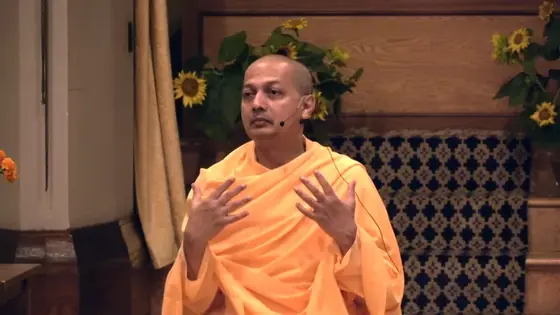
The photograph at the head of this page shows him teaching. It was released by its photographer, Subhobrata Chakravorti, under a Creative Commons Attribution-ShareAlike licence, and is used under that licence with the credit recorded on this site's credits page; the date it was taken is not stated in the release. The Vedanta Society's own media kit offers photographs for public use, and this site has not used them only because their terms are stated for event organisers rather than for websites; if the Society or the photographer objects to the picture used, it will be replaced. His name is given as his institutions give it, Swami Sarvapriyananda, without diacritical marks; with them it would be Sarvapriyānanda, and he does not use them himself. The card for him on this site formerly gave a birth year, a birthplace and a former profession; none is supported by an official source, and all three have been removed from the card and are absent from this page. Every date that remains — 1994, 2004, December 2015, January 2017, 2019–20, and the dates of the public events — is from the Order, the Society, Harvard, the Parliament, the United Nations or Duke, as named beside it.
Quotations. Every quotation on this page is verbatim from the source named beside it, and each was checked by machine against the text of the source before publication. The two Harvard lectures exist only as machine-generated transcripts of the video recordings, in which the speakers are not labelled and proper names are sometimes mis-heard; passages have been used only where the content shows who is speaking, and where the machine mis-heard a proper name it has been restored, as follows: “Shankararcharya” to “Shankaracharya” (the Harvard Center for the Study of World Religions transcript, 4 November 2019); “Vivekandana” to “Vivekananda” (the Harvard Center for the Study of World Religions transcript, 4 November 2019). The bold and italic markers that the web pages carry around some words are not reproduced, and one mark of emphasis that ran into a sentence on the Southern California page has been dropped. Nothing else has been altered, including the sources' own spelling, capitalisation and punctuation; where a source misprint would have fallen inside a quotation, the quotation has been cut short instead, and where the transcript wanders, the quotation stops.
Read the originals
Primary texts and the records kept by the teacher's own institution.
- The Vedanta Society of New York — Resident Minister: the Society’s own account of him and of the seven ministers before him, from Swami Vivekananda to Swami Tathagatananda; the first source for this page
- The Vedanta Society of New York — media kit: the Society’s biography and description of his public work, including the dialogues on consciousness and the Nostra Aetate programmes
- The Vedanta Society of New York — history: the Society founded by Swami Vivekananda in November 1894, and its house at 34 West 71st Street since 1921
- The Vedanta Society of New York — his books: the Society’s list of the seven titles
- The Vedanta Society of New York — conversations and lectures: the recordings themselves, including the dialogues with David Chalmers and others, and the archive of several hundred classes on the scriptures
- Belur Math — the Vedanta Society of New York: the Order’s own page on its oldest centre in the West
- Belur Math media archive — Swami Sarvapriyananda: the Order’s photographs and notices of his speech at Belur Math in November 2025, the Portland centenary, the Dublin retreats, the Bhava Prachar convention and the Hollywood classes on the Dṛg-Dṛśya-Viveka
- Harvard Divinity School, 19 March 2020 — “Vedanta in the 21st Century”: the video and machine-generated transcript of his Nagral Fellow lecture of 11 March 2020, from which the account of his teaching on this page is quoted
- Harvard Center for the Study of World Religions, 4 November 2019 — “Being Hindu, Being Monastic: Personal Journeys”: the video and machine-generated transcript in which he tells the story of his own path; the source for the early life on this page
- Parliament of the World’s Religions — the announcement of the keynote speakers for the 2018 Parliament in Toronto, naming him for the anniversary banquet
- Ramakrishna Mission Vivekananda Educational and Research Institute — flyer for the webinar of 30 July 2020 on consciousness studies, with the Order’s own summary of his posts before New York
- United Nations (OHCHR) — concept note for the peer-learning dialogue “Diversity as Strength” at Palais Wilson, Geneva, 25 August 2025, naming him as keynote speaker
- Vedanta Society of Southern California — contact page, with the notice that he no longer resides at the Hollywood temple
- Duke University Chapel — the listing for his talk “Authentic Existence”, presented by the Vedanta Society of North Carolina
- Advaita Ashrama — Mahavakya: The Essence of Vedanta (2025), the publisher’s page
- Advaita Ashrama — Fullness & Emptiness: Vedanta and Buddhism (Ramakrishna Math, Chennai, 2025), the publisher’s page
- Advaita Ashrama — Vedanta Yapan 1 (Udbodhan Karyalaya), the Bengali book
- Advaita Ashrama — the announcement of the public conversation with him at the Kolkata house, 12 March 2022
- Ramakrishna Vedanta Centre, Dublin — “Fighting Anxiety and Depression: Four Great Vedantic Practices”, the essay quoted at length on this page
- The Vedanta Kesari, January 2023 — “Chandrakirti’s Chariot: Self in Madhyamaka Buddhism and Advaita Vedanta”, part one, on the Ramakrishna Math’s own site
- Advaita Ashrama — talks and lectures in audio, including his
Every daily message names the teacher it came from. Read the messages, or see the whole line this teacher stands in: all fifty-one teachers.