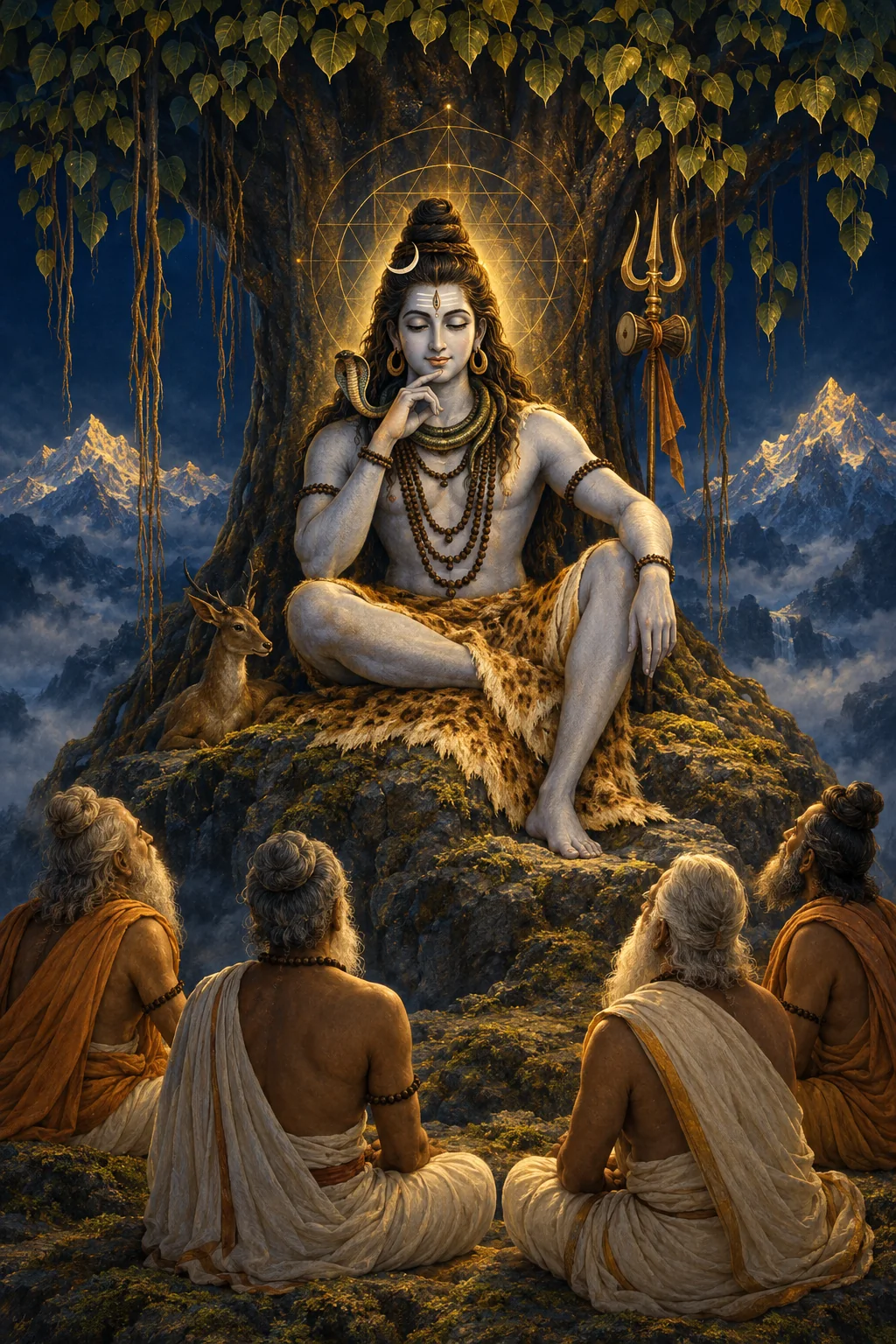
Swami Satchidānandendra Saraswatī
Founder of the Adhyātma Prakāśa Kāryālaya, Holenarasipur
1880–1975 · The Sri Shankara Lineage
- When
- 5 January 1880 – 5 August 1975
- Born
- Chikkamagalur, Mysore State (now Karnataka), at his mother’s family home; named Subrahmanya and called Subbaraya; son of Nanjundaiah, the village record-keeper of Yellambalase in Kadur taluk, and Lakshmi Devi; one of seven surviving children of sixteen, in a Smārta Brahmin family
- Where the life was lived
- The Malnad towns of the old Mysore State as a schoolboy; Bangalore as a student; twenty years of postings as a schoolmaster, 1903–23, at Jagalur, Holalkere, Molakalmuru, Hosadurga, Davanagere, Bangalore, Madhugiri and Chennapatna; Kalady in 1910 and Dharwad in 1911 for the commentaries; Gondavale for the Rāma mantra; Bangalore 1917–37 as teacher, lecturer and founder of the Kāryālaya; Holenarasipur from 1937, where he took sannyāsa in the Hemāvatī in 1948 and where his samādhi is; Mysore, Nasik, Madurai and Karaikudi for lectures and visits; Bangalore again in the last years, where he died.
- What is left of it
- The Kannada translations of Sri Śaṅkara’s commentaries on the Upaniṣads, the Gītā and the Brahma-sūtras; Mūlāvidyā-nirāsaḥ (1929); Śaṅkara-siddhānta; Māṇḍūkya-rahasya-vivṛtiḥ (1958); Vedānta-prakriyā-pratyabhijñā (1964), in English as The Method of the Vedanta (1989); Kleśāpahāriṇī on the Naiṣkarmya-siddhi; Essays on Vedanta, Salient Features of Sankara’s Vedanta and Misconceptions About Sankara (1973) in English; the monthly Adhyātma Prakāśa since 1923; the Kāryālaya at Holenarasipur, with branches at Bangalore, Mysore, Mattur and Rayadurga.
Made the case, in detail and against the scholarly consensus of his day, that Sri Śaṅkara should be read on his own terms.
The man
He was a village schoolmaster in the Mysore State who taught arithmetic and Kannada grammar to children for thirty years on a salary that began at twelve rupees a month, and who, in the evenings of those years, read the commentaries of Sri Śaṅkara so closely that he came to believe the whole learned tradition that claimed to expound them had misread them at the root. He printed his first Sanskrit book on a press he bought himself, at the age of forty-nine. He founded, in a rented house in Bangalore in 1920, “without any pomp, any inauguration”, a small institution for publishing Vedānta in his mother tongue, and lived long enough to see it become one of the most productive Vedānta presses in India. He was offered the headship of a monastery and lost it because he was a widower and not a lifelong celibate. He took sannyāsa at sixty-eight, in the Hemāvatī river at Holenarasipur, and in the twenty-seven years left to him wrote or edited, his tradition says, more than two hundred books in Kannada, Sanskrit and English. He died in Bangalore in August 1975, in his ninety-sixth year, having lived for his last month on a cup of milk a day.
Swami Satchidānandendra Saraswatī — Yellambalase Subbaraya, or Subrahmanya Sharma, for the first sixty-eight years of his life — belongs on this site because he is the one teacher in the modern history of Advaita Vedānta whose whole work was a question of method. Sri Ramaṇa taught by silence and Swami Vivekananda by fire; he taught by reading. His claim, put as simply as he put it himself, was that Sri Śaṅkara had one way of leading a student to the truth — deliberately attributing to the Self what does not belong to it, and then, when the student had understood, taking the attribution back — and that this way had been buried, within two or three centuries of Sri Śaṅkara’s death, under a scaffolding of technical theories which the commentators built to defend him and which ended by hiding him. The most famous of those theories, the doctrine of a “root ignorance,” mūlāvidyā, standing as a positive something between the soul and Brahman, he attacked in 1929 in a Sanskrit book whose title is its thesis, Mūlāvidyā-nirāsaḥ, the refutation of root ignorance, and he spent the rest of his life defending the attack.
The reader should know at the outset that this made him controversial, and that his tradition’s account of him — on which this page overwhelmingly depends, because it is the only detailed life that exists — is the account of disciples who think he was right. The page will report their view, report what is recorded of the other side, and, in a section of its own, leave the argument where the sources leave it: open. What is not in doubt is the life. It was a life of extraordinary steadiness, lived in small towns, on small salaries, in a language that most of the world’s Vedānta scholarship cannot read, and it produced, in the judgement of the leading German student of Sri Śaṅkara in the last century, some of the most “sharp-sighted” observations on that teacher’s doctrine made in modern times.
The sources, and how this page uses them
Three kinds of record survive. The first, and by far the fullest, is the life written by his foremost disciple. Veda Brahma Sri H. S. Lakshminarasimha Murthy (1928–2007) came to Holenarasipur in 1947 as a boy of nineteen to study the three great commentaries at his teacher’s feet, and stayed, in one capacity or another, for the rest of his life; his Kannada biography, Sri Gurucharitāmṛta, was published by the Kāryālaya in 1997, and an English translation by Smt. Savithri Devaraj followed in 2008 under the title Sri Sri Satchidanandendra Saraswathi: Life History and His Contributions to Shankara Vedanta. It is a disciple’s book, and it says so: the author writes in his first chapter that “reading about the Guru’s life history is as important as reading the spiritual works of the Guru”. But it is also, unusually for its genre, a book that disclaims wonders. “Such a life history bereft of miracles and useless clutter, though simple and elegant, will nourish, enthuse and prepare the reader’s mind for Vedantic study.” And its author is explicit about his source: “All instances narrated here are historic episodes and were narrated personally by Swamiji himself.” Where this page says “the biography says,” it means this book, and the reader should remember that its facts are, at one remove, the subject’s own recollection in old age.
The second is his own writing in English, which is considerable and which the Kāryālaya and the Internet Archive have put online: the English introduction to his Sanskrit magnum opus, published separately in 1964 as How to Recognize the Method of Vedanta; the Essays on Vedanta; Misconceptions About Sankara, the last book he wrote, dated at Bangalore on 24 October 1973 when he was ninety-three and going blind; and the “Appeal to Thoughtful Vedantins” of 1962 with his editorial replies, which the biography prints as an appendix. These are quoted here as the man’s own voice, and they are the only place on this page where the argument is put in his words rather than his disciples’. The Sanskrit Vedānta-prakriyā-pratyabhijñā itself is available in the English translation of A. J. Alston, The Method of the Vedanta (London, 1989), a book of nearly a thousand pages which is on the Internet Archive with a public-domain dedication; the translator’s preface is used for the outside estimate of him.
The third is the institutional record: the Kāryālaya’s own website, which gives the outline of the life in a paragraph; its centenary appeal of 2019–20; a short English life by D. B. Gangolli, An Advent of Adi Sankaracharya in Our Own Times, published for his birthday in January 1997, which is frankly devotional and is used only for what it reports of others’ opinions; and the publishers’ notes bound into the books. These give the dates and the tradition’s estimate of him.
Nothing on this page is invented. Every passage in quotation marks is copied from one of these sources and can be checked against it through the links at the foot of the page. The English biography and the Kāryālaya’s books have been read from scanned copies in which the machine occasionally misread a letter — “ofa” for “of a,” “Inistaking” for “mistaking”; where the printed word is obvious it has been restored in the quotations, and nothing else has been altered. Where the sources differ — and on his age at death, the year he moved to Holenarasipur and the number of his books, they do — both versions are given.
Where the life was lived
The map is the old Mysore State and the Bombay Karnatak: one language, Kannada, and a triangle perhaps two hundred miles on a side. He was born at Chikkamagalur, under the coffee hills of the Western Ghats, into a family whose village was Yellambalase, near Kadur; he went to school at Mudigere, Chikkamagalur, Tarikere and Hassan; he studied at Bangalore; and for thirty years he taught in the small towns of the Chitradurga and Tumkur districts — Jagalur, Holalkere, Molakalmuru, Hosadurga, Davanagere, Madhugiri — and in Bangalore. The two places outside the triangle that mattered most were both visited for a few days: Kalady in Kerala, Sri Śaṅkara’s birthplace, in 1910, and Gondavale in the Maratha country, where he received a mantra. His Vedānta teacher lived at Dharwad and then Bangalore; his printing was done at Mysore. From 1937 the life has one centre, Holenarasipur on the Hemāvatī in Hassan district, where the Kāryālaya stands and where he is buried, and from 1969 a second, the Bangalore branch at Thyagarajanagar, where he died.
Present-day coastlines; no border but India’s is drawn. Numbered pins are places named in the Kāryālaya’s biography of him and in Gangolli’s life; the dotted line joins the main stations of the life in order — the Malnad, the schoolmaster’s postings, Kalady in 1910, Dharwad, Bangalore, Holenarasipur from 1937, the southern journey of 1958, and Bangalore again at the end — and is not a surveyed route. Yellambalase, the family village, is pinned at its taluk town, Kadur. The Malnad school towns of his boyhood — Mudigere, Tarikere, Shimoga, Hassan — and the smaller postings of 1903–23 — Jagalur, Molakalmuru, Hosadurga, Madhugiri, Chennapatna — lie too close together for so small a map and are named in the text. No journey outside India is recorded.
- 1Chikkamagalur (Karnataka) — Born Monday 5 January 1880 at his mother’s family home, Hosamane, in the town; schooling here in 1891 and again at the high school from 1897, where V. Subramanya Iyer read him Sri Śaṅkara’s Gītā commentary
- 2Kadur (Yellambalase) (Karnataka) — Yellambalase, the family village where his father Nanjundaiah was the record-keeper, lies in Kadur taluk and is pinned here at the taluk town; his first job, as town overseer at Kadur on twelve rupees a month
- 3Holalkere (Karnataka) — Postings in the Chitradurga country, including 1906–09, after Jagalur, his first school in 1903; his son Narasappa born here in November 1907
- 4Davanagere (Karnataka) — Schoolmaster from 1909; the death of his father, the Kannada grammar Padatraya, the first English booklets; the years of the Gondavale mantra
- 5Bangalore (Karnataka) — Central College as a student; the Fort Anglo-Vernacular school and the Normal School; the study of the commentaries with Hanagal Virupaksha Shastry from 1917; the Kāryālaya founded 1920; lecturer at the Chamarajendra Sanskrit College from January 1923; the branch at Thyagarajanagar from 1969 and the hall opened 18 December 1974; died here 5 August 1975
- 6Kalady (Kerala) — Sri Śaṅkara’s birthplace; 1910, the consecration of the new temple, where the Sringeri Jagadguru Sri Śivābhinava Nṛsiṁha Bhāratī initiated him into the study of the commentaries
- 7Dharwad (Karnataka) — 1911: the Brahma-sūtra and Gītā commentaries begun with Hanagal Virupaksha Shastry during a school holiday
- 8Gondavale (Maharashtra) — About 1912: the Rāma mantra received from Sri Brahmachaitanya Maharaj, which he kept all his life
- 9Nasik (Maharashtra) — 1933: the religious conference under the Shankaracharya of Karavira, where he read “Conquest of Fear”
- 10Holenarasipur (Karnataka) — His home from April 1937 and the Kāryālaya’s from 1938; sannyāsa at the Hemāvatī, 10 June 1948; the press, the temple of Sri Digvijaya Rāma and the Adhyātma Vidyā Nilaya; his samādhi beside the temple, 6 August 1975
- 11Mysore (Karnataka) — December 1940: the four discourses on Sri Śaṅkara’s system at the Sanskrit college; the Maharaja who paid for the Kannada commentaries
- 12Madurai (Tamil Nadu) — On the southern pilgrimage that began in February 1958, where he presented the Māṇḍūkya book to the Sringeri Jagadguru
- 13Karaikudi (Tamil Nadu) — 1961: the visit to the Kanchi Jagadguru, by Gangolli’s account
Present-day coastlines are used and only India’s outline is drawn. Yellambalase is too small for ordinary maps and is pinned near Kadur, the taluk town, and the pin’s note says so. The itinerary line joins the main stations of the life in order and is not a surveyed route; the schoolmaster’s postings between 1903 and 1923 are pinned but not all threaded, because the biography gives their sequence with some gaps.
Yellambalase and Chikkamagalur, 1880
The biography opens with the village. “Yellambalase is a small village in the Chikkamagalur district of Kadur division in Karnataka.” It lay about ten miles from Kadur, and the family were Smārta Brahmins of the Kamme sub-sect who had held the village accountancy for generations. His father, Nanjundaiah — called Narayana as a child, the biography says — was a shanbhog, a hereditary village record-keeper; his mother was Lakshmi Devi, called Acchannamma, of the village of Anati. The biography counts sixteen children born to them, of whom seven lived; he was the sixth of the survivors. Three sisters are named, Rangamma, Lakshmi and Nanjamma, and three brothers, Srikantaiah, Sivaramaiah and Krishnaswamy.
He was born not in the village but at Chikkamagalur, the district town, in a quarter called Hosamane, on Monday 5 January 1880 — the eighth day of the dark fortnight of Mārgaśīrṣa in the year Pramāthi, under the star Hasta, the biography records, with the horoscopic care that Kannada family memory keeps. The name given him was Subrahmanya; Subbaraya, the everyday form, was what everyone called him for the next sixty-eight years, and it is what the biography calls him, and this page will follow it. The Kāryālaya’s website adds a detail that explains the two names on his title pages: he was “Sri Yellambalase Subbarao (1880-1975), a school teacher in Karnataka; (he also used the name Yellambalase Subrahmanya Sharma in some of the books he authored to distinguish himself from Sri Yedatore Subbarao, another author of many books on spirituality)”.
The biography’s astrologer, looking back, found the whole life in the chart — the Sun for the Kāryālaya, “the Sun of spiritual knowledge”, Sagittarius rising for the bow-bearing Rāma he would one day install in his temple — and the author reports this with evident pleasure. A reader may take it as the tradition’s way of saying that the man seemed, in retrospect, to have had only one direction.
The childhood was poor and pious in the ordinary way of a village Brahmin household of the 1880s, and the biography does not embroider it. He learned his letters at the school kept in the Charanth Maṭha and then at the government school; he had his sacred-thread ceremony at eleven; and his father’s transfers, and the family’s want of money, moved him from school to school across the Malnad, the hill country under the Ghats.
Schools across the Malnad
The list of schools is worth giving, because it is the first evidence of the man’s tenacity. Mudigere; Chikkamagalur in 1891; the lower secondary examination at Tarikere in 1894; the English lower secondary examination at Shimoga in 1895; Hassan in 1896; and the high school at Chikkamagalur in 1897, where he came under a headmaster named V. Subramanya Iyer. It was in that classroom, the biography says, that he first heard a sentence of Sri Śaṅkara. The teacher was expounding the Bhagavad Gītā with the commentary, and the passage was the one on the pairs of opposites in the second chapter — heat and cold, pleasure and pain, and the Self that is not touched by their coming and going. The biography treats the moment as the seed of everything, and the reader who knows how the mature man would insist that the Self is never modified by the states that seem to pass over it will see why.
He was married, in the custom of the time, at fourteen, to Venkatalakshmamma, daughter of Mylara Jois of Arasikere. The marriage lasted twenty-five years and gave him, the biography says, several sons who died in infancy and four children who lived, among them a son, Narasappa, born in November 1907, who would serve the Kāryālaya as its secretary and chairman for half a century and who is, in the record, the most constant human presence in the father’s life.
He sat the Matriculation of Madras University — Mysore had no university of its own until 1916 — and passed in the first class, though the biography records that the papers were leaked that year and the examination had to be sat again. He went up to Central College, Bangalore, for the F.A., the intermediate examination, and came out, the biography says, among the first four of ninety-four candidates. There the schooling stopped. Gangolli, writing for the Kāryālaya in 1997, puts it bluntly: “Born and brought up in a poor Brahmin family, he was denied higher university education than Intermediate (present P.U.C.) grade and he had to live the meagre, lack-lustre life of a school teacher.” There was no money for a degree. He became a town overseer at Kadur on twelve rupees a month, and then a schoolmaster.
Two things from the Bangalore years are the real education. He learned Sanskrit properly, under a pandit named Karigiriyachar, having come to it late and by way of a few school lessons; and he met the man the biography calls his first guide in Vedānta, K. A. Krishnaswamy Iyer, the author of a book called Fundamentals of Vedanta — a scholar of the English-educated kind, who read Sri Śaṅkara in the original and did not trust the sub-commentaries, and who would later, the biography says, put into his young friend’s head the question that became Mūlāvidyā-nirāsaḥ. The friendship lasted until Iyer’s death, and it is the first of three that shaped him.
The biography is the source for every date in this section, and it gives them from its subject’s own memory. The Kāryālaya’s English biography is linked at the foot of the page; the school years are its chapters two to four.
The schoolmaster, 1903–1923
The postings can be read off the biography like a railway timetable of the old Mysore State’s education department. Jagalur; Holalkere; Molakalmuru, where the pay was raised from twelve rupees to fifteen; Hosadurga; Holalkere again, 1906 to 1909; Davanagere from 1909; Kallurukatte in the Hosanagara hills; the Fort Anglo-Vernacular School in Bangalore, about 1917; the District Normal School, which trained teachers; the headmastership at Madhugiri; Chennapatna; and finally, in January 1923, a lectureship at the Chamarajendra Sanskrit College in Bangalore, which was the highest post he held. Twenty years of it were in towns of a few thousand people, in the dry country north of Bangalore where the Chitradurga hills stand out of the plain.
He was, by the biography’s account and by the evidence of the books, a born teacher of the patient kind, and two of his earliest publications were schoolbooks: a Kannada grammar, Padatraya, which brought him a prize of three hundred rupees from the government — more than a year’s salary — and a translation of Swami Vivekananda’s Rāja Yoga, which shows where a young Kannada reader of the 1900s was getting his Vedānta. Before he had read a line of the commentaries he had written two small English books of his own, The Highest Goal of Human Life and Spiritual Knowledge and How to Attain It, whose titles announce the direction of the next seventy years. He passed the Chatussūtrī examination — on the first four aphorisms of the Brahma-sūtras with Sri Śaṅkara’s commentary — at Hubli, and returned the ten-rupee prize.
The private life of these years was hard in the way that the lives of that generation were hard, and the biography does not dwell on it, so neither will this page. Several infant sons died. His father died in 1910 or 1911. His mother died at Chikkamagalur in a plague year, though not, the biography is careful to say, of plague. And in 1919, the year the influenza went through India, his wife died after a childbirth, leaving him at thirty-nine with four children, the eldest twelve. He never remarried. The biography says it in a sentence that it places, significantly, in the middle of the story of a monastery that he did not get: “He could have remarried after his wife’s death, but he didn’t consider that, instead he gave up all his worldly desires and led an austere life.” From 1919 he was, in everything but the robe, a monk with a household.
It is important to see that the whole intellectual achievement was built in the margins of this life. There was no library, no university chair, no leisure. There was a schoolmaster’s evenings and holidays, a Sanskrit teacher a hundred miles away, and, from 1929, a hand press. The site’s page on Swami Vivekananda describes a man who moved the world in ten years; this page describes a man who moved a very small piece of it, without ever leaving Karnataka, in seventy. The two are not in competition. But the second kind of life is the one most seekers actually have, and this page is written with that in mind.
Kalady, 1910
The event that the biography treats as the turning of the life happened not in Karnataka but in Kerala, at the village on the Periyar where Sri Śaṅkara was born. In 1910 the Jagadguru of Sringeri, Sri Sacchidānanda Śivābhinava Nṛsiṁha Bhāratī, whose great work had been to find and honour that forgotten birthplace, consecrated a temple to Sri Śaṅkara there, and people came from all over the south. Subbaraya, then thirty and a schoolmaster at Davanagere, went with two friends: Hosakere Chidambaraiah, a fellow teacher who would end his life as the pontiff of the Karavīra-Saṅkeśvara Maṭha, and Betageri Krishna Shastry, a Sanskrit scholar with connections at the Sringeri court. The biography’s account of the crowd is precise: “There were three times as many people gathered as on any other day, more than 50,000 of them.”
What the three had come for was not the spectacle but an initiation. They wanted the Jagadguru himself to begin them in the study of Sri Śaṅkara’s commentaries, in the traditional way, with the first words of the text spoken by a teacher; and, after a disappointment — they were first told to wait for a visit to Bangalore — it was arranged for the morning after the consecration through the good offices of Hanagal Virupaksha Shastry, the Sringeri court pandit, and of Krishna Shastry. The scene, as the biography gives it, is the one image of the young man’s life that his disciples treasured. The Jagadguru recited the peace-invocation and the assembly repeated it after him. Then he began the opening of the Brahma-sūtra commentary, the famous passage on superimposition, adhyāsa, with a Sanskrit exclamation the biography translates as “birthplace of the bhashya is Shankara, whose birthplace this is!” — the birthplace of the commentary is Śaṅkara, and this is the birthplace of Śaṅkara. He taught them the first and last verses of the Gītā with the first and last words of its commentary, and initiated them, before they left, into the five-syllabled mantra of Śiva.
A reader of this site will notice which text the initiation began with. The adhyāsa-bhāṣya, the preamble in which Sri Śaṅkara defines ignorance as the mutual superimposition of Self and not-self and says that the whole of the Vedānta exists to remove it, is the passage on which the whole of Subbaraya’s later argument turns; sixty-three years later, in his last book, he would still be calling it the court of first appeal. That the first words of Sri Śaṅkara spoken to him by a teacher were these words is a fact his biographer does not fail to record.
The Jagadguru died in 1912, and Sri Chandraśekhara Bhāratī succeeded him. Subbaraya’s relations with Sringeri over the next sixty years were, so far as the biography records them, respectful on both sides and occasionally distant, for reasons that will appear. He never claimed the Jagadguru as his teacher in Vedānta. The teacher was the court pandit who had arranged the initiation.
Hanagal Virupaksha Shastry, and the commentaries
Mahāmahopādhyāya Hanagal Virupaksha Shastry (the biography calls him Veda Brahma, and reports that the Maharaja of Mysore gave him the title Vidyānidhi in 1922 and the King-Emperor that of Mahāmahopādhyāya in 1923) was, by common consent, the greatest traditional Advaita scholar in Karnataka in the first quarter of the twentieth century. He taught in the Sringeri Jagadguru’s entourage, then at Dharwad, then, from about 1917, at the Sanskrit college in Bangalore, and from 1926 as head of the Advaita department at the Maharaja’s Sanskrit College in Mysore. Subbaraya went to him first at Dharwad in 1911, by way of the Shastry’s village and a stay at Uddagatti, to read the Brahma-sūtra and Gītā commentaries; and when he was posted to Bangalore in 1917 the biography allows itself two exclamation marks: “This was 1917, and it had been full six years since the school was established, and what was more — Vedabrahma Sri Virupaksha Shastry was the Vedanta teacher!!” He read with him for years — the Sūtra commentary, the Gītā commentary, logic, and, the biography notes, “a portion of Pancapadika”, the earliest of the great sub-commentaries and the one in which the theory of root ignorance is first fully set out.
The relationship was that of a traditional student to a traditional teacher, and it survived, on the evidence, the student’s eventual disagreement with the teacher’s whole school. Subbaraya continued to show the Shastry his work and to ask his approval; the biography records that when the head of the Uttarādi Maṭha published a defence of Madhva’s dualism, Subbaraya wrote a reply, showed it to Virupaksha Shastry, “and had gotten his approval”, and the pandits had it printed. What he did not get, and did not expect, was the Shastry’s agreement on the point that mattered most to him. The biography preserves the conversation in which the disagreement first showed, and it is the intellectual hinge of the life.
The question put to the teacher
K. A. Krishnaswamy Iyer, the Bangalore friend of the college years, was the questioner. He and Subbaraya went together to Virupaksha Shastry — the biography does not date the visit exactly, but places it in the Bangalore years before 1929 — with a set of difficulties about the state of the liberated man. If the knower of Brahman still sees duality, Iyer asked, what is the difference between him and the rest of us? The Shastry gave the classical answer of the Vivaraṇa school: like a burnt cloth that keeps its shape, duality persists for the liberated man only until his past karma is exhausted, and is no obstacle. Why is there any karma left? Because, the Shastry said, a trace of ignorance remains. And what, then, is complete liberation? The biography reports the exchange in indirect speech and then gives the last question and answer flat: “Sri Iyer asked, What is absolute realization? and Sri Shastry responded, Only videha mukti.” — only the liberation that comes with the fall of the body.
The biography’s next sentence is the whole of his later career in a line. “Subbaraya was dumb-founded, he had gone through all of Shankara bhashya for so long and had not seen even a trace of this avidya mentioned or implied anywhere, in spite of this Sri Shastry talks about it with such conviction!” The point is easy to miss and worth stating plainly. The Shastry was not being eccentric; he was giving the settled doctrine of the school as it had been taught for eight hundred years, in which ignorance is a positive stuff, bhāvarūpa-avidyā, with a “trace,” avidyā-leśa, that can outlast knowledge. Subbaraya’s difficulty was that he could not find that stuff in Sri Śaṅkara. Sri Śaṅkara had defined ignorance, in the passage he had first heard at Kalady, as a mistake — the taking of one thing for another — and a mistake does not leave a residue when it is corrected. Either the school had found something in the master that the schoolmaster could not see, or the school had added something. He spent the next fifty years arguing that it had added something.
He was not, at this point, a rebel. He went on studying with the Shastry, on receiving the Shastry’s help, and on honouring him; and the man who had first put the question, Iyer, inspired — the biography’s word — the book that was the answer. The reader should hold both facts together, because the tradition has sometimes told the story as one of a lone genius against the pandits, and the biography, which is a disciple’s book and would have had every motive to tell it that way, does not.
Gondavale, and the name of Rāma
Between the two intellectual attachments of these years there was a devotional one, and it is not a footnote. Through Chidambaraiah he came to know a musician-saint of Kurtukoti, and through him the great Maratha saint of the name of Rāma, Sri Brahmachaitanya Maharaj of Gondavale, in the Satara country. The biography records, in its summing-up of the influences on his life, that he “obtained mantropadesha from Brahmachaitanya Sadguru Maharaj” — initiation into a mantra, the thirteen-syllabled name of Rāma, which Sri Brahmachaitanya gave to everyone who came to him. The visit was on a Guru Pūrṇimā about 1912, in company with a friend, Ranga Shastri; the biography treats the initiation as one of the graces of the life, alongside Kalady and Virupaksha Shastry.
He kept the name. The reader who follows the Kāryālaya’s history will find him, in 1950, installing in its temple at Holenarasipur an image of Rāma as he left Ayodhyā for the forest, “Rama with his matted hair tied up, with bow and arrows, depicting Rama as he departed to the forest from his palace”, and will find the assembly singing the Hare Rāma mantra at the Kāryālaya’s functions into the 1960s. He wrote a Kannada commentary on Nārada’s aphorisms on devotion, and the Kāryālaya’s English edition of it is among its most-read books today. This matters for how one reads his Vedānta. The severe textual critic who denied the school its root ignorance said the name of Rāma every day of his life, and saw no contradiction; nor, this site holds, is there one. In Sri Śaṅkara’s own account devotion and knowledge are not rivals but the same movement at different distances from its end, and this man’s life is a demonstration of it.
Bangalore, 1920: a Kāryālaya without an inauguration
The Adhyātma Prakāśa Kāryālaya — the words mean, roughly, the Office of Spiritual Light, and the Kāryālaya has kept the plain word “office” in its English to this day — was born, the biography says, in Bangalore in 1920, “without any pomp, any inauguration”, out of the wish to publish. Its prehistory is a dream. Years before, when he and Chidambaraiah were young men at Yellambalase together, “Chidambaraiah had had a dream that the two of them had started a Vedantic magazine called ‘Pundarika’; he had mentioned this dream to Subbaraya.” The two friends were posted apart, and the plan waited fifteen years. In Bangalore, with a friend named Tipatur Surappa, the plan came back. The first book to carry the Kāryālaya’s name was his own Kannada translation of the Māṇḍūkya Upaniṣad with Gauḍapāda’s verses and Sri Śaṅkara’s commentary — the text which, of all the scriptures, states the method of Advaita most nakedly, and which he would return to, in Sanskrit, in 1958.
The biography’s own summary of what he was doing, written seventy years later, puts it in a sentence: “Seeing that Spirit was constantly losing over matter in an eternal struggle, to show humanity the elegance and beauty of the Spirit, he established the Adhyatma Prakasha Karyalaya.” The Kāryālaya’s centenary appeal of 2019 gives the founder’s stated purpose as “Enabling a higher place for Adhyatma Vidya in people’s lives” and lists among his objectives “Trying to make the aspects of Adhyatma enjoyable to all common people” — a phrase that a reader who has been told he was a dry textual scholar should keep in mind.
The Kāryālaya’s website today puts the whole matter in a paragraph, and since it is the institution’s own account it is given here entire: it was “founded in 1920 by Sri Yellambalase Subbarao (1880-1975), a school teacher in Karnataka”; “After his retirement he moved to Holenarasipura in 1937 and established the Karyalaya on its own premises there. Sri Subbarao took to Sanyasa in 1948 with the monastic name Sri Sri Satchidanandendra Saraswati.” The word “retirement” is doing some work there; he founded the Kāryālaya while a serving schoolmaster, ran it for fifteen years on a schoolmaster’s pay and a lecturer’s, and only at fifty-seven gave it a building.
‘Adhyātma Prakāśa’, Rāmanavamī 1923
The magazine came three years after the Kāryālaya, and the biography dates it to the day: in March 1923, on Rāmanavamī, the birthday of Rāma, in the Hindu year Rudhirodgāri, “the first issue of the monthly magazine ‘Adhyatma Prakasha’ took its birth”. Its first editorial is quoted by the biography and gives his voice at forty-three, in translation from his Kannada: “The entire world is divided into two parts — physical and spiritual. Our ancestors knew the value of each and transacted accordingly to enjoy happiness and bliss. But, with the progress of time, the spiritual aspect of the world has slowly become invisible. The physical aspect seems to be the primary reality.” He went on, the biography says, to argue that peace in society had been shattered as a result and that “There is now a need, more than ever, to remind people that the foundation of spiritual education is needed to enjoy the splendors of the physical world.”
It nearly died at once. The biography records that the magazine stopped after a year, was revived, stopped again after four months, and could not be published for six years; “It commenced circulation once again in September 1931.” It has not stopped since. The Kāryālaya’s centenary appeal counted its eighty-eighth volume in 2019 and “more than 2500 subscribers”; the Kāryālaya has put the back numbers online, and the link is at the foot of this page. For a Kannada monthly on Vedānta, founded by a schoolmaster and kept alive through the 1920s by his salary, this is an extraordinary record, and it is the Kāryālaya’s spine: much of what he wrote appeared first in its pages.
A hand press, and Mūlāvidyā-nirāsaḥ, 1929
In January 1923 he had become a lecturer at the Chamarajendra Sanskrit College in Bangalore, the first post in his life in which Sanskrit learning was the job. Some time in the 1920s — the biography’s chronology here is by episode rather than by year — he bought a printing press, tried for a while to make it pay with general work, and then, the biography says, gave up the idea and kept it for spiritual books alone; the first was a small work on devotion to the guru. And on it, in 1929, he printed the book that made his name and his troubles. “This Sanskrit book was printed and published in Subbaraya’s own printing press in the year 1929.” He was forty-nine.
Mūlāvidyā-nirāsaḥ — the full title adds that it is a critical examination of the Śaṅkara Vedānta of the sub-commentaries — is a Sanskrit treatise, with an English preface, which argues, text in hand, that the “root ignorance” of the sub-commentators is not to be found in Sri Śaṅkara. Its argument is given in the section “What he taught” below, in his own later English. Here the point is what happened to it. The biography records that a pandit who had begun to proof-read it, Naveenam Venkatesha Shastry, withdrew “due to differences of opinions” before it was finished; that it was sent to the newspapers and the pandits; and that “For a little while, there the book was both criticized and praised a lot by sections of society and many discussions took place.” Two critiques it singles out, one by K. Sundara Rama Iyer in the Review of Philosophy and Religion and one by the economist R. Shama Shastry in the Vedanta Kesari, the Ramakrishna Order’s monthly from Madras; he answered both. A second volume, which was to have compared Eastern and Western thought on the question, was planned and never written.
The reaction did not stop. Over the following decade, the biography says, a Kannada pandit, Sringagiri Kavi Narasimha Sharma, published a handbook against the book and announced an organisation to publish works in defence of root ignorance; “Sri M. Ranganna wrote and published a book called ‘Mula-avidyanirasa Khandana’ with the help of a few pundits.” — a khaṇḍana is a demolition — and a Vedānta scholar, Ramachandra Shastry Suri, wrote a critique of his reading of Sri Śaṅkara’s system which Subbaraya printed in his own magazine with a reply. That last detail is characteristic and should be noted by anyone weighing the controversy: he published his critics.
What the outside world made of it took longer to arrive, and came from an unexpected quarter. Sixty years later A. J. Alston, the English translator of the larger work, would record that “The leading western authority on Sankara’s Advaita in postwar years, the late Professor Paul Hacker of Münster, remarked on the ‘sharp-sighted’ way in which the author of The Method of the Vedanta drew attention, in his earlier work called The Mulavidya Nirasa, to a number of characteristics of Sankara’s doctrine that stand in pointed contrast to the received dogmas of the Advaita school.” Hacker is the one major academic name the schoolmaster’s book can be shown, from the sources used here, to have reached. The page returns to the argument below.
Two conferences, a retirement, and Holenarasipur
The 1930s made him, in a modest way, a public man. “Subbaraya participated in 2 religious conferences in the year 1933.” The first was an inter-faith meeting in Bangalore, organised by a Muslim gentleman named A. J. Khaleej and held in the Muslim Hall over four days, at which, the biography says, he presided for two of the days and at which, though most of those present were Muslims, every religion was given a hearing; the site records this because it is the earliest instance in his life of the courtesy to other faiths that is this site’s own rule. The second was a much larger religious conference at Nasik under Sri Karavira Śaṅkarāchārya, with Ārya Samājists, Muslims, Jews and Śāktas present, where “Subbaraya read on the topic ‘Conquest of Fear’. This was published in ‘Vedanta Kesari’ monthly magazine from Madras.” “Subbaraya became famous on account of his participation in the 2 conferences.”
“Subbaraya retired from government employment in 1935.” He could have stayed three years longer, the biography says, and chose not to. In April 1937 he moved to Holenarasipur, a small town on the Hemāvatī river in Hassan district, about a hundred miles west of Bangalore, and the Kāryālaya followed him there in the spring of 1938. Why Holenarasipur is not explained in the sources beyond the fact that friends and a house were available; it had no monastery and no university, and it was, in effect, a retirement to the country with a printing press. Until 1945, the biography says, the Kāryālaya was “housed in my Guru’s house itself”. The Kāryālaya’s website says the move was “in 1937”; the biography gives April 1937 for the man and April–May 1938 for the institution; the discrepancy is only the difference between a man and his boxes.
The ten years between his retirement and his sannyāsa were the most productive of his householder life. He translated the whole of Sri Śaṅkara’s Gītā commentary into Kannada, published in stages from 1930; he began the Kannada translations of the Upaniṣad commentaries; and in December 1940 he gave, at the Maharaja’s Sanskrit college in Mysore, the four lectures that are the first full public statement of his position. “Subbaraya gave a series of 4 discourses in December 1940 in Mysore Sanskrit Mahapathashala, for 4 days.” The topics, the biography says, were Sri Śaṅkara’s system, the differences among the post-Śaṅkara schools, the later literature, and the present state of Vedānta; and the thesis was that the post-Śaṅkara Advaitins had departed from the master. The lectures became the Kannada book Śaṅkara-siddhānta, and their audience was the very college where his old teacher, Virupaksha Shastry, had headed the Advaita department.
The Maharaja’s series, 1944–1948
The largest single undertaking of the householder years was made possible by a prince. From September 1944 the Kāryālaya kept the autumn Navarātri at Holenarasipur with nine days of lectures on the commentaries, and it was in that season, the biography says, that the ruler of Mysore, Sri Jayachamarajendra Wodeyar, took up the cost of the project Subbaraya had been chipping at since 1930: a complete Kannada translation, with the Sanskrit text and notes, of Sri Śaṅkara’s commentaries on the whole prasthāna-traya — the ten principal Upaniṣads, the Bhagavad Gītā and the Brahma-sūtras. The volumes were printed at Mysore under the name of the Sri Jayachamarajendra series, and “By the end of 1948, five volumes had been published.” — three of Upaniṣad commentaries and two of the Gītā. The biography, recording the Maharaja’s death thirty years later, describes him simply as the man “who had funded the translation and publication of all of Shankara’s prasthana traya bhashyas into Kannada”.
The scale of this should be seen. No complete translation of Sri Śaṅkara’s commentaries then existed in any modern Indian language, and very little of it in English; Kannada readers, if they wanted the master and not the manuals, had him only in Sanskrit. A village schoolmaster, retired, had set out to give his whole people the whole of the founding texts of their tradition in their own tongue, with the Sanskrit alongside so that they could check him, and a prince had paid for it. The Kāryālaya’s later English books are the part of his work that the world outside Karnataka can read; his tradition holds, and this page agrees, that the Kannada translations are the greater achievement, and the one that made the rest possible. The Kāryālaya’s centenary notice, listing what it publishes, puts first “the Prasthanatraya Bhashyas by Shri Shankaracharya”.
The Navarātri lectures went on for thirty years, and the Kāryālaya still keeps them, with Rāmanavamī, Śaṅkara-jayantī and the founder’s own memorial day, as its calendar.
The monastery that did not happen
A monastic career had been open to him once, and closed for a reason that tells the reader something about the world he lived in. The Avani Maṭha in Kolar district, an old Śaṅkara establishment east of Bangalore, needed a successor to its head, and K. A. Krishnaswamy Iyer proposed his friend. Subbaraya, the biography says, “wavered to consider the responsibility of a Mutt”; Iyer pressed him with the vision of a model spiritual institution and undertook to help, and referred the matter to the government, whose approval the succession required. “But, the committee had decided according to tradition that only celibates should occupy the holy seat. The matter stopped right there.” A widower with children, however austere, was not eligible for the throne of a maṭha. The biography does not date the episode exactly; it belongs to the years after 1919.
The biography’s comment is generous and, on the evidence of what followed, right: “This benefited Subbaraya in a way.” Expecting to enter the monastery, he had hurried to marry his daughter Girija to a graduate named Chandrashekaraiah and his son Narasappa to a kinsman’s daughter, Sarojamma, and so, when the door closed, he stood free of the last household obligations a Hindu father owes. He did not remarry, and the biography says he lived from then on “like an ascetic discharging all his duties for the development of Karyalaya”. Whether Advaita Vedānta in Karnataka gained or lost by his not becoming a maṭhādhipati is a question the sources do not ask. A pontiff has authority and a ritual calendar; a schoolmaster with a press has neither, and can print what he likes.
Sannyāsa in the Hemāvatī, 10 June 1948
He was sixty-eight when he took the robe, and he did it, the biography says, deliberately and in public, after announcing his intention and taking the date from an astrologer of Mattur. “It was planned for him to become a Paramahamsa parivrajaka on June 10, 1948” — a Monday, the third day of the bright fortnight of Jyeṣṭha in the year Sarvadhāri. The rite was performed at the Hemāvatī at Holenarasipur in the traditional form, and the biography describes the moment in the language of the tradition, saying that he “got rid of all his worldly bondages” and that, “On request from his disciples, and for the upliftment of the world, he received the ochre robes to protect his body that was left as a result of his prarabdha karma, and headed towards the ashrama.”
The monastic name and the initiation into the great sayings of the Upaniṣads came from a visiting monk of the Śaṅkara order: “Sri Bodhanandendra Saraswathi Swamiji, who had come from Mattur for gracing the occasion, initiated Subbaraya to the Mahavakyas from the Vedas and conferred on him the title Sri Satchidanandendra Saraswathi.” He taught him, the biography adds, the rules of a sannyāsin’s day and “welcomed him to the traditional Shankara sanyasa ashrama”, stayed a few days and left. The name means, roughly, the lord of being, consciousness and bliss, of the Saraswatī line of the daśanāmī order; the biography, with a translator’s tact, notes at this point that it will henceforth call its subject Swamiji, and so, from here, does this page.
Two things about the ceremony deserve comment. The first is that he took sannyāsa in the ordinary, orthodox way, from a monk of the order, with the rites; a man who had spent twenty years arguing that the orthodox schools had misread their master did not, when it came to his own life, step outside the tradition’s forms by an inch. The second is what he did with the property. At the time of his sannyāsa, the biography says, a managing committee was constituted for the Kāryālaya with his son Narasappa as chairman, and from that day the institution he had built was, formally, not his; he lived in it as its author and guide.
Holenarasipur, 1949–1957: a press, a temple, a school
The years immediately after the robe were years of building. The printing had been done at Mysore, a hundred miles away; “After Swamiji took up sanyasa, traveling to other places on a constant basis proved to be difficult.” So in 1949 the Kāryālaya set up its own press at Holenarasipur, and from then on the books were written, set, printed and posted from one compound on the Hemāvatī. The compound acquired, in 1950, a temple. The image was one he chose with care — “Rama with his matted hair tied up, with bow and arrows, depicting Rama as he departed to the forest from his palace” — the biography explaining that he wanted the Rāma who went into exile with his bow, not the crowned king of Ayodhyā, because the spirit in which Rāma protected dharma in the forest was, in his view, the spirit the times required. The sculptor was Pandurangi Hanumanthacharya; “By February 1950, the idols were ready and arrived.” The installation was in the Hindu year Vikṛti, and the temple of Sri Digvijaya Rāma, the Rāma of the conquest of the quarters, has been the centre of the Kāryālaya’s devotional life since. He is buried beside it.
The school was the oldest wish of the three. He had appealed since 1939 for funds to train a few students in the commentaries properly, and the Adhyātma Vidyā Nilaya opened at Holenarasipur in the 1940s as a small residential school in which young men read the prasthāna-traya with Sri Śaṅkara’s commentary, from the text, for five years, at his feet. Its most famous pupil is his biographer, whose own note in the book records that “During 1947 he joined Adhyatma Vidya Nilaya at Holenarasipur, founded by Sri Sri Satchidanandendra Saraswathi Swamiji. He studied Shankara’s Commentaries on the three canonical vedantic texts (Prasthanatraya Bhashyas) at the feet of Swamiji for five years. He was awarded a certificate and the title of ‘Adhyathma Vidya Pravina’ in 1952.” The Kāryālaya’s website still lists the Vidyā Nilaya among its three instruments, with the books and the magazine, and its centenary notice describes its purpose as “Preparing scholars to understand and propagate the philosophy of Sankara Vedanta”.
The day, as the biography describes it and as his pupils remembered it, was a schoolmaster’s day transposed to a monastery: worship in the temple, the classes, the correspondence, the proofs, the writing, and, in the evenings, the discourse. He travelled to lecture — the Kannada saptāha, a week of talks on one text, was his form — and received visitors; but he did not tour, did not found branches abroad, and did not, in the ordinary sense, have a following. He had readers and students. Among the Kannada works the biography lists as his masterpieces are Paramārtha-cintāmaṇi and Śaṅkara-vedānta-sāra; alongside them ran a steady stream of Upaniṣad translations, each with the Sanskrit and the commentary.
The Māṇḍūkya, and the southern journey of 1958
The first book he had published under the Kāryālaya’s name, in 1920, was a Kannada Māṇḍūkya; in 1958, in his seventy-ninth year, he returned to that Upaniṣad in Sanskrit with the work his tradition regards as his most original, the Māṇḍūkya-rahasya-vivṛtiḥ, an independent exposition of the Upaniṣad and Gauḍapāda’s verses with Sri Śaṅkara’s commentary and an English introduction. The Māṇḍūkya was the natural ground for him. It is the one scripture that sets out, in a dozen verses, the analysis of waking, dream and sleep that he thought was the key to the whole of Vedānta, and Gauḍapāda is the one teacher before Sri Śaṅkara whose work survives, and whom the tradition calls his teacher’s teacher. In his last book he would describe Gauḍapāda as “the only traditional teacher, Sri Gaudapadacharya, whose classical work is still available for reference”.
He took the book south. The biography records a three-week pilgrimage from 22 February 1958, with a small party of followers, to Madras, Kanchi, Tirupati, Srirangam, Madurai, Rameswaram and Palani, and says that on the way he met the Jagadguru of Sringeri, who was then staying at Madurai, and the Jagadguru of the Kanchi Kāmakoṭi Pīṭha at Kanchi, and presented a copy of the Vivṛtiḥ to each. Gangolli’s life adds that the Kanchi Jagadguru, Sri Chandrashekharendra Saraswati, “had invited this venerable octogenarian Sannyasin in 1961 to Karaikudi in Tamilnadu” and, Gangolli says, “had described his guest as a living example of a sage who had lived all his life steeped in contemplation on the Paramartha”; and that in 1979 the same Jagadguru urged the disciples to celebrate the centenary of his birth the following year. This page reports these as Gangolli reports them, without an independent source; the reader should weigh them as the recollection of a devotee. What they show, if accurate, is that the two great Śaṅkara seats of the south received the schoolmaster-monk with honour, whatever their pandits thought of his thesis.
The Vedantins’ Meet, 1962, and the great Sanskrit work, 1964
In 1962, when he was eighty-two, he did something unusual in the history of the tradition: he put his own position to a jury of his peers and published the verdicts. The Kāryālaya circulated to the leading Advaita scholars of India a pamphlet in Sanskrit and English, “An Appeal to Thoughtful Vedantins,” setting out his account of Sri Śaṅkara’s system under numbered heads and asking them to say where they thought he was wrong; the replies were to be gathered into a symposium, and a Vedantins’ Meet was convened. The biography prints his English introduction to the first part of the symposium, and it is the best statement in his own words of how he understood what he was doing. “It is a maxim of ancient teachers that doubts and misconceptions are dispelled and truth is fully revealed through discussion with those proficient in any particular branch of knowledge.”
The replies divided. Among those who dissented, the biography names M. Subramanya Sastrigal and K. Krishna Jois; among those who supported, H. S. Lakshminarasimha Murthy — his own student and future biographer — and S. Vitthala Shastry. The scholar whose opinion he most wanted did not reply. Polagam Srirama Sastrigal, the editor of the Pañcapādikā and one of the most learned defenders of the traditional school then living, had already, in a hundred-page introduction to his edition, attacked the Holenarasipur position at length; and the Swami, in his introduction, told his readers so: “That learned Pandit, whose opinion was most needed in this connection, did not deign to send us his valued contributions in spite of repeated requests”. He then set out the Sastrigal’s arguments from the introduction and answered them head by head. And he recorded, without heat, the gravest charge that had been made against him: “What is more, I have even been charged with having plagiarized the views expressed in the Laghu Manjusha of Nagesha Bhatta.” — that is, of having borrowed his thesis from an eighteenth-century grammarian. His reply, which runs to several pages, is that his reading is Sri Śaṅkara’s own and needs no borrowing, and that he would treat Nāgeśa’s position at length in the Sanskrit work then in press.
That work appeared in 1964. Vedānta-prakriyā-pratyabhijñā — the recognition of the method of Vedānta — is a Sanskrit treatise of nearly a thousand pages in its English translation, which surveys the history of Vedānta from the Upaniṣads through Sri Śaṅkara to the later sub-commentators, school by school, and asks of each the one question: does it teach by the traditional method of attribution and retraction, or has it replaced the method with a theory? Its English introduction, published the same year as a separate book, How to Recognize the Method of Vedanta, is the most accessible thing he wrote and is linked at the foot of this page; the Kāryālaya’s publishers’ note to the 1995 reprint calls it “the masterly English Introduction to ‘Vedanta Prakriya Pratyabhijna’, an original work in Sanskrit by Sri Swami Satchidanandendra Saraswati Maharaj, on the one comprehensive method which lays bare the true nature of Vedantic Revelation of the self-existing Reality or Brahman”. A. J. Alston’s English translation of the whole, The Method of the Vedanta: A Critical Account of the Advaita Tradition, came out in London in 1989, fourteen years after the author’s death; Alston’s acknowledgements record that his wife typed the entire manuscript “in the last stages of the cancer from which she died”. It is the only work of the Holenarasipur school that most Western students of Vedānta have ever seen.
Bangalore, 1969–1975: the last years
In 1969 the Kāryālaya opened a branch in Bangalore, at Thyagarajanagar in the south of the city, and it was there, rather than at Holenarasipur, that the old man spent most of his last six years, nearer to doctors and to the city’s scholars. Two disciples took sannyāsa from him: one in 1968, who took the name Sri Brahmānandendra Saraswatī and left the ashram in 1974, and, on 10 March 1975, a resident of two years’ standing, B. K. Lakshmi Narayana, of whom the biography says “Swamiji initiated him into sanyasa on 10th March 1975, and conferred the yoga patta of Sri Nityanandendra Saraswati.” The biography records the second as the monk who stayed near him to the end.
The Kāryālaya kept its Golden Jubilee in May 1973 — “the Golden Jubilee celebrations for Karyalaya’s 50th anniversary were conducted on a grand scale for three days from May 13th”, with a commemoration volume — and the same year he finished the last of his books. Misconceptions About Sankara is a small volume, and its preface, dated at Bangalore on 24 October 1973, explains why: “Owing to my rapidly failing health and eyesight, I have now thought it fit to condense my views within the limited compass of this small book appealing to the thoughtful Vedantins of our country to consider how far my conclusions are acceptable and to offer their candid opinion in this matter”. The publishers’ note is franker still: the Kāryālaya had put aside another of his books “for fear that the author may not be able to finish this last work that emerged from his pen owing to the unexpectedly rapid approach of cataract which came in the way of the indefatigable zeal with which his entire life has been dedicated to the task of restoring Sankara’s teachings on their pristine purity freed from all later encrustations in the shape of misinterpretations by recent writers”. He was ninety-three. The book is his last word, and it is quoted at length below.
The Maharaja who had paid for the Kannada commentaries died on 23 September 1974. On 18 December 1974 the Swami opened the new lecture hall of the Bangalore branch, and the biography preserves the speech, which is short: “Though this beautiful hall seems to have come into existence because of me, it is not meant for me alone. This is a temple for the synthesis of spiritual principles agreeable to all humanity. There should always be spiritual discussions, deliberations and lectures going on here.” It is the nearest thing to a testament he left, and the phrase “agreeable to all humanity,” from a man whose life had been spent in a very particular argument within one school, should be weighed.
From January 1975 he was ill. The Śaṅkara week of that year was kept in the Bangalore hall in his presence, but he could not take part; “Doctors couldn’t suggest any remedy; it became very difficult for Swamiji to recognize anyone.” A devotee, Srimati Lakshmidevamma, nursed him. “On Tuesday, 5th August 1975 (Ashada bahula trayodashi) morning at 10:05 AM, Swamiji gave up his mortal coil and became one with the eternal light of lights.” “Upto that time, he had sustained his physical body for about a month with a cup of milk once a day.” He was ninety-five years and seven months old — in his ninety-sixth year, which is why the Kāryālaya’s website says he died “at the age of 96” and Gangolli speaks of “96 meaningful and eventful years”; both reckonings are given here.
The body was seated in the lotus posture, taken by road to Holenarasipur with a following of buses and cars, and buried on 6 August, as he had instructed, “to the left of Sri Digvijaya Rama, in the main Karyalaya temple”. At the memorial rites on the twelfth day, “Some 12,000 people were fed without distinction of caste and creed that day.” The Kāryālaya keeps his ārādhana every August, and his birthday every January, and it was on his birthday in 1997 that Gangolli’s little life was published, and on his ārādhana day that the idea of it had been conceived.
What he taught: the method
Everything he wrote is an elaboration of one observation about how the Upaniṣads talk. He states it on the first page of his great work, in the translation Alston made from his Sanskrit. Careful students of Gauḍapāda and Sri Śaṅkara, he says, know that the Upaniṣads exist to give the sincere enquirer direct experience of the supreme reality as his own Self — a reality without a second, without features, beyond speech and mind — and “They know that, to this end, the texts begin by falsely ascribing to this entity various attributes that it does not really possess.” The texts call it Being, the Absolute, the Self; they say it can be known, that it is consciousness and bliss, that it transforms itself into the world and enters the world as the soul. “But these attributes are only imagined in this way for purposes of instruction.” The same texts, he says, mean to ward off any suspicion that the attributes belong to the reality: “So at the end of various passages of teaching they clearly retract what they had said earlier.” Being becomes “not this, not this”; the knower becomes that of which there is no knower; the cause of the world becomes that from which words fall back.
This is adhyāropa-apavāda, deliberate attribution followed by retraction, and his whole claim is that it is not one device among many but the method — the only method, he says, sanctioned by the tradition, taught before Sri Śaṅkara, taught by Gauḍapāda, and used by Sri Śaṅkara in every commentary. It has a consequence for what scripture is. If the Self is self-evident — if it is that by which everything else, including every means of knowledge, is known — then the Upaniṣads cannot be revealing it as a telescope reveals a planet. “For their function is to communicate that reality in its true nature, beyond the play of the means of knowledge and their objects, merely by putting an end to the superimposition onto it of attributes it does not possess.” Scripture, on this account, does not add knowledge; it removes a mistake. And the reality is untouched by the whole transaction: “The Absolute is not affected in any way either by the superimpositions made upon it in worldly experience or by the false attributions deliberately made by the Veda and the Teacher for purposes of instruction, or by their subsequent retraction. It gains no superior quality, nor does it suffer any defect.”
He is careful, and the reader should be too, about what this does not mean. “Nor should one suppose that the Upanishads and the Teachers conjure away a real universe by their teaching.” The teaching does not destroy a world; it withdraws an attribution. The table of contents of his last book carries the heading “The Universe is not an illusion”, and the distinction he relied on to make the point is the oldest in the school: the two standpoints, the empirical, vyāvahārika, in which the world, the means of knowledge, the scriptures and the teacher are all perfectly real and perfectly useful, and the transcendental, pāramārthika, from which none of them was ever anything but the Self. “Seeming self-contradictions in the Bhashya are all dissolved and adverse criticisms lose all their force when one reminds himself of the distinction of Paramarthic and Vyavaharic views”, runs the summary of one of its chapters. On the question of the means of knowledge he was, in his own way, radical: “pramanas are accepted only by those who are dealing with objects of empirical knowledge and Vedanta is not interested in proving or disproving the reality of the objects or disputing the nature, number, or validity of the pramanas”. Vedānta, on this view, is not a philosophy competing with other philosophies for the best account of the world; it is a way of taking a student to what he already is.
Why write nine hundred pages about it? His answer is in his own introduction, and it is not the answer of a philosopher. “I have written this book to bring this method home to the hearts of spiritual enquirers, by presenting it in an exact exposition.” The rest of the book, he says, shows how the method was obscured — by the pre-Śaṅkara Vedāntins who took bondage and ignorance for realities to be removed by practice; by later commentators of other schools who thought they had refuted Sri Śaṅkara when they had refuted a detail; and by those who claimed his name. “Further, I have shown that there have been other expositors of a later period who, calling themselves followers of Bhagavatpada, have not properly studied this true technique, and, while affirming that their views were in agreement with his, have set up theories that conflict both with his teaching and mutually with each other.” And he names the root of the trouble: “It is the writer’s view that the belief that all that is required is an explanation of the Vedic texts according to one’s own opinions, arrived at by mere reason, has been the chief cause of Vedantins’ falling a prey to disputation and mutual contradiction.”
What he taught: ignorance is a mistake, not a thing
The particular theory he attacked for fifty years follows from the method, and it can be put in a paragraph. Sri Śaṅkara opens his Brahma-sūtra commentary by defining avidyā, ignorance, as adhyāsa, superimposition: the mutual mistaking of the Self and the not-self for each other, as a man mistakes a rope for a snake. The later school — beginning, he argued, with the Pañcapādikā attributed to Padmapāda, and fully developed in the Vivaraṇa of Prakāśātman — asked what causes the superimposition, and answered: a positive, beginningless, indescribable power of ignorance, mūlāvidyā or bhāvarūpa-avidyā, residing in Brahman or in the soul, which projects the world and veils the Self, and of which the superimposition is the effect. On that theory, liberation is the destruction of this stuff by knowledge; a trace of it may survive knowledge in the living sage; and the theory can then be used to explain everything from the persistence of the world to the difference between the soul and God.
His objection was textual first and philosophical second. Textually, he could not find the stuff in Sri Śaṅkara. This is what he told the Vedāntins of India in 1962, in English: “Adhyasa (super-imposition) is nothing but mistaking one thing for another. And Avidya, as Shankara has defined it in so many words, is the mutual superimposition of the Self, the only Reality, and the not self. There is no other Ignorance worth the name, which according to Shankara is directly sublated by Vidya or the discriminative knowledge of the Self as it is.” Philosophically, the objection is that a mistake does not have a cause of the same kind as itself, and does not leave a residue when it is corrected. His illustration is the one the tradition had always used for error and had, he thought, forgotten the point of: “no one believes that the apparent silver in nacre has yet to be removed first by the true knowledge of nacre, and not one’s own false notion of it”. When you see that the shell is shell, the silver does not have to be separately abolished; there never was any. “Shankara avers that knowledge wipes off all ignorance or Adhyasa, the source of all ills of life.” The whole of Vedānta, on this account, is the correction of one mistake, and the elaborate machinery of root ignorance was built to explain the origin of something that has no origin, because it never happened.
The English translator of his great work, who was not a member of his school, put the historical point exactly. Alston asks his readers to note carefully “that the terms ‘Ignorance’ and ‘metaphysical Ignorance’, which are used synonymously, did not have the same meaning for Sankara as they came to have for his followers.” “For Sankara, metaphysical Ignorance was the crucial superimposition of Self and not-self that makes empirical experience possible”; whereas “for the author of the post-Sankara work called the Pancapadika, metaphysical Ignorance was that (assumed) ‘power of Ignorance’ that brought superimposition into being”. “It was this latter conception that prevailed in the school, and it is a large part of the purpose of the present work to demonstrate its fallibility.”
It should be said clearly what this argument was for. It was not scholarship for its own sake, and he did not present it as such. If ignorance is a positive thing with a trace that outlasts knowledge, then the goal of Vedānta recedes to the moment of death, as his teacher had told him at Bangalore: only videha-mukti, liberation on the fall of the body. If ignorance is a mistake, then the goal is available to anyone who sees, now, and the man who has seen is free while he lives, whatever his body goes on doing. The Mūlāvidyā-nirāsaḥ is, at bottom, a book about whether liberation is possible in this life, and its author believed that the scholastic theory had, without meaning to, taken it away.
What he taught: the three states, and the sleeper
The second pillar of his teaching, after the method, is the analysis of the three states of waking, dream and dreamless sleep, which he took from the Māṇḍūkya and Gauḍapāda and regarded as the tradition’s most direct proof. The argument is that each of us has, every night, direct acquaintance with a state in which there is no world, no body, no mind and no I, and in which nevertheless we are — for we wake and say that we slept well and knew nothing. The knowing-nothing was witnessed. His Essays on Vedanta puts the everyday view and the scriptural view side by side: “The common man with his natural partiality for the waking state which presents a world so useful to him for all his practical purposes, has the naive idea that sleep is merely a life of inevitable ignorance which one would gladly evade if he could.” In perfect contrast, he says, is the view of the Bṛhadāraṇyaka, which calls sleep the form of the Self “beyond desire, with all sin destroyed, fearless”, and from Sri Śaṅkara’s commentary on it he draws two conclusions: “(1) The self-revealing nature of Atman is not adventitious. (2) Atman’s inherent nature is directly intuited in deep sleep.”
The point of the three-states teaching, in his hands, is that it requires no faith and no special experience. The waking man treats waking as the standard and sleep as its absence; Vedānta asks him to notice that he has been present, unchanged, through all three, and that the one who was present was not the waking body, which was not there in dream, nor the dream body, which was not there in sleep, nor the nothing of sleep, which was witnessed. What remains is what the Upaniṣad calls the fourth, turīya, which is not a fourth state but the Self in which the three appear. He thought that anyone who followed this analysis honestly would find the method of attribution and retraction being performed on his own experience, without a text in sight, and that this was what Gauḍapāda had meant.
The rest of his teaching is the ordinary teaching of the school, and he would have been the first to say so: the authority of the Upaniṣads as the last means of knowledge about the Self, precisely because they cancel themselves; the qualifications of the student, the need for a teacher, the place of ritual and devotion in purifying the mind; the unreality, from the highest standpoint, of bondage, liberation and the teaching itself. The quarrel was never about the destination. It was about whether the maps drawn since the tenth century led there.
The controversy, honestly
A page that took only his side would fail him, since his own method was to publish his critics. This section sets out, as far as the sources allow, what was said against him and why the argument matters, and it does not adjudicate.
The case against him has three parts. The first is authority. The Vivaraṇa tradition, in which root ignorance is a settled doctrine, is not an aberration but the mainstream of Advaita scholarship since at least the tenth century — the tradition of the Sringeri and Kanchi seats, of the Pañcadaśī of Vidyāraṇya, of the Vedānta-paribhāṣā that every student of the school has learned from, and of the pandits, his own teacher among them, who had carried the texts through a thousand years without a printing press. To say that all of them misread the master is a very large claim for a schoolmaster to make, and the pandits said so. The Kāryālaya’s own note on his English introduction states the claim without softening it: “Except for one honourable exception in Sureswaracharya, all other post-Sankara Advaitins, even while professing to explain Sankara, have succumbed either to the influence of the ancient Monists or to that of the later Dualistic Vedantins and thus lost sight of the only method which holds the key to the right understanding of the Upanishadic teaching.” A reader may find that thrilling or presumptuous; the traditional scholars, in the main, found it the second.
The second is the texts themselves. Sri Śaṅkara does, in a number of places, speak of ignorance as a “seed,” as the māyā or power of the Lord, as the causal state of the world, as that which is destroyed by knowledge; and the defenders of root ignorance argued that these passages, read together, require exactly the positive principle he denied, and that his reading had to explain them away. He answered that the passages are attribution, not doctrine — the “seed” is the name for the unmanifest world spoken of from the empirical standpoint — and that “Avidya and Maya” are, as one chapter heading in his last book puts it, “Not Synonymous”. Whether he was right is a matter on which learned people continue to differ, and Alston, who translated him with sympathy, records that “Established scholars of the calibre of M. Hiriyanna and S.S. Suryanarayana Sastri have confessed to doubt and uncertainty in handling some of the passages here encountered.”
The third was personal, and it is recorded here because he recorded it himself. Polagam Srirama Sastrigal, editing the Pañcapādikā, devoted much of a long introduction to the fallacies he found in the Holenarasipur books, and charged their author with having taken his thesis from the Laghu-mañjūṣā of the grammarian Nāgeśa Bhaṭṭa. The Swami’s reply, printed in the biography, is that a resemblance in a conclusion is not a borrowing, that his authorities are Sri Śaṅkara and Gauḍapāda, and that he would deal with Nāgeśa in the Sanskrit work then in press, which he did. The reader will notice that a man whose thesis was that everyone since Sureśvara had got it wrong was being told that his own thesis was itself second-hand. There is a certain symmetry in the charge, and this page leaves it there.
What is not in dispute is the reception. He was criticised in print from 1929 to the end of his life, by pandits of his own Kannada country and by the great Sanskrit scholars of the Tamil south; he replied to all of them, in three languages, and published their critiques in his own magazine; the two Jagadgurus received him and his books with honour; the leading European student of Sri Śaṅkara called his first book sharp-sighted; and the school he founded survives, with its own centres and its own quarterly, as a recognisable and still slightly heterodox position within Advaita. The traditional doctrines he questioned belong to Sri Padmapāda, Sri Prakāśātman and Sri Vācaspati Miśra, who have pages of their own on this site; a reader who wants to judge the argument should read the two sides together.
Other schools, from the Advaita standpoint
Nothing in this man’s life or work belittles another path, and this site, which holds the same rule, records the evidence. He presided for two days at an inter-faith meeting in a Muslim hall in Bangalore in 1933, at which, the biography says, every religion was heard; he read a paper at Nasik before an assembly that included Ārya Samājists, Muslims, Jews and Śāktas; and he opened his last building with the words “This is a temple for the synthesis of spiritual principles agreeable to all humanity.” Within the Vedānta he argued hard against the dualist school — he wrote, the biography says, a critical reply to the Uttarādi Maṭha’s Dvaita-siddhānta-vicāra and had his teacher approve it — but the argument was an argument between scholars about the reading of texts, conducted in print and in Sanskrit, and the Kāryālaya he founded publishes today, its centenary notice says, “Books by Shri Ramanujacharya” alongside the works of Sri Śaṅkara and Swami Vivekananda. An institution that prints the founder of Viśiṣṭādvaita for its Advaita readers is not one that despises him.
The Advaita ground of this courtesy is the one he taught. If the method of the Upaniṣads is attribution and retraction, then every teaching short of the last — every form of God, every path of devotion, every philosophy of the world — is a true attribution for the student who needs it, and is to be honoured as such, not despised as a lower stage. The dualist who worships is doing, on this account, exactly what the Upaniṣads do in their first movement; the Advaitin only adds that there is a second. This site takes that as the right way to hold the differences between the schools, and it is the way his own life held them: a monk of the strictest textual non-dualism, who said the name of Rāma every day and built his ashram round a temple.
The people around him
He had no famous disciples and founded no order, and the people who made his work possible were, like him, obscure. The record names them, and so should this page. His son Y. Narasappa, born in November 1907, was the Kāryālaya’s chairman from the sannyāsa of 1948 and, the biography says, its secretary until 1977; his signature as “Chairman, A.P. Karyalaya Executive Committee” closes the publishers’ note to the father’s last book in November 1973, and it was he who performed the memorial rites. H. S. Lakshminarasimha Murthy, born in 1928 to a Vedic scholar of Sringeri, came to the Vidyā Nilaya at nineteen in 1947 and, the biography’s note on its author says, studied the three commentaries at his feet for five years; he became the school’s leading pandit, a supporter at the 1962 symposium and, fifty years after his arrival, the biographer, and his tradition gives him the title Veda Brahma. D. B. Gangolli, a translator of the Kannada works into English, wrote the short life of 1997. Smt. Savithri Devaraj translated the biography into English in 2008.
The patrons were merchants and officials of Bangalore and Mysore and, above them, a prince. The biography records the death on 30 July 1973 of “the philanthropist devotee of Swamiji and grand patron of Karyalaya, Sri Khoday Lakshmansa”, “one of the main contributors for the establishment and progress of the Bangalore branch”; a K. R. Venkata Krishna Shetty who gave silver crowns for the images of Rāma and Sītā in 1962; an A. Venkoba Rao who gave an acre of farmland for the temple; and the Maharaja, Sri Jayachamarajendra Wodeyar, whose money put Sri Śaṅkara into Kannada. The chairmen who signed the Kāryālaya’s later publishers’ notes — A. Thandaveshwar at Holenarasipur in the 1990s, H. Venkatanarasappa for the Bangalore trust — were lay trustees, not monks. The woman who nursed him in his last months, Srimati Lakshmidevamma, is named by the biography and by no one else.
The monastic succession was slight and the biography does not pretend otherwise: one disciple who took sannyāsa in 1968 and left the ashram in 1974, and Sri Nityānandendra Saraswatī, initiated five months before the founder’s death, who stayed. The Kāryālaya was not built to be a maṭha with a pontiff, and it did not become one. It was built to publish, teach and lecture, and it is run by a trust. That is a deliberate shape, and it is the shape of the man: a schoolmaster who declined, or was refused, a throne, and kept a press.
Questions a reader may ask
Who was his guru? The question has no single answer and the sources do not force one. He was initiated into the study of the commentaries by the Sringeri Jagadguru at Kalady in 1910; he learned the texts, over many years, from Hanagal Virupaksha Shastry; he received his mantra from Sri Brahmachaitanya of Gondavale; and he received sannyāsa and his name from Sri Bodhānandendra Saraswatī of Mattur. He honoured all four and called none of them his guru in the sense in which Sri Poonja called Sri Ramaṇa his. The verse of praise his disciple prefixed to the biography gives the tradition’s own answer: “(My Guru is) One who acquired self knowledge by (constantly) remembering the lotus feet of Sri Shankara; he is the thousand rayed Sun for the Vedanta-lotus; he has knowledge and dispassion for his ornaments.” His guru, on this account, was Sri Śaṅkara, met in the text.
Did he claim to be realised? Not in anything quoted here, and his biographer, who had every motive to claim it for him, is careful: “He was not an avatara purusha, but estimating the spiritual boost people got through this individual, it is obvious that the Lord has been very kind towards aspirants and seekers.” The nearest thing to an outside testimony is Gangolli’s report that the Kanchi Jagadguru “had even referred to him as a contemporary of Shri Ramana Maharshi” and described him in the Upaniṣad’s two terms for a true teacher, learned in the tradition and established in Brahman. That is Gangolli’s recollection of another man’s words and is given for what it is. What the record does show is a man who wrote, at ninety-three and nearly blind, that his conclusions were “my humble opinions” and asked his critics to say where he was wrong.
Why did he never leave Karnataka? The record of his travels is a round of lecture tours within the Kannada country, a pilgrimage to the south in 1958 and a visit to Karaikudi in 1961; his working life was spent within a few hundred miles of his birthplace, and there is no sign that he ever wished otherwise. Part of the answer is language: his instrument was Kannada, and his audience was the Kannada-reading public. Part is temperament: he was a teacher and an editor, not a preacher, and the work was on his desk. And part, this page suggests, is the nature of the work itself. A man whose claim is that a tradition has misread its founding text does his work by producing, in print, the text and the reading, and letting them be checked. It did not need him to travel. It needed him to stay where the press was.
Was he against the maṭhas? No. He took his initiation from one Jagadguru, presented his books to two, was received by them, nearly became a pontiff himself, and took sannyāsa in the orthodox form of their order. His quarrel was with a doctrine, not with an institution, and it was conducted, on the evidence of the biography, with the courtesies intact on both sides. Readers who have met his position only through partisans, of either side, may be surprised by how little rancour there is in the record.
How he read a text
Because his whole contribution was a way of reading, it is worth recording the rules he set himself, which he wrote down at ninety-three in the preface to his last book. The problem, as he saw it, was not Sri Śaṅkara’s obscurity. “Earnest students of Sri Sankaracharya’s Advaita system, have reason to be bewildered in their attempt to ascertain his exact teaching”, he began, and the bewilderment had two causes: “In the first place, Sankara’s works are now generally studied and taught by learned Pandits who are mostly guided by popular Sanskrit works relying on one or more of the conflicting sub-commentaries claiming to propound Sankara’s thought.” And in the second, he said, neither the professors nor the orientalists writing in English had troubled to compare what the sub-commentaries and the critics said Sri Śaṅkara taught with what Sri Śaṅkara’s own books said, before pronouncing on his views.
His remedy was four rules, and he numbered them. “(1) I have taken the Sutra Bhashya as the chief court of appeal for the obvious reason that it is an exegetical work which comprehends not only Sankara’s considered conclusions and lays down the principles by which an interpretation of Advaita-Vedanta, has to be guided, but also because it convincingly shows the critical qualified seeker how the truth of Advaita Vedanta may be intuited as corresponding to the real nature of the Self of each one of us.” “(2) Quotations from the Gita-Bhashya or any other commentary, are drawn upon only to confirm any conclusion based upon the Sutra-Bhashya.” “(3) I have tried to classify the important misconceptions under particular heads, and have produced my vouchers mainly in the form of citations from the Sutra-Bhashya.” “And lastly (4) I have tried to show how Sankara’s teachings can be corroborated by the declarations of the only traditional teacher, Sri Gaudapadacharya, whose classical work is still available for reference.”
The word “vouchers” is the schoolmaster’s. Every claim about what Sri Śaṅkara taught is to be receipted with a citation from the one work of his whose authenticity no one disputes, and the other commentaries are admitted only as confirmation; the sub-commentaries are not admitted as evidence of his views at all, since their reliability is the thing in question; and the one independent witness is Gauḍapāda, because he alone of the earlier teachers left a book. It is the method of a careful clerk, and it is exactly the method a modern textual scholar would prescribe. That it was worked out, in the 1920s, by a Kannada schoolmaster with no university degree, against the whole weight of the living tradition, is the remarkable thing, and Alston’s summary of the result is fair: the book’s purpose was to establish a view of Advaita “unencumbered by the mass of conflicting theories developed by later authors of the school”, and “Instead of crediting Sankara with an ontology, a cosmology, an epistemology and the other paraphernalia of traditional western metaphysics, the author concentrates on his theological method”.
The books
The Kāryālaya’s biography says that “He wrote over 200 books in Kannada, English and Sanskrit, including Kannada translations of all the original and genuine works of Shankara.” Gangolli says the same — “more than 200 books” — and the centenary notice, counting the disciples’ works with the master’s, gives “more than 250 books in Samskrutha, English and Kannada”. The figures are the Kāryālaya’s and are not independently checkable; the online catalogue, linked at the foot of the page, lists the titles by language and lets a reader count for himself. The most important, by the tradition’s own reckoning and this page’s, are these.
- The Kannada prasthāna-traya — Sri Śaṅkara’s commentaries on the ten Upaniṣads, the Bhagavad Gītā and the Brahma-sūtras, translated with the Sanskrit text and notes; the Sri Jayachamarajendra series from 1944, completed after his sannyāsa. The foundation of everything else.
- Mūlāvidyā-nirāsaḥ (Sanskrit, 1929) — the refutation of root ignorance; the book that made his name and started the argument.
- Śaṅkara-siddhānta (Kannada) — the four Mysore lectures of December 1940 on Sri Śaṅkara’s system and its later distortions.
- Māṇḍūkya-rahasya-vivṛtiḥ (Sanskrit, 1958) — his independent exposition of the Māṇḍūkya, Gauḍapāda and Sri Śaṅkara, with an English introduction; the work he carried to the two Jagadgurus.
- Vedānta-prakriyā-pratyabhijñā (Sanskrit, 1964) — the survey of the whole tradition by the test of method; in English as The Method of the Vedanta, translated by A. J. Alston (1989), and its introduction separately as How to Recognize the Method of Vedanta (1964).
- Kleśāpahāriṇī (Sanskrit) — his commentary on Sureśvara’s Naiṣkarmya-siddhi, the one post-Śaṅkara work he wholly trusted.
- Essays on Vedanta, Salient Features of Sankara’s Vedanta, The Vision of Ātman, Intuition of Reality, Misconceptions About Sankara (1973) — the English books, written for readers who could not follow him in Kannada or Sanskrit.
- Paramārtha-cintāmaṇi and Śaṅkara-vedānta-sāra (Kannada) — the biography’s two Kannada “masterpieces”; with the Kannada Nārada-bhakti-sūtra commentary, which in English is among the Kāryālaya’s most-read books.
- The magazine — Adhyātma Prakāśa, monthly since March 1923, and the Bangalore branch’s quarterly Śaṅkara Bhāskara since 1987; both, the Kāryālaya says, still appearing.
The biography’s estimate of the prose is a disciple’s, but it is what his readers say: “All his writings are characterized by precision, lucidity and erudition.” A reader of the English books will find them exactly that, and will also find them repetitive, because he was making one argument for fifty years to people who had not heard it the first time. The Sanskrit works are for scholars. The Kannada translations are for everyone who reads Kannada, and are still in print.
Legacy
The Kāryālaya is the legacy, and it is unusual among the institutions on this site in being a publishing house rather than a monastery or a mission. It was “registered as a Public Charitable Trust in 1992” and, its website says, “has continued the work for which it was founded using the three principal instruments — lectures, books and monthly magazine and Vidyanilaya — selected by Swamiji for this purpose”. It has, the site says, “four branches in addition, at Bangalore, Mysore, Mattur (Shimoga) and Rayadurga (A.P.)” It kept its centenary from December 2019 to his birthday in December 2020, with a plan, its appeal says, of a hundred week-long lecture series across Karnataka, a commemorative volume and a documentary of his life. It has put its founder’s books, and the back numbers of the magazine, online for nothing.
The intellectual legacy is harder to measure and this page will not overstate it. Within Karnataka he is a known and honoured figure, with a school of pandits who read Sri Śaṅkara his way and a public that reads him in Kannada. Within the wider world of Advaita his position is a recognised minority reading: the Sringeri and Kanchi traditions have not adopted it; some modern teachers and scholars have found it persuasive; the academic study of Sri Śaṅkara, since Hacker, has moved a good way in his direction on the specific question of what the master meant by avidyā, and Alston’s translation has made the whole argument available in English. The Kāryālaya’s website says he earned “the epithet Purusha Saraswati” — Saraswatī, the goddess of learning, in a man’s form — and Gangolli’s title calls him an advent of Sri Śaṅkara in our own times. Those are his tradition’s estimates, and the page reports them as such.
This site’s own estimate is narrower and, it hopes, more useful. He is the teacher on these pages who shows most clearly that Advaita Vedānta is a tradition of reading — that its texts are not scripture in the sense of a book to be believed but instruments to be used, and that the instrument can be blunted by the very commentaries meant to sharpen it. Whether or not he was right about root ignorance, he was right that a student should go to Sri Śaṅkara before going to Sri Śaṅkara’s interpreters, and right that the method of the Upaniṣads is something a reader can recognise in his own experience of waking, dreaming and sleep. That is a legacy any seeker can use, and it does not require taking a side in a Sanskrit quarrel.
For the seeker
What would he have a modern seeker do? The sources give a fairly clear answer, and it is not what a reader expecting a scholar might guess.
First, read the master, not the manuals. In whatever language you can — the Kāryālaya translated him into Kannada so that this would be possible for people who had no Sanskrit — read Sri Śaṅkara’s own commentary, beginning with the preamble on superimposition, and notice for yourself what he says ignorance is. Take the sub-commentaries, the summaries and the modern explanations as what they are, later opinions, and check them against the text. The four rules above are for scholars, but the first of them is for anyone: find the court of appeal and appeal to it.
Second, learn to see the method. When a text, or a teacher, says the Self is the cause of the world, or is consciousness, or is to be known, ask whether this is the first movement of the teaching or the last, and expect the retraction. When it comes, do not think the teacher has contradicted himself. Sri Śaṅkara’s Gītā commentary, he liked to recall, quotes an older saying that “That which has no plurality is communicated through false attribution followed by retraction”. That sentence is the whole of the technique, and a reader who holds it in mind will find that the Upaniṣads, which seem to say a hundred conflicting things, are saying one thing in a hundred ways.
Third, take sleep seriously. He held that the clearest evidence for what the Upaniṣads teach is available to everyone every night, and that the naive view of sleep as a blank is the one prejudice a seeker must give up. Ask who it was that knew nothing, and was there to report it. No teacher, text or belief is required for this; only honesty about your own experience.
Fourth, do not despise the first movement. He said the name of Rāma; he installed a temple; he kept the festivals; he opened his last building with a speech about spiritual principles agreeable to all humanity. Attribution is not error — it is how the truth is taught — and devotion, ritual and the forms of religion are, on his own account of the method, the Upaniṣads’ first word, to be honoured until the last word is heard.
Fifth, expect it to take a long time and to be done in the margins. He read Sri Śaṅkara for thirty years in the evenings of a schoolmaster’s life, printed his first book at forty-nine, took the robe at sixty-eight and wrote his last book at ninety-three, half blind. Nothing in the record suggests he thought there was a shortcut, and nothing suggests he thought the length of the road was a reason not to walk it. The Kāryālaya’s first stated objective for the institution he founded was “Trying to make the aspects of Adhyatma enjoyable to all common people”. Enjoyable is the word, and common people were the audience.
A note on pictures, names and dates
There is no picture of him on this page. Photographs of him exist and the Kāryālaya uses them, but this site shows only pictures that are in the public domain or free to reuse, and no such photograph of him has been found; rather than use one without right, or a drawing that might not be him, the page shows the lamp that stands for every teacher here whose likeness cannot be shown honestly. If a free photograph is found it will be added, with its source.
He had several names and the page uses them as his tradition does. He was named Subrahmanya at birth and called Subbaraya, Subbarao or Subbarayya, with the village name Yellambalase in front, as Kannada custom is; he signed some books Yellambalase Subrahmanya Sharma, the Kāryālaya says, to avoid confusion with another writer named Subbarao. His monastic name is spelt Satchidanandendra, Sacchidanandendra and Sachchidanandendra in the Kāryālaya’s own publications; the site uses the first, which is on his English title pages, and the diacritical form Satchidānandendra Saraswatī in its headings. The Kāryālaya’s name is spelt Adhyatma Prakasha Karyalaya on its books and Adhyātma Prakāśa Kāryālaya here; Holenarasipur is also Holenarsipur and Holenarasipura; the biography spells the Sringeri Jagadguru Shivabhinava Narasimha Bharathi and this site Śivābhinava Nṛsiṁha Bhāratī.
On dates the sources are unusually consistent, because they descend from one memory, and the few discrepancies are given where they occur. He was born on 5 January 1880 and died on 5 August 1975, which makes him ninety-five years and seven months old; the Kāryālaya’s website says he died at ninety-six and Gangolli speaks of ninety-six years, both counting the year he had entered. The website dates his move to Holenarasipur to 1937, the biography to April 1937 for him and the following spring for the Kāryālaya. The biography says he retired in 1935; the website says only “after his retirement.” The biography says the Kāryālaya was founded in 1920 and the magazine in March 1923, and the Kāryālaya kept its Golden Jubilee in 1973, fifty years from the magazine rather than the founding. The number of his books is given as more than two hundred, over two hundred and, with his disciples’ works, more than two hundred and fifty. No source used here has been found to contradict another on anything larger than these.
Timeline
- 5 January 1880 — Born Subrahmanya (Subbaraya) at Chikkamagalur, Mysore State, to Nanjundaiah, village record-keeper of Yellambalase, and Lakshmi Devi.
- 1891–97 — Schools at Mudigere, Chikkamagalur, Tarikere, Shimoga and Hassan; high school at Chikkamagalur under V. Subramanya Iyer; first hears the Gītā commentary. Married at fourteen to Venkatalakshmamma of Arasikere.
- c. 1898–1902 — Matriculation, Madras University; F.A. at Central College, Bangalore; Sanskrit under Karigiriyachar; friendship with K. A. Krishnaswamy Iyer. Town overseer at Kadur on twelve rupees a month.
- 1903–1923 — Schoolmaster at Jagalur, Holalkere, Molakalmuru, Hosadurga, Davanagere, Kallurukatte, Bangalore, Madhugiri and Chennapatna; the Kannada grammar Padatraya; translation of Rāja Yoga; two English booklets. Son Narasappa born November 1907.
- 1910 — Kalady: initiated into the study of Sri Śaṅkara’s commentaries by the Sringeri Jagadguru Sri Śivābhinava Nṛsiṁha Bhāratī at the consecration of the Śaṅkara temple, with Hosakere Chidambaraiah. Father dies 1910–11.
- 1911 — Begins the Sūtra and Gītā commentaries with Hanagal Virupaksha Shastry at Dharwad; studies with him again at Bangalore from 1917.
- c. 1912 — Receives the Rāma mantra from Sri Brahmachaitanya Maharaj of Gondavale.
- 1919 — Wife dies after childbirth; four children survive. He does not remarry.
- 1920 — Founds the Adhyātma Prakāśa Kāryālaya at Bangalore, “without any pomp, any inauguration”; first book, a Kannada Māṇḍūkya.
- January 1923 — Lecturer, Chamarajendra Sanskrit College, Bangalore. March 1923, Rāmanavamī — first issue of Adhyātma Prakāśa; the magazine lapses and resumes for good in September 1931.
- 1920s — The Avani Maṭha succession proposed and refused because he is not a lifelong celibate; his children married.
- 1929 — Mūlāvidyā-nirāsaḥ printed on his own press; critiques and replies in the Review of Philosophy and Religion and the Vedanta Kesari.
- 1930 — Kannada translation of the Gītā commentary complete.
- 1933 — Presides at an inter-faith meeting in Bangalore; reads “Conquest of Fear” at the Nasik religious conference.
- 1935 — Retires from government service. April 1937 — Moves to Holenarasipur; the Kāryālaya follows in 1938.
- December 1940 — Four lectures at the Mysore Sanskrit college on Sri Śaṅkara’s system; the Kannada Śaṅkara-siddhānta.
- 1944–48 — Navarātri lectures begin; the Maharaja of Mysore funds the Sri Jayachamarajendra series of Kannada prasthāna-traya commentaries; five volumes by 1948. The Adhyātma Vidyā Nilaya receives its pupils; H. S. Lakshminarasimha Murthy joins in 1947.
- 10 June 1948 — Sannyāsa at the Hemāvatī, Holenarasipur; named Satchidānandendra Saraswatī by Sri Bodhānandendra Saraswatī of Mattur.
- 1949–50 — The Kāryālaya’s own press at Holenarasipur; the temple of Sri Digvijaya Rāma installed.
- 1958 — Māṇḍūkya-rahasya-vivṛtiḥ; pilgrimage to the south from 22 February; meets the Jagadgurus of Sringeri and Kanchi.
- 1961–62 — Invited to Karaikudi by the Kanchi Jagadguru (Gangolli). “An Appeal to Thoughtful Vedantins” and the Vedantins’ Meet; the symposium published.
- 1964 — Vedānta-prakriyā-pratyabhijñā; its English introduction as How to Recognize the Method of Vedanta.
- 1968–69 — First disciple takes sannyāsa; the Bangalore branch opens at Thyagarajanagar.
- 1973 — Golden Jubilee, 13 May; Misconceptions About Sankara, preface dated 24 October, his last book.
- 18 December 1974 — Opens the Bangalore lecture hall: “a temple for the synthesis of spiritual principles agreeable to all humanity.”
- 10 March 1975 — Initiates Sri Nityānandendra Saraswatī. Ill from January.
- 5 August 1975 — Dies at Bangalore at 10.05 in the morning, in his ninety-sixth year; buried 6 August beside Sri Digvijaya Rāma at Holenarasipur; twelve thousand fed at the memorial rites.
- 1989 — Alston’s The Method of the Vedanta published in London. 1992 — The Kāryālaya registered as a public charitable trust. 1997 — The Kannada biography by H. S. Lakshminarasimha Murthy; Gangolli’s English life. 2008 — The biography in English. 2019–20 — The Kāryālaya’s centenary.
Read the originals
Primary texts and the records kept by the teacher's own institution.
- Adhyātma Prakāśa Kāryālaya, Holenarasipur — the institution he founded; its home page, with its own account of him
- The Kāryālaya about itself — its founding, aims, trust and branches
- Sri Sri Satchidanandendra Saraswathi Swamiji: Life History and His Contributions to Shankara Vedanta — the Kāryālaya’s biography by H. S. Lakshminarasimha Murthy, translated by Savithri Devaraj (2008); the book from which most of this page is drawn, on the Kāryālaya’s own site
- Sri Sri Satchidanandendra Saraswathi Swamiji: An Advent of Adi Shankara in Our Times — the short life by D. B. Gangolli (1997), on the Kāryālaya’s site
- The Kāryālaya’s centenary appeal (2019–2020), with its own summary of his work and its figures for books and readers
- The Kāryālaya’s catalogue of his English books
- The Kāryālaya’s catalogue of the Sanskrit books
- The Kāryālaya’s catalogue of the Kannada books
- Adhyātma Prakāśa, the monthly magazine he founded in 1923 — the Kāryālaya’s page, with back numbers
- The Method of the Vedanta: A Critical Account of the Advaita Tradition — his Vedānta-prakriyā-pratyabhijñā in A. J. Alston’s English translation (1989), with Alston’s preface; the whole book on the Internet Archive
- Misconceptions About Sankara (1973; second edition 1998) — his last book, with his preface of 24 October 1973, on the Internet Archive
- How to Recognize the Method of Vedanta (1964; second edition 1995) — the English introduction to the great Sanskrit work, on the Internet Archive
- Essays on Vedanta (second edition 2008) — his English essays, including the examination of the three states, on the Internet Archive
Every daily message names the teacher it came from. Read the messages, or see the whole line this teacher stands in: all fifty-one teachers.