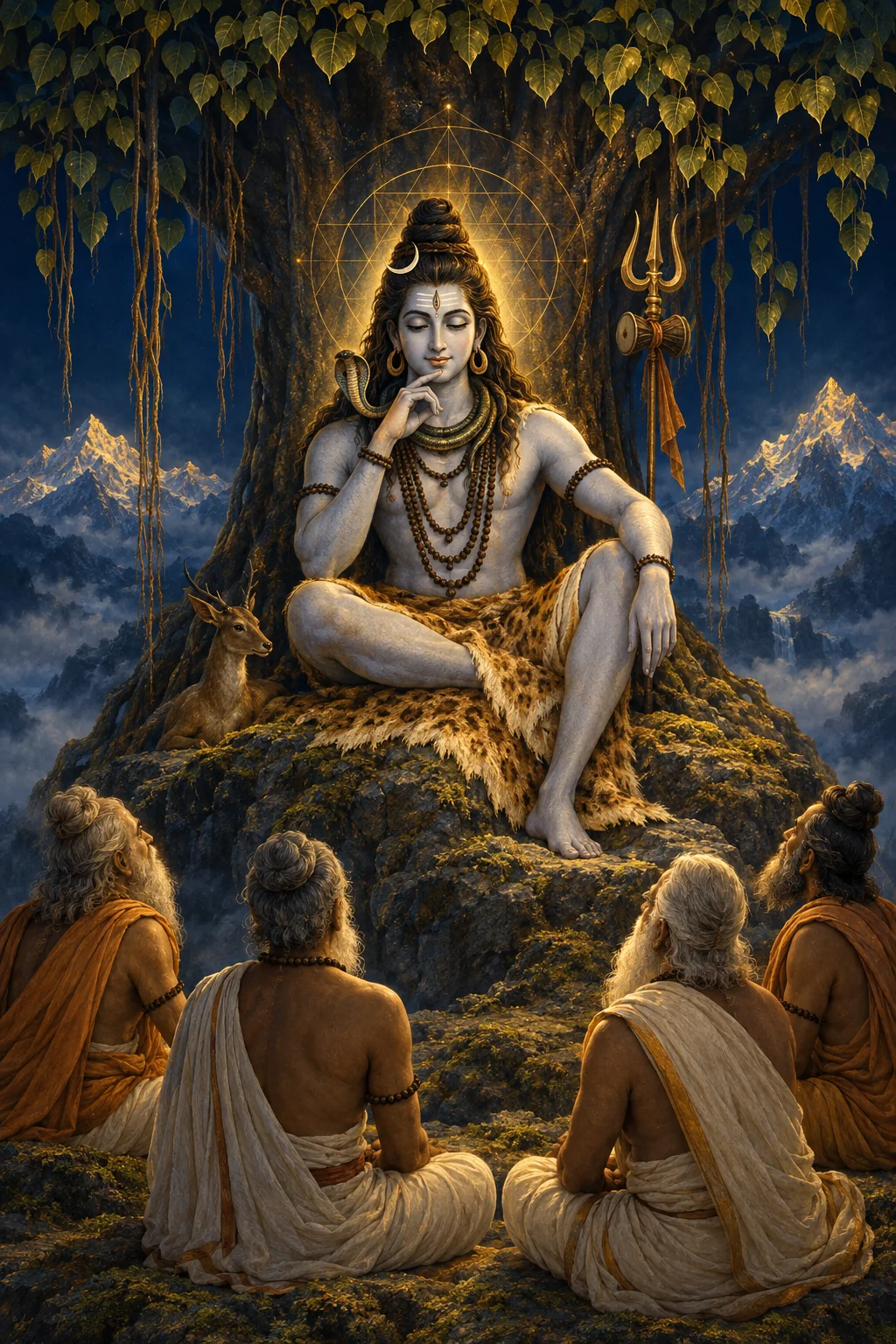
Dharmarāja Adhvarīndra
Author of the Vedānta Paribhāṣā
c. 17th century CE · The Shankara Lineage

- When
- Seventeenth century
- Born
- South India; the traditional account gives no closer location
- Where the life was lived
- South India; no closer location is recorded in the account used here.
- What is left of it
- The Vedānta Paribhāṣā, the standard Advaita manual on the means of knowledge, translated by Swami Mādhavānanda in 1942.
Gave Advaita a clear account of its own epistemology, which is why the tradition can be argued about rather than only believed.
The full-length study of this teacher is still being written. What is below is the complete short life, and it is accurate as far as it goes.
The life
Every claim on this site rests on something that has to be examined before the claim can be taken seriously: how does anybody know anything? He is the man the tradition sends you to for that. The Vedānta Paribhāṣā works through the means of knowledge one at a time — perception, inference, comparison, testimony, and the rest — and asks what each can and cannot deliver. Only then does it come to the question that matters here: what kind of knowing is involved when an Upaniṣadic sentence is said to reveal the Self. A tradition that answers that carefully can be argued with. One that skips it can only be joined. He wrote in the seventeenth century, in South India, in a scholarly culture that had been refining these instruments for well over a thousand years. The book became the classroom text and has stayed one; Swami Mādhavānanda of the Ramakrishna Order published a Sanskrit and English edition in 1942, and it is still in print, still assigned. Of his life the tradition preserves a name, a title indicating a family of Vedic ritualists, and a century. This is the last of the classical authors on these pages, and the pattern holds to the end: the argument was carefully signed and the biography was not thought worth keeping.
The turn it rests on
The Vedānta Paribhāṣā became the classroom text on Advaita epistemology and is still taught as one; Swami Mādhavānanda's Sanskrit-and-English edition appeared in 1942.
What was taught
Set out how knowledge actually works — perception, inference, testimony — so that the claim 'the Self is known through the Upaniṣadic sentence' could be examined rather than merely asserted.
Read the originals
Primary texts and the records kept by the teacher's own institution.
Every daily message names the teacher it came from. Read the messages, or see the whole line this teacher stands in: all fifty-one teachers.