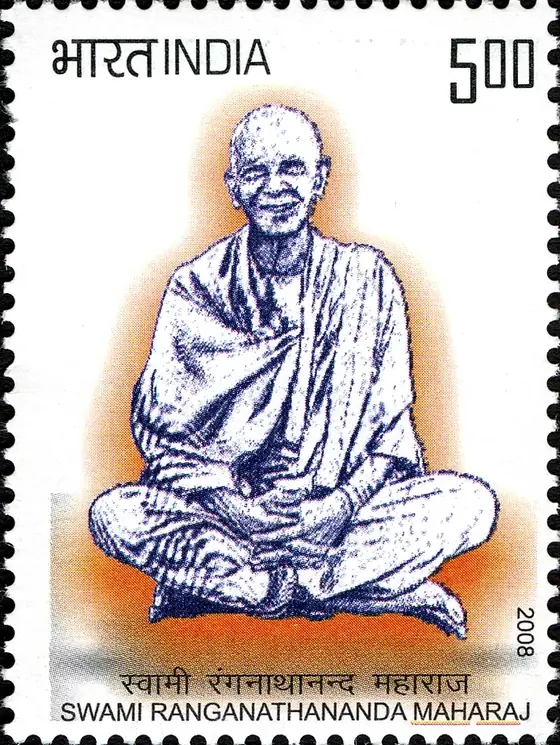
Swami Ranganathananda
13th President of the Ramakrishna Order
1908–2005 · The Ramakrishna Lineage
- When
- 1908–2005
- Born
- Trikkur, Kerala
- Where the life was lived
- Born on 15 December at Trikkur, a village near Thrissur in Kerala; joined the Order at Mysore in 1926; served at Rangoon in Burma from 1939, Karachi from 1942, New Delhi from 1949, Calcutta from 1962 and Hyderabad thereafter.
- What is left of it
- The Message of the Upanishads; Eternal Values for a Changing Society; his commentary on the Bhagavad Gītā.
Shipped 1,250 tons of rice from Karachi during the Bengal famine of 1943; served Partition refugees near Delhi; lectured for decades to civil-service and defence trainees; became the thirteenth President of the Ramakrishna Order.
The full-length study of this teacher is still being written. What is below is the complete short life, and it is accurate as far as it goes.
The life
He was born on 15 December 1908 at Trikkur, a village near Thrissur in Kerala, and joined the Order at Mysore in 1926, aged eighteen. What follows is a map of the twentieth century's worst years drawn by someone who kept turning up in them. Rangoon from 1939, as the war closed in. Karachi from 1942 — and from there, during the Bengal famine of 1943, he arranged the shipping of 1,250 tons of rice across India to Calcutta. New Delhi from 1949, working among Partition refugees in the camps outside the capital. Then Calcutta from 1962, and Hyderabad after that. And all through it, lectures. He spoke for decades to civil-service probationers, defence trainees, scientists and students, in their own vocabulary — the Upaniṣads presented as a discipline of thought rather than a matter of belief, which is why audiences of engineers sat still for him. The Message of the Upanishads and Eternal Values for a Changing Society came out of that work; so did his commentary on the Gītā. He became the thirteenth President of the Ramakrishna Order, and the Mission's work under him was recognised with the Gandhi Peace Prize. He died in 2005, at ninety-six. A long life, a lot of rice, and a body of exposition that treats the reader as capable of following an argument to the end.
The turn it rests on
He made Vedānta sound like a discipline of thought rather than a matter of belief.
What was taught
Interpreted the Upanishads alongside modern science and management for lay audiences worldwide.
Read the originals
Primary texts and the records kept by the teacher's own institution.
Every daily message names the teacher it came from. Read the messages, or see the whole line this teacher stands in: all fifty-one teachers.