Swami Ramakrishnananda
Direct disciple; founder of the Madras centre
1863–1911 · The Sri Ramakrishna Lineage
- When
- 1863–1911
- Born
- Ichapur, Bengal
- Where the life was lived
- Born Shashi Bhushan Chakravarti in the Hooghly district of Bengal; served at Dakshineswar, Shyampukur, Cossipore and Baranagore; sent to Madras in 1897, from where he opened the Order's work across south India, Bangalore, Mysore, Trivandrum and Burma.
- What is left of it
- A life of Rāmānuja in Bengali; The Universe and Man; The Soul of Man; Sri Krishna, the Pastoral and Kingmaker.
Carried the Order into southern India almost single-handed, and kept the daily worship of his teacher's shrine for years with the exactness of a temple priest; died at the Baghbazar monastery in Calcutta in 1911.
The Bengal he was born into
He was born Śaśī Bhūṣaṇ Chakravartī on 13 July 1863, into an orthodox Brahmin family of the Hooghly district, north of Calcutta; the Order's fuller biography names the village as Ichāpur. His father, Īśvar Chandra Chakravartī, was a strict observer of religious tradition and a devout worshipper of the Divine Mother, and Belur Math is explicit that it was the father's early training that laid the foundation of the character the son would show all his life — the exactness, the regularity, the refusal to treat any sacred duty as routine. His mother was Bhavasundarī Devī. A cousin, Śarat Chandra Chakravartī, the future Swami Saradananda, grew up almost as a brother; the two would go to Sri Ramakrishna together, and the Master would speak of them together to the end.
The Bengal of the 1860s and 1870s was a place where a clever Brahmin boy could expect an English education and a career in the courts or the colleges, and Śaśī was clever. He finished school and entered the Metropolitan College in Calcutta, where Belur Math records him as a brilliant student whose favourite subjects were English literature, Sanskrit literature, mathematics and philosophy — a combination that already suggests the two sides of the man, the exact and the devotional. Like many able young men of his generation he and his cousin came under the influence of the Brāhmo Samāj, the reforming movement that preached a formless God and no images; he became intimately known to its leader, Keshab Chandra Sen, and was appointed private tutor to Keshab's sons.
That last detail is worth holding on to. The man who would spend his life fanning a portrait of Sri Ramakrishna as if it were a living person, and who would refuse to eat food that had not first been offered to it, began as a tutor in the household of Bengal's most eloquent critic of image worship. He did not arrive at his devotion from a lack of alternatives. He arrived at it from the other side.
Where the life was lived
For its first thirty-four years the life is contained in a few miles of the Hooghly: the temple garden at Dakṣiṇeśvar, the sick-rooms at Śyāmpukur and Cossipore, the ruined house at Baranagore and the rented one at Ālambāzār where, alone among his brothers, he did not go on pilgrimage but stayed and kept the shrine. Then, in March 1897, it moves a thousand miles south in a single step, to Madras, and stays there for fourteen years, radiating outward in journeys to Bangalore, Mysore, Trivandrum, the Kerala coast, Tirunelveli, the Andhra coast, Sholapur and Bombay, and beyond India to Rangoon and to Ceylon. It ends where it began, on the Ganga at Belur. The map below shows the Indian places on present-day coordinates; Rangoon, Colombo, Kandy, Anurādhapura and Jaffna lie off it and are named in the text.
Present-day India. Numbered pins are places named in Belur Math’s account of his life and in the Order’s fuller biography; the dotted line joins them in the order they occur in the story and is not a surveyed route. Rangoon, where he spent the Master’s birthday in March 1905, and Colombo, Kandy, Anurādhapura and Jaffna in Ceylon, which he visited with Swami Abhedananda in 1906, lie off the map and are named in the text. The birth pin marks the Hooghly district town, since Belur Math names only the district.
- 1Hooghly (West Bengal) — Born Śaśī Bhūṣaṇ Chakravartī, 13 July 1863, in the Hooghly district — the Order’s fuller biography names the village as Ichāpur; this pin marks the district town, not a verified village site
- 2Calcutta (West Bengal) — Metropolitan College; the Brāhmo Samāj and Keshab Sen’s household; Śyāmpukur, 1885; the Udbodhan house at Bāgbāzār, where he died at 1.10 p.m. on 21 August 1911
- 3Dakṣiṇeśvar (West Bengal) — First visit with his cousin Śarat, October 1883: “Please come again and alone”; the Persian books thrown into the Ganga
- 4Cossipore (West Bengal) — Held the pillows on the last night, 16 August 1886; gathered the Master’s relics
- 5Baranagore (West Bengal) — “A mother to us”: kept the shrine and the monastery, 1886–92, then at Ālambāzār to 1897, without a single pilgrimage
- 6Āṅṭpur (West Bengal) — The night-long vigil round the fire, Christmas 1886; the formal vows of sannyāsa followed about a month later at Baranagore
- 7Belur Math (West Bengal) — Cremated on the Ganga bank at the south-east corner of what is now the Vivekananda Temple, August 1911
- 8Madras (Tamil Nadu) — Arrived by steamer 17 March 1897; Flora Cottage, then the Ice House on the seafront to 1907; the Mylapore Math from 17 November 1907; the girls’ school of 1906; fourteen years’ work
- 9Trivandrum (Kerala) — A month in 1903, with talks at the Padmavilāsam Palace; admitted to the sanctum of Ananta Padmanābha, where he answered the priest with the Advaita verse — neither man nor god, but pure Consciousness only
- 10Bangalore (Karnataka) — July 1903: met at the Cantonment station by some four thousand people and fifty-three bhajan parties; the monastery whose foundation Swami Abhedananda laid on 20 August 1906, opened by Swami Brahmananda on 20 January 1909
- 11Mysore (Karnataka) — October 1903: the Sanskrit address on Dharma Samanvaya, the harmony of religions; 7–12 August 1906 with Swami Abhedananda, meeting the Maharaja
- 12Sholapur (Maharashtra) — July 1904: a lecture on happiness to more than three hundred people
- 13Machilipatnam (Andhra Pradesh) — August 1904: opened the Vivekananda Mandira
- 14Tirunelveli (Tamil Nadu) — 25–31 December 1904; spoke in the Nellaiyappar temple to more than three thousand
- 15Alleppey (Kerala) — 18 January 1905: opened the Sanātana Dharma school for boys
- 16Ernakulam (Kerala) — January 1905: the Theosophical Society and the Maharaja’s College
- 17Bombay (Maharashtra) — From 29 March 1905, on the way back from Rangoon: three lectures on 1 April for the Master’s birthday, at one of which Bāl Gaṅgādhar Tilak presided
- 18Tuticorin (Tamil Nadu) — Landed here from Ceylon with Swami Abhedananda, 1906
- 19Coimbatore (Tamil Nadu) — The helpless children whose families had died of plague — the origin, Belur Math says, of the Students’ Home in Madras
- 20Purī (Odisha) — 1908: went to fetch Swami Brahmananda south
- 21Rāmeśwaram (Tamil Nadu) — Pilgrimage with Swami Brahmananda, 1908–09
- 22Madurai (Tamil Nadu) — Pilgrimage with Swami Brahmananda, 1908–09
“Please come again and alone”
He first went to Dakṣiṇeśvar on a day in October 1883, with Śarat and a few other boys. He was then in the First Arts class and, being the oldest of the party, the one to whom Sri Ramakrishna addressed himself. Belur Math records the conversation. The Master spoke warmly of the need for renunciation in spiritual life, and then asked Śaśī whether he believed in God with form or without form. The young Brāhmo answered frankly that he was not certain about the existence of God at all, and therefore could not speak one way or the other. Sri Ramakrishna was very pleased with the reply. The Order's fuller biography preserves what he said as the boys left: “Please come again and alone.” Śaśī and Śarat came again, and accepted him, the Order says, as their Master and the pole-star of their lives.
Quoted from Swami Ramakrishnananda: His Life and Legacy, the Order's biography published online by the Ramakrishna Mission Vivekananda Educational and Research Institute at Belur. Every other quotation on this page is from Belur Math's own life of Swami Ramakrishnananda unless another source is named.
Sri Ramakrishna said something about the two cousins that the Order has kept. The fuller biography dates it to 23 December 1885, in conversation with the schoolmaster Mahendranāth Gupta, who recorded the Master's talk: “When God assumes a human body for the sake of His devotees, many of His devotees accompany Him to this earth. … The Divine Mother used to reveal to me the nature of the devotees before their coming. In a vision I saw that Shashi and Sharat had been among the followers of Christ.” Belur Math gives the same tradition in a shorter form — that the two were “followers of Jesus Christ in a former incarnation” — and, whatever a reader makes of it, it explains something that runs through the whole life: Śaśī's lifelong reverence for Christ, his knowledge of the Bible from end to end, and the Good Friday talk on the Crucifixion he would one day give in Madras.
The turning came over a book. At Dakṣiṇeśvar one day he was deep in Persian, which he was learning in order to read the Sufi poets in the original, and Sri Ramakrishna had to call him three times before he heard. Asked what he had been doing, he said he had been absorbed in his books. The Master warned him that if he forgot his duties for the sake of study he would lose all his devotion. Śaśī understood. He took the Persian books and threw them into the Ganga, and from that day, the Order says, book-learning had little importance in his scheme of life. It is an alarming story for anyone who loves books, and it should not be read as a verdict on learning — he remained a Sanskrit scholar who could argue with pandits in their own language, and he wrote a standard life of Sri Rāmānuja. It is a verdict on divided attention. He had found the one thing, and he would not let anything, even the Sufis, come between him and it.
The choice at Śyāmpukur
By 1885 he was in the final B.A. class with the examination approaching, and Sri Ramakrishna, ill with the cancer of the throat that would kill him, had been moved to a house at Śyāmpukur in Calcutta for treatment. The two claims could not both be met. Belur Math says he chose unhesitatingly: he gave his body, mind and soul wholly and unreservedly to the service of the Master, and followed him from Śyāmpukur to the garden house at Cossipore. In the middle of January 1886, the fuller biography records, Sri Ramakrishna distributed ochre cloths among his young disciples, and Śaśī received one.
The Order describes him at Cossipore as the very embodiment of service. He knew no rest. He did not care for any other spiritual practice; service to the guru was the only concern of his life. He had a strong physique, and its strength, the Order says, came from a mind whose strength came from love. On the last night, 16 August 1886, the Master sat up for a time against five or six pillows; Śaśī held the pillows in place while fanning him with his other hand. When Sri Ramakrishna entered the final samādhi, the disciples did not at first understand what had happened, and Śaśī rebuked those who thought it was anything other than samādhi, and led the chanting of holy texts. The doctor at last pronounced it death. At the burning ghat, the Order says, he passed through two states in succession: first a triumphant joy in what the Master had given them, singing his name; then utter loneliness and violent grief. When the fire had done its work he gathered the relics — the ashes and bones — placed them in an urn, and carried them back to the garden house. He would keep vigil over them for eleven years.
The mother of the monastery
When the young men gathered that autumn in the ruined house at Baranagore, Śaśī held them together. Belur Math is specific about how. He regulated the routine of their monastic life. While the others were indifferent whether their bodies lived or died in the search for the Highest, he saw to it that they did not actually starve; for a short time he worked as a schoolmaster to pay the monastery's bills, and he told his brothers, “You just continue your spiritual practices with undivided attention. You need not bother about anything else. I shall maintain the Math by begging.” The parents came to take their sons home and were refused; Śaśī's own father came, begged and threatened, without success. Śaśī's answer, as the Order reports it, was that the world and home were like a place infested with tigers.
At Christmas 1886, at Āṅṭpur, the young men took informal vows around a fire through a night-long vigil; about a month later, the fuller biography says, they took the formal vows of sannyāsa through the traditional fire sacrifice at Baranagore and changed their names. Narendranāth, who led them, wanted the name Ramakrishnananda — “the bliss of Ramakrishna” — for himself, and gave it to Śaśī instead, believing his claim the stronger because of his unparalleled love for the Master. Then, one by one, the others went out on pilgrimage and took up the wandering life. He did not. He stayed at the place where the Master's relics were temporarily enshrined, and gave himself two duties: to worship Sri Ramakrishna, and to keep the monastery as the centre to which the wanderers could return. He did not visit a single place of pilgrimage. He brought the Ganga water himself, gathered the flowers, cooked the offering, and attended to every item of the worship, and he would not eat food that had not first been offered. When the monastery moved to Ālambāzār in February 1892, he moved with the shrine.
Vivekananda's account of those years, recorded many years afterwards and quoted by Belur Math, is the best description of him that exists: “Oh, what a steadfastness to the ideal did we ever find in Shashi! He was a mother to us. It was he who managed about our food. We used to get up at three o'clock in the morning. Then all of us, some after bathing, would go to the worship room and be lost in japa and meditation. There were times when the meditation lasted to four or five o'clock in the afternoon. Shashi would be waiting with our dinner; if necessary, he would by sheer force drag us out of our meditation. Who cared then if the world existed or not!” A mother to us. Among men who were competing to see who could most completely forget the body, he was the one who remembered it on their behalf, and the Order records this as his sanctity and not as its absence.
The bond with Vivekananda ran the other way too. From Chicago at the beginning of 1894, having heard from Śaśī of what the letter calls “Mazoomdar's doings” against him, Vivekananda wrote back a letter that is one of the plainest statements of his own mind: “I want no name — I want to be a voice without a form. I do not require anybody to defend me.” And: “I am an instrument, and He is the operator.” He wrote it to the brother who would take that sentence more literally than anyone.
From Swami Vivekananda's letter to Swami Ramakrishnananda from Chicago, 1894, translated from Bengali, in the Complete Works, volume 6, Epistles — Second Series, letter LIV.
“More orthodox than the most orthodox”: Madras, 1897
When Vivekananda came home from the West in early 1897 and was received in Madras with a welcome the city had never given anyone, a devotee asked him to send someone who could keep alive what he had begun. His answer is recorded, in slightly different words, by Belur Math and by the Order's journal The Vedanta Kesari; Belur Math's version is: “I shall send you one who is more orthodox than your most orthodox men of the South and who is at the same time unique and unsurpassed in his worship of and meditation on God.” He meant Śaśī, and he had a reason beyond the orthodoxy. Belur Math records that he first tested him. Śaśī's love and obedience were such that any word of Vivekananda's was more than a command; and Vivekananda, knowing his brother's strictness in matters of food, asked him one day whether he could buy a piece of English bread from a Muslim shop. Śaśī agreed at once and did it. Then came the real request. The fuller biography gives it in Vivekananda's words: “I have given word to my friends that I shall very soon send one of my brother disciples there. I have selected you. You are to go to Madras and found a monastery there in the name of our beloved Master.”
Consider what that asked. He had not left the shrine overnight in eleven years. He had never travelled. He did not know a word of Tamil. He would have to give up, Belur Math says, many long-established habits, and leave the place where he had steadfastly worshipped the Master's relics since 1886. He responded immediately. He sailed by steamer with Swami Sadananda, and arrived in Madras on 17 March 1897. He stayed at first in a small rented house, Flora Cottage on Ice House Road in Triplicane, and then moved into the Ice House itself, the building on the Madras seafront where Vivekananda had stayed for nine days in February 1897. The Order's biography gives its other name, Castle Kernan; today it is Vivekanandar Illam, and the Chennai Math records that the monastery lived there until the end of 1907.
His instructions came from Darjeeling, in a letter of 20 April 1897 that the Order's biography quotes, and they show how carefully Vivekananda had thought about the South. “In Madras the worship should be done in a completely SATTVIC MANNER, without a trace of Rajas in it. … Don't enter into wrangles with anybody — always maintain a calm attitude. For the present let the worship of Sri Ramakrishna be established and continued in the house of Biligiri. But see that the worship does not become very elaborate and long. Time thus saved should be utilized in holding classes and doing some preaching.” And, with an eye to the Vaiṣṇava devotion of his hosts: “Teach them pure devotion to Sita-Ram and Hara-Parvati. … Specially Biligiri and other followers of Ramanujacharya are worshippers of Rama; so see to it that their innate attitude of pure devotion is never disturbed.” The man who would write the life of Sri Rāmānuja was being told, at the outset, to respect the Śrī Vaiṣṇavas on their own terms. He did.
Quoted in Swami Ramakrishnananda: His Life and Legacy; the capitals and the ellipses are as given there.
The vow of the empty room
What he did in Madras for fourteen years is described by Belur Math with a plainness that lets the labour show. He conducted the daily worship. He held scripture classes and gave religious discourses. He lectured, sometimes more than twice or thrice in a single day, and his classes were scattered across different parts of the city; for a long period he went to them on foot. He was not, the Order says, an especially eloquent speaker, and he used no oratorical flourishes; what made his talks impressive was his sincerity and his grasp of spiritual realities, and he was at his best not on a platform but in conversation, where he could take the hardest questions and make them simple enough for a child. Not knowing Tamil, he sometimes conversed with the orthodox pandits in Sanskrit. He knew the Bible from beginning to end, and could expound it, the Order says, with an insight that impressed orthodox Christian theologians; he knew Islam well enough that when some Muslim students took shelter from the rain in the monastery he spoke to them not about his own faith but about theirs, and they came back again and again.
And when nobody came, he taught anyway. Belur Math records that if no student appeared for a class he would deliver the discourse to the empty room, or meditate through the allotted hour; and it preserves his explanation: “I have not come here to teach others. This work is like a vow to me, and I am fulfilling it irrespective of whether anyone comes or does not come to my class.” The fuller biography has a companion saying, made to the devotee C. Rāmaswāmy Iyengar: “I do not care so much to see whether my students hear me or not. I am always a student myself and I myself listen to my own talks. I feel refreshed and elevated thereby and that is my highest reward.” It is the same discipline as the eleven years at the shrine, turned outwards. The worship did not depend on a congregation; neither did the teaching.
He was uncompromising and fearless in teaching renunciation, the Order says, and equally uncompromising about what he would teach. To a suggestion that the message be softened to attract support he answered: “What, am I to preach anything other than what I have learnt from my Master? If the Math cannot be financially maintained, I shall very gladly find accommodation in the verandah of one of my students' houses.”
Poverty, and the Ice House auction
Money was the difficulty of the Madras years, and the Order's biography does not pretend otherwise. There were days with nothing to eat. His response was to argue with his Master, and the fuller biography preserves the arguments. “You have brought me here, old man, and left me helpless. Are you testing my powers of patience and endurance? I will not go and beg hereafter for my sake or even for yours. If anything comes unasked, I will offer to you and share the prasadam. Or, I will bring sea sand for offering to you and I shall live upon that.” And on another day: “You want to test me! I will eat sand and do Swamiji's work here! Sirrah! You are testing me, I know. But you should also know my grim resolve. I shall rather die and perish here than budge an inch from this place!” The tone is not despair. It is the tone of a son who knows he will be fed and is angry about the delay, and it belongs to a man for whom the portrait on the altar was a person who could be shouted at.
He was made to beg, and he turned the begging into a teaching. “Begging is a test of egotism and you can measure how much ego you have by how much you mind it,” he told a devotee; and to another, that anxiety was a sign of lack of faith in God. To Sister Devamātā, the American nun who later lived at the Madras monastery and wrote of it, he said: “I do not need any one to help me. I am all full of God. What need have I of any one else? If He sends people to help me, I am satisfied. If He does not send, I am satisfied. I know that whatever He sends is for my good and is the best thing for me.”
All from Swami Ramakrishnananda: His Life and Legacy, which draws on Sister Devamātā's Days in an Indian Monastery and on the reminiscences of the Madras devotees.
In 1906 the Ice House was put up for auction, four years after the death of its owner, Biligiri Iyengar, whose family had first housed the worship. Belur Math records the scene. While the sale went on he sat unconcerned at the far end of the compound on a rickety bench, and when someone worried aloud he said: “Why do you worry about it? What do we care who buys or sells? My wants are few. I need only a small room for Sri Guru Maharaj. I can stay anywhere and spend my time in talking of him.” The building changed hands, and the monastery moved into one of its outhouses, at great personal inconvenience to him, the Order says. That same year a devotee, Akula Kondiah Chettiar, gave a plot of land in the suburb of Mylapore; Swami Abhedananda, visiting from America, laid the foundation; building began at the end of March 1907 and was finished at the beginning of November; and on 17 November 1907, by a devotee's recollection, he moved in. It was a simple one-storey house — four rooms, a spacious hall, a kitchen and outhouses. He was delighted. There was at last a permanent place where the Master's worship could go on without interruption, and he laid down the rule of the house at once: “This is a fine house for Sri Ramakrishna to live in. Realizing that he occupies it, we must keep it very clean and very pure. We should take care not to disfigure the walls by driving nails or otherwise.” The building cracked and had to be abandoned in 1914; Swami Brahmananda laid the foundation of its successor on the next plot in 1916 and opened it in 1917, and that is the building the Chennai Math still calls the Old Temple.
The living presence
What he did in the shrine every day is the heart of the life, and Belur Math describes it in detail because the detail is the teaching. He offered the food while it was hot, and kept the stove burning so that it could be offered piece by piece as it came off the fire. He offered a softened twig as a toothbrush. After the midday offering he fanned the Master so that he could sleep. On hot nights he opened the shrine and fanned him so that the heat would not disturb his rest. Sometimes he spoke to him sulkily and blamed him for something. He would fan the portrait for two hours and more, repeating names — Śiva Guru, Sat Guru, Sanātana Guru, Parama Guru. To a young monk who arrived in 1906 and took the picture for a picture, he said: “Look here, my boy, don't consider that as a mere picture of Sri Ramakrishna. He is actually present here. Try to feel his living presence and do your services accordingly.”
He had a defence of this ready for the philosophically minded, and Belur Math gives it: “The images in temples were not simply dull, dead, inert matter, but were living gods who could be spoken to.” The Brāhmo tutor had come a long way; but he had not stopped thinking. His whole position on worship was that the reality of God is not diminished by being met in a form, and that the person who cannot meet God in a form has not thereby met God without one. When he visited St Thomas's Church in Madras he went straight to the altar, knelt like a Christian, and prayed. It was the same act.
The apostle to the South: the journeys
From Madras he went out, and the Order's biography keeps the itinerary with dates that deserve to be set down, because they show the scale of what one man on a small allowance did in eight years. In 1898 and 1899 he gave two public talks on Sri Kṛṣṇa — “the Pastoral” and “the King-Maker” — at the Triplicane Literary Society on Kṛṣṇa's birthday; they became a book in 1909. From 1899 he was writing, in Bengali, a serial life of Sri Rāmānuja for Udbodhan that ran until 1906. On 24 June 1899 the ship carrying Vivekananda westward a second time, with Swami Turiyananda and Sister Nivedita aboard, called at Madras, and the monks could not reach them; he went out in a boat and said to the boatman, “Let us at least make a pradakshina of the two great souls whose feet we have not been able to touch today,” and circled the ship.
On 4 July 1902 Vivekananda died at Belur. At about the same hour, the biography records, Śaśī was meditating in the Ice House and reported a vision of him. On 29 July he spoke at the memorial meeting in Pachaiyappa's Hall. That year a committee was formed in Madras for a Ramakrishna Vivekananda Home, with a memorial fund — the seed of what became the Ramakrishna Mission Students' Home, whose origin Belur Math traces to something else again: his loving response to helpless children at Coimbatore whose families had died of plague. It was, the Order says, the beginning of the Mission's educational work in the South.
Then the tours. In 1903, at the invitation of a devotee, a month in Trivandrum, with talks at the Padmavilāsam Palace, and a visit to the great temple of Ananta Padmanābha, where, after some hesitation on the part of the authorities, he was admitted to the sanctum; the biography records that he answered a priest's question about who he was with a verse of the Advaita tradition — that he was neither man nor god nor ghost, neither Brahmin nor warrior nor merchant nor servant, neither student nor householder nor forest-dweller, nor even properly a monk, but pure Consciousness only. In July 1903, Bangalore, at the invitation of the Vedānta Society of Ulsoor: met at the Cantonment station at six in the morning by a procession of some four thousand people and fifty-three bhajan parties, twelve lectures in twenty days, and conversations morning and evening. In October, Mysore: three days, a Sanskrit address to the pandits of the Sanskrit College on Dharma Samanvaya, the harmony of religions, four lectures at the Rangāchārlu Memorial Hall, and a halt at Śrīraṅgapaṭṭaṇa on the way back.
In 1904: Sholapur in July, a lecture on happiness to more than three hundred people; Machilipatnam on the Andhra coast in August, to open a Vivekananda Mandira; Bangalore again the same month, where he left a junior swami, Ātmānanda, to build a permanent centre; and from 25 to 31 December, Tirunelveli in the far south, where he spoke in the Nellaiyappar temple to more than three thousand. In January 1905, Kerala: on the 18th he opened a Sanātana Dharma school for boys at Alleppey and spoke that evening on the eternal religion, on the 19th on the Gītā; then Ernakulam, at the Theosophical Society and at the Maharaja's College. In March 1905 he sailed to Rangoon for the Master's birthday — four lectures in five days, and the Buddhist pagodas including the Shwedagon — and came back by way of Bombay, where on 1 April three lectures were given for the birthday celebration, at one of which Bāl Gaṅgādhar Tilak presided.
In 1906 Swami Abhedananda came home from America for a short visit, and Śaśī went to Colombo with the young Swami Paramananda to receive him; the two brothers visited Kandy, Anurādhapura and Jaffna, where Abhedananda spoke at the Hindu College, crossed to Tuticorin, and then toured together. From 7 to 12 August they were at Mysore and met the Maharaja; on 20 August Abhedananda laid the foundation of the Bangalore monastery according to Śaśī's plan. Swami Brahmananda opened it on 20 January 1909, and Śaśī went to Purī in 1908 to fetch him south for the purpose; the two then went on pilgrimage together to Rāmeśwaram and Madurai. On 22 February 1909 the Master's birthday was kept at Madras with a public feeding of some five thousand poor. Belur Math sums up what all this produced: as a result of his extensive tours, centres were started in several important places of South India, and the work in Bangalore and Mysore was directed from Madras.
The girls' school, and the children
One institution needs its own paragraph because it shows a side of him that the image of the stern worshipper can hide. In 1906, a few residents of George Town in north Madras, under his inspiration, started a school for girls; the Order's journal The Vedanta Kesari records that it began with three pupils, and it preserves a letter of his of 20 November 1906: “Our boys get some sort of education now-a-days, but girls are mostly neglected all over India. So our primary duty is to look after the education of our girls, the future mothers of India.” The school was formally recognised on 20 October 1917, six years after his death; the Math took it over in 1921; it still exists, in north Chennai, as the Math's National School. And the Students' Home for boys that grew out of the Coimbatore orphans and the 1902 committee was given its present form by Swami Brahmananda on 10 May 1921, the day of Akṣaya Tṛtīyā, on land a devotee had given in 1916. He saw neither completion. He had begun both.
The letter is quoted in The Vedanta Kesari for May 2015, in its account of the school he started, published online by the Ramakrishna Math and Mission.
The difficulties, which he did not hide
The difficulties have been visible throughout, but it is worth gathering them, because the Order does. He was poor for years, poor enough to threaten his Master with a diet of sea sand, and he begged. He was a Bengali in a Tamil city with no Tamil, reduced to Sanskrit for his conversations with the learned and to English for everyone else. He was alone: the brothers were in Calcutta or the Himalaya or America, and his letters to them do not survive on this page, but the sulky conversations with the portrait do, and they are the conversations of a man with no one else to talk to. He lived in a borrowed building, then in its outhouse when it was sold, then in a house that cracked. He was, by his own account and the Order's, a strict disciplinarian who required those under his influence to be perfect and exemplary in every detail of conduct; he rebuked a visitor for reading a newspaper in the Math, corrected a proud pandit, told a student not to sit in a pensive attitude, and there is no reason to think that everyone found this easy to live with. Belur Math balances the account: though stern in managing the monastery he was soft and kind at heart, fed a departing junior monk with his own hands and burst into tears as the young man left, and went himself to sit with a sick young brahmachārin at his parents' house in Calcutta.
And then his body gave way. Belur Math is precise about the cause. When the Holy Mother, Sri Sarada Devi, came south on pilgrimage in 1911 with a party of women devotees, he worked so intensely to remove even the slightest inconvenience from their path that his health permanently broke down. He had worked under severe strain in Madras for fourteen years, and the strain had been telling; the pilgrimage finished it. The doctors' diagnosis was consumption; the fuller biography names diabetes and tuberculosis together. He did not stop. Despite indifferent health, the Order says, he continued his hard work until the body broke down completely.
What he taught
He was not a system-builder, and his teaching survives, as Belur Math notes, in the concise sayings in which he could probe to the heart of a subject in a few words. Four themes run through them. The first is the living presence: that God met in a form is God, that the image and the portrait are not inert but persons, and that worship is therefore not symbolic but literal. The second is regularity as a spiritual discipline. He began every day with the Gītā and the Viṣṇu Sahasranāma, and when he once spent a night away from the Math he had copies of both procured so as not to miss the next morning's reading; he was, the Order says, extremely regular and punctual, and he treated the routine of worship as a vow rather than a habit. The third is reliance. Anxiety was a lack of faith; begging was a test of ego; God sent what was needed, and what he sent was best.
The fourth is the largest and the least expected in so orthodox a man: the equal standing of the paths. Belur Math records him saying, “In the dualistic method enjoyment is the ideal; in the monistic method freedom is the ideal. By the first the lover gets his beloved at last, and by the second the slave becomes the master. Both are sublime. One has no need to go from one ideal to the other.” This is the position of Sri Ramakrishna stated as doctrine, and it is why the disciple who kept an image could write reverently of Sri Rāmānuja, kneel at a Christian altar, teach Islam to Muslim students, and tell a Vaiṣṇava audience in Madras to keep their devotion to Rāma undisturbed. He did not think Advaita was for everyone, and he did not think that made it less true. He thought the seeker should go to the end of the road he was on.
Two more sayings mark the boundaries of his mind. On the relation of the inner and outer sciences: “Science is the struggle of man in the outer world. Religion is the struggle of man in the inner world. Both struggles are great, no doubt, but one ends in success and the other ends in failure. That is the difference. Religion begins where science ends.” And on politics, in a city where the national movement was gathering: “Politics is — the freedom of the senses, while religion is freedom from the senses.” He was not hostile to either; he wanted them kept in their places.
The sayings, and what they were for
Everything here is verbatim from the source named, and nothing is paraphrased. Where the Order gives the person addressed or the date, they are given.
- “I shall maintain the Math by begging.” — to his brother monks at Baranagore, 1886–87, telling them to go on with their practices and leave the rest to him. The first recorded sentence of a life spent doing exactly that.
- “Why do you worry about it? What do we care who buys or sells? My wants are few. I need only a small room for Sri Guru Maharaj. I can stay anywhere and spend my time in talking of him.” — on the rickety bench at the far end of the compound while the Ice House was auctioned, 1906. The freedom of a man who had reduced his requirements to one.
- “Begging is a test of egotism and you can measure how much ego you have by how much you mind it.” — to a devotee, while collecting funds. A humiliating duty turned into an instrument of self-knowledge.
- “If we cannot get on altogether without help, then why not ask the Lord Himself? Why go to others?” — Belur Math. The logic of his poverty.
- “Suppose a pen were conscious; it could say, ‘I have written hundreds of letters’, but actually it has done nothing, for the one who holds it has written the letters. So, because we are conscious we think we are doing all these things, whereas in reality we are as much an instrument in the hands of a Higher Power as the pen is in our hands, and He makes all things possible.” — Belur Math. His version of Vivekananda's “I am an instrument, and He is the operator.”
- “Look here, my boy, don't consider that as a mere picture of Sri Ramakrishna. He is actually present here. Try to feel his living presence and do your services accordingly.” — to the young Swami Śarvānanda, newly arrived, 1906. The rule of the shrine.
- “Put away your paper. You can read that anywhere. When you come here, you should think of God.” — to a visitor reading a newspaper in the Math. A small saying that describes what he thought a monastery was for.
- “Do not sit like that, it is a pensive attitude. You should always cultivate a cheerful attitude.” — to a student. Cheerfulness as a discipline, not a mood.
- “I wonder what God did before you were born.” — to a proud pandit who spoke of reforming the temples and society. The one joke the Order records, and it is a good one.
- “In this age, whoever takes refuge in the Ramakrishna Incarnation shall undoubtedly realise the goal. But if you want money and fame and all that, better go and read for M.A.” — to the future Swami Madhavananda at their first meeting, 22 April 1909. The young man, a graduate wondering whether to continue his studies, joined the Order and was in time its President.
- “The senses only touch the surface of things. Take, for instance, this wall. When you look at it, all you see is a coloured surface. The eyes do not tell you what is inside. It is the mind that supplies you further information about its thickness, its being made of bricks, and so on.” — to Swami Madhavananda, 1909. Vedāntic epistemology explained with a wall.
- “When you see a goat suckling her kid, salute, for the Lord is manifesting Himself there.” — to Swami Madhavananda, 1909. The living presence, outside the shrine.
- “When you will be longing in that intense way for just a little bit of God, and nothing else, then you will realise Him.” — to Swami Madhavananda, 1909, on one-pointed yearning.
- “Our boys get some sort of education now-a-days, but girls are mostly neglected all over India. So our primary duty is to look after the education of our girls, the future mothers of India.” — letter of 20 November 1906, on the school he had just started with three pupils.
- “When I speak of the Lord, all pain leaves me, I forget the body.” — to an attendant in the last illness, 1911, when asked why he went on talking of God through the pain.
Sayings marked Belur Math are from the Order's life of him on its own site; the rest, with their dates and the persons addressed, are from Swami Ramakrishnananda: His Life and Legacy, published online by the Ramakrishna Mission Vivekananda Educational and Research Institute, and from The Vedanta Kesari of May 2015. Swami Madhavananda's recollections of 1909 are from his eight days at the Madras Math.
The books, and how to read them
He wrote more than the image of the worshipper suggests, and the books are still in print from Sri Ramakrishna Math, Chennai, the monastery he founded. The Order's biography lists them, and this page follows that list. The principal work is the Life of Sri Ramanuja, written in Bengali and serialised in Udbodhan from 1899 to 1906, published in English translation in 1956; Belur Math calls it an authoritative book on the great Vaiṣṇava teacher, and it is the only full life of Sri Rāmānuja written by a monk of Sri Ramakrishna's order — a mark of the respect in which he held the qualified non-dualist tradition of the South that had received him. Read it if you want to understand how an Advaitin can honour Sri Rāmānuja without condescension.
For his own thought, begin with The Universe and Man, published in his lifetime and admired, Belur Math records, by the Yuvarāja of Mysore, and with its companion The Soul of Man; the Order describes both as lucid expositions of the fundamental principles of Vedānta. Sri Krishna: Pastoral and King-Maker, the two Triplicane lectures of 1898 and 1899 published together in 1909, is his study of Kṛṣṇa as, in the Order's phrase, the hero as Godman. God and Divine Incarnation, Search after Happiness and For Thinkers on Education gather lectures given across the South. Shorter pieces — Consolations, Path to Perfection, Sri Ramakrishna and His Mission, Sri Ramakrishna, Our Refuge, and the little collection of sayings called Flashes from Swami Ramakrishnananda — are the easiest way in. His Sanskrit hymn in praise of Swami Vivekananda, which the biography records him chanting at the Swami's birthday celebration on 29 January 1911, is still sung.
How to read him: remember that these are spoken books. He was not an orator and did not try to be; the value is in the plainness and the occasional sudden image — the pen, the wall, the goat. Read the sayings first, then The Universe and Man, and keep in mind while reading that the author began each of the days on which he wrote by reading the Gītā and the thousand names of Viṣṇu, and spent two hours fanning a portrait. The books were written in the intervals of worship, and they are better understood as its overflow than as its substitute.
For his life, the Order's own accounts are the ones to trust: Swami Tapasyananda's Swami Ramakrishnananda: The Apostle of Sri Ramakrishna to the South (Sri Ramakrishna Math, Chennai, 1972), the anonymous Story of a Dedicated Life (1948), Sister Devamātā's Days in an Indian Monastery, and the online biography drawn on throughout this page. The Prabuddha Bharata gave him a special issue in October 1911, two months after his death.
The Mother in the South, and the last illness
In February 1911 the Holy Mother, Sri Sarada Devi, came to Madras and stayed a month in a two-storeyed house he had rented for her opposite the Math. On 2 March the Master's birthday was celebrated at the monastery with her present, and she initiated many devotees. On 24 March she went on by train to Bangalore with him and her party. Belur Math records that he worked through those weeks to spare the women of the party even the slightest inconvenience, and that the effort broke his health for good. Soon after she left for Calcutta, the fuller biography says, he fell seriously ill with diabetes and tuberculosis.
The brothers in Calcutta asked him to come and spend his last days with them. He had thought of it, but he would not leave Madras, the Order says, until the command came from the President of the Order, Swami Brahmananda; when it came he left, in June 1911, and on 10 June he was received at the Udbodhan house at Bāgbāzār, where the Mother lived, and put under the care of physicians. Noted doctors came unasked. His condition worsened. Even in physical suffering, Belur Math records, he gave eloquent discourses on spiritual subjects, and when an attendant asked him why, he answered: “When I speak of the Lord, all pain leaves me, I forget the body.” In delirium his mind and voice stayed on God; “Durgā, Durgā, Śiva, Śiva” and the name of Sri Ramakrishna were continually on his lips. His love for Christ came forward at the end: he spoke of the Master's attitude to Christ, of the Master's vision of Christ in samādhi, and of the tradition that Christ's body entered into the Master in that vision. He died — entered, in the Order's words, into Final Realisation — on Monday 21 August 1911, at ten minutes past one in the afternoon, in samādhi.
The body was taken in procession from Udbodhan, stopping first at the Cossipore garden house where he had held the pillows in 1886 and then at the Cossipore cremation ground where he had gathered the relics, and carried across the river to Belur Math. He was cremated on the bank of the Ganga at the south-east corner of what is now the Vivekananda Temple. A memorial meeting was held at Pachaiyappa's Hall in Madras on 4 September. He was forty-eight.
For the seeker now
He is the teacher on this site for people who have been told that devotion to a form is a lower stage, to be outgrown by the philosophically mature. He was philosophically mature — a mathematician and a Sanskritist who argued with pandits and wrote on the epistemology of the senses — and he spent his life fanning a portrait. His example does not say that everyone must do as he did. It says that the person who meets God in a form and the person who meets God without one are both on a road that arrives, and that neither need move to the other's. “Both are sublime. One has no need to go from one ideal to the other.”
His practical counsel, as it comes down through the Order, is as exact as he was. Choose the one thing and let the Persian books go. Do the daily practice as a vow, not a mood: the reading before breakfast, the class in the empty room. When you are anxious, notice that it is a failure of faith, and when you must ask for help, notice how much you mind it. Keep the place of worship clean and do not drive nails in the walls. Be stern with yourself and soft with the departing. And when you see a goat suckling her kid, salute.
A note on the pictures and the dates
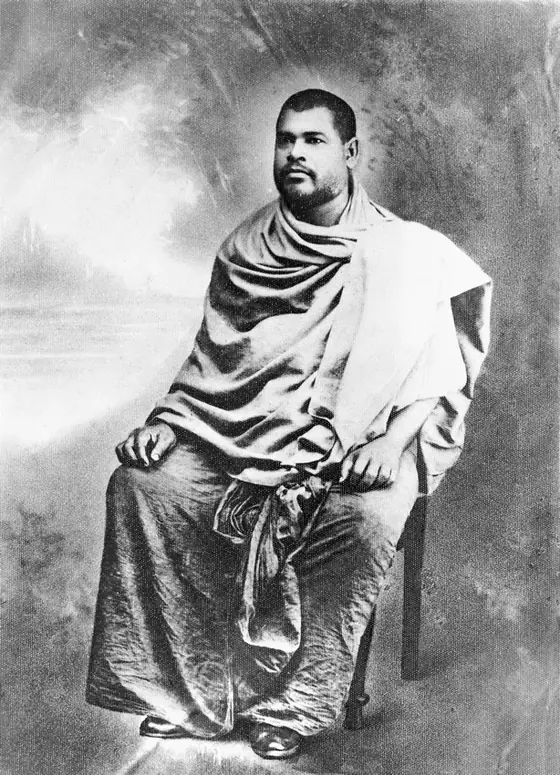
Photographs of Swami Ramakrishnananda survive from his Madras years. The portrait at the head of this page is one of them, from the Ramakrishna Order's archives, published under a free licence and credited on the picture credits page; it is a photograph, not a painting or a generated image. Dates and places follow Belur Math's own life of him, supplemented by the Order's fuller biography, Swami Ramakrishnananda: His Life and Legacy, by the Chennai Math's published history, and by The Vedanta Kesari. Where they differ, both are given: the biography and the Chennai Math date his arrival to March 1897 (the biography to the 17th), while The Vedanta Kesari gives April; Belur Math places his birth in the Hooghly district without naming the village, and the biography names Ichāpur, so the birth pin on the map marks the district and not a verified village site. Belur Math does not explicitly name the place of his death; the biography places it at the Udbodhan house in Bāgbāzār, Calcutta, which is where Belur Math last locates him. The map is drawn on present-day coordinates, not from any historical source; Rangoon and the Ceylon towns are named in the text rather than pinned.
The timeline, plainly
- 13 July 1863 — born Śaśī Bhūṣaṇ Chakravartī, Hooghly district (Ichāpur), Bengal.
- c. 1880–83 — Metropolitan College, Calcutta; the Brāhmo Samāj; tutor to Keshab Chandra Sen's sons.
- October 1883 — first visit to Sri Ramakrishna at Dakṣiṇeśvar with his cousin Śarat: “Please come again and alone.”
- 1885 — throws his Persian books into the Ganga; gives up the B.A. to serve the Master at Śyāmpukur and Cossipore.
- January 1886 — receives an ochre cloth from the Master; 16 August 1886 — holds the pillows at the end; gathers the relics.
- 1886–87 — Baranagore: schoolmaster to pay the bills; “a mother to us”; the vow at Āṅṭpur (December 1886) and formal sannyāsa as Swami Ramakrishnananda (about January 1887).
- 1886–97 — eleven years' unbroken worship of the Master's relics at Baranagore and, from February 1892, Ālambāzār; no pilgrimage.
- February–March 1897 — Vivekananda's promise to Madras; the English-bread test; sails with Swami Sadananda; arrives 17 March 1897; Flora Cottage, then the Ice House.
- 20 April 1897 — Vivekananda's instructions from Darjeeling: sāttvic worship, short ritual, classes, respect for the Rāma-worshippers.
- 1898–99 — the two Kṛṣṇa lectures at the Triplicane Literary Society; the Rāmānuja serial begins in Udbodhan (to 1906); 24 June 1899, the circling of Vivekananda's ship.
- January 1902 — chants the mantras as Vivekananda gives sannyāsa to Swami Paramananda; 4 July 1902 — Vivekananda dies; 29 July, memorial meeting at Pachaiyappa's Hall; the Students' Home committee formed.
- 1903 — Trivandrum (a month); Bangalore (July, twelve lectures); Mysore (October, the Sanskrit address).
- 1904 — Sholapur (July); Machilipatnam and Bangalore (August); Tirunelveli (25–31 December).
- 1905 — Alleppey and Ernakulam (January); Rangoon (20–25 March); Bombay (from 29 March).
- 1906 — the Ice House auctioned; the outhouse; Kondiah Chettiar's land at Mylapore; Ceylon with Swami Paramananda to meet Swami Abhedananda; Mysore (7–12 August) and the Bangalore foundation (20 August); the girls' school with three pupils; letter of 20 November.
- 17 November 1907 — moves into the first Mylapore Math building.
- 1908–09 — fetches Swami Brahmananda from Purī; Rāmeśwaram and Madurai; Bangalore Ashrama opened 20 January 1909; five thousand fed on 22 February 1909; the Kṛṣṇa book published.
- February–March 1911 — the Holy Mother a month in Madras; birthday celebration 2 March; Bangalore 24 March; his health breaks.
- 10 June 1911 — received at the Udbodhan house, Calcutta.
- 21 August 1911 — dies in samādhi at 1.10 p.m.; cremated at Belur Math.
- Afterwards — Mylapore Math rebuilt by Swami Brahmananda, 1916–17; the girls' school recognised 20 October 1917; the Students' Home inaugurated 10 May 1921.
Read the originals
Primary texts and the records kept by the teacher's own institution.
- Belur Math — the Order’s own life of Swami Ramakrishnananda
- Swami Ramakrishnananda: His Life and Legacy — the Order’s fuller biography, with the dated itinerary and sayings (Ramakrishna Mission Vivekananda Educational and Research Institute)
- Sri Ramakrishna Math, Chennai — the history of the monastery he founded, from the Ice House to Mylapore
- The Vedanta Kesari, May 2015 — the school he started in 1906 with three girls, and his letter of 20 November 1906
- Swami Vivekananda’s letter to him from Chicago, 1894 — “I want to be a voice without a form” (Complete Works, vol. 6)
Every daily message names the teacher it came from. Read the messages, or see the whole line this teacher stands in: all fifty-one teachers.