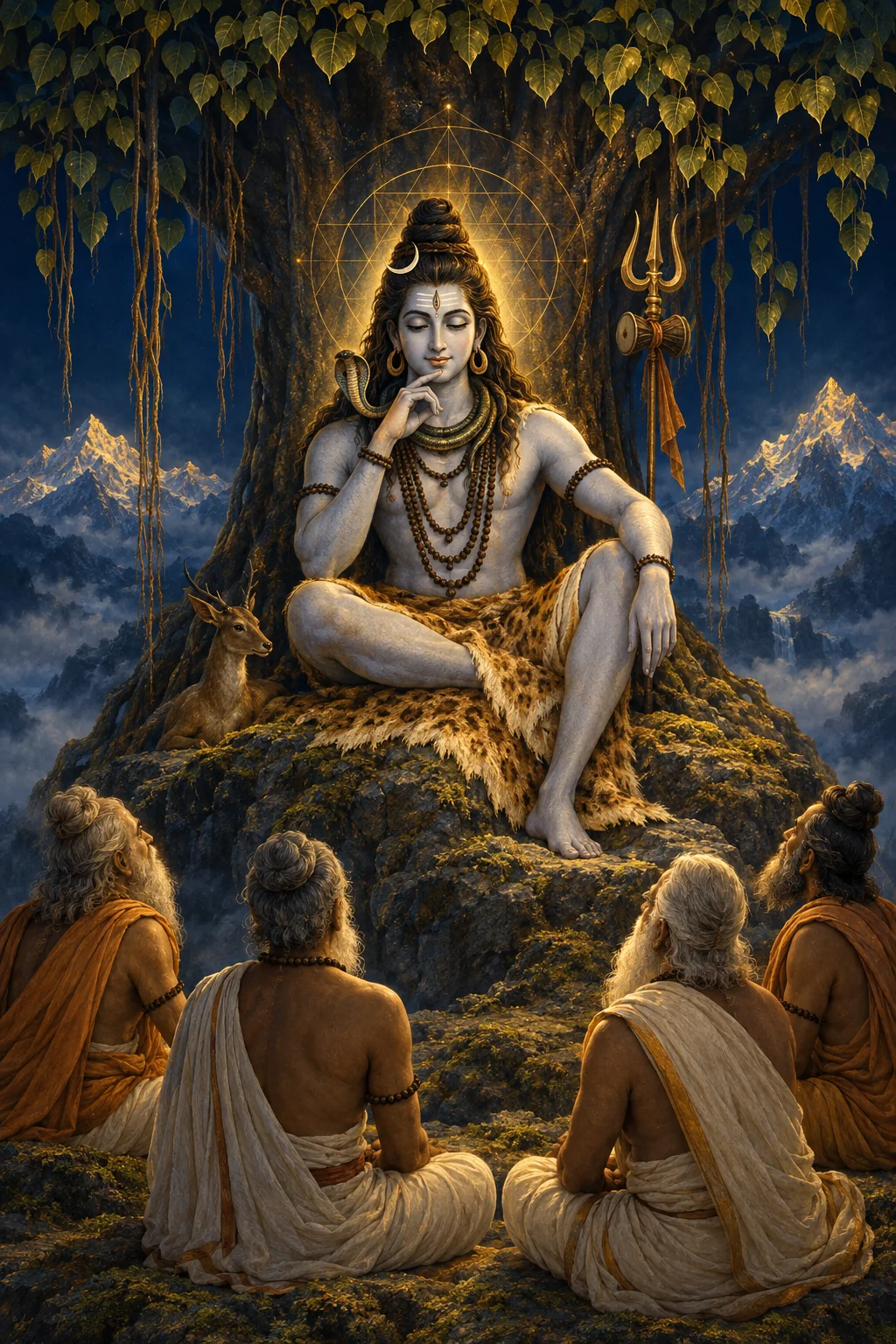
Padmapādāchārya
Direct disciple of Adi Shankara
8th century CE · The Shankara Lineage
- When
- Eighth century
- Born
- South India
- Where the life was lived
- Born to a brahmin named Vimala on the banks of the Kāverī in the old Chola country; performed austerities in the Ahobila hills and met Śaṅkara at Kāśī on the Ganga.
- What is left of it
- The Pañcapādikā, a commentary on Śaṅkara's Brahma Sūtra Bhāṣya.
Mastered the Vedas in his teens, was initiated by Śaṅkara and given the name Sanandana, had the commentaries explained to him three times over, and became the foremost of the four disciples.
The full-length study of this teacher is still being written. What is below is the complete short life, and it is accurate as far as it goes.
The life
He was born Sanandana, son of a brahmin named Vimala, on the banks of the Kāverī in the old Chola country — the delta of rice fields and temple towns in what is now Tamil Nadu. He had the Vedas by his teens, refused marriage, and before meeting his teacher went to the Ahobila hills, in the Nallamala range of the eastern Deccan, for austerities as a devotee of Narasiṃha. Then he walked to Kāśī, on the Ganges, where Śaṅkara was expounding the commentaries. What the tradition records of him afterwards is an appetite for exactness. He had the Bhāṣyas explained to him three times over. The name he is remembered by comes from the story of lotus footprints appearing in the river as he crossed to reach his teacher — which the tradition tells as a story and which need not be believed to see what it is saying about the quality of the man's attention. His Pañcapādikā comments on Śaṅkara's commentary on the first four Brahma-sūtras, and it is the earliest such commentary; every later reading of Śaṅkara's opening moves passes through it, and the whole Vivaraṇa school is built on it. He was appointed, as the accounts have it, to the western seat at Dvārakā on the Gujarat coast — though the maṭhas' own records differ on which disciple went where, and this page follows the source it cites rather than pretending the question is settled.
The turn it rests on
He wrote the commentary that made his teacher's commentary teachable.
What was taught
Author of the Pañcapādikā, an early and influential commentary on Shankara's Brahma Sūtra bhāṣya.
Read the originals
Primary texts and the records kept by the teacher's own institution.
Every daily message names the teacher it came from. Read the messages, or see the whole line this teacher stands in: all fifty-one teachers.