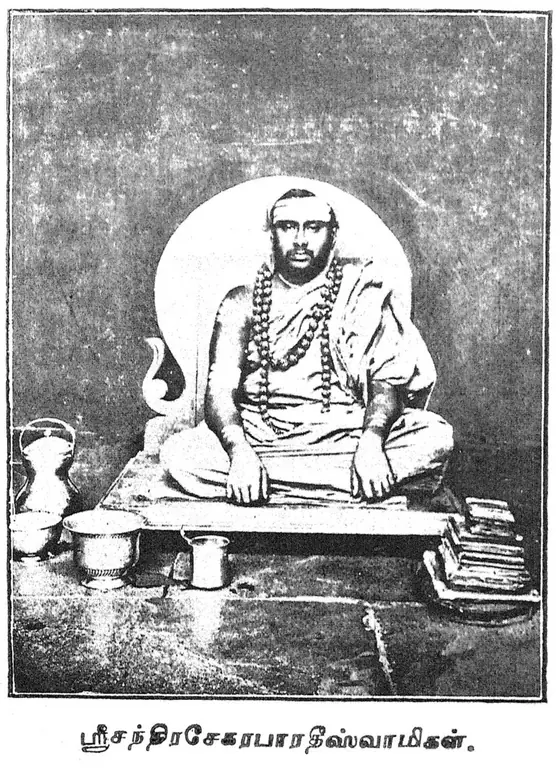
Chandraśekhara Bhāratī III
34th Jagadguru of Sringeri
1892–1954 · The Shankara Lineage
- When
- 1892–1954
- Born
- Sringeri, Karnataka
- Where the life was lived
- Educated at Śṛṅgeri in Karnataka — the local school, then the Peetham's own Sanskrit college — and Jagadguru there from 1912 until 1954.
- What is left of it
- Discourses and letters collected by the Peetham, and his dialogues published as conversations with the Jagadguru.
Became the 34th Ācārya of Śṛṅgeri on 7 April 1912; completed the renovation of the Śāradā temple; initiated his successor in 1931; known in his own time for a degree of detachment unusual even among monks.
The full-length study of this teacher is still being written. What is below is the complete short life, and it is accurate as far as it goes.
The life
Śṛṅgeri sits in the Malnad, the rain country of the Karnataka hills, where the Tuṅga comes down through forest so dense that the maṭha's own records speak of tigers. He was born there in 1892, educated at the local school and then at the Pīṭham's Sanskrit college, and on 7 April 1912, at twenty, he became the thirty-fourth Jagadguru of the seat. He held it for forty-two years, and by every account of the period he held it reluctantly. He completed the renovation of the Śāradā temple and did what the office required, but he withdrew for long stretches into solitude, and in 1931 initiated a successor so that the administration could pass out of his hands. People who met him in his own lifetime described him as a jīvanmukta — liberated while living — which is not a word the tradition uses loosely. What survives best is the Dialogues with the Guru: visitors' questions and his answers, taken down as they happened. They are startlingly free of flattery in both directions. He does not console, he does not perform, and he frequently tells a questioner that the question is the wrong one. He died in 1954, in the river at Śṛṅgeri. For a site like this one he is the corrective to the idea that an institution and an awakened person are incompatible: he was both, and found the second far easier than the first.
The turn it rests on
He treated the office as an obstacle to be borne rather than a position to be enjoyed.
What was taught
Renowned for immersion in the Self while holding the seat; his dialogues were collected as Dialogues with the Guru.
Read the originals
Primary texts and the records kept by the teacher's own institution.
Every daily message names the teacher it came from. Read the messages, or see the whole line this teacher stands in: all fifty-one teachers.