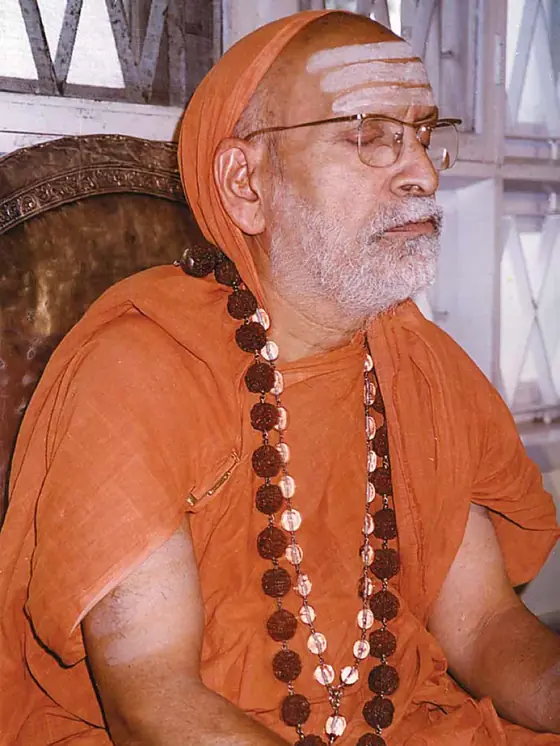
Sri Abhinava Vidyātīrtha
35th Jagadguru of Sringeri
1917–1989 · The Sri Shankara Lineage
- When
- 13 November 1917 to 21 September 1989, by the Sringeri seat’s biography and the Foundation’s books; born on Deepavali of the year Piṅgala, and the seat keeps his birthday by the lunar date. Jagadguru from 16 October 1954.
- Born
- Bangalore, on the Mysore plateau, as Srinivasa, the son of Rama Sastry and Venkatalakshmi; taught by his father to worship Śiva after school, and brought to Sringeri at twelve for his sacred-thread ceremony.
- Where the life was lived
- Sringeri, on the Tuṅgā in the Western Ghats, from 1930 to his death fifty-nine years later: the maṭha at Narasiṃhavana, the Śāradāmbā temple, the Kālabhairava hill. Thirty-five tours in thirty-five years as pontiff, seventeen of them on the road, from Kanyakumari to Kashmir and to Nepal in 1967.
- What is left of it
- Twelve short treatises in Kannada, three of them translated in the centenary biography; the conversations about his own sādhanā recorded by a disciple between 1975 and 1989 and published as Yoga, Enlightenment and Perfection; the discourses and answers collected by the Sri Vidyatheertha Foundation; the Veda and Sanskrit schools he enlarged and the Surasaraswathi Sabha he founded; and the successor he trained.
Initiated into monastic life on 22 May 1931 at fourteen; took charge as the 35th Jagadguru on 16 October 1954; convened the meeting of the four Śaṅkarācāryas in May 1979.
The man
Sri Abhinava Vidyātīrtha was the thirty-fifth Jagadguru of the Sringeri Śāradā Pīṭham, the seat in the Western Ghats that the tradition traces to Sri Śaṅkara himself. He held it for thirty-five years, from 1954 to 1989, and he is remembered in two quite different ways that this page tries to hold together. The first is public. He was the pontiff who took a monastery that had been in government hands since 1936, recovered its administration, put it on a footing that did not depend on the estates it had just lost, and then walked and drove across India for the better part of two decades, consecrating temples, founding schools, and speaking to crowds in five languages. His own seat’s summary is a single sentence: he “was a perfect embodiment of virtues: compassion, truthfulness, patience, fortitude and righteousness.” The second is inward, and it is the reason this page is as long as it is. Between his fourteenth and his nineteenth year, in the years 1931 to 1935, this boy-monk went through a course of yoga and meditation of which he later gave, to one disciple and over fourteen years of conversations, a detailed dated account that has no parallel among the teachers on this site. The account ends on the evening of 12 December 1935, on a hill above Sringeri, and its last sentence is his: “To this day, there has been no deviation from the Reality.”
The two halves belong to one life, and the tradition insists that they do. The Sringeri seat calls him “a great Pandit among Pandits; a great Yogi among Yogis.” His successor’s verse on him, which every Sringeri devotee knows, praises neither his learning nor his yoga first but his judgment:
“vivekinaṃ mahāprajñaṃ dhairyaudāryakṣamānidhim | sadābhinavapūrvaṃ taṃ vidyātīrthaguruṃ bhaje ||” “I worship my Guru Sri Abhinava Vidya Tirtha; Endowed with discrimination; Great perception, a repository of courage, Forgiveness and generosity.”
This page follows the shape of his life. It gives his boyhood in Bangalore and his year as a student at Sringeri; his initiation into sannyāsa at thirteen; the four and a half years of sādhanā, told as far as possible in his own recorded words; the long bond with his guru; the pontificate, the tours, the loss and recovery of the maṭha’s standing; the choosing of his successor; his teaching, of which a great deal survives; and his death at Sringeri in September 1989. It ends, as every page on this site does, with what can be said for certain and what cannot, with how he regarded the other schools, and with what a reader might take from him.
The sources for this page, and what each can bear
He is the best-documented teacher on this site after Swami Vivekananda, and the documentation is of a particular kind: almost all of it was produced by his own institution and by disciples who knew him, and it is candid about that. The reader should know which document is speaking at each point.
- The Sringeri Pīṭham’s own pages: the biography of the 35th Jagadguru on the seat’s site, its page on his tours, its main page for him carrying his successor’s verse, and its long report of the birth-centenary celebrations of October 2017. These are the seat’s official record and are linked at the foot of this page.
- Yoga, Enlightenment and Perfection of His Holiness Jagadguru Sri Abhinava Vidyatheertha Mahaswamigal, published by the Sri Vidyatheertha Foundation, Chennai, and read here in the Foundation’s own online edition. It is the record of conversations that the Jagadguru had with one disciple between 1975 and 1989, in which, in the disciple’s words, “In His infinite and unconditional kindness, Acharyal recounted to me the full details of His divine sport of practising spiritual disciplines and attaining enlightenment and Jīvanmukti.” The book gives the date and place of every conversation it reproduces. It is the source for everything on this page about his inner life.
- The Multifaceted Jivanmukta by R. M. Umesh, the comprehensive biography written at the present Jagadguru’s direction and released at Sringeri on 18 October 2017, the day his birth centenary was completed. It is over a thousand pages, with a tabulated journal of all thirty-five of his tours, and its author says of his method: “in this book, I have avoided hyperbole and stuck to just the presentation of facts.” It is read here in the Foundation’s digital edition.
- The Foundation’s collections of his teaching: Divine Discourses, Exalting Elucidations, Edifying Parables and Didactic Treatises, all published by the Sri Vidyatheertha Foundation and available on its site. They are the source for the section on how he taught.
- His successor’s words: the essay of 1993 and the discourse of 4 October 1989 by Sri Bhāratī Tīrtha excerpted at the head of the yoga book; the śrīmukha he wrote for the biography, dated 12 September 2017; and his discourses at the centenary as reported by the Sringeri seat.
Two conventions in these books need a word. In the Foundation’s volumes the author calls Sri Abhinava Vidyātīrtha “Acharyal” and his guru, Sri Chandraśekhara Bhāratī, “Paramacharyal”; but when Sri Abhinava Vidyātīrtha is himself speaking, “Acharyal” means his own guru, and the reader will meet both uses in the quotations below. The books also capitalise the pronouns that refer to him. Both are kept as printed. Where the machine-read text of these books carries a running page-heading or a footnote numeral inside a sentence, it has been removed and the removal is noted at the foot of the page. Nothing else in any quotation has been altered.
Two further things should be said. This page relies almost entirely on his own tradition’s account of him, because that is where the record is; it does not have independent witnesses to his inner life, and no such witnesses could exist. And the people who wrote these books believed him to be a liberated sage and say so. This page reports what they record, marks it as their record, and leaves the reader to weigh it.
Where the life was lived
Two places hold the whole of his settled life, and they are a night’s journey apart. He was born in Bangalore, on the Mysore plateau, and lived there until he was twelve. He was brought to Sringeri, in the forested hills of the Western Ghats on the river Tuṅgā, in 1930, and from then until his death fifty-nine years later Sringeri was home: the maṭha’s buildings at Narasimhavana on the south bank, the temple of Śāradāmbā on the north bank, and the small hill in Narasimhavana with its Kālabhairava shrine, where he sat to meditate as a boy and where, by his account, the last of his sādhanā was completed.
Present-day coastlines; no border but India’s is drawn. Every pin is a claim and the caption says whose; the claims here are the Sringeri seat’s and the Sri Vidyatheertha Foundation’s books. Bangalore is his birthplace and Sringeri, on the Tuṅgā in the Western Ghats, is where the rest of the life was lived, from the initiation of 1931 through the pontificate of 1954–1989 to his adhiṣṭhāna. The other pins are stopping-places on thirty-five tours that mark turns in the story: Kalady, Sri Śaṅkara’s birthplace, visited on the first tour in 1956 and the site of the university foundation of 1984; Ujjain, where his successor found him in 1966; Kathmandu, where he kept Śivarātri in 1967 at the King of Nepal’s invitation; and Nerur, the samādhi of Sri Sadāśiva Brahmendra, whose poem he was reading in the last week of his sādhanā. No line joins the pins: the tours went everywhere, and the seat’s own count is seventeen years on the road in thirty-five.
- 1Bangalore (Karnataka) — Born Srinivasa on 13 November 1917, the night of Deepavali, to Rama Sastry and Venkatalakshmi, by the Sringeri seat’s biography and the Foundation’s books; lived here until he was twelve
- 2Sringeri, on the Tuṅgā (Karnataka) — Brought here in 1930 for his sacred-thread ceremony, initiated here on 22 May 1931, and home for the remaining fifty-nine years of his life: the maṭha at Narasiṃhavana, the Śāradāmbā temple, the Kālabhairava hill where by his own account his sādhanā was completed in December 1935; anointed 35th Jagadguru here on 16 October 1954; died here on 21 September 1989, and his adhiṣṭhāna stands here
- 3Kalady, Sri Śaṅkara’s birthplace (Kerala) — Visited on the first tour, July to November 1956; kept his third cāturmāsya here in 1984 and laid the foundation stone of the Sanskrit university on 10 September 1984, by the seat’s record
- 4Ujjain, on the Shipra (Madhya Pradesh) — Where he kept cāturmāsya in the summer of 1966 during the all-India tour, and where a fifteen-year-old from Andhra, Sitarama Anjaneyulu, came without leave and was accepted as a pupil: the future Sri Bhāratī Tīrtha, by the seat’s record and the Foundation’s books
- 5Kathmandu, Nepal (Nepal) — Visited 3–11 March 1967 at the invitation of King Mahendra; kept Śivarātri at Paśupatināth on 9 March; the seat calls him the only head of an Āmnāya Pīṭha after Sri Śaṅkara to have visited Nepal. Outside India’s border, which is the only border drawn
- 6Nerur, on the Kāverī (Tamil Nadu) — The samādhi of Sri Sadāśiva Brahmendra, whose Ātmavidyāvilāsa he was reading in the last week of his sādhanā in 1935; he worshipped here on 21 March 1962 and again in June–July 1965, re-consecrating the temple before the samādhi, by the Foundation’s biography
The rest of his geography is motion. His guru, the biography records, “undertook only two tours during His pontificate (1912-1954) and these were confined to South India”; the disciple, by contrast, “toured extensively from Kanyakumari to Kashmir, nay, even beyond to Nepal, and Dwaraka to Puri.” The map marks four of those stopping-places because they mark turns in the story: Kalady in Kerala, Sri Śaṅkara’s birthplace, which he visited on his first tour; Ujjain, where a boy from Andhra found him in 1966 and stayed; Kathmandu, where in March 1967 he kept Śivarātri at the invitation of the King of Nepal; and Nerur on the Kāverī, the resting-place of Sri Sadāśiva Brahmendra, whose verses he was reading in the last week of his sādhanā. The biography counts thirty-five tours in thirty-five years and notes that “During His pontificate of 35 years, He toured for over 17 years, the total number of tours, long and short, being 35.”
The names: Srinivasa, Abhinava Vidyātīrtha, Acharyal
He was named Srinivasa at birth, and the books call him Sri Srinivasa Sastry for the years before his initiation. The monastic name was given by his guru on 22 May 1931, and the Sringeri seat offers a reason for it: “The Guru named His holy successor designate Abhinava Vidyatirtha, perhaps because He foresaw that His illustrious disciple would equal the great Yogi, the 10th Pontiff of the Peetham, Sri Vidya Shankara Tirtha, in Yoga.” Abhinava means “new”; the name declares him a new Vidyātīrtha, after the tenth pontiff, whom the tradition remembers as a master of yoga and over whose samādhi, the tradition holds, the Vidyāśaṅkara temple at Sringeri was raised in the fourteenth century. The seat’s word is “perhaps”, and this page keeps it.
In the Sringeri usage he is Mahāsvāmin or Mahaswamigal, with the title Jagadguru Śaṅkarācārya that every occupant of the seat carries. Within his lifetime, and in the Foundation’s books, he is Acharyal, the Tamil-inflected form of ācārya with the honorific ending, and his guru is Paramacharyal. Since his death the seat uses Jyeṣṭha Mahāsannidhānam for him in some records. This site, as a mark of respect, writes Sri before his name, as it does for every teacher.
Birth and family: Bangalore, the night of Deepavali, 1917
The seat’s biography gives the facts in one sentence: he was “Born to Venkatalakshmi Ammal and Rama Sastry, a primary school teacher, on November 13, 1917, the day of Deepavali at Bangalore”. His successor, in the essay of 1993 excerpted at the head of the yoga book, gives the same date in the traditional calendar: “This great soul took birth at Bangalore on Āśvina-kṛṣṇa-caturdaśī of the year Piṅgala (November 13, 1917) as the eldest son of a virtuous couple, Kaipu Rama Sastry and Venkatalakshmi, and was named Srinivasa.” The day was Naraka-caturdaśī, the Deepavali day on which, the tradition says, Kṛṣṇa slew Narakāsura; the seat’s centenary report notes that his successor drew attention to the coincidence at the hundredth Jayantī.
The family name Kaipu points to a village; the father was a schoolteacher; there were an elder sister and a younger brother, both of whom appear in the boyhood stories. Nothing else about the household is recorded in these sources, and the boyhood is told, in both books, not as a chronicle but as a set of incidents remembered by those who knew him and, in some cases, told by him. The successor’s summary of the boy is that he was “endowed from childhood with devotion to God, detachment to sensory objects, fondness for noble people and with good conduct”. The incidents that follow are the tradition’s illustrations of that sentence.
The boy in Bangalore
The yoga book’s third chapter gathers what was remembered of him before Sringeri, and the stories have a consistent character: a helpful, argumentative, fearless child with a settled intention. He did housework so that his mother should not have to, and explained why: “My mother is busy in the kitchen and My elder sister is assisting her. Who will attend to this young one? If I do not do so, this task will add to my mother’s strain.” When a friend’s father punished the boy by making him bend under a heavy stone, Srinivasa intervened: “You are older than Me and wiser too. Your son is writhing in pain. Please let him rest for a while. You may place the stone on My back instead and I shall support it for him.”
Two of the stories are about the tongue and about pain, and both are the kind of thing a later yogin’s biographers would remember. Challenged by friends who were screaming for water after a pungent meal, he ate a handful of chillies without a flicker and then told them, “It is not necessary to consume spices like this. You have demanded it and so I ate them to convince you that it is possible to be contented with what food one gets.” When the same friends tested his forbearance by beating him with a stick, he bore it and then told them the story of a Buddhist monk who humbled a king by patience. The book says the boys “hung their heads in shame on hearing the tale”.
He was not passive, though. Finding a boy tearing the wings off insects and feeding them to a dog, he twisted the boy’s hands until he screamed and then said, “The insects also must feel like this. Just as you have hands, the insects have wings. Abstain from torturing them hereafter.” He argued for the existence of God with a friend who said no one had seen Him, and his argument was already the argument from testimony that Vedānta uses for scripture: “Can you prove that there is no God? Would you say that something does not exist because you have not seen it? For instance, have you seen Bombay?” When the friend replied that he believed in Bombay because others had seen it, the boy closed the point: “Likewise, our ancient sages who had seen the Lord have given clear indications to that effect. What is wrong if we unreservedly accept their words? Their experience cannot be set aside and so we must concede the existence of God.”
Asked what he would do when he grew up, he said he would strive to realise God, and gave as his reason, “For that is what is good.” Dared to run to a tank the boys believed haunted, he went on a moonless evening, washed, and came back; asked why he had not been afraid, he said, “I was chanting the name of God. How could any evil spirit accost Me?” And when a friend asked what use there was in becoming a sannyāsin when one could become a king, the answer recorded is this:
“What long-lasting benefit is there in becoming a king? An emperor can enjoy only when he is at the helm of power. This state must come to an end sooner or later. If, however, I become a saṁnyāsin, I can constantly meditate and be without any worries. There will be a wonderful opportunity to behold God and I shall remain ever protected by Him.”
The book adds: “He was just thirteen then.” The Sringeri seat’s biography compresses all of this into a line — “From a very young age, He began expressing to His friends a desire to renounce the world and attempt to see God.” — and the compression is fair. What the stories describe is not a mystical childhood; there are no visions in them. They describe a boy who had decided.
Sringeri: the sacred thread and a year as a student
How he came to Sringeri is told only in outline. His successor writes that he “became the recipient of the unlimited kindness of then pontiff of the Sringeri Sharada Peetham, the pre-eminent Jagadguru Sri Chandrasekhara Bharathi Mahaswamigal, who it was who arranged to bring Him to Sringeri.” The yoga book gives the date of what followed: “Acharyal’s upanayana was performed at Sringeri in Śāradāmbā’s temple on 4.5.1930. With the express approval and the blessings of Paramacharyal, He stayed on at Sringeri as a student; His parents returned to Bangalore.” The seat’s biography records that the ceremony “was performed at the Math’s expense at the Sharadamba temple in Sringeri”. He was twelve and a half.
He lodged not at the maṭha’s school across the river but at Narasimhavana itself, in the guru’s own compound, with a small group of boys chosen to study alongside him. The book’s account of that year is a series of examinations, and the examiner was the Jagadguru. He would ask the boys whether the day’s food had been good; the others gave opinions and Srinivasa said nothing, and when asked why, answered, “Whatever we get is Acharyal’s prasāda. As such, it is always tasty.” On evening walks to the Kālabhairava temple on the hill he made them chant verses in chain, each beginning with the syllable that ended the last, and set them puzzles. One evening he recited a verse in which the syllable me, “mine”, is also the bleat of a sheep, and asked the next day why he had done so. Srinivasa’s answer:
“This verse illustrates the greatness of Sanskrit. The syllable ‘me’ means ‘mine’. Thus, the verse portrays the play of the ego in man. The syllable also represents the sound made by sheep. Thus, the same sound gives rise to more than one sense.”
Another evening’s verse contrasted a sow that quickly bears a hundred wretched piglets with an elephant that after long gestation bears one calf fondled by kings. Srinivasa read it as a verse about schools: a great school may teach a hundred who grasp nothing, while a small one with a single able student brings it fame. The boys’ Sanskrit teacher, Vaidyanatha Sastry, read it otherwise, because the Jagadguru had recited it minutes after Srinivasa’s mother had left after her darśana: “It is given to only one mother to give birth to a child who becomes a Jagadguru worshipped by kings. Other mothers do not get this blessing.” Asked later whether the verse had not been about his own mother, the boy said, “I could not even think of advancing such a meaning. So, I thought of another one.” The seat’s biography puts the year’s result plainly: “Srinivasa was unquestionably the most brilliant of the students at the Math and came up with thought-provoking interpretations of the Sanskrit verses that He was taught.”
One detail from that year he supplied himself, in 1982, and it is the first sign of the temperament that the next chapters of this page will follow. Of the Gāyatrī mantra he had received at his upanayana he said: “I felt a great fondness for the Gāyatrī-mantra and started chanting it mentally whenever I could, right from the day of My upanayana. In about a month’s time, I was able to do so even while engaged in My regular activities. I was happy to find that I soon mentally repeated the Gāyatrī during My dreams too. I did not disclose My practice to anyone.” The guru, meanwhile, was teaching detachment. The book records him taking Srinivasa and the teacher aside to debate the merits of the householder’s life against the renouncer’s, making the boy argue the householder’s case first and then dismantling it with verses on the shortness of life. The reader can see what was being prepared.
The fever, the announcement, and 22 May 1931
The turn came through an illness. “In 1931, Sri Srinivasa Sastry developed high fever one night and became delirious. He started to speak incoherently. When the matter was reported to Paramacharyal, He neither authorised medical attention nor did He give sacred ash as prasāda as He had done in the case of the other students when they had taken ill. He, however, specifically instructed Vaidyanatha Sastry to note whatever Sri Srinivasa Sastry uttered while delirious and inform Him.” What the boy kept saying, the book records, was “sadguro śaraṇaṁ śivo’haṁ śivo’ham” — “O Sadguru, You are the refuge. I am Śiva. I am Śiva.” The book calls this “an unusual combination of a dedication to Paramacharyal and a declaration of the Truth”. After three days the guru came, touched him, and the fever left; that night and on the nights that followed, during his worship of the Candramaulīśvara liṅga, the Jagadguru prayed, “sarvajñaṁ śrīnivāsaṁ kuru śivadayite satvaraṁ madvinamram” — “O beloved of Śiva, quickly make Srinivasa, My disciple, omniscient.”
“About a month later, Paramacharyal formally announced that impelled by the will of Śāradāmbā and His Guru, He had decided to initiate Sri Srinivasa Sastry into saṁnyāsa and nominate Him as His successor to the Peetham. The initiation into saṁnyāsa took place on May 22, 1931.” The seat’s biography gives the age: “On May 22, 1931, Srinivasa was initiated into the holy order of Sanyasa, even before He had attained the age of 14.” He was thirteen years and six months old, and the reader should pause on that. A Paramahaṁsa sannyāsin’s vows are for life; the tradition holds that a boy of that age may take them only when a competent guru judges him ready and the parents consent, and both conditions are recorded here. His successor’s śrīmukha of 2017 makes the fact the first thing it says about him: “Having embraced saṁnyāsa at the age of fourteen and having duly performed the duties ordained for a saṁnyāsin till the end, He was an ideal for all ascetics.”
The evening of the initiation produced the first of the stories about the bond between guru and disciple that fill the biography’s chapter on it. The two were to ride through Sringeri in palanquins, gold for the Jagadguru and silver for the new sannyāsin. “Paramacharyal held out His finger and Acharyal grasped it. Paramacharyal led the way till He reached the silver palanquin. Unexpectedly, He withdrew His finger and occupied it. Then, He asked Acharyal to sit in the golden palanquin. This was most unusual.” The book explains why: the disciple should follow the guru and never take his seat, and the crowd could not know the reason. The boy obeyed. Asked decades later what he had felt at receiving so difficult an order, he answered: “What was there to feel? ‘My Guru’s command is inviolable. As a disciple, it is My duty to carry it out.’ That was My only thought then”. It is the sentence to hold onto through everything that follows, because everything that follows was done, by his own account, under instruction.
The book that records his sādhanā fixes its own limits at this point: “The account covers the period from May 1931, when Acharyal became a Paramahamsa-saṁnyāsin at the age of thirteen years and six months, to December 1935, when He attained perfection at the age of eighteen.” Those four and a half years are the subject of the next part of this page.
The seven dreams: haṭha-yoga, from the first night
What follows in this and the next four sections is drawn from one book, and the reader should hold its nature in mind throughout. Yoga, Enlightenment and Perfection is not a memoir. It is a disciple’s record of what his guru told him, in conversations dated between 1975 and 1989, about events of 1931 to 1935; the disciple asks and the guru answers, and the book prints both sides. Its author says the conversations “have been ordered to reflect the sequence in which the principal events occurred”. This page follows that sequence. The Sringeri seat’s own biography compresses the whole of it into three sentences, and one of them is the frame for everything below: “Ever since He was initiated into Sanyasa, Sri Abhinava Vidyatirtha was extremely keen on being an ideal ascetic. Mere reading of the scriptural texts could never satisfy His need for perfection. The Acharya was temperamentally inclined to the royal path of Yoga.”
The account begins on the night of the initiation itself. In May 1975, after a disciple reported having been taught a text in a sequence of dreams, the Jagadguru told him, “I can particularly appreciate your experience because I had a similar one when I was young.” Then: “Parameśvara (Śiva) instructed Me about yoga through seven dreams that occurred on successive nights. Each dream was a continuation of the preceding one.” The first is told in detail.
“I was exhausted when I retired for the night on the day I was initiated into saṁnyāsa. As was usual, I fell asleep almost the moment I shut My eyes. That night I had a dream that I can vividly recall even now. In it, I found Myself on the amazingly scenic summit of a tall, ice-clad mountain.” … “In front of Me, at a distance of about twenty feet, I saw a huge, crystal Śivaliṅga. A torrent of water was falling on it in a column from above. I could not see the source of the water. I could hear the chanting in chorus of the Rudra (praśna) but no chanter was visible. Suddenly, there was a great flash of light and from the Liṅga, Lord Śiva manifested.”
The dream-Śiva has one face and two arms; he “smilingly looked at Me and raised His right hand in a gesture of blessing. I felt a great power entering into Me. Automatically, I began to chant the Praṇava mentally.” What follows is a lesson in postures and breath. The Lord sits in the lotus posture and then the siddhāsana, corrects the boy’s posture with his hands, and “Seated in the siddhāsana, the Lord demonstrated how to perform prāṇāyāma.” The description that follows is technical: inhalation through one nostril, the chin-lock, the abdominal lock, the body rising a foot from the ground on retention and settling again on exhalation. Asked whether the Lord named the postures and locks, he said, “No. The Lord did not refer to the padmāsana and siddhāsana by name either.” Asked whether the Lord gave the relative durations of the phases of breath, he said, “What need was there for Him to do so for I was able to time them Myself?”
A detail in the telling shows the boy’s scruple, and it is the kind of detail that makes the account credible as a record of a temperament whatever one makes of the dream. Two days before his initiation, he said, he had resolved that his renunciation should be so firm that he would not see himself in a dream in the white cloth of a student, nor chant in a dream the Gāyatrī that a Paramahaṁsa sannyāsin gives up: “Dreams are not under My control. Mistakes committed in them do not result in sin. Nevertheless, My renunciation should be so sincere and firm that after being initiated into saṁnyāsa, I should not see Myself in any dream as clad in white as I am now.” In the dream, he noted, he was already in ochre. The six dreams that followed continued the lesson, and the book’s fourth chapter records the years of daily practice of what they taught. It is from this period that the accounts of his physical discipline as a young monk descend; the biography’s chapter on it is titled “Haṭha-yoga Mastered”.
The Goddess’s lesson: the kuṇḍalinī shown
The second thing that happened to him in 1931 he described in May 1978, when he handed a disciple two English books on the kuṇḍalinī and asked for comments. Asked about his own first experience of it, he said: “This took place a few months after My being initiated into saṁnyāsa (on May 22, 1931). I had just finished My morning āhnika and was about to get up.” He joined his palms, without intending to, and said a salutation to Śāradā. “Abruptly, I felt an upsurge of joy and stopped being aware of My surroundings. It began to seem that My body was becoming transparent and that I was seeing My backbone from some vantage point in front of My chest.”
What follows is a guided anatomy of the subtle body as the yoga texts describe it, delivered, he said, by “A mellifluous female voice” that named each channel as it appeared — the suṣumnā, the vajrā, the citriṇī, the iḍā and piṅgalā arching to left and right — and then the lotus at the base of the spine:
“At the pericarp of the lotus, there was a Śivaliṅga. A cobra lustrous like lightning lay with its body making about three and a half turns around the Liṅga. The serpent’s hood rested on the upper end of the Liṅga and its mouth effectively blocked the passage to the triad of tubes. The serpent was motionless and appeared to be fast asleep.”
Asked whether he could see the speaker, he said, “No. I just heard the words.” The book elsewhere calls this “the dream that Acharyal had a few months after saṁnyāsa in which Śāradāmbā threw light on the arousal and ascent of the kuṇḍalinī”; he himself attributed the voice to the Goddess of the Sringeri temple. Two things should be noticed. The first is that the lesson is a lesson: it names and shows, in order, exactly what the Sanskrit manuals of yoga describe, and the boy who received it had not yet read them. The second is what he did with it. He did not, by his own account, try to rouse the serpent. He practised the postures and the breath he had been shown in the dreams and waited four years. When the ascent came, in 1935, it came unbidden and after his first samādhi, not before it; that order matters in his teaching and will be returned to.
The guru’s method, and the first samādhi
The Sringeri seat’s biography records that “Sri Jagadguru Chandrasekhara Bharati Mahaswamigal initiated the Acharya into the process of meditative contemplation when He was just 15 years of age. By the time Acharya attained 16 years of age, the deep contemplation of the Self became natural.” The yoga book preserves the lesson itself, as the disciple remembered it in June 1976. One morning during the guru’s worship, the boy was asked how he began the visualisations his daily rites required, and then whether he would like to practise deep meditation on divine forms independently of them. He said he would. The guru told him to sit:
“I will tell You a simple method that will help You to start any meditation that You wish to do. During meditation, there is no need for You to use a rosary. Instead of straightaway picturing a devatā in Your heart, first direct Your gaze to the middle of Your eyebrows. While doing so, You could chant a mantra such as the Praṇava.” … “You will experience a tingling sensation between the brows. After You mentally apprehend a light in that region for some time, picture the divine form that You wish to meditate on. Then, focus on that form.”
The book prefaces this with a caution that is the Jagadguru’s own and that this page repeats for any reader tempted to try it: “He said that in His opinion, it ought to be practised only if advocated by the Guru. Those for whom it is unsuited would not derive benefit from it.” The boy went the same day to the Śāradāmbā temple and began. He meditated on the Goddess in the mornings, on Bālā-Tripurasundarī in the evenings, and in the evenings he climbed the hill in Narasimhavana to the Kālabhairava temple. In March 1981, sitting in that temple with the disciple, he said: “This is where I first started meditating in the evenings. This is also where I first attained savikalpa-samādhi (the exalted stage of yoga preceding nirvikalpa-samādhi).”
The first samādhi came on a form of the Goddess. “After about one and a half hours, I regained awareness of the body and opened My eyes. I could literally see Ambā in front of Me within the temple. I reached out and touched Her feet with My hands. A few moments later, She disappeared.” The next four, he said, came on forms of Viṣṇu — Lakṣmī-Narasiṁha, Kṛṣṇa with a flute, the child Mukunda, Viṣṇu with eight arms — and the book notes their date: “Acharyal’s first savikalpa-samādhi as also the next four savikalpa-samādhis occurred months before Acharyal completed eighteen on October 26, 1935.” The book’s date is his birthday by the traditional calendar, the Deepavali day of 1935; by the civil calendar he turned eighteen on 13 November. The first samādhi therefore fell in the first half of 1935, when he was seventeen.
The weeks after it have a boy’s curiosity in them. He tested whether he could enter samādhi lying down, then standing on his head — “I performed śīrśāsana near a wall to arrest a fall, if it occurred during meditation.” — and having found that he could, “I did not bother to go into samādhi in śīrśāsana in the future.” He reported to his guru on several occasions and, asked how the guru responded, said only, “He normally expressed His satisfaction and approval.” The ascent of the kuṇḍalinī he had been shown four years before came now, unsought, during the cāturmāsya of 1935: “Before I visualised any form, I felt something like an electric shock at the middle of My soles. As the sensation started to move upwards, diffusing through the body, I felt intense heat. My body jerked sharply. Then, My breathing abruptly stopped. In moments, the sensation travelled up My back and into My head. I plunged deeply into savikalpa-samādhi.” Asked whether the ascent was swift or slow, he answered like an observer: “The movement from the soles to the base of the back was very quick. It was almost instantaneous. From the base of the back to a little below the navel, the ascent was slower but, nonetheless, swift. Thereafter, it was like that of an ant.”
From forms to the formless: Thursday, 5 December 1935
Up to this point everything in the account is yoga in the sense of Patañjali: concentration on a form, absorption in it, the body’s currents. Advaita Vedānta holds that no such absorption is itself liberation, because every form is still a form and the knower is still standing apart from it. The turn from the one to the other is the centre of this life, and by his account it was made for him. The book dates it: Thursday, 5 December 1935, the tenth day of the bright fortnight of Mārgaśīrṣa in the year Yuva.
That evening on the hill he did not chant the Praṇava alone. “Having adopted the siddhāsana, I mentally offered My namaskāras to Acharyal and Śiva before commencing My meditation. I directed My gaze to the space between My eyebrows. Keeping My eyes fixed, I mentally chanted ‘oṁ namaḥ śivāya’ That day, I did not chant just the Praṇava.” He visualised Śiva with Pārvatī, five-faced and ten-armed, in the lotus of the heart. “Suddenly, the form became extraordinarily vivid. No effort to concentrate was needed any more. I could then literally experience the immediate presence of Śiva.” After what he later judged to be an hour and a half he became aware of his body, opened his eyes to the sun near the horizon, and: “I then definitely beheld Śiva in front of and facing Me. Oh, what a glorious sight that was!”
What the Lord said is given in Sanskrit and English, and it is the instruction of a guru to a disciple who has finished one course and must begin another:
“vatsa śvaḥprabhṛtyatra nirākāre pare tattve manaḥ samādhatsva । acireṇa brahmasaṁstho bhaviṣyasi” — “O, child, from tomorrow, fix Your mind on the Formless, Supreme Reality here. You will soon become established in Brahman.”
“Then Śiva blessed Me by placing His hand on My head. Having done so, He disappeared. How compassionate He is to grace in such abundance one so insignificant and lacking in devotion as I! No sooner had He vanished than there was a drizzle.” He composed ten verses on the spot, and never wrote them down; asked for them decades later he said, “They were, after all, just the prattle of an ignorant boy and not the compositions of any mahātman or of literary value.” One sentence shows how he understood what had happened: “As the Lord had directly instructed Me as a Guru, I thought of meditating on Him as Dakṣiṇāmūrti, the Teacher.” A reader is free to take the vision as he pleases. What the page can say is that the man who reported it took its content as a command, and that the command was the Advaita one: leave the form, even this form, and turn to what has none.
The last week: 6 to 12 December 1935
The book gives the dates of the final phase in a table, and they can be set out plainly. On Friday 6 December he began meditation on the attributeless Brahman after reflection on the scriptures. On Saturday 7 December he attained savikalpa samādhi with Brahman, not a form, as its object. On Tuesday 10 December, the full-moon day, he attained nirvikalpa samādhi. On Thursday 12 December, he says, the realisation became final and permanent. Each step is described in his own words in the conversations of 1982 and 1984, and a little of each is given here.
The method of the first days was the Advaita method of stripping name and form from being. “Having reflected in this manner, I started My meditation, taking the sun as the object of relevance. I gazed at the sun, which was to set in about half an hour and was pleasant to behold. With effort, I increasingly ignored everything about the sun, such as its shape, size and brightness, and focused on just its being.” Then: “Abruptly, I almost totally forgot Myself. Just unqualified being, unrelated to space, time and objects, remained and that too not as an inert entity but as objectless consciousness. When My mind descended from this savikalpa-samādhi, I found that the sun had already set and that the place was illumined by the moon.” The next morning a wall served as well as the sun had. By the evening he needed no object at all but a sentence, said to himself with open eyes: “sarvādhiṣṭhānabhūta-sanmātra-brahmāsmi” — “I am Brahman of the nature of absolute existence, the substratum of everything.” He learned only much later, he said, that the Vedānta texts classify exactly these varieties of samādhi, and “that I had properly practised all of them”. Of the full-moon day he says simply: “That evening I transcended the stage of savikalpa-samādhi and attained nirvikalpa-samādhi.”
What happened between the full moon and the Thursday is the part of the account that matters most for Advaita, because it is here that yoga and knowledge part company. On the afternoon of the full-moon day he read the Ātmavidyāvilāsa of Sri Sadāśiva Brahmendra, and a phrase in its fourth verse stopped him: “Vigalita-sarvavikalpaḥ śuddho buddhaścakāsti paramātmā” — “The Supreme Ātman shines pure, enlightened and devoid of all variety.” His reflection on it is the reflection of a Vedāntin on his own samādhi:
“Even in samādhi, I have not realised the Ātman as shining totally free from diversity. After all, the sense of ‘I’ and the awareness of the distinction of the concentrator, concentration and the object of concentration also shine, no matter how feebly.” … “Infinite bliss is, on the authority of the scripture, My very nature. What is My very nature cannot, undoubtedly, be known objectively by Me. It is avidyā that conjures diversity in the Truth, which is non-dual. Thus, no matter how great it may be, bliss that is experienced by Me as an object lies in the realm of avidyā. It must not be savoured but transcended.”
This is the whole of Advaita in a paragraph, and it was thought by a boy of eighteen about his own experience: that bliss enjoyed is still duality, that what one is cannot be an object, and that samādhi is a means and not the end. The end, as he describes it, came two days later on the hill, an hour and a half before sunset:
“I directed My gaze to between the brows and, without any premeditation, chanted, ‘oṁ namaḥ śivāya’ rather than just the Prāṇava. Soon, I beheld a moon-like disc of light between My brows. The mind became increasingly quiet, the sense of ‘I’ faded away and, effortlessly, nirvikalpa-samādhi ensued. When I opened My eyes, the sun was about to set. Two birds were seated on My shoulders. That Brahman is all was as clear as a fruit in one’s palm.” … “Shortly after I regained awareness of the body and the surroundings, a big monkey bounded up to Me and positioned itself on My lap. After being cuddled for a while by Me, it left. I walked down the hill and found My attendant waiting there with a lamp. By the grace of Acharyal and God, the ‘svanubhavo brahmātmanā saṁsthitiḥ (direct realisation of Brahman and firm establishment in Brahman)’, spoken of in the Vivekacūdāmaṇi (in verse 2) occurred at one stroke that evening. To this day, there has been no deviation from the Reality.”
He was eighteen years and one month old. The Sringeri seat’s biography says, without the detail, “He was a Jivan Mukta before He was 20.” The tradition’s claim is that from that evening he was what the texts call a jīvanmukta, one liberated while living. This page cannot verify such a claim and does not try; it records that the man himself made it, quietly and once, in the last sentence quoted above, and that those who lived with him for the next fifty-four years believed it.
The drama that followed: the embrace, the danger, and the tiger
Asked in August 1989, a month before his death, whether he had told his guru that the Lord had foretold the completion of his sādhanā, he said no, and gave a reason that is itself a piece of Advaita teaching: “Being My Guru and an excellent śrotriya- brahmaniṣṭha (sage versed in the scriptures and established in Brahman), He had the authority and the competence to decide upon not only the initiation and form of My sādhanā but also its progress and culmination.” He cited Yājñavalkya confirming Janaka’s realisation and Sanatkumāra correcting Nārada. It is the guru who says whether the disciple has arrived. And the guru did:
“As I was returning from the hill, I saw Acharyal standing outside Sacchidananda Vilas and looking in My direction. He beckoned to Me and went inside. When I went to His presence, He was alone. Even before I could prostrate before Him, He rushed to Me and embraced Me. Then, holding Me by My shoulders, He said, ‘I am so very happy.’”
Sri Chandraśekhara Bhāratī then recited the Upaniṣadic passages on the knot of the heart being cut and said, “Such declarations of the Śruti and Smṛti are applicable to You who abide as the Supreme Brahman.” The disciple’s comment fifty-four years later was not about himself: “Such was Acharyal’s greatness that He highly appreciated anything positive in another. His instructions, blessings and grace were responsible for My sādhanā and whatever I achieved. Yet, Acharyal did not take any credit. He was so thoroughly free from egoism. Where can one now find the likes of Him?”
Then came a danger the texts warn of and few lives illustrate. “Since that evening, samādhi ceased to have any role as an aid to realise Brahman.” But the habit of it had become overwhelming; his mind fell into nirvikalpa samādhi on its own, at night, during his rites, during his Tarka lesson, for longer and longer, until emerging became difficult. On the third morning: “I descended from samādhi on becoming vaguely aware of the intonation of the Praṇava in Acharyal’s voice. When I opened My eyes, I beheld Acharyal Himself. He was seated next to Me and was gently stroking My head with His hand.” The guru had come before dawn. What he said, as the disciple recalled it, was this:
“Last night, however, the Lord made it clear to Me that Your samādhi had become so intense that You would not emerge from it on Your own. Unless aroused from samādhi, You would remain in it till physical death.” … “Do not leave Me by entering irreversible samādhi and discarding Your human form. There is so much to be done by You for Me, for others and for the Math.”
The disciple obeyed, as he always did, and within a day could again fix the length of his samādhi in advance. But the guru had a second instruction, and it is the one that made the pontiff of the next half-century. A face that showed only peace, he told the boy, would be unexceptionable in an independent sannyāsin; “On You, however, rests the future of this great Peetham.” He held up the example of his own guru, the thirty-third Jagadguru, who though ever established in Brahman had wept, rejoiced, promoted learning and disapproved of wrong, “enacting His role to perfection”. Then:
“Accordingly, though unswervingly established in Brahman, You should study diligently and master the śāstras. Further, You should learn to show, whenever appropriate, interest, appreciation, concern, anger, curiosity and the like in Your dealings with devotees, Math staff and others.”
The disciple’s report of how this went is the most human passage in the book. “Displaying emotional responses proved tougher to achieve. The mind felt just peace and bliss and the emotions that had been so readily experienced in the past seemed no more than a vague, distant dream. Laughable though it sounds, the sādhanā that followed the vision of Śiva was simpler and smoother than learning afresh to display anger or anxiety.” And then, the book records, pointing to himself and laughing: “This short-tempered tiger was a very gentle cow at that time!” Those who knew the Jagadguru of the 1970s and 1980s, a man of decided views who could, by his own description, be short-tempered in the maṭha’s affairs, will understand the joke. He had been taught to be a tiger, and had learned.
Learning after knowing: Nyāya, Vedānta, and the guru’s letters
The order of his education is the reverse of the usual one, and both his seat and his successor say so. The Sringeri biography: “Strange as it may seem, His formal lessons in Vedanta commenced much after he had attained perfection in yoga. His guru expounded the Bhagavad Gita Bhashyam, Brahma Sutra Bhashyam and Bhashyam on Isa, Kena, Katha and Taittiriya Upanishads. To the Acharya, these lessons merely served to confirm what He had already learnt through His personal experiences earlier in life.” The order of study was the traditional one: first Nyāya, the school of logic that Advaita students learn in order to argue, and only then Vedānta. His successor writes: “Commencing thereafter the study of the Nyāya-śāstra, He attained extraordinary proficiency in it in a few years and, even as He imparted it to students, His unique intellectual prowess was readily discernible.” His Nyāya teacher in 1935 was Sri Ramachandra Sastry; the lessons he missed in the days after 12 December were Tarka lessons.
The guru followed the studies from a distance and by letter, and his successor quotes one such letter in Sanskrit with a translation: “I experienced unlimited happiness on learning from Your letter about the healthy condition of Your body and about the mode of Your study and teaching, which are proceeding without any impediments.” Then, “diligently learning the Vedānta-śāstra from His Guru, He acquired excellent proficiency in it too.” He mastered Sanskrit, and “Though not enamoured of composing poems, He did glorify His Guru in beautiful verses.” Two are quoted; one of them salutes “the ascetic whose mind is absorbed in consciousness and the lustre of whose feet destroys the blinding darkness of avidyā”. He learned to speak Telugu, Tamil, Kannada and Hindi as well as Sanskrit, and “North-Indian scholars have been struck with awe on hearing Him discourse in chaste Hindi.”
Why the order matters is worth a sentence, because it bears on a question readers of this site often ask: whether Advaita is a philosophy to be studied or an experience to be had. His life answers that the two are not rivals. The realisation of December 1935 was, by his own account, brought on by scripture — the Ātmavidyāvilāsa, the Vivekacūḍāmaṇi, the Upaniṣadic sentences he repeated to himself — heard from his guru and reasoned over, exactly as the texts prescribe: hearing, reflection, steady contemplation. What he learned afterwards was how to defend and transmit it. The biography’s summary is that the later lessons “merely served to confirm what He had already learnt”; the man himself, as the next part of this page shows, spent the rest of his life teaching others in the order they needed rather than the order he had followed.
Two decades as the disciple: the guru who withdrew
Between the realisation of 1935 and his accession in 1954 lie nineteen years in which he was, formally, only the junior pontiff, and in practice ran the maṭha. The Sringeri seat’s biography puts it briefly: “Sensing the capability of His disciple, the Jagadguru who was least interested in administrative affairs, wished to be relieved of the responsibilities of pontifical duties. He handed over the running of the Mutt to His disciple and entrusted the performance of the Chandramoulishwara Puja.” The Candramaulīśvara worship is the daily worship of the crystal liṅga that the tradition says Sri Śaṅkara received from Śiva and gave to the maṭha; to perform it is the pontiff’s central duty, and the guru gave it to a disciple in his teens. His successor’s essay says why: “His Guru was generally thoroughly introverted; the Guru’s mind did not incline even a little towards the activities relating to the Math.” Sri Chandraśekhara Bhāratī spent long periods in seclusion; in 1936, when the disciple was eighteen, the government of Mysore took the maṭha’s administration into its own hands, and that arrangement lasted twenty-three years.
What the disciple was to the guru is the subject of a chapter of the centenary biography called “A Unique Bond”, and its anecdotes are of the kind that a tradition remembers. During a camp at the Durgāmbā temple near Sringeri when the senior Jagadguru was unwell, one of two attendants sleeping outside his door was chilled through; “he rolled up his bed and retired to the boiler room, where the flames licking the water vessel diffused warmth throughout the room.” Uneasy about his master, he came back in the dark and touched the sleeper by the door to ask after him; the voice that answered “What is it?” was the junior Jagadguru’s, who had quietly taken the attendant’s place to be at hand if his guru needed anything. The biographer’s comment: “To Him, who had the status of a Jagadguru, functioning as an attendant to His Guru was not undignified; it was a sacred privilege.” Holding the ceremonial umbrella over his guru, he once stood on one leg; asked why, he said that otherwise his foot would have touched his guru’s shadow. He walked fast, “almost a sprint”, and his guru walked slowly; “not once in the over two decades that They were together did He, even inadvertently, overstep His Guru.” He told the biographer, “It is not that I took care not to move ahead of Him; it was impossible and inconceivable for me to do so.”
The other side of the bond is the guru’s. It was in these years that the two of them sat together at Śāradāmbā’s temple, that the elder came before dawn to call the younger out of a samādhi he could not leave, and that the lessons in Vedānta were given. The centenary biography’s account of 1946 has the junior standing outside his guru’s door rather than interrupt him at a book. The relationship the Advaita texts describe — the disciple who “is intent upon serving (his Guru), is free from vanity, greatly values offering prostrations” — is the one the seat says it saw for twenty-three years, and it is the relationship this pontiff would later ask of his own successor.
26 September 1954: the river, and the coconut
The centenary biography’s account of the guru’s death is detailed and drawn from named witnesses, and it is given here because the disciple’s conduct on that day is part of his life. “In 1954, the senior Jagadguru began to give hints that He no longer wished to retain His mortal coil since He felt that His work had been completed. However, the indications were rather subtle and not taken seriously.” He had said, “Let this body be of some use after death. If it were to be cast off in a forest, animals could devour it. Likewise, if it were discarded in the waters of the Tuṅgā, fishes could feed on it.” On the morning of 26 September 1954, the new-moon day of the ancestors, he went to the river before dawn with an attendant, “sat on a lower step in padmāsana and started to perform prāṇāyāma.” A few minutes later the attendant found him gone, saw him floating downstream, and swam after him. “The sage was motionless and not breathing. His legs were locked in the padmāsana. His face looked quite normal and relaxed. There was no sign of suffocation.” Doctors found no water in the lungs. The book’s conclusion is careful: “After performing prāṇāyāma in the padmāsana, the senior Jagadguru had, presumably, cast off His body in yoga.” The Sringeri seat’s biography says only that he “ended His mortal life in the waters of the Tunga”.
The disciple came running from the other bank. “On seeing the senior Jagadguru’s lifeless frame, He rushed to it and rubbed it with great affection.” By half past nine two thousand people had gathered. “His Holiness was pacing up and down. Having loudly uttered ‘Ambā (Divine Mother),’ He sat for some moments. Immediately thereafter, He collected Himself and was ready to execute the final rites in the traditional manner.” He performed them himself through the day: the bathing and adornment, the procession through every street of Sringeri, the second bathing at the river, the interment in a seated posture in a pit he had chosen to the north of the thirty-third Jagadguru’s tomb, against strong advice that it should be across the river. The book records that the senior Jagadguru had once stopped a gardener from planting a tree on exactly that spot — “Do not plant any tree there. That spot is reserved.” — and that the disciple did not know it. The rite for a sannyāsin requires the crown of the skull to be opened; “The senior Jagadguru’s skull opened up even as His Holiness struck it once with a coconut.” He broke the staff in three and the water-pot, and laid them at the feet.
Twenty-five years later, telling the biographer, “Still His voice choked as He did so and His eyes filled with tears.” He said: “My Guru had been occasionally saying that He had finished doing what He had to do and, thus, did not wish to continue to keep His body. However, none of us thought that He had decided to cast off His mortal coil.” And of the man: “He had brought me up as His own child.” The Navarātri festival began the next day and he kept every part of it, but “He did not, however, don the royal robes that year during the nightly durbar”; he set his guru’s photograph on the throne instead. On 16 October 1954, the seat records, “Sri Abhinava Vidyatirtha formally took over as the 35th Jagadguru Shankaracharya of the Sringeri Sharada Peetham.” He was thirty-six, and had been a monk for twenty-three years.
The administrator: recovering the maṭha, 1959
The seat he inherited was, on paper, not his to run. The Mysore government had taken the maṭha and its properties under its management in 1936, by an order that the centenary biography prints, “for a period of two years in the first instance”; the two years had become eighteen, and when the princely state merged into the Republic of India the control passed to the state government. The biography is frank about the odds: “It is known that if the administration of an institution passes into the Government hands it is almost gone for good. His Holiness, however dealt with the Government with great dexterity so as to effect the restoration of the administration to the Maṭha. His efforts bore fruit in 1959.”
The documents are quoted. In answer to his letter of 23 March 1959, the government issued Order No. RD 22 MDI 59 of 26 March 1959: “His Holiness Jagadguru Mahaswamigalavaru of Sringeri Math has expressed a desire to assume personal management of the Math and its properties. As the circumstances in which the Math and its properties were taken under Government management in 1936 have ceased to exist, Government are pleased to direct that the management of the Math and the properties belonging to it, both in and outside the state, with the exception of the villages notified for vesting in the notification read in para 3 of the preamble be handed over to the management of Sri Swamigalavaru with effect from 1st April, 1959.” He was not at Sringeri to receive it; he was camping at Karur, in Tamil Nadu, from 22 March to 14 April, and the transfer was made to his private secretary. He then asked the government’s own officer to stay on and run the maṭha, reporting now to him. “This move of His Holiness was a master stroke because it took some time before people could realise that the change had occurred and by then it was too late for those opposed to it to do anything.”
The restoration came at a price. “The Government did return the administration of the Maṭha to His Holiness but without the 23 villages that had constituted the Sringeri Math’s Jahagir and 22 other Inam villages that had belonged to the Maṭha. Hence, a body blow was struck to the income of the Maṭha.” The villages had been royal grants of centuries; in their place came an annual compensation. Both sources record his answer to those who came to him in mourning over it. The seat’s biography: “The Jahagirs were non-existent in the Bhagavatpada’s time. The Math had been functioning quite well even before the lands were granted. Likewise, it shall carry on now without them. There is nothing to worry about.” The centenary biography adds his principle: “Īśvara is there to take care of everything. Whatever He decides is indeed the best.” and its verdict, “His stand was thoroughly vindicated, for the patronage of the devotees took over the patronage of the former kings.”
What kind of administrator he was, the seat’s biography describes in the language of management: “Power in the Math was initially concentrated in the hands of a few in the administrative cadre. This provided scope for bottlenecks. The Acharya effectively implemented the well-known management principle of decentralisation.” and “The Acharya gave no room for partiality and the relatives of His former days were no exception.” The centenary biography adds a portrait: “While He was easily and willingly swayed by a person’s purity of heart and very accommodative of incompetent but sincere persons, He quickly sensed hypocrisy, insincerity and the buttressing of data to camouflage underperformance.” A chapter is given to what it calls his technical acumen: “Production units and technical centres drew Him and so deep was what He absorbed about them that were He not a saṁnyāsin, He would, indubitably, have made an exceptional engineer.” The seat records his own account of his memory, given when someone questioned the accuracy of his recollections: “I used to remember details of the construction work that was carried out in my presence. In fact, I could even recall the exact number of nails used for a particular task as also the number of strokes with which each nail was driven in, provided the task was carried out in my presence.”
Thirty-five tours, seventeen years on the road
His guru had toured twice in forty-two years and not at all in the last fourteen. “He, however, stated that His disciple would do so but after satiating Himself with His tapas.” The disciple set out in March 1956, eighteen months after his accession, and the centenary biography’s arithmetic is the frame for the rest of his life: “He was the 35th pontiff, reigned for 35 years and undertook 35 tours, long and short; overall, He toured for over 17 years.” The first tour “lasted six and a half years” and covered the four southern states; the Sringeri seat’s account says that “starting from Sringeri in June 1964, He covered southern and northern India continuously for four years. This was His second major tour.” Between them and after them, “He toured extensively from Kanyakumari to Kashmir, nay, even beyond to Nepal, and Dwaraka to Puri. He graced not merely cities and towns connected by good roads, but also remote villages. He thereby reached out to millions, blessing them regardless of their caste, creed or religion.”
He spoke, the biography says, “in Hindi, Kannada, Tamil, Telugu and Sanskrit”, and performed the evening Candramaulīśvara worship wherever he camped. “In many locations across the country, He established branch Maṭhas with shrines of Śrī Śāradā and Śrī Śaṅkara, among other deities. On His tours, He consecrated hundreds of temples, instituted several religious and educational centres, and set up many cultural, social and charitable organizations.” The Kalady of this site’s map is one of the stops: on the first tour he spent four months at Sri Śaṅkara’s birthplace in the second half of 1956 and kept his fortieth birthday there, and he returned to it for the four-month monsoon retreat in 1958 and again in 1984, when he laid the foundation stone of the Sanskrit university that now stands there. The tours were not planned: “The tours were not pre-planned in great detail; they would even go with the flow of events as and when they transpired. Uncertainties, surprises and challenges were part and parcel of His tours.”
His own account of how the great northern tour came about was given at Shivamogga on 1 February 1968, as it was ending, and it is worth quoting at length because it is the man’s own voice on his own work:
“When I set out, I had no inclination to undertake such a long tour, save an occasional desire to visit Varanasi, bathe in the holy Ganges and have the darśana of Lord Viśvanātha. I wished to behold, if possible, the Himalayas once, visit Badrinath and Kedarnath. Again, the urge to worship, if feasible, Lord Paśupatināth in Nepal was lurking somewhere inside. However, I made no efforts in this regard. When devotees exhorted me now and then to undertake a tour, I thought, ‘Let Īśvara’s will prevail,’ and consented. Even then, I had not thought of where to go, when and how. Somehow, things started to fall in place and the tour started, went on and is finally coming to an end.” … “Looking back, it is clearly evident that all these were, in fact, possible due to the glory of Śaṅkara Bhagavatpāda and my Guru’s grace.”
The same address has his account of the climb to Kedarnath, alone and far ahead of his party at nine at night in falling snow, “On one side of the narrow path was a ravine, over 500 feet deep, with the torrential Gaṅgā below. On the other was the rocky steep mountain.” — and of the lantern that came down the path to meet him: “Lo and behold, a person approached me from the direction of the temple with a lantern and escorted me! What else if not the glorious divine sport of Śaṅkara Bhagavatpāda?” And of Varanasi, which he had been warned away from by reports of communal violence, and reached anyway after two men from the city came forty miles to turn him round: “I declined; they insisted; I acceded. Evidently, the Lord’s grace was there. What a grand welcome awaited me at Kashi!”
Nepal, Śivarātri 1967; the four seats together, 1979
Two events of the pontificate are singled out by the Sringeri seat itself. The first is Nepal. “He is the only Amnaya Pithadhipati after Adi Shankara to have visited Nepal. Maha Shivaratri was celebrated by the Jagadguru at Nepal in 1967. That too was on the earnest and devout request made by the then king of Nepal. Out of gratitude for the special blessings received by his father, King Tribhuvan, from Sri Chandrasekhara Bharati, king Mahendra of Nepal extended a reverential invitation to the Acharya.” The centenary biography’s tour journal gives the days. He entered Kathmandu on 3 March 1967, “Royal welcome in Nepal was given” under the king’s own supervision, and a five-day Mahārudra sacrifice began on the 4th. On Śivarātri, 9 March, “His Holiness went on foot to Sri Pasupatinath Temple followed by thousands of pilgrims and devotees to the accompaniment of Vedic chant.” The king and queen came for his blessing; the night-long worship was his. “It is significant that the entire expenses of the Mahārudra-yajña were met by His Majesty, the King. A rare recognition was given to the visit when the Nepal Government decided that a large plaque commemorating His Holiness’s visit should be suitably inscribed and kept in the Pasupatinath Temple for one and all to see and recapture the thrilling memory.” Among the places he visited, the journal records, was “the Swayambhu, one of the holiest Buddhist Chaityas in Nepal”. He left on 11 March for Bihar.
The second is the meeting of the four seats. The tradition holds that Sri Śaṅkara founded four maṭhas at the four quarters of India — Sringeri in the south, Dwaraka in the west, Badri in the north, Puri in the east — and their heads had not, so far as anyone knew, met since. “There being no available record of a meeting of the heads of the four Āmnāya-pīṭhas (of Sringeri, Dwaraka, Badrinath and Puri) ever since the days of Bhagavatpāda, disciples were eager that such a meeting should take place. The Jagadgurus of the four Āmnāya-pīṭhas gave Their consent.” At his suggestion it was fixed for Śaṅkara-jayantī, and the meeting took place at Sringeri on 1 May 1979, the visiting pontiffs having arrived the day before; the seat’s biography records that “during the Jayanti of Shankara Bhagavatpada in May 1979, the Acharya organised a historic summit meeting at Sringeri with the Jagadguru Shankaracharyas of the three other Mutts of Dwaraka, Badri and Puri, established by Adi Shankara”. The visitors were Sri Abhinava Saccidānanda Tīrtha of Dwaraka, Sri Svarūpānanda Sarasvatī of Badri and Sri Nirañjana Deva Tīrtha of Puri. They met in private in the maṭha’s school, witnessed the worship at Sri Śaṅkara’s shrine, and spoke in the evening before a great crowd; the Dwaraka Śaṅkarācārya said, in the biography’s summary, “After the time of Bhagavatpāda, this is the first time that the pontiffs of all the four Āmnāya-pīṭhas are meeting.” The Sringeri seat’s note on him calls it “a historic Summit Meeting at Sringeri with the Jagadguru Shankaracharyas of the three other Amnaya Peethams, Dwarka, Badri and Puri established by Sri Shankarabhagavatpada, thus showing the unity of spiritual strength of the religious leaders.” Seated with the four that evening, the book records, was his own successor-designate, then twenty-eight.
Institutions, the nation, and the pen
The institutional record can be stated briefly, from the seat’s own account. “For propagation of Vedas, the Acharya added a Veda Patashala to the existing one at Bangalore where only Sastras were being taught. Tremendous developments took place in the 100-year old Patashala at Sringeri. Similarly, for the propagation of Sanskrit, He established ‘Surasaraswathi Sabha’ which is conducting examinations for a large number of students twice a year.” The Sringeri school of Sanskrit and Vedic learning that he enlarged is the one his successor was educated in, and the Surasaraswathi Sabha still examines students in Sanskrit across Karnataka. The seat also credits him with land reclamation, roads and irrigation at Sringeri, and with the branch maṭhas and temple consecrations across the country that the tours produced.
A chapter of the centenary biography is called “Nation First”, and its argument is one an Advaitin should notice: that a man who had passed beyond “I” and “mine” could still love a country: “While having transcended the limiting senses of ‘I’ and ‘mine’ by virtue of His realization of and firm abidance in the non-dual Reality, His Holiness manifested intense patriotism. freedom fighters and spoke admiringly and He greatly valued the freedom movement. Having a keen sense of history, He was quite conversant with the lives of great freedom fighters and spoke admiringly and movingly of those who unhesitatingly sacrificed their lives for Indian independence.” In 1965, at the celebration of his forty-ninth birthday in Madras, gold coins offered by devotees for the worship of the Goddess were, at the close of the function, “spontaneously donated” to the National Defence Fund; he gave again in 1971. Addressing soldiers at Hyderabad in 1967 he told them, “In ancient times, the task of protecting the nation and its people was enjoined on the Kṣatriyas. That duty has now been entrusted to you. Whatever subgroup you may belong to, all of you of the armed forces have a paramount duty and that is to guard the nation.” and, in the same breath, “To attain the objective of life, salvation, one should cultivate qualities such as compassion to all beings.” The reconciliation of the two is the Gītā’s, which he cited: “Think of Me and fight.”
He wrote little and published less, and what he wrote was in Kannada. The centenary biography translates three of “the twelve immensely beneficial treatises penned in Kannada by His Holiness”, two of them written before the first tour of 1956, and describes the style: “He has not penned a single phrase that is superfluous, inaccurate, improvable or not pregnant with import.” The first, “Worship of Īśvara”, opens with the fact of death and argues to the necessity of knowledge: “So, if people are to fulfil their desire for freedom from death, it is imperative that they acquire jñāna, the realization of the Truth. For this, it is necessary that they secure the means for the dawn of realization.” Most of what survives of his teaching, however, is spoken: the benedictory addresses of thirty-five years of tours, gathered in the Sringeri seat’s volumes Divine Discourses and Exalting Elucidations, and the conversations his disciple recorded. The “Read the originals” list below points to the seat’s own pages for all of these.
The chosen successor: Ujjain 1966 to Sringeri 1974
The choosing of a successor is the most consequential act of a Sringeri pontiff, because the line has no other mechanism; the centenary biography calls it an “avicchinna-guru-paraṁparā (unbroken line of Gurus)”. His own choice was fifteen years old when they met. The boy, Sitarama Anjaneyulu, “was the first son of Ananthalakshmamma and Venkateshwara Avadhani, a Vedic scholar”, born “in Machilipatnam, on 11th April, 1951, corresponding to caitra-śukla-ṣaṣṭhī of the cyclical year Khara”, and raised at Narasaraopet in Andhra Pradesh, where his father settled when he was a few months old. He learned Sanskrit from his sister before he was five, and “By the time He was nine, He attained proficiency in Sanskrit and was able not only to converse in that language, but also to compose verses in it.” The biography says, “In fact, it was His command over Sanskrit that first caught the attention of His Holiness.”
That happened at Vijayawada in 1961, when the boy’s teacher had him speak in Sanskrit before the visiting Jagadguru. The boy’s own recollection, years later: “I got a special prize from Him. At that time, it struck me that His Holiness was my teacher and my saviour. His beatific smile, I felt, was giving me a message. I felt that I got what I wanted. That day onwards, His benevolent looks were etched in my mind.” and, “My feelings towards Him grew to such an extent that I could no longer stay in my house.” In 1966, aged fifteen and without telling his parents, “He left Narasaraopet and went to Ujjain in 1966, where His Holiness was observing cāturmāsya.” The Jagadguru took him in and himself began teaching him the introductory text of Nyāya, then had him taught at Sringeri by a Nyāya scholar. For eight years he was a brahmacārin in the maṭha, “with His strict regime, burning dispassion, great erudition and unassuming demeanour.”
The decision was made public on 26 October 1974: “upon emerging from Goddess Śāradāmbā’s sanctum sanctorum, He announced to the assembled devotees that, with the concurrence of the Divine Mother, He had decided to nominate Sri Sitarama Anjaneyulu as His successor-designate and that the siṣya-svīkāra (acceptance-of-disciple) ceremony would take place on 11th November, 1974.” A devotee’s account, printed in 1977 and reproduced in the biography, has the Jagadguru asking for a Tamil almanac from a shelf to fix a date, and a paper falling from the top of the bookcase as it was taken down: “It happened to be the cyclostyled copy of the brochure in Kannada of the Shishya-Sweekaram program of His Holiness by His Guru Sri Chandrasekhara Bharathi in 1931. His Holiness immediately exclaimed that Goddess had given Him the favourable signal for the Sishya-Sweekaram.” The rites of November 1974 followed those of May 1931. “Sri Anjaneyulu became a saṁnyāsin on 11th November, 1974 and was blessed by His Holiness with the yoga-paṭṭa ‘Bhāratī-tīrtha’.”
One detail of the choice was recorded by the successor himself, at the centenary in 2017: “before initiating Him into Sannyasa, the Acharya had never ever asked for His horoscope.” The reason, as he gave it, was that what mattered in a man who was to bear the seat was not his stars but “whether the person has Vairagya (dispassion towards worldly matters), Bhakti and Shraddha towards Sri Adi Shankaracharya & Goddess Sharada, inclination towards study of the Shastras & understanding the Vedanta Tattva, as well as empathy, compassion and a tendency to help others.” The two lived and travelled together for fifteen years. From 1974 devotees called the younger “Sannidhānam (meaning divine Presence)” and the elder Mahāsannidhānam, and “After the functions, His Holiness instructed the devotees that Śrī Sannidhānam should be accorded full respect by them.” The instruction the elder gave, as the younger recalled it in 1995, was the one he had himself been given: “One should ever contemplate, even when moving about, on the Truth expounded by Bhagavatpāda.”
September 1989: the last week, day by day
The centenary biography gives his last week from named witnesses, day by day, and this page follows it. He had kept the four-month monsoon retreat of 1989 at Sringeri; it ended on 15 September. On Saturday 16 September, between four and five in the afternoon, his secretaries brought him the day’s letters on the veranda of Sacchidananda Vilas. One was from a devotee asking how to control the senses. His reply, dictated for the letter and then, the secretary felt, repeated to him personally, was the last written teaching he gave: “As long as an object is perceived as pleasing, it is but natural that a want develops towards that object. By discrimination, when one recognizes its inherent worthlessness, the craving, and hence, the consequent distractions, cease by themselves.” He gave the Sanskrit for the method — “doṣa-dṛṣṭyā muhur-muhuḥ (By the repeated discerning of the defects)” — and then, turning to the second secretary, “What else? That is all.” “This turned out to be the last day that letters were presented to Him.”
On Sunday he drove to the maṭha’s estate at Narasimhapura, went down into the pump house to check the pumps himself, and on climbing back up “Feeling pain, He put His right hand on His left chest.” On Monday 18 September the pain returned; the doctor found changes in the electrocardiogram “indicative of a recent heart attack” and proposed rest and then surgery at Manipal. His answer: “Wait for a week. If after that, there is any possibility or need for this, I will not object.” The biographer’s comment: “He gave up His body in less than a week.” On Tuesday evening he called the estate manager to ask about the farm works and told him, “I will trouble you for only a day more.” The same evening he remembered that when he was ill his guru used to have curd-rice offered at the Durgāmbā temple, and ordered the same for the next day.
Thursday 21 September 1989 was, the book records, “bhādrapada-kṛṣṇa-saptamī of the cyclical year Śukla”. The pain recurred in the morning; he bathed, performed his rites, and went to his room. At eleven a young doctor who had been his devotee since childhood, and whom he had asked to come to Sringeri, was allowed in; “When she came to His presence, He sanctified her sphaṭika-mālā (rosary with crystal beads) and gave it back to her. Having blessed her, He gave her an apple as prasāda and permitted her to leave.” Her own account adds that a year before she had asked him that she should not be present when he left his body, and that “It appeared to me that He was waiting for me to leave the room to do so.” He was then alone, “seated alone in His room, facing west, with His back resting against the eastern wall. Through the window on His right, He could have a view of the gopura of Goddess Śāradā’s temple.” He rang his bell; the attendant found him short of breath and ran for the doctor. “When Mahabala came back, He found His Holiness seated, but without any signs of suffering or discomfort on His countenance.” “The time of His Holiness’s setting aside His body was specified as 11:20 a.m.” The biographer, who had seen him enter samādhi at will in pain six years before, says only that “It is presumable that, in an instant, He went into samādhi, as He had done many a time before.”
The news went to his successor, “who was then camping at Pune”. The body was seated in the hall of Sacchidananda Vilas for the darśana of devotees, who came by bus and lorry past midnight because the river was too high for boats. He was interred, as his guru had been, in Narasimhavana, where his tomb — the adhiṣṭhāna — stands near those of the thirty-third and thirty-fourth Jagadgurus. He had been pontiff for thirty-five years less twenty-five days, and a monk for fifty-eight.
Since: the successor, the verse, and the centenary of 2017
Sri Bhāratī Tīrtha was anointed the thirty-sixth Jagadguru on 19 October 1989, and has held the seat since; his own page on this site tells his life. What he has said of his guru is the best evidence of how the tradition remembers this man, and much of it was said at the birth centenary at Sringeri in October 2017, which the Sringeri seat reported in detail. The celebrations opened on 10 October, and the seat notes what the Jagadguru’s own successor-designate pointed out: that the day was, by the lunar calendar, “the Pattabhisheka day of His Paramaguru (16 October 1954) and the Pattabhisheka day of His Guru (19 October 1989)”. A week of remembrance followed, for “those who have directly experienced the grace of the Jagadguru”; a hundred-and-eight-name litany was chanted ten thousand times at his tomb; an exhibition, “Pictures of Perfection”, was mounted; a twenty-minute film of him “engaging in Ahnika, meditation, discoursing on Sadhana & Samadhi, as well as doing the Chandramoulishwara Puja” was shown daily.
Sri Bhāratī Tīrtha, the seat reports, expounded a verse he had composed on his guru after his passing, which begins by calling him discerning, of great wisdom, and a treasury of courage, magnanimity and forbearance, and he gave an incident for each word. For courage: “Once during the Vijaya Yatra in 1967, a child accidentally fell in front of one of the Math’s vehicles. Though the child miraculously escaped unharmed, an angry mob gathered. At that time, the Acharya stepped out of His car, walked towards the angry mob directing its attention towards Him and asking them to speak to Him on the issue. The entire mob immediately calmed and fell at His Feet, and received His blessings.” For forbearance: “Once a person serving in the Math had committed a blunder. The Acharya seemingly in a rage stated that the person never come before Him again. However a few days later, the Acharya Himself sent for him. When the person hesitated, the Acharya smilingly said that His reprimanding was only for that day and blessed the person.” For open-mindedness, the maxim his guru lived by — “Whatever is rightfully & logically said is acceptable, whether it comes from a child or even a parrot.” — with the story of a suggestion of his own that the guru first rejected and, two days later, adopted: “What You had suggested can be implemented immediately, as it is appropriate.” And of his speech, one of the names in the litany, “one who confers the state of having a pure mind” being another: that he “always spoke in a manner that brought about joy and cheer”, so that “everyone felt that he alone was the most favoured devotee of the Acharya.”
The successor’s judgement, delivered at the same gathering: “amongst the Mahatmas who lived in the later half of the 20th century, His Guru was the foremost.” On 18 October 2017, his birthday by the lunar calendar, the seat released the two books this page rests on: “a comprehensive biography on Jagadguru Sri Abhinava Vidyatirtha Mahaswamiji, authored by Sri RM Umesh and titled ‘The Multifaceted Jivanmukta’” and “the Kannada translation (‘Yoga, Sakshatkara mattu Jivanmukti’) of the book ‘Yoga, Enlightenment & Perfection of Jagadguru Sri Abhinava Vidyatirtha Mahaswamiji’”. Both are published by the Sri Vidyatheertha Foundation and are read from its own website; the “Read the originals” list below links to them.
What can be said for certain, and what cannot
This page has been able to be more exact than most on this site, because this is a twentieth-century life documented by the institution that he headed, by a biographer who cites named witnesses and government orders, and by the subject’s own words in dated conversations. It is worth being clear about which layer each claim belongs to.
- Documented fact. The dates of birth, initiation, accession, the 1959 restoration order, the tours, the Nepal visit, the 1979 meeting, the choice of successor and the death are all recorded by the Sringeri seat and by a biography that quotes documents and witnesses by name. The government order of 26 March 1959 is quoted in full. These can be relied on.
- Testimony. The inner history of 1931 to 1935 — the dreams, the voice, the vision, the samādhis — rests on one witness: the man himself, speaking to one disciple between 1975 and 1989, whose notes were published after his death. The disciple is careful; he dates each conversation and marks his own interpolations. But no reader is obliged to accept the content of a vision because the account of it is well kept, and this page has reported it as what he said, not as what happened.
- The tradition’s judgement. That he was a jīvanmukta, one liberated while living, is the claim of his guru, who embraced him and said so; of himself, once, in the last sentence of the account of 12 December 1935; and of the tradition since. Advaita holds that only a knower can recognise a knower. This page cannot adjudicate it and has not tried.
- Two small points where the sources themselves hedge. The Sringeri seat’s biography says he was initiated “even before He had attained the age of 14”; the centenary biography gives his age on 22 May 1931 as thirteen years and six months, and the dates bear both out. The seat’s biography says his monastic name was given “perhaps because He foresaw that His illustrious disciple would equal the great Yogi, the 10th Pontiff” — the “perhaps” is the seat’s own, and this page has kept it. The shrine of that tenth pontiff, the Vidyāśaṅkara temple, is said by the tradition to stand over his samādhi; the page reports this as tradition.
- What this page does not claim. That the vision of 1935 occurred as described; that his guru left his body by yoga, which the biography itself hedges — “had, presumably, cast off His body in yoga”; that he died in samādhi, which the biography marks with “It is presumable”. Where the sources hedge, this page hedges.
The other schools, seen from this life
The Sringeri seat is the guardian of one school, and its pontiff’s duty was to teach that school. Nothing in the record suggests he softened it: his 1935 realisation was, by his own account, the Advaita one, and the essay on the worship of Īśvara argues from the Upaniṣads to knowledge as the only freedom from death. But the same record shows a man who did not need to belittle another school to hold his own, and the instances are specific enough to be worth listing. In 1958, in the Mīnākṣī temple at Madurai, he described the qualities of a true guru by expounding a verse of Vedānta Deśika, the great fourteenth-century teacher of Viśiṣṭādvaita, who had written against Advaita; the biographer remarks that “it did not even strike Him as unusual that He, an Advaitin and the pontiff of a Maṭha founded by Śaṅkara-bhagavatpāda, was taking up, and that too, in a Śaiva temple, a verse of a Viśiṣṭādvaitin”. The principle his successor named for it was the one already quoted: what is rightly said is to be accepted, from whoever says it.
Beyond the Vedānta schools, the record is of the same kind. In 1962 at Shravanabelagola “He was honoured by the Jain Svāmin”. In 1967 in Kathmandu he visited the Swayambhu, and in 1969 and 1975 his tours took him to Sri Ramakrishna Mission ashrams at Salem and Kalady. When his car was once driven by mistake to a Muslim house where a death was being mourned, “His Holiness did not turn back and leave. Instead, addressing a middle-aged woman who was weeping inconsolably, He enquired kindly as to what the matter was.” He sat with the family, consoled them, gave them fruit, and “neither did His Holiness chide His staff for the mix up nor did He even show any sign that something had gone amiss”. To a group of foreign visitors including a Christian priest who raised their doubts about Hinduism and image-worship, he answered their questions and then taught Advaita by questions of his own — Who are you? — until the priest, having given his name, parentage and profession, said he did not know, and was told: “See, this is the problem. We do not know who we really are. Your name, relationship to someone else and your profession – all these pertain to your body and not to you.” The centenary biography’s summary of the tours is that he blessed those who came “regardless of their caste, creed or religion”. Readers who follow other paths will find in this life a teacher of one path who treated theirs with courtesy, and this site, which is written from the Advaita standpoint, intends the same.
Legacy: what he leaves to Advaita
Three things, and they are of different kinds. The first is a life that settles, for those who accept it, a question Advaita students argue about: whether yoga and knowledge are rivals. His life says they are not, and says how they are related. Four years of yoga — postures, breath, concentration on forms, samādhi — brought his mind to the stillness the Upaniṣads presuppose, and then had to be left behind, on the instruction of his guru and, by his account, of Śiva, because “bliss that is experienced by Me as an object lies in the realm of avidyā. It must not be savoured but transcended.” The realisation itself came through scripture reasoned over — Sri Sadāśiva Brahmendra’s verse, Sri Śaṅkara’s Vivekacūḍāmaṇi, the Upaniṣadic sentence he repeated to himself. Yoga prepared; knowledge freed. That is the classical Advaita position, and here it is a biography rather than a doctrine.
The second is the recorded case itself. Advaita literature is rich in doctrine and poor in first-person accounts of the path, and the few there are — Sri Sadāśiva Brahmendra’s poem, Sri Ramana Maharshi’s account of 1896 — are brief. Yoga, Enlightenment and Perfection is the most detailed account in the tradition of an Advaita realisation as it was experienced, given by the man who had it, dated to the day, and set beside the classical texts he later found described it. Whatever a reader concludes about it, it exists, and nothing quite like it did before.
The third is institutional, and Advaita depends on institutions more than its doctrine suggests. He took a seat whose administration had been in government hands for eighteen years and whose guru had not left it for fourteen, recovered it, funded it by the devotion of ordinary people after its royal lands were gone, carried it to every part of India and to Nepal, brought the four seats of Sri Śaṅkara together for the first time on record, built the schools, and chose and trained for fifteen years the successor who has held it for more than thirty-six years since. The Sringeri of today — the temples, the pāṭhaśālā, the tours, the Advaita Sharada digital library of Sri Śaṅkara’s works — is the maṭha he rebuilt and the successor he chose. His seat’s own sentence is the plainest: “He was a great Pandit among Pandits; a great Yogi among Yogis.”
For the seeker
Most readers of this site will not take sannyāsa at thirteen or sit on a hill at Sringeri, and it is fair to ask what a life this extraordinary has to say to an ordinary one. His own last teaching, dictated for a stranger’s letter five days before he died, is the answer he gave: “By discrimination, when one recognizes its inherent worthlessness, the craving, and hence, the consequent distractions, cease by themselves.” It is the oldest advice in Advaita — look repeatedly at what a desired thing actually is, and desire subsides on its own — and he gave it without ornament to a man he had never met.
A few other things follow from the life. He did not begin with Advaita; he began with devotion, to Śāradāmbā and to Śiva, and with discipline, and Advaita came at the end. A seeker who is drawn to worship or to yoga need not feel that Advaita asks them to give these up at the start; his life shows the order in which they were given up, and that the giving up was done for him, when he was ready, by a guru. He did not seek experiences; when the kuṇḍalinī rose he watched it like an observer and did not chase it, and when bliss came he called it duality and let it go. He obeyed. The one moment in the account where his own will appears — the night in 1931 when he resolved never to see himself in a dream in the white cloth — is a resolution about sincerity, not attainment. And he was taught, having arrived, to come back: to learn the texts he no longer needed and the emotions he no longer felt, because others needed him to have them. That last instruction is the one most seekers can use at once. The point of the path is not to leave the world unfit for it.
For those who want the texts he used, they are on this site: the Vivekacūḍāmaṇi whose second verse he said had been fulfilled in him at one stroke; the Ātmavidyāvilāsa of Sri Sadāśiva Brahmendra, whose fourth verse showed him what his samādhi still lacked; the Upaniṣads his guru taught him afterwards. His own words are in the “Read the originals” list.
A note on pictures, names and dates
The picture. The photograph on this page is a portrait of Sri Abhinava Vidyātīrtha made available by its photographer, who publishes under the name Hebbale, under a Creative Commons Attribution-ShareAlike 4.0 licence; the site’s credits page records the licence. It is used under that licence and is not the property of this site. No image has been generated for this page.
Names. His birth name was Srinivasa; his monastic name is written Abhinava Vidyātīrtha here and Abhinava Vidyatirtha in the Sringeri seat’s English pages. In the two Foundation books quoted, “Acharyal” means Sri Abhinava Vidyātīrtha when the author is speaking and Sri Chandraśekhara Bhāratī when Sri Abhinava Vidyātīrtha is speaking; “Paramacharyal” is Sri Chandraśekhara Bhāratī in the author’s voice; “His Holiness” in Multifaceted Jivanmukta is Sri Abhinava Vidyātīrtha and “the senior Jagadguru” is his guru. Devotees called him Mahāsannidhānam from 1974. His guru is written Sri Chandraśekhara Bhāratī here; the sources write Chandrasekhara Bharati and Candraśekhara Bhāratī. The capitalised “He”, “My” and “You” inside quotations are the sources’ own convention and have been left as printed.
Dates. Civil dates are the sources’; the lunar dates are given where the sources give them. His birthday by the lunar calendar falls on Deepavali, which is why the seat celebrated the centenary on 18 October 2017 rather than 13 November. The centenary biography gives his age at initiation as thirteen years and six months; the seat’s biography says only that it was before he was fourteen. The first samādhi is dated by the book only as “months before Acharyal completed eighteen on October 26, 1935”, that date being his lunar birthday in 1935.
Quotations. Every quotation on this page is verbatim from the source named beside it, and each was checked by machine against the text of the source before this page was published. The two Foundation books are quoted from the Foundation’s own online editions, which carry running page-headings, page numbers, footnote numerals and boxed pull-quotes interleaved with the text. Where such a page-heading or number fell inside a sentence quoted here it has been removed without other change (for example “Childhood to Saṁnyāsa: The Spiritual Foundation 25” and a page number “229”), footnote numerals attached to two Sanskrit words (“saṁsthitiḥ”, and the verse from the Ātmavidyāvilāsa) have been dropped, and six passages of Multifaceted Jivanmukta into which fragments of a boxed pull-quote had been interleaved by the online edition’s layout have been restored to their running text, with nothing added. Four line-break hyphens (“savikalpa- samādhis”, “nirvikalpa- samādhi”, “super- fluous”, “Āmnāya- pīṭhas”) have been closed. One doubled bracket in the seat’s centenary report has been corrected. Nothing else has been altered, including the sources’ own spelling and punctuation. Where the sources translate Sanskrit, their translation is used and marked as theirs.
Sources not linked. The two Foundation books are linked only through the Foundation’s own site. A 1968 volume, Preceptors of Advaita, has a chapter on the Sringeri line and is cited elsewhere on this site through the Kanchi Kāmakoṭi Pīṭham’s pages; it is not used here. No encyclopaedia or user-edited source has been used or linked.
Timeline
Civil dates as given by the Sringeri seat and the two Foundation books; lunar dates where the sources give them.
- 13 November 1917: born Srinivasa at Bangalore, on Deepavali (Naraka-caturdaśī) of the year Piṅgala, to Rama Sastry and Venkatalakshmi.
- 1927 (about): taught by his father to worship Śiva after school; the boy’s morning walks to the Śiva temple.
- 4 May 1930: upanayana at Sringeri at the maṭha’s expense; stays on as a student of Sanskrit for a year.
- 21–22 May 1931: fever, recovery, and initiation into sannyāsa by Sri Chandraśekhara Bhāratī as Abhinava Vidyātīrtha and successor-designate, aged thirteen years and six months.
- Night of 22 May 1931: the first of the seven dreams of Śiva teaching yoga.
- Later 1931: the vision of the channels and the sleeping serpent at Śāradāmbā’s name.
- About 1932–33: taught the method of meditation by his guru; daily meditation at the Śāradāmbā temple and on the Kālabhairava hill.
- First half of 1935: first savikalpa samādhi, on the Goddess, at the Kālabhairava temple; four more on forms of Viṣṇu; experiments in samādhi lying down and inverted.
- July–September 1935: the ascent of the kuṇḍalinī in the waking state, during the cāturmāsya.
- Thursday 5 December 1935: the vision of Śiva and the instruction to fix the mind on the formless.
- 6–7 December 1935: meditation on being alone, with the sun, a wall and a sentence as supports; savikalpa samādhi with Brahman as object.
- Tuesday 10 December 1935 (full moon): nirvikalpa samādhi; the afternoon reading of the Ātmavidyāvilāsa.
- Thursday 12 December 1935: the final realisation on the hill at sunset, aged eighteen years and one month; his guru’s embrace: “I am so very happy.”
- December 1935: the guru rouses him from an irreversible samādhi and instructs him to study and to live in the world “hot without and cool within”.
- 1936: the Mysore government takes over the maṭha’s administration. Studies in Nyāya and then Vedānta under his guru; increasingly conducts the maṭha’s affairs and the Candramaulīśvara worship.
- 26 September 1954: his guru’s death in the Tuṅgā at Sringeri; he conducts the rites.
- 16 October 1954: anointed thirty-fifth Jagadguru of the Sringeri Śāradā Pīṭham.
- March 1956 to 1962: first tour, six and a half years across the four southern states; Kalady, July–November 1956.
- 26 March 1959: government order restoring the maṭha’s management to him from 1 April, without its forty-five villages.
- June 1964 to 1968: the all-India tour: Ujjain, Gwalior, Varanasi, Kolkata, Badrinath, Kedarnath, Kashmir.
- 3–11 March 1967: Nepal at the invitation of King Mahendra; Śivarātri at Paśupatināth on 9 March.
- 1 February 1968: the Shivamogga address looking back on the tour.
- 26 October 1974 and 11 November 1974: announces and initiates his successor, Sitarama Anjaneyulu, as Sri Bhāratī Tīrtha.
- 1 May 1979: the Śaṅkarācāryas of Sringeri, Dwaraka, Badri and Puri meet at Sringeri on Śaṅkara-jayantī.
- 10 September 1984: lays the foundation stone of the Sanskrit university at Kalady during his third cāturmāsya there.
- 16–21 September 1989: the last letters; the heart attack; death at 11:20 a.m. on Thursday 21 September 1989 at Sacchidananda Vilas, Sringeri.
- 19 October 1989: Sri Bhāratī Tīrtha anointed thirty-sixth Jagadguru.
- 10–19 October 2017: birth centenary at Sringeri; Multifaceted Jivanmukta released on 18 October.
Questions a reader may ask
Was he really enlightened? This page cannot tell you, and it is worth being honest about why. Advaita holds that liberation is not an event observable from outside; it is the ending of a mistake about oneself, and only the one who made it, and perhaps a guru who has ended the same mistake, can know it has ended. What can be reported is that his guru said so, embracing him; that he said so, once, without emphasis; and that the people who lived beside him for fifty years, including the exacting successor who has held his seat since, have said so ever since. The reader may weigh that testimony as he would any other.
Did the visions really happen? He said they did, in dated conversations that a careful disciple wrote down. Nobody else was present. The page reports them as his testimony and does not ask the reader to believe more than that a truthful man described what he experienced. What is not in doubt is what he did with them: he took each as an instruction, and the instructions were, in order, discipline, devotion, and finally the abandonment of every form for the formless — which is exactly the Advaita sequence.
Why does an Advaitin need yoga at all, if the Self is already what one is? His answer, given in his own life, is that the Self is what one is but the mind is not ready to see it, and yoga readies the mind. He also gave the warning, from experience, that yoga’s attainments — bliss, samādhi, the currents in the body — are themselves experiences and therefore not the Self, and must be gone through and left: “It must not be savoured but transcended.” Both halves matter. Advaita without preparation is talk; preparation mistaken for the goal is a very refined bondage.
Why was he sent back to study texts he no longer needed? Because, his guru told him, the seat needed a scholar and the people needed a teacher, and a man who has understood something owes it to others to be able to explain and defend it. “On You, however, rests the future of this great Peetham.” The realised man in Advaita is not exempt from work; he is free in it.
Is he connected to the other teachers on this site? Directly to three. His guru, Sri Chandraśekhara Bhāratī, and his disciple, Sri Bhāratī Tīrtha, have their own pages, and the line runs through him from one to the other. He read Sri Sadāśiva Brahmendra’s Ātmavidyāvilāsa on the afternoon of his nirvikalpa samādhi, and it was a verse of that poem that showed him what remained; his seat has kept Sri Sadāśiva’s tomb at Nerur since the thirty-third Jagadguru’s time. And the whole life stands in the line from Sri Śaṅkara, whose Vivekacūḍāmaṇi he quoted for the moment of his realisation and whose four seats he brought together in 1979.
Where can I read his own words? In the two books of the Sri Vidyatheertha Foundation, read from the Foundation’s own site, and in the volumes of his benedictory addresses; all are in the list that follows. Readers of Kannada have his twelve essays in the original. The Sringeri seat’s biography and its centenary report are the official record.
Read the originals
Primary texts and the records kept by the teacher's own institution.
- Sri Abhinava Vidyatirtha Mahaswamiji: biography — the Sringeri Śāradā Pīṭham’s own life of its thirty-fifth Jagadguru, the source for the dates and the institutional record on this page
- Sri Abhinava Vidyatirtha Mahaswamiji — the Sringeri Pīṭham’s main page for him, carrying his successor’s verse in his honour
- Vijaya Yatras of Sri Abhinava Vidyatirtha Mahaswamiji — the Sringeri Pīṭham’s page on his tours, including Nepal and the schools he founded
- Shata Jayanti: birth-centenary celebrations of the 35th Jagadguru, October 2017 — the Sringeri Pīṭham’s report, with the present Jagadguru’s discourses on his guru
- Sri Chandrashekhara Bharati Mahaswamiji: biography — the Sringeri Pīṭham’s life of his guru, the thirty-fourth Jagadguru
- Yoga, Enlightenment and Perfection of His Holiness Jagadguru Sri Abhinava Vidyatheertha Mahaswamigal — the Sri Vidyatheertha Foundation’s own online edition of the record of his conversations about his sādhanā, 1975–1989; every quotation on this page about his inner life is from it
- The Multifaceted Jivanmukta, by R. M. Umesh — the comprehensive biography released at the centenary of 2017, in the Foundation’s digital edition; the source for the day-by-day dates on this page
- Divine Discourses — the Foundation’s collection of his discourses, on its own site
- Exalting Elucidations — the Foundation’s collection of his answers to disciples’ questions, on its own site
- Edifying Parables — the Foundation’s collection of the stories he told in teaching, on its own site
- Publications of the Sri Vidyatheertha Foundation — the Foundation’s list of its books on him and his successor
- Sri Bharati Tirtha Mahaswamiji — the Sringeri Pīṭham’s page for the successor he chose in 1966 and initiated in 1974
- Nerur — the Sringeri Pīṭham’s page on its branch at the samādhi of Sri Sadāśiva Brahmendra, whose verses he was reading in the last week of his sādhanā
- Ātmavidyāvilāsa, translated by S. N. Sastri — the poem of Sri Sadāśiva Brahmendra whose fourth verse he later recalled as the description of his own experience
- Advaita Śāradā — the Sringeri Pīṭham’s searchable library of the Sanskrit texts
Every daily message names the teacher it came from. Read the messages, or see the whole line this teacher stands in: all fifty-one teachers.