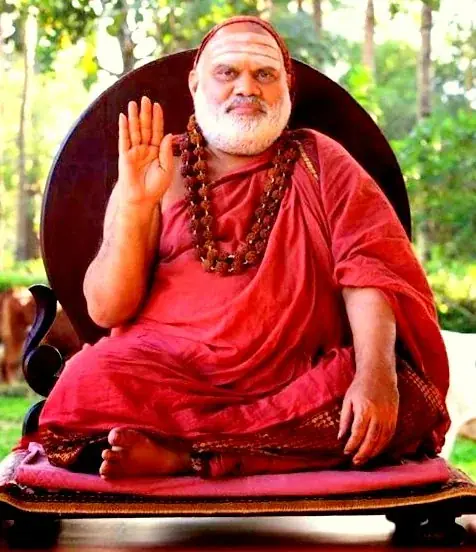
Sri Bhāratī Tīrtha
36th Jagadguru of Sringeri
b. 1951 · The Sri Shankara Lineage
- When
- Born 11 April 1951, Caitra-śukla-ṣaṣṭhī of the year Khara, by the Sringeri seat’s biography; sannyāsa on 11 November 1974; Jagadguru since 19 October 1989. Living. His birthday is kept by the seat by the lunar date, so the civil date of the Vardhanti moves from year to year.
- Born
- Machilipatnam, on the Andhra coast, as Sitarama Anjaneyulu, the first son after four daughters of Venkateswara Avadhani, a Vedic scholar, and Anantalakshmamma, of the Taṅgirāla family whose village was Alugumallepadu on the Naguleru in the Palnadu country; the family’s home was Narasaraopet in Guntur district, and the seat’s biography calls it his home.
- Where the life was lived
- Narasaraopet as a boy; Ujjain in the summer of 1966, where he found his guru; the roads of north India and Andhra in the guru’s retinue; and Sringeri, on the Tuṅgā in the Western Ghats, from March 1968 to this day, first in a basement room called the Guhā, since 1989 as Jagadguru. Tours, in his successor’s words, from the Setu to the Himalayas.
- What is left of it
- The benedictory addresses in five languages, gathered in part in Inspiring Saint and on the seat’s pages; Sanskrit hymns and verses, published by the seat as the Jagadguru’s Compositions; the verse on his guru in four cyclical years; and the institutions: the lifetime stipend for young śāstra scholars (1990), the Sri Shankara Advaita Research Centre (2001) and its Advaita Śāradā library, the Śaṅkara temple at Sringeri (2011) and its festival, the Rajagopuram (2014), and a trained successor.
Became a disciple at fifteen in 1966, took monastic vows in 1974, and as the present Jagadguru maintains the Peetham's Veda schools, hospitals and scholarly assemblies.
The man
Sri Bhāratī Tīrtha is the thirty-sixth Jagadguru of the Sringeri Śāradā Pīṭham, and he is the only teacher on this site who is alive as it is written. He was born in coastal Andhra in 1951, left home at fifteen to find the Sringeri pontiff in Ujjain, was made a sannyāsin and successor-designate at twenty-three, and has held the seat since October 1989, longer than any Sringeri ācārya of the last two centuries except the one who trained him. In January 2015 he chose his own successor; in April 2021, at seventy, he told his devotees that he would take no further part in the affairs of the maṭha and would spend his time in contemplation. The seat’s own summary of him is unembarrassed: he is, it says, “arguably the foremost scholar today of Vedanta and sastras”. Its main page for him opens with a verse that every Sringeri devotee knows:
“भारती करुणापात्रं भारती पदभूषणम् । भारती पदमारूढं भारती तीर्थमाश्रये ॥” “Jagadguru Sri Sri Sri Bharati Tirtha Mahaswami – The presiding Jagadguru Shankaracharya of Dakshinamnaya Sri Sharada Peetham at Sringeri”
Three things make his page different from the others on this site, and the reader should have them in mind from the start. First, he is a scholar before he is anything else in the public record: the stories his tradition tells of him are less often stories of visions than of a verse recalled, a doubt of twenty years’ standing resolved in a sentence, a passage of Vedic recitation supplied to a room of specialists who had forgotten it. Second, his life has been shaped by a single relationship. Asked which event of his life was the most significant, he answered:
“The most significant event in my life was my Guru’s anugraha and His accepting me as His śiṣya. He was my father, my Guru, and my God. He taught me the sannyāsa dharma, the sampradāya of the pīṭha and everything. He never concealed anything from me. I can never forget Him.”
Third, he is a builder in a way none of the medieval teachers here could be. Under him Sringeri acquired a granite temple to Sri Śaṅkara with its own annual car-festival, a hundred-and-twenty-seven-foot tower at its gate, a golden roof over its goddess, a bridge across its river, a research centre for its manuscripts, and a system of lifetime stipends that has made young scholars of the śāstras outnumber old ones in its assemblies. This page follows the life from Alugumallepadu to the seat, tells how he taught and what he built, and ends where the record ends, with a man who has said he would rather have been a wandering monk and who sits, by his own choice, in silence.
The sources for this page, and what each can bear
Because he is living, and because he has spent his whole adult life inside one institution, almost everything written about him has been written by that institution or by devotees writing with its blessing. This page does not pretend otherwise. It uses the following, and names which one is speaking at each point.
- The Sringeri Pīṭham’s own pages: its biography of the present ācārya, its main page for him, its page for his successor, its Guru-paramparā page carrying a discourse of his on the guru, and its event reports of the śiṣya-svīkāra of January 2015, the fifty-ninth Vardhanti of 2009, and the golden jubilee of his sannyāsa in November 2023. These are linked at the foot of this page.
- Inspiring Saint: The Life and Teachings of His Holiness Jagadguru Sri Bharathi Theertha Mahaswamin, published by the Sri Vidyatheertha Foundation, Chennai, and read here in the Foundation’s own digital edition. The book was first written by K. Suresh Chandar and published in 1995; the present edition was brought out for his seventy-first Vardhanti in 2021 with, in the Foundation’s words, “the extensive addition of new content”, and carries a śrīmukha by his successor dated 7 April 2021 and a foreword by the maṭha’s administrator. It is the source for most of the incidents and speeches on this page.
- The Multifaceted Jivanmukta by R. M. Umesh, the biography of his guru released at Sringeri in October 2017, whose twenty-first chapter is about him. It was written by a disciple who knew both men for decades and who is careful about dates; where it and Inspiring Saint differ, both are given.
- His own words: the essay of 1993 and the discourse of 4 October 1989 on his guru that open the Foundation’s Yoga, Enlightenment and Perfection; the verse on his guru that stands on the seat’s page for the thirty-fifth Jagadguru; his letters of 1988; the discourses reproduced in Inspiring Saint; and the appendix of his teachings in the same book.
Two cautions follow from this. The books capitalise the pronouns that refer to him and to his guru, and call him “His Holiness” throughout; the capitals are kept as printed. And the people who wrote them regard him as a sage and say so. This page reports what they record, marks it as their record, and leaves the reader to weigh it. Where the machine-read text of the books carries a page number, a footnote numeral or a fragment of a pull-quote inside a sentence, it has been removed, and every such removal is listed at the foot of the page. Nothing else in any quotation has been altered.
One thing is not here. This page does not report the private opinions of people outside the tradition about a living religious leader, and it does not speculate about his health, his intentions or his institution’s internal affairs beyond what his own seat has chosen to publish. Where it touches on matters that concern other maṭhas it confines itself to what the Sringeri record states.
Where the life was lived
Four places carry the story. He was born on the Andhra coast, at Machilipatnam, into a family whose village was Alugumallepadu in the Palnadu country, on the river Naguleru; he grew up at Narasaraopet, an inland town of Guntur district, and the seat’s biography calls Narasaraopet “his home in Narasaraopet in Guntur District of Andhra Pradesh”. At fifteen he went, without leave, to Ujjain on the Shipra, where the Sringeri Jagadguru was keeping his cāturmāsya retreat in the summer of 1966. From March 1968 his home has been Sringeri, in the forested hills of the Western Ghats on the river Tuṅgā: the maṭha’s compound at Narasiṃhavana on the south bank, where he lived first in a basement room called the Guhā, the cave, and the temple of Śāradāmbā on the north bank, joined since 1990 by the bridge he named for his guru.
Present-day coastlines; no border but India’s is drawn. Every pin is a claim and the caption says whose; the claims here are the Sringeri seat’s and the Sri Vidyatheertha Foundation’s books. He was born at Machilipatnam on the Andhra coast, to which his father had moved from the family’s village of Alugumallepadu in the Palnadu country; Narasaraopet, inland in Guntur district, is the town the seat’s biography calls his home, and the map marks the birthplace and the home. Ujjain is where, at fifteen, he found his guru in 1966; Sringeri, on the Tuṅgā in the Western Ghats, has been home since 1968 and his seat since 1989. Pune is where he was when his guru died in September 1989; Rameswaram is the southern end of the tours and a kṣetra of the seat; Kalady is where he keeps his yearly assembly at Sri Śaṅkara’s birthplace. No line joins the pins: his tours have gone, in his successor’s words, from the Setu to the Himalayas.
- 1Machilipatnam (Andhra Pradesh) — Born Sitarama Anjaneyulu here on 11 April 1951, Caitra-śukla-ṣaṣṭhī of the year Khara, to Venkateswara Avadhani and Anantalakshmamma, by the Sringeri seat’s biography and the Foundation’s books; his father had moved here from the family’s village of Alugumallepadu on the Naguleru, in the Palnadu country
- 2Narasaraopet (Andhra Pradesh) — The Guntur-district town the seat’s biography calls his home, where he grew up and went to school, and where in 1961 he was brought before Sri Abhinava Vidyātīrtha; he left it for Ujjain in 1966
- 3Ujjain, on the Shipra (Madhya Pradesh) — Where, aged fifteen, he came without leave in the summer of 1966 to the Jagadguru keeping cāturmāsya there, was examined in Sanskrit, and was accepted as a pupil; by the seat’s and the Foundation’s account
- 4Sringeri, on the Tuṅgā (Karnataka) — His home since March 1968: the basement room called Guhā under his guru’s house, sannyāsa in the Tuṅgā on 11 November 1974, the coronation of 19 October 1989, and the temples, bridge, research centre and Rajagopuram he has built since; the seat of the Śaṅkarācāryas of the south
- 5Pune (Maharashtra) — Where he was on tour when the news came on 21 September 1989 that his guru had died at Sringeri; he flew to Mangaluru and reached Sringeri that night, by the Foundation’s books
- 6Rameswaram (Tamil Nadu) — The Setu, southern end of the tours his successor describes as running “from the Setu to the Himalayas”; the seat regards it as its own kṣetra, and he consecrated its temple in 2001 and its new tower in 2016
- 7Kalady, Sri Śaṅkara’s birthplace (Kerala) — Where he keeps a five-day assembly of scholars every year at Śaṅkara-jayanti, by the Foundation’s account
The rest is travel. His successor’s śrīmukha to the biography says that “Our Guru has repeatedly undertaken extensive tours from the Setu (Rameswaram in the south) to the Himalayas (in the north of India)”, and the biography’s chapter on the tours lists the pilgrim-towns where he has offered worship on the maṭha’s behalf: “Rameswaram, Srisailam, Varanasi,” “Ujjain, Gokarna, Somnath, Nasik,” and, among many others, “Jamnagar (Gujarat), Pandharpur, Kolhapur, Siddhi-Vinayak Temple in Mumbai, Ellora (Ghrishneshwar), Mookambika in Kollur, Palani, Tiruchendur, Vemulawada, Kaleswaram etc.” The map marks Pune, because he was there, on tour, when the news came in September 1989 that his guru had died; Rameswaram, which the seat regards as its own kṣetra and which he has visited repeatedly, consecrating its temple in 2001 and its new tower in 2016; and Kalady, Sri Śaṅkara’s birthplace, where he keeps a five-day assembly of scholars every year at Śaṅkara-jayanti.
The names: Sitarama Anjaneyulu, Bhāratī Tīrtha, Sannidhānam
He was named for two vows. His father, praying for a son after four daughters, “took a vow to name his child after Sita and Rama if his wish was fulfilled”; his mother “had sought Lord Anjaneya’s favour and promised to name the male child born to her ‘Anjaneyulu’. Hence the infant was named Sitarama Anjaneyulu.” The books call him Sri Anjaneyulu for the years before his initiation, and this page does the same.
The monastic name was given on 11 November 1974 by his guru. Bhāratī is the goddess of speech and learning, and it is also the name-ending of one of the two lines of Sringeri’s pontiffs, whose ācāryas have alternated for centuries between names ending in Bhāratī and names ending in Tīrtha; his guru was Sri Abhinava Vidyātīrtha, his guru’s guru Sri Chandraśekhara Bhāratī. The name joins the two. It is also a name with a history in the seat: the eleventh ācārya of Sringeri, in the fourteenth century, was Sri Bhāratī Tīrtha, the disciple of Sri Vidyātīrtha and the guru-brother of Sri Vidyāraṇya, and it was he who, the present pontiff said in 2011, “constructed a massive temple for His Guru, Jagadguru Śrī Vidyātīrtha (the tenth Ācārya) and performed kumbhābhiṣeka” — the Vidyāśaṅkara temple that still stands on the north bank. The disciple of a new Vidyātīrtha was given the name of the old Vidyātīrtha’s disciple. The books do not say whether the guru intended the echo; the reader may notice it.
From the day of his sannyāsa, the biography records, “Devotees thereafter reverentially referred to Him as Śrī ‘Sannidhānam (meaning divine Presence)’ and to His Holiness as Śrī ‘Mahāsannidhānam’.” Since 1989 he has been Mahāsannidhānam himself, and since January 2015 his own successor has been Sannidhānam; the reader will meet all three uses in the quotations below, and the page says each time who is meant. He carries the title Jagadguru Śaṅkarācārya that every occupant of the seat carries, and the seat writes his name with a triple Sri. This site, as a mark of respect, writes Sri before his name, as it does for every teacher.
Birth and family: a vow on the Naguleru, a birth at Machilipatnam, 1951
The family were Smārta brāhmaṇas of the Taṅgirāla house. The seat’s biography gives the particulars in a single sentence: “He was born into a Smartha family bearing the name ‘Tangirala’, of Apasthamba sutra, Krishna Yajur sakha, Kutsasa gotra, living in Alugumallepadu village in Palnadu area of Guntur, on the banks of river Naguleru.” His father, Venkateswara Avadhani, “had studied the Vedas , though learning English was the current fashion”; his mother was Anantalakshmamma. The guru’s biography names the deity of the vow: the father “observed strict fasts and worshipped Lord Bhavānī-śaṅkara at the local temple near the river Naguleru in Alugamallepadu in Andhra Pradesh. He unfailingly bathed in the river early in the morning and performed mahānyāsa- purassara-rudra-abhiṣeka (abhiṣeka accompanied by chanting of the śrī-rudra and preceded by the chanting of the mahānyāsa) to the Lord” “every day for a year. He continued his fasts and prayers after he shifted to Machilipatnam.”
The mother’s side of the vow is told as a dream: “One night, she dreamt that Lord Āñjaneya gave her three mangoes and vanished. She woke up and narrated to her husband, her dream through which, she felt, Lord Āñjaneya had graced her. She decided that if she gave birth to a son, she would name the child after Him.” Then the date, which the guru’s biographer gives in both calendars: “a baby boy was born to them, in Machilipatnam, on 11th April, 1951, corresponding to caitra-śukla-ṣaṣṭhī of the cyclical year Khara; His birth- star was mṛgaśīrṣa. The couple named Him Sitarama Anjaneyulu.” Inspiring Saint gives the same civil date and the same tithi. He was the fifth child and the first son; the four sisters appear once more in the story, when the eldest becomes his first Sanskrit teacher.
Two things should be said about place. The family belonged to Alugumallepadu and had moved to Machilipatnam, the old port on the Krishna delta, before the birth; the birth itself was at Machilipatnam, and that is what this site’s card records. But the town of his childhood was neither. “Avadhani settled down with his family in Narasaraopet when Sri Anjaneyulu was a few months old.” It is Narasaraopet that the seat calls his home, and it is at Narasaraopet that the rest of his boyhood was lived.
The boy in Narasaraopet
The childhood is told, as such childhoods are in this tradition, as a handful of signs and a course of study. The signs first. “One day, when Ananthalakshmamma woke up at 5:00 a.m. as was her wont, she was surprised to see a halo around the face of her darling child who was asleep.” At three, taken crying to the local Śiva temple, “the little one not only stopped crying but also began to utter repeatedly, ‘Śambho, Śiva, Śiva.’ Śambhu is a name of Lord Śiva. Śiva later became His iṣṭa-devatā (favourite deity).” The seat’s biography puts the same thing without the anecdotes: “Sitarama Anjaneyulu even at the age of three evinced signs of great devotion towards the Gods. The name of Lord Shiva was on his lips constantly.” This page reports these as the family’s memories, which is what they are.
The course of study is better documented, and it is the real substance of the boyhood. “Sri Anjaneyulu’s elder sister, Srilakshmi, started teaching Him Sanskrit before he was five years of age. Pratapagiri Sivarama Sastry, a Sanskrit scholar, took over when Sri Anjaneyulu turned five. By the time He was nine, He attained proficiency in Sanskrit and was able not only to converse in that language, but also to compose verses in it. He bagged several prizes and was invited by All India Radio, Vijayawada, to participate in Sanskrit programmes.” The seat adds a name to the list of those who noticed: “Scholars and poets, including the Kavi Samrat Sri Viswanatha Satyanarayana, praised him for his eloquence.” Viswanatha Satyanarayana was the leading Telugu poet of his generation; the praise is the seat’s report, and no text of it is given.
The Veda came from the father, at night, after school. “At night, he learnt the Vedas from his father. He studied Samhita, Brahmana and Aranyaka so well that he could take part in the Guntur District Vedapravardhaka Vidwat Pariksha. He passed the examination with honours.” The sacred thread had been given at seven. One incident from these years is told in both books because it shows the boy already able to do a priest’s work: a man came to the house for the father, who was to conduct his son’s upanayana, and the father was delayed. “Sri Anjaneyulu who had, till then, only seen His father perform the upanayana rites five times, stepped in for His father. He Himself conducted the ceremony to the satisfaction of all.”
The secular schooling was ordinary and good. “Sri Anjaneyulu had His secular education in the local school. Being a bright student, He consistently stood first in his class. However, He did not complete his S.S.L.C., for, His intense dispassion, desire to study the śāstras and His regard for His Holiness drew Him away.” Inspiring Saint adds that mathematics was his favourite subject and that he moved to the English medium in the tenth class and still stood first. The seat’s summary of the whole boyhood is a sentence about language: “Jagadguru Sri Sri Sri Bharati Tirtha Mahaswamiji was seen more often talking in Sanskrit than in Telugu, his mother tongue.”
Vijayawada, 1961: a talk in Sanskrit and a silk shawl
The turn of the life is dated to his eleventh year. In 1961 Sri Abhinava Vidyātīrtha, the thirty-fifth Jagadguru of Sringeri, was camping at Vijayawada on the Krishna, and a scholar of Narasaraopet who knew the Jagadguru took the boy to see him. Inspiring Saint tells it thus: “Brahmasri Kavitha Subrahmanya Shastri of Narasaraopet, known to His Holiness, took Sri Anjaneyulu to Vijayawada for the darśana of the great Guru. There he introduced this divine boy to the worshipful Guru saying, ‘This boy speaks fluent Saṃskṛta’. Surprised” “that a 10-year old boy could converse fluently in Saṃskṛta, His Holiness started conversing with Sri Anjaneyulu in Saṃskṛta. The ease with which Sri Anjaneyulu spoke in Saṃskṛta impressed His Holiness. He was incredibly happy and blessed Sri Anjaneyulu with a silk shawl.”
What the boy made of it he said himself, years later, and the two books preserve the recollection in slightly different English. The seat’s version: “I had the good fortune of having the darshan of the Jagadguru quite early in life. Once I was asked to talk in Sanskrit by my teacher before His Holiness in Vijayawada. I got a special prize from him. At that time, it struck me that His Holiness was my teacher and my saviour. His beaming smile was giving me a message. I thought I got what I wanted.” The guru’s biographer gives a fuller text of the same recollection:
“I had the good fortune of beholding the Jagadguru early in life. Once, I was asked to talk in Sanskrit by my teacher before His Holiness, in Vijayawada. I got a special prize from Him. At that time, it struck me that His Holiness was my teacher and my saviour. His beatific smile, I felt, was giving me a message. I felt that I got what I wanted. That day onwards, His benevolent looks were etched in my mind. The affection that He showered on me was more pleasant than the affection of my parents. I decided then that He was my Guru. Whenever there was a problem, I felt that I was guided by the Jagadguru. My feelings towards Him grew to such an extent that I could no longer stay in my house.”
The guru’s biographer, who is careful about such things, notes that the seat’s account and his own differ on the order of the first two meetings: in his account “He had His first darśana of His Holiness when His Holiness visited Narasaraopet. Later, His Sanskrit teacher took Him and some other students to Vijayawada”; in Inspiring Saint the Vijayawada meeting comes first and “A few days later, the holy Master paid a visit to Narasaraopet itself.” Both agree that the boy of ten spoke Sanskrit to the Jagadguru, was rewarded, and never afterwards thought of anyone else as his teacher. Five more years passed at school and at the father’s side. In February 1966 the Jagadguru came again to Narasaraopet, and the boy, now in the eleventh class, saw him and spoke with him once more in Sanskrit. The book records his conclusion: “He alone is my Guru. I can only reach the goal of human life with His grace. For this, surrendering at His Lotus Feet alone is the way.” “From that day on, Sri Anjaneyulu’s mind was constantly looking forward to the right time to reach His Guru.”
Ujjain, 1966: leaving without leave
The Jagadguru was to keep the rainy-season retreat of 1966 at Ujjain, on the Shipra in Madhya Pradesh, a thousand kilometres to the north. A sannyāsin of Narasaraopet, Sri Vidyāraṇya Svāmin, was going there, and the boy asked to go with him. The Svāmin told him “that He could do so only with due permission from His parents. However, Sri Anjaneyulu was determined to leave.” His answer is preserved, and it is the first recorded sentence of his that the reader meets:
“As per the dictate उद्धरेदात्मनाऽऽत्मानम ् (Uddharedātmanā’’tmānam — One should uplift oneself by one’s own self)” “I’m leaving to secure Self-realisation. The permission from my parents is therefore not necessary. I have already made up my mind to reach His Holiness.”
“Impressed by the boy’s determination, Śrī Vidyāraṇya Svāmīn agreed to take Sri Anjaneyulu with him to Ujjain. When they reached Vijayawada railway junction and boarded the Delhi express, the joy of Sri Anjaneyulu found no bounds.” The guru’s biographer states the matter of the parents plainly: “Without informing His parents, He left Narasaraopet and went to Ujjain in 1966, where His Holiness was observing cāturmāsya. After reaching there, He informed His parents about His whereabouts and that they need not be concerned about Him.” The seat’s biography says the father “advised by his father to go for higher education” had other plans for the boy who “had just finished high school studies”; the guru’s biographer says he had not completed his school-leaving certificate. The two are not quite the same, and the reader should have both. Inspiring Saint records that the parents, once they knew, wrote to him with their blessings.
The meeting at Ujjain is told in the seat’s biography and in Inspiring Saint in almost the same words. The Jagadguru was at the Kaliadeh palace on the Shipra. “As the great Acharya was returning after bath in the river Sipra, Sitarama Anjaneyulu prostrated before him and sought his tutelage, which was granted. The very next day the Acharya started teaching him.” The fuller account gives the conversation:
“The great Jīvanmukta asked Sri Anjaneyulu: ‘Aren’t you the boy who spoke to me in Saṃskṛta?’ That His Holiness recognized Him made Sri Anjaneyulu incredibly happy and He answered in the affirmative. ‘What has brought you all the way here?’ asked His Holiness. ‘I have come here with a firm resolve to learn the śāstras from Your Holiness.’ Sri Anjaneyulu’s surrender was total and His determination not to leave His Guru thereafter was very firm. ‘Well, come for class from tomorrow. I will teach you ‘Tarka-saṅgraha’.’”
The seat’s biography draws the moral the tradition draws: “What prompted the boy who had just finished high school studies, and who was advised by his father to go for higher education, to leave his home? Why did he go all the way to Ujjain from his home in Narasaraopet in Guntur District of Andhra Pradesh? It must have been predetermined so by Goddess Sharadamba, the presiding deity of Sringeri Mutt.” A reader outside the tradition may prefer the boy’s own explanation, given above, which is the verse from the Gītā and a decision. Either way, “Since then Sitarama Anjaneyulu did not leave the lotus feet of the Acharya.”
The brahmacārin: Ujjain, the road, and a cave at Sringeri, 1966–1974
The lessons began the day after the meeting on the river-bank, and for the next year and a half they continued wherever the Jagadguru went, for the cāturmāsya at Ujjain was followed by a long tour through northern India and then through Andhra. The boy travelled in the retinue as a student. Devotees noticed him. “Many” “of them offered Sri Anjaneyulu gifts — cash and kind — but this ever-content lad would politely decline the offers with a smile.” One story from Mumbai is told at length because it shows the guru as well as the pupil. A devotee “wanted to gift Sri Anjaneyulu an imported notepad and a pen. When he approached Sri Anjaneyulu and requested Him to accept the gift, the sincere brahmacārī politely refused to take it. Disappointed and feeling sad, the devotee left.” The Jagadguru, seeing the man’s face, guessed the cause, called him over, admired the paper — “How smooth it is! It should be of very high quality. Isn’t it?” — and asked, “Shall I keep this notepad and the pen with me for my personal use?” The devotee went away delighted, the boy’s refusal stood, and nobody had been reproved.
The parents saw him again when the tour reached Vijayawada. His father asked to take him home to Narasaraopet for a few days and then bring him to the Jagadguru’s next camp at Srisailam; the book says that during “those four days” “of home-stay, He” “immersed himself in” “revising His lessons!” “As agreed, Sri Avadhani took Sri Anjaneyulu to” “Srisailam after four days.” Then the road ended: “Finally, in March 1968, His Holiness reached Sringeri. His Holiness arranged a comfortable stay for Sri Anjaneyulu at a small building called Āhnika-mandiram inside Narasiṃha-vana, the region on the southern side of the River Tuṅgā inside the Maṭha complex.”
An exchange from those first months at Sringeri is the one the tradition likes best, because it shows the kind of attention the boy was under. He had gone one day across the river to the shrine of Śakti-gaṇapati. That night at the Candramaulīśvara pūjā the Jagadguru “asked Sri Anjaneyulu: ‘Did you go to the other side of the river today?’ Sri Anjaneyulu answered very obediently, ‘Yes, I went.’ His Holiness said to Him, ‘It is enough if you stay in Narasiṃha-vana itself. I will always be observing you.’” Soon after, “His Holiness asked Sri Anjaneyulu to shift His residence from the Ahnika- mandiram to Guhā, a room newly constructed by His Holiness in the basement of His holy abode, Saccidānanda Vilāsa. His Holiness also arranged for Sri Anjaneyulu’s advanced studies in Nyāya (Tarka) śāstra under the great scholar Sri Gollapudi Gopalakrishna Shastri who was a student of the celebrated scholar of Varanasi,” “Sri Rajeshwara Shastri.” The guru’s biographer confirms the arrangement and its result: “In a short span of time, Sri Anjaneyulu could comfortably participate and hold His own in the annual Vidvat-sadas.”
The regimen is recorded. “Sri Anjaneyulu had the habit of getting up at 4 a.m. to start His studies, soon after His bath. He also observed admirable austerities. His needs were very frugal. He used to have only one meal a day and that too after His Holiness partook of His bhikṣā.” A small story about patience is told of the bathing-place, where two men in turn stepped in front of him while he waited, and “A third person then arrived and repeated what the second one had done. Even then Sri Anjaneyulu did not lose” “His patience.” The reader may set these beside the stories told of his guru’s boyhood on this site and notice the family likeness; they are the tradition’s way of saying that the disposition was there before the training. Six years passed in the cave. Then, in 1974, the Jagadguru’s personal assistant, Padmanabha Upadhyaya, died in an accident, and, the biographer records, “His Holiness asked Sri Anjaneyulu to assist Him in some Maṭha- related activities. The transition from the life of a recluse to involvement in the Maṭha’s activities was tough for Sri Anjaneyulu but He took it in His stride.”
Navarātri 1974: the choice, and 11 November
How the decision was made is told from the guru’s side in a passage that his biographer reproduces from an article of 1977 by one of the devotees present, Vaidyasubramanya Iyer, and it deserves quoting because it is rare to have a Sringeri succession described by an eyewitness at the moment of decision:
“In 1974, at Sringeri I, with all due apology, asked His Holiness as to whether He was having in mind the appointment as His Sishya, the Brahmachaari who was learning Tarka, etc., at the Math. I conjectured that His Holiness could have such an intention. His Holiness told me that He was contemplating it, but had not reached a decision. While so, He asked me casually to fetch the almanac (Panchangam) and He started discussing an auspicious date for Shishya-Sweekaram, I could not follow the almanac as it was in Kannada script. He indicated a place in an open almirah and asked me to take the Tamil version of the almanac. I located the same and was about to take that out, when a piece of paper fell from the top of the bookshelf. His Holiness noticed this and wanted it to be brought to Him. It happened to be the cyclostyled copy of the brochure in Kannada of the Shishya-Sweekaram program of His Holiness by His Guru Sri Chandrasekhara Bharathi in 1931. His Holiness immediately exclaimed that Goddess had given Him the favourable signal for the Sishya-Sweekaram. We both went through the almanac and the date was fixed for Sishya-Sweekaram, scheduled for November 1974. He made His decision public during Navarathri.”
The parents were at Sringeri for the Navarātri of 1974, and Inspiring Saint records what the Jagadguru said to the father: “As per Śāradāmbā’s command, I have decided to grant sannyāsa to Sitaramanjaneyulu and make him my successor-designate for this Pīṭha. You may convey this to your wife. Your other son (Sri Dakshinamurthy) will take diligent care of both of you. My blessings are there for you all.” The mother, “like any other mother, felt” “sad over the fact that her son was going” “to leave her once and for all.” She gave her consent. The public announcement came on the last day of the festival: “His Holiness entered the sanctum sanctorum of Śrī Śāradāmbā temple and” “sat absorbed in meditation. After His meditation, His Holiness came out and announced to the assembled devotees that with the concurrence of the Divine Mother, He had chosen Sri Taṅgirāla Sitaramanjaneyulu as His successor-designate and that the śiṣya-svīkāra ceremony would take place on the 11th day of November 1974.”
The rite followed the form his guru had himself undergone in 1931, and is described in detail. On the morning of 11 November, after the fire-offerings, “The Śiṣya-designate then went to the River Tuṅgā and having had a bath, stood in waist deep water. He then discarded all His clothes including the thread that held His loin cloth. Next being discarded was His sacred thread. Then He chanted the ‘Preṣoccāraṇa mantra’ granting freedom to all beings from fear on account of Him. As He took a few steps downstream, His Holiness Jagadguru Śrī Abhinava Vidyātīrtha Mahāsvāmin called Him and gave Him the saffron robes, a bamboo staff, and a vessel (kamaṇḍalu).” At the samādhi-shrine of Sri Chandraśekhara Bhāratī the guru gave the praṇava and the great sentences of the Upaniṣads, and whispered the new name; in the Śāradāmbā temple, with the disciple seated on the Vyākhyāna-siṃhāsana, “His Holiness kept a Śāligrāma on the head of the Śiṣya-designate and worshipped It. After Maṅgalārati, the Guru took His seat on the Vyākhyāna siṃhāsana and Śrī Bhāratī Tīrtha Mahāsvāmin worshipped the Lotus Feet of His Guru. After this worship was complete, the senior Jagadguru made public His Holiness’s yoga-paṭṭa, ‘Bhāratī Tīrtha’.”
Two details from the two books. The guru’s biographer, who was there, records a story from the night before that he plainly does not know what to make of: a devotee walking past the samādhis at night saw the candidate “sitting alone close to the sacred fire, melodiously chanting the name of Lord Rāma and oblivious of His surroundings”, while another devotee was certain he had been with him all night in a room in front of the thirty-fourth pontiff’s samādhi; the biographer’s dry conclusion is that “if Jagannathan had not been hallucinating, Sri Anjaneyulu should have been in two places at the same time that night.” This page records it as the biographer does, as two men’s reports. And the seat’s biography records the first speech: “In 1974 on the day in which he was initiated into Sanyasa, His Holiness spoke in Kannada for the first time at the felicitation meeting with such a telling eloquence that all those present, including ministers, High Court judges, members of the Legislature and University professors, could not control their admiration while listening to him.” He was twenty-three years and seven months old.
On the lunar date. Inspiring Saint gives the tithi of 11 November 1974 in a footnote as Ānanda-āśvayuja-kṛṣṇa-ekādaśī, the eleventh day of the dark fortnight; the Sringeri Pīṭham’s report of the golden jubilee of the sannyāsa, celebrated on 10 November 2023, gives it as “Ananda Samvatsara Ashwayuja Krishna Dvadashi (November 11, 1974)”, the twelfth. The two accounts of the same institution differ by a day in the tithi while agreeing on the civil date; both are given here.
What the guru said of him
From that day the two were seen together, and the older man’s regard for the younger is on record in his own words. “The senior Jagadguru started addressing His Holiness as ‘Svāmin’ from the very day of the śiṣya-svīkāra. He even advised His devotees that whatever respect they had been showing Him must be shown to His Holiness also.” Three sayings are preserved:
“Every Ācārya of this pīṭha faces an acid test. It is about choosing the right successor for this sacred seat. By selecting the Svāmin for the post, I have passed that test with First Class!” “The Svāmin is an incredibly special person. He has mastered the Vedas and the śāstras even before taking up sannyāsa.” “I have chosen a very competent Guru to guide you all. He is a remarkable person.”
The initiations that followed are part of the seat’s tradition, and the guru’s biographer records one of them with a detail he heard from the disciple himself: “In the next few days, in accordance with the pontifical tradition in the Maṭha, His Holiness initiated Śrī Sannidhānam into several mantras such as those of Lakṣmī- narasiṁha, Medhā-dakṣiṇāmūrti, Bālā-tripurasundarī and the Śrīvidyā. When initiating Śrī Sannidhānam into the Śrīvidyā, as His Holiness was uttering the dhyāna- śloka concerned, He abruptly became motionless and unmindful of His body and surroundings. After some time, He regained normalcy and told Śrī Sannidhānam, ‘You are fortunate. As I was reciting the dhyāna-śloka, I had a fascinating vision of the Goddess and was forcefully drawn into samādhi.’ This incident was narrated to me by Śrī Sannidhānam.” The same biographer records that, while the disciple was still a brahmacārin in the basement room, the guru “had sent for Him one morning and told Him (then Sri Anjaneyulu) to observe Him performing yoga-āsanas on that and the following days and learn to do them. Śrī Sannidhānam told me about this in 2013.” The reader of this site’s page on Sri Abhinava Vidyātīrtha will know why that matters: the guru’s own path had run through yoga, and he passed on what he could of it.
What the disciple took from the training he stated in a discourse in Kannada on 4 October 1995, recalling an instruction that his guru gave him one day as they walked back from the goddess’s temple: “He instructed me, ‘One should ever contemplate, even when moving about, on the Truth expounded by Bhagavatpāda. We have just returned from Śāradāmbā’s temple. We prostrated before Her. That is a bodily activity. The inner activity should be the constant contemplation on the Truth taught by Bhagavatpāda. That indeed will make one’s birth fruitful.’” The instruction is the whole of Advaita practice in three sentences, and its recipient has repeated it, in his own discourses, for fifty years.
Fifteen years as Sannidhānam, 1974–1989
The pattern of the fifteen years is set out by the guru’s biographer. The disciple accompanied his guru on his “various tours in the period 1974 to 1983.” Then, when ill health made the older man curtail his own travelling, in response “to His directive, Śrī Sannidhānam started touring independently too. Śrī Sannidhānam’s first such tour commenced on 18th May, 1983; the last of His independent tours during the lifetime of His Holiness began on 11th February, 1989, covered Karnataka, Andhra Pradesh, Telangana and Maharashtra and He was in Pune when His Holiness attained videha-mukti on 21st September, 1989.”
The seat’s biography dwells on the languages. “A few months after Sishya Sweekaram both the Holinesses started on a Vijayayatra to Rameshwaram. Enroute at Gobichettipalayam, the Acharya delivered a speech in chaste Tamil, electrifying the devotees as they had never expected such a clear language flow from someone whose language was not Tamil and who had not been taught Tamil by anyone.” In the north he “lectured in Hindi. His benedictory speeches were highly appreciated. Even scholars in Hindi language and literature were fascinated with his melodious Sanskritised Hindi.” The tours took him to the far corners of the country and once beyond them; the Sringeri record states that in 1982 he was at Dwaraka in Gujarat with his guru, “where His Guru and His Holiness had performed the paṭṭābhiṣeka of Śrī Svarūpānanda Sarasvatī Mahāsvāmin anointing him as the Śaṅkarācārya of the Dwaraka Pīṭha.” On his own first tours he consecrated temples: at Tiruchendur, on the Tamil coast, “The kumbhābhiṣeka was performed in the divine presence of His Holiness on June 27, 1983.”
The relationship in those years was watched by everyone at Sringeri, and the seat’s biography describes it in a passage that reads like a rule of conduct: “Sri Sannidhanam used to visit Sri Mahasannidhanam every morning, offer His prostrations at the most sacred lotus feet of His beloved Guru and only then commence the day’s work. Whenever Sri Mahasannidhanam spoke to Sri Sannidhanam, the latter would reverentially bend forward and listen. Whenever They walked together, Sri Sannidhanam would never over-step his Guru. Whenever both of Them were to occupy Their seats, Sri Sannidhanam would wait for Sri Mahasannidhanam to be seated first.” Two incidents illustrate it. At a function at Srirangam the guru spoke first and said the disciple would speak next but could not speak long because it was late; the disciple began, “Our revered Guru Himself has said that I would not be able to speak for long. His words contain His ajñā (orders), and it is my first and for”… and kept it short. And once, wanting to be simple, he put on a plain ochre robe without the gold border that the successor-designate wears; his guru sent for him: “Svāmin! You are wearing an ordinary vastra! Though you personally want to be simple, you should be aware that you are the Uttarādhikārī (successor-designate) of this pīṭha and should therefore follow certain traditions. Please wear only the type of robes you are required to.” “His Holiness obeyed.” The reader should keep the robe in mind; it comes back at the end of this page.
What he himself said about the bond he said in public at Chennai in 1977, at the celebration of his guru’s sixtieth year: “The knowledge of highly metaphysical treatises and spiritual texts may help one win laurels in an assembly of scholars or score a victory in a debate. But this knowledge, astounding though it may be, will not by itself attune one’s mind to think of”… and, at the close, “In this respect, I consider myself most fortunate in having had a unique opportunity of getting initiated into the ascetic order by my revered Guru.” A visiting scholar, Dr Mandana Mishra, watching the two together, said to the guru: “We have read that Shankara’s disciple’s went with him. How was He? How were his disciples? I was only conjecturing. Now I have come to the conclusion that they must have been like this. It is so satisfying.”
The letters survive, and two are printed in translation. From Namakkal, on 4 February 1988, the disciple set out the tour ahead — a consecration at Kallidaikurichi, a Sahasra-caṇḍī at Coimbatore, Śaṅkara-jayanti to be begun at Chennai — and ended: “I have an intense desire to prostrate before the feet of Your Holiness at Sringeri after completing the tour as quickly as possible. I believe that it will be fulfilled through the unlimited compassion of Your Holiness and Śrī Śāradā Candramaulīśvara. Your disciple offering sāṣṭāṅga namaskāra Sd/- Bhāratī Tīrtha.” The reply from Sringeri, dated 15 February 1988, is the only letter of Sri Abhinava Vidyātīrtha to his disciple that this site has, and the reader may want to hear its voice:
“May the blessings, preceded by the contemplation of the unity of the inner self and Brahman, conferred in respect of my dearest disciple, the eminent monk Śrī Bhāratī Tīrtha manifest well. I have received your letter penned on prabhava-māgha-kṛṣṇa-dvitīyā (04 February 1988), Thursday. I felt pleased to note from the letter that the tour is proceeding satisfactorily as planned, Several institutions are being established at various places for the benefit of disciples, as well as many sacred events and festivals are being conducted. From the letter, I understood that you yearn to have my darśana at Sringeri after completing the tour as quickly as possible. I pray that Goddess Śrī Śāradā fulfils your wish. Though old and weak, acting in accordance with my age, I am serving the feet of Śrī Śāradā.” “All is well here. With the recollection of Narayana Sd/- Vidyātīrtha.”
September 1989
The guru had begun to speak of his death, and the disciple did not want to hear it. “On another occasion the senior Jagadguru said to His Holiness, ‘I know your grief will be uncontrollable when this body ceases to exist, but it is the way with all flesh.’” Early in 1989, before the February tour, came a conversation that the book reproduces:
“He asked, ‘Svāmin, how much longer should I live?’ His Holiness, treating this question as a casual one, replied, ‘I will not be greedy. The Veda itself declares that the life span of a human being is one hundred years. Now my revered Guru is about seventy-two. So, my revered Guru can very well live for another twenty eight years at least.’ The senior Jagadguru was quick to reply, ‘Svāmin, what are you saying? Is this not enough? Should I live for twenty eight more years? I do not want it at all.’ His Holiness did not realise at that time that His Guru really meant His words.”
Sri Abhinava Vidyātīrtha died at Sringeri on Thursday 21 September 1989. Inspiring Saint puts it “at about 11:30 in the morning”; his biographer, who was in the house, records that “The time of His Holiness’s setting aside His body was specified as 11:20 a.m.” The disciple was in Pune, on tour. “The news was conveyed to His Holiness who was then in Pune. His Holiness never expected that He would be physically separated from His most beloved Guru once and for all, this soon. His grief was uncontrollable. His Holiness air–dashed to Mangaluru from Pune and from there reached Sringeri by car at 12 midnight.” The biographer gives the hour as “around 1:00 a.m.”, and adds that the flight was “in a devotee’s private aircraft”. “When He entered Saccidānanda Vilāsa, He went running to behold the sacred physical form of His supreme Master and, upon reaching the place, lay prostrate before His Guru for long.” Then, the book says, “Realising that He had the duty left by His Guru for Him, He soon composed Himself and addressed the grief-stricken devotees.”
The biographer, who helped lay out the body, records a single sentence of his from that night: “Śrī Sannidhānam came there and asked me, in Tamil, ‘Did you place Acharyal in a meditative posture?’ I answered in the affirmative.” The next day the body was carried through the town and brought to the bathing-ghat of the pontiffs. “Thousands of devotees including Sri Rajiv Gandhi, the then Prime Minister of India, paid their respects.” “His Holiness had a dip in the river and performed abhiṣeka to the revered body of His Guru with the waters of Tuṅgā.” The book notes what made this hard: “He had to perform the abhiṣeka at the same place where His Guru had initiated Him into sannyāsa and blessed Him with the kamaṇḍalu using which He now performed abhiṣeka to His beloved Guru’s mortal remains.” At the burial one detail is recorded that the reader will understand without comment: “As per the rituals, a coconut had to be broken on the head. However, His Holiness was not ready to do such a thing on the head of His most beloved Guru. So, the head was pierced by the thin end of a conch and five coconuts were broken separately.”
The thirteen days of rites ended on 4 October 1989, and he spoke. “It is said that Śrī Saccidānanda Śivābhinava Nṛsiṃha Bhāratī Mahāsvāmin was in intense grief when His Guru passed away. Then the Guru appeared in His dream and said, ‘What are you grieving for? Where have I gone? Till now I was confined to a certain body. Now I have become one with the all-pervading Absolute.’ I recall this message and console myself that our Guru has not left us at all and ask you to follow in the footsteps of our Guru and deserve His blessings.” That Navarātri he “had the portrait of His Guru placed on the seat and conducted the sabhā as if He were conducting it in the august presence of His great Guru.” And he composed, in his own hand, a litany of a hundred and eight names of Sri Abhinava Vidyātīrtha; the book reproduces the manuscript page.
19 October 1989: the coronation, and what he said it meant
“The mantle fell on His Holiness Śrī Bhāratī Tīrtha Mahāsvāmin on October 19, 1989, when He formally took over as the Head of the Sringeri Sri Sharada Peetham, the throne of transcendental wisdom.” The day is described in the manner of a court chronicle. “The Vyākhyāna siṃhāsana, the throne of transcendental wisdom, was placed facing Śrī Śāradāmbā.” He came from Narasiṃhavana in the forenoon over a path carpeted with flowers, prostrated at the samādhis of his predecessors, “then ascended the Siṃhāsana as the 36th head of the Sringeri maṭha amidst Vedic chants and the playing of maṅgalā-vadyās. The Karnataka Governor, Sri P. Venkatasubbaiah, read out the message of the President of India, Sri R. Venkatraman. Sri M.L. Fotedar, Union Minister, read out the special message and greetings sent by the Prime Minister of India,” “Sri Rajiv Gandhi.” The crowd is given as “50,000 devotees”, watching on closed-circuit television around the compound. The heads of the Hariharapura, Shivaganga and Nelamavu maṭhas made their offerings; in the evening two of them spoke in his honour.
His own speech that evening is the first of his as pontiff that the book gives at length, and it is about the incongruity of the ceremony itself:
“Many people asked me, ‘Does not a ceremony like the paṭṭābhiṣeka (coronation) to a Sannyāsi, look a” “bit incongruous?’ In fact, from the times of Śrī Ādi Śaṅkara Bhagavatpāda to Śrī Vidyāraṇya, the Ācāryas of Sringeri did not possess royal regalia, or royal insignia. They did not undergo the coronation ceremony. Jagadguru Śrī Vidyāraṇya, himself a great ascetic, became the Karnāṭaka Siṃhāsana Pratiṣṭhāpanācārya. He blessed two royals named Hakka and Bukka and helped them establish the Vijayanagara empire by the power of tapas. The royals expressed their gratitude by placing all their royal insignia at His lotus feet, requesting the Ācārya to adorn them during the Navarāthrī festival. The Ācārya graciously accepted their request. Śrī Vidyāraṇya did not seek such honours. Neither the Ācārya nor” “his successors who have borne these royal insignia, had any fascination for these insignia. The Ācāryas are Sannyāsīs devoted always to the Upanishadic teaching expounded by Śrī Ādi Śaṅkara Bhagavatpāda. The royal insignia are adorned, during the ceremony, only to uphold tradition. There is no other ulterior motive; nor is there expectation of anything.”
He went on, the book says, to “the reason for the establishment of Āmnāya- pīṭhas by Śrī Ādi Śaṅkara Bhagavatpāda, explaining that the primary objective of a pīṭhādhipati is dharma pracāra – spreading dharma by taking steps to ensure that people live in the dhārmic way.” The ceremonies ended with the Aḍḍapallakki procession, in which the pontiff’s golden palanquin is carried crosswise across the street so that nothing can pass it, “a unique event that highlights the special status accorded historically only to the Sringeri Jagadgurus”. The reader who finds royal regalia on a renouncer strange has, in the speech above, the renouncer’s own account of why he wears it.
The guru remembered in stone: the bridge, the shrine, the verse
The first works of the pontificate were for the dead man. His guru had “decided in 1986 to construct a bridge across the river Tuṅgā to link the maṭha complex on the northern bank with Narasiṃha-vana on the southern bank.” It was unfinished at his death. The disciple finished it and opened it on 21 May 1990 and named it Vidyātīrtha Setu, saying: “Jagadguru Śrī Abhinava Vidyātīrtha Mahāsvāmin was the 35th in the unbroken line of succession and was the Pīṭhādhipati for 35 years. During these 35 years, our Guru worked for the benefit of the āstikas by establishing pāṭhaśālās, branch maṭhas and other institutions to encourage and honour thousands of scholars. The construction of this bridge is one of the great contributions of the Guru.” Every pilgrim to Sringeri now crosses it.
Then the tomb. The seat’s biography records that “Paying a fitting tribute to Sri Mahasannidhanam, Sri Sannidhanam had a beautiful and majestic granite Adhistanam (Samadhi temple) built at Narasimhavanam. Sri Sannidhanam performed the Kumbabhisheka of the Adhistanam on the 12th of May 1993.” It stands beside the shrines of the thirty-third and thirty-fourth pontiffs, and inside it a marble image of the guru bears a verse the disciple composed, which compresses a life into the four cyclical years that framed it:
“jātaḥ piṅgalahāyane yatirabhūdyaśca prajāpatyabhi- -khye’bde pīṭhapatirbabhūva jayavarṣe yaśca śṛṅgācale. kīrtiṃ prāpya digantagāṃ tanumimāṃ yaśśuklavarṣe jahau vidyātīrthagururjayatyabhinavo lokān sadā pālayan..” “Born in the year piṅgala (1917), He became a Sannyāsi in the year prajāpati (1931), and the Pīṭhādhipati of Sringeri in the year jayā (1954). Having attained fame that spread to the end of the quarters, He discarded the body in the year śukla (1989). Triumphant is He, Guru Abhinava Vidyātīrtha who ever protects all.”
And there is the shorter verse, the one the seat prints at the head of its page for the thirty-fifth Jagadguru and that this site quotes on his page: “vivekinaṃ mahāprajñaṃ dhairyaudāryakṣamānidhim | sadābhinavapūrvaṃ taṃ vidyātīrthaguruṃ bhaje ||” — “I worship my Guru Sri Abhinava Vidya Tirtha; Endowed with discrimination; Great perception, a repository of courage, Forgiveness and generosity.” The reader may notice what the verse does not praise. It says nothing of the guru’s yoga or his learning; it names four qualities of character. That is the disciple’s judgment on the man who trained him, and it is the standard by which, on the evidence of this page, he has tried to hold the seat himself.
The scholar: what the assemblies saw
Every autumn Sringeri holds a ten-day assembly of scholars in honour of Gaṇapati, at which a text is taken up in the morning and argued in the evening before the pontiff. The seat’s biography describes it: “Learned scholars and philosophers, invited from all over India and Nepal, assemble in the Sadas. It is customary for each Vidwan to choose some text and analyze it in the mornings with other Vidwans and discuss it in detail in the evenings in the august presence of His Holiness. His Holiness encourages candid communication among the scholars, and intervenes when any issue remains undecided and settles the same in His characteristic style.” At the first of these assemblies after his guru’s death, in 1990, he set out what he understood the assembly to be for, and the reader should hear the whole sentence, because it governs everything on this site that touches the other schools:
“The discussions in this sabhā are not for asserting one’s superiority over others. Nor are they for decrying any school of thought. Our Guru never allowed anyone to put unwarranted, embarrassing, or offending questions to tease any vidvān. He saw to it that no vidvān was insulted in any way. Our Guru wanted educative, constructive, and healthy discussions at the vākyārtha-sabhā.”
The stories of his learning are of a particular kind. They are not stories of eloquence, though the seat records that too, but of a passage supplied when specialists had lost it. “Once, a scholar approached Him and sought clarifications regarding a particular portion in Ghana (a mode of Vedic chanting). Though not having practiced Ghana chanting, Sri Sannidhanam at once recited the same beautifully and the scholar was stunned.” A party of ghanapāṭhins, masters of the most difficult mode of recitation, came and announced that they could recite any portion he cared to name; he named one; “To their own surprise none of those Ghanapatis could recollect and recite that particular portion. Finally, it was Sri Sannidhanam who recited the initial lines of that portion with the appropriate intonation. It was only then that the wonder-struck Ghanapatis could recollect that portion and recite it.”
The most substantial example the book gives is from the Brahma-sūtra assembly of 2007. A reader had come to the passage in Sri Śaṅkara’s commentary where the sage Śuka is quoted from a smṛti as “desirous of liberation (mumukṣu)”, and a senior scholar objected: “The universal view is that Śuka was a Mukta (a liberated one). How is it that he has been spoken of here as a mumukṣu (one desirous of liberation)?” “The scholar admitted that he had had this doubt for over two decades but had been unable to resolve it. None of the several sub-commentaries on the Brahmasūtra -bhāṣya has taken up this point.” The pontiff answered: “The word Mumukṣu specifies here that Śuka desired liberation from the body; he wanted to shed his body. It does not convey that Śuka wished for liberation from the bondage of saṁsāra.” The book then shows the grammar behind the answer — the root muc, the desiderative affix, the resulting noun meaning “one desirous of liberation from something or desirous of freeing something” — and cites the Mahābhārata’s use of the same word for freeing oneself from troubles. This is what the tradition means when it calls him a scholar: not that he has read everything, but that he can resolve a twenty-year doubt from first principles, in the room, in a sentence.
Two of his arguments are preserved that show the same habit turned outward. Inaugurating a course for Sanskrit teachers he took the three usual objections to the language in order — “Three objections are raised by people against the study of Saṃskṛta. The first is, ‘Saṃskṛta is a dead language.’” — and answered each with a distinction: a language is not dead because not everyone speaks it, or Telugu and Kannada would be dead too; it is not for a few, since “Pāṇini speaks of the intonation of the womenfolk of Saurashtra who sold curds”; and “‘tough’ and ‘easy’ are relative terms.” And when the seat’s Sanskrit college reached a hundred and twenty years and he named the celebration Amṛta Mahotsava, a phrase nobody had heard, he explained it in the discourse: “The pāṭhaśālā has been functioning for one hundred and twenty years. It thus has amaraṇa dharma, (the nature of immortality). The adjective of the word ‘immortality’ in Saṃskṛta is ‘Amṛta.’ It is indeed apt for the occasion.”
He composes. The book records that he made verses “even before He was nine years of age!”, that the poet “took a back seat when He left home”, and that after sannyāsa the gift returned in hymns on his guru, his predecessors and the gods. The best-known feat is small and technical: asked for an acrostic on the eight syllables of his guru’s name, he had to begin the last verse with the syllable rtha, with which no Sanskrit word begins, and did it with “rthamapūrvaṃ” — “‘rtha’ preceded by ‘a’” — which yields artha, meaning. The verse is the one that ends the acrostic: “I take refuge in Him who makes known the true import of the scripture to disciples and makes them dedicated to the path of dharma.” On his own mastery he has said only this, when a devotee asked why a man who had mastered Sri Śaṅkara’s commentaries still read a few pages of them every day:
“Whoever has said that I have mastered these great works? They are the perennial springs of spiritual excellence that attract even distinguished scholars to pay repeated visits!” “One should not claim that one has acquired mastery over Śrī Śaṅkara’s monumental works. I, for my part, honestly feel that I could never fathom the depths of these unparalleled commentaries. I derive great joy and my knowledge gets reinforced every time I read them.”
How he teaches: seven answers
The public teaching is in the anugraha-bhāṣaṇa, the benedictory address given at the end of every function, in Kannada, Telugu, Tamil, Hindi or Sanskrit as the audience requires. Inspiring Saint gathers a set of them in an appendix, and the Sringeri Pīṭham prints one on its own page on the guru-lineage. The reader who wants to know what this teacher sounds like should read these seven answers rather than anything this page says about him.
Why a guru is needed. “In our tradition, a very high status has been accorded to the Guru. Without the Grace of the Guru, no one can attain fulfilment of the purpose of life. We all desire Moksha, and the sole means to attain it is Jnana (knowledge). The Veda says: ‘It is only by knowing the Supreme Brahman that one attains immortality. There is no other path’.” “How can that knowledge be obtained by us? Can it be obtained by study of texts? No, this knowledge can be attained only through a Guru.” “Only that knowledge which is obtained from the lotus lips of the Guru is potent. Sans a Guru, no matter how many texts we may delve into, we cannot attain that knowledge.” The book’s fuller version adds the Advaita point on which this rests: some hold that “liberation can be attained by a combination of karma and jñāna”, and Sri Śaṅkara argued against that combination in his commentaries, because the scripture says liberation comes through knowledge alone. That is the classical Advaita position, stated as such; the schools that hold otherwise are not named or belittled.
Who is fit to be one. He takes Sri Śaṅkara’s two marks: “The first is, ‘He is well-versed in the teachings of the śāstras, is familiar with tradition and is a Knower of Truth.’ The second characteristic is, ‘He constantly strives for the upliftment of his disciple.’” “One may be a scholar, but if one were to be disinterested”…“in expounding to another,”…“then what is the use of that”…“scholarship as far as another”…“is concerned?” And why Sri Śaṅkara himself sought a guru: “If Śrī Śaṅkara Bhagavatpāda had not sought a Guru, we too would not have been inclined to seek a Guru. We also note that even incarnations such as Śrī Rāma studied under a Guru. What great people do forms the basis of the actions of others.”
Does God have a form? “The Paramātmā has no form, as it is said, ‘He is formless, ageless and will never cease to be.’ Though this is the case, He can manifest Himself in any form. Pure water has no taste, but if salt is added to it, it tastes salty; sugar makes it sweet. The Paramātmā is akin to pure water which can acquire different qualities.” “Therefore, if it was true that the Paramātmā has a single form, then it must be concluded that He cannot assume any other form. In such a case, He will be no God. Hence, it is said that He is formless, whereby there will be no difficulty in accepting that He takes on various forms.” This is the whole of Advaita’s reconciliation of the formless Brahman with the worshipped gods, given in the terms of a kitchen.
What is true worship? “Our worship should not be for the sake of showing others that we are devoted. It must be remembered that we engage ourselves in divine worship in our interest alone.” On the long lists of wishes people have priests recite: “Does” “Īśvara not know what we require? Do we not believe that He is the all-knowing One?” “Kuchela, when he approached Lord Kṛṣṇa, did not express any of his needs. He merely offered a handful of puffed rice to the Lord, with the sole intention of pleasing Him. Lord Kṛṣṇa consumed it with love and Kuchela turned Kubera in a trice. Does this incident not provide a proof for our belief that nothing need be asked of Īśvara?” “Set aside all your worldly thoughts when you sit for pūjā and concentrate on Īśvara during that short period of ten minutes or so. Even though the time spent for the pūjā is very short, if it is spent with devotion, it will yield great puṇya.”
“We have no time.” “It is true that in cities, people do leave early for work and return home late. But I ask them, ‘How is it that you find time for the newspaper, radio, and television?” “He, who has no devotion, tries”…“to find excuses for his own lapses.” Chant the name. “When asked to repeatedly chant ‘Hare Rāma, Hare Rāma, Rāma Rāma Hare Hare,’ people sit tightlipped. However, they become garrulous when it comes to idle talk like discussing what an MLA or an MP said or what interesting happening took place in town.” “If we are unable to do anything else, we can chant the Lord’s name. This is the best dharma, and through it we can achieve the aim of our life.”
Why does God not appear? “Such being our faith, if He were to appear before us, would anyone allow Him to go back to His abode? We would not spare even a minister if he were to visit our place. We would pester him with all our needs such as electricity, borewells and water. Such being the case, what need be said about our conduct if Īśvara were to actually appear before us? Some may even force Him to bring heaven to their place before He leaves!” The sages saw him and we do not, he goes on, because “Sages performed penance to get rid of all longings. However, our penance is for the fulfillment of the thousands of desires in our mind.” And on our tolerance of heat and cold: “In winter, we may also agree to bathe in cold water, but only if it is impossible to get hot water. This is our way of ‘tolerating’ heat and cold.” The reader will notice the method. There is no exhortation. There is a distinction, an example from the kitchen or the street, and a joke at the audience’s expense that includes the speaker. It is the method of a logician who has decided to be understood.
Devotion to Sri Śaṅkara, and a temple with its own festival
Asked what the greatness of the Sringeri seat is owed to, he said: “What else but the fact that it was instituted by Śrī Ādi Śaṅkara Bhagavatpāda Himself? Till this date, it is His grace that sustains all of us here! Even hereafter it will gloriously take this pīṭha right into the future. Have no doubt about this.” The book says he “advises everyone to recite at least one verse composed by the great Ācārya every day”, that he arranged “a five-day annual Vidvat Sadas during the five-day śankara Jayanti celebrations at Kalady, the birthplace of Bhagavatpāda”, and that at Chennai in 2012 he “explained the Brahma-sūtra-bhāṣya, in a simple language through a series of discourses to thousands of devotees.” On the pilgrimage to Kalady he has said it is the duty of every believer to go there at least once.
The devotion took granite form. Sringeri had only a small shrine to its founder; he built a temple. “The granite temple consists of the sanctum sanctorum, the Ardha Maṇḍapa and the Mahāmaṇḍapa.” “The main entrance has a flight of eleven steps, and as one enters it, one can see the carved images of two elephants and two lions. A beautiful 19-feet high two-storey Vimāna decorates the sanctum sanctorum. The śikhara (top of the Vimāna) is a single granite structure of about 25 tonnes.” Around it “we find sculpted depictions of the various events from the holy life of Śrī Śaṅkara Bhagavatpāda. The periphery of the temple is beautified by sixty six lamps.” The image was consecrated on 16 February 2011, the thirteenth day of the bright fortnight of Māgha in the year Vikṛti, with “abhiṣeka from one hundred and eight kalaśas” and “waters from about twenty-five different sacred rivers of the country”. Then he did something that reaches back six centuries in the history of his own name:
“More than six hundred years ago, the then Jagadguru Śrī Bhāratī Tīrtha (the eleventh Ācārya of the pīṭha) constructed a massive temple for His Guru, Jagadguru Śrī Vidyātīrtha (the tenth Ācārya) and performed kumbhābhiṣeka. On that occasion, He resolved that a Rathotsava (Car Festival) must be held every year on the day following the arādhanā of Jagadguru Śrī Vidyātīrtha. On this day, I, having performed the kumbhābhiṣeka of Śrī Śaṅkara Bhagavatpāda temple, resolve that from this year on, a Rathotsava for Śrī Śaṅkara Bhagavatpāda be held every year on vaiśāka-śukla-śaṣṭhī day (the day following Śaṅkara Jayanti). This resolve is due solely to the grace of Goddess Śāradā, Śrī Ādi Śaṅkara Bhagavatpāda, and our revered Guru Jagadguru Śrī Abhinava Vidyātīrtha Mahāsvāmin. May everyone celebrate the Rathotsava and attain śreyas.”
The first car-festival was held that same spring, “on the vaiśāka śukla ṣaṣṭhī (May 9, 2011) in the divine presence of His Holiness. Since then, the Rathotsava has been jubilantly conducted on the day following the Śaṅkara-jayanti day every year.” Eleven years later, on Śaṅkara-jayanti, Friday 6 May 2022, he gilded the tower: he “performed the grand Svarṇā-śikhara kumbhābhiṣekas of Śrī Ādi Śaṅkara Bhagavatpāda and Śrī Toraṇa-gaṇapati temples” and spoke “from atop the Toraṇa-gaṇapati temple” — one of his very few public words after 2021 (the book elsewhere places this address atop the Śaṅkara temple’s own tower), and the reader will meet the occasion again below. The seat’s report of the golden jubilee of his sannyāsa in November 2023 records the last of these works, a hillside statue that he had resolved on years before: “a beautiful 32 foot granite statue of Sri Shankara Bhagavatpada surrounded by figures of His four primary disciples including Sri Sureshwaracharya (the first Acharya of Dakshinamnaya Sringeri Sri Sharada Peetham)”, with a second image of Sri Vidyāraṇya; on 10 November 2023 the two Jagadgurus “inaugurated the beautiful statue of Bhagavatpada by lighting a lamp”.
Building at Sringeri
The list of what he built is long, and the reader is entitled to ask why a page on an Advaita teacher should contain it. The answer is that this teacher would give it himself: the Sringeri Jagadguru’s stated duty is dharma-pracāra, and temples, stipends and schools are how a maṭha does that. The list is given here with the dates the seat gives, and nothing added.
For the goddess. He “dedicated a golden chariot to Goddess Śāradā in 1999 to mark the completion of twenty-five years of His sannyāsa. In 2001 commemorating His fifty-first Vardhanti, the silver doors of the sanctum sanctorum of Goddess Śāradā were replaced with gold doors and the inner walls fitted with gold sheets.” “His Holiness ceremoniously laid the foundation stone for the Rajagopuram in 2008. The Jagadguru performed the grand consecration of majestic one hundred-twenty-seven foot Rajagopuram in 2014.” “To mark the centenary of the consecration of Goddess Śāradā in the present granite temple, His Holiness dedicated a Svarṇā- vimāna above the sanctum sanctorum of Goddess Śrī Śāradā and performed the kumbhābhiṣeka in February 2017 on the auspicious lalitā-pañcamī day.” He also “consecrated the Vaikuṇṭha- nārāyaṇa-yantra in the Goddess Śāradāmbā temple beside the shrine of Śrī Śakti-gaṇapati”, on an instruction his guru had given him as a brahmacārin: “The mantra- śāstra describes a distinctive Yantra. The śāstra state that worshipping this yantra results in great well-being. Therefore, the Yantra must be drawn, consecrated and worshipped in the maṭha.”
For the ancestors of the seat. The fourteenth-century Vidyāśaṅkara temple, “built in honour of the revered tenth Ācārya and renowned Yogi, Jagadguru Śrī Vidyātīrtha Mahāsvāmin (1229 – 1333 CE)”, was reconsecrated twice: “On February 15, 2012, His Holiness performed a historic kumbhābhiṣeka of Śrī Vidyāśaṅkara temple by worshipping at the sanctum sanctorum and performing the śikhara-kalaśa-abhiṣeka atop the massive Gopuram of the temple. Eleven years later, on February 3, 2023, His Holiness along with Śrī Sannidhanam performed the kumbhābhiṣeka at the Garba Gṛha of Vidyāśaṅkara Temple.” “As a mark of offering His respect to Bhagavān Veda Vyāsa, His Holiness had an exclusive shrine built for Sage Veda Vyāsa in the Narasiṃha- vana and performed kumbhābhiṣeka in 2007.” At Siṁhagiri near Sringeri the stone image of the tenth ācārya in yoga, with his two disciples, was restored: “His Holiness along with Śrī Sannidhānam performed Kumbhābhiṣeka at the renovated historic temple of Śrī Caturmūrti-vidyeśvara Svāmī at Siṁhagiri, on April 28, 2022.” And the oldest shrine in the town, the Malahānikareśvara liṅga on the hill above the river, older than the seat itself, was given a gate-tower: “The Rajagopuram is sixty-five feet tall in accordance with the Vāstu śāstra, with a twenty foot foundation.” “His Holiness along with Śrī Sannidhānam performed the mahā-kumbhābhiṣeka of Śrī Bhavānī Malahānikareśvara svāmi and the Rajagopuram on February 12, 2023.” “On this occasion, Śrī Mahāsannidhānam directed that the hillock will be henceforth addressed as ‘Īśvara-giri’.”
For the pilgrims and the town. On 4 November 1999 he dedicated a new dining hall so that the free feeding that is a maṭha’s first duty could be done at scale; the seat’s biography records the guest-houses “‘Sri Sharada Krupa’ and ‘Yatri Nivas’” and the hospital his guru had begun: “The Sharada Dhanvantari Charitable hospital run by the Math at Sringeri is the brainchild of Sri Mahasannidhanam who strongly felt that the residents of Sringeri and of the neighboring areas should be given proper medical facilities. The 100-bed hospital received constant attention from Sri Mahasannidhanam who took all steps to modernize it in all respects.” “The hospital now has separate units for ‘Ayurveda’ and ‘Homeopathy’ too. A ‘Photo Gama Isotope Scanner’ was installed in the hospital in November 1992.” Beyond Sringeri, the book says, “Hundreds of ancient temples, both in and near Sringeri as well as in various villages of South India have been renovated with the support of the maṭha as per the directions of His Holiness.”
Sustaining the Veda and the śāstras
This is the work he would most want remembered, and it began from an observation. “the early 1990s, His Holiness observed that the mean age of scholars participating in the vidvat-sadas kept increasing and that there was a dearth of young scholars. His Holiness then instituted the Śāstra-poṣaka-sabhā to foster the tradition of studying śāstras under a Guru. To encourage Guru-śiṣya education, His Holiness announced a life-time monthly allowance for fresh śāstraic scholars. His Holiness announced this at the concluding session of the Mahāgaṇapati-vākyārtha-vidvat-sadas held at Sringeri in September 1990.” “The stipend is given to those who have completed one of the four śāstras — Vyākaraṇa, Nyāya, Mīmāṁsā, and Vedānta — in the traditional way under a competent vidvān.” The seat’s own biography gives the original figure, “a lifetime allowance of Rs.1000/- per month to deserving Sastra Pundits”. The result is stated flatly: “Owing to the initiative of His Holiness, young scholars who participate in the vidvat- sadas today outnumber the elderly scholars. Subsequently, a similar scheme was extended to Vedic scholars too! Hundreds of scholars have received this benefit and continue to do so.”
Around the stipends grew a structure. “Every year, during the Śrī Śaṅkara Jayanti festival, under the auspices of the Sringeri maṭha’s Veda-poṣaka-sabhā, Vedic scholars who have passed advanced exams conducted by the Maṭha at various points of time, attend the function and are honoured in the presence of the Jagadguru.” “The other important step His Holiness took was in setting up of the Central Sanskrit University in Sringeri and the Shankaracharya Sanskrit University in Kalady.” “By the grace of His Holiness, the first All-India Vedic Conference was held at Sringeri for three days from April 18-20, 1994, and was jointly sponsored by the Veda-poṣaka-sabhā of Sringeri, Shastra Samvardhini Sabha of Sringeri, Maharishi Sandipani Rashtriya Veda Vidya Pratishthan of Ujjain, and Shankara Vidya Kendra of New Delhi.” “Vedic Sammelans have been conducted throughout the country since the turn of the millennium to give a thrust to traditional education by conducting Veda-pārāyaṇa, honouring proficient scholars, and encouraging students to excel in their branch of study.”
The seat’s century-old Sanskrit college was rehoused: “In February 1996, as part of the centenary celebrations of the Śrī Sadvidyā Sañjīvinī Saṃskṛta Mahāpāṭhaśālā, His Holiness inaugurated the new pāṭhaśālā building.” “His Holiness takes personal interest in grooming every sincere student to become a Ghanapāṭhī or a Kramapāṭhī. From time to time, the Jagadguru personally evaluates the students at the pāṭhaśālā in Sringeri.” In 2001 he founded a research centre for the seat’s manuscripts. “His Holiness established Sri Shankara Advaita Research Centre in Narasiṃha- vana in 2001.” “Under His Holiness’s active guidance, rare and hitherto unpublished texts are being published by the centre as a series under the title, Śrī Bhāratī Tīrtha Veda Śāstra Granthamala. Since 2005, His Holiness has arranged for the annual publication of ‘Vidvat-pratibhā’ containing the proceedings of the vidvat-sadas. The ‘Advaita-Śāradā’ project blessed by His Holiness is a major step taken towards spreading Śrī Ādi Śaṅkara Bhagavatpāda’s monumental works online.” That last project is the one this site’s readers can use directly: Advaita Śāradā is the searchable online edition of Sri Śaṅkara’s commentaries with their sub-commentaries, and it is linked in the reading list below.
And he teaches, himself. “His Holiness, notwithstanding His duties as a pīṭhādhipati, regularly engages in teaching the śāstras such as Vedānta and Nyāya to qualified students.” His successor has said: “I am fortunate to have experienced it as a disciple who has been taught by my Guru, Śrī Mahāsannidhānam, during the 2012-2013, 2015 and 2017 vijaya-yātras. In spite of my revered Guru’s busy schedule during the vijaya-yātras, He graciously took time to teach classes. I am indeed fortunate to have had the privilege of learning all the śāstras at the Lotus Feet of my Guru.” The book’s claim on his behalf is precise and modest: that he is the first of the recent Sringeri Jagadgurus to have taught all the śāstras in person.
The tours
A Sringeri pontiff’s vijaya-yātrā is a slow procession through the towns of the south, consecrating, teaching, receiving. His own were drawn from the pattern of his guru’s, and the book describes the day: “During a vijaya-yātrā, His Holiness almost always travels by road in the afternoon hours from 3:30pm to 6:00 pm in order that none of His anuṣṭhānas are disturbed. His Holiness reaches the intended destination and graces the thousands of devotees welcoming him by travelling in a procession to enable all of them to have His darśana at once.” The longest was the fourteen-month tour of south India in 2012 and 2013. One day of it is given as a specimen: on 23 November 2012 at Shamshabad near Hyderabad he consecrated a Vināyaka temple at 6:30 in the morning, its tower at 8, a new branch maṭha with seven deities at 9, their towers at 11:30, gave darśana “From noon till about 2 pm”, bathed and ate, received the priests at 3:30 and the public at 4. The reader who has followed the earlier pages will recognise the day; it is his guru’s day, and it was his for forty years.
Rameswaram, where the peninsula ends, is the tour’s traditional terminus, and the passage on it is the one this site most wants to quote, because of the last sentence:
“In 2001, His Holiness conducted the kumbhābhiṣeka of Sri Ramanatha Swamy temple by undertaking a week-long yātrā. During an earlier vijaya-yātrā in 1986, His Holiness observed Mahāśivārātri at Rameswaram. His Holiness also visited Rameswaram in 2012 during the 14-month long yātrā in south India and in 2017 along with Sri Sannidhanam. During each of these occasions, His Holiness was accorded a ceremonial reception by the people of Rameswaram. After the customary dhūli-pādapūjā, a unique Samūha-pādapūjā is performed in accordance with tradition that stretches back over a millennium. This is performed by six families representing the three Tamil brāhmaṇa communities of Bṛhaccharaṇam, Vadamā, Aṣṭasahaśram and the three brāhmaṇa communities hailing from Maharashtra, Andhra and the Mādhva community. The local Muslim community also makes it a point to offer their respects to His Holiness.”
Other stops are recorded. At Tiruchendur, whose temple to Subrahmaṇya has been bound to Sringeri “Ever since the time of Śrī Ādi Śaṅkarācārya”, he consecrated the temple on 27 June 1983 and in 2017 dedicated a granite hall for the festival image. At Rajahmundry on 15 January 2013 he presided over a Vedic assembly organised by the Tirumala temple trust at his suggestion, at which “six scholars giving an introduction in simple Telugu to the six āstikas-darśanas—Nyāya, Vaiśeṣikā, Yoga, Sāṇkhya, mīmāṁsā and Vedānta” — six schools, one platform, no ranking. He has met the heads of the other Śaṅkara seats formally: “Significant amongst these are the two Cāturāmnāya Sammelans held in 1993 at Sringeri and in 2007 at Bengaluru.” And on every tour, the book says, he visits the Veda schools of the region and honours their scholars; the tours were how the stipends found their recipients.
Choosing a successor, January 2015
The passage of the seat from one man to the next is, in Sringeri’s own account, the one act by which an ācārya is finally judged; the reader has seen what his guru said about passing that test. In the first week of January 2015 the silver jubilee of his accession was celebrated, and at its end he made an announcement: “The Jagadguru announced that He had chosen, with the concurrence of Goddess Śāradāmbā, Brahmacārī Kuppa Venkateshwara Prasada Sharma to be His Uttarādhikārī – the successor- designate to the Dakṣiṇāmnāya Sringeri Sri Sharada Peetham, and that the śiṣya- svīkāra ceremonies would take place on 22nd and 23rd January 2015 at Sringeri.”
The young man’s history, as the book gives it, has a symmetry with his own that nobody could have arranged. “Sri Kuppa Venkateshwara Prasada Sharma was born on the auspicious Nāgā- pañcamī day — July 24, 1993 — in Tirupati, Andhra Pradesh. Born as the second son of Sri Kuppa Shivasubrahmanya Avadhani and Smt. Seetha Nagalakshmi, He belonged to the Kauṇḍinya-gotra and is a native of Anantavaram, Guntur district in Andhra Pradesh.” The same Guntur district; a family of Vedic scholars; and a first meeting with the Sringeri guru in the boy’s own village a generation earlier — “In 1961, when the thirty-fifth Jagadguru of Sringeri, Śrī Abhinava Vidyātīrtha Mahāsvāmin visited Anantavaram village,” the boy’s great-grand-uncle received him, the same year that the ten-year-old Sitarama Anjaneyulu was brought before the same guru at Vijayawada. The father had studied at the śāstra school the present pontiff founded in Hyderabad. “Since 2006, when He was thirteen years old, Sri Prasada Sharma began to accompany His father and grandfather who were participating in the dhārmic events at Sringeri Sri Sharada Peetham. During His first visit, the darśana of the present Jagadguru, Śrī Bhāratī Tīrtha Mahāsvāmin had a profound impact on Him. He visited Sringeri again in 2008, and during His subsequent visit in early 2009, He expressed to the Jagadguru His desire to study śāstras under Him. Touched by the young boy’s sincerity and impressed by His intelligence, the Jagadguru blessed Him with His consent and Sri Prasada Sharma took refuge under the Lotus Feet of the Jagadguru in June 2009.” Five and a half years of study followed, the pontiff teaching him the śāstras himself, as his own guru had arranged for him.
The rite of 22 and 23 January 2015 was the rite of 11 November 1974, and the seat’s own report of it may be read in full at the link below. “Ceremonies related to the Shishya Sweekara of Dakshinamnaya Sri Sharada Peethadhipati, Jagadguru Shankaracharya Sri Sri Bharati Tirtha Mahaswamiji commenced at Sringeri on Jaya Samvatsara Magha Shukla Dwiteeya – 22nd January 2015.” On the first day the candidate performed “the Ashta-Shraadha ceremony. This ceremony is performed to free oneself of the three debts towards the Devas, Rishis and Pitrus.” On the second, “the 36th Jagadguru Shankaracharya Sri Sri Bharati Tirtha Mahaswamiji anointed His successor. In a traditional ceremony, the Jagadguru initiated Brahmachari Sri Kuppa Venkateshwara Prasada Sharma into Sannyasa and bestowed upon him the Yoga Patta (monastic name) of Sri Sri Vidhushekhara Bharati. Over 40,000 people from all corners of the country and abroad, descended upon the sacred town of Sringeri to witness this rare event.” “At 9AM the Brahmachari proceeded to the banks of the Tunga river and performed Preshochaarana and Sarva-bhoota-abhaya Pradhana — signifying a vow of non-violence towards all beings.”
What followed in the final week of January is the hinge of the rest of the life. “In the final week of January 2015, as devotees thronged Sringeri to have darśana of His Holiness and His newly anointed śiṣya-svāmin, His Holiness began instructing them that there was no difference between Himself and the newly initiated Śrī Sannidhānam.” He used, the book says, a phrase from Sri Śaṅkara’s Brahma-sūtra commentary, “bhedasya upāsanārthatvāt abhede tātparyāt” — “the differences in describing the Absolute Reality exist only for engaging in upāsanā (focussed worship). The essence lies in non-difference” — and told the devotees to apply it to the two of them. And he praised the young monk in public, which Sringeri pontiffs do not do. Introducing him at a camp on tour he recited a verse of his own composition and then said: “Glorifying my disciple is indeed apt. He is indeed endowed with knowledge, humility, dispassion, discrimination, and is a Knower of the Vedānta-tattvā.” “He has intense Guru Bhakti. He is ever ready by my side whenever required; he carries out my wishes and is a source of great joy to me.” The reader who remembers the words of 1974 — “incredibly special person” — will hear the echo. It is deliberate.
Handing over, 2016–2020
The disengagement that the book’s last chapter describes was gradual and, it insists, intended from the start: “What everyone failed to realise then was that this impeccable nurturing of disciples and devotees to orient themselves towards the new Ācārya was the start of a total disengagement by His Holiness.” The steps are dated. In 2016, at the Gaṇapati assembly, the two debated together in Nyāya on the Śatakoṭi, and he began: “Forty years ago, I and my revered Guru ( Jagadguru Śrī Abhinava Vidyātīrtha Mahāsvāmin) had engaged in such a Vākyārtha. Presently, at the request of our Śiṣya-svāmin, we are both engaging in such a Vākyārtha.” “In obedience to the command of His Guru, the young successor- designate commenced His independent vijaya- yātra on February 18, 2018, to visit a few districts of Karnataka followed by extensive tours in the states of Telangana and Andhra Pradesh.”
At Guntur in June 2018 the young monk explained to his audience, with a Brahma-sūtra, why some things still could only be done by his guru. “Our revered Guru, Śrī Mahāsannidhānaṃ had once explained to me one of Bhagavān Veda Vyāsa’s Brahma-sūtras which states — ‘जगद्व्यापारवर्जं प्रकरणादसन्निहितत्वाच्च – jagad-vyāpāra-varjaṃ prakaraṇād asannihitatvāc- ca’. The sūtra points out that while in essence, the Paramātman (Īśvara) and the Jīvātman are not different from each other, only Īśvara engages in certain actions in the empirical (vyāvahārika) plane.” “Likewise, while the Guru may instruct the śiṣya to undertake certain ventures, for instance this vijaya-yātrā as His representative, certain actions can be undertaken only by the Guru in accordance with sampradāya.” That autumn, on Vijayadaśamī, the older man reported the result with evident pleasure: devotees who had been “a little dejected that Your Holiness is not coming” had returned after the tour and said, the book records, that they had never felt his absence.
The year Vikārī, beginning 6 April 2019, is where the book places the visible change, and it begins with cloth. “Devotees noted that His Holiness was wearing saffron robes without any zari (the silk border).” The reader will remember the plain robe of forty years earlier and the guru who sent him back to change it. Now there was no one to send him back. That Śaṅkara-jayanti he came to the temple an hour early each day and read the commentaries before the image, and “did not grace the evening sabhā where pārāyaṇa of Mādhavīya-śankara-vijaya and discourses took place. Instead, Śrī Sannidhānam graced the sabhā. Much to everyone’s surprise, it was” “Śrī Sannidhānam who performed the Śankara-jayanti pūjā at the temple with His Holiness Śrī Mahāsannidhānaṃ arriving only for the Maṅgalārati.” At that autumn’s Gaṇapati assembly he “attended only the first śāstraic deliberation and left immediately afterward, at about 6 pm every day. Śrī Sannidhānam then presided over the proceedings to their completion. On the concluding day, His Holiness did not grace the sabhā.” The young monk gave his first closing address to the assembly, and said in it that his guru “has been teaching qualified disciples personally and making them proficient in the śāstras. His inimitable style of lucidly expounding the śāstras ensures that the śiṣyas clearly comprehend the intricacies.” Then the pandemic closed the gates of Sringeri in 2020, and when they opened again the seat had, in practice, two heads and one voice.
18 April 2021: the last address, and the silence since
His seventieth year was to have been celebrated in 2020; the pandemic moved it. “On April 18, 2021, the 71st Vardhanti day, His Holiness delivered a historic anugraha-bhāṣaṇa, revealing that it would be the last time He would grace a sabhā and address a gathering of devotees.” He began where he always begins, with Sri Śaṅkara’s charge to the seats and with his guru: “Our Guru showered His unbounded compassion on Me and gave Me the responsibility of heading this Pīṭha. By His Grace, I have fulfilled my duties in accordance with my capacity by travelling across India and spreading the tenets of dharma amongst the masses, establishing many pāṭhaśālās, having many temples built and consecrating many deities therein, conducting many sabhās (conferences), honouring scholars and bringing about the publication of many books.” He said he had prayed for a successor fit for the seat and been given one. Then he quoted a Tamil-country scholar of five centuries ago, Appayya Dīkṣita, who went to Chidambaram in his seventieth year and wrote that he had done what he had to do and now wished only to see Śiva:
“The import of Sri Appayya Dikshita’s words is that ‘I have achieved whatever I had to achieve in life. Having crossed the age of 70, I do not have any expectations. I am in need of only Parameśvara-sākṣātkāra.’” “I am in this state now. I am neither interested in any worldly affairs nor have the inclination to engage in any activity. Whatever had to be done, has been done. What must be done henceforth will be guided by our śiṣya-svāmin. Such a personage as our śiṣya-svāmin has come to this position owing to My fortune, or maybe the fortune of the śiṣyas or the fortune of this maṭha. I have total faith in the Svāmin. I have the confidence that the Svāmin will guide this maṭha exemplarily. I will henceforth not be engaged in the general affairs of the maṭha and will remain aloof.” “Henceforth, do not have the desire that you must have my darśana. My blessings are ever with you. If you are faced with any troubles or need guidance, you can place them before our śiṣya-svāmin, and the Svāmin will provide you with what is needed. Whatever power you feel that I possess, that very power is present in totality in the Svāmin also. Hence whatever you expect from Me, will be fulfilled through the Svāmin.” “I have decided to spend time only in Self-contemplation. May you all understand this well. My blessings are with you. People need not come here asking for darśana of the senior Svāmin, as there is no difference between the senior and junior here. This does not mean I shall never see anyone. If and when the situation arises, I will definitely meet people.” “We must always remember that all events take place in accordance with Īśvara-saṅkalpa and we have to merely submit to it.”
He kept to it. “When it was time for the usual morning and evening darśana to resume post- pandemic, His Holiness had already decided that only Śrī Sannidhānam would grant darśana. His Holiness continued to perform only the Candramaulīśvara pūjā at night.” Even there the last habit went: he had always glanced up at devotees entering the hall during the night worship, and would sometimes ask a Vedic scholar to chant or a singer to sing; “However, by December 2021, His Holiness completely stopped this practice.” “His Holiness kept Himself facing only the Śrī Candramaulīśvara-liṅga during the pūjā and would turn towards the devotees only after the completion of mahāmaṅgalārati.”
Two kinds of exception are recorded, and both concern the tradition rather than himself. He still consecrates: the Siṁhagiri image in April 2022, the gilded towers of the Śaṅkara and Toraṇa-Gaṇapati temples that May, the Vidyāśaṅkara sanctum and the Malahānikareśvara gate-tower in February 2023. At two of these, the gilded towers of May 2022 and the gate-tower of February 2023, he spoke a few sentences of blessing from the tower-top; the book counts these as his only addresses to a gathering since April 2021. He still gives darśana after the night pūjā: “His Holiness also interacts with them, enquires about their well- being and conveys his blessings.” And on 26 September 2022, the first day of Navarātri, he performed one act that belongs to the office alone. “His Holiness performed abhiṣeka to Dandi Swami Śrī Sadānaṇda Sarasvatī jī Mahārāj and Dandi Swami Śrī Avimukteśvarānanda Sarasvatī jī Mahārāj declaring them as the Śaṅkarācāryas for the Paścimāmnāya Dwaraka Pīṭha and Uttarāmnāya Jyotir Maṭha at Badrinath respectively. The event took place in front of the Sannidhi of Jagadguru Śrī Ādi Śaṅkarācārya temple at Śṛṅgerī and was performed following the videha-mukti of Jagadguru Śaṅkarācārya Śrī Svarūpānanda Sarasvatī Mahāsvāmin in early September. This event took place in Sringeri because His Holiness had already resolved that He would not undertake further vijaya-yātrās and would remain in Śṛṅgerī.” The formal enthronements at Dwaraka and Badrinath were performed the next month by his successor, who remarked on the symmetry: “In 1982, two Ācāryas (Śrī Sannidhānam’s revered Paramaguru and His Holiness) had performed the paṭṭābhiṣeka of one Ācārya (the then Dwaraka Śaṅkarācārya). Now, one Ācārya (Śrī Sannidhānam) had performed the paṭṭābhiṣekas of two Ācāryas — the Śaṅkarācāryas of Dwaraka and Badri!” This site records the event as the Sringeri book records it, and takes no position on any question about the succession to those two seats, which belongs to them.
At his seventy-second birthday, in April 2022, his successor described the state of things in words that the reader of this site’s page on Sri Chandraśekhara Bhāratī will recognise:
“Our revered Guru, Jagadguru Śrī Mahāsannidhānaṃ has gone deep into antarmukha (turned inward), engaging only in activities that involve worship of Bhagavān and distancing Himself from all public gatherings and other external activities. Whatever we have read about Jagadguru Śrī Candraśekhara Bhāratī Mahāsvāmin in books, we see the same in the life of Śrī Mahāsannidhānaṃ today. We read in those books that even those who could not have the Jagadguruʼs darśana and could only mentally submit their prayers had been tremendously blessed. Similar is the experience felt with respect to Śrī Mahāsannidhānaṃ now. Disciples must always remember that the compassion-filled blessings of our revered Guru are always with them because our revered Guru, Śrī Mahāsannidhānaṃ is ever engaged in Ātma-dhyāna and praying for the śreyas of all.”
The golden jubilee of his sannyāsa opened at Sringeri on 10 November 2023, fifty years by the lunar calendar from 11 November 1974, with the great fire-rites and the unveiling of the hillside Śaṅkara. The seat’s report says he came: “Jagadguru Sri Mahasannidhanam and Jagadguru Sri Sannidhanam arrived at Shankaragiri and inaugurated the beautiful statue of Bhagavatpada by lighting a lamp.” “Sri Mahasannidhanam then performed Mahamangalarati to the silver murti placed at the base of the statue. Sri Shankaracharya Stava (composed by Sri Mahasannidhanam) was then chanted by scholars and devotees.” That is where the public record of this life stands as this page is written: a man of seventy-two who lit a lamp before the founder of his order, on a hill above the town he has said he will not leave again, and went back to his room.
What can be said for certain, and what cannot
He is alive, and this page has been written with the restraint that fact requires. The sources are all institutional: the Sringeri seat’s own pages and reports, and two books published by the Sri Vidyatheertha Foundation, which the seat blesses. There is no independent biography and no critical one, and nothing here pretends otherwise. What the sources say about his scholarship, his building and his conduct of the office is confirmed by the record of things done — the temples exist, the stipends are paid, the assemblies meet — and by the testimony of scholars outside the seat, such as Mandana Mishra, whom the seat quotes. What they say about his inner state is testimony, his own and his successor’s, and is reported here as that.
The sources disagree among themselves on small matters, and the disagreements are set out rather than smoothed:
- His schooling. The seat’s biography says he “finished high school”; his guru’s biographer, who knew him, says he “did not complete his S.S.L.C.” Both agree the family had him taught the Veda at home.
- The first meetings, 1961. Inspiring Saint places the first meeting with the Sringeri guru at Vijayawada; the guru’s biographer has the guru pass through Narasaraopet first and the boy brought to Vijayawada after. The page follows the fuller account and notes the other.
- The day of his initiation. Both accounts give 11 November 1974; the book’s footnote gives the tithi as the eleventh of the dark fortnight of Āśvayuja, the seat’s 2023 report as the twelfth.
- His guru’s death. Inspiring Saint: “at about 11:30 in the morning”; the biographer, who was present: “The time of His Holiness’s setting aside His body was specified as 11:20 a.m.” His own arrival from Pune that night: “12 midnight” in one book, “around 1:00 a.m.” in the other.
- His birthday. The civil date is 11 April 1951; the seat celebrates the Vardhanti by the lunar date, which in 2009 fell on 1 April and in 2021 on 18 April.
- His birthplace. Machilipatnam, to which his father had moved from the family’s village of Alugumallepadu on the Naguleru; his boyhood home was Narasaraopet. The site’s map marks Machilipatnam and Narasaraopet, and the caption says which is which.
Two things cannot be said. The first is anything about his health or his intentions beyond what he himself said on 18 April 2021, which is quoted in full above. The second is any judgment of the kind this site allows itself for teachers long dead. Advaita holds that liberation is not visible from outside, and the tradition has always been reluctant to pronounce on the living. His successor has said that what the books say of Sri Chandraśekhara Bhāratī is what one now sees in him. This page reports the saying and leaves the reader to weigh it.
The other schools, seen from this life
This site has a rule, that no school of Indian thought is to be belittled on it, and on this page the rule has a source in the subject himself. The sentence he spoke in 1990 — “Nor are they for decrying any school of thought.” — was said to an assembly of Advaitin scholars about their own debates, and the debates at Sringeri include Mīmāṃsā, Nyāya and grammar, disciplines with their own doctrines, argued by their own specialists. A Sringeri assembly is not a place where Advaita is proved to non-Advaitins; it is a place where the whole apparatus of traditional learning is kept in working order, under an Advaitin’s chairmanship, and the book’s stories of the frightened young scholar coaxed into speech are stories about that.
The record shows the same in the country. At Rameswaram the six families whose worship of the Sringeri pontiff goes back, the book says, over a thousand years include Mādhvas, followers of the dualist school with which Advaita has argued longest; and “The local Muslim community also makes it a point to offer their respects to His Holiness.” At Rajahmundry in 2013 the assembly he presided over had six scholars introduce the six orthodox schools in plain Telugu, side by side. He has sat twice in formal council with the heads of the other Śaṅkara seats, and in 2022 he anointed two of their successors in his own courtyard. None of this is ecumenism in the modern sense; he holds that the scripture teaches liberation by knowledge alone, and has said so. It is something older: the conviction that dharma is wider than doctrine, and that a man who keeps the Veda alive in a Mīmāṃsaka’s house is doing the Advaitin’s work.
Where the doctrine itself is stated on this page, it is stated as Advaita states it and no further. On the guru: “Some opine that liberation can be attained by a combination of karma and jñāna.” Sri Śaṅkara argued against that view; he holds with Sri Śaṅkara. The view being argued against is a serious one, held by serious schools, and the reader who wishes to see it stated by its own defenders will find it in the Bhedābheda and Viśiṣṭādvaita sections of this site’s page on the other schools. On God’s form: the formless Brahman assumes forms for the worshipper, as water takes salt or sugar. A Vaiṣṇava will say the Lord’s form is eternal and not assumed; the difference is real and is not concealed here; and the reader will notice that the Sringeri pontiff’s own answer is framed so that the worshipper of forms loses nothing by it.
Legacy: what he leaves to Advaita
It is early to speak of legacy, and the seat would not thank a website for doing it, but four things are already facts and may be listed as such.
The first is the young scholars. The stipend he announced in September 1990 has, on the seat’s own account, reversed the ageing of the assemblies: “young scholars who participate in the vidvat- sadas today outnumber the elderly scholars.” The tradition of studying a śāstra for five or six years under one teacher, which every earlier page on this site depends upon and which was dying in the 1980s, has a generation in it again, and it is in it because a twenty-three-year-old pontiff noticed the average age in a room.
The second is Sri Śaṅkara online. The Advaita Śāradā project, blessed by him and built by his research centre, has put the commentaries and their sub-commentaries on the web in searchable form. This site links to it from its pages on Sri Śaṅkara’s commentaries. It is, in the plainest sense, the thing he has done that reaches furthest beyond Sringeri.
The third is the succession. He found a boy from his own district, taught him every śāstra himself, made him a monk at twenty-one, and then spent six years teaching the devotees to see no difference between them, quoting Sri Śaṅkara to do it. When he withdrew in 2021, the seat did not stop; that was the point, and it worked. Whatever else is said of him, he will have been the Sringeri ācārya who managed his own disappearance.
The fourth is the disappearance itself. A man who said in front of fifty thousand people in 1989 that the crown and the palanquin meant nothing to him, and whose guru once sent him back to change out of a plain robe, took off the gold border in 2019 when there was no longer anyone to object, and two years later all but stopped speaking in public. The seat’s book presents this as the fulfilment of the Kaupīna-pañcaka, Sri Śaṅkara’s five verses on the fortune of the man with a loincloth, which he “would quote a verse or two from” to visiting monks. For Advaita, which has always said that the realised man may act or not act as karma disposes and that neither is a proof, the value of the example is not that it proves anything but that it was done in full view, by a man whom his own seat calls “arguably the foremost scholar today of Vedanta and sastras”, at the height of his power, without a word of explanation beyond the one he gave.
For the seeker
What can a person who is not a Sanskrit scholar and will never sit in the Sringeri assembly take from this life? Four things, all of them in his own words.
Begin with ten minutes. “Set aside all your worldly thoughts when you sit for pūjā and concentrate on Īśvara during that short period of ten minutes or so. Even though the time spent for the pūjā is very short, if it is spent with devotion, it will yield great puṇya.” The whole argument of the appendix of teachings is that the excuse of having no time is an excuse, and that the newspaper proves it. Advaita is not, in this teacher’s hands, a thing for after retirement.
Then take the instruction his guru gave him on the road back from the temple: “The inner activity should be the constant contemplation on the Truth taught by Bhagavatpāda.” Bodily acts — the prostration, the pūjā, the pilgrimage — are to be done, and are not the thing. The thing is what the mind is doing while the body does them. This is the same teaching that this site’s page on Sri Abhinava Vidyātīrtha gives from the other side; the seeker who has both pages has the whole of it.
Third, do not ask. “Kuchela, when he approached Lord Kṛṣṇa, did not express any of his needs. He merely offered a handful of puffed rice to the Lord, with the sole intention of pleasing Him.” The long saṅkalpa of wishes, the pestering of the visiting minister for borewells: he makes the seeker laugh at these and then leaves the seeker to notice that his own prayers are of that kind.
Fourth, and last, learn from what he did rather than said. He stayed with one teacher for twenty-three years and then served the teacher’s memory for thirty-five more; he read the commentaries every day for fifty years and denied, when asked, that he had mastered them; and when his work was done he said so and stopped. The seeker who wants a rule of life could do worse than those three sentences. And the reader who wants to hear the man rather than read about him may still do so: his discourses are published by the Sringeri seat and the Foundation in print and online, and the links are below.
A note on pictures, names and dates
The picture. The photograph on this page is of Sri Bhāratī Tīrtha at a public function in 2018, made available by its photographer, who publishes under the name Smaranharidashwa, under a Creative Commons Attribution-ShareAlike 4.0 licence; the site’s credits page records the licence. It is used under that licence and is not the property of this site or of the Sringeri seat. No image has been generated for this page.
Names. His birth name was Sitarama Anjaneyulu, of the Taṅgirāla family; the books also write Seetharama Anjaneyulu and Sitaramanjaneyulu. His monastic name is written Bhāratī Tīrtha here and Bharati Tirtha or Bharathi Theertha in the seat’s English pages. Sringeri devotees call the reigning pontiff Mahāsannidhānam and the successor-designate Sannidhānam; in Inspiring Saint “His Holiness” is Sri Bhāratī Tīrtha and “the senior Jagadguru” is Sri Abhinava Vidyātīrtha, while in The Multifaceted Jivanmukta “His Holiness” is Sri Abhinava Vidyātīrtha and “Śrī Sannidhānam” is Sri Bhāratī Tīrtha, who was then successor-designate. Since January 2015 Sri Bhāratī Tīrtha is Mahāsannidhānam and Sri Vidhuśekhara Bhāratī is Sannidhānam; the later chapters of Inspiring Saint follow that usage. The capitalised “He”, “His” and “Me” inside quotations are the sources’ convention and are left as printed.
Dates. Civil dates are the sources’; lunar dates are given where the sources give them. He was born on 11 April 1951, Caitra-śukla-ṣaṣṭhī of the year Khara; the seat keeps his Vardhanti by the lunar date. He was initiated on 11 November 1974 and enthroned on 19 October 1989. The disagreements between the sources are listed in the section above.
Quotations. Every quotation on this page is verbatim from the source named beside it, and each was checked by machine against the text of the source before publication. The two Foundation books are quoted from the Foundation’s own online editions, which carry page numbers, footnote numerals, picture captions and boxed pull-quotes interleaved with the running text. Where such matter fell inside a sentence quoted here it has been removed without other change: a page number “72” inside the answer about Śuka; footnote numerals attached to two dates (“20125”, “20236”) and to one Sanskrit dictum (“own self 3)”); a picture caption and a stray sentence about temple renovation that the layout dropped into the sentence on the gold doors; a pull-quote heading “Deep devotion” inside the question about newspapers; and fragments of boxed pull-quotes in four passages — his answer about the most significant event of his life, the biographer’s sentence on the tours of 1974 to 1989, his 1995 recollection of his guru’s instruction, and the sentence on the Veda-poṣaka-sabhā — which have been restored to their running text with nothing added. One doubled letter in a place-name (“Śṛṅgerīi”) has been corrected, and a superscript marker that the seat’s web page attaches to “36th” has been dropped. Nothing else has been altered, including the sources’ own spelling, capitalisation and punctuation; where a source misprint would have fallen inside a quotation the quotation has been cut short instead. Where the sources translate Sanskrit, their translation is used and marked as theirs.
Sources not linked. The two Foundation books are linked only through the Foundation’s own site, not through any copy elsewhere. No encyclopaedia or user-edited source has been used or linked, and nothing on this page rests on a report that could not be traced to the seat or the Foundation.
Timeline
Civil dates as given by the Sringeri seat and the two Foundation books; lunar dates where the sources give them.
- 11 April 1951: born Sitarama Anjaneyulu at Machilipatnam, Caitra-śukla-ṣaṣṭhī of the year Khara, to Venkateswara Avadhani and Anantalakshmamma of the Taṅgirāla family of Alugumallepadu; the family lives at Narasaraopet.
- 1961: first meeting with Sri Abhinava Vidyātīrtha at Vijayawada, aged ten; the guru tells the father to bring him back.
- Summer 1966: leaves home without leave for Ujjain, where the guru is keeping cāturmāsya; accepted as a pupil after a conversation in Sanskrit; his lessons begin the next day.
- 1966–1968: travels in the guru’s retinue through north India and Andhra as a student.
- March 1968: reaches Sringeri; lodged in the Āhnika-mandiram, then in the basement room called Guhā under the guru’s house; Nyāya under Gollapudi Gopalakrishna Shastri.
- 1974: death of the guru’s assistant Padmanabha Upadhyaya; he is asked to help with maṭha business.
- Navarātri 1974: the guru finds the 1931 brochure, tells the parents, and announces the choice on the day of the car-festival.
- 11 November 1974: sannyāsa and śiṣya-svīkāra in the Tuṅgā at Sringeri; named Bhāratī Tīrtha; first speech in Kannada. Aged twenty-three.
- 1974–1983: tours with his guru across India; first Tamil speech at Gobichettipalayam; 1977 Chennai speech on the guru; 1982 at Dwaraka for the anointing of Sri Svarūpānanda Sarasvatī.
- 18 May 1983: first independent tour; 27 June 1983 consecration at Tiruchendur.
- 4 and 15 February 1988: the exchange of letters between Namakkal and Sringeri.
- 11 February 1989: last tour in the guru’s lifetime begins.
- 21 September 1989: death of Sri Abhinava Vidyātīrtha at Sringeri; he flies from Pune to Mangaluru and reaches Sringeri that night. 22 September, the burial; 4 October, the rites end.
- 19 October 1989: enthroned as thirty-sixth Jagadguru; the coronation speech on the regalia.
- 21 May 1990: opens the Vidyātīrtha Setu over the Tuṅgā. September 1990: announces the lifetime stipend for young śāstra scholars.
- 12 May 1993: consecrates his guru’s adhiṣṭhāna, with his verse in four cyclical years. 1993: first Cāturāmnāya council at Sringeri.
- 18–20 April 1994: first All-India Vedic Conference at Sringeri. February 1996: new building of the Sadvidyā Sañjīvinī college.
- 1999: golden chariot for the goddess for the twenty-fifth year of his sannyāsa; 4 November 1999, the new dining hall.
- 2001: gold doors of the sanctum; Sri Shankara Advaita Research Centre founded; consecration at Rameswaram.
- 2007: Veda Vyāsa shrine; the Brahma-sūtra assembly and the Śuka answer; second Cāturāmnāya council at Bengaluru. 2008: foundation of the Rajagopuram.
- 16 February 2011: consecrates the Sri Śaṅkara temple at Sringeri and institutes its car-festival, first held 9 May 2011.
- 15 February 2012: reconsecration of the Vidyāśaṅkara temple. 2012–2013: the fourteen-month tour of the south; Shamshabad, 23 November 2012; Rajahmundry, 15 January 2013.
- 2014: the hundred-and-twenty-seven-foot Rajagopuram consecrated.
- January 2015: silver jubilee of the accession; 22–23 January, initiation of Kuppa Venkateshwara Prasada Sharma as Sri Vidhuśekhara Bhāratī.
- 2016: the two debate together in Nyāya at the Gaṇapati assembly. February 2017: golden roof over the goddess for the centenary of her granite temple.
- 18 February 2018: the successor’s first independent tour begins.
- 6 April 2019: the year Vikārī; robes without the gold border; the successor conducts Śaṅkara-jayanti and the autumn assembly.
- 18 April 2021: the final public address. December 2021: ceases to look up from the night pūjā.
- 28 April 2022; 6 May 2022: Siṁhagiri consecration; gilded towers of the Śaṅkara and Toraṇa-Gaṇapati temples. 26 September 2022: anoints the Śaṅkarācāryas of Dwaraka and Jyotir Maṭh at Sringeri.
- 3 and 12 February 2023: Vidyāśaṅkara sanctum and Malahānikareśvara gate-tower consecrated; the hill named Īśvara-giri.
- 10 November 2023: golden jubilee of the sannyāsa opens; the thirty-two-foot Śaṅkara on Śaṅkara-giri unveiled with a lamp.
Questions a reader may ask
Is he still the Jagadguru? Yes. The Sringeri seat’s page describes him as “The presiding Jagadguru Shankaracharya of Dakshinamnaya Sri Sharada Peetham at Sringeri”, and describes Sri Vidhuśekhara Bhāratī as “the successor-designate of the 36th Jagadguru Sri Sri Bharati Tirtha Mahaswamiji”. What changed in 2021 was not the office but its exercise: he asked that all business, all darśana and all blessings go through his successor, and said that “there is no difference between the senior and junior here”.
Why does a renouncer sit under a crown? He answered this on the day he was crowned, and the answer is quoted in full above: the regalia were laid at Sri Vidyāraṇya’s feet by the founders of Vijayanagara in the fourteenth century, and “The royal insignia are adorned, during the ceremony, only to uphold tradition. There is no other ulterior motive; nor is there expectation of anything.” The reader may judge the sincerity of that by what he did with the gold border in 2019.
Did he choose to withdraw, or was he made to? The only account is his own, given in public on 18 April 2021, and it is a statement of choice, made in the terms of a verse by a scholar of five centuries ago about having done what one came to do. The seat’s book treats the withdrawal as the deliberate completion of a plan begun in 2015. This page has no other evidence and reports no other view.
What did Sringeri do at Dwaraka and Jyotir Maṭh in 2022? According to the Foundation’s book, on 26 September 2022, after the death of Sri Svarūpānanda Sarasvatī, who had headed both seats, he performed abhiṣeka at Sringeri for Sri Sadānanda Sarasvatī as Śaṅkarācārya of Dwaraka and Sri Avimukteśvarānanda Sarasvatī as Śaṅkarācārya of Jyotir Maṭh, and his successor performed the enthronements at the two places in October. The book notes the 1982 precedent, when his guru and he did the same for Sri Svarūpānanda at Dwaraka. That is the whole of what this site reports; questions about the succession at those seats are for those seats.
Why is a page about a living pontiff on a site about Advaita? Because the Sringeri seat is, on its own account and in the view of the tradition, the institution Sri Śaṅkara founded to keep his teaching alive, and its present head is the man who has done most in living memory to keep the scholarship behind that teaching alive too. A reader who has followed this site from the Upaniṣads through Sri Śaṅkara to the twentieth century deserves to know where the line stands today, and to be told by the line itself.
How can I hear him? The Sringeri seat publishes his discourses and the Foundation his biography and teachings, and the Advaita Śāradā site he blessed carries Sri Śaṅkara’s commentaries in searchable form. All are linked below. Anyone may attend the Gaṇapati assembly at Sringeri each September, where his successor now presides, or the Śaṅkara-jayanti festival in May, when the car of the temple he built goes round the town.
Read the originals
Primary texts and the records kept by the teacher's own institution.
- Biography of Sri Bharati Tirtha Mahaswamiji — the Sringeri Śāradā Pīṭham’s own life of its thirty-sixth and presiding Jagadguru; the first source for every date on this page
- Sri Bharati Tirtha Mahaswamiji — the Sringeri Pīṭham’s main page for him
- Guru Parampara — the Sringeri Pīṭham’s page on its lineage of Jagadgurus, carrying a discourse of his on the guru
- Sri Vidhushekhara Bharati Mahaswamiji — the Sringeri Pīṭham’s page for the successor he initiated on 23 January 2015
- Historic Uttaradhikari Shishya Sweekara, January 2015 — the Sringeri Pīṭham’s report of the announcement and initiation of his successor
- Jagadguru Shankaracharya of Sringeri anoints his successor — the Sringeri Pīṭham’s report of 23 January 2015
- 59th Vardhanti of Jagadguru Shankaracharya Sri Bharati Tirtha Mahaswamiji, 2009 — the Sringeri Pīṭham’s report of the birthday celebrations, kept by the lunar date
- Sannyasa Sweekara Swarna Mahotsava, November 2023 — the Sringeri Pīṭham’s report of the golden jubilee of his sannyāsa
- Jagadguru’s Compositions, volume 1 — the Sringeri Pīṭham’s record of the release of his Sanskrit hymns and verses
- Inspiring Saint: The Life and Teachings of His Holiness Jagadguru Sri Bharathi Theertha Mahaswamin — the Sri Vidyatheertha Foundation’s own digital edition (2021) of the biography first written by K. Suresh Chandar in 1995; the source for most of the incidents and speeches on this page
- The Multifaceted Jivanmukta, by R. M. Umesh — the biography of his guru released in 2017, whose twenty-first chapter is about him, in the Foundation’s digital edition
- Yoga, Enlightenment and Perfection of His Holiness Jagadguru Sri Abhinava Vidyatheertha Mahaswamigal — the Foundation’s online edition, opening with his essay of 1993 and his discourse of 4 October 1989 on his guru
- Publications of the Sri Vidyatheertha Foundation — the Foundation’s list of its books on him and his guru
- Sri Abhinava Vidyatirtha Mahaswamiji: biography — the Sringeri Pīṭham’s life of his guru
- Vijaya Yatra: Karur and Nerur, 2012 — the Sringeri Pīṭham’s report of his visit to the samādhi of Sri Sadāśiva Brahmendra and his words on the saint
- Advaita Śāradā — the searchable library of Sri Śaṅkara’s commentaries built by the Sri Shankara Advaita Research Centre he founded in 2001
Every daily message names the teacher it came from. Read the messages, or see the whole line this teacher stands in: all fifty-one teachers.