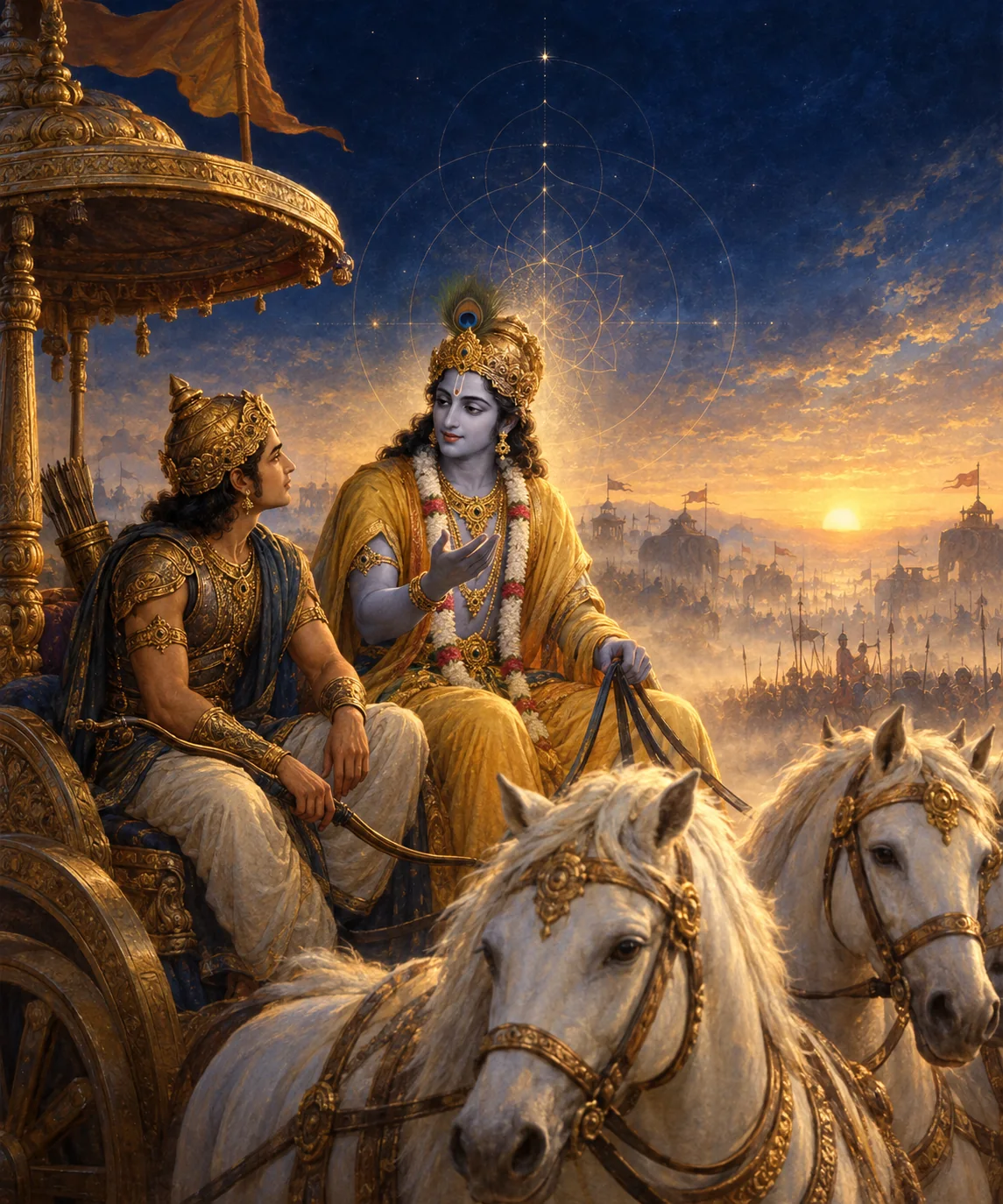
Māṇḍūkya Upaniṣad
Twelve verses. Waking, dream, deep sleep, and the fourth — that which is aware of all three.
c. 500–200 BCE
- When
- c. 500–200 BCE
- Where it sits
- The three points of departure
The densest text in the tradition and the one Advaita rests on most heavily. Usually read last, with Gauḍapāda's commentary.
Twelve verses
The Māṇḍūkya Upaniṣad is the shortest of the principal Upaniṣads. Twelve prose sentences, belonging to the Atharva Veda. You can read the whole thing in the time it takes a kettle to boil.
The tradition's estimate of it is out of all proportion to its length. The Muktikā Upaniṣad, listing the canon, says that if a seeker can get nothing else, the Māṇḍūkya alone is enough for liberation. Gauḍapāda, the earliest teacher we can name in this line, wrote two hundred and fifteen verses of commentary on it — the Māṇḍūkya Kārikā — and that commentary became the first systematic statement of Advaita Vedānta in existence. Śaṅkara then commented on both. Almost everything distinctive in this tradition is either in these twelve sentences or in the argument Gauḍapāda builds on them.
What it does that nothing else does
Most of the Upaniṣads argue from the world to its ground. The Māṇḍūkya does something stranger and much harder to dismiss: it argues from your own states of consciousness, which nobody can deny having, and it uses the one experience every human being has every night.
The method is to take the whole of experience — not the waking part of it — as the data set. You spend your life in three states. You are awake, and there is an external world, a body, other people, and a self that transacts with them. You dream, and there is an entire world with its own space, time, people and body, which while it is running is not experienced as a dream at all. And you sleep dreamlessly, where there is no world, no body and no separate someone, and from which you come back reporting rest rather than absence.
Set them side by side and something immediately follows. The waking self is not present in dream; the dreaming self is not present in deep sleep. None of the three selves persists through the other two. And yet something does, because it is the same person who can compare them and say "I slept well" — a judgement you could not make about a period you were entirely absent from.
That something is what the text is pointing at. It names three states and then names a fourth term, which is not a fourth state but what is present in all three and limited by none. The Sanskrit word is simply turīya, the fourth. The text describes it only by subtraction: not the waking self, not the dreaming self, not the sleeping self; unseen, ungraspable, without a distinguishing mark, unthinkable, unnameable; the cessation of the whole appearance; peaceful; without a second. And then, at the end of the seventh sentence, it says what it is: that is the self, and that is to be known.
The syllable
Half the text is about the sound OM, and it is not a digression.
The Māṇḍūkya maps the three states onto the three sounds of the syllable — A, U, M — and then onto the silence after it. The waking state is A, the first and broadest sound, made at the back of the open mouth. Dream is U, formed as the sound moves forward and narrows. Deep sleep is M, the mouth closed, the sound ended. And the fourth is the silence in which all three sounded and into which they went, which is not a fourth noise.
This is a piece of teaching design worth admiring. The text takes the most abstract claim in the tradition and attaches it to something the reader can produce with their own throat, slowly, once, and feel the three movements and then the quiet. It is the reason this syllable is chanted at the start of everything in this tradition rather than merely discussed.
How it came to exist, and who stands behind it
The Upaniṣad itself is anonymous, like all of the śruti — the layer the tradition regards as heard rather than composed. It closes the Atharva Veda. There is no biography to give and no date that can be defended; the principal Upaniṣads are generally placed in the last centuries before the common era, and the Māṇḍūkya is usually read as one of the later ones in that group, on the strength of its compressed prose.
The history that can be traced begins with Gauḍapāda. He is the teacher of Govinda Bhagavatpāda, who was the teacher of Śaṅkara — so he stands two generations before the man who organised the tradition, and everything Śaṅkara later argued at length is present in outline in his verses.
Gauḍapāda's Kārikā is in four parts. The first follows the twelve sentences directly. The second argues that what is seen in a dream and what is seen while awake have the same status as objects: both are experienced as real while they last, both are set aside by the other. The third makes the positive case that the self is unborn, and that nothing has ever in fact been produced. The fourth — the most rigorous and the most contested — argues the case against the philosophical schools of his day, and does so in a register so close to Buddhist logic that scholars have argued for a century about the influence. The tradition's own answer is that he uses the sharpest tools available to defend a conclusion drawn from the Upaniṣads, which is what Śaṅkara went on to do as well.
Gauḍapāda's compressed slogan for the whole position is the doctrine of no-origination: nothing was ever really produced, so nothing needs to be undone. That single move is what distinguishes Advaita from every other Vedāntic school, and it starts here.
How it is built
- Sentence 1: everything is OM; the past, present and future, and whatever is beyond time.
- Sentences 2 to 7: the four — the waking self and its outward-facing awareness; the dreaming self and its inward-facing awareness; the sleeping self, undivided and unaware; and the fourth, described by negation and identified as the self.
- Sentences 8 to 12: the same four mapped onto A, U, M and the silence, with the closing statement that the one who knows this enters the self by the self.
Then, layered on it: Gauḍapāda's two hundred and fifteen verses in four chapters, and Śaṅkara's commentary on both. Read in that order — the twelve sentences first, slowly, several times, before going anywhere near the Kārikā.
What it is for, in an ordinary life
It removes the need to take anybody's word for anything. This is the most sceptic-friendly text in the tradition, because its evidence is not scripture, history or testimony. It is your own three states, which you have every twenty-four hours. Everything the Māṇḍūkya asks you to accept is either something you can verify tonight or a conclusion drawn from it.
It gives you a place to stand when a state is bad. The practical yield of these twelve sentences is the distinction between a state and what the state appears in. A mood, an illness, a failure and a triumph are all contents. The claim is that the awareness in which they appear is not itself anxious, ill, failing or elated — and the test is simple: notice that you can be aware of your own agitation. Whatever is noticing is evidently not identical with what it notices. That one observation, made in the middle of a difficult hour, is this text in use.
It explains why the tradition does not treat deep sleep as nothing. We treat dreamless sleep as an interruption. The Māṇḍūkya treats it as the nightly evidence that the sense of being a separate someone is intermittent and therefore not fundamental — and that its absence is not experienced as horror but as the best rest available. That is a significant piece of data about what we actually are, hiding in plain sight in the middle of every night.
And it is short enough to keep. Twelve sentences can be carried in the head. No other text in this tradition offers the whole position in a form you can hold entire while walking to the station.
The text itself
Complete originals, in free copies wherever one exists.
Commentaries worth trusting
Read by teachers within the tradition, not summaries of it.
- Māṇḍūkya Upaniṣad and Kārikā lectures — Swami Sarvapriyananda Waking, dream and deep sleep treated as three sets of evidence about one experiencer.
- Māṇḍūkya Upaniṣad, Chinmaya commentary — Swami Chinmayananda Twelve verses that the tradition calls sufficient on their own, made usable.
This text sits inside a shelf with a shape. See how the whole corpus is organised, or start from today's message.