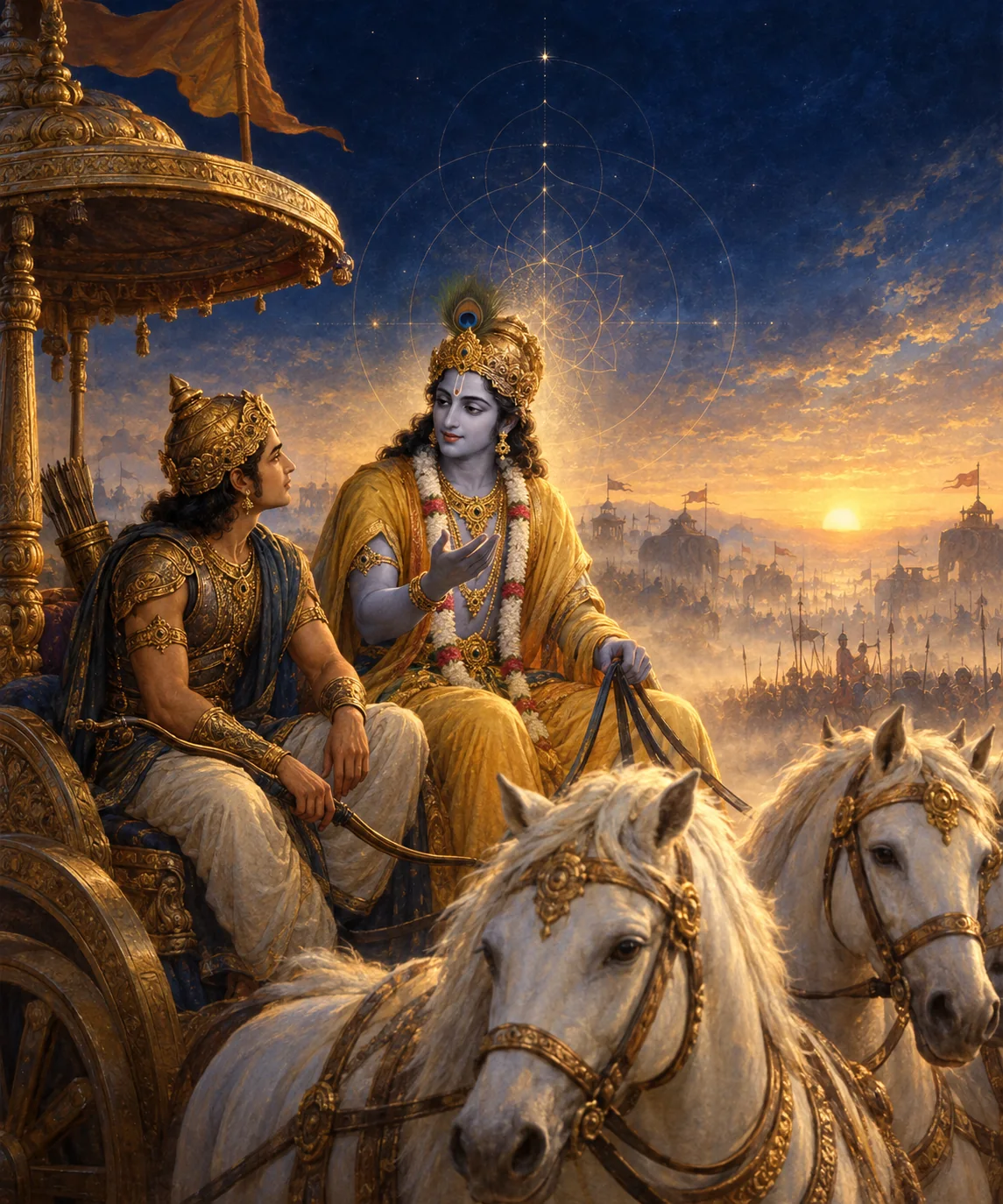
Bhagavad Gītā
Eighteen chapters spoken on a battlefield to a man who wants to walk away from his duty. Knowledge, action and devotion are reconciled without any of them being demoted.
c. 200 BCE
- When
- c. 200 BCE
- Where it sits
- The three points of departure
The most practical text in the tradition: it assumes you have obligations, conflict and a real life, and refuses to let renunciation mean escape.
A teaching delivered in the worst possible place
Every other text in this tradition is set somewhere sensible. A forest clearing. A teacher's house. A hall of assembly. The Bhagavad Gītā is set between two armies, drawn up and waiting, on the morning of a battle that will destroy most of the people standing in it — and it is spoken to a man who has just realised, too late to withdraw, that the people opposite are his own family.
That setting is not decoration. It is the argument. The Gītā's claim is that the highest knowledge available to a human being is not the property of people who have arranged quiet lives, and that it can be delivered, understood and acted on by somebody who has no time, no privacy, no way out, and a decision to make before the sun is much higher. If you only ever read one thing from this tradition while holding down a job and a household, read this one, and read it for that reason.
Where it sits, and how it came to us
The Gītā is not a standalone book. It is seven hundred verses inside the sixth book of the Mahābhārata, the vast epic of the Bhārata war, which the tradition attributes to Vyāsa. It is narrated to us at two removes: Sañjaya, given the power to see the battlefield, reports the conversation to the blind king Dhṛtarāṣṭra, whose sons are on the other side. So the first thing we are told about this teaching is that a man received it verbatim and it changed nothing in him, which is a quietly devastating point about information and transformation.
When it was composed is genuinely uncertain. It belongs to the long formation of the epic and is usually placed in the centuries either side of the start of the common era, though the tradition itself does not date it and there is no manuscript that settles it. What is not uncertain is its standing. Śaṅkara chose it as one of the three foundations of Vedānta, alongside the Upaniṣads and the Brahma Sūtras, and commented on it; after that, every school of Vedānta that wanted a hearing had to comment on it too. It is the only text in that trio which is not either revelation or aphorism — it is a conversation, in verse, which is why it has been the most read of the three for a thousand years.
The situation, exactly
Arjuna is the finest archer of his generation, on the just side of a war he has spent thirteen years working to avoid. He asks his charioteer to drive him between the armies so that he can see who has come. He sees teachers, cousins, fathers-in-law, friends.
His response is not cowardice, and the text is careful about this. He makes an ethical argument: that the war will destroy the families and customs that hold a society together, that winning would leave him with a kingdom bought by killing his own, and that therefore not fighting is the better act. Then his hands shake, his mouth dries, his bow slips, and he sits down in the chariot and says he will not fight.
Kṛṣṇa's first reply is not consoling. He tells Arjuna that his grief is misplaced and that he is speaking like a wise man while acting from collapse. The whole rest of the text is the repair of a man who has to stand up.
What it actually says
It is easier to hold if you take it as four moves rather than eighteen chapters.
First: you have never actually lost anyone. Kṛṣṇa's opening answer is the direct one. What is essentially you was not born and will not die; bodies begin and end as childhood, youth and age come and go in the same person. This is not offered as comfort but as a correction of fact, and it is the point at which the Gītā becomes a Vedāntic text rather than a book of ethics.
Second: you cannot get out of acting, so the question is how. Doing nothing is also doing something, and Arjuna sitting down is a choice with consequences for everyone depending on him. The instruction is not to abandon action but to abandon the grip on its result: do what is yours to do, do it as well as it can be done, and let go of the accounting. The Gītā's word for this is karma-yoga, and it is precisely not indifference — the same chapter demands excellence. What is given up is the inner bookkeeping that makes every act a transaction and every outcome a verdict on you.
There is a test for whether this has been understood. Anyone who thinks it means "try less" has not understood it. It means try completely, and stop harvesting the result for your sense of self.
Third: devotion is not a lower path. Around the middle of the text the register changes. Kṛṣṇa says that whatever anyone offers with real love — a leaf, a flower, water — he accepts; that those who turn to him with everything they have are not lost, whatever their birth or history; and in the eleventh chapter he shows Arjuna what he actually is, at which point the strongest man on the field is reduced to apologising for his earlier familiarity. A tradition that insists on one reality without a second also insists that love of God is the most available road to it. The Gītā is where those two claims are held in one hand.
Fourth: watch what is watching. The later chapters do the analytical work — the difference between the field and the one who knows it, the three strands out of which all temperament and behaviour is woven, the marks of somebody who has actually come to rest. The text ends, after all eighteen chapters, with Arjuna saying his confusion is gone and taking up his bow. Nothing external has changed. The armies are still there.
How it is built
- Chapters 1 to 6: the crisis, the nature of the self, and action without grasping at results. The practical end.
- Chapters 7 to 12: the nature of God, devotion, and the vision in chapter eleven. The devotional end.
- Chapters 13 to 18: the analysis — field and knower, the three strands, the three kinds of faith, food, charity and renunciation, and the closing instruction.
The tradition reads those three blocks as a commentary on the three words of the great statement "that thou art": chapters 1 to 6 on "thou", 7 to 12 on "that", and 13 to 18 on "art". Whether or not that scheme was intended, it is a useful way to keep seven hundred verses in order.
Who stands behind it
Attributed to Vyāsa as part of the Mahābhārata. Its philosophical standing, though, comes from the commentators. Śaṅkara's commentary establishes the non-dual reading and is the one every later commentator argues with. Rāmānuja read it as a text of devotion to a personal God who is not identical with the self; Madhva read it as asserting a permanent difference. In the modern period, Swami Chinmayananda's line-by-line commentary was written explicitly for readers with no Sanskrit, and it is the reason a large number of people in the last sixty years met this text at all.
A word of warning worth having early: there are more loose English versions of the Gītā than of any other Indian text, many of them retellings with the philosophy filed off. Use a translation that carries the Sanskrit and a commentary from a named teacher in a living line.
The one misreading to avoid
The Gītā is not an instruction to fight, and it is not a general licence to do difficult things on the grounds that nobody really dies. Kṛṣṇa never tells Arjuna that killing does not matter; he tells a soldier standing in a formed battle line, having exhausted every alternative over thirteen years, that abandoning his own duty at that moment out of grief is not renunciation but collapse. The transferable instruction is about the relationship between you and your own action. The war is Arjuna's, not yours.
What it is for, this week
Three things, all checkable without believing anything.
It is the text for people who cannot retire. Its entire premise is that the highest teaching works in the middle of obligation. If your objection to spiritual life is that you have a job, dependants and a commute, this text was composed with you in view.
It separates effort from outcome, which is where most suffering actually lives. Look at the last thing that upset you at work. In almost every case the pain was not in the doing but in what the result was going to say about you. The Gītā's proposal is that you can keep the doing at full strength and drop that second thing, and it claims the doing gets better, not worse. That is a testable prediction about your own week.
It refuses the split between thinking and loving. People who cannot bear devotion are sent to the analysis; people who cannot bear analysis are sent to devotion; nobody is told their temperament disqualifies them. Few religious texts of any tradition are that generous about the ways in are.
And it ends the way it begins: with a person who still has to go and do the difficult thing, only no longer alone inside it.
The text itself
Complete originals, in free copies wherever one exists.
- Bhagavad Gītā with Śaṅkara's Bhāṣya and ten translations, Gita Supersite (IIT Kanpur)
- Śaṅkara's commentary, translated by A. Mahadeva Sastri
- Śaṅkara's commentary on the Gītā, searchable — Advaita Śāradā
- The Gītā with Swami Chinmayananda's commentary, Chinmaya Mission
- The Gītā home-study course of the Chinmaya International Foundation, thirty lessons by post or email In print rather than free: the people who publish it keep the text alive.
Commentaries worth trusting
Read by teachers within the tradition, not summaries of it.
- The Holy Geeta — Swami Chinmayananda The commentary that put the Gītā in the hands of ordinary working people, chapter by chapter.
- Bhagavad Gītā Bhāṣya of Śaṅkara, translated by Swami Gambhirananda — Ādi Śaṅkara Read alongside the verses on the Supersite: Śaṅkara states the objection before he answers it.
This text sits inside a shelf with a shape. See how the whole corpus is organised, or start from today's message.