Sri Toṭakāchārya
Direct disciple of Sri Adi Shankara
8th–9th century CE · The Sri Shankara Lineage
- When
- Eighth to ninth century by the historians’ dating of Sri Śaṅkara, which the Kanchi chapter, the Anusandhana Kendra and the Sringeri page’s “more than twelve centuries” support; the traditional chronologies of the seats place him earlier. His own dates are not recorded.
- Born
- Not recorded. The Kanchi chapter makes him the son of Viśvanātha Adhvari and gives him a second name, Kalanātha; the Digvijaya’s third canto makes him Udaṅka, son of Śilāda, born of a tenth part of the god of Fire. Neither names a place, and this page reports both.
- Where the life was lived
- Sringeri, where the Digvijaya’s twelfth canto has Giri join the teacher and serve him, and where the wall, the eight verses and the name belong; afterwards the Jyotirmaṭh in the Badarī country of the Himalaya, at Joshimath below Badrinath, which every source says he was given. Nothing is recorded of where he died.
- What is left of it
- The Toṭakāṣṭaka, eight verses to his teacher in the Toṭaka metre, each ending “bhava Śaṅkara deśika me śaraṇam”, sung at Śaṅkara Jayantī and printed by the Sringeri Pīṭham among the hymns of the lineage; and the Śrutisārasamuddharaṇa, about a hundred and seventy-nine verses in the same metre on “That thou art”, printed at Srirangam in 1946 with Sri Saccidānanda Yogi’s commentary. Nothing else is attributed to him.
Known first only for his service, he was found to have the whole teaching by his teacher's grace, and composed his eight verses on the spot in the metre that gave him his name.
The man
Sri Toṭakācārya is the disciple who was not clever. Every other name on this site is the name of someone who read, argued, wrote or saw; his is the name of a young man called Giri who washed his teacher’s clothes, walked behind him, anticipated what he would need, and was thought by his fellow students to be a fool. The Kanchi Kāmakoṭi Pīṭham’s volume on the preceptors of Advaita says so without softening it: “Tradition has it that the devotion of Giri to his Master was very profound; but he did not profit much by the teachings.” One morning at Sringeri he was late back from the river, and the teacher held up the class for him; the cleverest disciple present said there was a wall in his place and that would do as well; and the teacher, the tradition says, gave the absent man by an act of will the whole of what the others had spent years acquiring. He came back reciting eight verses in a difficult metre, each ending “bhava sankara desika me saranam” — “Śaṅkara, my teacher, be my refuge” — and the metre gave him his name.
That is the story, and this page tells it from every source that tells it. But it is also careful about what the story is for. Advaita is a tradition of learning, and it has kept, among its four founding disciples, one whom it describes as having had none. The Kanchi chapter draws the lesson the tradition intends: he “exemplified in his life the spirit of service and dedication to his Guru, even at the expense of knowledge. In this respect he is on a par with Bharata, the illustrious brother of Sri Ramachandra, and with Hanuman, Sri Rama’s great devotee.” And it is honest about what happened to the learning once he had it: it went into two works, one of eight verses and one of about a hundred and eighty, and then, the tradition says, into a lifetime of service and a seat in the Himalayas.
This page gives both works: the eight verses of the Toṭakāṣṭaka in full, in a published translation, and the plan and teaching of the Śrutisārasamuddharaṇa as its editors and the Kanchi chapter describe it. It gives the several names the sources attach to him and the disagreements between the sources about his father, his birth and his identity with a disciple called Ānandagiri. It tells the story of his nursing his teacher through a last illness, which is less often told. And it asks what a tradition that has always prized understanding meant by keeping, at its centre, a man it remembers for something else.
The sources for this page, and what each can bear
- The Śaṅkara-dig-vijaya of Mādhava-Vidyāraṇya, in Swami Tapasyananda’s English translation (Sri Ramakrishna Math). Its twelfth canto tells the Sringeri story in full; its thirteenth records the teacher asking him and the others to write; its sixteenth describes him nursing the teacher; its third gives his birth as a portion of the fire-god and his early name. The poem is centuries later than the events.
- The Sringeri Śāradā Pīṭham: its abridged Mādhavīya Śaṅkara Digvijayam, part four; its page on Sri Toṭakācārya among the primary disciples; its page on the Āmnāya Pīṭhams; and its text of the Toṭakāṣṭakam among the hymns of the lineage.
- The Kanchi Kāmakoṭi Pīṭham’s Preceptors of Advaita (1968), chapter 11, on Sri Toṭaka, which gives the names, the story, the two works and a summary of the teaching of the Śrutisārasamuddharaṇa.
- The Śrutisārasamuddharaṇa itself, in the Sri Vani Vilas Press edition (Srirangam, 1946) with the commentary of Sri Saccidānanda Yogi and an English introduction by R. Krishnaswamy Iyer, in a public scanned copy. The scan is poor and the machine that read it made many errors; the few passages quoted from it have been restored word by word and every restoration is recorded in the closing note.
- The Toṭakāṣṭaka in Anand Hudli’s text and translation on the Sanskrit Documents site, which also carries a short account of the disciple and a note on the metre. Every verse quoted on this page is from that translation.
- The Advaita Vedanta Anusandhana Kendra for the lineage hymn, for the historians’ caution, and for the note that a later teacher wrote a gloss on his longer work.
- The Govardhana Maṭha, Puri: its own page on the four seats, for the northern seat’s Veda and first head.
Every quotation on this page is word for word from one of these sources, and each is linked at the foot of the page. Where the sources disagree, both are given. Nothing has been quoted from any source not named.
Where the life was lived
One place is certain in every telling: Sringeri, on the Tuṅgā river in the Western Ghats, where Sri Śaṅkara had stopped to teach and to build. The Digvijaya sets the scene: “travelled with Padmapada and other disciples to the place called Sringa-giri (Sringeri), where the sage Risya-sringa had for a long time meditated on the Supreme Self. Nearby flows the Tungabhadra, which brings good to all who bathe in its waters.” It was there that the teacher “had a temple, as graceful as those of Indra-loka, built and installed therein an image of the Divine Mother” — the shrine of Śāradā that the Sringeri Pīṭham keeps to this day — and there, the poem says, “a new disciple named Giri joined the Acharya”. The Sringeri disciple page: “During Sri Adi Shankaracharya’s residence at Sringeri, he accepted a disciple named Giri”. The river where he washed the clothes is the Tuṅgā, and the pin on the map is set at the town.
Present-day coastlines; no border but India’s is drawn. Two places are claimed for him and every source agrees on both. Sringeri, in the Western Ghats of Karnataka, is where the Digvijaya, the Kanchi chapter and the Sringeri pages set the whole of his story: the service, the wall, the eight verses, the name. The Jyotirmaṭh in the Badarī country of the Himalaya is the seat every account says he was given afterwards; it is pinned at Joshimath, where it stands, a few miles below the shrine of Badrinath whose deity it serves. No birthplace is recorded by any source — the two accounts of his father do not name a place — and nothing is recorded of where he died. No line is drawn, because no journey between the two is described.
- 1Sringeri (Karnataka) — Where the Digvijaya’s twelfth canto has the young man Giri join the teacher and serve him, and where the morning of the wall, the eight verses and the naming took place; the Kanchi chapter and the Sringeri pages agree
- 2Jyotirmaṭh, Joshimath (below Badrinath) (Uttarakhand) — The northern seat, which every source — the Kanchi chapter, the Sringeri pages, the Puri seat’s page and the Sanskrit Documents page — says he was given as its first head. The Sringeri disciples page places it at Joshimath; the Sringeri Āmnāya page gives its location as Jyotirdhāma (Badrinath), the shrine a few miles up the same valley, and the Kanchi chapter calls it “the Matha which he founded in the Badari Kshetra”; one pin serves both
The second place is the one the tradition gives him afterwards: the northern seat in the Himalayas, near the shrine of Badrinath. The Kanchi chapter: “Sri Sankara, after his digvijaya, seems to have made Totaka the head of the Matha which he founded in the Badari Kshetra.” The Sringeri page on the Āmnāya Pīṭhams: “Northern Amnaya — Uttaramnaya Jyotir Math — Acharya: Sri Totakacharya — Location: Jyotirdhama (Badrinath), Uttarakhand”; its page on the disciples places the seat at Joshimath, the town below Badrinath where the Jyotirmaṭh stands. The two are a few miles apart in the same valley, and the map gives them one pin, set at Joshimath, with Badrinath named in its note. Nothing in any source used here says where he was born or where he died; the pin for his birth is therefore absent, and the map begins where the sources do, at Sringeri.
A third place belongs to the story of his service rather than to geography. The Digvijaya’s sixteenth canto describes him nursing the teacher through an illness; the poem does not say where, and the map does not pretend to know.
The names: Giri, Toṭaka, Ānandagiri, Kalanātha, Udaṅka
He has more names than any other disciple of Sri Śaṅkara, and the sources do not agree on all of them. This page uses Sri Toṭakācārya, the name the tradition gives him, and Giri for the young man before the morning at Sringeri, because every source does; the others are set out here so that a reader who meets them will know whom they mean.
- Giri. The name he had when he came. The Digvijaya: “a new disciple named Giri joined the Acharya”. The Kanchi chapter: “All that we know about him definitely is that his original name was Giri”. Giri is also one of the ten names of the Daśanāmī orders of Advaita monks, the one the Digvijaya’s translator links to the Himalayan seat; whether it was his given name or his monastic one the sources do not say.
- Toṭaka, Toṭakācārya. The name of the metre in which he spoke his eight verses, and so his name from that morning. The Digvijaya: “As this poem emerged from this disciple’s mind entirely out of his devotion to the Guru and as it took shape in Totaka metre, he (that disciple) has come to be known as Totakacharya among wise men.”
- Ānandagiri. The Digvijaya, in its thirteenth canto, says the teacher “asked Anandagiri (the same as Totaka) and other disciples to write works on Advaita”; the Sanskrit Documents page on the hymn begins its story, “Anandagiri was one of the less scholarly disciples living with Shankara at Sringeri. But Giri, as he was called, was extremely devoted to the Ācārya.” The Kanchi chapter, however, attaches the name to a different disciple — “Anandagiri better known as Hastamalaka” — and the Digvijaya’s own third canto makes Ānandagiri a third man, an incarnation of Gaṇeśa. The section on the tangle of names sets these out.
- Kalanātha. The Kanchi chapter alone: “Giri who seems to have also another name, Kalanatha. This Giri was the son of one Visvanatha Adhvari and he later on came to be called Totakacharya.”
- Udaṅka. The Digvijaya’s third canto alone: “Totaka, the terror of his antagonists, was known in his early life as Udanka, the son of Silada.”
So the two fullest sources give him two different fathers — Viśvanātha Adhvari in the Kanchi chapter, Śilāda in the Digvijaya — and two different early names. This page does not choose; it has no means to. An adhvari or adhvaryu is a priest of the Yajur Veda, so the Kanchi tradition makes him, like Sri Hastāmalaka, the son of a ritualist. The name Śilāda is, in the Purāṇas, the name of the father of Nandi, Śiva’s bull; and since the same canto of the Digvijaya says of Ānandagiri that “also that Anandagiri was the incarnation of Nandi, the bull of Siva”, there may be a thread of tradition here connecting Giri, Śilāda and Nandi that the poem has not spelt out. That is a conjecture and is marked as one.
When he lived
His dates are his teacher’s, and the Kanchi chapter on him opens with the fairest statement of the problem that this site has found: “Sri Sankara, the greatest expounder of Advaita Vedanta is reputed to have flourished between 788 and 820 A.D. This date cannot be regarded as finally settled and a large number of Indian scholars bring down his date to the first or second century A.D. or B.C. However, the latter part of the eighth century has been accepted by thinkers as the most probable date. It is not worth-while to enter into a controversy regarding the date of this acharya; for, the absence of relevant inscriptions and historical records permits a pliability in investigation which need not always take us in the right direction. Nor are the teachings of Sri Sankara affected in any way by the absence of certainty regarding his date.”
The Anusandhana Kendra agrees on the century: “Sankara can be dated more or less reliably to the 8th century CE.” The Sringeri page on the seats speaks of the four maṭhas functioning “after more than twelve centuries”, which puts their founding, and his headship of one, in the same period. On that reckoning the morning at Sringeri fell in the early ninth century, and his time at the Himalayan seat after it. The card for this page gives the eighth to ninth century. The Digvijaya’s translator, in his introduction, argues for a date some centuries earlier, and the tradition of some of the seats gives the fifth century before Christ; both views are recorded on the pages for Sri Śaṅkara and Sri Govinda, and neither changes anything on this one.
Within the teacher’s life, the poem places him last of the four. In its telling Sri Padmapāda had come first, at Kāśī; Sri Sureśvara had come from the debate at Māhiṣmatī; Sri Hastāmalaka had been found at Śrī Bali on the coast; and it was at Sringeri, after all three, that Giri joined. The Digvijaya says he “came to be known as one of the chief disciples of Sankara” only after the morning of the eight verses; before it, the poem says nothing of him except how he served.
What the tradition says he was before: a tenth part of Fire
The Digvijaya’s third canto, which gives the divine origins of all the teacher’s companions, gives his: “By a tenth of his being, the deity of Fire became Totaka, the sea of whose reputation was deep enough to drown the earth and whose mission was to pulverize the arguments of all opponents who faced him.” The Kanchi chapter records the same tradition: “According to tradition, Totakacharya, whose original name was Giri was the amsa of Agni, while Hastamalaka and Padmapada were the incarnations of Vayu and Sri Narayana.”
An aṁśa is a portion, and the poem is specific: a tenth. The reader may make of the fraction what he likes; the poem does not explain it, and this page does not. What the choice of god says is easier to read. Agni is the god of the sacrificial fire and the messenger between men and gods, the one who carries the offering; and the disciple who became a portion of him is the one who carried his teacher’s clothes to the river and back. The poem’s formula about his “mission was to pulverize the arguments of all opponents who faced him” is the same formula the canto applies to every disciple, and nothing in the rest of the poem shows him arguing with anyone; the Kanchi chapter, more accurately, says that “he lost himself in the service of his master”. The fire the tradition means was not the fire of debate.
The same canto lists the four disciples together as “the four Vedas themselves embodied” in the eyes of those who saw them, and the four seats were in time each assigned a Veda. The Sringeri Pīṭham’s page on the seats gives the northern one, his, the Atharva. Whether the tradition had a fitness in mind between the Atharva Veda — the Veda of the household fire and of practical rites — and the disciple whose whole distinction was practical service, the sources do not say. It is a thought the reader may hold lightly.
Sringeri: the disciple who followed like a shadow
Before the story of the wall, the Digvijaya gives a portrait of the young man as he was, and it is the only such portrait of any of the four disciples before their fame. It is a portrait entirely of conduct:
“At this place a new disciple named Giri joined the Acharya. He was noted for his obedience, industry, righteousness and taciturnity. His devotion to the service of the teacher was such that he would do everything for him anticipating his want. Thus he would take his bath before his teacher, make all arrangements for his personal needs like cleaning of teeth, ablutions, sitting, sleeping, etc. He would shampoo his feet and follow him like a shadow. He would never do before the teacher anything smacking of disrespect — never sit listlessly before him, talk too much in his presence, or turn his back to him. He always walked behind the teacher, stopped when he stopped, listened attentively to whatever he said, and did everything for him even without being told.”
The Sringeri abridgement keeps the same details in fewer words — “he could never do anything smacking of disrespect; will not sit listlessly before him, talk too much in his presence, walked always behind the Acharya never showing his back” — and adds the other disciples’ view of him and the teacher’s: “The others took him to be a dull uninformed person and were indifferent to him. The Acharya knew his heart and waited to bring forth his greatness to others.” The Sringeri disciple page: “Unlike Sureshwara and Padmapada with their scholarly brilliance, or Hastamalaka with his innate Self-realization, Giri possessed neither exceptional learning nor profound spiritual insights. Yet he excelled in one invaluable virtue: wholehearted service to his Guru. Giri attended to the Acharya’s needs with meticulous care and unwavering devotion, finding profound joy in even the simplest tasks.”
Every item in the poem’s list is a rule from the ancient codes of conduct for a student towards a teacher: bathe before him, do not sit slackly in his presence, do not talk too much, do not turn your back, walk behind, stop when he stops. The Digvijaya is describing a young man who kept the whole code, which is to say a young man who had learned the one thing the tradition says must come before learning. The Kanchi chapter is blunt about the cost: “The reverence which he had for his Guru, the great Sankaracharya so completely dominated him that Giri had no other interest in his life except to serve the great Master and neglected even his teachings” And it is equally blunt about the teacher’s view of the cost: “He used to absent himself frequently from the classes taught by the Preceptor, preferring to do personal service to the teacher without wasting even that time in mere listening. Sri Sankara who was aware of the depth of his disciple’s affection and reverence towards himself did not mind his absence during the discourses.”
One word in the poem’s portrait is worth keeping in view for the rest of the story: taciturnity. Giri did not talk. The disciple who is about to speak eight verses in the hardest metre in the language, and then some hundred and seventy-nine more, is introduced as the one who said least.
The wall: the morning the class waited
The Digvijaya tells the morning in one paragraph and every later source retells it. “One day, this disciple had gone to wash his teacher’s clothes and was a bit late in returning, and so the teacher, out of love for the disciple, delayed his discourse for a time, awaiting his arrival. As it was getting late, some of the other disciples started the Santipatha uttered at the beginning of the class, but the teacher stopped them and asked them to wait for a while until the disciple Giri returned.” The śāntipāṭha is the chant of peace with which a Vedic class opens; the disciples had begun, in effect, without him, and the teacher stopped them.
Then the remark. In the Digvijaya: “Thereupon, Padmapada said, pointing to a wall near by with his eye, ‘Whom are we to wait for? What qualification has a fellow, so dull as that wall, for the study of the Sastra?’” In the Kanchi chapter: “Getting impatient at this delay, Padmapada suggested to the teacher that since all the students had come, the discourse might start. ‘Let Giri also come’, were the words of the Master. Padmapada who had a great contempt for the intellectual backwardness of Giri exclaimed rather hastily that there was the wall in the place of Giri.” In the 1946 edition of the Śrutisārasamuddharaṇa, the editor’s introduction gives the exchange as dialogue: the Master replied “Let Giri also come”; Sri Padmapāda, “We have the wall in his stead”; and the Master, “All the same, let him come”. The Sringeri disciple page has Sri Padmapāda, “Unable to contain his frustration”, asking “Why should we wait for one who is no better than a wall?” The Sanskrit Documents page: “Padmapāda, who was obviously proud of his erudition, said, ‘Giri is a dull fellow. He really does not deserve to learn the śāstras. What is the point in waiting for him to join us?’”
It matters who said it. Sri Padmapāda was the teacher’s first disciple and, by the poem’s own measure, the standard of learning among them; his own page on this site tells how he walked across the Ganges on lotuses that rose to meet his feet, out of pure obedience to a call. The tradition did not give the remark to a minor figure. It gave it to the disciple whose devotion was proverbial, to show that devotion and contempt for a slower brother can live in the same heart, and that the second is what a teacher corrects first. The Kanchi chapter’s comment is dry: “The Master who should have been a bit pained at this discourteous reference to Giri, nevertheless waited for his arrival.” The Sringeri page is plainer: “This disparaging remark deeply displeased Sri Shankaracharya.”
What the teacher did next is the hinge of the story, and the sources describe it as an act, not a lesson. The Digvijaya: “In order to dispel the pride of these disciples, and out of his love for the one they traduced, the Acharya awakened in him, by an act of will, the knowledge of fourteen subjects.” The Kanchi chapter: “With a view to teach the students that a mere intellectual comprehension of the philosophical problems was after all only of secondary importance and that a right attitude and reverence were very necessary in the spiritual sphere, he silently blessed the absent Giri with a complete knowledge of the Vedantic truth.” The Sringeri page: “A wave of compassion arose in his heart for the faithful Giri, and he resolved to bless him. Through his yogic powers, the Acharya instantly bestowed upon Giri complete mastery of all the sacred scriptures.” The fourteen subjects, caturdaśa vidyā, are the traditional count of the branches of sacred learning: the four Vedas, the six auxiliary sciences, and the Purāṇas, logic, Mīmāṁsā and the law-books. The poem means that in a moment, by the river, the young man was given the whole curriculum.
The return: eight verses in a difficult metre
The man at the river felt it before he understood it. The 1946 introduction: “He felt a sudden flash of illumination which brightened and invigorated his mind to an extraordinary extent.” The Kanchi chapter: “Giri who was still engaged in washing his Master’s clothes, suddenly felt an upsurge of his intellect and a divine flash of illumination. This made him experience and realise the spiritual uplift instantly. While others took years and perhaps several births to realise this truth, Giri was able to perfect this state of realisation almost in an instant.”
Then he came back. The Digvijaya: “With all knowledge awakened in him by the grace of the Guru, the disciple Giri now appeared on the scene, uttering a great hymn in the metre known as Totaka, and for this reason he afterwards came to be known by the name Totaka.” The Sringeri abridgement has one detail the full translation does not: “Giri came to the class dancing and uttering a great hymn in the metre known as Totaka.” The Kanchi chapter names the hymn and its refrain: “Gratitude to the Guru who in his extraordinary compassion had inspired him with divine knowledge and bliss made Giri spontaneously praise Sri Sankara in eight verses … in Totaka metre each verse ending with the refrain, ‘bhava sankara desika me saranam.’ It is clear that the composition of this work in Totaka metre earned for him the name of Totakacharya.”
The poem then does something it does for no other disciple: it stops to describe the hymn in a figure, and the figure is a garden.
“On the supporting tree of the Acharya grows the creeper of devotion, taking its root at his own feet and watered by his grace. On that creeper, on the stalk called ‘Totaka’, has grown this fruit of a wonderful poem which will for all time be relished by the superb parrots, the ‘men of wisdom.’ Devotion to the Guru is an aid like a ladder that helps man in ascending to that high, sky-transcending state of spiritual absorption, from which all the three worlds look very small. What wonder is there if the veil of ignorance was so rapidly dispelled in one who knew the proper use of this aid!”
The other disciples’ reaction, in the poem, is put in their own mouths and is not flattering to them: “‘It must indeed be the grace of the Acharya that enabled the fool of this fellow to compose the great poem in Totaka metre, embodying all the highest teachings of the Veda.’ So thought all the disciples.” — they credit the grace and still call him a fool in the same breath. But the poem lets them come round: “Thus on witnessing the wisdom and the poetical skill that their co-disciple had acquired through his devotion to the Guru, Padmapada and others abandoned their pride of learning and came to hold him in high regard.” And it gives him his place: “Receiving the new name of Totaka from the Acharya, and equalling Padmapada himself in learning and intelligence, he came to be known as one of the chief disciples of Sankara.” The Sringeri page: “From that moment, Giri became known as Totakacharya, and his position among Sri Adi Shankaracharya’s foremost disciples was firmly established.”
The Toṭaka metre
His name is the name of a metre, and a reader who does not know what the metre is cannot know what the name means. The Sanskrit Documents page gives the rule: “The Toṭakāṣṭaka has been composed in the Toṭaka meter, in which each pāda (quarter) has four sa-gaṇa’s. Here a sa-gaṇa is made up of two short syllables followed by a long one. The hymn naturally lends itself to be set to music.” A sa-gaṇa is the foot short-short-long; four of them to a quarter-verse make twelve syllables in a running triple rhythm, da-da-DUM da-da-DUM da-da-DUM da-da-DUM, and four quarters make a verse. The refrain fits the pattern exactly: bha-va ŚAṄ-ka-ra DE-śi-ka ME śa-ra-ṆAM.
The same page calls it “the difficult but beautiful meter called Toṭaka”, and the Sringeri page “the intricate Totaka meter, renowned for its complex rhythmic structure”. The difficulty is real. A metre that requires every third syllable to be long and the two before it short leaves the poet almost no freedom in his choice of words; most Sanskrit words will not fit, and the ones that do must be found and arranged while keeping the sense. It is a metre for a virtuoso, and it is dance-like — which is presumably why the Sringeri abridgement remembers Giri “dancing” as he came. The tradition’s point is exact: the disciple who was thought incapable of the plainest prose came back speaking in the form that only masters attempt, and speaking it extempore.
The Kanchi chapter observes that his longer work is in the same metre and has the same quality: “These slokas have an even flow and rhythm and an easy diction, but manifest an unrivalled depth of thought.” The 1946 edition’s introduction, in its damaged scan, says the same of the man: his stanzas “flowed out of him. He did not write them nor is he known to have written any other work.” A metre that most poets labour over was, for him, the tradition says, the way the words came.
The eight verses, one to four
The Toṭakāṣṭaka — the “eight in Toṭaka” — is recited to this day in the maṭhas and in homes, and the Sringeri Pīṭham prints it among the hymns of the lineage. The translation below is Anand Hudli’s, from the Sanskrit Documents site; each verse is quoted exactly, and the remarks between them are this page’s.
“O knower of the nectar-ocean of the scriptures, the expounder of the knowledge of the great upanishadic treasure! I meditate on Your pure lotus feet in my heart. O Preceptor Shankara, be my refuge.”
The first word of the hymn, vidita, means “known”; the first verse addresses the teacher as the one who knows, and its speaker is the disciple who, a minute earlier, knew nothing. The ocean of nectar is the scriptures; the treasure is the Upaniṣads; and the disciple’s act is to hold the teacher’s feet in his heart. The refrain, which will close every verse, asks for one thing only, and it is not knowledge: śaraṇam, refuge.
“Save me whose heart is afflicted by the misery of the ocean of births, O (You who are) the ocean of compassion! (By Your grace) make me the knower of the truths of all the systems of philosophy. O Preceptor Shankara, be my refuge.”
The second verse asks for what the disciple has just been given — “make me the knower of the truths of all the systems of philosophy” — and asks it as one still drowning. The poem’s account of the morning and the hymn’s own words are at odds here in an instructive way. The poem says he came back knowing everything; the hymn he came back with says “save me, make me know.” The tradition would answer that both are true and that the second is why the first was given: the one who knows he is drowning is the one who can be pulled out.
“The people have found happiness due to You, who have the intellect adept in the inquiry into Self-knowledge. Make me understand the knowledge of God and the soul. O Preceptor Shankara, be my refuge.”
The knowledge asked for is named: īśvara-jīva-viveka, the discrimination between God and the soul, which in Advaita means seeing what is true of each and what is only apparent, so that their identity can be understood rightly. It is the whole subject of his longer work, and the third verse of the short one already asks for it.
“You are Lord Shiva Himself. Knowing this my mind is filled with an abundance of joy. Put an end to my sea of delusion. O Preceptor Shankara, be my refuge.”
“You are Lord Shiva Himself.” The tradition holds Sri Śaṅkara to be an incarnation of Śiva, and the hymn says so as a thing the disciple has just come to know — and the knowing fills him, the verse says, with kautukitā, wonder or delight. The verse plays on two nearly identical words: bhava, a name of Śiva, and bhavān, the respectful “you” — bhava eva bhavān, “you are Bhava himself.” The refrain’s first word is the same two syllables again, now as a verb: bhava, “be.” Be my refuge, Śiva.
The eight verses, five to eight
“Only after numerous virtuous deeds have been performed in many ways, does a keen desire for the experience of Brahman through You arise. Protect (me who am) extremely helpless. O Preceptor Shankara, be my refuge.”
The fifth verse is Advaita’s account of why the desire for liberation is rare, and it is the young man’s account of himself: the desire arises “Only after numerous virtuous deeds have been performed in many ways”, and he calls himself “extremely helpless”. A reader who knows the story hears the wall in the word. The disciple who was called as dull as a wall calls himself atidīna, utterly poor, and asks to be protected as such. He does not dispute the estimate; he offers it to the teacher.
“For the sake of saving the world, (Your) great (disciples) wander assuming various forms and guises. O Guru, You shine like the sun (among them). O Preceptor Shankara, be my refuge.”
The sixth verse looks around the room. The “great (disciples)” who “wander assuming various forms and guises” are, as the translator’s brackets suggest, the great disciples; a reader of the Digvijaya’s third canto, in which the disciples are gods come down in human guise and Giri himself a tenth of Fire, will hear that story in the words. Among them the teacher shines like the sun. The verse is generous to the men who had just called him a fool; it calls them great, and puts them, with himself, below the one they all serve.
“O Best among the Gurus! The Lord whose flag bears the emblem of the bull! You have no equal among the wise. You who are affectionate to those who seek refuge! The treasure of truth! O Preceptor Shankara, be my refuge.”
The seventh verse names the teacher by Śiva’s emblem, “The Lord whose flag bears the emblem of the bull!”, and by two of his qualities: śaraṇāgata-vatsala, tender to those who come for refuge, and tattva-nidhi, treasury of truth. The two are the hymn’s whole theology. The teacher is the place where truth is kept and the one who is kind to those who come without it.
“I have neither understood even one branch of knowledge clearly, nor do I possess any wealth, O Guru. Quickly bestow on me the compassion which is natural to You. O Preceptor Shankara, be my refuge.”
The last verse is the one the tradition loves best, because it is the only one that describes its speaker and it describes him as he was before the river: “I have neither understood even one branch of knowledge clearly, nor do I possess any wealth, O Guru.” Every other verse asks; this one confesses. The Digvijaya, the Kanchi chapter and the Sringeri page all say that at the moment he spoke these words he had just been given the fourteen branches of knowledge entire. He says he has not understood one. The tradition does not find a contradiction, and a reader who thinks about it will not either. The man had been given knowledge; what he had not been given, and did not ask for, was the belief that it was his.
What the eight verses teach
The Digvijaya calls the hymn “This brief but superbly beautiful, well-reasoned and profound poem in Totaka metre, introductory to the study of the Vedanta”, and the Sringeri abridgement repeats the phrase: “This poem brief but superbly beautiful and well reasoned is an introduction to the study of Vedanta and is known as Totakashtakam.” It is a curious description of a hymn that contains almost no doctrine. The eight verses do not say what Brahman is or how the soul is related to it; they ask the teacher for the knowledge of those things. Why should the tradition call a prayer for Vedānta an introduction to it?
The Kanchi chapter’s description points to the answer: “It was a spontaneous outpouring of profound gratitude to the Guru whom the disciples held as Isvara himself. It contains only eight verses and invokes in every verse the grace of Sankara.” In Advaita the knowledge of Brahman is not something a student works out; it is something a teacher gives, by pointing, to a student who is ready to be shown. The readiness is the introduction. What the eight verses model is the readiness: the recognition that one does not know, the wish to know, the turning to the one who does, and the refuge. A student who has those has begun Vedānta whether or not he has opened a book; a student who has not, and has read every book, has not begun. That is what the morning at Sringeri was about, and the hymn is its record. The Kanchi chapter states the tradition’s judgement: the teacher meant “to teach the students that a mere intellectual comprehension of the philosophical problems was after all only of secondary importance and that a right attitude and reverence were very necessary in the spiritual sphere”.
There is a second thing the verses teach, and the Sanskrit Documents page’s own note catches it: the hymn “naturally lends itself to be set to music”. It is sung. Most of Advaita’s literature is read in silence by scholars; the Toṭakāṣṭaka is sung aloud by people who may know nothing of the Brahma-sūtras, at the start of a class, at the feet of a teacher, in a home. The disciple who could not follow the lectures gave the tradition the one text of his teacher’s circle that everyone can follow. The tradition has never thought that a small thing.
The Śrutisārasamuddharaṇa: the work and its names
The eight verses were not all that came out of the morning. The Kanchi chapter: “Repeating these verses he approached his Guru and his holy presence, and in the midst of all his disciples he composed the work by name – Srutisarasamuddharanam. It is also known by another name Vedantavedyaparatattvanivedanam.” The 1946 edition’s preface, in its damaged scan, says the same: he composed the work in the master’s presence and “since it contains the essence of all the Vedanta it has been given the name Srutisarasamuddharanam. It is also known by another name Vedantavedyaparatattvanivedanam.”
The two titles describe the book twice. Śruti-sāra-samuddharaṇa is “the lifting-out of the essence of the Veda” — samuddharaṇa is what one does to something sunk or buried, and the title claims that the heart of the scriptures has been raised out of them and set in view. Vedānta-vedya-para-tattva-nivedana is “the declaration of the supreme truth that is to be known through Vedānta.” The first title says where the teaching comes from; the second says what it is.
Its length is given variously. The Kanchi chapter: “The only other work of his is called Srutisarasamuddharanam in about 179 slokas which contains the quintessence of the Advaita Vedanta.” and again, “This small work in one hundred and seventy-nine slokas has been published by the Sri Vani Vilas Press, Srirangam, with the commentary of Sri Sacchidananda Yogi, together with a foreword in English by R. Krishnaswamy Iyer.” The 1946 edition’s own stanza-count, worked out from the plan its introduction gives, comes to the same figure. It is in the Toṭaka metre throughout; the Sringeri disciple page: “This concise yet comprehensive treatise distills the essential teachings of the Upanishads, written entirely in the same Totaka meter that had marked his spiritual transformation.” The Sanskrit Documents page: “Giri also composed another work, again in the Toṭaka meter, called the Śrutisārasamuddharaṇa.”
That is the whole of his output, and his editors were content with it. The 1946 preface: besides these two works he is not believed to have written any other, and the two “are quite sufficient to rank him as a sound philosophic scholar”. The Kanchi chapter: “With this single work, the fame of Totakacharya was made and he has now an abiding place in the galaxy of Advaita Acharyas.” The edition was made, its preface says, at the wish of the Kanchi Mahāswāmigal, and it describes the text as “this rare and precious gem” of Sanskrit philosophical literature. Rare it was: it reached print with a single commentary, and, so far as this page can find, has not been reprinted in English since.
The plan of the work: Thou, That, Art
The Śrutisārasamuddharaṇa is an exposition of one sentence, tat tvam asi, “That thou art,” the great saying of the Chāndogya Upaniṣad; and it is arranged around the three words of the sentence. The Kanchi chapter, following the 1946 introduction, explains the method: “The identity between the Self and Brahman is one of essential identity and the similarity should not be carried on the non-essential and trivial things. As the english Introduction points out, all unnecessary and irrelevant factors in each of the two equating terms should be eliminated. The Mahavakya Tattvamasi contains three words, viz., tat, tvam and asi (That, thou, and art).”
The 1946 introduction illustrates the method with an arithmetic example that is worth preserving, because it makes the method plain. Three times five equals nine plus six, the editor observes; but the shapes of the figures and the sounds of the words on the two sides of the sign are entirely different, and a person who insisted on the shapes and sounds could only ever say that three times five equals three times five, which tells him nothing. It is only when each side is evaluated — when both are seen to come to fifteen — that the sign of equality means anything. So with “That thou art”: the word “thou” must be evaluated until only the pure consciousness in it remains, and the word “That” until only the boundless reality in it remains, and then the “art” can be seen to be true.
The introduction then gives the plan of the poem by stanza, and this page reproduces it, restoring the numerals where the scan has damaged them. The concept “Thou” is evaluated in stanzas five to thirty-three and again in stanzas one hundred and eight to one hundred and fifteen; the concept “That” in stanzas one hundred and sixteen to one hundred and fifty-six; and the sign of equation, “Art,” in stanzas thirty-four to one hundred and seven and again in one hundred and fifty-seven to one hundred and seventy-one. “The first four stanzas are introductory and describe the qualified aspirant and his thirst for freedom from bondage.” “The last eight stanzas give an idea of the joy experienced by the Realised Soul and enunciate the necessity for devotion to a Guru in all attempts at spiritual progress”. Four, plus a hundred and sixty-seven, plus eight: a hundred and seventy-nine. The book begins with the man who wants to be free and ends with the joy of the man who is, and with the teacher; the whole of the middle is the sentence.
The Kanchi chapter draws out what the first four stanzas require, and it is not gentle: “The Acharya insists that before one begins the Vedanta vichara, one should be disciplined and be pure in mind. The four Sadhanas are very necessary and the novice should have disciplined himself thoroughly. He should have the firm belief that the Atman alone is eternal and consequently worthy of cultivation and that all the other things are worthless. A stern negative attitude to all types of sense enjoyments, either in this world or in heaven should be cultivated. At the same time, the senses should be restrained from going outward, the mind must be content, and more than all, the aspirant should have an ardent desire to attain mukti. Without this moral discipline Vedantic study is entirely useless.” A reader who knows the author’s story will hear him in the last sentence. The man who had been given Vedānta whole, without study, begins his one treatise by saying that study without discipline is useless. He is describing the only qualification he had ever had.
The teaching of the work: the sheaths, the three states, the witness
The Kanchi chapter’s summary of the book’s argument is the fullest account of Sri Toṭaka’s thought available in English, and this section follows it closely. The evaluation of “thou” proceeds by peeling: “The seeker should completely renounce his attachment to the five sheaths or kosas, annamaya (food), pranamaya (vital airs), manomaya (intellect), vijnanamaya (buddhi) and Anandamaya (bliss). In other words, the aspirant should not identify himself with any of these sheaths. These are merely the outer coverings as it were of the true Self.” Then the ego: “Most of all, one should never identify oneself with ahamkara (ego) because it is after all an adventitious factor and is not the real self. Brahman is absolutely unrelated to ahamkara, and Totakacharya affirms that Atman should not be equated with the individual self.”
The book’s most distinctive passage, by the Kanchi account, is its analysis of the sentence “I see this,” which the 1946 introduction also singles out. The chapter: “Of these ‘thou’ stands for the Jiva which when divested of the adventitious conditions, is really the Pure Consciousness. This Pure Consciousness is delimited by individuality, when it comes to believe that it is a particular being. It then acquires ahanta (‘I-ness’) Again the Jiva (as we should now call the particularised and delimited self) is limited by its experiences. There is also a third limitation when the Jiva qualified by experiences begins to perceive empirical and personal states. When one says, ‘I see this’, it is an indication that one is bound by a particular experience or perception. The state of ‘I see’, is devoid of this particularity of perception but nevertheless is a limitation of the self in the direction of experience or perception. The statement implies a possibility of generalised experience. The most underlying delimitation lies in reducing the pure self to the status of an individual.” Three limitations, nested: the “this,” the “see,” the “I.” Strip the object and “I see” remains; strip the seeing and “I” remains; and the “I” itself, the book says, is a limitation on what has no limit.
The three states of experience are the proof that the limitations are real and removable: “The Acharya points out that the state, namely, the one in which the direct apprehension of the various objects is simultaneous with the functioning of the sense organs is called the waking state. The second one is the dream state in which the knowledge of things is acquired without the functioning of the sense-organs and is due to the latent impressions present in the mind. And, the third one is the deep sleep state when the intellect together with its latent impressions merge in avidya. The real self is the eternal Witness (sakshi) of these three states. It subsists in these three states but at the same time is beyond them. This is described as the Turiya (the fourth).” The 1946 introduction puts the three states beside the three phrases: in waking one can say “I see this”; in dream, with the senses quiet and no objects, only “I see”; in deep sleep, “It is then possible to say merely ‘I’”. The introduction notes that the book spends its eighth to thirty-third stanzas on this one point, against the other schools: “In other Systems of thought, the I itself is usually taken to be the Self and our author therefore in stanzas 8 to 33 takes great pains to demonstrate that the I, the principle of limiting individuality, is really the subjective aspect of the Intellect and is therefore incapable of being identified with the ever-conscious Self”. The Kanchi chapter: “Totakacharya points out that the individuated ‘I’ though regarded by some as the real self is not so and that it is only the upadhi of the buddhi.”
The evaluation of “That” is the book’s account of Brahman and the world: “Regarding the term ‘That’ (tat), it is pointed out that it is real, eternal, impartite and infinite. It is also satyam (truth) at all the three times. There was no time at which Brahman did not exist and in the same way there will be no time at which Brahman will cease to exist. The universe has no substantiality or reality apart from Brahman. It is created, sustained and destroyed, and hence it is not eternal and not true. But at the same time it is not an absolute nothing because it exists. It cannot be both true and untrue for this is a logical impossibility. It is clear that Sri Totaka is making a reference to Maya while speaking about the prapancha in this way.” Neither real, nor nothing, nor both: the tradition’s word for this is anirvacanīya, indescribable, and the Kanchi chapter is right that the book is describing what Advaita means by māyā without, in this passage, using the word.
And the “art”: “We thus see that the true meaning of the Mahavakya is that the individual Jiva is not different from the Paramatman (Brahman). The former is neither a part nor a modification of Brahman. The embodied self, when the embodiment is removed, is the same disembodied, eternal, impartite Self. Totakacharya drives home this conclusion by removing certain possible misconceptions which may arise in the equation process.” The 1946 introduction records one such misconception and the book’s answer: if “the chain is gold” means the chain is mere appearance and the gold alone real, does “the Self is Brahman” make the Self mere appearance? No, the author says, because only an effect is unreal beside its cause, and the Self is not an effect of Brahman at all; the same Brahman that appears as the world is what gets the name “Self” while in a body, as the space in a pot is not a small space but space.
The commentary, its errors, and a later gloss
The book reached print with one commentary, and its editors did not think much of it. The 1946 preface: “As regards the commentary by Sri Sacchidananda Yogi of whom not much is known, it contains several inaccuracies.” It gives examples. The commentator refers to salt as an effect of water, in three stanzas, which the English introduction shows to be a misreading of the text. And, more seriously: “The commentator’s reference to Dravidacharya as the author of the Upadesasahasri (which is a well-known work of Sri Sankaracharya) and his confusion of Dravidacharya with Sri Sankara in commenting on sloka 106 are glaring instances of his want of research.” The preface then does a small piece of scholarship of its own to show that Draviḍācārya was an earlier teacher — it cites Ānandagiri’s gloss on the Chāndogya commentary, and the separate honours paid to the two men in the rite of Vyāsa-pūjā — and concludes that no work of his survives. That earlier Draviḍācārya is one of the teachers before Sri Śaṅkara whose works are known only from others’ references to them, and Dasgupta’s History discusses him among the predecessors of the tradition.
The editors printed the commentary anyway: “Still, as this was the only commentary available it has been published along with the text”. That is the honest thing to do with a flawed sole witness, and it is the reason the book can be read at all. The Kanchi chapter, twenty-two years later, cites the same edition and the same commentary without further comment.
There is one other commentary of which this page knows. The Anusandhana Kendra, in its account of the modern teachers of Advaita, lists among the recent authors “Sri Vidyānanda Giri, who wrote a ṭīkā to Toṭaka’s Śrutisārasamuddharaṇa”. A ṭīkā is a gloss; the Kendra gives no date or place, and this page has not seen the work. But it is worth recording that the little book in the dancing metre, which its author spoke and did not write, has been thought worth explaining twice — once by a Yogi of whom nothing is known, and once in modern times by a monk who bore the same monastic name, Giri.
Nursing the master: the sixteenth canto
The story of the wall is told everywhere; a second story about Sri Toṭaka is told only in the Digvijaya, and it belongs beside the first because it shows what the service the first story praises actually consisted of. In the sixteenth canto the teacher falls ill. The poem attributes the illness to sorcery: a defeated opponent named Navagupta, “the master of black magic”, “produced in the body of the Acharya a rectal fistula of an incurable nature”. Then one sentence about the disciple:
“The disciple Totaka always nursed his teacher and washed and cleansed his cloth stained with blood and faecal matter that flowed through the fistula, which yielded to no treatment.”
The poem gives the sentence no emphasis and passes at once to the other disciples’ speech about finding a physician. But the reader who has followed the twelfth canto will see what the poet has done. The young man who was late to class because he was at the river washing his teacher’s clothes is, four cantos later, at the bedside washing them again, and what he is washing now is what the poem says it is. The tradition put the two scenes in one poem so that no one could suppose the first was a story about laundry. The devotion the wall-story praises is the devotion that does this, without being asked, and does it “always.”
The poem also says, in the same canto, that the other disciples together urged the teacher to accept treatment, with an argument about duty: “The Sastras say that even if a teacher is careless about his bodily comforts owing to his indifference to the body, nonetheless, it is the obligation of dutiful disciples to do everything to relieve him and look after his comforts. Your happiness is our happiness. Your feet are our only support in life.” The teacher declines: “Diseases are the results of the sins of the past. Only through these sufferings are such sins destroyed, so say the Sastras.” Sri Toṭaka is not given a line in that speech. He is the one who was already doing the duty. The Kanchi chapter’s summary of his whole life is the summary of this scene: “from the time that Sri Sankara accepted him as his disciple, he lost himself in the service of his master”.
Bharata and Hanumān: devotion measured against learning
The Kanchi chapter reaches for two comparisons, and both are from the Rāmāyaṇa: “In this respect he is on a par with Bharata, the illustrious brother of Sri Ramachandra, and with Hanuman, Sri Rama’s great devotee.” Bharata is the brother who was offered Rāma’s throne and refused it, and ruled for fourteen years in Rāma’s name with Rāma’s sandals on the seat, waiting. Hanumān is the servant who, in the tradition’s telling, tore open his chest to show Rāma and Sītā seated in his heart. Neither is remembered chiefly for what he knew. Both are remembered as the pattern of what it is to belong to someone else entirely.
The comparison is exact, and it tells a reader how the tradition wants Sri Toṭaka read. He is not the disciple who understood least; he is the disciple in whom the relation to the teacher was most complete, and the tradition’s claim is that the second is more than the first. The Kanchi chapter puts the claim in his own supposed reasoning: “He seems to have felt that a strong personal devotion to the Guru was of far greater importance than a mere intellectual grasp of the teachings. The latter influenced only the intellect, while the former bound the whole personality to the Guru.” And it ends its chapter by choosing, for itself, the same side: “Apart from the intellectual superiority of these teachings, one should admire the utter self-lessness and spirit of devotion characteristic of Sri Totakacharya; and if the Acharya is today regarded as a resplendent luminary in the galaxy of Advaita teacher, one may be excused if appreciation is more for the high moral and spiritual character of the teacher than even for his teachings.”
But the tradition did not leave him without the learning, and the comparison should not be pushed to make it seem so. Bharata was a king, and Hanumān is praised in the epic itself for the learning his speech shows; and Giri, after the river, was “equalling Padmapada himself in learning and intelligence”. The point of the story is not that learning does not matter. It is that learning came to him as a consequence of something else, and that the something else is what the tradition names when it names him. The 1946 introduction says that his case “has no parallel in extant Sanskrit literature except in that of his co-disciple Sri Hastamalakacharya” — the other disciple who spoke without having learned. The two of them, the boy who knew and the servant who was given knowing, stand in the tradition as the two ways round the long road the rest of us walk; and both, the tradition insists, were still standing at the feet of a teacher.
The seat: the Jyotirmaṭh in the Himalayas
On the seat, unusually, every source agrees. The Kanchi chapter: “Sri Sankara, after his digvijaya, seems to have made Totaka the head of the Matha which he founded in the Badari Kshetra.” The Sanskrit Documents page: he “became one of Shankara’s four most important disciples, and was later entrusted with running the Jyotirmaṭh at Badari”. The Sringeri abridgement: “He assigned Sureshwara to Sringeri, Padmapada to Dwaraka, Hastamalaka to Puri and Totaka to Badri.” The Sringeri page on the disciples: “Uttaramnaya Jyotir Peetham (North) Location: Joshimath, Uttarakhand First Acharya: Sri Totakacharya Presiding Deity: Sri Badrinarayana” And the Puri seat’s own page, which is ambiguous about the other three, is clear about him: the northern seat, “at Badarinath as Jyotirmath dedicated to Atharva Veda”, with Toṭaka named for the north.
The Badarī-kṣetra is the country round the shrine of Badrinath, high in what is now Uttarakhand, where the Alakanandā comes down from the snow; the Jyotirmaṭh, the “seat of light,” stands at Joshimath below it. It is the same region in which, by the Kanchi tradition, Sri Śaṅkara’s own teacher Sri Govinda had received his initiation from Sri Gauḍapāda and been met by Vyāsa, and where, the Digvijaya says, Sri Śaṅkara wrote his commentaries; the tradition placed the disciple who had served him in the place where his own service had begun.
The translator of the Digvijaya, in his introduction, is candid about how little can be known: “Nothing more precise than this can be said about the question as to which are the Maths originally founded by Sankaracharya, or even whether he founded any Math at all.” The historians treat the tradition with the caution the Anusandhana Kendra shows: “Tradition has it that Sankara appointed these four disciples as heads of the four maṭhas that he founded.” The Puri seat’s page assigns the northern seat the Atharva Veda; the Sringeri page names its deity Badrinārāyaṇa. The same introduction observes that the Daśanāmī orders link three of their ten names — “Giris, Aranyas and Vanas with Jyothi Math” — and one of those names is his. Whether the young man was called Giri because he was destined for the seat of the Giris, or the seat came to be the seat of the Giris because of him, is the kind of question the sources cannot answer; the coincidence is at least a pleasing one.
Ānandagiri, Kalanātha, Udaṅka: the tangle of names
The names were listed earlier; here the disagreements are set side by side, because a reader who goes to the sources will find them and should not be surprised.
- Who was Ānandagiri? The Digvijaya says Sri Toṭaka: “he asked Anandagiri (the same as Totaka) and other disciples to write works on Advaita”. The Sringeri abridgement follows it: “Ananda Giri (Totaka) and other disciples produced works full of spiritual fervour”. The Sanskrit Documents page follows it too. The Kanchi chapter says Sri Hastāmalaka: “Anandagiri better known as Hastamalaka”. The Digvijaya’s own third canto names an Ānandagiri who is neither, an incarnation of “Ganesa” or, by another view, of “Nandi, the bull of Siva”. And the Ānandagiri who wrote glosses on Sri Śaṅkara’s commentaries, and whom the 1946 preface cites on Draviḍācārya, lived some five centuries later and is a different man again.
- Who was his father? The Kanchi chapter: “This Giri was the son of one Visvanatha Adhvari”. The Digvijaya: “Udanka, the son of Silada”. The two cannot both be right unless one is a monastic and the other a family name, and nothing in either source suggests that.
- What was he called before Giri? The Kanchi chapter gives Kalanātha as a second name; the Digvijaya gives Udaṅka as an early one. Neither source knows the other’s name.
- How many disciples? The Kanchi chapter’s list of the chief disciples is three names long, and it makes Ānandagiri one of them by identifying him with Sri Hastāmalaka. The Digvijaya’s twelfth canto counts four, “Hastamalaka, Padmapada, Sureswara and Totaka”, and by identifying Ānandagiri with Sri Toṭaka keeps it at four. The lineage hymn names four. The third canto’s separate Ānandagiri, if he existed, was a fifth.
The likeliest account, though it is only likely, is the one the Digvijaya gives: that Giri, on becoming a monk, took a Daśanāmī name of the Giri order and was Ānandagiri, and that the Kanchi chapter’s attaching of the name to Sri Hastāmalaka is a slip in a chapter its author admits is written from scanty materials — “But in the case of Sri Totaka even tradition seems to be silent; for, what we know about this Acharya is very little”. The fathers cannot be reconciled and are not. The reader is told all of it and left with it, which is what a page that respects its sources can do.
The other schools, seen from this life
Sri Toṭaka’s life has, at its centre, a dispute that is not between schools but within one — between the learned disciple and the serving one — and Advaita has taken it as a lesson about itself before any lesson about others. But his book takes positions, and this page, which is written from the Advaita side, says what they are and does not disparage those it differs from.
The Kanchi chapter records that the Śrutisārasamuddharaṇa engages other systems: “By the process of negation (apavada) we prove that the self is not the ‘I’ nor the buddhi nor the manas nor the senses nor the prana. References are made to other systems and their views are criticized. Direct references are made to the Vaiseshika philosophy and its statements are regarded as mistaken.” The Vaiśeṣika is the school of atoms and categories founded by Kaṇāda, which analyses the world into substances, qualities and motions and treats the self as one substance among nine. Advaita’s objection, and Sri Toṭaka’s, is that a self which is one substance among others is an object, and the Self is what all objects are objects to. The objection is made in the book, the Kanchi chapter says, by argument, not by abuse. The Vaiśeṣika’s analysis of the world was for centuries the common property of all Indian philosophers, Advaitins included, who used its categories to describe the very world they held to be appearance; the disagreement is about the last step, not the first.
The 1946 introduction says that the book’s long central argument about the “I” is directed at “other Systems of thought” generally, in which “the I itself is usually taken to be the Self”. That includes the Sāṅkhya and Yoga, which take the individual self as ultimate and many, and Nyāya, which takes it as a substance with knowledge as a quality. Advaita’s reply, that the “I” is “only the upadhi of the buddhi”, a mask worn by the intellect, is offered in the book as a demonstration, and the other schools have their own demonstrations against it. They are among the greatest achievements of Indian thought, and a reader is invited to study them.
The devotional schools of Vedānta — the Viśiṣṭādvaita of Sri Rāmānuja and the Dvaita of Sri Madhva — would read the whole of Sri Toṭaka’s life differently, and it is fair to say how. For them the eight verses, which ask the teacher for refuge and call him Śiva, are the truth of the matter: the soul is other than God and finds its safety in him, and the disciple’s devotion is not a preparation for a higher knowledge but the highest thing there is. Advaita replies that the same disciple, when the knowledge came, spoke a hundred and seventy-nine verses on the identity of the soul and Brahman, and that his devotion was the door to that room and not the room. Both readings honour the man. The difference is over what he saw when he came back from the river, and the sources record only that he danced.
Legacy
His legacy is a hymn that is sung, a book that is read by few, a seat that stands, and a story that everyone knows. The hymn first: the Toṭakāṣṭaka is recited wherever Sri Śaṅkara is honoured, on his birthday above all, and the Sringeri Pīṭham prints it among the hymns of the lineage; the Sringeri disciple page calls it “a hymn that continues to inspire devotees across centuries”. The Sanskrit Documents page’s author says he posted it “On the occasion of Śrī Shankara Jayanti”, the master’s birthday, which is when it is most sung.
The book has had two commentaries and one printing that this page knows of, and the Kanchi chapter’s judgement of it stands: “we have in this work a careful and authoritative exposition of the subject and Totakacharya being the direct disciple of Sri Sankara has lent to this work a peculiar significance”. It is one of a very small number of Advaita texts by men who heard the teaching from Sri Śaṅkara himself, and for that reason alone it will always be read by those who want to know what the first generation understood.
The seat is the Jyotirmaṭh, and the Sringeri Pīṭham speaks for all four when it says they “continue to function with undiminished spiritual authority after more than twelve centuries”. And the lineage hymn that honours the paramparā names him. The Anusandhana Kendra gives the verse, and the Sanskrit Documents page lists the names in it in order — “11) Padmapāda, 12) Hastāmalaka, 13) Toṭaka, and 14) Sureśvara, and other Gurus”. He is the thirteenth name in a lineage that begins with Nārāyaṇa.
But his real legacy is the story, and what the story did to the tradition. Advaita is a tradition of formidable intellect, tempted like every such tradition by its own cleverness, and it has kept at its foundation a man it calls a fool, given his name to one of its four seats, and put his hymn in the mouth of every student. The Sringeri page states the moral in one sentence: “His story remains a testament to the truth that pure devotion and selfless service often surpass mere intellectual prowess in winning the Guru’s grace and achieving spiritual realization.” A tradition that says this about itself, and means it, is a tradition that has understood something about the limits of what it does best.
For the seeker
Most readers of this page are Giri and not Sri Padmapāda. They have not read the commentaries; they will not write one; they came to Vedānta late and understand it slowly, and there are people in the room who understand it faster. The story of the wall is for them, and it is worth saying carefully what it does and does not promise.
It does not promise that devotion will be rewarded with learning. The Digvijaya is explicit that what happened at the river was “an act of will” of the teacher’s, done for a reason of the teacher’s — “In order to dispel the pride of these disciples” — and not a wage paid for service rendered. A seeker who washes clothes in order to be given the fourteen sciences has misread the story; Giri washed them because they were dirty and his teacher would need them.
What it promises is stated by the poem in the figure of the ladder: “Devotion to the Guru is an aid like a ladder that helps man in ascending to that high, sky-transcending state of spiritual absorption, from which all the three worlds look very small.” The tradition holds that the knowledge of Brahman is given, not achieved, and that what the seeker can do is become someone to whom it can be given. The eight verses are a portrait of such a person. He knows he does not know; he wants to; he has found someone who does; he asks. The last verse, “I have neither understood even one branch of knowledge clearly, nor do I possess any wealth, O Guru.”, is the sentence the seeker can say truthfully now, without waiting for anything, and the tradition’s claim is that it is the sentence that matters most.
And there is the sixteenth canto. The seeker who wants to know what the devotion the story praises actually looks like, as distinct from what it feels like, has the answer in one sentence about a sick man’s cloth. It is not a feeling. It is a thing done, always, without being asked, for someone else. Sri Toṭaka’s own book, by the Kanchi account, begins by saying that “Without this moral discipline Vedantic study is entirely useless.” He knew what he was talking about.
A note on pictures, names and dates
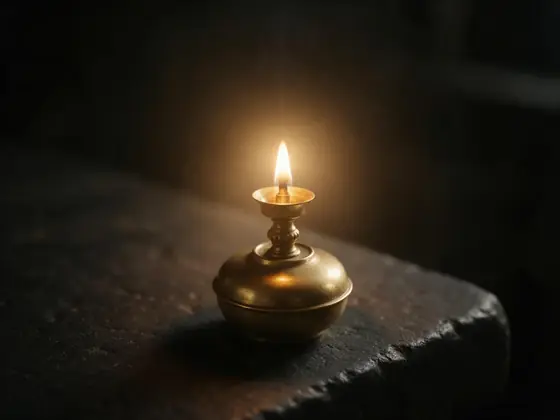
No portrait of Sri Toṭakācārya exists, and the page shows the lamp rather than a face that would have to be invented. His name is given on this page as Sri Toṭakācārya and, for the young man before the morning at Sringeri, as Giri, following every source; the Sringeri pages write Totakacharya, the Kanchi chapter Totaka and Totakacharya, and the Sanskrit texts Toṭaka. The hymn is called the Toṭakāṣṭaka, its Sanskrit colophon’s alternative title being Śrī Śaṅkara-deśikāṣṭaka, “the eight verses to the teacher Śaṅkara”; the longer work the Śrutisārasamuddharaṇa, as its 1946 edition and the Kanchi chapter call it.
Dates: the page uses the historians’ eighth-to-ninth-century dating of Sri Śaṅkara, which the Kanchi chapter, the Anusandhana Kendra and the Sringeri page’s “more than twelve centuries” support, and refers the reader to the pages for Sri Śaṅkara and Sri Govinda for the traditional alternatives. The disciple’s own dates, birthplace and place of death are not given by any source used here and are not given here.
Quotations: every quotation on this page is word for word from the source named beside it. Two sources are scanned books in which the machine that read the pages made errors, and where a quotation includes such an error the printed word has been restored. In Swami Tapasyananda’s Digvijaya these are few and small: “everything” for “every- thing,” “disciples” for “discipies,” “abandoned” for “aban- doned,” “small” for “smali,” “all” for “ali,” “profound” for “pro- found,” “meditated” for “medi- tated,” “happiness” for “happi- ness,” “absorption” for “absorp- tion,” “Padmapada” for “Padma- pada,” a stray full stop after “(Sringeri),” a doubled opening quotation mark, and one running page-head (“144 SANKARA-DIG-VIJAYA: CANTO 12”) removed from inside a sentence. In the 1946 Vani Vilas edition of the Śrutisārasamuddharaṇa the scan is very poor and the restorations are many; each quoted passage has been compared letter by letter with the printed sense, and the restored words are: “Giri” for “Gin,” “in his” for “m hts,” “felt” for “lelt,” “illumination” for “illummation,” “brightened” for “bnghtered,” “mind to” for “mmd lo,” “of him” for “oi him,” “have written any” for “liave written anv,” “contains” for “con- tains,” “the name Srutisarasamuddharanam” for “tbe name Srulisarasamuddharanatn,” “Vedantavedyaparatattvanivedanam” for “Vedanlavedyaparatallva* nivedanam,” “rank” for “sank,” “this” for “lliis,” “his” for “bis,” “of the” for “cf the,” “by the” for “bj the,” “the necessity for devotion” for “(he necessity /or de’ otion,” “then” for “ihen,” “say” for “saj,” “the I” for “the /,” “taken” for “token,” “author” for “autlior,” “takes” for “lakes,” “individuality” for “indiviJualitj,” “really” for “rcallj,” “therefore” for “lliereforc,” “ever-conscious” for “eicr-conscious,” “regards the” for “Kgards (he,” “Sri Sacchidananda” for “Sr! Sacchida^ nanda,” “commentator’s” for “commenlafors,” “Dravidacharya” for “Dravidachaiya,” “Still” for “Stil),” and, in the sentence comparing him with his fellow disciple, “in extant Sanskrit literature except in that of his co-disciple Sri Hastamalakacharya” for the scanner’s unreadable rendering of the same words. Where the scan was too damaged to restore with confidence, the passage has been paraphrased and not quoted. Where a source quotes speech inside double quotation marks, the inner marks have been changed to single ones for display; the transliteration scheme for plain keyboards used on the Sanskrit Documents and Anusandhana Kendra pages has been respelt in standard diacritics, and the Sringeri Āmnāya page’s formatting marks replaced with dashes. One quotation from the Kanchi chapter has been shortened with an ellipsis around a misprinted title. Nothing else has been changed, and nothing has been quoted from any source not named.
The page does not link to encyclopaedia articles, and does not resolve what the sources leave open — the father, the early name, the identity of Ānandagiri — because it cannot, and a reader is better served by being told so.
Timeline
- Eighth century, by the historians’ dating — Sri Śaṅkara born in Kerala. The Digvijaya’s third canto gives Sri Toṭaka’s birth as “a tenth of his being” of the god of Fire, under the name Udaṅka, son of Śilāda; the Kanchi chapter makes him the son of Viśvanātha Adhvari.
- Early ninth century, by the same reckoning — at Sringeri, where Sri Śaṅkara has built the shrine of Śāradā, a young man named Giri joins him and gives himself to his service (Digvijaya, canto 12).
- One morning at Sringeri — late from washing the teacher’s clothes; the class held; the wall; the awakening “by an act of will”; the eight verses in the Toṭaka metre; the name (Digvijaya, canto 12; Kanchi chapter 11; Sringeri pages; 1946 introduction).
- The same day, by the Kanchi account — in the master’s presence, the Śrutisārasamuddharaṇa in about a hundred and seventy-nine verses.
- Afterwards — the teacher asks him and the other disciples to write works on Advaita (Digvijaya, canto 13).
- Towards the end of the teacher’s life — he nurses the teacher through an illness the poem attributes to sorcery, washing his stained cloth (Digvijaya, canto 16).
- After the master’s tour — head of the Jyotirmaṭh in the Badarī country, by every account.
- Fourteenth century — Mādhava-Vidyāraṇya’s Śaṅkara-dig-vijaya, the fullest telling, composed.
- 1946 — the Śrutisārasamuddharaṇa printed for the first time known to its editors, by the Sri Vani Vilas Press at the wish of the Kanchi Mahāswāmigal, with Sri Saccidānanda Yogi’s commentary and R. Krishnaswamy Iyer’s introduction.
- 1968 — the Kanchi Kāmakoṭi Pīṭham’s Preceptors of Advaita devotes its eleventh chapter to him.
- Modern times — Swami Tapasyananda’s English translation of the Digvijaya; Sri Vidyānanda Giri’s gloss on the Śrutisārasamuddharaṇa, noted by the Anusandhana Kendra among the authors of recent times.
- Today — the Toṭakāṣṭaka sung at Śaṅkara Jayantī and at the opening of study; the Jyotirmaṭh continues at Joshimath.
Questions a reader may ask
Did it really happen — a man given all learning in an instant? The tradition says so in every telling, and the historians have nothing to test it against; the story comes to us from sources written centuries afterwards. What is not in doubt is that a disciple of Sri Śaṅkara named Toṭaka left two works in a very difficult metre, that the tradition has always said he was the least learned of the four, and that the two facts together needed a story. Whether the story explains the works or the works generated the story is a question a reader may hold open. The Kanchi chapter’s own phrase is “Tradition has it”.
Why is he called Toṭaka? After the metre of his eight verses. The section on the metre explains what it is and why speaking in it extempore was remarkable.
Who was his father? The sources give two different men, Viśvanātha Adhvari and Śilāda, and this page reports both.
Is he the Ānandagiri who wrote the commentaries? No. That Ānandagiri lived about five centuries later. Whether the disciple was also called Ānandagiri is itself disputed between the sources, as the section on the names explains.
What did he teach? That the sentence “That thou art” is true when both its terms are rightly evaluated; that the “I” is a limitation on the limitless and not the Self; that the Self is the witness of waking, dream and sleep; that the world is neither real nor nothing; and that none of this can be studied to any purpose by someone who has not first disciplined himself. The section on the teaching of his book sets it out from the Kanchi summary and the 1946 introduction.
Why does a tradition of learning honour him? Because it has always held that the learning is a means, and he is its proof. The Kanchi chapter’s closing sentence is the answer, and it is given in the section on Bharata and Hanumān.
Where should a reader begin? With the eight verses, sung if possible; then the twelfth canto of the Digvijaya for the story; then the Kanchi chapter for the book. The Śrutisārasamuddharaṇa itself is linked below in its 1946 edition for a reader with Sanskrit and patience with a damaged scan.
Read the originals
Primary texts and the records kept by the teacher's own institution.
- Toṭakāṣṭakam — the Sringeri Śāradā Pīṭham’s text of the eight verses among the hymns of the lineage
- Toṭakāṣṭaka, with Anand Hudli’s translation and the story of the disciple — on the Sanskrit Documents site; every verse quoted on this page is from this translation
- Śrutisārasamuddharaṇa of Sri Toṭakācārya, with the commentary of Sri Saccidānanda Yogi and an English introduction by R. Krishnaswamy Iyer (Sri Vani Vilas Press, 1946) — the Sanskrit text of his longer work, in a scanned copy on the Internet Archive; the scan is poor
- Preceptors of Advaita, chapter 11: Totaka — the chapter in the Kanchi Kāmakoṭi Pīṭham’s volume (1968), with the names, the story and the summary of the Śrutisārasamuddharaṇa, on the maṭha’s own site
- Preceptors of Advaita, chapter 10: Hastamalaka — on the fellow disciple with whom the 1946 introduction compares him
- Śaṅkara-dig-vijaya of Mādhava-Vidyāraṇya, translated by Swami Tapasyananda (Sri Ramakrishna Math) — canto 12 tells the morning at Sringeri; canto 13 the instruction to write; canto 16 the nursing of the teacher; canto 3 his birth as a portion of Fire
- Sri Totakacharya — the Sringeri Pīṭham’s page on him among the primary disciples
- The primary disciples — the Sringeri Pīṭham’s overview of the four, with the seats, their locations and their deities
- Abridged Mādhavīya Śaṅkara Digvijayam, part four — the Sringeri Pīṭham’s own telling of the wall, the dancing return and the assignment of the seats
- The Āmnāya Pīṭhams — the Sringeri Pīṭham’s page on the four seats, naming him first head of the northern Jyotir Maṭh
- About Govardhan Matha — the Puri seat’s own page on the four seats, naming the northern seat at Badrinath and its Veda
- The Advaita paramparā — the Advaita Vedanta Anusandhana Kendra’s page giving the lineage verse that names him and the historians’ caution on the four seats
- The later teachers of Advaita — the Anusandhana Kendra’s outline, which notes Sri Vidyānanda Giri’s gloss on his Śrutisārasamuddharaṇa
- Surendranath Dasgupta, A History of Indian Philosophy, volume I (1922) — on Draviḍācārya, the earlier teacher whom the 1946 preface distinguishes from Sri Śaṅkara
- Advaita Śāradā — the Sringeri Pīṭham’s searchable library of the Sanskrit texts
Every daily message names the teacher it came from. Read the messages, or see the whole line this teacher stands in: all fifty-one teachers.