Swami Shivananda
2nd President of the Ramakrishna Order
1854–1934 · The Sri Ramakrishna Lineage
- When
- Born in the 1850s, died 1934
- Born
- Barasat, Bengal
- Where the life was lived
- Born Taraknath Ghosal into a family of Barasat in Bengal; worked in Delhi, visited Sri Ramakrishna at Dakshineswar until 1885, joined the monastery at Baranagore, did plague relief in Calcutta in 1899, and served at Belur Math.
- What is left of it
- Letters and instructions to disciples published by the Order.
Served plague victims in Calcutta in 1899, became the second President of the Ramakrishna Order, and was known among the monks for a steadiness that never varied with circumstance; died 20 February 1934.
The Bengal he was born into
He was born Tāraknāth Ghoṣāl in the 1850s — the year is uncertain, and the site's date of 1854 follows the Order's usual reckoning — on the eleventh day of the dark fortnight of the month of Agrahāyaṇa, which falls in November or December. Belur Math, whose account of his life this page follows, says frankly that the exact year "is obscure": he did not remember it himself, and the elaborate horoscope his father had drawn up for him he threw into the Ganga when he chose the life of renunciation. It is a fitting beginning for a man who spent his life refusing to be pinned down, and who would end it as the head of the largest monastic order in India.
The family was respectable and influential and came from Barasat, north of Calcutta; an ancestor, Harakṛṣṇa Ghoṣāl, had been Dewan to the Raja of Krishnanagar. His father, Rāmkānāi Ghoṣāl, was a successful lawyer with a substantial income, a noted Tāntrika, and for a time legal adviser to Rāṇī Rāsmaṇi, the woman who built the Kālī temple at Dakṣiṇeśvar; later he became a deputy collector and then assistant Dewan of Cooch Behar. He spent much of what he earned on holy men and on poor students, sometimes boarding twenty-five or thirty of them in his house at once, and when his income fell he had to cut back his charities against his will. And he knew Sri Ramakrishna. He had met the young priest of the temple on a business visit to Dakṣiṇeśvar, was captivated, and never missed seeing him when he was there. During the years of Sri Ramakrishna's most intense practice, when he suffered a burning sensation through his whole body that no medicine would cure, it was Rāmkānāi who suggested he wear on his arm an amulet containing the name of his chosen deity — and the burning, the Order records, was instantly relieved. The boy grew up, in other words, in a house where the man who would become his master was already spoken of.
Two features of that world matter for what follows. The first is that mid-century Bengal offered a religious young man two very different doors: the reformed, rational, hymn-singing theism of the Brāhmo Samāj, which drew the educated; and the older world of the temples, the Tāntrikas and the wandering ascetics, which his father belonged to. Tārak tried the first and found it did not feed him. The second is that the Ramakrishna Order, of which he would be the second President after Swami Brahmananda, did not yet exist even as an idea, and would be built by boys.
Where the life was lived
The map below shows the Indian places on present-day coordinates. The shape of the life: Calcutta and Dakṣiṇeśvar until the Master's death; Bodh Gayā with Narendra and Kālī; the wandering years across the north and the Himalayas, with Almora as their pivot; Madurai to meet Vivekananda; seven years in Vārāṇasī; Amarnāth; and then, from 1909, Belur Math, with tours to East Bengal, the south and the west as President. The eight months in Ceylon are drawn on the world map further down.
Present-day India. Numbered pins are places named in Belur Math’s account of his life and in the Vārāṇasī centre’s own history; the dotted line joins them in the order they occur in the story and is not a surveyed route. Ceylon (Colombo), where he taught for about eight months in 1897, and Dacca and Mymensingh, where he first gave initiation in 1922, lie off the map and are named in the text.
- 1Barasat (West Bengal) — His family’s home, north of Calcutta; born Tāraknāth Ghoṣāl in the 1850s (1854 by the usual reckoning — Belur Math calls the year obscure)
- 2Calcutta (West Bengal) — Youth; the Brāhmo Samāj for a time; the Ālambāzār years and public classes
- 3Dakṣiṇeśvar (West Bengal) — Visits to Sri Ramakrishna in the early 1880s
- 4Cossipore (West Bengal) — Service to the dying Master, 1885–86
- 5Baranagore (West Bengal) — First to move into the monastery, 1886; sannyāsa as Swami Śivānanda
- 6Belur Math (West Bengal) — Manager from 1917, Vice-President 1910, President 1922; the dated talks of 1920–33; died here 20 February 1934
- 7Bodh Gayā (Bihar) — Under the Bodhi tree with Narendra and Kālī, 1886
- 8Deoghar (Jharkhand) — The Mission’s first buildings opened; the asthma of the winter of 1925
- 9Vārāṇasī (Uttar Pradesh) — Left Belur for Kāśī 23 June 1902 with Swami Achalananda; the ashrama at Luxa from 4 July 1902 — the day of Swami Vivekananda’s passing; seven years of austerity, to 1909
- 10Delhi (Delhi) — Worked here as a young man; his friend Prasanna first told him of Sri Ramakrishna
- 11Pilibhit (Uttar Pradesh) — Left here by Swami Vivekananda in 1900 to raise funds for Belur
- 12Mayavati (Uttarakhand) — With Swami Vivekananda at the Advaita Ashrama, 1900
- 13Almora (Uttarakhand) — Austerity in the wandering years; met E. T. Sturdy here, late 1893; the Almora monastery begun 1915 and completed with Swami Turiyananda
- 14Amarnāth (Jammu & Kashmir) — Pilgrimage to the ice-cave with Swamis Turiyananda and Premananda, 1910; the dysentery that followed
- 15Bombay (Maharashtra) — Centre opened on the southern tours of 1924 and 1927
- 16Nagpur (Maharashtra) — Centre opened on the southern tours
- 17Madurai (Tamil Nadu) — Received the returning Swami Vivekananda, 1897, before sailing to Ceylon
- 18Ootacamund (Tamil Nadu) — Centre opened on the southern tours
A boy who fell silent
Belur Math's picture of the child is of a bold, straightforward boy, talented but with very little interest in studies, who in the middle of play and laughter would suddenly become austere and grave in a way that filled his companions with awe. A vague longing would come over him and he would forget himself in reverie. He was drawn to meditation early. His schooling did not go beyond school. Through Keśab Chandra Sen he was drawn for a time to the Brāhmo Samāj, but what he received there did not satisfy his spiritual hunger.
When his father's income fell, Tārak had to find work, and went to Delhi. There, at the house of a friend named Prasanna, he spent hours discussing religion, and one day asked Prasanna about samādhi — the absorption in which the mind stops and the truth is seen directly. Prasanna told him it was a very rare thing, experienced by very few, but that he knew at least one man who had certainly experienced it: Sri Ramakrishna. Tārak waited for his chance to meet him. The Order does not record the date of the first meeting or how old he was; it says only that he went to Dakṣiṇeśvar and kept going until the Master fell seriously ill in 1885.
Swami Turiyananda, who knew him from those days, preserved the thing Sri Ramakrishna said about him, once, as Tārak was coming back from the Kālī temple: "His 'home' is that high Power from which proceed name and form." The Order glosses it: there was something of the Transcendental Verity in him. It is the kind of sentence one might expect of a teacher describing a philosopher, and Tārak was no philosopher; he was a man whose mind fell naturally into the formless.
All quotations on this page are taken verbatim from Belur Math's own life of Swami Shivananda, unless another source is named.
Cossipore, and the tree at Bodh Gayā
In 1885 Sri Ramakrishna was moved, ill with cancer of the throat, first to Calcutta and then to a garden house at Cossipore, and the young men who would become the Order gathered there to nurse him: Narendra, Rākhāl, Bāburām, Yogīn, Nirañjan, Śarat, Śaśī, Lāṭu, Kālī, the two Gopāls, and Tārak. Belur Math calls Cossipore the most decisive period in their lives: service to the Master and loyalty to a common ideal forged a bond among them that nothing afterwards broke, and their yearning for realisation became a fire.
In that period Narendra, Tārak and Kālī were absorbed, the Order says, in thoughts of the Buddha and of Brahman without qualities, and the three went to Bodh Gayā to meditate. Under the Bodhi tree Narendra suddenly began to weep and embraced Tārak. The Order offers two explanations and does not choose: that Narendra was overcome by the thought of the Buddha's compassion, or that he saw something of the Buddha in Tārak — Kālī said he had heard from Narendra that a light flashed from the Buddha's image and went towards him. Whatever it was, the friendship between the man who would be Vivekananda and the man who would be Shivananda was sealed there, under the tree where the Buddha had sat.
When the Master died in August 1886 the disciples had nowhere to go. A devotee found them a dilapidated house at Baranagore, and Tārak was the first to move into it; Gopāl-dā, Kālī and the others followed. He took the vows there and became Swami Śivānanda, "he whose bliss is Śiva". His brothers, in later years, called him Mahāpuruṣ Maharaj — the great soul.
One piece of cloth
The years that followed were, for all these young men, years of wandering — they left the monastery again and again to be away from crowded places and familiar faces, and the period, the Order says, was marked by severe austerities and "great miracles of faith", and forged the characters the world later saw. Shivananda's own account of it is the best description we have of what the wandering life of that generation actually was:
"Often it happened that I had only one piece of cloth to cover myself with. I used to wear half of it and wrap the other half round the upper part of my body. In those days of wandering I would often bathe in the water of wells, and then I used to wear a piece of loincloth and let my only piece of cloth dry. Many a night I slept under trees. At that time the spirit of renunciation was aflame and the idea of bodily comfort never entered the mind. Though I travelled mostly without means, thanks to the grace of the Lord, I never fell into danger. The Master's living presence used to protect me always. Often I did not know where the next meal would come from. … At that period a deep dissatisfaction gnawed within, and the heart yearned for God. The company of men repelled me. I used to avoid roads generally used. At the approach of night I would find some suitable place just to lay my head on and pass the night alone with my thoughts."
His temperament in these years, the Order says, inclined to the orthodox and austere path of knowledge. He put little value on popular religion, avoided ceremony, disregarded the emotional approaches, and concentrated on the formless. Beneath that sternness was a boundless love for Sri Ramakrishna, and in later life a broader experience opened his heart to what the Order calls the beauties of spiritual emotion; but the young Shivananda was a jñānī of the old kind, and one should remember it when reading of the gentle old President.
The wandering took him through northern India and the Himalayas, and to Almora, where he made a friend in a rich man of the town, Lālā Badrīlāl Śāh, who became a devoted admirer of the Master's disciples and looked after them whenever they passed. And at Almora in the later part of 1893 he met an Englishman interested in Theosophy, E. T. Sturdy. Sturdy was greatly taken with him, and from him heard about what Swami Vivekananda — who had reached America that summer — was doing in the West. When Sturdy returned to England he invited Vivekananda there and arranged for Vedānta to be taught; the whole English chapter of Vivekananda's work, in other words, began with a conversation on a hillside with a wandering monk in one piece of cloth.
Ceylon, plague, and the Raja's five hundred rupees
Vivekananda's return in 1897 ended the wandering. Shivananda went south to Madurai to receive him and travelled back to Calcutta with him, and almost at once was sent, at Vivekananda's request, to Ceylon, where for about eight months he taught Vedānta — classes on the Gītā and Rāja Yoga that became popular with the local educated community and with several Europeans. One of his students, a Mrs Picket, he named Haripriyā and trained specially to teach Vedānta to Europeans; at Vivekananda's direction she later went to Australia and New Zealand and gathered interested students there. He came back to the Math, then housed in Nīlāmbar Babu's garden at Belur, in 1898. The Ceylon months are on the world map below; they were his only journey outside India.
Coastlines only; no borders. The line is the direction of the journey, not the recorded road.
- 1Kolkata — Dakshineswar and the Baranagar monastery; later Belur Math, where he was President from 1922
- 2Ceylon — Sri Lanka: about eight months in 1897, teaching Vedānta and Yoga; the Math names no town
In 1899 plague broke out in Calcutta and Vivekananda asked Shivananda and others to organise relief for the sick; he worked, the Order says, without concern for his own safety. When a landslide at Darjeeling did great damage, he collected money for the victims. Then his nature reasserted itself and he went back to the Himalayas for some years, coming down to the Math from time to time; Vivekananda wanted him to found a monastery there, which could not then be done. In 1900 he went with Vivekananda to Mayavati, the Advaita Ashrama in the Kumaon hills, and on the way back down Vivekananda left him at Pilibhit to raise money for the maintenance of Belur Math, which he did.
Shortly before his death in 1902, Vivekananda was given five hundred rupees by the Raja of Bhinga for the preaching of Vedānta. He handed the money to Shivananda and told him to start an ashrama at Vārāṇasī. Shivananda did, in 1902, and stayed seven years.
The Vārāṇasī years
The Vārāṇasī centre keeps its own record of how it began, and the dates matter. Swami Shivananda left Belur for Kāśī on 23 June 1902 with Swami Achalananda, and the two took a house in the Khajanchi Bagicha at Luxa; they moved in, the centre records, on 4 July 1902 — the very day on which, at Belur, Swami Vivekananda passed away. The centre he founded that night in a rented garden-house is the Ramakrishna Advaita Ashrama of today, and its temple to Sri Ramakrishna, built of Chunar stone, was consecrated in 1936, two years after his death.
The Vārāṇasī ashrama was, in the Order's phrase, a school of hard discipline and rigorous tapasya for the building of individual character. The five hundred rupees did not last. There were times when no one knew where the day's expenses would come from, and Shivananda remained unruffled until the difficulty eased. He scarcely left the ashrama; day and night, the Order says, he remained in a high spiritual mood. The inmates hardly had a full meal for months and had little clothing against the winter. He slept most nights on a small bench. In winter he rose at about three, lit a dhuni fire in one of the rooms, and the monks sat before it in meditation, often far into the morning. When Swami Saradananda, the Secretary of the Mission, urged him to raise funds for the Order's Home of Service in the city, he asked, half in jest, "Will mere meditation bring money?" Shivananda did not change.
He was not idle. For a time he ran a school at the ashrama and himself taught English to a group of local boys. He translated Vivekananda's Chicago lectures into Hindustani so that his brother's ideas could reach the people of the north in their own language. He looked after the ashrama's affairs until 1909, when he returned to Belur. In 1910 he went on pilgrimage to the ice-cave of Amarnāth in Kashmir with Swami Turiyananda and Swami Premananda, and came back with a dysentery so obstinate that he kept to a strict diet for the rest of his life.
The President
In 1910 he was elected Vice-President of the Order. In 1917, when Swami Premananda, who managed Belur Math, fell seriously ill, Shivananda took over his duties. Shortly before he became President he accepted an invitation to Dacca and Mymensingh in East Bengal, and something new happened: great crowds gathered to hear him speak, and devotees begged him for initiation. He had been strongly opposed to giving it. He gave way, and for the rest of his life he initiated people into spiritual life — the Order calls the tour the beginning of a new phase in his career. In 1922 Swami Brahmananda died and Shivananda became President of the Ramakrishna Math and Mission; he held the office until his own death twelve years later.
Under him the work steadily expanded, and the Order records what he did in person. In 1924 and again in 1927 he made long tours of the south and west, formally opening centres at Bombay, Nagpur and Ootacamund and initiating great numbers of people. In the winter of 1925 he went to Deoghar with a large party of monks and opened the first buildings of the Mission there, staying a little over three weeks. When news of floods or famine reached him he could not rest until relief was organised. He supported the national movement in his own way: he held that national salvation lay through the formation of character on a spiritual basis, which he called Vivekananda's real message, and that the Mission must not abandon its ideals for temporary political advantage; and he said of Gandhi, "The patriotism of Swamiji has taken possession of Gandhiji. All should imitate Gandhi's character. There will be some hope of peace only when such people are born in every country."
What the monks remembered was his love for Sri Ramakrishna, and how it expressed itself in small things. He regarded everything at Belur — monastery, shrine, cowshed, kitchen, dispensary — as belonging to the Master and to be cared for as such. Fruit or flowers brought for him had first to be offered in the shrine. Anyone entering the monastery had to salute there. He asked every day what was being offered to the Master. And when the young monks were laughing together he was heard to pray: "The boys are laughing much and seem to be happy. They have left their hearth and home in search of bliss. Master! Make them blissful."
What he taught
He wrote no book. The Order's page records only the Hindustani translation of the Chicago lectures, and his teaching survives in what he said to the monks and devotees who came to him at Belur in his last twelve years, and in his letters. Those conversations were written down, at the time, by the people who had them — after the morning meditation the monks would gather in his room, and on Sunday afternoons the householders — and his long-serving attendant Swami Apurvananda collected the Bengali reports into the two volumes of Shivananda Vani, published by the Udbodhan Office. The English selection, For Seekers of God, translated by Swami Vividishananda and Swami Gambhirananda, dates each talk to the day and the place, so that the reader knows exactly when and where a sentence was said. The stern jñānī of the wandering years had become the most approachable of teachers, but the substance had not changed: the formless Power "from which proceed name and form" was still his home, and he wanted people to find the way to it inside their ordinary days. His most quoted instruction is exactly that: "Fill your mind in the morning so much with the thoughts of God that one point of the compass of your mind will always be towards God though you are engaged in various distracting activities."
Two other sayings the Order preserves show the two sides of him. Of devotion, pointing to himself and then to a disciple: "That fellow's master is here" — "and this fellow is His dog." And of the Name, which the jñānī had come to value as highly as the bhakta: "Janaki (Sita) is all right so long she is able to take the name of Rama." He was, in the end, the demonstration of what Sri Ramakrishna had told all of them: that knowledge and love are not two paths but one, seen from the two ends.
The difficulties, which he did not hide
The record of this life is unusually candid about hardship, because the man himself was. The first difficulty was the one he could do nothing about: nobody knows quite when he was born, and he threw his own horoscope into the Ganga. The second was money. The family fortune failed; he had to take work in Delhi and elsewhere as a young man, and the poverty of the Vārāṇasī years was not a discipline chosen for effect — there were months, the Order says, when the inmates hardly had a full meal and had little clothing against the winter, and he slept on a bench. He stayed. When Swami Saradananda came asking him to raise funds for the Home of Service and wondered aloud whether mere meditation would bring money, he took it in good humour and did not change.
The body gave him the third set of difficulties. The dysentery he brought back from Amarnāth in 1910 put him on a restricted diet for the rest of his life. At Deoghar, in the winter of 1925, asthma; and in April 1933, the stroke that took his speech and half his body, so that a man who had spent his last twelve years talking to people could no longer talk to them. The fourth difficulty was the one that every teacher in this tradition faces in one form or another: the reluctance to give initiation. He had refused for decades. He gave way at Dacca in 1922 only because he believed the Master had told him to, and then gave himself to it without reserve.
He did not hide the difficulties of the inner life either, and this is what makes his recorded talks so usable. “For some days we enjoy meditation, but other days come when we don’t,” he told a visitor at Belur in September 1923. “In the initial stage all aspirants have to go through this experience, but one should not stop practice for that reason. Did not the Master speak of the hereditary farmer? Even as he sticks to the family profession, so you must stick to your spiritual practice, and in trying periods pray fervently to the Lord.” And in October 1920, to someone who had come for peace: “Look here, my boy, peace is not such an easy thing to attain. The way to peace is very difficult — full of thorns.” He then quoted the Upaniṣad on the razor’s edge, and added: “The path is indeed extremely difficult, however easy it may seem to those who have not entered it.”
The sayings, and what they were for
Because the talks are dated, the sayings can be read as a single teacher speaking to a single stream of visitors over twelve years, and the teaching turns out to be remarkably consistent. All quotations below are verbatim from For Seekers of God, in the Advaita Ashrama edition, with the date and place the book gives for each.
- On what actually counts (Belur, 28 October 1920): “Spiritual efforts without sincere love for God are fruitless. Sincere love is what counts.” He then repeats the Master’s measure of longing — the devoted wife’s, the mother’s, the miser’s, made one.
- On the Order (same day): “In the body of the Order the spirit of the Master is manifestly present and will be so for many centuries for the good of the world.… Constantly bear in mind that loyalty to the Order is loyalty to the Master.”
- On regularity (Belur, 25 December 1920): “Night is the ideal time for spiritual practice. Meditation and japa should be performed regularly with great devotion. They purify the mind.” And, on the itinerant life he had himself lived: “Aimless wandering by itself cannot be beneficial in the spiritual realm.”
- On remembrance (Belur, September 1923): “Remember and think of Him continually, while walking, eating, lying down and even when you are actively busy. Let it be as if an undercurrent is all the time flowing.” This is the fuller form of the compass-needle instruction quoted above.
- On renunciation (Belur, 14 September 1923): “What counts is not the mere renunciation of external attachments; inner attachments must also be given up.” And: “All the spiritual practices and disciplines have one aim, to develop resignation.”
- On death, and Vārāṇasī (Belur, October 1923) — from the man who had lived seven years there: “But with us every place is the same as Varanasi. Wherever and in whatever state we die, it is equal to dying in Varanasi. As long as the Master wants us here in the flesh, death cannot touch us.”
- On the Self (Belur, October 1923) — the Advaita, stated without a single technical term: “The Self, unaffected by disease and old age, is beginningless, endless, eternal and immortal. Pure, illumined and free. It dwells in every being as Consciousness itself. This counting of age by years — ten, twenty, fifty, a hundred, and so on — is a figment of ignorance.”
- On work (Belur, August 1925): “Unless work is accompanied by meditation, japa and other spiritual practices, its very spirit is lost. Then one forgets it is the Lord’s work and not his own.… The object of one’s life is not work; it is the realization of God.” And (7 December 1928): “Meditation on God will obliterate the ego, and He will then be all in all. Only when your mind reaches this state, will you be able to do genuine philanthropic work.”
- On the body (Belur, 21 July 1929): “It is good if this body perishes while doing good to others. It is enough compensation if a single soul is helped by this body.”
- On grace (Belur, 2 February 1930): “The Master used to say: ‘The breeze of divine grace is ever blowing. Simply hoist the sail.’ The grace of God is ever present but one must make an effort to deserve that grace.”
- On bereavement (Belur, 28 December 1932, to a father who had lost his son): “The only purpose of life is to realize God — no matter whether sons and wife remain or go.”
What were they for? Read together they show a teacher who never let the monks mistake activity for realisation, never let the householders mistake despair for humility, and never let anyone mistake the path for an easy one. The formless Power “from which proceed name and form,” the home of his wandering years, is present in every one of them as the thing all the effort is for; but he has stopped saying so in the language of the jñānī and says it in the language of a grandfather. That was the point of the last twelve years.
The books, and how to read them
He wrote nothing for publication except the Hindustani rendering of his brother’s Chicago lectures, so the books are the records others kept.
- For Seekers of God: Spiritual Talks of Mahapurush Swami Shivananda (Advaita Ashrama) — the English selection from Shivananda Vani. Part I was translated by Swami Vividishananda and Part II by Swami Gambhirananda, whose translation first appeared serially in Prabuddha Bharata between January 1961 and December 1962. The fourth edition of 1975 is freely available at the Internet Archive, linked below; the current edition is sold by Advaita Ashrama.
- Shivananda Vani (Bengali, two volumes, Udbodhan Office) — the full record, for those who read Bengali.
- Conversations with Swami Turiyananda — recorded at Almora in the summer of 1915 in the ashrama the two brothers built together, and so a picture of the Almora that Shivananda made, though the words are Turiyananda’s.
How to read For Seekers of God: not from the beginning, and not at a sitting. The entries are dated, so the natural way is to take one talk at a time, as the visitor did, and read it as if you had asked the question. Notice who is being addressed — a monk, a widow, a student, a bereaved father — because the counsel changes with the person and the principle does not. The heading of each talk lists its subjects; a reader in a dry period should go straight to September 1923, and a reader who has just lost someone to December 1932. The book’s own preface says that much was lost in translation, and that the setting of a talk cannot be reproduced on a page. That is honest, and the reader should hold the sentences lightly for that reason, as reports of a voice and not as scripture.
The last years
From the late 1920s his health declined. At Deoghar in 1925 he had a severe attack of asthma and had to spend the night sitting upright; the Order records that the suffering was intense, that he felt as if he were dying, and that he fixed his mind on the indwelling Self and immediately became oblivious of the pain. After 1930 he could still take short walks. In April 1933 he suffered an attack of apoplexy which took away the use of half his body and his speech. He did not complain. The physicians, the Order says, were amazed by his buoyant spirits, and even then he went on trying to help those who came, with a kindly look, with the gentle movement of his left hand in blessing, and with his presence. He died on 20 February 1934, at Belur Math, where he had lived since 1909.
For the seeker now
He is the teacher on this site for people whose temperament is quiet and inward, and who fear that a life of meditation must mean a life apart from other people. He was by nature a solitary — "the company of men repelled me" — and he ended as the father of a family of hundreds, initiating strangers he had once refused, opening centres in cities he had once avoided, and praying for the laughing boys. He did not become a different man; the inward turn of his youth simply became, with time, a compass point that stayed fixed while the rest of him did the day's work. That is what he asks of you: not to give up the world, but to fill the mind so full of God in the morning that one point of it stays turned that way all day.
His counsel, in his own words and the Order's record of his habits, is simple. Fill the morning with God. Offer what comes to you before you use it. Salute the shrine when you come in. Treat everything in your care — kitchen, cowshed, dispensary — as belonging to the One you serve. Rise early and sit before the fire. Give to those in flood and famine before you rest. And when pain comes that you cannot escape, fix the mind on the Self within, which does not suffer.
A note on the pictures and the dates
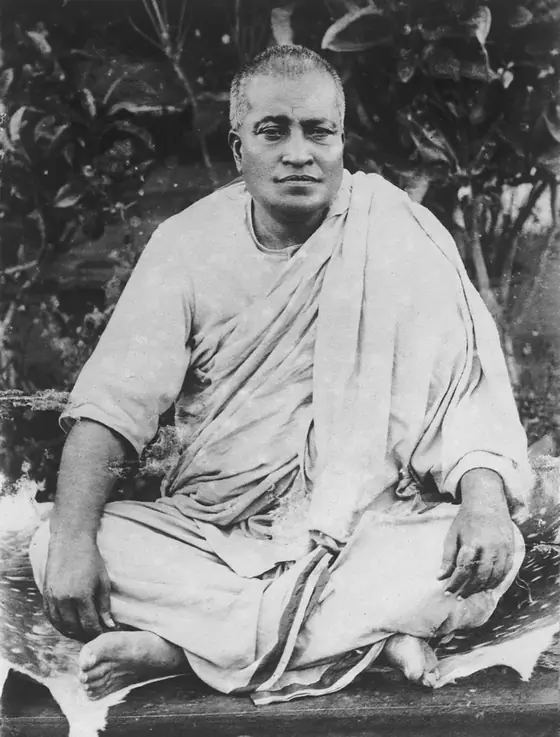
Many photographs of Swami Shivananda survive from his years as President. The portrait at the head of this page is one of them, from the Ramakrishna Order’s archives, published under a free licence and credited on the picture credits page; it is a photograph, not a painting or a generated image. Belur Math states plainly that his birth year is obscure and gives no birthplace; the year 1854 used on this site is the one generally given by the Order, and Barasat is his family's home rather than a recorded place of birth. The Order does not date his first meeting with Sri Ramakrishna or the individual stops of his wandering years, and the map marks those places without dates. Dacca and Mymensingh, which he visited shortly before becoming President, lie in present-day Bangladesh and are named in the text rather than pinned. The maps are drawn on present-day coordinates, not from any historical source.
The timeline, plainly
- 1850s (1854 by the usual reckoning) — born Tāraknāth Ghoṣāl, of a Barasat family; his father Rāmkānāi, lawyer and Tāntrika, already knows Sri Ramakrishna.
- Youth — drawn for a time to the Brāhmo Samāj; works in Delhi, where his friend Prasanna tells him of Sri Ramakrishna.
- Early 1880s — visits Dakṣiṇeśvar until the Master's illness in 1885.
- 1885–86 — serves Sri Ramakrishna at Cossipore; Bodh Gayā with Narendra and Kālī.
- 1886 — first to move into the Baranagore monastery; becomes Swami Śivānanda.
- c. 1887–97 — wandering and austerity across northern India and the Himalayas; Almora; meets E. T. Sturdy there in late 1893.
- 1897 — receives Swami Vivekananda at Madurai; sent to Ceylon, where he teaches for about eight months.
- 1898–99 — returns to the Math; Calcutta plague relief; collects for the Darjeeling landslide.
- 1900 — Mayavati with Swami Vivekananda; left at Pilibhit to raise funds for Belur.
- 1902 — leaves Belur for Kāśī on 23 June with Swami Achalananda; the Vārāṇasī ashrama opens in a garden-house at Luxa on 4 July, the day of Swami Vivekananda's passing, on the Raja of Bhinga's five hundred rupees; stays seven years.
- 1909–10 — returns to Belur; Amarnāth pilgrimage with Swamis Turiyananda and Premananda; elected Vice-President.
- 1915 — lays the beginnings of the Almora monastery, completed with Swami Turiyananda.
- 1917 — takes over the management of Belur Math from the ailing Swami Premananda.
- 1922 — Dacca and Mymensingh; begins to give initiation; becomes President on Swami Brahmananda's death.
- 1924, 1927 — the two southern tours; centres opened at Bombay, Nagpur and Ootacamund; Deoghar in the winter of 1925.
- 1920–33 — the dated talks recorded in For Seekers of God, from 28 October 1920 to 28 December 1932.
- April 1933 — apoplexy; loses speech and the use of half his body.
- 20 February 1934 — dies at Belur Math.
Read the originals
Primary texts and the records kept by the teacher's own institution.
- Belur Math — the Order’s own life of Swami Shivananda
- For Seekers of God — his recorded talks, dated and placed; the Advaita Ashrama edition
- For Seekers of God — the fourth edition of 1975, free to read at the Internet Archive
- Ramakrishna Advaita Ashrama, Varanasi — the centre’s own account of how he founded it in 1902
Every daily message names the teacher it came from. Read the messages, or see the whole line this teacher stands in: all fifty-one teachers.