Swami Saradananda
Direct disciple; first General Secretary
1865–1927 · The Sri Ramakrishna Lineage
- When
- 1865–1927
- Born
- Calcutta, Bengal
- Where the life was lived
- Born Sharat Chandra Chakravarti on 23 December to a family on Amherst Street, Calcutta; at Dakshineswar from 1883; took the vow of renunciation at Antpur at Christmas 1886; practised at Baranagore and Puri; worked from Calcutta for the rest of his life.
- What is left of it
- Śrī Śrī Rāmakṛṣṇa Līlāprasaṅga — the standard life of his teacher, translated as Sri Ramakrishna, the Great Master.
Wrote the Order's authoritative account of Sri Ramakrishna's life, served as its General Secretary, edited Udbodhan, attended Sri Sarada Devi throughout her later years, and organised relief work.
The Calcutta he was born into
He was born Śarat Chandra Chakravartī on 23 December 1865, in the family house on Amherst Street in north Calcutta. The city was then the capital of British India and the largest in Asia after Tokyo, a place of jute mills, law courts, printing presses and the new University, eight years old, which was turning out the first generation of Bengalis educated in English. The Mutiny of 1857 was eight years behind; the Crown had taken direct charge of the country; the railway ran west to Delhi. In the same year, in the temple garden of Dakṣiṇeśvar a few miles up the river, a priest named Gadādhar — Sri Ramakrishna — was in the middle of the long years of spiritual practice that would make him the centre of the boy's life.
The family was Brahmin, comfortable, and religious in the settled, ceremonial way of old Calcutta households. His father, Girish Chandra Chakravartī, had a large joint family under his roof; a cousin, Śaśī Bhūṣaṇ Chakravartī — the future Swami Ramakrishnananda — grew up almost as a brother. Belur Math's account of these years is brief and specific: he was born on a Saturday evening, which alarmed the older members of a household that took omens seriously; the family guru was a pandit adept in Tāntrika practice; and Śarat grew into a serious, religious boy who topped almost every examination and shone in the debating class. In 1882 he passed the Entrance examination from the Hare School, and in 1883 he entered St Xavier's College, whose Jesuit principal, Father Laffont, undertook to teach him the Bible because of what he saw of the boy's religious nature. It was in that same year, at eighteen, that he first went to Dakṣiṇeśvar.
Two features of that world matter for what follows. The first is that an educated young Bengali of the 1880s stood between two cultures — the English education that promised a career, and a religious inheritance that the new learning had taught him to doubt — and that many of the young men who gathered round Sri Ramakrishna were exactly such doubters. The second is that the Ramakrishna movement, which now runs hospitals, schools and monasteries across the world, did not exist. There was no Order, no Math, no Mission; there was a priest in a temple garden and a handful of boys. The man who would give that movement its administrative shape, and write the definitive record of its founder, was one of the quietest of those boys.
Where the life was lived
He was a Calcutta man from first to last, and the anchor of the whole life is the small stretch of the Hooghly between Dakṣiṇeśvar, the Baranagore and Alambazar monasteries, and Belur Math on the opposite bank. Around that anchor the life falls into three great circles: the years of wandering and pilgrimage across the north of India in his twenties; two years in England and America in his thirties; and thirty years of administration in Calcutta, broken by tours of Gujarat, Rajasthan, East Bengal and Orissa on the Order's business. The map below shows the Indian places on present-day coordinates; the journeys beyond India are drawn separately further down.
Present-day India. Numbered pins are places named in Belur Math’s account of his life; the dotted line joins them in the order they occur in the story and is not a surveyed route. Dacca, Narayanganj and Barisal, where he toured for the Mission in what is now Bangladesh, lie off the map to the east and are named in the text. Cossipore, Baranagore and Belur Math are within a few miles of Calcutta and are shown separately for clarity.
- 1Calcutta (West Bengal) — Born 23 December 1865 at Amherst Street; St Xavier’s College; the Udbodhan house at Bāgbāzār, built 1908–09, where the Holy Mother lived from 23 May 1909 and where he died at 2.34 a.m. on 19 August 1927
- 2Dakṣiṇeśvar (West Bengal) — First visit to Sri Ramakrishna, October 1883; Thursdays there while at college
- 3Cossipore (West Bengal) — Nursed the Master through his last illness, 1885–86
- 4Baranagore (West Bengal) — The first monastery, 1886–92; sannyāsa as Swami Sāradānanda; Ālambāzār Math afterwards
- 5Belur Math (West Bengal) — Secretary of the Ramakrishna Mission from 1898; the 1926 Convention; cremated on the Ganga bank
- 6Antpur (West Bengal) — The vow of renunciation before the fire, Christmas Eve 1886
- 7Jayrāmbāṭī (West Bengal) — The Holy Mother’s village; caught malaria here in the 1890s; built her memorial temple, dedicated 19 April 1923
- 8Burdwan (West Bengal) — Flood relief supervised for many months, 1913
- 9Purī (Odisha) — Pilgrimage in the wandering years; sea-bathing for rheumatism, March–July 1913, with the Jagannāth temple every morning; later, to nurse Swami Turiyananda
- 10Vārāṇasī (Uttar Pradesh) — The forty-mile circuit of Kāśī on foot, 1891, and the fever that followed
- 11Ayodhyā (Uttar Pradesh) — Wandering years, early 1890s
- 12Kanpur (Uttar Pradesh) — Wandering years
- 13Agra (Uttar Pradesh) — Wandering years
- 14Delhi (Delhi) — Wandering years
- 15Meerut (Uttar Pradesh) — Winter 1890–91 with Swami Vivekananda and the brothers
- 16Hardwar (Uttarakhand) — Hardwar and Rishikesh, on the way to the hills
- 17Kedārnāth (Uttarakhand) — Gaṅgotrī, Kedārnāth and Badrināth on foot, 1890–91
- 18Almora (Uttarakhand) — With Swami Vivekananda in the hills, 1890
- 19Jaipur (Rajasthan) — Wandering years
- 20Ahmedabad (Gujarat) — Gujarat and Kathiawar, 1892: Ahmedabad, Limbdi, Junagadh, Bhavnagar
- 21Junagadh (Gujarat) — Kathiawar, 1892
A boy at Dakṣiṇeśvar
He first saw Sri Ramakrishna in October 1883, going up to the temple garden with his cousin Śaśī. Belur Math records what happened: the Master asked the two young men about their families and their studies, spoke to them of God, and told them to come again; and Śarat did, on Thursdays, when the college had a holiday. He was not a boy who was swept away. He watched, listened, tested what he heard, and gradually found himself unable to stay away. Sri Ramakrishna, for his part, recognised in the reserved student a particular quality. Years later Swami Vivekananda would tease his brother monk with the Master's own phrase about him: "Sharat's is the blood of a fish, it will never warm up." It was a joke about his composure, and it was not quite true; but it named the thing everyone noticed — a calm that nothing seemed to disturb.
The saying is quoted on Belur Math's own life of Swami Saradananda, from which every quotation on this page is taken unless another source is named.
Belur Math preserves the exchange that set the direction of his whole life. When Śarat said that Gaṇeśa was his ideal, the Master corrected him: “No, Ganesha is not your ideal. Your ideal is Shiva. You possess Shiva attributes,” and then, “Always think of yourself as Shiva and of me as Shakti. I am the ultimate repository of all your powers.” Asked what form of God he wished to see in meditation, the student answered that he did not want any particular form — he wanted to see God manifested in all creatures. “That is the last word in spiritual attainment,” Sri Ramakrishna told him. “You cannot have it all at once.” The boy’s reply is the first sentence of his that the Order records, and it could stand as the motto of the life: “But I won’t be satisfied with anything short of that. I shall trudge on in the path of religious practice till that blessed state arrives.”
He had met Narendranāth before he met the Master, and had formed, he admitted later, a wrong impression of him; it was Sri Ramakrishna’s praise that sent him to find the young man again, and the two walked the streets of Calcutta talking until one in the morning, each escorting the other home and back. “However freely Swamiji mixed with us,” he said afterwards, “at the very first meeting I saw that here was one who belonged to a class by himself.” The Master, delighted that the two had become attached, said what a Bengali grandmother might have said: “The mistress of the house knows which cover will go with which cooking utensil.”
His family objected. When Śarat began to spend more time at Dakṣiṇeśvar than at his books, his father tried, as many fathers did, to break the attachment. His father, who owned a pharmacy, wanted him to study medicine, and on the advice of Narendranāth — the future Vivekananda, three years his senior and already the leader of the group — he entered the Calcutta Medical College in 1885, though he had no wish to be a doctor. Then, in 1885, Sri Ramakrishna fell ill with the cancer of the throat that would kill him, and was moved first to a house in Śyāmpukur in Calcutta and then, in December, to a garden house at Cossipore. The young disciples gathered to nurse him, and Śarat was among the most constant. One incident from those months is the key to his temperament. On a day when Sri Ramakrishna, in an ecstatic mood, was blessing the devotees with a touch, Śarat and Lāṭu stayed at the duties assigned to them and did not go to receive it. Asked why, he said: “I did not feel any necessity for that. Why should I? Was not the Master dearer than the dearest to me? Then what doubt was there that he would give me, of his own accord, anything that I needed? So I did not feel the least anxiety.” When the boys were told to beg their food, he went out for alms, and an elderly woman, seeing his strong build, rebuked him from her doorstep — “With such a robust health are you not ashamed to live on alms? Why don’t you become a tram conductor at least?” — and shut the door. It was there, in the Cossipore garden, that the boys became a brotherhood.
His father locked him in a room to stop him going. His younger brother, out of sympathy, opened the door, and Śarat fled to the monastery at Baranagore. That detail, preserved by the Order, tells you what the pull was, and what it cost. When Sri Ramakrishna died on 16 August 1886, Śarat was twenty and had already chosen.
The vow at Antpur, and the road
The disciples had nowhere to go. A devotee rented a tumbledown house at Baranagore, near the cremation ground where the Master's body had been burned, and there the young men lived on almost nothing, meditating, singing, studying, and quarrelling with their families. During the Christmas holidays of 1886 a group of them went to the village of Antpur, the birthplace of Swami Premananda, and there resolved together to lead lives of renunciation. Belur Math names Śarat among them. When they returned to Baranagore they took the formal vows of sannyāsa, and Śarat Chandra Chakravartī became Swami Sāradānanda — the name means "he whose bliss is Sāradā", the goddess of learning; it would prove apt in more ways than one.
Then came the wandering years, which for the monks of this generation were not a romantic interlude but the traditional test. He went to Purī to practise austerity and learn complete reliance on God; then to Vārāṇasī and Ayodhyā; then by way of Hardwar to Rishikesh, where he spent several months in tapasya. In the summer of 1890 he, Swami Turiyananda and a lay companion walked the high pilgrimage of Garhwal — Gaṅgotrī, Kedārnāth, Badrināth — and on 12 August 1890 he was at Almora, where he found Swami Vivekananda, who had lost his own father's memory to grief and was himself about to set out on the long walk through India that would end at the Parliament of Religions. From Almora Sāradānanda went on to Meerut and Delhi with other brothers.
The hardest of these journeys was in the summer of 1891, at Vārāṇasī, where Swami Abhedananda met him. With a third monk they made the ceremonial circuit on foot round the sacred area of the city, about forty square miles of it; all three came down with severe fever, and Sāradānanda then contracted dysentery. He was back at the Baranagore monastery in September 1891, went from there to Jayrāmbāṭī to see the Holy Mother, and caught malaria in her village, which troubled him for a long time afterwards. It is worth remembering this when you meet the composed administrator of the later years. The composure had been paid for.
London and New York
By 1895 Swami Vivekananda, alone in the West, needed help. The choice, the Vedanta Society of New York records, "finally fell upon Swami Saradananda". He sailed for England and arrived in London on 1 April 1896, where Vivekananda was holding classes. Sāradānanda gave a few lectures in London and was then sent on to New York, where a Vedanta Society had been formed two years earlier and needed a resident teacher.
In America he was invited to teach at the Greenacre Conference of Comparative Religions in Maine, a summer gathering of liberal religious thinkers; and after it, on 24 October 1896, he gave his first New York lecture at the Brooklyn Ethical Association. He then settled in New York to carry the Society’s work on in a regular and organised way; the Society’s own history places him, in 1896, at 509 Fifth Avenue. The Vedanta Society of New York, which still exists at its house on West 71st Street, preserves this account of him: "His dignity of bearing, gentle courtesy, his readiness to meet questions of all kinds, and above all, the spiritual height from which he could talk, won him a large number of friends, admirers and devotees everywhere he went." He lectured in Brooklyn, Manhattan and Boston, and then settled in New York to put the Society's work on a regular footing.
Quoted from the Vedanta Society of New York's own history of its ministers.
He was not there long. Vivekananda, back in India, had founded the Ramakrishna Mission in May 1897 and needed someone to run it. Sāradānanda sailed home on 12 January 1898, passing through London, Paris and Rome, where he went again to St Peter's — on his first visit there, on the way out in 1896, the Order records that he had fallen into ecstasy and lost all sense of his surroundings — and reached Calcutta early in February. He never left India again. The world map below shows the two years abroad.
Out through London to New England, and home through London, Paris and Rome. Coastlines only; no borders.
- 1Kolkata — home; back in Calcutta in February 1898, and soon the Order's first General Secretary
- 2London — arrived 1 April 1896; Vedānta classes with Swami Vivekananda; passed through again in January 1898
- 3New York — the young Vedanta Society; classes in Brooklyn
- 4Boston — lectures and classes in Boston; the Greenacre summer conferences at Eliot, Maine, up the coast; Brooklyn near New York
- 5Paris — January 1898, on the way home
- 6Rome — the last European stop before the ship east, 1898
The Secretary
For roughly three decades, from 1898 until his death in 1927, he was the Secretary of the Ramakrishna Math and Mission — in effect its chief executive. It is difficult to convey now how much this meant, because the institution he administered had, when he took it over, almost no money, no property except a plot of land at Belur bought with the gifts of Vivekananda's Western students, a few monks, and a founder who was already ill and would be dead within four years. Everything that followed — the branch centres, the relief work, the publishing, the schools, the discipline of a religious order that has never had a schism — had to be built, and much of it was built by him, at a desk, with a ledger.
He was not only at a desk. Belur Math records the tours: from 7 February 1899, with Swami Turiyananda, a preaching and fund-raising journey through Kanpur, Agra and Jaipur and on into Gujarat — Ahmedabad, Limbdi, Junagadh, Bhavnagar — cut short in May by a wire from Vivekananda, who was about to leave for the West a second time; then in December 1899 to Dacca, Narayanganj and Barisal in East Bengal. When the monks quarrelled, as young men in a new institution will, he was the one who kept his temper. When a brother monk once remarked that a certain prosperous devotee might not want to be asked for money, his reply was characteristic: "If the Master wills, he will have it done." He believed it, and it repeatedly turned out to be true.
There was another side to the administrator that the Order is careful to record. Whenever a monk fell ill he was at the bedside or arranging the treatment; he dealt in person with patients who refused injections or demanded food that would harm them, and sometimes sat the whole night beside a difficult one. He nursed a devotee with smallpox who had been abandoned in a hut on the bank of the Ganga, and brought him through. In old age he visited a tuberculosis patient in a hotel and nursed him with his own hands, and when his attendant scolded him for eating fruit the sick man had offered, in conditions no doctor would approve, he answered with his teacher’s words: “The Master used to say, ‘it will not do you any harm if you take food offered with love and devotion.’” In 1917 it was he who supervised the treatment of Swami Premananda for kālā-āzār, and when Swami Turiyananda lay seriously ill at Purī he went there himself.
The story that best shows the man belongs to 1909. Two young men accused of revolutionary activity in connection with the Maniktala bomb case, Devavrata Bose and Sachindra Nath Sen, having given up politics, asked to join the Order. Sāradānanda accepted them, and other young political suspects after them; he went in person to the police chief and the senior officials of Calcutta and stood guarantee for them. He knew what it might cost the Order to be associated with such men, and he did it anyway. Belur Math adds that they repaid his trust with exemplary lives — and that when a Government report later insinuated that Vivekananda's writings had inspired the revolutionaries, it was he who had to answer for the Order.
The house for the Mother
Sri Ramakrishna's wife, Sāradā Devī — the Holy Mother to the Order — had after his death no home of her own in Calcutta. She stayed in rented rooms when she came from her village, and the rooms were not suitable for a woman to whom hundreds of people were beginning to come. Sāradānanda decided to build her a house. He borrowed the money on his own personal responsibility, against opposition within the Order — a very large sum for a monk with no income — and put up a building at Bāgbāzār in north Calcutta which would also house the Order's Bengali magazine, Udbodhan; the house was ready at the end of 1908 and the Mother moved in on 23 May 1909. She lived there, with him as her doorkeeper, guardian and household manager, until her death in 1920.
To repay the loan he did something that no one had done. He wrote, in Bengali, the great biography of Sri Ramakrishna, Sri Sri Ramakrishna Lilaprasanga — "the divine play of Sri Ramakrishna" — in five parts, serialising it in Udbodhan and living on the proceeds of the book. It is not a hagiography in the loose sense. He had been trained in medicine and in the sceptical philosophy of St Xavier's; he interviewed everyone still living who had known the Master, he cross-examined memory against memory, and he set the whole within an account of Hindu spiritual psychology that was itself a work of scholarship. The book was never finished — the last part, on the Master's final years, was not written — but in its English translations it remains the standard life. He said, late in life, that everything he had written in it about spiritual matters he had himself directly experienced — a claim he made about nothing else. He refused to take credit for it, saying that the Master had made him the instrument — "If the Master wills, he will have it done" — and he wrote it, the Order notes, in a crowded house, with the Mother upstairs, devotees coming and going all day, and the whole administration of the Mission on his hands.
He was in Purī from March to July 1913, visiting the Jagannāth temple every morning, and in the same year he supervised relief after the great flood in Burdwan, work that went on for months. In 1914 his kidneys began to trouble him; he hid the extent of the pain from the Mother. On 19 April 1923 he dedicated the temple at Jayrāmbāṭī, the Mother's village, built over the spot where she was born, having said that once it was finished he would retire from all work. In 1926 he organised the Ramakrishna Mission's first Convention at Belur Math, which brought together about a hundred monks from centres across India and abroad; he gave the Address of Welcome at the first session, and after it he did, at last, largely withdraw into meditation.
What he taught
He was not, by temperament, a lecturer. His teaching was given to individuals, often in the small room on the ground floor of the Udbodhan house where devotees waited to see the Mother upstairs, and much of it survives in the recollections of those who sat with him. The thread through it is the one Sri Ramakrishna had given him: that God is real, is one, and can be known; that every path honestly followed reaches the same place; and that the seeing of God in all beings is the only test that matters. His own emphasis, as the man who ran a working institution, fell on steadiness — on doing the work in front of you without excitement and without anxiety, in the faith that the Master's will governs the outcome. The sentence "If the Master wills, he will have it done" is the whole of his method.
He was unusually free of sectarian feeling. He read the Bible as a boy; he taught at a conference of comparative religion; he defended the nationalist boys the Order was afraid of; he built the Mother's house with borrowed money and paid for it by scholarship. Ask what Advaita looks like in an administrator, and this is the answer: the conviction that the one Self is in the accounts clerk and the revolutionary and the widow at the door, acted upon, daily, for thirty years.
The difficulties, which he did not hide
The composure that Vivekananda teased him for was not a gift of temperament alone; the Order’s record shows what it was tested against. His father locked him in a room to keep him from the Master, and a brother let him out. The wandering years nearly killed him: the fever after the forty-mile circuit of Vārāṇasī in 1891, then dysentery, then the malaria he caught at Jayrāmbāṭī that hung about him for years. Kidney disease began in 1914 and never left; he endured the pain, Belur Math says, with great fortitude, and concealed its extent from the Holy Mother so as not to trouble her. Rheumatism sent him to Purī for sea-bathing in 1913.
The institutional difficulties were of a different kind and he met them the same way. When Swami Trigunatita left for America the Bengali magazine Udbodhan faced a financial and organisational crisis, and he had to save it. The Udbodhan house was built with money borrowed on his personal responsibility over the objections of others. Standing guarantee for young men accused in the Maniktala bomb case put the Order itself at risk with the Government, and the risk was real: a Government of Bengal administration report insinuated that Swami Vivekananda’s writings had inspired the revolutionaries, and in 1916 Lord Carmichael, the Governor, made remarks about the Mission in a durbar speech at Calcutta. Sāradānanda wrote to the Governor, met the senior officials in person, and removed the misunderstanding. From 1920 came the bereavements — the Holy Mother, then Swami Brahmananda two years later, then brother after brother — and the Order says plainly that he withdrew his mind from work and gave more of it to meditation. Even the great book was a difficulty he did not hide: it was never finished, and he never pretended otherwise.
The one flash of temper the Order records is instructive. At Ālambāzār he sharply called a cook whose footprints had dirtied the shrine — and then, at once, checked himself: “No, there is nothing, you may go.” That is the whole of his method with himself: the fault noticed, the reaction stopped, the man let go.
The sayings, and what they were for
He was not a maker of aphorisms, and the sentences of his that survive were all said to someone, about something in front of them. Read in that light they form a small, exact teaching.
- “If the Master wills, he will have it done.” — said of the book he refused to take credit for. It is not resignation. It is the working faith of a man who then went and did the thing.
- “But I won’t be satisfied with anything short of that. I shall trudge on in the path of religious practice till that blessed state arrives.” — to Sri Ramakrishna, aged eighteen, on being told that seeing God in all creatures is “the last word” and cannot be had at once. Note the verb: trudge.
- “I did not feel any necessity for that. Why should I? Was not the Master dearer than the dearest to me?” — on why he did not leave his duties to receive the Master’s blessing at Cossipore. The teaching is that love does not queue.
- “However freely Swamiji mixed with us, at the very first meeting I saw that here was one who belonged to a class by himself.” — his considered judgement of Vivekananda, from the man who worked under him and then carried his institution for thirty years.
- “The Master used to say, ‘it will not do you any harm if you take food offered with love and devotion.’” — to an attendant who scolded him for eating a sick man’s fruit. The Advaita of it: the giver and the taker are one, and the risk is nothing beside the refusal.
- “No, there is nothing, you may go.” — to the cook, a moment after rebuking him. Self-correction, in seven words.
- “Did we merely vegetate at Dakshineswar?” — his last recorded saying, in answer to an attendant who asked what he had attained. It is the only statement he made about his own realisation, and he made it as a question.
All of these are given on Belur Math’s own life of Swami Saradananda, from which they are quoted verbatim. Swami Shivananda, his brother disciple, spoke to the monks at Belur in September 1927 of his “unique life”; the talk is recorded, under that heading, in For Seekers of God.
What they were for is clear enough. He taught almost no one from a platform, and he did not need to: the sayings were made to stop a particular anxiety in a particular person — a monk worried about money, an attendant worried about hygiene, a cook worried about his job, a young man worried that he would die without seeing God. The Advaita in them is never stated and always present. If the one Self is in all, then the outcome is not yours to be anxious about, the sick man’s fruit is your own, the cook is yourself, and the question of what you attained is the wrong question — hence the answer that is a question about Dakṣiṇeśvar, the place, and not about him.
The books, and how to read them
- Sri Sri Ramakrishna Lilaprasanga (Bengali, five parts, unfinished) — the foundational life of Sri Ramakrishna, translated into English as Sri Ramakrishna the Great Master and, in a newer translation, Sri Ramakrishna and His Divine Play. Written to repay the loan on the Udbodhan house, and still the work every later biographer depends on.
- Sri Ramakrishna the Great Master — the older English translation, published by Sri Ramakrishna Math, Mylapore, in one large volume; a free copy can be borrowed at the Internet Archive, linked below. Sri Ramakrishna and His Divine Play — the newer translation by Swami Chetanananda, published by the Vedanta Society of St Louis, which keeps the five parts in their Bengali order and adds notes.
- Bharate Shakti-Puja is dedicated, in his own words as Belur Math reports them, to those through whose grace he had realised the special manifestation of the Divine Mother in every woman on earth — the Advaita of the household, stated as plainly as it can be.
How to read the great book: slowly, and not as a story. It was written by a man trained in medicine and in Jesuit argument, who interviewed every surviving witness and set down only what he could stand behind, and it opens not with a birth but with long chapters on what a spiritual teacher is and how such a life is to be understood at all. A reader who wants the narrative can begin with the parts on the Master’s boyhood and his years of practice and return to the introductory chapters afterwards; a reader who wants the doctrine should begin where the author did. Either way, remember that the fifth part, on the last years, was never written, and that the author said that everything spiritual in the book he had himself seen to be true. It is a work of testimony, and should be read as one.
The last years
The Holy Mother died in the Udbodhan house on 21 July 1920, and something of his own purpose went with her; for eleven years he had lived as her guardian. He continued to run the Order, to see visitors, to write, and to travel when he had to, but the kidney disease of 1914 had never left him, and his brother monks watched him tire. On 6 August 1927 he was struck down by what the doctors called apoplexy. His last words, the Order records, were to an attendant: prepare the medicine, and keep the news quiet so as not to alarm people. He lay for thirteen days, cared for by the monks he had trained, and at 2.34 in the morning of 19 August 1927 he died, in his own room, aged sixty-one.
When, in those last years, an attendant asked him what he had attained spiritually, he answered with a question that is the last of his recorded sayings: "Did we merely vegetate at Dakshineswar?" It is the only claim he ever made for himself, and he made it as a question.
For the seeker now
He is the teacher on this site for people who suspect that spiritual life and responsible work cannot be combined — that the one requires withdrawal and the other requires compromise. He combined them for thirty years, and the combination did not cost him his depth; the monks who knew him best speak of a man whose inner stillness was the most remarkable thing about him, and whose outer life was a succession of ledgers, letters, building sites and difficult people. His example says that the test of realisation is not how far you get from the world but how you treat it, and that the seeing of one Self in all can be carried on in an office as well as in a cave.
His practical counsel, as it comes down through the Order, was simple. Do the work that falls to you, fully, and leave the result to the Master. Do not be in a hurry; the fish's blood is a compliment. Be exact about facts — he interviewed and cross-examined for years before he would write a page about the man he loved most. And when someone comes to you in trouble, as the revolutionaries did in 1909, ask not what they may cost you but what they may become.
A note on the pictures and the dates
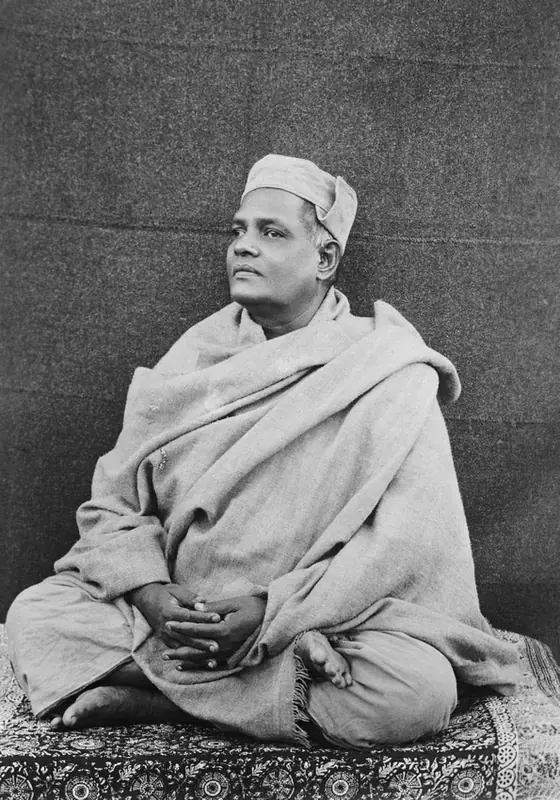
Photographs of Swami Saradananda survive from his years in America and from Calcutta. The portrait at the head of this page is one of them, from the Ramakrishna Order’s archives, published under a free licence and credited on the picture credits page; it is a photograph, not a painting or a generated image. Dates and places follow Belur Math's own account of his life; the account of his American work follows the Vedanta Society of New York's history of its ministers. Belur Math does not explicitly name the place of his death, only that he lay down in his own room; that room was in the Udbodhan house, where he lived. The maps are drawn on present-day coordinates, not from any historical source; Dacca, Narayanganj and Barisal, which he visited in December 1899, lie in present-day Bangladesh and are named in the text rather than pinned.
The timeline, plainly
- 23 December 1865 — born Śarat Chandra Chakravartī, Amherst Street, Calcutta.
- 1882–83 — passes the Entrance examination from the Hare School; enters St Xavier's College.
- October 1883 — first visit to Sri Ramakrishna at Dakṣiṇeśvar, with his cousin Śaśī.
- 1885–86 — serves the Master through his illness at Śyāmpukur and Cossipore.
- Christmas 1886 — the vow of renunciation at Antpur; becomes Swami Sāradānanda at Baranagore.
- 1887–91 — pilgrimage and austerity: Purī, Vārāṇasī, Ayodhyā, Rishikesh; the Garhwal shrines with Swami Turiyananda (1890); Almora, 12 August 1890; the near-fatal illness at Vārāṇasī (1891).
- 1 April 1896 — arrives in London to help Swami Vivekananda; sent on to New York; teaches at Greenacre; first New York lecture 24 October 1896.
- 12 January 1898 — sails for India via London, Paris and Rome; becomes Secretary of the Ramakrishna Math and Mission.
- 1899 — with Swami Turiyananda, tours Kanpur, Agra, Jaipur and Gujarat (from 7 February); Dacca, Narayanganj and Barisal (December).
- 1908–09 — builds the Udbodhan house at Bāgbāzār; the Holy Mother moves in on 23 May 1909; stands guarantee for young men accused in the Maniktala bomb case who have given up politics; writes Lilaprasanga to repay the loan.
- 1913–14 — Purī (March–July 1913); Burdwan flood relief; kidney disease begins.
- 1916–17 — answers Lord Carmichael’s durbar remarks about the Mission and removes the Government’s misconceptions; supervises Swami Premananda’s treatment.
- 21 July 1920 — death of the Holy Mother in the house he built.
- 19 April 1923 — dedicates the temple at Jayrāmbāṭī.
- 1926 — organises the Ramakrishna Mission's first Convention at Belur Math and gives the Address of Welcome.
- 19 August 1927 — dies at 2.34 a.m., thirteen days after the attack of apoplexy of 6 August, aged sixty-one.
Read the originals
Primary texts and the records kept by the teacher's own institution.
- Belur Math — the Order’s own life of Swami Saradananda
- Sri Ramakrishna the Great Master — his life of the Master in the older English translation (Sri Ramakrishna Math; free to borrow at the Internet Archive)
- Sri Ramakrishna and His Divine Play — Swami Chetanananda’s translation, Vedanta Society of St Louis
- Vedanta Society of New York — its history of the swamis who led it, including his years there
- Vedanta Society of New York — the Society’s history, with its 1896 address under Swami Saradananda
Every daily message names the teacher it came from. Read the messages, or see the whole line this teacher stands in: all fifty-one teachers.