Sri Nisargadatta Maharaj
Householder sage of Bombay
1897–1981 · Kindred Voices
- When
- 1897–1981
- Born
- Bombay, India; childhood in Kandalgaon, Maharashtra
- Where the life was lived
- Childhood at Kandalgaon in Maharashtra; moved to Bombay in 1915 after his father died; kept a small shop there; after his teacher's death in 1936 he set out for the Himalaya and turned back; taught in the upper room of his house at 10 Ketwadi Lane, Bombay, for the rest of his life.
- What is left of it
- I Am That — dialogues recorded in that room — and the later collections Seeds of Consciousness and Prior to Consciousness.
An unlettered man who received mantra initiation from Siddharāmeśvar Mahārāj, and whose recorded conversations became one of the most widely read modern statements of non-duality.
The India he was born into
He was born in Bombay on 17 April 1897, on the day of Hanumān Jayantī — the birthday of the monkey god — and was named Māruti after him, in the manner of Marāṭhī families who name a child for the festival it arrives on. His full name was Māruti Śivrāmpant Kāmbḷī. Bombay in 1897 was the second city of the British Empire in Asia, a port of cotton mills and chawls and plague: the bubonic plague that had arrived the year before was killing thousands a week, and the city's poor were being moved out of it by force. His father, Śivrāmpant, was a poor man who worked as a domestic servant and then, when Māruti was small, took the family back to the country — to Kandalgāon, a village in the Konkan south of Bombay, in what is now the Sindhudurg district — where he farmed a little land and the children grew up. The tradition's own account of Nisargadatta's life, on the site of his guru's lineage, gives almost nothing about these years, and he himself gave less. He said he had gone to the village school, that he had worked in the fields, that his father had a friend, a Brahmin named Viṣṇu Haribhaū Gore, who talked about religion and gave the boy his first taste of it, and that he had thought a good deal and read a little.
India in his childhood was the India of the National Congress and of the first stirrings of the movement that would end British rule: Tilak was writing in Poona, Gandhi was still in South Africa, and the plague and the famines of the 1890s had made the Empire's claims to good government sound hollow to a generation. None of that touched a farmer's son in the Konkan very directly. What touched him was the ordinary religion of the Marāṭhī countryside — the saints Tukārām and Jñāneśvar sung in the fields, the pilgrimages to Paṇḍharpur, the household shrine — and it never left him. To the end of his life he sang bhajans four times a day in a loft in Bombay while the philosophers from Europe waited for him to finish.
Where the life was lived
His life was lived almost entirely in Bombay and the Konkan, with one long journey out of it. The map shows Bombay, the village of Kandalgāon where he grew up, and the places of his guru's lineage — Pathrī, Siddharāmeśvar Mahārāj's birthplace, and Inchegeri, the village in the Bijāpur district that gives the lineage its name. His wandering in 1937–38 took him north towards the Himalaya; the tradition does not record the route, and it is not drawn.
Present-day India. A life lived in one city: Bombay, where he was born, kept shop and taught from a loft for forty years. Kandalgāon is the village of his boyhood; Pathrī and Inchegeri are the places of his guru’s lineage, not his own. His wandering toward the Himalaya in 1937–38 is not drawn because no route is recorded.
- 1Bombay (Maharashtra) — Born 17 April 1897; the bīḍī shops; the loft at 10 Khetwāḍī Lane, Girgaum, where he taught until his death on 8 September 1981
- 2Kandalgāon (Maharashtra) — The Konkan village where he grew up after the family left the city; his father farmed here until 1915. Position approximate
- 3Pathrī (Maharashtra) — Birthplace of his guru, Siddharāmeśvar Mahārāj, August 1888, in the Solāpur district. Position approximate
- 4Inchegeri (Karnataka) — The village of Bhāūsāheb Mahārāj that gives the lineage its name; he never lived here. Position approximate
The shopkeeper
His father died in 1915. Māruti was eighteen, and he went back to Bombay, where his elder brother was, to earn. He worked first as a junior clerk in an office and hated it, and after a few months he did what enterprising poor men in Bombay did: he opened a shop. It sold bīḍīs — the hand-rolled leaf cigarettes that working India smoked — and it did well enough that within some years he had, by his own account, eight shops, and had brought his family to the city. In 1924 he married Sumatibāī, and they had four children, three daughters and a son. He was, by the time he was thirty-five, a small businessman with a family and a house in the crowded lanes of Girgaum, and no particular reason to think his life would be different from any other.
He was also a man with a question, and a friend who noticed. Yaśvantrāo Bāgkar, a neighbour and a fellow devotee, kept telling him about a teacher he went to hear, a man from the Solāpur district named Siddharāmeśvar Mahārāj, who taught in the lineage the tradition calls the Inchegeri Sampradāya — a line of Marāṭhī and Kannaḍa householder-saints, going back through Bhāūsāheb Mahārāj of Inchegeri to the Nāth teachers of medieval India, who taught non-duality in the vernacular to shopkeepers and farmers and did not require anyone to leave home. In 1933, when Māruti was thirty-six, Bāgkar took him along.
Siddharāmeśvar
Siddharāmeśvar Mahārāj was born in August 1888 at Pathrī, a village in the Solāpur district, and initiated in 1906 by Bhāūsāheb Mahārāj; he taught in Bāgevāḍī, in Solāpur and in Bombay through the 1930s, and died on 9 November 1936, aged forty-eight. His samādhi is at Bāṅgaṅgā, on Malabar Hill in Bombay. Nisargadatta met him, then, in the last three years of his life, and saw him perhaps a few dozen times. What he got from him he described many times, and always in the same terms. The guru gave him a mantra and a single instruction: you are not what you take yourself to be; find out what you are; attend to the sense "I am", to that alone, and stay with it. And he told him to trust the instruction absolutely — to take it, as Nisargadatta put it later, "as the absolute truth".
He did exactly that, for three years. "My guru told me: 'You are not what you take yourself to be. Find out what you are. Watch the sense "I am", find your real self.' I obeyed him, because I trusted him." He spent every free hour in the shop and at home sitting with the bare sense of being, not as a thought but as the fact prior to thought; he sang the bhajans of the lineage; and he said afterwards that it was the trust, not the method, that did the work. "My teacher told me to hold on to the sense 'I am' tenaciously and not to swerve from it even for a moment. I did my best to follow his advice and in a comparatively short time I realised within myself the truth of his teaching." The lineage's own account of him ends that part of the story with a single sentence of his: "Nothing was wrong anymore."
His guru died in November 1936. Nisargadatta had been his disciple for three years, and the death — he was quite clear about this — changed nothing in what he had been given. It changed his life. In 1937 he left the shops, the wife and the children, and set out on foot for the Himalaya, to live as a wandering renunciant.
The journey, and the return
He did not get there. The tradition's account says he "travelled across India" in 1937 and came home in 1938, and that the awakening he had been moving toward came to completion on the road back. He told the story himself with some amusement. On the way, somewhere in the north, he met another disciple of his guru's line, who asked him what he thought he was doing, and pointed out that a man who had understood that he was not the body had no reason to walk that body to the Himalaya — that renunciation of the world was as much a form of attachment to it as anything else. He saw the point. He turned round. He was back in Bombay within the year, and he found that in his absence his family had kept only one of the eight shops going, and that it was enough.
He ran that shop for the next twenty-eight years. He lived in a tenement at 10 Khetwāḍī Lane, in Girgaum, and above the family's rooms he built a mezzanine — a loft, reached by a steep wooden stair, where he could sit — and it was there, from the late 1930s, that a handful of neighbours and fellow devotees came in the evenings to sit with him, sing, and ask questions. His wife died in 1942; a daughter died in 1948; he brought up the rest. He was known in the lane as a shopkeeper with something about him, and outside it he was not known at all. In 1966, at sixty-nine, he retired from the shop and gave the loft his whole day: two sessions of talks, morning and afternoon, the bhajans four times a day, and anyone who climbed the stair.
The name
The name he taught under was given to him, the tradition says, from within: Nisargadatta, "given by nature" — or "naturally given" — Mahārāj, the honorific the Marāṭhī tradition gives to any revered teacher. He disliked being called a guru and said so. He wore the ordinary dress of a Bombay working man, smoked bīḍīs from his own former stock, spoke only Marāṭhī, and treated the loft as a place of work: you came with a question, you asked it, you got an answer that was often abrupt, and you left. There was no ashram, no organisation, no publications, no disciples in the formal sense, and no charge. This did not change when the world found him.
"I Am That"
The world found him through a book. Maurice Frydman — a Polish-born engineer who had come to India in the 1930s, been close to Sri Ramaṇa and to Gandhi, and had spent a lifetime looking — climbed the stair in the late 1960s and recognised what he had found. He recorded the talks, with a Marāṭhī translator, over several years, translated and edited them into English, and in 1973 a small Bombay publisher, Chetana, brought them out in two volumes as I Am That. The book was passed from hand to hand, and by the late 1970s the loft, which held perhaps fifteen people sitting close, was full every day with visitors from Europe and America, philosophers and psychiatrists and seekers who had read every other book and found this one different. The tradition's account says plainly that the publication "brought him worldwide recognition and followers, especially from North America and Europe". He did not go to them. They came to Khetwāḍī Lane, up the stair, and sat on the floor.
The book is a series of a hundred and one dialogues, and what makes it what it is, is that he refused every question's premise. Asked how to reach the Self, he asked who was asking. Asked about the world, he asked whether it was there in deep sleep. Asked about God, he said God was a concept, and so was the questioner, and that the one thing that was not a concept was the sense of being, prior to all of them, and that the whole of the work was to go back to that. "Give up all questions except one: 'Who am I?' After all, the only fact you are sure of is that you are. The 'I am' is certain. The 'I am this' is not." He said it in a hundred ways, to a hundred questioners, and he did not soften it for anyone.
The teaching, put plainly
The teaching has two levels, and he taught the first to most people and the second to the ones who stayed. The first is the practice his guru gave him: attend to the sense "I am" — not "I am a man", "I am a shopkeeper", "I am unhappy", but the bare fact of being that all those additions are added to — and stay with it, without words, whenever you can, until it becomes clear that everything else, the body, the mind, the world, appears in it and depends on it. "Go back to that state of pure being, where the 'I am' is still in its purity before it got contaminated with 'I am this' or 'I am that.' Your burden is of false self-identifications — abandon them all." This is the whole of the method, and he said so: refuse to be anything in particular, and see what remains.
The second level is what he called going "prior to consciousness", and it is the part of his teaching that is most his own. The sense "I am", he said, is itself an arrival: it was not there before the body formed, it will not be there when the body goes, it is absent in deep sleep, and it is therefore not the final truth but the last appearance. What you are is what is aware of the "I am" — the absolute, the unborn, that on which even consciousness appears as a guest. He would not describe it, because it is not an object, and he would not let anyone claim it, because to claim it is to be a claimer. But he pointed at it with a consistency that the Western students, who had read the Upaniṣads, recognised: it is the turīya of the Māṇḍūkya, the witness that is not a witness, the Self that "is not this, not this". He had never read the Māṇḍūkya. He had sat in a shop with the sense of being for three years.
What made the teaching Advaita, and not merely a personal report, was his insistence that the "I am" and the world are one movement — that consciousness, when it appears, appears as the whole of the world at once, the body and everything the body sees; that the world is in you, not you in it; and that the individual, the person you take yourself to be, is a concept within that movement and not its owner. "Wisdom tells me I am nothing. Love tells me I am everything. Between the two, my life flows." The line is the whole of the tradition — the Self as neither the individual nor the world, but that in which both appear — in the words of a man who had never learned the tradition's language.
The difficulties, which he did not hide
He was poor, and he stayed poor. He was a shopkeeper with a primary-school education in a lineage of householder-saints, teaching in a language his visitors did not speak, through translators, in a room above a lane, to people who had come expecting a sage in white and found a small, fierce old man with a cigarette. He lost his guru after three years, his wife in his forties, a daughter in his fifties. He had, at the end, throat cancer, which took his voice — the one instrument he had — and he taught through it, in whispers and in the last months in single words, until the week he died. The last talks, recorded by Jean Dunn and published as Consciousness and the Absolute, are among the most uncompromising things in the literature, and they were given by a man in pain who could barely speak.
He did not hide the difficulties and he did not dramatise them. Asked about his illness, he said that the body was sick, and that he was not the body, and that the pain was there and was witnessed. Asked whether he was afraid, he said there was no one to be afraid. Asked, near the end, what would remain of him, he said: what was there before the body, and the "I am" would go the way it came. He had said all this for forty years. The last months were the proof that he meant it.
The sayings, and what they were for
"You are not what you take yourself to be. Find out what you are. Watch the sense 'I am', find your real self."
His guru's instruction to him, as he repeated it; I Am That.
"Go back to that state of pure being, where the 'I am' is still in its purity before it got contaminated with 'I am this' or 'I am that.' Your burden is of false self-identifications — abandon them all."
I Am That; quoted on the Siddharāmeśvar lineage's own account of him.
"Give up all questions except one: 'Who am I?' After all, the only fact you are sure of is that you are. The 'I am' is certain. The 'I am this' is not."
I Am That.
"Wisdom tells me I am nothing. Love tells me I am everything. Between the two, my life flows."
I Am That.
"Trust me, I tell you: you are Divine. Take it as the absolute truth. Your joy is divine, your suffering is divine too. All comes from God."
I Am That; quoted on the Siddharāmeśvar lineage's own account of him.
"The mind creates the abyss, the heart crosses it."
I Am That.
The sayings are for use, and their use is single. Each one turns the listener from every object of attention — the world, God, the teaching, the teacher, the problem — back to the one fact that cannot be doubted, the sense of being, and tells them to stay there. He had no other instruction. He said many times that if you did that one thing sincerely, everything else would follow of itself, because the truth is not far away and not hidden; it is what is looking.
The books, and how to read them
I Am That is the book, and there is no substitute for it. It is a hundred and one dialogues and it need not be read in order; open it anywhere, read one dialogue, and stop. Read it slowly and argue with it; it was made to be argued with, and he wins. The Chetana edition from Bombay is the original and is still in print; a copy is on the Internet Archive and is linked below. The later collections — Seeds of Consciousness and Prior to Consciousness, edited by Jean Dunn from the talks of 1979–81; Consciousness and the Absolute, the final talks; The Nectar of Immortality and The Ultimate Medicine, edited by Robert Powell — are harder and more compressed, and are for the reader who has lived with I Am That for a year. The lineage's own account of him, on the Siddharāmeśvar Mahārāj site, is linked below and is the source for the dates on this page; the site of his own line gives the lineage back to the Nāth teachers. There is no ashram and no institution; there never was.
The timeline, plainly
- 17 April 1897 — born Māruti Śivrāmpant Kāmbḷī in Bombay on Hanumān Jayantī; the family moves to Kandalgāon in the Konkan while he is small.
- 1915 — his father dies; he returns to Bombay at eighteen, works as a clerk, then opens a bīḍī shop; in time he has several.
- 1924 — marries Sumatibāī; four children, three daughters and a son.
- 1933 — taken by his friend Yaśvantrāo Bāgkar to Siddharāmeśvar Mahārāj; receives the mantra and the instruction to attend to the sense "I am".
- 1933–36 — three years of practice while running the shops.
- 9 November 1936 — Siddharāmeśvar Mahārāj dies.
- 1937 — leaves home to wander toward the Himalaya as a renunciant; is turned back by a fellow disciple's argument.
- 1938 — returns to Bombay; the awakening completes on the road home, the tradition says; one shop remains, and he keeps it.
- c. 1938–66 — lives at 10 Khetwāḍī Lane, Girgaum; builds the loft; talks to neighbours and devotees in the evenings. His wife dies in 1942, a daughter in 1948.
- 1966 — retires from the shop; talks twice a day, bhajans four times a day, in the loft.
- Late 1960s–1973 — Maurice Frydman records and translates the talks; I Am That published in Bombay in 1973.
- 1973–81 — visitors from Europe and America fill the loft; Jean Dunn, Robert Powell and others record the later talks.
- 8 September 1981 — dies in Bombay of throat cancer, aged eighty-four.
For the seeker now
He is the teacher on this site for people who have no time, no Sanskrit, no teacher within reach and no patience with anything that looks like religion. He was a shopkeeper who was given one instruction and did it, and he is the proof that the instruction works: that a person with a family, a business and a primary-school education can, by attending to the bare sense of being for a few years with complete trust, arrive at what the Upaniṣads describe, and can then say it in words that people from every country recognised. He asked nothing of anyone except that they stop being what they were not.
His instruction has not changed. Find the sense "I am" — not any thought about yourself, but the fact of being that the thoughts are about. Stay with it. When you find you have become something in particular — a body, a mood, a story — go back. Do it in the shop, in the kitchen, on the train. Do not wait for a better place. He never had one.
A note on the pictures and the dates
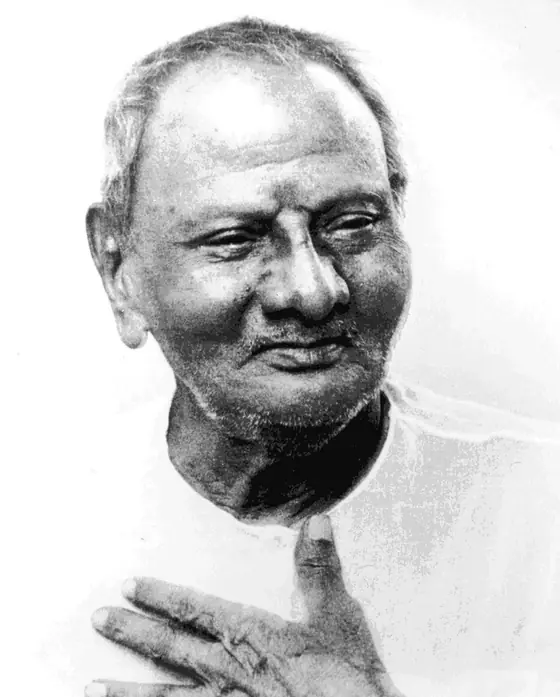
No portrait of him is used on this page, in keeping with this site's rule against inventing likenesses of real teachers; photographs of him in the loft exist and are widely reproduced. Dates follow the account of his life on the site of his guru's lineage, which gives his birth as 17 April 1897, his meeting with his guru as 1933, his wandering as 1937–38, his retirement as 1966 and his death as 8 September 1981; details of his early life and family are as he himself gave them in the talks and as his editors recorded them. The sayings are as printed in I Am That and as quoted on the lineage's own page. The map is drawn on present-day coordinates.
Read the originals
The lineage’s own page is the source for the dates here; I Am That is the book. There was never an ashram or an institution. Nothing here links to a third-party encyclopaedia.
Every daily message names the teacher it came from. Read the messages, or see the whole line this teacher stands in: all fifty-one teachers.