Hastāmalaka
Direct disciple of Adi Shankara
8th century CE · The Shankara Lineage
- When
- Eighth century
- Born
- Kerala, by tradition
- Where the life was lived
- Grew up in the village of Śribali with his father Prabhākara, and joined Śaṅkara's company after the Ācārya questioned him there.
- What is left of it
- The verses he spoke in reply to the question 'Who are you?', on which Śaṅkara himself later wrote a commentary.
Answered a direct question about his own identity in spontaneous Sanskrit verse; the tradition records that Śaṅkara accepted him as already established in the truth and asked no further study of him.
The full-length study of this teacher is still being written. What is below is the complete short life, and it is accurate as far as it goes.
The life
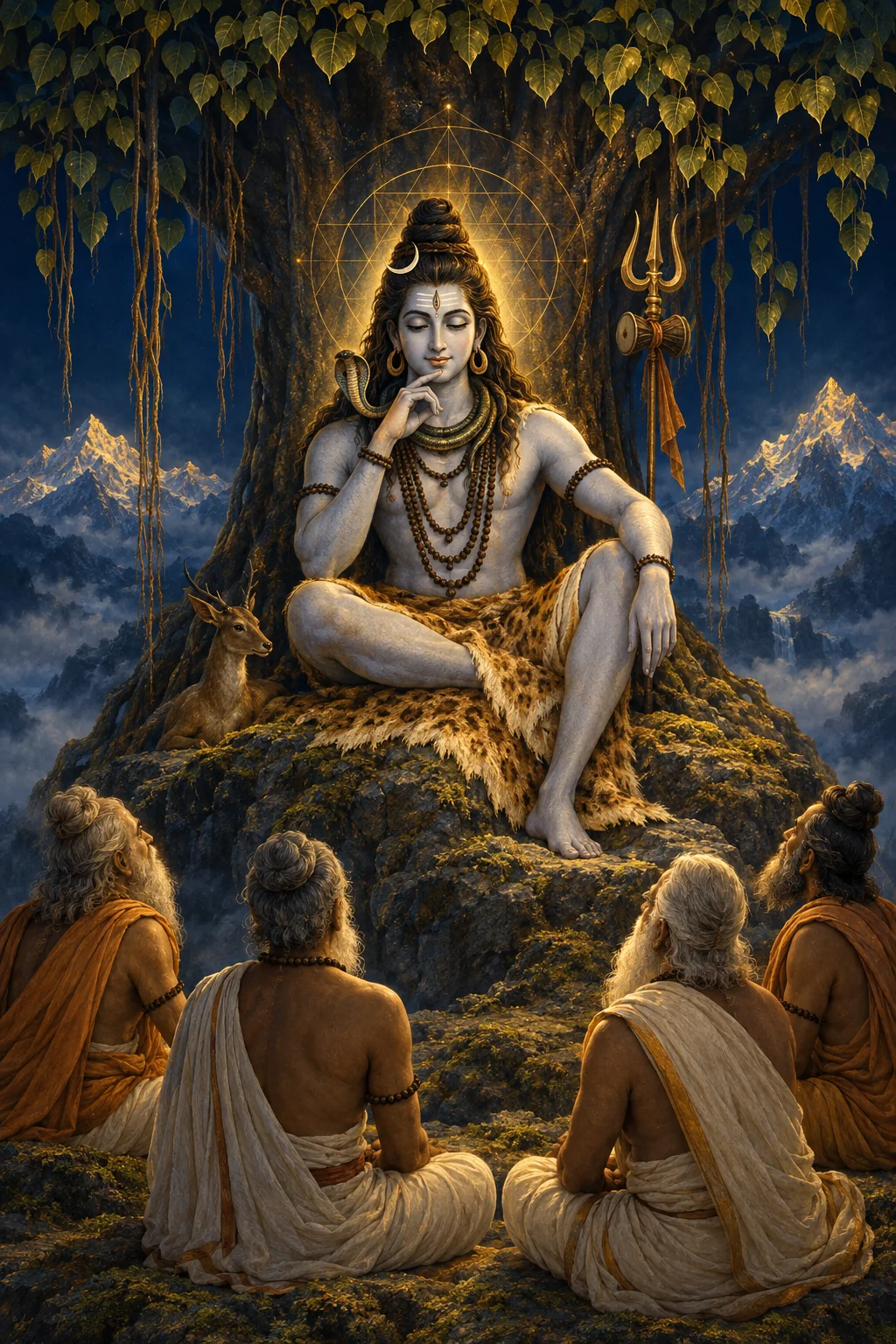
The village is named: Śribali, where he grew up with his father Prabhākara. The tradition remembers him as a child who did not speak — who was taken for defective, and for whom nothing was expected. Then Śaṅkara came through, and asked him who he was. What came back was twelve verses in Sanskrit, spoken without preparation, on the nature of the Self: not this body, not these senses, not the mind that knows them, but that by which all of it is known and which is never itself an object. The verses survive as the Hastāmalaka Stotra, and Śaṅkara thought them worth a commentary of his own — the teacher commenting on the disciple, which happens nowhere else in this literature. The maṭha's account adds a detail worth keeping: some of the disciples urged him to write a vārtika, a full metrical commentary, on the Sūtra Bhāṣya, and Śaṅkara declined on his behalf. He was taken to be already established, and nothing further was required of him. His name is said to mean that the truth lay in his hand as plainly as a fruit. No dates survive, and the geography is a single village name. The episode is what the tradition preserved, because it makes a claim it is prepared to repeat: the answer to the only question that matters is not the property of the learned.
The turn it rests on
His first sentence was an answer to the only question the tradition asks.
What was taught
His short Hastāmalakīyam states the Self's nature in a handful of verses — clarity as brevity.
Read the originals
Primary texts and the records kept by the teacher's own institution.
Every daily message names the teacher it came from. Read the messages, or see the whole line this teacher stands in: all fifty-one teachers.