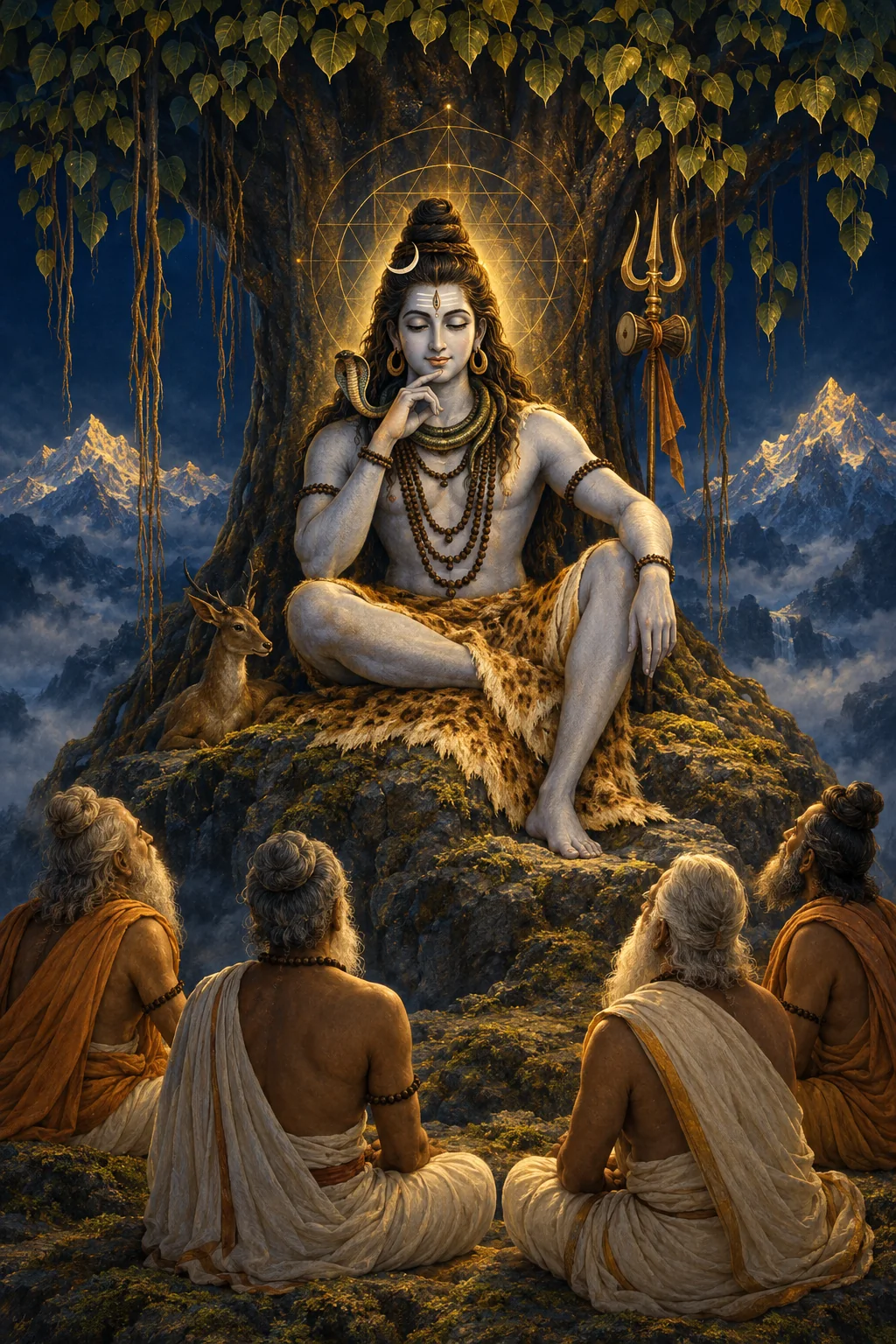
Sri Govinda Bhagavatpāda
Guru of Sri Adi Shankara
c. 7th–8th century CE · The Sri Shankara Lineage
- When
- Seventh to eighth century by the historians’ bracket, inferred from his pupil’s dates (788–820 in Dasgupta’s reckoning); between the fifth and seventh centuries by the Digvijaya translator’s estimate; the initiation dated to 499 BCE by the Puri seat’s own chronology. This page gives all and settles none.
- Born
- Kashmir, by the Kanchi Kāmakoṭi Pīṭham’s account alone, as a Brahmin named Chandra Śarmā; no other source names a birthplace.
- Where the life was lived
- The bank of the Narmadā, agreed by every source, where the Digvijaya sets his hermitage and cave and where the young Sri Śaṅkara came to him; the town of Omkareshwar keeps the cave. Ujjain and Badarikāśrama by the Kanchi account. Nothing is recorded of where he died.
- What is left of it
- No work survives under his name and no early source says he wrote one; the tradition credits him, as Patañjali in an earlier life, with the Yoga-sūtra and the Mahābhāṣya, and this page reports that as the tradition’s. What remains is the lineage verse’s title for him, yogīndra, and his pupil’s salutations at the head of the Vivekacūḍāmaṇi and the foot of the Māṇḍūkya commentary.
Received Sri Śaṅkara as a disciple, initiated him into monastic life, and passed on the teaching he had from Sri Gauḍapāda — the reason the lineage counts him as the link between the Kārikā and the commentaries.
The man
Every lineage has a teacher who is remembered for one pupil. In the Advaita tradition that teacher is Sri Govinda Bhagavatpāda, and the pupil is Sri Śaṅkara. The Kanchi Kāmakoṭi Pīṭha’s volume on the preceptors of Advaita opens its chapter on him with the plain fact that carries him: “The preceptor who enjoys this honour of being the preceptor of Sri Sankara is Sri Govinda Bhagavatpada.” Nothing he wrote survives under his name. No date, no birthplace and no place of death can be fixed from any record of his own time. What comes down is a name, a river, a cave, a story told in the lives of his pupil, and the salutations that pupil placed at the head and foot of his own books.
And yet he is not a blank. The traditional lives of Sri Śaṅkara give him a former name, a country, a teacher, a curse, a night-long lesson written in blood on leaves, a sheep, three marriages, an ordination in the Himalaya, a prophecy from Vyāsa, and the scene by which every Advaitin knows him: a cave on the Narmadā whose mouth was a cubit wide, a boy from Kerala prostrate at its door, a question — “Who are you?” — and an answer in verse that has been recited ever since. The scholars who came after the stories, and who distrust them, have said less: that he was the disciple of Sri Gauḍapāda, the teacher of Sri Śaṅkara, and the author of nothing that remains. The Advaita Vedanta Anusandhana Kendra’s outline of the lineage says it in one sentence: “not much historical information is known about Govinda Bhagavatpāda, Sankara’s teacher, except that Sankara salutes him in the invocatory verses in some of his works”.
This page holds both accounts side by side and says at every point which is speaking. It tells the traditional life fully, because it is the only life there is, and because the tradition that tells it is a living one with its own seats and its own reasons. It also says, without apology, where the stories differ from each other and where the historians fall silent. He is the hinge on which the whole of what follows on this site turns — the man who received the teaching of the Māṇḍūkya Kārikā from its author and gave it to the boy who would write the commentaries — and the honest way to honour a hinge is to describe exactly what it joins.
The sources for this page, and what each can bear
Seven kinds of document stand behind this page. They are of very unequal weight, and the reader should know which is speaking at each point.
- The Śaṅkara-dig-vijaya of Mādhava-Vidyāraṇya, in Swami Tapasyananda’s English translation (Sri Ramakrishna Math). Its fifth canto is the fullest account anywhere of Sri Śaṅkara’s arrival at Sri Govinda’s hermitage, his initiation, the flood on the Narmadā and his commissioning to Vārāṇasī. The translator’s introduction weighs the dates and the rival lives. It is a poem, written centuries after the events, and the translator says so.
- The Sringeri Śāradā Pīṭham’s abridged Mādhavīya Śaṅkara Digvijayam, on the maṭha’s own site, which prints the Sanskrit of the verses on the meeting (5.91, 5.96–97 and the reply) with its own translations.
- The Kanchi Kāmakoṭi Pīṭham’s Preceptors of Advaita (1968), chapter 7, by V. A. Devasenapati, which tells a different and much fuller story of Sri Govinda’s early life — Chandra Śarmā of Kashmir, the grammar lesson from a Brahmarākṣasa, Ujjain, the three marriages, Badarikāśrama — and records that its material came from the Madras lectures of the Kanchi Paramācārya in 1932. It also cites the Patañjali-vijaya and the Patañjali-carita. Chapters 8, 10 and 11 of the same volume are used for context.
- Sri Śaṅkara’s own salutations: the first verse of the Vivekacūḍāmaṇi in Swami Madhavananda’s translation, and the concluding salutation of the Māṇḍūkya Upaniṣad commentary in Swami Nikhilananda’s. These are the only words about Sri Govinda that may come from his own pupil, and the page is careful about what they do and do not say.
- The Advaita Vedanta Anusandhana Kendra’s page on the Advaita paramparā, which gives the lineage verses and the historians’ caution.
- The historians: Surendranath Dasgupta’s History of Indian Philosophy, volume one (1922), for the conventional dating, and Swami Nikhilananda’s preface for what tradition makes of Sri Gauḍapāda.
- The living institutions: the Govardhana Pīṭha at Puri on its own dating of the initiation; the Sringeri Pīṭham on the four seats; the Madhya Pradesh tourism board and the Acharya Shankar Sanskritik Ekta Nyas on the cave at Omkareshwar that the town keeps for him.
Every quotation on the page is taken word for word from one of these, and each is linked at the foot of the page where it is free to link. Where the scanned books have been misread by the machine that copied them, the printed words have been restored and every restoration is recorded, as the closing note explains. Where the sources disagree — and on this life they disagree about his country, his dates, his former life and his master’s — both accounts are given, and neither is quietly dropped.
Where the life was lived
Four places are claimed for him, and one is certain in the sense that every source agrees on it. The certain one is the Narmadā. The Digvijaya sets his hermitage on its bank; the Kanchi chapter sends him there on Vyāsa’s instruction; the Sringeri abridgement says the young Śaṅkara “found his Guru on the banks of the river Narmada, in Govinda Bhagavatpada, disciple of the famous Gaudapada”; the Kanchi chapter on Sri Śaṅkara says he “found his master in Sri Govinda Bhagavatpada on the banks of the river Narmada”. The town of Omkareshwar in Madhya Pradesh, on an island in that river, keeps a cave under his name, and the state’s tourism board lists it among the town’s sites. The pin on the map is set there, and the caption says why.
Present-day coastlines; no border but India’s is drawn. Every pin is a claim and the caption says whose. The Narmadā is the one place every source agrees on: the Digvijaya puts his hermitage and his cave on its bank, and the Kanchi chapter and the Sringeri abridgement bring the boy from Kāladi to him there; the pin is set at Omkareshwar, the island town that keeps a cave under his name, and the exact site is the town’s tradition. Kashmir, Ujjain and Badarikāśrama belong to the Kanchi Kāmakoṭi Pīṭham’s account alone, which tells of a Kashmiri Brahmin named Chandra Śarmā who became Govinda; no other source names them. No line joins the pins, because no journey is recorded in an order the sources agree on, and nothing is recorded of where he died.
- 1Omkareshwar, on the Narmadā (Madhya Pradesh) — The river is agreed by every source: the Digvijaya sets his hermitage and cave on its bank, and the Kanchi chapter and the Sringeri abridgement bring the young Śaṅkara to him there. The town on the island keeps a cave under his name and the state’s tourism board lists it; the exact site is the town’s tradition
- 2Kashmir (approx.) (Jammu & Kashmir) — The Kanchi chapter alone gives his birth: Chandra Śarmā, “a handsome Brahmin of Kashmir”. No other source names a birthplace; the pin is set by region only
- 3Ujjain (Madhya Pradesh) — Where the Kanchi chapter’s story has the young grammarian collapse from hunger and be married; the Kanchi account’s alone
- 4Badarikāśrama (Badrinath) (Uttarakhand) — Where the Kanchi chapter says he found Sri Gauḍapāda again as a monk and took sannyāsa from him, and where Vyāsa sent him south to the Narmadā to await Sri Śaṅkara; the Digvijaya places his meeting with Vyāsa in the Himalaya too
The other three places belong to the Kanchi account alone. Kashmir is where that account says he was born, a Brahmin named Chandra Śarmā. Ujjain is where it says he collapsed from hunger and was married. Badarikāśrama, in the high Himalaya, is where it says he found his old teacher again as a monk and took sannyāsa from him. No other source names any of these, and the pins are marked as the claims of one tradition. Nothing is recorded anywhere of where he died, and the map does not guess.
Two things should be said about this geography before the story is told. The first is that it is the geography of a teacher, not of a traveller: the Narmadā is the one fixed point, and every other place is on the way to it or from it. The second is that the Narmadā itself was, in the poem’s telling, a place of many hermits. The Digvijaya has the young Śaṅkara arrive “at the forest hermitage of sage Govinda towards one evening, even like the sun at the western horizon”, where “the sight of deer skins and bark clothes on the branches of bushes indicated to him that he had arrived at a hermitage”, and where he “sought the advice of the ascetic inhabitants of the place” before being directed to “sage Govinda’s residence, a cave with an entrance only a cubit in width”. Sri Govinda was one hermit among many on that river; the difference was who came to his door.
What his own pupil wrote of him
The one place a historian would want to start is with the words of the pupil, and there are two. Neither is a biography. Both are salutations, and the tradition has read them as addressed to Sri Govinda for as long as it has read them at all.
The Vivekacūḍāmaṇi, the “Crest-Jewel of Discrimination,” opens with a verse that names him. In Swami Madhavananda’s translation (Advaita Ashrama): “I bow to Govinda, whose nature is Bliss Supreme, who is the Sadguru, who can be known only from the import of all Vedanta, and who is beyond the reach of speech and mind.” The verse is built to be read two ways at once. Govinda is a name of the Lord; Govinda was also the author’s teacher; and the phrases “whose nature is Bliss Supreme” and “beyond the reach of speech and mind” fit Brahman exactly and a human guru only by the doctrine that the true teacher is not other than the truth he teaches. The tradition has always taken the double meaning as intended, and it is the oldest form of the claim this page is about: that Sri Govinda was, to his pupil, the place where the teaching and the teacher were one.
The second is quieter. At the close of his commentary on Sri Gauḍapāda’s Kārikā on the Māṇḍūkya Upaniṣad, Sri Śaṅkara set three verses of salutation, which Swami Nikhilananda prints under the heading of the concluding salutation. The first bows to Brahman. The second bows to a teacher who churned the Vedas:
“I prostrate to the feet of that Great Teacher, the most adored among the adorable, who, — out of sheer compassion for the beings drowned in the deep ocean of the world, infested with the terrible sharks of incessant births (and deaths), — rescued, for the benefit of all, this nectar, hardly obtainable even by the gods, from the innermost depths of the ocean of the Vedas by churning it with the (churning) rod of his illumined reason.”
And the third bows to the author’s own master:
“I make obeisance with my whole being to those holy feet — the dispellers of the fear of this chain of births and deaths— of my great teacher who, through the light of his illumined reason, destroyed the darkness of delusion enveloping my mind ; who destroyed for ever my (notions of) appearance and disappearance in this terrible ocean of innumerable births and deaths ; and who makes all others also that take shelter at his feet, attain to the unfailing knowledge of Scriptures, peace and the state of perfect non-differentiation.”
Neither verse names its teacher, and this page will not pretend they do. But the book being closed is Sri Gauḍapāda’s, and the commentator’s own teacher was Sri Govinda; the natural reading, and the one the tradition has made, is that the second verse honours the author of the Kārikā and the third the man who taught it to the commentator. The reader should hold that as an inference from the placing of the verses, not as a record. What the third verse does say, on any reading, is what a pupil thought his teacher had done for him: destroyed “the darkness of delusion enveloping my mind”. It is the only testimonial to Sri Govinda’s teaching that may be in his pupil’s own hand, and it is enough to explain why the lineage remembers him.
The names: Govinda, Bhagavatpāda, Yogīndra
He is known by a name and two titles, and each says something. Govinda is a name of Kṛṣṇa — in its oldest sense the cowherd, the finder of cattle — and, as the Vivekacūḍāmaṇi verse shows, it let his pupil bow to the Lord and the teacher in a single breath. It is also, in the Kanchi account, a name he took: the chapter says he “henceforth came to be known as Govinda Bhagavatpada” on receiving initiation from his teacher, having been Chandra Śarmā before. A monastic name that is also a divine name is common in the tradition; what is uncommon is that it became the one under which the teacher of Sri Śaṅkara was remembered.
Bhagavatpāda is a title, “he whose feet are blessed,” and it is the title the tradition gives to Sri Śaṅkara himself. That the two men share it is not an accident of speech. The Kanchi volume calls the one “Sri Govinda Bhagavatpada” and the other Sri Śaṅkara Bhagavatpāda throughout; the Sringeri Pīṭham writes of “Bhagavatpada” when it means Sri Śaṅkara. The title marks the two ends of a single transmission.
Yogīndra, “lord of yogins,” is the title he bears in the lineage verse that Advaitins recite. The Anusandhana Kendra prints it: “vyāsaṁ śukaṁ gauḍapadaṁ mahāntaṁ govindayogīndram athāsya śiṣyam” — “Vyāsa, Śuka, the great Gauḍapāda, Govinda the lord of yogins, and then his disciple,” the disciple being Sri Śaṅkara, whom the next line names. The site of the Sanskrit documents that carries the Toṭakāṣṭaka prints the same verse with the same word. It is a title of practice rather than of learning, and it matches the man of the Digvijaya, who, when praised at his cave door, “came out of super-conscious state” before he could answer to answer the boy at his door. The Digvijaya also calls him simply Govindapāda, “the feet of Govinda,” a form of reverence by which a teacher is named through the part of him a disciple touches.
Who was his teacher? Sri Gauḍapāda, and the line from Vyāsa
On this, every source agrees, and it is the one link in his life that historians treat as more than a story. The Sringeri abridgement calls him “disciple of the famous Gaudapada, the author of the famous Karika on Mandukya Upanishad”. Swami Nikhilananda, in the preface to his edition of that Kārikā, puts the matter as tradition and no more: “Who was Gaudapada ? Tradition makes him the teacher of Govinda who was the teacher of Sankara.” Dasgupta, in the first volume of his history, states it as a date: “About the period 780 A.D. Gaudapada revived the monistic teaching of the Upanisads by his commentary on the Mandukya Upanisad in verse called Māṇḍūkyakārikā. His disciple Govinda was the teacher of Sankara (788 — 820 A.D.).” The Anusandhana Kendra’s page notes that the date of Sri Gauḍapāda “is usually inferred from the tradition that he was Sankara’s teacher’s teacher” — which is to say that Sri Govinda is the middle term by which scholars fix the age of the Kārikā itself.
The tradition sets this link inside a longer chain. The Digvijaya, at the moment of initiation, recites it: “Vyasa was the son of Parasara, and Suka, of Vyasa. Suka had as his disciple Gaudapada, and Gaudapada had as his disciple Govindapada, from whom Sankara now received initiation in the knowledge of Brahman.” The lineage verse goes further back still, to Nārāyaṇa, Brahmā, Vasiṣṭha, Śakti and Parāśara, and the Anusandhana Kendra explains the shape of it: “the advaita guru-paramparā begins with the daiva-paramparā, followed by the ṛṣi-paramparā”, and “After Suka, we turn to the mānava-paramparā, which brings us to historical times and personalities.” Sri Govinda stands at the very beginning of that human line — the first teacher after Sri Gauḍapāda whom no one has tried to place in a mythic age, and the last before the one whom everyone has tried to date.
The Kanchi account adds a detail no other source has, and it changes the colour of the relationship. In its telling, Sri Gauḍapāda was Chandra Śarmā’s teacher twice: first in grammar, on the Narmadā, under a curse; then in Vedānta, at Badarikāśrama, as a monk. The chapter draws the point itself: “It is significant that Gaudapada was his teacher both before and after he became a sannyasin. It is significant again that to play the role of the teacher he was at the foot of the same tree on which he had sat earlier to receive instruction from Gaudapada.” Whatever one makes of the story, the tradition that tells it wanted the teacher of Sri Śaṅkara to have been, first and thoroughly, a pupil.
When he lived: the reckonings, and why they differ
No source gives Sri Govinda a date of his own. His dates are his pupil’s, moved back a generation, and his pupil’s dates are one of the longest-running disagreements in Indian history. The card for this page gives the reckoning the historians use and names the other.
The eighth century. Dasgupta’s sentence, quoted above, places Sri Gauḍapāda “About the period 780 A.D.” and Sri Śaṅkara at 788–820. The Kanchi volume’s chapter on Sri Toṭaka states the common view with its caveat: “Sri Sankara, the greatest expounder of Advaita Vedanta is reputed to have flourished between 788 and 820 A.D. This date cannot be regarded as finally settled and a large number of Indian scholars bring down his date to the first or second century A.D. or B.C. However, the latter part of the eighth century has been accepted by thinkers as the most probable date.” The Anusandhana Kendra agrees: “Sankara can be dated more or less reliably to the 8th century CE.” On this reckoning Sri Govinda taught in the second half of the eighth century, and a boy of eight who came to him around 796 would have found an old man in the cave.
The traditional chronologies. The Govardhana Pīṭha at Puri, one of the four seats the tradition ascribes to Sri Śaṅkara, states on its own page that he “was born in Kalady, a village in the present Ernakulam district of Kerala state in India in 507 BC on the Vaisakha Shukla Panchami day of the Hindu calendar” and that “At the age of 8 years, he received the initiation into sanyasa order” from Sri Govinda Bhagavatpāda “on the Kartika Shukla Ekadashi”. That places Sri Govinda’s initiation of his pupil in the year 499 BCE, some thirteen centuries earlier than the historians’ date. Swami Tapasyananda’s introduction to the Digvijaya surveys the arguments for an early date and records one scholar’s reasoning that turns on Sri Govinda’s own place in the line: “Patanjali, Gaudapada, Govindapada and Sankara form the accepted line of discipleship. Patanjali, Sri Ramesam contends, lived in the 2nd century B.c., a conclusion which, if accepted finally (?), gives much credence to his theory.” The translator does not accept the argument; he reports it.
What this page does with the difference. It does not adjudicate it. The maṭhas that keep Sri Govinda’s memory keep the early dates as part of their own succession lists; the historians, working from who quotes whom, keep the late one. The Kanchi volume’s own words are the fairest summary: “Nor are the teachings of Sri Sankara affected in any way by the absence of certainty regarding his date.” Neither are his teacher’s. The card gives the eighth century, and this section gives the rest.
The Kanchi tradition: Chandra Śarmā of Kashmir and the lesson from a Brahmarākṣasa
The Digvijaya of Mādhava says nothing of Sri Govinda before the cave. The Kanchi Pīṭham’s volume says a great deal, and it tells the reader where the material came from: the author closes by recording “his deep sense of gratitude to His Holiness the present Sankaracharya of Kanchi for the material of this biography. (Vide His Holiness’ Madras lectures, 1932).” What follows in this section and the next is that account, told as the Pīṭham tells it. It is the tradition of one seat, and it is offered here as such.
In this telling, he began far to the north. “In his purvasrama, he was Chandra Sarma, a handsome Brahmin of Kashmir.” He was a student of grammar — vyākaraṇa — and he was on the road for a teacher: “Yearning to hear Patanjali’s exposition of the vyakarana at Chidambaram, he was coming to the South.” Patañjali is here the author of the Mahābhāṣya, the great commentary on Pāṇini’s grammar, teaching at the temple town of Chidambaram; the tradition of the South has long held that the Patañjali of grammar and the Patañjali of the Yoga-sūtra are one, and the story assumes it.
He never reached Chidambaram. On the bank of the Narmadā he met a demon who had been a scholar. “On the bank of the River Narmada, he saw Gaudapada who under a curse from Patanjali for leaving the place of instruction without permission had become a Brahmaraksas.” A Brahmarākṣasa, in the old tales, is a learned Brahmin who has fallen by some fault into the state of a flesh-eating spirit, and who keeps his learning. The curse had a condition: “Patanjali had decreed that the curse would be lifted when Gaudapada found a disciple fit enough to learn the vyakarana.” The condition had been costly. “It so happened that till the arrival of Chandra Sarma, every scholar who came that way went wrong in giving the ending of a tricky word and was eaten up by the Brahmaraksas. Chandra Sarma proved an exception. He gave the correct ending. The time for the lifting of the curse had come.”
The demon then offered to be the teacher the young man was looking for. “On being told that he was going to Chidambaram to learn at the feet of Patanjali, Gaudapada said that the exposition at Chidambaram was over and that he would himself teach the young man. But the condition was that without getting down from the tree on which the Brahmaraksas sat, and without sleeping, the disciple should learn what he was taught as quickly as possible.” And then the detail that the story is remembered for: “Having no access to writing materials, Chandra Sarma made a deep scratch in his thigh and with the blood that oozed out wrote on the leaves of the tree all that he was taught. The instruction continued night and day without food and sleep for nine days. On the completion of his instruction, he gathered up the leaves and tying them up into a bundle, took leave of his teacher.”
The reader will recognise the shape. A student who will write with his own blood rather than lose a word is a picture of what the tradition means by a fit disciple, and the story is told to make that point, not to make a point about grammar. But it also does something for the lineage. It makes Sri Gauḍapāda, the author of the Kārikā, a teacher of grammar before he was a teacher of Vedānta, and it makes the future teacher of Sri Śaṅkara a man who had earned the right to be taught by being able to give “the correct ending” when everyone else had died on the wrong one. Whether or not any of it happened, it is how the seat at Kanchi has chosen to describe the seriousness of the man.
The leaves, the sheep, Ujjain and Badarikāśrama
The story goes on, and it becomes, for a while, a story of loss. “Chandra Sarma walked some distance with his precious bundle. Overpowered by sleep and hunger, he slept for a while. On waking, he found that a sheep had eaten away part of the leaves in his bundle.” The Kanchi text lets the sentence stand without comment, and this page will do the same, except to notice that a tradition which wished only to glorify its teacher would not have invented a sheep. Part of what Sri Gauḍapāda taught was lost before it ever reached a pupil. The account is honest about that, and its honesty is one reason to take the rest of it as a story told in earnest.
He went on to Ujjain, and there his body gave out. “He took the bundle with the remaining leaves and on reaching Ujjain, he lapsed into a state of unconsciousness on the pial of a Vaisya.” A pial is the raised platform at the front of a South Indian house, where travellers rest. “The daughter of the Vaisya who was struck by the radiant face of Chandra Sarma found him in this state of unconsciousness on account of complete starvation and exhaustion. She fed him by applying on his body curd rice. The nourishment entered his body through the pores of the skin and Chandra Sarma woke up.”
What followed was a marriage he had not sought, and then two more. “He wanted to resume his journey. But Vaisya wanted him to marry his daughter who had saved his life. On finding him disinclined for marriage, the Vaisya took Chandra Sarma to the king. The king who was favourably impressed by the striking appearance of Chandra Sarma wanted him to marry his own daughter. He sent for his minister to consult him in order to see whether there was sanction in the Dharma Sastra for such a marriage. It so happened that the minister himself had a daughter; and so he was keen on giving her in marriage to this stranger. Thus, Chandra Sarma had to marry all the three girls. He stayed with them till each of them had a son by him.” In this account, then, the teacher of Sri Śaṅkara was a householder before he was a monk, and the father of three sons. No other source says so, and the Digvijaya, which knows only the hermit in the cave, gives no hint of it.
Then the road again, and this time the teacher found was a monk. “Then he continued his journey to find his teacher, Gaudapada, from whom he had learnt the vyakarana. Gaudapada had become a sannyasin and was in Badarikasrama.” Badarikāśrama is Badrinath, in the high Himalaya, and it is the place where the tradition also puts the composition of the Māṇḍūkya Kārikā: Swami Nikhilananda’s preface reports Ānandagiri’s note that “Gaudapada performed great austerities in the Badarika”śrama. There the pupil took the vows. The Kanchi text says that he received dīkṣā from his preceptor and “henceforth came to be known as Govinda Bhagavatpada”. The name by which the lineage knows him begins, in this account, at Badrinath.
The Patañjali identification, and Ādiśeṣa
Here the Kanchi account and the Digvijaya meet, for both hold that the man in the cave was not, in the ordinary sense, a man. The Kanchi chapter states it as the claim of a named text: “According to the Patanjali-vijaya, a work by Ramabhadra Dikshita written about 200 years ago, Chandra Sarma is none other than Patanjali himself. Feeling that Gaudapada was not likely to secure a suitable disciple and thus might have to languish under his curse, Patanjali took pity on him and was himself born as Chandra Sarma. This was but one more of the many roles that Patanjali played. Patanjali is none other than Adisesha. Among the roles he played, those of Lakshmana and Balarama may be remembered.” Rāmabhadra Dīkṣita was a Sanskrit poet of Tamil country in the late seventeenth century; the chapter, written in 1968, dates his work from itself. Ādiśeṣa is the great serpent on whom Viṣṇu rests and on whose hoods the worlds are held, and Lakṣmaṇa and Balarāma are, in the Purāṇic reckoning, his births as the brothers of Rāma and Kṛṣṇa. The story therefore makes the teacher of Sri Śaṅkara a form of the being who has always stood beside the Lord as his second.
The Digvijaya makes the same identification in the mouth of the boy at the cave door. The hymn he chants there begins:
“I worship Thee, the incarnation of the great serpent Sesha, who is the bed of Mahavishnu, an ornament of Siva, and the one on whose head the earth with all its mountains and rivers rest. Thou art the same sage Patanjali, a manifestation of Adisesha, whose thousand faces put his disciples to fright and who thereupon assumed a gentle form with a single face. Thou alone, as Patanjali, produced the great work on Yoga, as also the exegesis on the grammatical treatise of Panini. O far-famed one! Thou didst attain to the highest spiritual realisation from the instruction of the great Gaudapada, a disciple of Suka the son of Vyasa. Praying to Thee for instruction in the truth of Brahman, I salute Thee, the repository of all great virtues !”
The Sringeri abridgement prints the Sanskrit of two of these verses and translates the first as: “Having learnt all Vidyas from Adisesha in the nether world, you came to this world to give it the Yoga Sutras and Mahabhashyam (Bhashyam on Panini Sutras of grammar).” The poem, having reported the hymn, then states the identification in its own voice: “Govindapada was considered an incarnation of Adisesha, described in the Puranas as the serpent supporting the worlds”. The Anusandhana Kendra records it as the tradition’s view: “His disciple, Govinda, is regarded as an incarnation of Ādiśeṣa, the cosmic serpent. He was the preceptor of Sankara, who is regarded as an incarnation of Siva.”
Three things follow, and the reader may weigh them. First, the identification is old enough to be in the fourteenth-century poem and firm enough to be in a seventeenth-century one; it is not a modern flourish. Second, it does philosophical work: it makes the teacher of the commentator on the Brahma-sūtra the same being who wrote the Yoga-sūtra and the Mahābhāṣya, so that grammar, yoga and Vedānta are gathered in one line before Sri Śaṅkara is even born. Third, the historians have nothing to say about it at all. Dasgupta’s sentence gives Sri Govinda a teacher and a pupil and stops. The Anusandhana Kendra says that “typically, they are regarded as incarnations of various deities”, and leaves it there. This page does the same: it reports what the tradition holds and does not present it as history.
The Kanchi chapter adds one more witness, a Sanskrit verse from the Patañjali-carita, which it says “narrates briefly some facts of the life of Sankara” and whose last verse it prints: “govindadesikamupasya chiraya bhaktya tasmin sthite nijamahimni videhamuktya advaitabhashyamupakalpya diso vijitya kancipure sthitim avapa sa sankararyah.” In plain words: having long served the teacher Govinda with devotion, and when that teacher was established in his own glory through bodiless liberation, the noble Śaṅkara composed the Advaita commentary, conquered the directions and took his seat at Kāñcī. The verse is the only source on this page that says anything of Sri Govinda’s end, and what it says is a phrase, videhamukti, the liberation that comes when the body is left. It does not say where or when.
Vyāsa’s commission: why he was on the Narmadā at all
In both traditions Sri Govinda did not simply happen to be on the Narmadā when the boy arrived. He was sent. The Kanchi account puts the sending at Badarikāśrama: “While Govinda Bhagavatpada was with his teacher at Badarikasrama, sage Vyasa, the author of the Brahma-sutra visited them. He asked Govinda Bhagavatpada to go to the bank of the River Narmada and await the arrival of Sri Sankara who was the incarnation of Lord Siva. The purpose of this incarnation was to write a commentary on the Brahma-sutra. Prior to that, Sri Sankara was to be accepted formally as a disciple by Govinda Bhagavatpada.” And so, the chapter says, he came to the river and sat down at the foot of the tree on which he had once sat as a pupil, to wait.
The Digvijaya puts the commission in the other direction, and gives Sri Govinda a part in it that the Kanchi account does not. In the fifth canto, after the flood told in a later section, the teacher explains to his pupil why he must now leave, and he does so by recalling a scene from his own past. “Hear what the sage Vyasa once told me on this point. In the Himalayas the sage Atri once conducted a great Satra (sacrificial festival) when the Devas presented themselves in forms visible to the eyes. In that assembly the sage Vyasa discoursed on the subject of the truth of Brahman. I (Govindapada) then said to that great one: ‘O great sage! You have divided the Vedas, written the Puranas and the Mahabharata. You have expounded the Yoga Sastra, and you have also composed the Vedanta-sutras (aphorisms on the Vedanta). Many scholars, representing different traditions, are interpreting these Sutras divergently. It is therefore necessary, O great sage, that you write a commentary on these Sutras, so that no one may in future interpret them as they please and cause confusion in the minds of men.’”
So in the poem it was Sri Govinda who first asked for the commentary on the Brahma-sūtra — asked its author to write it. Vyāsa’s reply, as the teacher reports it, turned the request back on him:
“Once the Devas went to the heaven of Siva to make a similar request. Now, for your information, I shall reveal to you the future a little. In course of time you will get a disciple who will be a master of all learning and an equal to me in all respects. You can recognise him by his miraculous feat of confining in his water-pot the waters flooding the river Reva. He will refute all heretical religions. He will also produce a great commentary on the Vedanta-sutras. All quarters will become white, as it were, with your fame as his teacher, just like all land when winter snow is falling.”
The Revā is another name of the Narmadā, and the water-pot is the flood the next section but one will tell. What matters here is the shape both traditions give the teacher’s role. Sri Govinda is not the origin of the teaching; he is its steward, holding it on a river bank until the one who is to write it down arrives — and, in the poem’s version, he is the one who saw that it needed writing and asked. The Kanchi chapter states the purpose flatly — “The purpose of this incarnation was to write a commentary on the Brahma-sutra.” — and the Digvijaya has Vyāsa promise the same. The whole of the teacher’s life, in the tradition’s telling, points at a book he did not write, and had once asked someone else to.
The meeting on the Narmadā: the fifth canto
The scene by which he is known is told in the fifth canto of Mādhava’s poem, and it is best given in the poem’s own order. The boy who arrives has already taken the vows of a wandering monk on his own account, by the Periyār in Kerala, in the jaws of a crocodile. He has come north for a teacher. The poem sets the hour: “arrived at the forest hermitage of sage Govinda towards one evening, even like the sun at the western horizon”. The Sringeri abridgement gives the same verse as: “Sri Shankara went to the middle of this forest, enjoyed the cool breeze and felt relieved of the fatigue caused by his walking and saw the abode of the sage, Sri Govinda Bhagavatpada.” That is Mādhavīya Śaṅkara Vijaya 5.91.
He does not go straight in. “Desirous of being initiated into Brahman-knowledge there, he sought the advice of the ascetic inhabitants of the place. As directed by them, he approached sage Govinda’s residence, a cave with an entrance only a cubit in width. In the presence of the hermits, he went round the cave three times, and then falling prostrate at its door, began to chant a hymn in praise of sage Govinda full of the spirit of devotion to the Guru.” The hymn is the one quoted in the section before this, in which the boy hails the man inside as Śeṣa and Patañjali, and closes: “I salute thee, the repository of all virtues and have come praying for instruction in the truth of the Supreme Brahman.” That is 5.96–97 in the Sringeri numbering.
There is a detail here that the tradition treasures and a reader might pass over. The boy already knows who is in the cave, and says so at length; the man in the cave does not yet know who is outside. “Praised thus, the sage came out of super-conscious state and asked, ‘Who are you?” The Sringeri abridgement renders the moment: “When Sri Shankara was thus praying, Sri Govinda Bhagavatpada deeply immersed in Samadhi, intuitively learnt even in that state about the greatness of the visitor, got out of his supreme consciousness and asked, ‘Who are you?’” It is the question every teacher in this tradition asks first, because it is the question the teaching answers.
“Who are you?” — the answer, and the ten verses
The boy’s answer is the reason the scene has been retold for six hundred years. Swami Tapasyananda gives it as: “Revered Sir. I am neither the earth, nor water, nor fire, nor air, nor sky, nor any of their properties. I am not the senses and the mind even. I am Siva, the divisionless essence of Consciousness.” The Sringeri abridgement prints the Sanskrit and explains what the tradition takes the answer to be: “To repeat Shankara’s own words that are couched in ten verses (known as Dasa Shloki), each with a refrain ‘only one remains, and that Shiva I am’, the first and last verses are reproduced below.” The Daśaślokī, the “ten verses,” is a short hymn attributed to Sri Śaṅkara; the tradition holds that it was spoken here, at the cave door, as an eight-year-old’s answer to his teacher’s first question. Its refrain, in the Sringeri rendering, is “only one remains, and that Shiva I am”.
Two points in the answer deserve notice, since they are the whole of Advaita in a sentence. The boy does not say what he is; he says what he is not — not the five elements, not their qualities, not the senses, not the mind — and only then names the remainder. That is the method of the Upaniṣads, neti neti, “not this, not this,” and it is the method Sri Śaṅkara would use in every commentary. And the remainder is named as Śiva, which in this line means not a god among gods but “the divisionless essence of Consciousness” — the one without parts. The teacher, hearing it, knew what he had at his door.
“Hearing these words, pregnant with the spirit of non-dualistic consciousness, the sage was delighted beyond description and replied: ‘Dear boy, through the supersensuous insight which the experience of Samadhi has given me, I see that you are the great God Siva come on earth in human form.” The Sringeri page gives the Sanskrit of the teacher’s reply — “sa prāha śaṃkara sa śaṃkara eva sākṣāt” — “he said: Śaṅkara, he is Śaṅkara himself, before our eyes.” The pun is the point. The boy’s name is Śaṅkara; Śaṅkara is a name of Śiva; and the boy has just said that he is Śiva. The teacher’s first act is to agree with him.
What the tradition sees here is not a teacher being told something he did not know. It is a teacher recognising, in a boy’s first sentence, the whole of what he has to give — and then giving it anyway, in due form, because that is what a teacher is for. The Digvijaya makes the point explicitly in the next lines: “One may have an inborn knowledge of the Truth, but it is the scriptural dictum that one should be instructed duly by a teacher.” The Sringeri page makes the same point in its own words: “Sri Shankara pointed out that it is only the knowledge obtained from the Guru after service to him that can yield fruits and so he did humble service to the Guru.”
The feet through the cave mouth, and the four great sentences
Then comes the gesture that every image of the scene shows. “Then, in observance of the customary rules for establishing the relationship between the teacher and the disciple, the sage extended his feet through the mouth of the cave, which the would-be disciple worshipped with all devotion and ceremony.” The Sringeri abridgement: “Having said this, Sri Govinda Bhagavatpada stretched his legs outside the cave and showed his feet. Sri Shankara worshipped the Guru by performing Puja to his feet. By his conduct, Sri Shankara indicated to the world that the first duty of a disciple is to perform Puja to his Guru’s feet.” The cave’s mouth is a cubit wide; the teacher does not come out; the pupil does not go in. The relationship is made through the one part of the teacher that will fit through the gap, and it is the part a disciple touches. Hence Govindapāda, “Govinda’s feet,” and hence Bhagavatpāda.
Then the teaching itself, which the poem gives in a single sentence and which the tradition has never enlarged: “Highly pleased with the disciple’s service, the sage imparted to him the knowledge of Brahman through the four Maha-Vakyas (great Vedic sentences) Prajnanam Brahma (Brahman is pure Consciousness): Aham Brahmasmi (I am Brahman) ; Tat-twam-asi (Thou art That); Ayamatma Brahma (This Atman is Brahman). He was then taught the Vedanta Sutras of Vyasa, and through them, the innermost essence of the Vedanta philosophy.”
The four sentences are the four Upaniṣadic declarations that each of the four Vedas is held to contain: prajñānaṁ brahma from the Aitareya of the Ṛg Veda; ahaṁ brahmāsmi from the Bṛhadāraṇyaka of the Yajur; tat tvam asi from the Chāndogya of the Sāma; ayam ātmā brahma from the Māṇḍūkya of the Atharva. To be taught them by a teacher is, in this tradition, to receive the whole of the Veda’s meaning at once; and the fourth of them is the opening of the very Upaniṣad on which Sri Gauḍapāda, Sri Govinda’s own teacher, had written his Kārikā. The Kanchi account says the same in fewer words: “Govinda accepted Sankara as his disciple and initiated him in all the mahavakyas. Sankara lived with his guru for sometime and learnt the spiritual truth and disciplines under him.”
The poem then names the line, and closes the scene with the one condition the teacher laid down: “it was from him that the world teacher Sankara learned all the Sastras as a disciple, with the undertaking that he would do his best to spread that knowledge among men.” Everything Sri Śaṅkara did afterwards — the commentaries, the journeys, the debates, the four seats — the tradition understands as the keeping of that undertaking, given to Sri Govinda at the mouth of a cave.
The flood, the water-pot and the parting
The Digvijaya keeps its teacher in the cave for one more scene, and it is a scene in which he is asleep to the world. The rains came. “While in that season of heavy clouds and torrential rains, powerful winds were blowing all round, pulverising the forest trees with their heavy impact and threatening the lives of pedestrians moving about in the open, the great sage Sankara was sitting on the banks of the river Reva with its many human habitations, wrapt in deep spiritual communion and his organs of perception completely closed to external contacts. Thus, for five continuous days did Indra, the Lord of rain, harass the land with torrential showers and brilliant flashes of lightning, until consternation spread among the inhabitants of the place.”
“The river Reva now got flooded, and as at the time of the deluge, its roaring waters began to carry away the trees and villages situated on its banks. The wild cries of the flood-stricken people reached the ears of Sankara. Seeing that his teacher was absorbed in Samadhi, he waited for a while watching the situation. Then uttering a powerful Mantra, he gathered all the flood waters into his water vessel, as Agastya in days of yore confined the waters of the ocean in the hollow of his palm.” The Sringeri abridgement tells it in a sentence, and names the mantra: “Once, when the river Narmada was in spate, causing great discomfort to the people, Sri Shankara without disturbing the penance of his Guru, brought the river under control by uttering the Pranava (Aum).”
The teacher learns of it afterwards, from others. “Coming to normal consciousness from the state of Samadhi, Sankara’s teacher Govindapada happened to hear about his disciple’s prodigious feat from the reports of people. He was glad to note that Sankara had attained perfection in Yoga so soon.” This is the one place in the poem where Sri Govinda is shown as a teacher of yoga and not only of Vedānta, and it fits the tradition that made him Patañjali: the pupil’s mastery of the flood is read as “perfection in Yoga”, and it is the sign by which, in Vyāsa’s prophecy, the teacher was to know him.
Then the long speech — some days later, “after the weather had cleared” — in which the teacher reads the cleared sky as a lesson. It opens: “Dear one! Look around and see how the sky has become clear and visible, as the Supreme Truth is at the dawn of Knowledge. The clouds and the Sannyasins move from place to place after fulfilling the needs of vegetation and men respectively—the clouds through rain and Sannyasins through spiritual instructions.” And it runs on through the moon, the stars, the river, the swans, the trees, each turned into a figure of the mind cleared of passion — “Like your own heart, purified and enlightened by knowledge, the waters of yonder lake are unperturbed, without impurities, without the fury of wind” — before it arrives at its purpose: “Holy men generally spend the rainy season in one place in the observance of the vow of Chaturmasya when they occupy themselves with meditation and study. After that, as if to render the earth holy by the dust of their feet, they travel from place to place during the rest of the year. Therefore, you have now got to move to Varanasi, the city of Siva.” Then the recollection of Vyāsa given in the section on the commission, and the charge: “You are a unique personage. There is none equal to you in this world. You have to restore the spiritual greatness of the country by the production of many great writings on the Vedanta. So, O dear one, you hasten to the city of Siva, Varanasi, which is washed by the holy waters of the Ganga. There the Divine Mother will shower on you Her choicest blessings.”
The poem’s last words on the teacher are about a parting, and they are the most human words it gives him. “Though Sankara desired to stay all his life serving his teacher Govindapada, the latter sent him, his dear disciple, away on this world mission, though it be with tears in his eyes. He prostrated himself before the lotus feet of the Guru, and with great difficulty and deep sorrow at heart, took leave of him somehow.” The Sringeri page has the same moment: “Sri Govinda Bhagavatpada now asked his gifted disciple to go to Varanasi, where all learned men converged and blessed Sri Shankara to bring out commentaries on the Brahma Sutras.” Sri Govinda does not appear again in the poem. He sent away the only pupil who mattered, so that the pupil could do what the teacher had once asked Vyāsa to do. The tradition remembers him weeping.
The works: what is and is not under his name
No work of Sri Govinda Bhagavatpāda survives, and no early source says that he wrote one. The Anusandhana Kendra states the position of scholarship exactly: “not much historical information is known about Govinda Bhagavatpāda, Sankara’s teacher, except that Sankara salutes him in the invocatory verses in some of his works”. Dasgupta, in the second volume of his history, which surveys the Advaita literature at length, does not treat him as an author at all. The Kanchi volume, whose chapters on other preceptors run through their books one by one, has for him only the life.
What the tradition does attribute to him is attributed to him as Patañjali. The hymn at the cave door says it: “Thou alone, as Patanjali, produced the great work on Yoga, as also the exegesis on the grammatical treatise of Panini.” The Sringeri translation: “you came to this world to give it the Yoga Sutras and Mahabhashyam (Bhashyam on Panini Sutras of grammar)”. On the tradition’s own terms, therefore, the teacher of Sri Śaṅkara is the author of two of the foundational books of Indian thought — the Yoga-sūtra and the Mahābhāṣya — written in an earlier life. The historians treat the two Patañjalis as probably different men and neither of them as the teacher of Sri Śaṅkara; the Digvijaya’s translator records the dating argument built on the identification and does not accept it. This page reports the attribution as the tradition’s and does not list the books as his.
The honest summary is short. Sri Govinda is the one teacher in this whole lineage of writers who is known only by what others wrote. The lineage verse gives him a title, yogīndra, and not a book. His pupil’s two salutations are the closest thing to a record of his teaching, and they describe an effect, not a doctrine: a mind’s delusion destroyed. If a reader wishes to know what Sri Govinda taught, the tradition’s answer is: read the man he taught.
What he taught, as far as it can be known
Three things can be said with some confidence about the content of his teaching, and each is an inference.
First, he taught the Māṇḍūkya Kārikā, because he was its author’s pupil and because his own pupil wrote its only ancient commentary. Swami Nikhilananda notices the weight of that fact: “Sankara, who has commented only on Vedantic works of the most authoritative character, such as the Gita, the Upanishads and the Sutras, has deemed it necessary to write a commentary on Gaudapada’s Karika. This indicates the supreme importance and value of this treatise to the philosophy of Advaita Vedanta.” The Kārikā’s teaching — that the waking world has the same standing as a dream, that nothing is ever born, that the Self is the fourth beyond the three states — is what a pupil of Sri Gauḍapāda would have had to give, and what Sri Śaṅkara, alone among the early ācāryas, chose to defend line by line. The middle link of that transmission is Sri Govinda.
Second, he taught the four great sentences and the Brahma-sūtra. The Digvijaya says so in the sentence quoted earlier, and the Kanchi account agrees: “initiated him in all the mahavakyas”. This is the standard curriculum of an Advaita initiation, and the poem’s insistence that “He was then taught the Vedanta Sutras of Vyasa, and through them, the innermost essence of the Vedanta philosophy” matters because the poem also makes the teacher the one who had asked for those Sūtras to be explained. He taught the boy the text that the boy would explain.
Third, he taught by recognition rather than by instruction in the ordinary sense, and the tradition wants that understood. The whole scene at the cave turns on a teacher who asks one question, hears one answer, and knows. The Digvijaya’s comment — “One may have an inborn knowledge of the Truth, but it is the scriptural dictum that one should be instructed duly by a teacher.” — is not a description of what Sri Govinda added to his pupil. It is a description of why the pupil needed him anyway. In Advaita the teacher does not put the truth into the pupil; the pupil is already the truth. The teacher removes the last doubt that he is, and gives the pupil the standing to say so to others. Sri Govinda’s teaching, as the tradition remembers it, was the granting of that standing, and the “undertaking that he would do his best to spread that knowledge among men” was its condition.
The cave at Omkareshwar: a living geography
The Narmadā is long, and the Digvijaya does not say where on it the cave was. The town of Omkareshwar, in the Khandwa district of Madhya Pradesh, has claimed it for a very long time, and the claim is now built into the town. The state’s tourism board lists among the town’s sites the “Govinda Bhagavatpada Caves” and says of them: “It was within these sacred caverns that Adi Shankaracharya experienced enlightenment under the wise guidance of his Guru” The Acharya Shankar Sanskritik Ekta Nyas, the trust that keeps the Ekatma Dham there, puts the claim in its own words: “Adi Shankaracharya’s guru Govinda Bhagavatpada trained him to attain enlightenment on the Om-shaped island of Omkareshwar, his Jnana Bhumi” — his “ground of knowledge.” The same trust describes its Statue of Oneness: “Standing tall at 108 feet, the Statue of Oneness in Omkareshwar is a towering monument of spiritual enlightenment. It rests atop a 54-ft pedestal, supported by a 27-ft lotus petal base”. The statue is of the pupil as a boy, not of the teacher; the teacher has the cave.
The reader should know what kind of claim this is. It is a local tradition, kept by a town and now by a state, and it is not confirmed by any early text; the Digvijaya gives a river, not an island. But it is the only place in India that has taken responsibility for Sri Govinda’s memory in stone, and the map on this page sets his pin there for that reason, with the caption saying so. The island is shaped, the town says, like the syllable Oṁ; the temple on it is one of the twelve Jyotirliṅgas; and the small cave below the temple is, to the pilgrims who stoop into it, the one whose mouth was a cubit wide.
Puri’s reckoning: the Kārtika Ekādaśī
The Govardhana Pīṭha at Puri, one of the four seats the tradition ascribes to Sri Śaṅkara, gives the initiation a day. Its own account says that at “the age of 8 years, he received the initiation into sanyasa order” from Sri Govinda Bhagavatpāda “on the Kartika Shukla Ekadashi” — the eleventh day of the bright half of the month of Kārtika, which falls in October or November. It is the only source on this page that gives the event a date in the calendar, and it does so inside a chronology of its own: the birth “in 507 BC on the Vaisakha Shukla Panchami day”, and the Pīṭha itself “established in 486 BC in the Karthika month of the Hindu Calendar”. On that reckoning Sri Govinda taught his pupil in the last years of the sixth century before Christ; on the historians’ reckoning, in the last years of the eighth century after. The day of the month can be the same in both; the year cannot.
The Puri page is also a reminder that the seats which remember Sri Govinda do so as a step in their own succession. Each Śaṅkarācārya of each maṭha is, in the tradition’s view, the pupil of a pupil of the man in the cave. The page says that “Adi Shankaracharya initiated a practice that the head pontiffs of each of the four peethas would be considered his image”, and gives its present head as the hundred and forty-fifth in line. Sri Govinda is at the head of that line as no one else is, because he is the one whom its founder called teacher.
The four seats, and his place before them
Sri Govinda founded no seat and headed none. The four maṭhas belong to the pupil and the pupil’s pupils, and this page treats them only to show where he stands in relation to them. The Sringeri Pīṭham’s page on the four Āmnāya Pīṭhams lists them: Sringeri in the south under Sri Sureśvara; Dvārakā in the west under Sri Padmapāda; Puri in the east under Sri Hastāmalaka; Jyotirmaṭh at Badrinath in the north under Sri Toṭaka. It says the four “continue to function with undiminished spiritual authority after more than twelve centuries”. The Puri site gives the assignments differently, with Sri Hastāmalaka in the west and Sri Padmapāda in the east, and the Digvijaya’s translator gives the same alternative order and records that “this four-Math theory has been propounded first in Chidvilasa’s Sankara-vijaya” and that Mādhava’s poem “maintains only that Sankara in his last days sent several of his disciples to preach the doctrine at ‘Sringa-giri and other centres’”. Those disagreements are treated on the pages of the disciples concerned.
What concerns Sri Govinda is this: every one of the four seats, whichever way the disciples are assigned, traces itself through Sri Śaṅkara to him. He is the first name in the human lineage that the maṭhas share, before their lines divide. The parampara verse that the Anusandhana Kendra prints lists after Sri Śaṅkara “Padmapāda, Hastāmalaka, Toṭaka, Sureśvara (Vārttikakāra)” and others; and before Sri Śaṅkara, alone, “Govinda Bhagavatpāda”. The tradition calls this line sadāśiva-samārambhā śaṅkarācārya-madhyamā — beginning with Sadāśiva, with Śaṅkarācārya in the middle — and the Anusandhana Kendra prints that verse too. Sri Govinda is the last name before the middle.
The other schools, seen from this life
This site answers from the standpoint of Advaita, and it does not belittle other schools. In the case of Sri Govinda the point can be made with unusual force, because the tradition that honours him has folded three other disciplines into his person and treated none of them as rivals.
Yoga and Grammar. If the tradition is right that he was Patañjali, then the teacher of the greatest Vedāntin was the author of the Yoga-sūtra, the founding text of a school that Sri Śaṅkara would criticise in his Brahma-sūtra commentary for its doctrine of two ultimate principles, and of the Mahābhāṣya, the greatest work of a discipline that had nothing to do with liberation at all. The tradition saw no difficulty. The Digvijaya has the boy praise his teacher for both books in the same breath as it asks him for Brahman, and the Kanchi account makes the future teacher of Vedānta first earn his place by giving “the correct ending” of a tricky word. In this line, yoga is a discipline of the mind that prepares it; grammar is a discipline of speech that makes the Upaniṣads legible; and the Advaitin who has learnt both from a single teacher is the better for it. The Digvijaya’s praise of the pupil’s “perfection in Yoga” after the flood shows the tradition treating yogic attainment as a real fruit of a real discipline, and not as an error to be corrected.
Devotion, and the Lord’s names. Sri Govinda’s name is a name of Kṛṣṇa, and the tradition makes him a form of Ādiśeṣa, the servant who has been beside Viṣṇu in every age. The Vivekacūḍāmaṇi verse bows to Govinda “whose nature is Bliss Supreme, who is the Sadguru”, and the tradition hears in it the Lord and the teacher at once. When Sri Govinda’s speech after the flood describes the cleared river, it does so entirely in the figures of Viṣṇu — “Look at the river with its clear waters. Does it not resemble the form of Mahavishnu?” — and the pupil who answered him “I am Śiva” would go on to compose hymns to Viṣṇu, Devī and Gaṇeśa alike. Advaita, seen from this life, is not a school set against the worship of a personal God. It is the school in which the teacher can be called by the Lord’s name and no one thinks the compliment is to the Lord.
The Mīmāṁsā and the ritual schools. Nothing in Sri Govinda’s life sets him against the ritualists; that debate belongs to his pupil’s later years. But the Kanchi account makes him, before his vows, a householder who married under the guidance of a king’s minister consulting “the Dharma Sastra” and who stayed with each wife “till each of them had a son by him”. The tradition did not think it beneath the future teacher of Sri Śaṅkara to have discharged the duties of the householder’s order before he left it. Advaita’s claim is not that ritual and duty are worthless; it is that they are for a stage, and that the stage ends.
The Buddhists. The Digvijaya has Vyāsa promise that the coming pupil “will refute all heretical religions”, and the reader will know that the Buddhist schools were chief among what the poem meant. Sri Govinda himself is given no such role in any source. His own teacher’s Kārikā is a work whose fourth chapter uses the Buddhist logicians’ vocabulary with evident respect for its rigour, and whose relation to Buddhist thought scholars still debate. Whatever Sri Govinda taught his pupil about the Buddhists, it came from a master who had learnt from them how to argue.
Two tellings, and what each wants
A reader who has followed this far will have noticed that the page rests on two accounts that barely overlap. It is worth setting them side by side once, plainly, so that the differences are not lost in the telling.
- Before the cave. The Digvijaya has nothing; Sri Govinda enters the poem as a hermit already in samādhi. The Kanchi account has a whole life: Kashmir, the road south, the Brahmarākṣasa, the leaves, the sheep, Ujjain, three wives and three sons, Badarikāśrama.
- His teacher. Both say Sri Gauḍapāda. The Kanchi account says he taught him twice, first grammar under a curse and then Vedānta as a monk; the Digvijaya says only that “Gaudapada had as his disciple Govindapada”.
- Vyāsa. In the Kanchi account Vyāsa comes to Badarikāśrama and sends Sri Govinda to the Narmadā to wait for a pupil whose purpose he names. In the Digvijaya Sri Govinda meets Vyāsa at Atri’s sacrifice, asks him to write a commentary on his Sūtras, and is told that his own future disciple will write it instead.
- The meeting. The Kanchi account gives it two sentences: “Sri Sankara came to the bank of the River Narmada and offered his salutations at the lotus-feet of Govinda Bhagavatpada. Govinda accepted Sankara as his disciple and initiated him in all the mahavakyas.” The Digvijaya gives it a canto, with the hymn, the question, the answer, the feet and the flood.
- Patañjali. Both make the identification. The Kanchi account cites a seventeenth-century poem for it; the Digvijaya puts it in the boy’s hymn and then states it in its own voice.
- The end. Neither says where or when he died. The Kanchi account’s closing verse has the single word videhamuktyā; the Digvijaya lets him go with tears in his eyes and does not return.
What does each telling want? The Digvijaya is a poem about Sri Śaṅkara, and its Sri Govinda is what the poem needs him to be: the teacher whose recognition confirms the pupil’s divinity, and whose commission sends the pupil out. Its interest in him ends where the pupil’s road begins. The Kanchi account is a chapter in a book about the preceptors, and it wants Sri Govinda to have been a whole man before he was anyone’s teacher — a student who suffered for his learning, a householder who did his duty, a monk who took his vows late and from the right hands. It even wants him to have been a grammarian, and a pupil of the same master twice. The two tellings are not rivals so much as answers to different questions: what did the teacher do for the pupil, and who was the teacher?
The reader should also notice what neither telling wants. Neither makes him a philosopher. Neither gives him a book, a doctrine, a debate or a disciple other than the one. Neither gives him a seat. In a tradition that has recorded the works and arguments of its ācāryas with great care, the silence about the works and arguments of the ācārya who taught the greatest of them is itself a fact, and it is the fact the two accounts most fully agree on. Whoever Sri Govinda was, the tradition did not remember him for what he said. It remembered him for whom he recognised.
Legacy
Sri Govinda’s legacy is a person, and it is the largest legacy on this site. Every commentary Sri Śaṅkara wrote, every hymn, every debate, every seat and every teacher in the line that follows is, on the tradition’s own account, the keeping of an undertaking given to him. The Digvijaya has Vyāsa promise the teacher that “All quarters will become white, as it were, with your fame as his teacher, just like all land when winter snow is falling.” The fame has been of the kind the verse describes: everywhere, and nowhere in particular. He is named at the head of every Advaita lineage recitation, and there is not a book, a temple or a festival that is his.
Three parts of that legacy can be pointed to. The first is the lineage itself. The verse that the Anusandhana Kendra prints, and that the Sanskrit-documents site prints with the Toṭakāṣṭaka, is recited by Advaitins as a matter of course, and it puts govindayogīndram immediately before śrī śaṅkarācāryam. Whenever the line is remembered, so is he, and always in that place.
The second is the form of the guru. The scene at the cave is the tradition’s picture of what a teacher is: someone who is asked for the truth, asks the pupil who he is, hears the right answer, and gives the teaching anyway because “it is the scriptural dictum that one should be instructed duly by a teacher”. The feet through the cave mouth have become the tradition’s image of initiation itself. The Sringeri page draws the lesson without hesitation: “the first duty of a disciple is to perform Puja to his Guru’s feet”. And the parting — a teacher sending away, in tears, the one pupil he would have kept — is the tradition’s picture of what a teacher is for. It is not accidental that the two greatest hymns of guru-devotion in the Advaita tradition, the Toṭakāṣṭaka and Sri Hastāmalaka’s twelve verses, were composed by Sri Śaṅkara’s own pupils; they had learnt from him what he had learnt at the cave.
The third is a place. Omkareshwar keeps the cave, and since 2023 a hundred-and-eight-foot statue of the pupil as a boy stands above it. The tourism board describes the town’s sites and the trust describes its museum; and the cave, which is small and dark and requires a pilgrim to stoop, is the one thing there that is his.
What he does not have is a doctrine of his own, and this too is a legacy of a kind. Advaita has never held that its truth was invented by anyone. The lineage runs back through Sri Govinda to Sri Gauḍapāda, to Śuka, to Vyāsa, to the seers, to Nārāyaṇa, and the point of the recitation is that no one in it is the author. Sri Govinda, who wrote nothing and is remembered for one pupil, is the purest instance in the whole line of what the line claims about itself.
For the seeker
A reader who has come this far, and who is not a historian, may ask what a teacher of whom so little is known has to give. Three things, at least.
The first is the question. “Who are you?” is what Sri Govinda asked, and the tradition’s answer — not the earth, not water, not fire, not air, not space, not their qualities, not the senses, not the mind, but the one remainder — is available to anyone who will sit with the question long enough. The Daśaślokī that the tradition puts in the boy’s mouth is short, and it can be read in an evening; its refrain, in the Sringeri rendering, is “only one remains, and that Shiva I am”. A seeker can make the question his own without believing anything about caves.
The second is the teacher’s reticence. Sri Govinda, in every telling, says almost nothing. He asks one question, gives one recognition, teaches the four sentences and the Sūtras, and sends the pupil away. The Advaita tradition has always distrusted teachers who say a great deal, because the truth it teaches is not information; it is the removal of a mistake, and a mistake is removed by a very few words rightly placed. The Vivekacūḍāmaṇi verse says the true teacher “can be known only from the import of all Vedanta, and who is beyond the reach of speech and mind”. A seeker who finds a teacher who talks less than the pupil expects should not conclude that the teacher has nothing to say.
The third is the story of the leaves and the sheep. The Kanchi account’s student who wrote in his own blood, and then lost part of what he had written to an animal while he slept, is a picture of how this teaching is actually received: at great cost, incompletely, and with a portion always lost between the teacher and the page. The tradition did not hide that. It kept the sheep in the story. A seeker who finds that he has forgotten most of what he was taught, and kept only the part that mattered, is in the company of the teacher of Sri Śaṅkara.
And a fourth, which is really the first. In the Kanchi account Sri Govinda spent his life waiting on a river bank for one pupil, at the instruction of a seer who had told him whom to expect. In the Digvijaya he asked Vyāsa for a commentary and was told he would get, instead, a pupil who would write it. Either way, the tradition’s teacher of teachers is a man whose whole work was to be ready for someone else. That is a description of the spiritual life that most seekers will recognise, and it asks nothing of them but readiness.
A note on pictures, names and dates
There is no portrait of Sri Govinda Bhagavatpāda from any period, and none could be authentic; this site shows only pictures whose age and origin are known and credited, and the lamp stands in the picture’s place.
His name is given on this page as Govinda Bhagavatpāda, the form the Kanchi volume and the Sringeri pages use; the Digvijaya calls him Govindapāda and Govinda, the lineage verse Govinda Yogīndra, and the Kanchi account gives his name before his vows as Chandra Śarmā. The lineage verse is printed on the Anusandhana Kendra’s page in a Roman transliteration scheme of its own; this page has re-spelt the words quoted from it in the standard diacritic scheme, without changing a word, and has removed the emphasis marks that the page’s formatting added to Sanskrit terms. The scanned copies of Swami Tapasyananda’s Digvijaya, Swami Nikhilananda’s Māṇḍūkya and Dasgupta’s history have been misread in places by the machine that copied them (“Gaudapaca.a,” “super-conscicus,” “reJationship,” “accepted fine of discipleship,” a running page-heading dropped into the middle of the boy’s reply, and the like); the printed words have been restored wherever a quotation was affected, every restoration has been logged, and nothing else in any quotation has been altered. The Kanchi chapter’s own spellings (“Chandra Sarma,” “Brahmaraksas,” “Badarikasrama”) and the Puri and Madhya Pradesh pages’ own spellings have been left as they stand; where a web page’s own text contained a slip in a name, the quotation has been ended before it rather than corrected.
The dates on his card, “c. 7th–8th century CE,” are the historians’ bracket, inferred from his pupil’s; Dasgupta’s figures are 780 for Sri Gauḍapāda and 788–820 for Sri Śaṅkara, and the Digvijaya’s translator, weighing the arguments, concludes that “Most probably he must have lived somewhere between the 5th and the 7th century A.D.”, “earlier than the end of the 8th century, his generally accepted date by modern scholars”. The Govardhana Pīṭha at Puri dates the initiation to 499 BCE by its own reckoning, and the Kanchi volume notes that a large number of Indian scholars bring Sri Śaṅkara down to the first or second century before or after Christ. This page gives all of these and settles none. The place of birth on his card, Kashmir, is the Kanchi account’s alone; no other source names any birthplace, and the pin is marked as one tradition’s claim. The Narmadā is agreed by every source; Omkareshwar is the town’s tradition; Ujjain and Badarikāśrama are the Kanchi account’s. Nothing is recorded of where or when he died beyond the Patañjali-carita’s phrase videhamukti, and the map does not guess.
Timeline
Two chronologies are in use for this life, and they cannot be reconciled. The entries below give the historians’ one and mark the traditional alternative where the sources give it.
- Before history — the lineage verse: Nārāyaṇa, Brahmā, Vasiṣṭha, Śakti, Parāśara, Vyāsa, Śuka, Sri Gauḍapāda, Sri Govinda; the Anusandhana Kendra calls the portion after Śuka the “mānava-paramparā”, the human line, which “brings us to historical times and personalities”.
- An earlier birth (tradition) — Patañjali, author of the Yoga-sūtra and the Mahābhāṣya, himself “none other than Adisesha”; the Kanchi account, citing the Patañjali-vijaya, and the Digvijaya’s hymn at the cave both make Sri Govinda his incarnation.
- Youth (Kanchi tradition) — born Chandra Śarmā, “a handsome Brahmin of Kashmir”; travels south for grammar; is taught for nine days on the Narmadā by Sri Gauḍapāda under Patañjali’s curse; loses part of the leaves to a sheep; collapses at Ujjain; marries three wives and has a son by each.
- Badarikāśrama (Kanchi tradition) — finds Sri Gauḍapāda a monk; receives dīkṣā and the name Govinda Bhagavatpāda; Vyāsa sends him to the Narmadā to await Sri Śaṅkara.
- Atri’s Satra in the Himalaya (Digvijaya) — Sri Govinda asks Vyāsa to write a commentary on his own Sūtras; Vyāsa foretells the pupil who will write it and the sign of the water-pot.
- c. 780 CE — Dasgupta’s date for Sri Gauḍapāda’s Kārikā; Sri Govinda’s own life falls in the same century on this reckoning.
- c. 796 CE, or 499 BCE (Puri) — a boy of eight from Kāladi arrives at the cave on the Narmadā towards evening; the hymn, the question, the answer, the feet, the four great sentences, the Sūtras. Puri dates the initiation to the Kārtika Śukla Ekādaśī.
- The following rains — the five-day storm; the flood gathered into a water-pot while the teacher is in samādhi; the teacher hears of it from others.
- After the rains — the speech on the cleared sky; the recollection of Vyāsa; the pupil sent to Vārāṇasī “though it be with tears in his eyes”. Sri Govinda does not appear in the poem again.
- Later (tradition) — videhamukti, liberation at the leaving of the body, by the Patañjali-carita’s single phrase; no place or year is recorded.
- 14th century — Mādhava-Vidyāraṇya’s Śaṅkara-dig-vijaya, the fullest surviving account of the meeting.
- c. late 17th century — Rāmabhadra Dīkṣita’s Patañjali-vijaya and Patañjali-carita, which identify Chandra Śarmā with Patañjali and close with the verse on Sri Śaṅkara’s service to “govindadesikam”.
- 1922 — Dasgupta’s first volume: “His disciple Govinda was the teacher of Sankara”.
- 1932 — the Kanchi Paramācārya’s Madras lectures, the source the 1968 chapter names for its life of Sri Govinda.
- 1968 — Preceptors of Advaita, Kanchi, chapter 7 (linked below).
- 20th century — Swami Tapasyananda’s English Digvijaya, Sri Ramakrishna Math, Madras (linked below; the copy used here is the 2008 printing).
- September 2023 — the Statue of Oneness unveiled at Omkareshwar above the cave the town keeps as his.
Questions a reader may ask
Is anything at all known about him for certain? That he was Sri Śaṅkara’s teacher, that his own teacher was Sri Gauḍapāda, that his pupil saluted him at the head and foot of his books, and that he lived on the Narmadā. The Anusandhana Kendra’s summary is the fair one: “not much historical information is known” beyond that. This page has not pretended otherwise.
Then why does he matter? Because the whole of the Advaita tradition after him passes through one pupil, and the pupil said that this teacher “destroyed the darkness of delusion enveloping my mind”. A hinge is small and everything turns on it.
Was he really Patañjali? The tradition says so, in the fourteenth-century Digvijaya and the seventeenth-century Patañjali-vijaya, and both the Kanchi and Sringeri seats repeat it. The historians do not accept it, and the Digvijaya’s own translator reports the dating argument built on it without endorsing it. This page gives it as the tradition’s belief.
Where was he born? Kashmir, according to the Kanchi account and no other. The card follows that account and says so.
Did he write anything? Nothing survives under his name, and no early source says he wrote. What the tradition credits to him it credits to him as Patañjali, in an earlier birth.
Where exactly was the cave? On the Narmadā, by every source. At Omkareshwar, by the town’s long tradition, now marked by the state and by a trust. The Digvijaya gives the river and not the island.
What did he teach Sri Śaṅkara? The four great sentences of the Upaniṣads and the Brahma-sūtra, by the Digvijaya and the Kanchi account alike; and, by inference from the lineage, the Māṇḍūkya Kārikā of his own teacher, on which Sri Śaṅkara alone among the early ācāryas wrote a commentary.
Why did he send his pupil away? Because, in both tellings, the pupil had a book to write. In the Digvijaya the teacher had once asked Vyāsa to write it and been told it would be written by his disciple. In the Kanchi account Vyāsa had told him the disciple’s purpose before they met. The poem says he wept.
When did he live? In the eighth century, if his pupil did; some thirteen centuries earlier by the reckoning of the Puri seat; and the Kanchi volume records that many Indian scholars place his pupil in the first or second century before or after Christ. The card gives the eighth century and this page gives the rest.
Where can I read the sources? The Kanchi chapter and the Sringeri abridgement are linked below and are short. The Digvijaya’s fifth canto is the fullest account and is freely available in Swami Tapasyananda’s translation. The Vivekacūḍāmaṇi and the Māṇḍūkya commentary carry the two salutations. The lineage verse is on the Anusandhana Kendra’s page and on the Sanskrit-documents page for the Toṭakāṣṭaka.
Why does this page keep saying “the tradition says”? Because the promise of this site is not to state as fact what is not known, and of this teacher almost nothing is known except through the tradition. What the tradition says is here, in its own words, and what the historians say is here beside it.
Read the originals
Primary texts and the records kept by the teacher's own institution.
- Preceptors of Advaita, chapter 7: Govinda Bhagavatpada — V. A. Devasenapati’s chapter in the Kanchi Kāmakoṭi Pīṭham’s volume (1968), which tells the Chandra Śarmā story from the Kanchi Paramācārya’s 1932 lectures, on the maṭha’s own site
- Preceptors of Advaita, chapter 8: Sri Sankara — the same volume’s chapter on the pupil, with the meeting on the Narmadā and the conventional dates
- Śaṅkara-dig-vijaya of Mādhava-Vidyāraṇya, translated by Swami Tapasyananda (Sri Ramakrishna Math) — the fifth canto is the fullest account of the arrival at the cave, the initiation, the flood and the sending to Vārāṇasī; the introduction weighs the dates
- Abridged Mādhavīya Śaṅkara Digvijayam, part one — the Sringeri Śāradā Pīṭham’s own telling, with the Sanskrit of the verses on the meeting and its translations
- Vivekacūḍāmaṇi of Sri Śaṅkara, translated by Swami Madhavananda (Advaita Ashrama) — the opening salutation to Govinda, on the Internet Archive
- Māṇḍūkya Upaniṣad with Gauḍapāda’s Kārikā and Śaṅkara’s commentary, translated by Swami Nikhilananda (Sri Ramakrishna Ashrama, Mysore) — the closing salutation to the teacher, and the translator’s preface on Sri Gauḍapāda
- The Advaita paramparā — the Advaita Vedanta Anusandhana Kendra’s page giving the lineage verse and the historians’ caution about him
- Surendranath Dasgupta, A History of Indian Philosophy, volume I (1922) — the conventional dating of Sri Gauḍapāda and his pupil’s pupil, on the Internet Archive
- Sri Sankara Bhagavatpada and Sri Kanchi Kamakoti Peetham — the Kanchi maṭha’s own history, on its lineage from Sri Govinda
- About Govardhan Matha — the Puri seat’s own page, with its dating of the initiation on the Narmadā
- The Āmnāya Pīṭhams — the Sringeri Pīṭham’s page on the four seats his pupil’s disciples were given
- Omkareshwar — the Madhya Pradesh tourism board’s page on the island town, listing the cave the town keeps under his name
- Statue of Oneness, Omkareshwar — the Acharya Shankar Sanskritik Ekta Nyas’s own site on the monument to the pupil on the island where the town keeps the teacher’s cave
- Advaita Śāradā — the Sringeri Pīṭham’s searchable library of the Sanskrit texts
Every daily message names the teacher it came from. Read the messages, or see the whole line this teacher stands in: all fifty-one teachers.